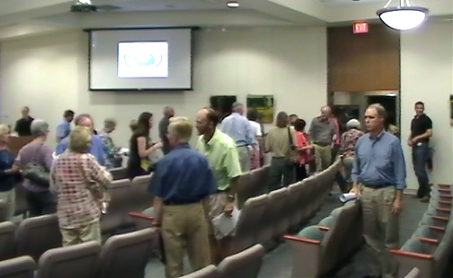
 On Tuesday night, October 9, City Manager Randy Knight hosted a well-attended workshop whose purpose was to explore proposed changes to Winter Park’s Tree Preservation Ordinance. Even though the lead-up to the workshop caused some heartburn on the City Commission [video ], citizens at Tuesday’s workshop took full advantage of the opportunity to speak their minds and engage city officials in a lengthy give and take that took some surprising turns. On Tuesday night, October 9, City Manager Randy Knight hosted a well-attended workshop whose purpose was to explore proposed changes to Winter Park’s Tree Preservation Ordinance. Even though the lead-up to the workshop caused some heartburn on the City Commission [video ], citizens at Tuesday’s workshop took full advantage of the opportunity to speak their minds and engage city officials in a lengthy give and take that took some surprising turns.
The workshop was attended by City Commissioners and members of various boards including Planning & Zoning and the Tree Preservation Board. Some officials participated, some just listened. All input at the workshop was recorded and will be part of City Commission deliberations when changes to the ordinance come before the Commission again on November 12.
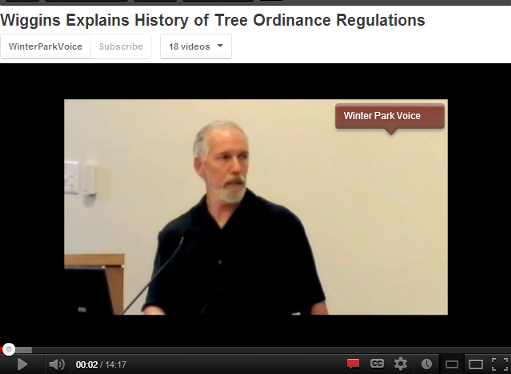
Building Department Director, George Wiggins, kicked off the meeting with a presentation of city tree preservation regulations dating back to 1957. Wiggins outlined the evolution of rule changes up through Winter Park’s current ordinance, pausing mid-way to stress, “There is an extremely important point here that I cannot over-emphasize . . . we have never issued a permit to remove a ‘historic’ tree.” Wiggins did admit that, on at least one occasion when city staff denied a permit for removal, the City Commission overturned the denial on appeal. Wiggins also pointed out that 95% of current ordinance rules are unaffected by the proposed changes. However, changes that will modify the current ordinance were of concern to many members of the audience.
State Forester Makes Surprise Appearance – Questions Wisdom of Proposed Changes
One surprise for city officials on Tuesday evening was the un-scheduled appearance of Dana Sussmann, an official from the state Forest Service. Ms. Sussmann is the state Forestry official in charge of overseeing a multi-county area in central Florida that includes Winter Park. Sussmann spoke to the assembled group of her concern about the city’s proposed changes. She noted that she had attended past ceremonies at City Hall to present the city with its “Tree City USA” award and said that the city has received the award for 32 consecutive years. Sussmann warned that the proposed ordinance changes could “. . . jeopardize the city’s chances of receiving the award for a 33rd year” and offered her opinion that “. . . the proposed changes, to me, significantly weaken the existing ordinance.”
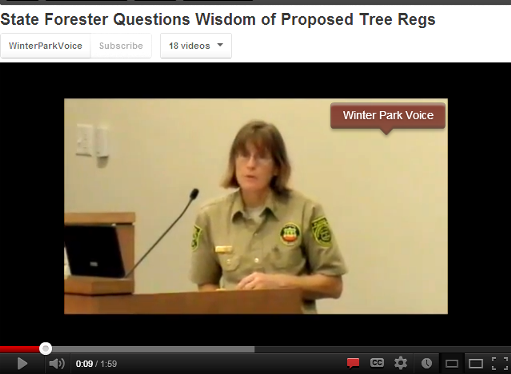
In a telephone interview with the Voice, Ms. Sussmann confirmed that her agency, the Florida Forest Service, is responsible for reviewing applications for “Tree City USA” awards. According to Sussmann, even though this National Arbor Day Foundation award does not include a cash grant, the award enables cities to score higher on grant applications that do result in additional funding. Sussmann praised Winter Park’s history of protection for trees on public and private property, but questioned the new direction taken by the city’s Tree Preservation Board, “I’ve not had a community where something like this has happened before.”
Speaking about Winter Park’s reduction in forestry staffing, Sussmann acknowledged that she’s uncertain about the impact of hiring contractors to perform city forestry services, but noted that by “. . . reducing staffing you lose so much knowledge and experience of the city. And yes, maybe it’s less expensive to outsource it, but when you have people who work directly for the city, who’ve been there, who care about the city…their level of knowledge and commitment, I think, is higher because they have a personal connection with the city.”
Authors of Current Ordinance – Hagle and Weldon – Still Disagree
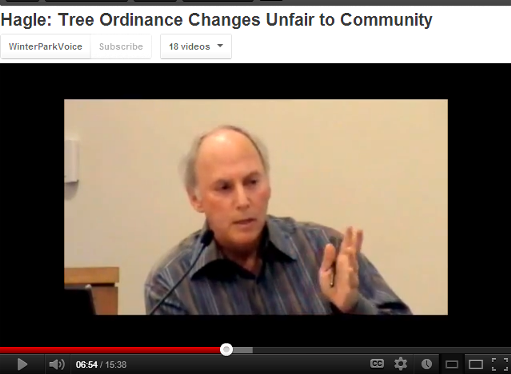
At the start of audience Q&A, Marc Hagle, one of the authors of the current ordinance, presented an analysis of ordinance rules and launched a detailed critique of tree removal and replacement rules proposed by the Tree Preservation Board. Hagle pointed out that the property rights of homeowners were vigorously debated by the committee that wrote Winter Park’s current Tree Protection Ordinance. Hagle characterized Pete Weldon, a member of the ordinance-drafting committee as being a strong advocate for the primacy of homeowner rights. “Pete Weldon was on that committee – he’s also on the committee that is re-writing this ordinance . . . I have great respect for Pete . . . we just don’t agree on this particular issue.” Hagle noted that Weldon was the only dissenting vote on the committee that wrote the current ordinance, adding that the current ordinance was supported and adopted by unanimous votes on the City Commission and Planning & Zoning board. Woody Woodall, chair of the current Tree Preservation Board, told the Voice that Weldon is a key author of the proposed changes to the ordinance. The Voice contacted Mr. Weldon for comment, but received no comment on this issue as of press time.
Meeting Heats Up (Literally) During Discussion
As the evening wore on, the meeting got hotter – not the debate, but the room itself. Despite at least one request to crank up the AC, city officials were unmoved. Any hope officials may have had that a stuffy room would end the meeting at the advertised time was unfulfilled. The meeting ran long as city residents continued to communicate their concerns to city staffers and politicians despite the heat.
Who Pays for Right-of-Way Trees? City Residents Focus on Danger & Expense
The evening’s second surprise was the appearance of an issue tangentially related to tree removal: the high cost of pruning and otherwise maintaining large trees that are planted in the city right-of-way in Winter Park’s neighborhoods. The issue was a high priority for some city residents, including Martha Kuhn, a resident of Park Grove in north Winter Park. Kuhn spoke of a close encounter with a right-of-way oak tree, “My daughter and I were almost killed when one of those big oak tree limbs fell right on our car while we were driving in it.” Kuhn stated that the city had been called three times about the tree.
Kuhn’s husband later recounted a catastrophic event this past summer when a storm knocked down a large live oak in their neighborhood right-of-way, which then fell into other trees, taking them down, culminating in one of the downed trees crashing into a parked Post Office jeep. Kuhn questioned George Wiggins about the maintenance, clean-up and removal of the trees: “Who pays?. . . is that my responsibility or the city’s?” Mr. Wiggins responded that hazardous trees in the right-of-way are handled by the city, but noted that ongoing maintenance is the responsibility of homeowners. John Holland, Director of Parks and Recreation , confirmed that in years past, the city had informally taken responsibility for right-of-way tree maintenance — despite ordinance requirements to the contrary. This practice ended when hurricane clean-up in 2004 forced the city to re-focus its priorities.
Earlier in the meeting, Mrs. Kuhn summed up the feeling of many in the audience, “I think we have to do something about these really old trees . . . and I don’t think the home owners can do it.” Others pointed out that city residents are confused about who is responsible for tree maintenance in the city.
Workshop Clarifies City Policy, Promotes Communication, but Strong Differences Remain
Near the end of the meeting, Pitt Warner, a long-time resident and real estate broker, brought the meeting back to its original focus: “Let’s pass this ordinance and give people an incentive to plant as many trees as possible without having a three, four, five thousand dollar bill . . .that’s punitive. It’s bureaucratic – and as you can see here, it’s confusing . . . people don’t even know the rules here in town. So let’s try and encourage it.” George Wiggins agreed, “That’s the rationale that the Tree Preservation Board is employing by asking the replanting of trees instead of paying large amounts into the Tree Replacement Fund.”
As always in Winter Park – when it comes to trees – there was a distinct difference of opinion regarding the city’s rationale. Sally Flynn spoke to the assembled group and read a letter from Steve Goldman that disputed the rationale for changing tree protection rules. Goldman’s letter was in response to a recent email sent by Mayor Bradley to Winter Parkers supporting the ordinance changes, “I feel that Ken Bradley is certainly entitled to his opinion about whether Winter Park’s current tree preservation ordinance is too strict. However, what bothers me about this communication is that he describes these proposed changes as taking steps to ‘protect this valuable asset’, when in fact the proposal is simply to reduce the fees which must be paid when someone decides to remove part of our tree canopy. What’s wrong with being honest and saying what you really propose to do, instead of this double talk? This proposal makes it easier to remove Winter Park’s trees – plain and simple.”
Proposed changes to Winter Park’s Tree Protection Ordinance will be given a first reading at the November 12 City Commission meeting.
|
 “. . . the only way to know . . . how the ordinance will be enforced by the city police would be to challenge it in court. Such court challenges are certainly coming, not only from Florida pro-life activists, but possibly from many other legal advocacy groups around the country who are concerned with free speech issues. Before this is all over, I expect the ordinance to be culled back to the parameters of Frisby. I also expect it to cost the City of Winter Park Florida tens of thousands of dollars to defend in court.
Recent Comments