Will Orange Mayors Join Push to Rethink how Tourist Taxes are Spent?
Winter Park’s resolution is the latest sign of growing pressure to use the county’s nearly $400 million in annual Tourist Development Tax revenue for transportation, affordable housing and other needs
Sept. 15, 2026
By Beth Kassab
Mayor Sheila DeCiccio sent an email this week to her counterparts in other Orange County cities urging them to adopt resolutions in support of using the Tourist Development Tax to help pay for local needs such as transportation improvements and more affordable housing.
Winter Park adopted such a resolution last week that calls for Orange County to “explore every avenue to expand alternative uses of the tax, including but not limited to transportation and affordable housing, adding additional pennies, and lowering the 40% threshold for tourism promotion, and to make this a legislative priority.”
“This is the direction we need to go considering potentially November and the regional areas wanting to get access to public transportation,” said Commissioner Kris Cruzada during a brief discussion.
“November” referred to Amendment 3 on the Nov. 3 ballot, which could significantly reduce property tax collections by increasing the homestead exemption for homeowners and capping property tax growth on commercial and other properties. Property taxes pay for local police and fire departments, road and infrastructure work, parks and recreation and other services provided by local governments.
But the outcry over how Orange County spends its enormous haul of tax dollars collected on hotel rooms — a record $385 million last year — started long before the push this year to threaten property tax revenues.
A disparate chorus of local voices, from County Commissioner Kelly Semrad — who represents Winter Park and was elected on a platform that included reforming TDT in 2024 — to a few local lawmakers and Orlando Sentinel columnist Scott Maxwell, who was one of the earliest advocates for change, has reached a crescendo in recent years, urging that the largesse be used to help solve problems that stem from hosting 75 million visitors a year and housing the low-wage workers who power the tourism industry.
DeCiccio’s effort appears to be the first to attempt to organize mayors to come together on the topic and push for change at the county level.
Commissioner Warren Lindsey applauded her leadership shortly after the unanimous vote on Winter Park’s resolution.
“Hopefully it’ll make a difference to not only people in Winter Park but everyone in the Orlando area,” he said.
The wording of the resolution mirrors a recommendation made last month by Mayor Jerry Demings’ most recent Citizen Advisory Task Force, which, in a stunning rebuke of the long-held status quo, also voted down spending the tax on yet another expansion of the Convention Center, a parking garage at Camping World Stadium and more projects at the University of Central Florida.
Instead, the 34-member group, made up of appointees of county commissioners and city mayors, recommended spending more of the dollars collected from levies on hotel rooms on grants to support local arts and culture, as well as ecotourism projects.
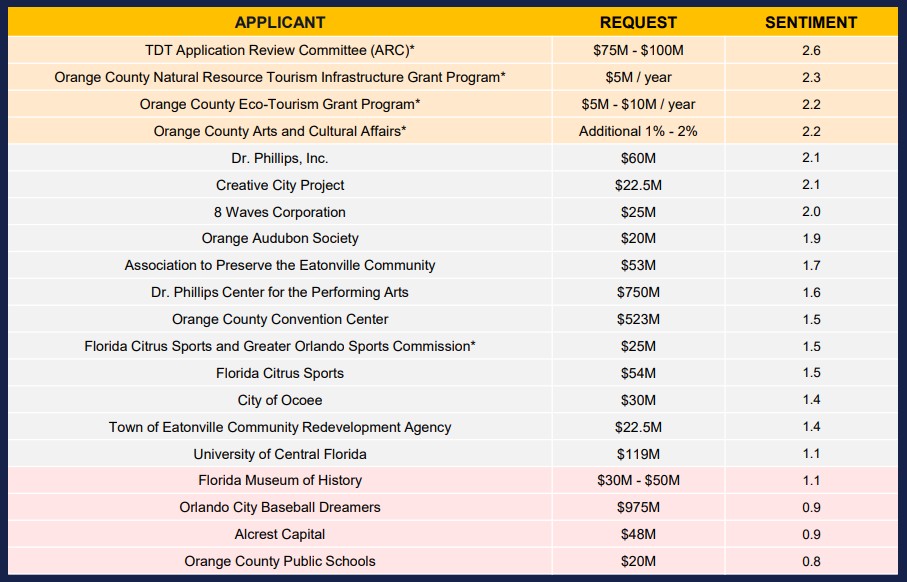
The projects related to the Orange County Convention Center, Florida Citrus Sports, the University of Central Florida as well as the bottom four projects on the above list were NOT recommended by the citizen task force.
The Orange County mayor and Board of County Commissioners arguably have the most power to change the way TDT money is spent.
They have the ultimate say over which projects get the dollars each year within the current confines of the spending rules. And, if other counties across Florida provide any guide, they could succeed in getting state permission to use the dollars for local needs if they made a deliberate lobbying push in Tallahassee.
But Demings, who has served as Orange County mayor since 2018, has not made a major effort to that end — or at least not a public one. Such a campaign would likely involve not only making a case to state lawmakers but also attempting to coalesce the major hotels, as well as Walt Disney World, Universal Orlando and other attractions, behind the idea.
November will also bring a new mayor for Orange County for the first time in eight years and, in another sign that the tide could be turning, both candidates recently rejected the idea of another convention center expansion and said they would support broadening how TDT dollars can be spent.
Linda Chapin moderated a forum last week between Tiffany Moore Russell and Chris Messina for the Orange County League of Women Voters and tried to pin both candidates down on the topic.
Chapin, who served as Orange County’s elected leader in the 1990s and just co-chaired the citizen task force, asked if they would support a convention center expansion.
Moore Russell, a former county commissioner and clerk of court and a Democrat in a very blue-leaning county who lives in Horizon West, hedged her response somewhat on the idea that “data” could one day show a need for more investment in the center.
“I would not have supported the expansion of the convention center unless I saw data that showed me where are we trying to go, what is it trying to achieve, and what’s the return on that investment,” she said. “And so, out of all the projects that I’ve seen so far, I’m a fan of the cultural and arts projects because I think they enhance our quality of life in this community. I am not a fan right now of building any major facilities until we know how do we support those who work in tourism? … We know we have a transportation challenge when it comes to those who visit here and those who work in the industry, as well as affordable housing and workforce housing. So for me, I’m not a fan of big projects right now because I think we need to support those who make our industry thrive in this community.”
Messina, a businessman and Republican who lives in unincorporated Winter Park, said he does not support an expansion because the convention business has changed and said he would have given more support to a proposed long-shot baseball project known as the Dreamers.
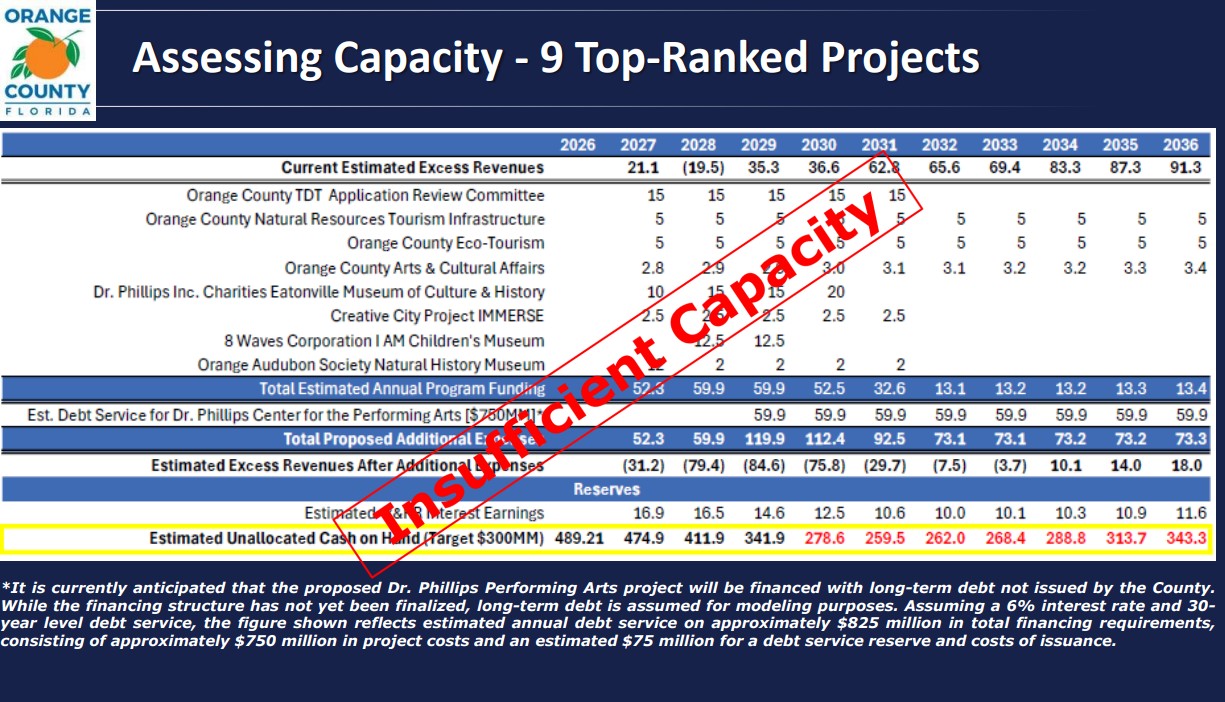
Under one scenario, a chart provided by Orange County, shows how the projects can be funded and maintain reserves. Multiple scenarios were presented at the county meeting on Aug. 25.
“There are only so many very large conventions you can bring into Orange County,” he said. “So I know we lost the Home Builders convention, and it was sort of like the sky is falling for some people, but that’s actually not the case. It’s better to be targeting two medium-sized conventions. They’ll bring more money, more business into Orange County than one large convention. One thing, though, I’ve been very public about that I would have done with the TDT dollars, is I would have looked at supporting the Dreamers in some way, shape, or fashion.”
When Chapin followed up about how the candidates would like to see Tourist Development Dollars used, Messina said he supported using them for tourist-related transportation, but not much else.
“I think we can look at an expanded definition of what tourism is, and without trying to go too far,” he said. “So, for instance, we have a world-class firefighting center, and we have a world-class SWAT team here. So why don’t we do some marketing around that and bring firefighters from around the world, SWAT teams from around the world, for a competition? That’s one thing we could do. Second thing, we can expand it to include transportation that’s focused on bringing tourists to their primary destinations, so from the airport to one of the big hotels or the theme parks. I think that’s a good use of the expanded TDT dollars. But beyond that, to affordable housing? I think that’s a stretch too far and will run us into a brick wall in terms of the legislation.”
Moore Russell was more willing to expand uses but echoed concerns expressed by Demings that the governor and state legislature could attempt to seize on the pot of money for their own use if given an opening.
“I want to marry this also with a question you asked previously about home rule,” she said during the forum. “So I am open to expanding the legislation, but I’m concerned that Tallahassee will take over the control of how we spend our TDT dollars. So we have to be very mindful and keep our eye on the control of our local dollar … But I do believe there is an opportunity to look at our statute about how we can support indirectly, or things that are impacted by tourism. So, you know, transportation — not just moving those who visit Orange County, but the people who work in this industry. There are many who ride the bus, to get to our theme parks, to get to our hotels, who are making sure that we are a great destination to visit. I believe we can justify with the data why we should invest those dollars. Workforce housing down on I-Drive for people to be able to live where they work? I think we can justify that.”
Today, the money is primarily used to pay off debt related to the convention center, as well as support its operations and maintenance, along with subsidizing advertising for the tourism industry and paying debt for the city of Orlando on the arena used by the Orlando Magic.
County officials have long pointed to a state law that governs the tax and limits its uses as the reason the pot of dollars can’t be used to pay for mass transit, public safety, affordable housing or other essential needs.
But other counties have succeeded in carving exceptions into the law when they have made a deliberate lobbying push.
For example, some beachfront counties are now allowed to use tourist tax dollars to fund lifeguards and law enforcement services “which are needed to address impacts related to increased tourism and visitors to an area.” And in 2024, the Legislature allowed local governments in the Florida Keys to use a portion of the money to purchase or build affordable housing.
A critical issue now is the timing of when the County Commission will vote on projects recommended by the task force or move to reintroduce the convention center or other proposals into the mix.
If Demings pushes the matter forward in the final months of his term, then it’s possible there won’t be any money left for the county to spend on other needs such as public transit.
Both DeCiccio and Semrad have expressed concerns about that happening.
A county spokeswoman said a date for the next vote and discussion in front of the Orange Commission has not been set, but that Demings intends to hear the matter before new commissioners and a new mayor take their posts on Nov. 17.
Winter Park Steps Out Front to Challenge Status Quo on Tourist Taxes
Will other cities follow a call to push Orange County and lawmakers to use the public money for transit and other needs?
Sept. 8, 2026
By Beth Kassab
UDPATE: This story has been updated to include a comment from Winter Garden City Manager Jon Williams.
Mayor Sheila DeCiccio and others on the City Commission are already on the record saying they want to see Orange County use its gargantuan pot of tourist tax dollars to solve local problems that come along with welcoming masses of visitors each day such as fixing crowded roads and improving the local bus and rail systems.
The question the Winter Park Commission seems to be asking now is: “Who’s with us?”
On Wednesday, the Commission will take up a resolution that solidifies its position that local governments should “explore every avenue to expand alternative uses of the tax, including but not limited to transportation and affordable housing, adding additional pennies, and lowering the 40% threshold for tourism promotion, and to make this a legislative priority.”
Such an action would not only serve as a message to the Orange County Commission, and particularly whoever is elected in November as the next Orange mayor, but also as a call for other cities to follow suit.
Michael Poole, the local investment banker who DeCiccio appointed as the city’s representative to Orange County’s latest citizen task force on the tourism development tax, put the political juggernaut that is changing the status quo in stark terms to Winter Park officials.
“You know, it’s hard to do it from behind the curtain,” Poole told city commissioners at a meeting last month. “ButIthinkifyouguyswouldlead,Ithinkothercities …Imetotherrepresentatives … theyalltalkthesamewaythatwe’retalking.Thatweneedmoneyfordifferentthings,especiallytransportation … Ithinkothercitieswouldfollowyourlead,especiallyifyoucalledthemupandsaid, ‘Hey,let’sdothistogether.'”
Leaders in neighboring Maitland told the Voice they would consider a similar resolution.
“I can see the case for it,” said Scot French, the Maitland council member who will take over as interim mayor in November when John Lowndes resigns because he is seeking a state Senate seat. “We’ll certainly have a louder voice if we’re speaking in concert on these issues … My sense is there is a great deal of support for broadening the areas in which these funds can be spent to include transportation and county-wide problems.”
Winter Garden City Manager Jon Williams said his city, which has a population of about 46,000 people on the west side of the county, has not taken a formal position, but generally supports expanded uses of the tax.
Officials in Orlando, Apopka and other cities in Orange County did not immediately respond to questions about the uses of TDT from the Voice.
DeCiccio has emerged as an outspoken voice in favor of using the 6% tax levied on hotel rooms for infrastructure projects. She said she is grateful Winter Park-based groups such as the Rollins College art museum and the Winter Park Playhouse have received grants in recent years from a portion of TDT set aside for arts and sports organizations, but sees a greater need that still isn’t being fulfilled.
“I’m a firm believer we need to get a train from the airport to the attractions to I-Drive and to Winter Park,” DeCiccio said. “And affordable housing is so necessary right now,” she said pointing to Killarney Elementary, which serves a portion of Winter Park and lists 20% of its students as homeless, often because they are living in motels or doubling up with another family.
The projects related to the Orange County Convention Center, Florida Citrus Sports, the University of Central Florida as well as the bottom four projects on the above list were NOT recommended by the citizen task force.
Orange County collects the largest haul in all of Florida when it comes to hotel taxes — a record $385 million last year. The money is primarily used to pay off debt related to the convention center as well as support its operations and maintenance along with paying to subsidize advertising and promotion for the tourism industry and pay debt for the city of Orlando on the arena used by the Orlando Magic.
County officials have long pointed to a state law that governs the tax and limits its uses as the reason why the pot of dollars can’t be used to pay for mass transit, public safety, affordable housing or other essential needs.
But, to be clear, other counties have succeeded in carving exceptions into the law when they have made a deliberate lobbying push.
For example, some beachfront counties are now allowed to use tourist tax dollars to fund lifeguards and law enforcement services “which are needed to address impacts related to increased tourism and visitors to an area.” And in 2024 the Legislature allowed local governments in the Florida Keys to use a portion of the money to purchase or build affordable housing.
The current law also says if a county that spends at least 40% of its tourist tax revenue on tourism promotion then it can spend a portion of the tax dollars on transportation, sewer, water or “pedestrian facilities.”
Some members like Poole have suggested that, depending on how the figure is counted, Orange County might already meet the threshold.
Orange County says it’s spending 26% to 30% on tourism advertising, according to Poole, but he also said he doesn’t have the calculation for how that figure was determined.
“All I know is people have asked for it and we haven’t gotten it. Maybe people you know might be able to get it,” he told DeCiccio at a city meeting.
“I’ve tried,” she responded. ” I don’t have that much pull. I wish I did.”
The resolution Winter Park will vote on this week is based, nearly word-for-word, on one of the recommendations made last month by Orange Mayor Jerry Demings’ TDT Citizen Advisory Task Force.
DeCiccio and others including County Commissioner Kelly Semrad, who represents Winter Park, urged Demings to expand representation on the group to more people who understand what it is like to live in different parts of the county rather than be focused on a group of people who mostly represent the interests of the major hotels, theme parks and the convention center.
Tourism companies are known for pumping hundreds of thousands of dollars into political campaigns for local offices.
“In looking at the proposed makeup of the Task Force, it appears to be heavily weighted toward those who currently benefit from how TDT funds are allocated,” DeCiccio wrote in a letter to Demings in June. “I respectfully request the Task Force makeup be weighted more to the entities that represent the people of Orange County and the entities that must provide the needed infrastructure.”
As a result, Demings allowed each county commissioner to appoint two people from their districts instead of just one to serve on the task force. Each city was allowed to appoint one person to the group.
Lowndes, the current mayor of Maitland, sent Demings a letter in July urging a broader scope for the task force than evaluating capital proposals like a convention center expansion or new museums. He called on Demings to help “fairly distribute the burden” of supporting low-wage tourism workers across the county.
“Tourism is, of course, the prime engine of Central Florida’s economy,” wrote Lowndes, who is challenging Sen. Jason Brodeur for a district that includes parts of Orange and Seminole counties. “It demands strong infrastructure: roads, mass transit for tourists and tourist-corridor workers, robust public safety, and affordable housing for thousands who work in the industry, many at modest wages. The residents of Orange County now shoulder much of this burden through our property taxes. Certainly, the community benefits from tourism, but it is time to fairly distribute the burden.”
A snapshot of promotional materials on the website for Visit Orlando, which receives dollars from the TDT to subsidize industry advertising.
Together, Maitland and Winter Park represent about 50,000 people, including about 35,000 registered voters who are close to evenly split between Republican and Democrat, according to the latest voter roll statistics. That’s a small piece of the voter roll for all of Orange County, which tallies about 813,000 registered voters who lean Democrat (39%) over Republican (28%) with the remainder without a party affiliation or registered to a third party (33%).
But there is evidence the sentiment in Winter Park and Maitland is present elsewhere given the actions of the committee led by former Orange Mayor Linda Chapin and Lift Orlando President Eddy Moratin.
The 34-member task force spent much of its time evaluating 20 applications for a combined $3 billion dollars to build everything from a Zora Neale Hurston museum in Eatonville to another expansion of the convention center at a proposed $523 million and a nearly $1 billion expansion of the Dr. Phillips Center for the Performing Arts.
Ultimately, the group did not include the convention center among it’s list of recommended projects — a notable shift from a similar task force that convened just three years ago.
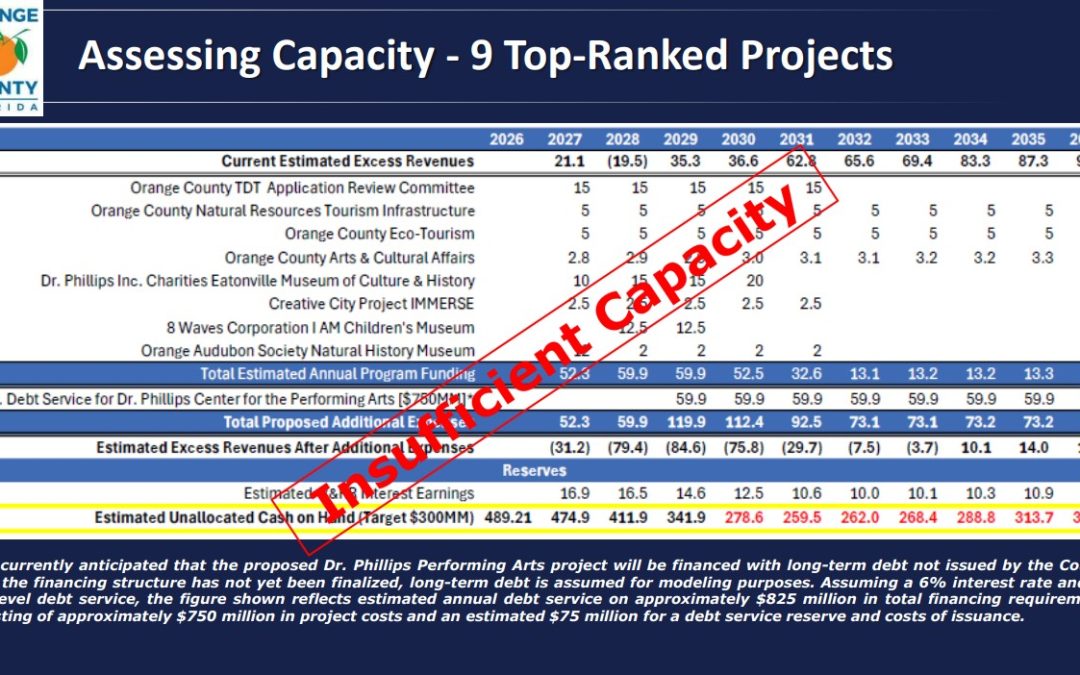
A chart from Orange County shows reserves (bottom line) dipping below the recommended $300 million by 2030 if the Top 9 projects are funded in the above scenario.
Chapin, who led the county from 1990-1998 and has a theater named for her in the convention center after overseeing previous expansions, noted that since the inception of the tourist development tax more than $3 billion was spent on the building. This time around, she said, she couldn’t support a motion to approve another addition.
“Giventheopportunitieswehavetobenefitmoreofthecommunityanddifferentkindsofvisitors,” she told the group. “Theideaofmovingthisforwardwhenitisstillunderconstructionfromthelastamounttheyweregranted … whatIwouldliketoseeisthatwevotethemotiondown,expectthe County Commissiontorequestareviewofallthat’sbeendonewhentheprojectiscompleted,andthendecide,dependingonwhatthecircumstancesareatthatpointintime,toeithermoveforwardwithmoreornot. SoIwon’tbesupportingthemotion.”
And the group took extra time to discuss and include a recommendation that Orange County expand its uses of the tax — the one Winter Park is now looking to formalize in a resolution.
That motion was made by Chapin and seconded by Doug Gomber, who was the city of Ocoee’s representative to the group. Chris Mueller, a Hilton executive who represented the International Drive Chamber of Commerce and Jacqueline Bozzuto, a Lowndes law firm attorney who works with hospitality clients and represented the Central Florida Hotel & Lodging Association, voted against the recommendation.
Central to the discussion now is whether enough political will exists among leaders in Orange County to follow through with that recommendation and ask the Legislature when it convenes again next year for an exception similar to the way other areas in the state have received special permission for certain needs.
Also in question is how much money from hotel collections would be left — if any at all — for mass transit or affordable housing if the County Commission approves all or even some of the projects that the task force recommended move forward. The task force was not told how much money they had to work with so they didn’t put dollar figures to their recommendations, though those asking for the money listed a dollar figure in their requests.
The Dr. Phillips Center for the Performing Arts, for example, is asking for $750 million for new theaters and a parking garage and other improvements at its downtown Orlando campus. If the entire amount was funded it would leave little to nothing for new uses like transportation improvements sought by Winter Park and others.
“Ifthemoneyforalltheseprojectsispaidoutforthenext10years,therewon’tbeanyextramoney.So,howwillwebeabletopayfortransportationthen?” DeCiccio asked at a recent City Commission meeting, noting Dr. Phillips’ request to build 11 more theaters struck her as “a little excessive.”
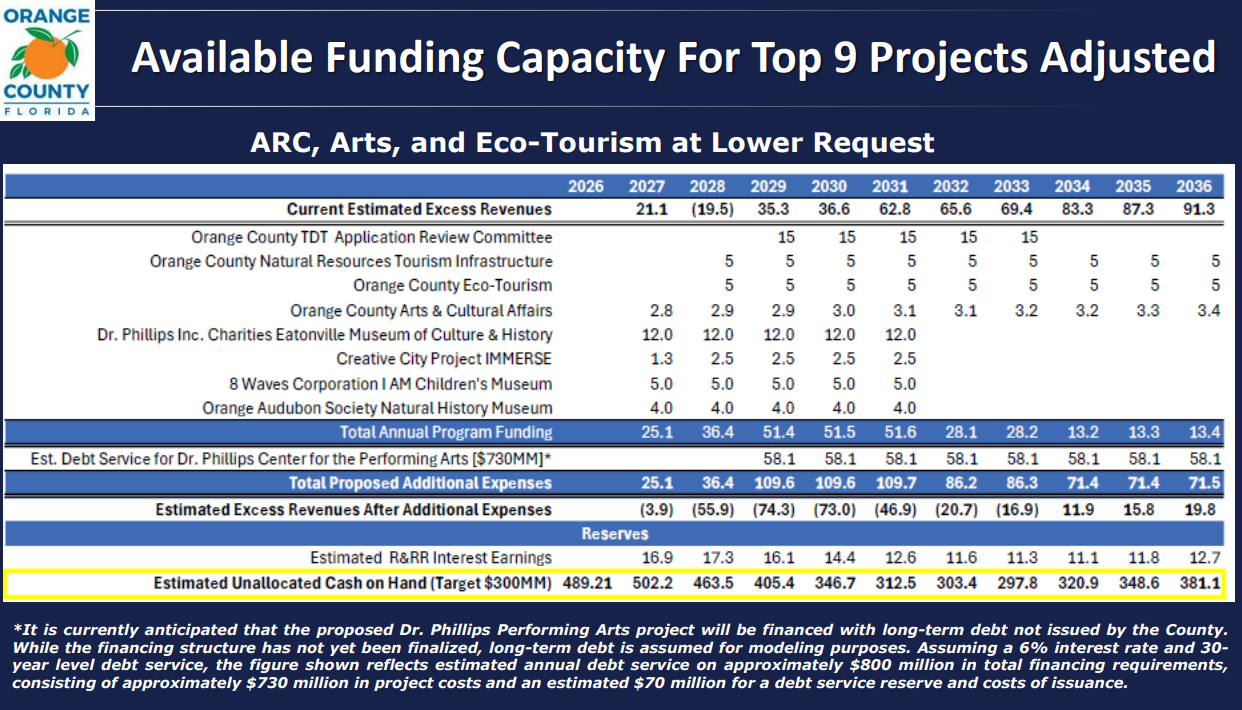
Under a different fund scenario, a chart provided by Orange County, shows how the projects can be funded and mostly maintain reserves. Multiple scenarios were presented at the county meeting on Aug. 25.
The County Commission accepted the task force’s recommendations late last month, but did not give an official a thumbs up or thumbs down to any of the projects on the list. At least two county commissioners said they even wanted to reconsider more projects, which means the convention center or Camping World Stadium could still receive funding.
Semrad, who was elected in 2024 after running on a platform of expanding the uses of TDT and refusing to take any campaign contributions from the tourism industry, called the process rushed and said she was disappointed there wasn’t more clarity surrounding how much money will be available.
A county spokeswoman said the comptroller is working on the question of exactly how much funding can be used and the timing of that funding. Then the County Commission will made a decision on who gets money and who doesn’t and whether the group will back a push to use the dollars for more community needs.
“[The Legislature]pretty much gives the changes when cities ask for them,” DeCiccio told the Voice. “We want to do it but we aren’t strong enough to do it alone. We need Orange County.”
The county commission appears to support the comptroller’s plan to keep at least $300 million from TDT reserves in case of an economic downturn so that figure is factoring into the discussion about what money is available and when.
Early voting for the General Election will run from Oct. 19 to Nov. 1
Central Florida supervisors say it’s time to get ‘election ready’
The following story originally published by Central Florida Public Media and is being republished in partnership with the News Collaborative of Central Florida
Supervisors of elections from throughout Central Florida find themselves battling misinformation as they promote voter participation and the safety and security of Florida elections.
Seminole County Supervisor of Elections Amy Pennock urged voters to contact their supervisor’s office for accurate information if they read a story that they don’t trust or that gives them “a bad gut feeling.”
“We are in the proactive confusion management business,” she said. “We all are out there trying to get you the right information so that when you get the wrong information you question it right away.”
The supervisors said they’re being transparent so voters can see the processes that keep Florida elections secure from tampering and interference.
That includes testing all devices used in each election, election audits and “layers” of cyber security.
“[I]n order for a bad actor to penetrate our election system with cyber breaches, they have to get on the internet,” said Lake County Supervisor of Elections Alan Hays. “Our tabulation networks are never ever connected to the internet. So you can sleep tight at night knowing that our tabulation system is not connected to the internet at any time.”
Volusia County Supervisor of Elections Lisa Lewis emphasized the security of their elections process. It’s something that she wants skeptical voters to see for themselves.
She said it’s “a little disheartening that people are so quick to believe the bad stuff rather than the good stuff.”
Hays said their goal is get all Americans, regardless of party, to participate.
“If you can fog a mirror and sign your name and you’re a citizen,” he said, “we want you to vote.”
Aug. 18 primary
The supervisors of elections said they especially want people to vote in the August primary, at which voter turnout can range from a dismal 17% to 24%.
Orange County Supervisor of Elections Karen Castor Dentel emphasized that the primary is important even if you’re not a registered Republican or Democrat.
“We have the county mayor, we have county commission, and these are all nonpartisan races,” she said. “School board, judicial, school board chair, some very consequential elections, and most of them will be determined in the primary.”
The supervisors underscored the need to be “election ready” and said they’re working to educate some voters about changes in their polling places due to congressional redistricting this year.
That includes making a plan to vote in one of three ways available in Florida: by mail, during early voting or at their polling place on Election Day.
ICE at the polls?
The supervisors also addressed fears that Immigration and Customs Enforcement officers could be at polling places this year.
Brevard County’s Tim Bobanic says the FBI briefed Florida’s supervisors of elections at their latest conference. He cited a statute — Title 18 U.S. Code 592 — prohibiting troops at polling places.
“Armed federal agents,” Bobanic said, “are prohibited from conducting investigative activity in any place where election activity is being held.”
Hays, of Lake County, said Florida law has a 150-foot buffer around polling places that applies to those agents, too.
“There’s nothing in that law that excuses anybody from any agency, no matter whether it’s federal government, local government, or anything else, from being inside there,” Hays said.
He said law enforcement officers also are not allowed there, unless they’re voting, responding to an emergency, or working at the school where the polling place is situated.
Orange Schools Ban E-Bikes and E-Scooters Unless Students have Driver's License or Permit
The change voted on this week prompted pushback from parents who say their students rely on the devices. Winter Park is drafting its own ordinance related to electric bikes and scooters.
July 29, 2026
By Gabrielle Russon
Two weeks before the new school year starts, the Orange County School Board voted Tuesday to ban kids from riding e-bikes and e-scooters unless they have learner’s permits or driver’s licenses.
The school board’s unanimous vote Tuesday came after a divided debate where school board members insisted the new rules are necessary to stop the rising number of crashes and protect children. Meanwhile, some parents and students argued the board is overstepping its bounds with a new policy that will make it harder for kids to get to school.
“This is one of the hardest decisions to make, and I think because there are so many strong compelling arguments on both sides,” school board chair Teresa Jacobs said.
Critics called the policy rushed since the first day of school is Aug. 11, giving families little time to prepare.
Stephanie Vanos represents Winter Park schools.
“I’m here to ask you to slow down before making a decision that could have unintended consequences for many families. Micromobility devices are a vital form of transportation for many students,” said parent Heather Grimmer who lives in Avalon Park. “We all want to protect our children, but protecting them doesn’t mean always taking something away.”
School board member Stephanie Vanos, who represents Winter Park schools, argued the school board held four public meetings over the last year on the issue ahead of Tuesday’s vote.
“This has been a thoughtful and deliberate process,” Vanos said. “I would be surprised if anybody on this board actually wants to ban micromobility devices. I don’t think anybody does.”
“The reality is we’re here now and school is starting and there’s nothing in place,” Vanos said.
For school board member Maria Salamanca, the ban will stop elementary and middle schoolers who are too young to drive from having to make split-second decisions on the road when a mistake can lead to a tragedy.
“I cannot in good conscience vote to encourage these devices in our campus,” said Salamanca, who represents Lake Nona schools where a 13-year-old boy was killed after an e-scooter crash on Mother’s Day. “It’s really dangerous.”
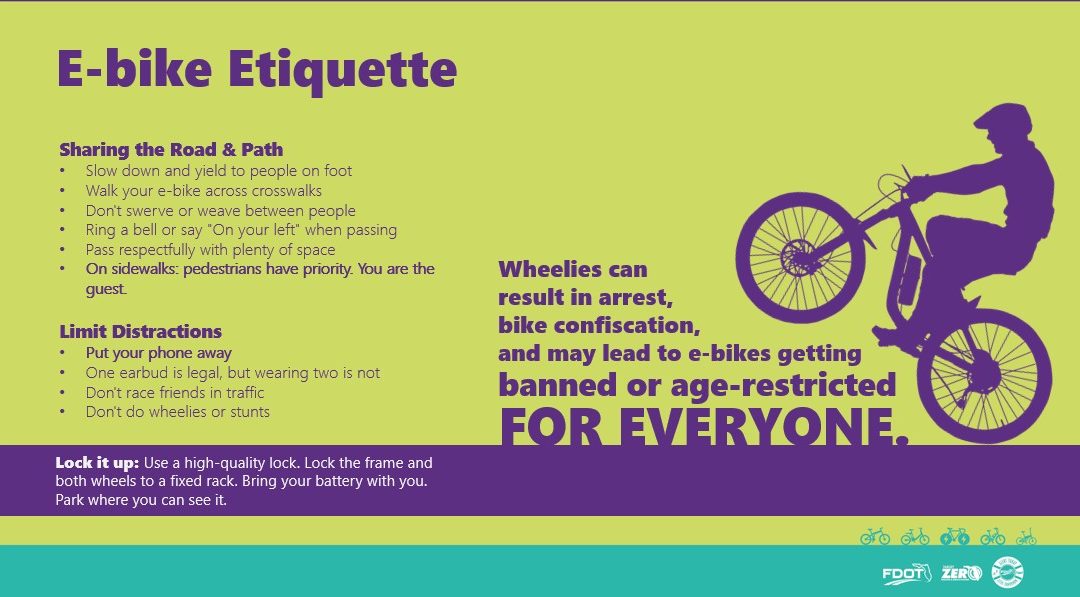
E-bikes and e-scooters are a growing concern throughout Winter Park and Orange County. The city of Winter Park is in the process of creating its own ordinance to crack down on reckless riders.
Tuesday’s meeting shows the challenge of regulating the popular devices. Nearly 12,000 OCPS students regularly went to school on e-scooters or e-bikes, according to a district survey in December. About 42% of those students were in middle school, 32% in high school and 26% in elementary school, the survey found.
Nate Clark’s four kids are among those depending on e-scooters since they live too far to walk and too close to catch a bus to Baldwin Park Elementary or Glenridge Middle School, both not far from Winter Park.
“If this passes tonight, I don’t know how they’re getting to school on Aug. 11,” Clark told the school board.
The ban is “unnecessary” and “unfair,” he said, arguing state law treats e-bikes or e-scooters as bicycles — not cars. Why is the district treating them differently?
Other parents urged the school district to focus on teaching safety rules, improving infrastructure or enforcing helmet rules instead of banning them outright from elementary and middle schoolers.
“Let the kids scoot,” said Mike Bustillos, a former teacher who advocates for a more walkable community. “We shouldn’t be removing freedom and mobility options from kids in order to make things more comfortable for cars. Kids today have precious little freedom to roam the way that I did when I was a kid.”
School board members pushed back on the criticism. Before e-scooters and e-bikes existed, working parents found ways to get their kids to school, said school board member Melissa Byrd.
“I do not believe that taking away e-bikes and e-scooters is going to cause students to not be able to get to school,” she said.
Superintendent Maria Vazquez said she supports phasing in the ban for the first month of school to get families time to figure out other transportation options.
Vazquez and school board members also expressed a willingness to revisit the ban later this year.
“I am going to vote in favor of this policy now with the hopes that our counties and cities are going to come up with some great policies and rules and we can go back and revisit this and change it,” Vanos said. “Hopefully that will happen soon.”
New Law Could Require New Fines and Data Collection on Electric Bikes and Scooters
Lawmakers approved the measure earlier this month and it is awaiting Gov. Ron DeSantis’ signature. Locals hope the changes are a first step toward better safety.
March 30, 2026
By Gabrielle Russon
Local officials concerned about electric bike and scooter crashes and near-misses in Winter Park said a new bill is moving in the right direction to improve safety.
The Legislature unanimously passed Senate Bill 382 this month. The bill is awaiting Gov. Ron DeSantis’ signature in order to become a law and go into effect.
State lawmakers said the bill is necessary following a series of crashes across the state that killed young people.
“While nothing can undo the tragedies that brought us here, I believe some good will come out of this,” said state Rep. Yvette Benarroch, R-Marco Island, fighting back emotion on the House floor before the final vote on March 9. Benarroch had sponsored the House companion bill.
SB 382 would set in motion a statewide task force to create recommendations by Oct. 1 related to how to regulate “micromobility devices” like e-scooters and e-bikes that travel slower than cars but faster than pedal bikes. The task force would report back to DeSantis, Florida Senate President Ben Albritton and Florida House Speaker Danny Perez.
Orange County School Board Member Stephanie Vanos, who represents Winter Park in District 6, called the bill “a good first step” but added one concern is the task force is missing school leaders’ voice.
Vanos had urged lawmakers to pick an educator to join the task force since so many e-bike and e-scooter users are children to and from school.
“This is an issue really affecting the schools the most,” Vanos said.
But lawmakers ignored her request after she testified in Tallahassee during the 60-day legislative session.
The members of the task force will instead include representatives from the Florida Sheriffs Association, the Florida Police Chiefs Association, Florida League of Cities, Florida Association of Counties, someone from the medical field with experience treating pedestrian injuries and a representative from an organization focused on rider safety.
Vanos said she hopes the task force recommends how to better educate young riders, which she called an essential element for improving safety.
Children currently are not required to go through rider safety training and don’t need any certification or permit to use an e-bike or e-scooter. Some as young as elementary or middle school are driving them.
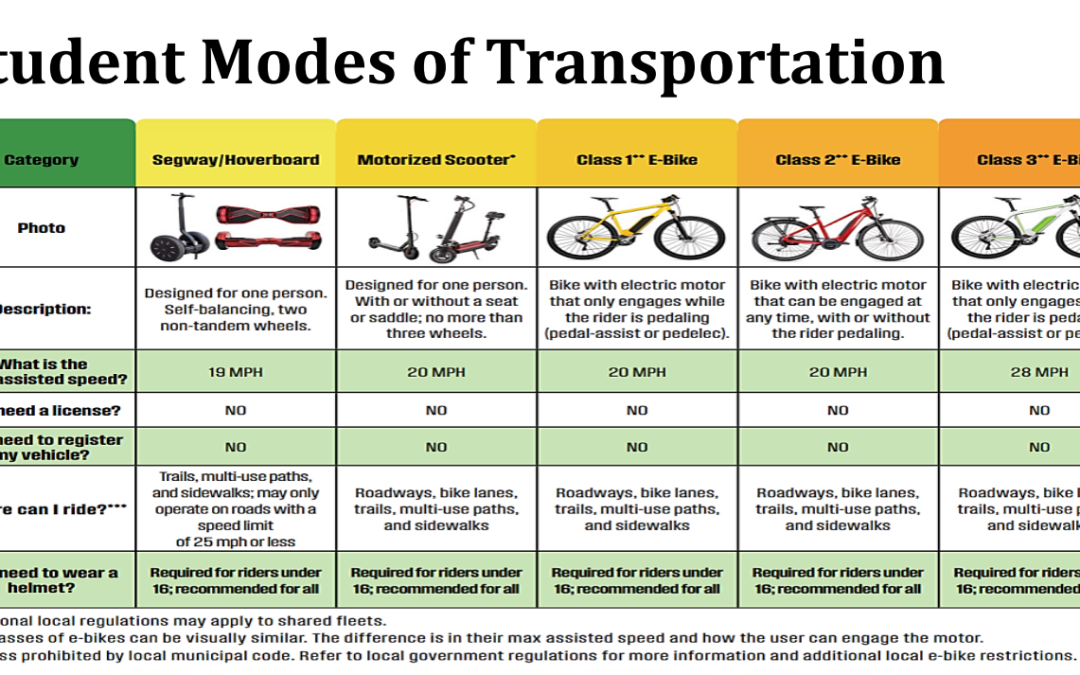
One provision in SB 382 had been stripped out from the final bill version that would have required a valid learner’s drive license or driver license for anyone to ride a Class 3 e-bike, which goes up to 28 mph.
Orange school officials discussing that issue had raised concerns about how schools would know if student e-bike riders had the right credentials and also brought them to school every day, Vanos said.
Orange County government is scheduled to discuss e-bike safety at a May 19 work session and has been working with the school district, Vanos added.
Vanos also hopes the state task force tackles recommendations for making infrastructure improvements, like wider sidewalks so riders and walkers have more room to co-exist.
Under the bill, Winter Park Police Department would be required to start documenting e-bike and e-scooter crashes to help the state officials better understand the scope of the problem.
Currently, law enforcement agencies report the crashes differently, making it difficult to get uniform statistics statewide.
All local police departments and sheriff’s offices around the state, as well as the Florida Highway Patrol, would need to report each crash’s date, time, the micromobility device rider’s age, if he or she had a valid Florida learner’s driver license or regular license and more.
Vanos praised the bill for trying to collect more data.
“That’s a really good first place to start,” Vanos said. “What do the accidents look like? Where are they? What are the ages of the children? What time of day? … What type of micromobility device are we seeing the most accidents on? I do think that those are important things.”
Finally, the bill would also allow police to issue $30 nonmoving traffic violations if an e-bike goes faster than 10 mph on a shared path with pedestrians 50 feet away. E-bike users would also be required to yield to pedestrians and give an audible warning before passing them.
If the bill is signed into law, “it doesn’t change the way we police them, but it does change the fact that we can ticket them now,” said Winter Park High School Resource Officer Lindsey Ellison. “It gives us more enforcement which is something that we do need because there are unfortunately bad eggs out there that choose to not abide by the law. This gives us more ammunition to give them consequences.”
Ellison said the fines put more pressure on parents to be vigilant that their children obey the law.
At his job, Ellison looks for rule breakers and is known for keeping a snack stash to pass out to hungry teens. Regularly, he reminds students to wear their helmets and slow down. Usually every week, he gets a complaint about an e-bike or e-scooter from a pedestrian who said one zoomed past her on the sidewalk or a teacher driving to school who was cut off by one.
The problems mounted as e-bikes and e-scooters have skyrocketed in popularity in the past few years.
If 200 Winter Park High students ride bikes and scooters to school, about 90 of them are electric, Ellison estimated. Ellison added they are owned by students, so the devices are not the kind you can rent around town.
“The reason they want to pass bills like this is to keep people safe. It isn’t to add more regulations and more red tape for you not to buy these e-bikes,” Ellison said of SB 382. “We want people to buy e-bikes, we want them to enjoy them. We just want them to do it as safely as possible.”
Vanos, Ellison and MetroPlan Senior Transportation Engineer Adriana Rodriguez spoke at a recent Winter Park community meeting to help parents better understand the rules, the dangers and the different types of micromobility devices.
MetroPlan is launching a pilot program this year to pay for online e-bike safety training for 500 students in Orange, Osceola and Seminole school districts. No Winter Park schools are currently involved, but Rodriguez said she hopes the pilot program will expand so more young people can participate and learn how to ride safely.
AdventHealth Winter Park does not track the number of e-bike injuries, but one doctor said medical professionals are treating head injuries, upper extremity fractures and abrasions as the most common injuries from crashes “As an emergency medicine physician, I’ve seen firsthand how important helmets are,” said Dr. Mitchell Maulfair, the Winter Park hospital’s director of emergency services, in a statement. “As e-bikes have become more popular, it’s important to remember that they’re capable of higher speeds, which can increase the risk of injury if riders aren’t taking proper precautions.”
Podcast: Local ICE Detainees; Moon Mission and Micro-Transit in Seminole County
Watch or listen to the latest Talking Central Florida episode, a project supported by the Winter Park Voice and News Collaborative of Central Florida
Orlando Sentinel reporter Ryan Gillespie discusses the dispute over federal reimbursements for the holding of ICE detainees and federal inmates at the Orange County jail. And Brendan Byrne from Central Florida Public Media explains the latest setback for the Artemis II mission, and SpaceX CEO Elon Musk’s ambitious goals for the Moon. Plus, Abe Aboraya from the Oviedo Community News joins the show to talk about his reporting on the challenges facing Seminole County’s micro-transit system.
Talking Central Florida is a production of the News Collaborative of Central Florida, a collective of independent local news outlets and aligned partners working toward a more informed and engaged Central Florida. The program is made possible through funding support from Central Florida Public Media, Orlando Sentinel, Winter Park Voice and the Central Florida Foundation.
Hosted by local journalist Steve Mort, the weekly radio and podcast program explores key issues in Central Florida through conversations with the local journalists who cover them. Episodes air on Wednesdays at 6:30 p.m. on Central Florida Public Media’s radio frequencies 90.7 FM and 89.5 FM. It’s also available on YouTube and all podcast platforms.
We Depend on your support, make a tax-deductible donation here.
Mission
The Winter Park Voice is a trusted nonprofit journalism site that covers our City Hall and beyond. We endeavor to engage, inform and connect citizens on all sides of issues affecting the quality of life in Winter Park.




Recent Comments