No Budget, No Power, No Paycheck: Who Wants to Serve on Orange's Soil and Water Board?
Three of five seats on the board charged with helping people keep their soil and water clean are on the Nov. 3 ballot
Oct. 5, 2026
By Beth Kassab
The five people elected to serve on the Orange County Soil and Water Conservation District don’t have a budget, don’t have any power, don’t receive a paycheck and lack even basic tools like official district email addresses.
When it comes to civic and government jobs, the soil and water board is as humble as it gets. PTA presidents and homeowners association board members get more glory because they typically have a budget to spend, some authority and perhaps receive a round of appreciative applause at an end-of-year banquet.
Yet for nearly 80 years, voters in Orange County have elected supervisors to a board that few understand or ever see.
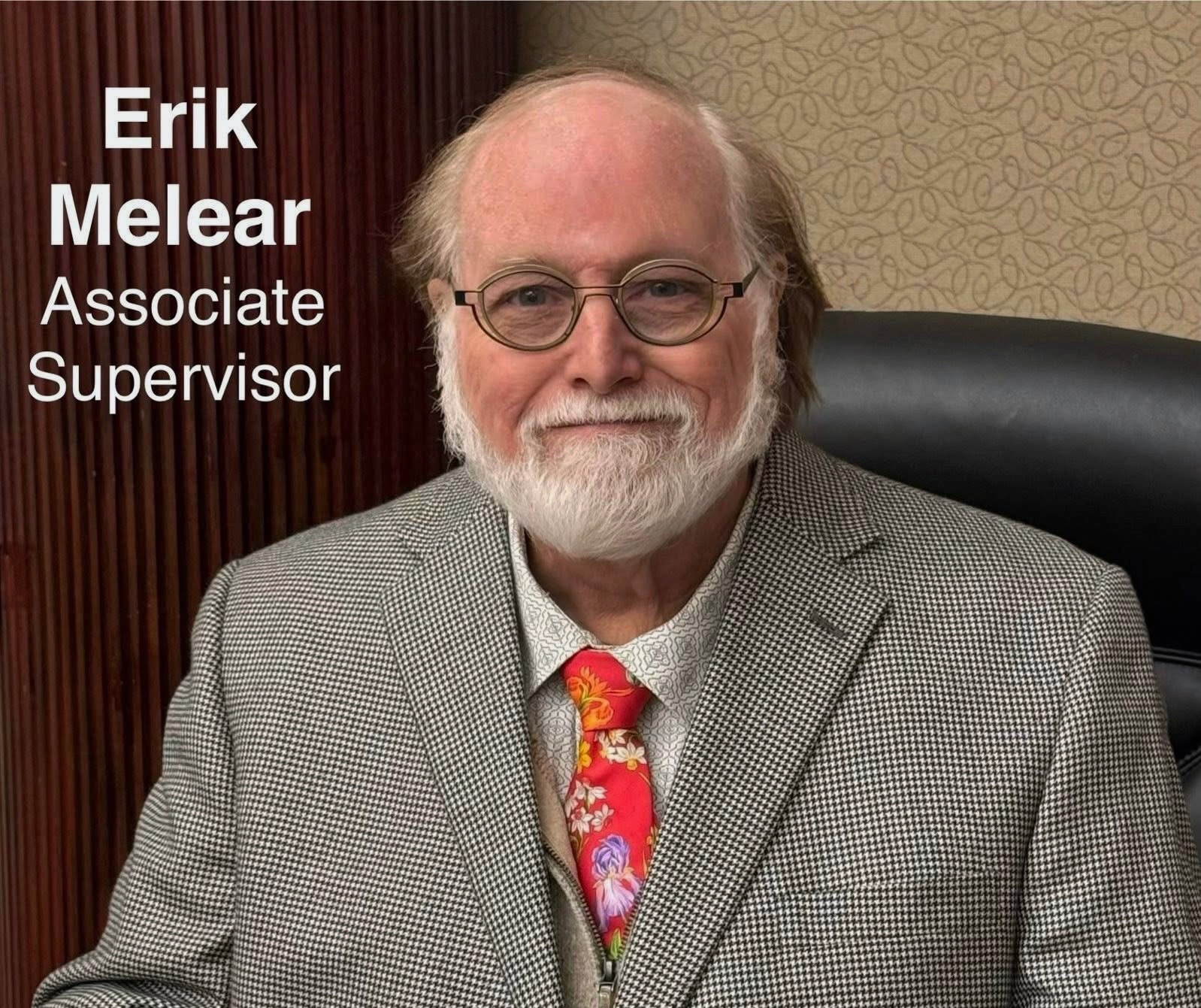
Erik Melear
Those campaigning this time around, like candidates before them, face a steep climb in convincing voters that their choices near the very bottom of the Nov. 3 ballot matter.
“Why do you even exist?” is a question Erik Melear, a candidate for Seat 3 on the district board, says he has heard plenty of times.
“But we do have a role to play,” he said. “Unfortunately, when you have no budget, no taxing authority and no other resources, it becomes very difficult to develop and do things.”
The state began creating soil and water districts across Florida as far back as the 1930s and charged them with carrying out local programs to conserve and protect soil, water and land for agricultural purposes.
In recent years, lawmakers in Tallahassee have tried a series of efforts to wholesale abolish the districts, though none has succeeded.
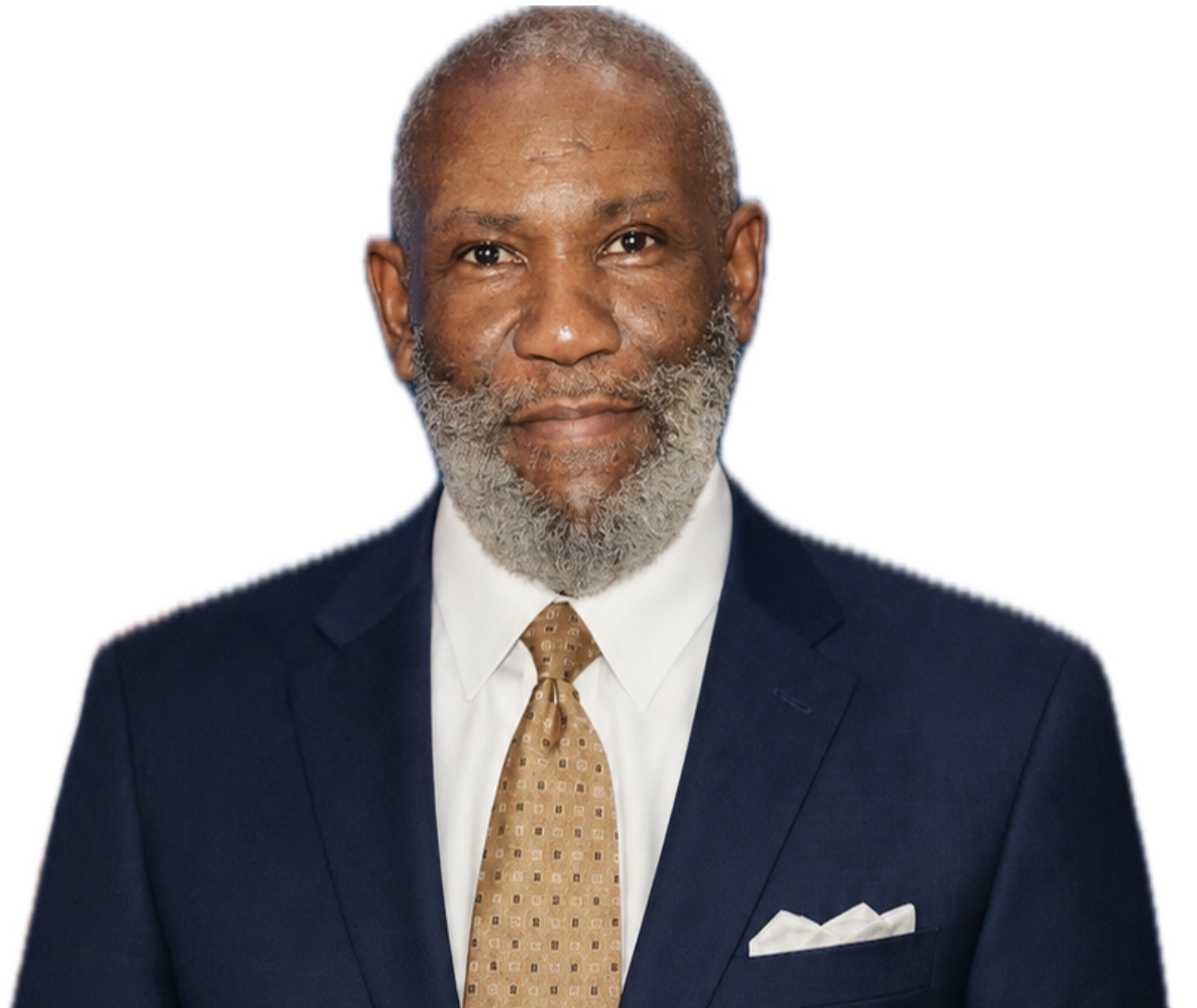
Chuck Drake, a geologist who specializes in potable water who previously served on the St. Johns River Water Management District, is also a candidate for Seat 3 and said he understands the push to get rid of the board if it isn’t effective.
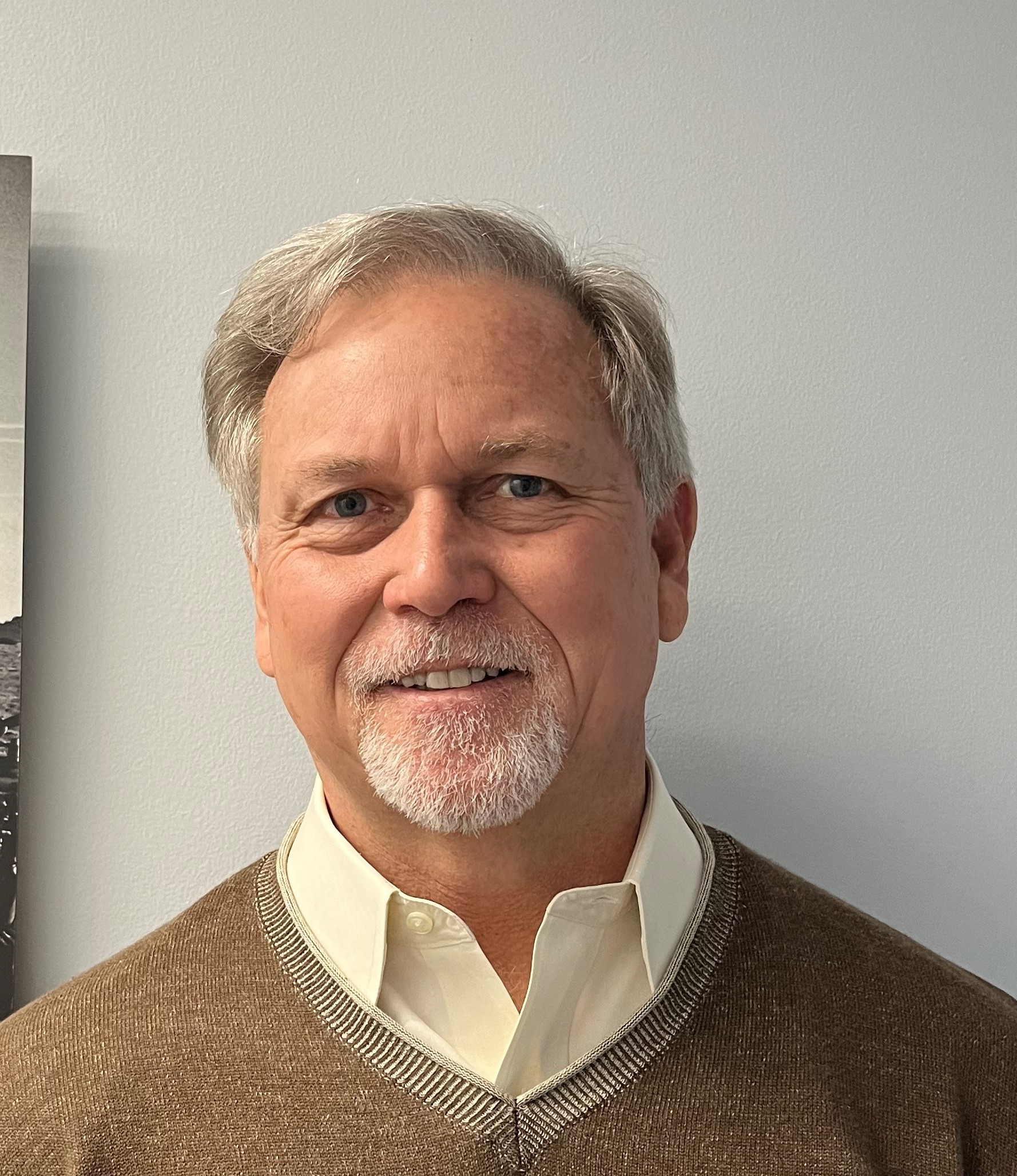
Chuck Drake
“I don’t like government for government’s sake,” he said, but at the same time as a native Central Floridian who has spent his more than 40-year career focused on groundwater, he said he understands the local challenges related to finding fresh supply and water quality.
Drake, who also serves as president of the American Institute of Professional Geologists, pointed to converting septic tanks to sewer as one specific way to add to the reclaimed water supply.
“I’d like to find out what they really do,” he said of the board. “And see if I can add any benefit to it,” noting there could be grant opportunities the previous board members have failed to seek.
Several candidates argued that a board focused on teaching residents best practices to maintain clean water, the local tree canopy and growing plants and food could surge back to relevance. They point to an age of AI data centers that consume water and power, soaring grocery prices and environmental challenges such as frequent named storms.
“If we can teach you how to conserve water, which saves money, how to keep soil healthy, which reduces landscaping costs, how to maintain a mature tree canopy that not only reduces your water bill, but also your power bill and can increase your property value …,” said Melear, who works as a senior project manager for the city of Orlando’s water utility. “Then the district board has the opportunity to be an ombudsman to communicate with government agencies and HOAs and community groups and serve as a nexus for information so they can make the prudent and wise decisions that affect all of us.”
Melear already volunteers as an associate supervisor for the district and is working to establish partnerships with Orange County Public Schools for community gardens and contests to engage students. He raised $500 from a labor union over the summer for his campaign and gave himself another $500.
Drake, like five out of the eight candidates running for the three open seats, isn’t raising campaign money.
The third candidate for Seat 3, which includes much of central Orange County, from Orlando, Edgewood and Belle Isle south to the county line, is Jose Antonio Rodriguez. He also has not raised any funds and did not respond to emails or phone calls seeking comment.
Jimm Middleton, a candidate for Seat 5, also sees untapped potential for the district.
Jimm Middleton
“The board should have a strategic plan in place so they can get things done and, by golly, make announcements about what is going on,” said Middleton, an IT manager at Walt Disney World. “They are too quiet about it.”
He said he was first inspired to run for the board in 2016, unsuccessfully, after seeing the reports about lead in the water in Flint, Mich. He said he is driven by an interest in service and the environment and wants to help people in Central Florida learn to keep their water and soil clean.
“I do not see this as a springboard to run for a higher office,” he said. “I’m doing it solely for the purpose of helping out the community.”
Some board members have sought other offices without leaving much of a mark on the district. Multiple current candidates blame that inactivity as one reason behind the weak state of the board today, though its biggest problem is the absence of a regular source of funding.
Daisy Morales, who was elected to the district board in 2014, missed nearly a year of meetings in 2019 and 2020, which other board members said made it difficult to conduct business. She ran for a state House seat and won in 2020 but lost re-election. This year, she ran for House District 43 but lost the Democratic primary to Samuel Vilchez Santiago.
Middleton isn’t raising any money for his campaign. Zack Green, the other candidate for Seat 5, which includes Maitland, Winter Park and the northeast rural portion of the county, did not respond to requests for comment and also has not reported any financial contributions.
“I’m doing it the old-fashioned way,” Middleton said. “I’m talking to people. I’m posting on social media. It doesn’t make sense to ask people to donate money to this campaign when the current board doesn’t have any money. If you’re going to donate, donate to the board itself.”
According to the district’s current budget plan, it will hold a fundraiser in November, an attempt to raise the board’s profile and build a cash balance that is starting from nearly zero. The district projects about $3,000 in cash and nearly $1,000 in expenses, including renting a post office box, maintaining its rudimentary website and buying supplies for outreach and education events, such as handouts and volunteer shirts.
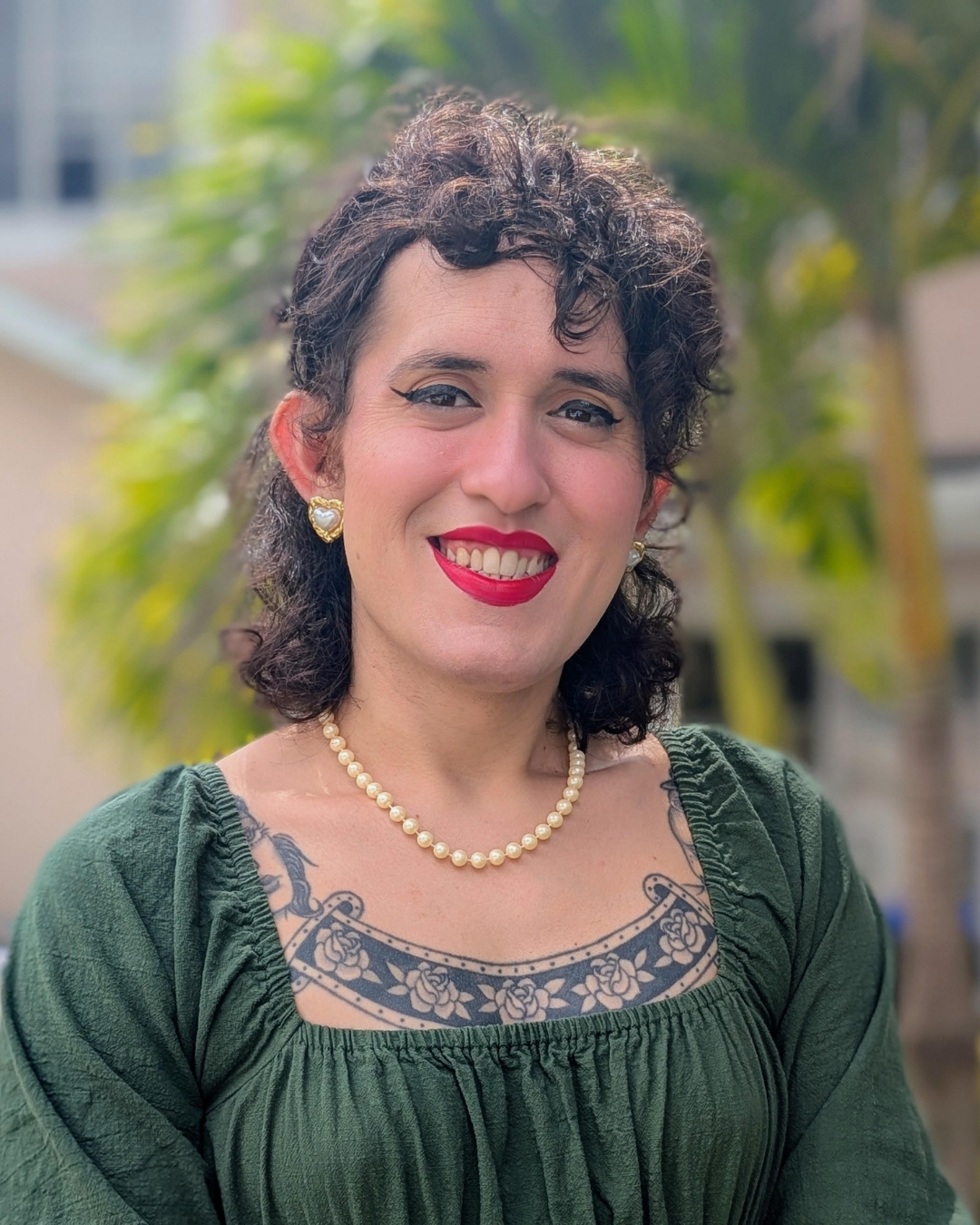
Quinnie Perez
Its most critical budget item is a donation in the form of space and services from Orange County government valued at about $11,000. The donation includes a meeting room for the board, broadcasts of its meetings on OrangeTV and some legal services.
The board members use their personal email addresses to conduct business and, without a staff, volunteer for different roles such as acting as treasurer, keeping records, sending out agendas and minutes and updating the website and Facebook page.
Quinnie Perez, a candidate for Seat 1, is the only candidate who has raised substantial funds: about $4,500, more than the district itself currently has to spend.
She said she wants to bring her experience on other political campaigns and in community organizing to the district to jumpstart awareness of its purpose.
Perez describes herself as the daughter of Mexican farmworkers. She grew up in Ocala and now works in the medical cannabis industry.
“It doesn’t matter if you are running for soil and water or city council or something else, there’s a lot going on with our environment and it’s very important we are advocating for these issues,” she said. “It’s the kind of position that you can make your own, and that’s what I plan on doing by holding regular office hours, even if it’s in the library, and showing people how they can access grants that are available to them.”
In addition to running for an office few voters know about, Perez says she has faced challenges as a transgender woman who has sometimes been met with hostility online.
“I do get stares,” she said. “I always direct them back to the policy. I’ve gotten more harassment on social media than anywhere else … it can work to my advantage because I stand out. It would be a historic race if I’m elected.”
Vicente Perez Carreno
Perez would be the first openly transgender person elected in Florida if she is successful in November.
Vicente Rafael Perez Carreno, who is also running for Seat 1 and serves as the district’s current volunteer treasurer, said he believes in the mission of the district and wants to help it raise more funds through private donors, partnerships and grants.
As an immigration and employment lawyer who also serves as legal director for Casa de Venezuela in Orlando, he said he is driven to run by his passion for environmental issues and an appreciation for the role agriculture plays in the local and state economy.
“One of our greatest challenges is public awareness,” Perez Carreno said of the district, noting that the group must do more to foster collaborations with other organizations such as the school district and recruit more volunteers willing to spread its message across the urban and more rural areas of the county.
Doug Sahr, the third candidate for Seat 1, which covers the southwest portion of the county from Oakland through Winter Garden and Windermere down to Lake Buena Vista, did not return calls seeking comment.
Perez Carreno has joined with Melear and Middleton to run as an unofficial slate for the three seats up for grabs this year. They call themselves “Team VEJ,” for their first initials.
For voters who live in the areas covered by Seats 1, 3 and 5, the soil and water candidates will appear nearly last on their ballots, just above the state constitutional amendments.
None of the candidates has the name recognition, dollars or buzz of those at the top of the ballot for U.S. Senate, governor or even Amendment 3, which would increase homestead property tax exemptions. But some are choosing to count their wins one voter at a time, particularly as mail voting has already started and early voting is set to begin Oct. 19.
Melear, for example, said he was recently at an Einstein Bros. Bagels working on a mock-up of a campaign sign when a woman sat down next to him and happened to notice the name.
“She said, ‘Oh, I just voted for him,’ and I said, ‘Oh, I happen to be him,'” Melear recounted. “I was almost moved to tears.”
Will Orange Mayors Join Push to Rethink how Tourist Taxes are Spent?
Winter Park’s resolution is the latest sign of growing pressure to use the county’s nearly $400 million in annual Tourist Development Tax revenue for transportation, affordable housing and other needs
Sept. 15, 2026
By Beth Kassab
Mayor Sheila DeCiccio sent an email this week to her counterparts in other Orange County cities urging them to adopt resolutions in support of using the Tourist Development Tax to help pay for local needs such as transportation improvements and more affordable housing.
Winter Park adopted such a resolution last week that calls for Orange County to “explore every avenue to expand alternative uses of the tax, including but not limited to transportation and affordable housing, adding additional pennies, and lowering the 40% threshold for tourism promotion, and to make this a legislative priority.”
“This is the direction we need to go considering potentially November and the regional areas wanting to get access to public transportation,” said Commissioner Kris Cruzada during a brief discussion.
“November” referred to Amendment 3 on the Nov. 3 ballot, which could significantly reduce property tax collections by increasing the homestead exemption for homeowners and capping property tax growth on commercial and other properties. Property taxes pay for local police and fire departments, road and infrastructure work, parks and recreation and other services provided by local governments.
But the outcry over how Orange County spends its enormous haul of tax dollars collected on hotel rooms — a record $385 million last year — started long before the push this year to threaten property tax revenues.
A disparate chorus of local voices, from County Commissioner Kelly Semrad — who represents Winter Park and was elected on a platform that included reforming TDT in 2024 — to a few local lawmakers and Orlando Sentinel columnist Scott Maxwell, who was one of the earliest advocates for change, has reached a crescendo in recent years, urging that the largesse be used to help solve problems that stem from hosting 75 million visitors a year and housing the low-wage workers who power the tourism industry.
DeCiccio’s effort appears to be the first to attempt to organize mayors to come together on the topic and push for change at the county level.
Commissioner Warren Lindsey applauded her leadership shortly after the unanimous vote on Winter Park’s resolution.
“Hopefully it’ll make a difference to not only people in Winter Park but everyone in the Orlando area,” he said.
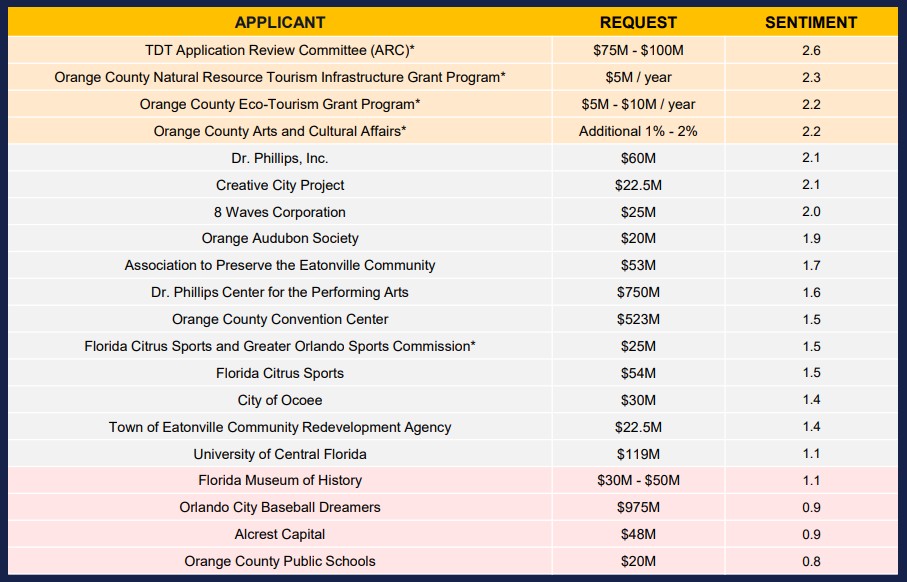
The wording of the resolution mirrors a recommendation made last month by Mayor Jerry Demings’ most recent Citizen Advisory Task Force, which, in a stunning rebuke of the long-held status quo, also voted down spending the tax on yet another expansion of the Convention Center, a parking garage at Camping World Stadium and more projects at the University of Central Florida.
Instead, the 34-member group, made up of appointees of county commissioners and city mayors, recommended spending more of the dollars collected from levies on hotel rooms on grants to support local arts and culture, as well as ecotourism projects.
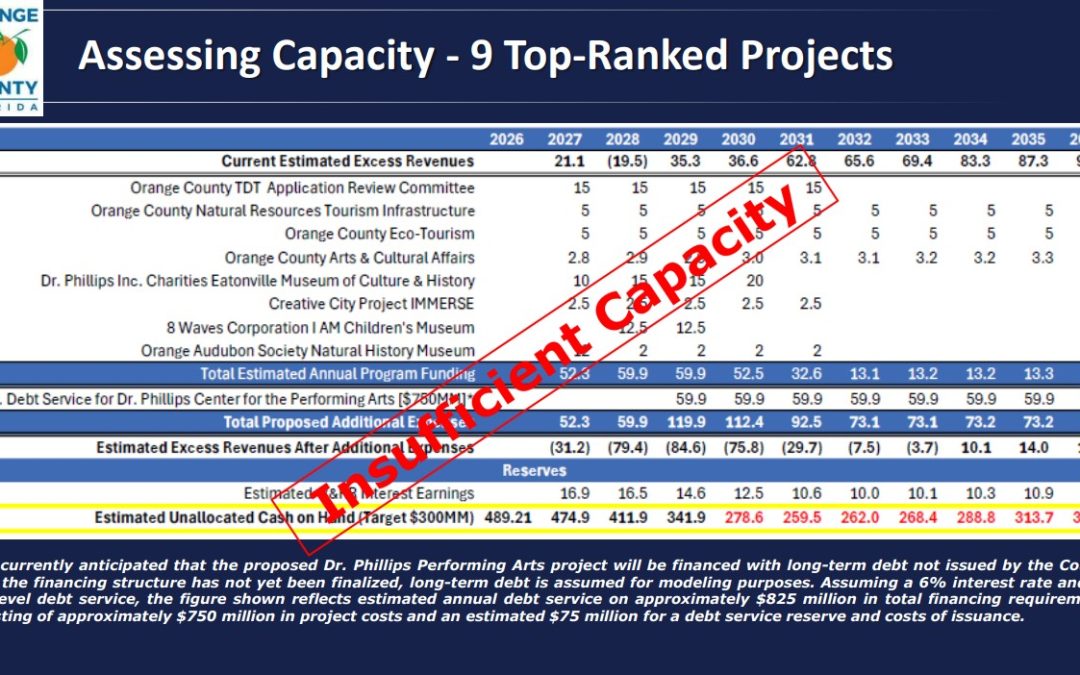
The projects related to the Orange County Convention Center, Florida Citrus Sports, the University of Central Florida as well as the bottom four projects on the above list were NOT recommended by the citizen task force.
The Orange County mayor and Board of County Commissioners arguably have the most power to change the way TDT money is spent.
They have the ultimate say over which projects get the dollars each year within the current confines of the spending rules. And, if other counties across Florida provide any guide, they could succeed in getting state permission to use the dollars for local needs if they made a deliberate lobbying push in Tallahassee.
But Demings, who has served as Orange County mayor since 2018, has not made a major effort to that end — or at least not a public one. Such a campaign would likely involve not only making a case to state lawmakers but also attempting to coalesce the major hotels, as well as Walt Disney World, Universal Orlando and other attractions, behind the idea.
November will also bring a new mayor for Orange County for the first time in eight years and, in another sign that the tide could be turning, both candidates recently rejected the idea of another convention center expansion and said they would support broadening how TDT dollars can be spent.
Linda Chapin moderated a forum last week between Tiffany Moore Russell and Chris Messina for the Orange County League of Women Voters and tried to pin both candidates down on the topic.
Chapin, who served as Orange County’s elected leader in the 1990s and just co-chaired the citizen task force, asked if they would support a convention center expansion.
Moore Russell, a former county commissioner and clerk of court and a Democrat in a very blue-leaning county who lives in Horizon West, hedged her response somewhat on the idea that “data” could one day show a need for more investment in the center.
“I would not have supported the expansion of the convention center unless I saw data that showed me where are we trying to go, what is it trying to achieve, and what’s the return on that investment,” she said. “And so, out of all the projects that I’ve seen so far, I’m a fan of the cultural and arts projects because I think they enhance our quality of life in this community. I am not a fan right now of building any major facilities until we know how do we support those who work in tourism? … We know we have a transportation challenge when it comes to those who visit here and those who work in the industry, as well as affordable housing and workforce housing. So for me, I’m not a fan of big projects right now because I think we need to support those who make our industry thrive in this community.”
Messina, a businessman and Republican who lives in unincorporated Winter Park, said he does not support an expansion because the convention business has changed and said he would have given more support to a proposed long-shot baseball project known as the Dreamers.
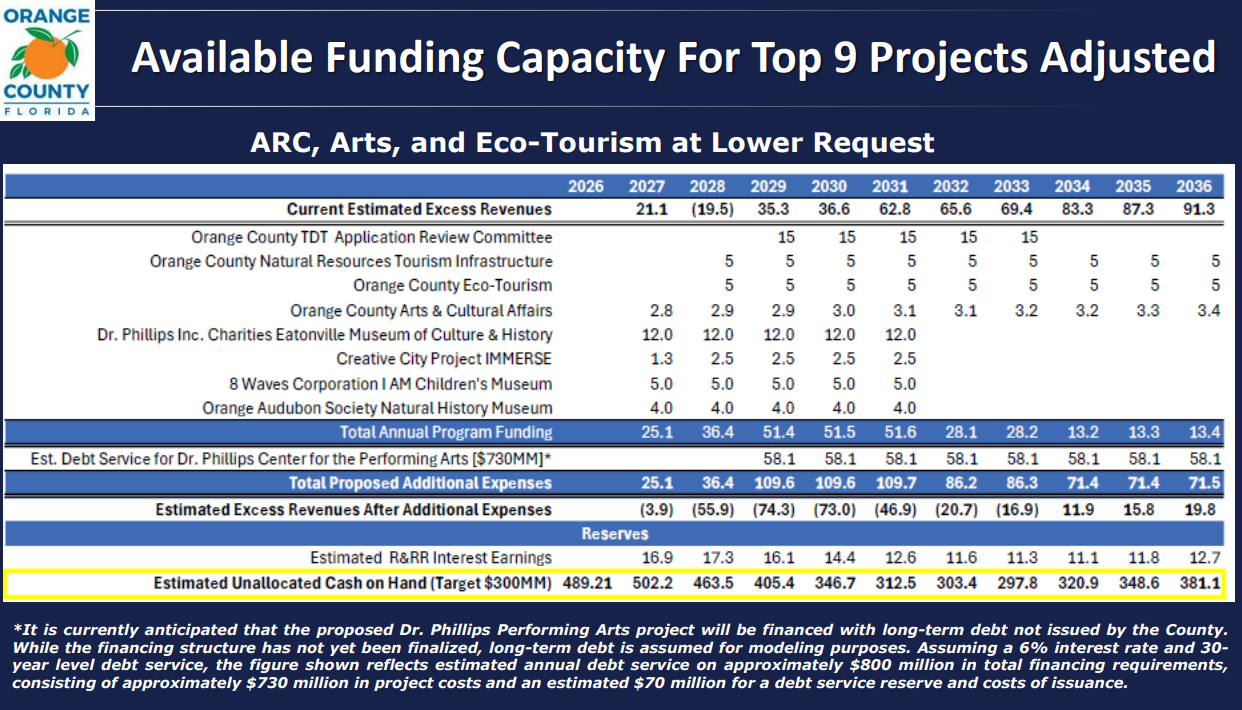
Under one scenario, a chart provided by Orange County, shows how the projects can be funded and maintain reserves. Multiple scenarios were presented at the county meeting on Aug. 25.
“There are only so many very large conventions you can bring into Orange County,” he said. “So I know we lost the Home Builders convention, and it was sort of like the sky is falling for some people, but that’s actually not the case. It’s better to be targeting two medium-sized conventions. They’ll bring more money, more business into Orange County than one large convention. One thing, though, I’ve been very public about that I would have done with the TDT dollars, is I would have looked at supporting the Dreamers in some way, shape, or fashion.”
When Chapin followed up about how the candidates would like to see Tourist Development Dollars used, Messina said he supported using them for tourist-related transportation, but not much else.
“I think we can look at an expanded definition of what tourism is, and without trying to go too far,” he said. “So, for instance, we have a world-class firefighting center, and we have a world-class SWAT team here. So why don’t we do some marketing around that and bring firefighters from around the world, SWAT teams from around the world, for a competition? That’s one thing we could do. Second thing, we can expand it to include transportation that’s focused on bringing tourists to their primary destinations, so from the airport to one of the big hotels or the theme parks. I think that’s a good use of the expanded TDT dollars. But beyond that, to affordable housing? I think that’s a stretch too far and will run us into a brick wall in terms of the legislation.”
Moore Russell was more willing to expand uses but echoed concerns expressed by Demings that the governor and state legislature could attempt to seize on the pot of money for their own use if given an opening.
“I want to marry this also with a question you asked previously about home rule,” she said during the forum. “So I am open to expanding the legislation, but I’m concerned that Tallahassee will take over the control of how we spend our TDT dollars. So we have to be very mindful and keep our eye on the control of our local dollar … But I do believe there is an opportunity to look at our statute about how we can support indirectly, or things that are impacted by tourism. So, you know, transportation — not just moving those who visit Orange County, but the people who work in this industry. There are many who ride the bus, to get to our theme parks, to get to our hotels, who are making sure that we are a great destination to visit. I believe we can justify with the data why we should invest those dollars. Workforce housing down on I-Drive for people to be able to live where they work? I think we can justify that.”
Today, the money is primarily used to pay off debt related to the convention center, as well as support its operations and maintenance, along with subsidizing advertising for the tourism industry and paying debt for the city of Orlando on the arena used by the Orlando Magic.
County officials have long pointed to a state law that governs the tax and limits its uses as the reason the pot of dollars can’t be used to pay for mass transit, public safety, affordable housing or other essential needs.
But other counties have succeeded in carving exceptions into the law when they have made a deliberate lobbying push.
For example, some beachfront counties are now allowed to use tourist tax dollars to fund lifeguards and law enforcement services “which are needed to address impacts related to increased tourism and visitors to an area.” And in 2024, the Legislature allowed local governments in the Florida Keys to use a portion of the money to purchase or build affordable housing.
A critical issue now is the timing of when the County Commission will vote on projects recommended by the task force or move to reintroduce the convention center or other proposals into the mix.
If Demings pushes the matter forward in the final months of his term, then it’s possible there won’t be any money left for the county to spend on other needs such as public transit.
Both DeCiccio and Semrad have expressed concerns about that happening.
A county spokeswoman said a date for the next vote and discussion in front of the Orange Commission has not been set, but that Demings intends to hear the matter before new commissioners and a new mayor take their posts on Nov. 17.
Annemarie Cooper Named New Winter Park Chamber President
Cooper, who was promoted from inside the chamber, replaces Betsy Gardner, who left in May
Aug. 13, 2026
By Beth Kassab
Leaders at the Winter Park Chamber of Commerce announced Annemarie Cooper as the new president and chief executive of the 103-year-old organization that aims to promote the city’s businesses, arts scene and, in recent years, has taken an active role in city elections with a political action committee.
Cooper, who was the chamber’s director of government affairs, steps into the role about four months after Betsy Gardner left the position.
“My vision is to further strengthen our Chamber’s role as a driving force within the community by fostering meaningful, lasting partnerships that create opportunities for businesses and residents alike,” she said in a statement. “I want to ensure the Chamber remains the trusted voice of our business community, a respected advocate, a collaborative leader and a reliable resource that brings people together and helps shape a strong, vibrant future for our region.”
Annemarie Cooper
The chamber did not immediately respond to a question about whether Cooper would continue Winter PAC, the political action committee that most recently funded a candidate who tried to unseat Commissioner Kris Cruzada in 2025.
This year commissioners Elizabeth Ingram and Craig Russell were elected after no one filed to run against either one.
The next city election is the contest for mayor, which will be on the ballot in March of 2027. Sheila DeCiccio appears poised to run again, though the qualifying period doesn’t end until December.
Cooper’s previous experience includes lobbying for the Tennessee Valley Authority, the nation’s largest public utility, and serving as the executive director of the National Independent Pharmacy Coalition.
“Annemarie is the ideal leader to guide the Chamber into its next chapter,” said chamber board Chairman Keith Whittingham, the Rollins business professor and founder of Artfix Cafe, a “direct trade” coffee supplier that aims to provide more income to coffee bean farmers. “Her proven leadership experience, unwavering commitment to serving our members, and passion for advocating on behalf of the business community make her exceptionally well-suited for this role. She understands the importance of bringing people together, listening to the needs of our members, and leading events and programs that deliver real value.”
Other members of the chamber’s 2026 executive committee include Laura Walda of the Lowndes law firm, Arnaldo Oliveras of 180 Commercial Real Estate Advisors, Joel Knopp of Forvis Mazars, Diane DiFebbo of Full Sail University, Ivan Lys-Dobradin of The Gulf Stream Law Firm and Emily Williams of Be on Park and Z Properties.
On Sept. 18, the chamber will host a panel on Amendment 3, which will appear on the November ballot and could significantly reduce property tax revenue for local governments. The panel will include City Manager Randy Knight, Orange County Tax Collector Scott Randolph and Jeff Kottkamp, former lieutenant governor and current president of Florida TaxWatch.
Early voting for the General Election will run from Oct. 19 to Nov. 1
Central Florida supervisors say it’s time to get ‘election ready’
The following story originally published by Central Florida Public Media and is being republished in partnership with the News Collaborative of Central Florida
Supervisors of elections from throughout Central Florida find themselves battling misinformation as they promote voter participation and the safety and security of Florida elections.
Seminole County Supervisor of Elections Amy Pennock urged voters to contact their supervisor’s office for accurate information if they read a story that they don’t trust or that gives them “a bad gut feeling.”
“We are in the proactive confusion management business,” she said. “We all are out there trying to get you the right information so that when you get the wrong information you question it right away.”
The supervisors said they’re being transparent so voters can see the processes that keep Florida elections secure from tampering and interference.
That includes testing all devices used in each election, election audits and “layers” of cyber security.
“[I]n order for a bad actor to penetrate our election system with cyber breaches, they have to get on the internet,” said Lake County Supervisor of Elections Alan Hays. “Our tabulation networks are never ever connected to the internet. So you can sleep tight at night knowing that our tabulation system is not connected to the internet at any time.”
Volusia County Supervisor of Elections Lisa Lewis emphasized the security of their elections process. It’s something that she wants skeptical voters to see for themselves.
She said it’s “a little disheartening that people are so quick to believe the bad stuff rather than the good stuff.”
Hays said their goal is get all Americans, regardless of party, to participate.
“If you can fog a mirror and sign your name and you’re a citizen,” he said, “we want you to vote.”
Aug. 18 primary
The supervisors of elections said they especially want people to vote in the August primary, at which voter turnout can range from a dismal 17% to 24%.
Orange County Supervisor of Elections Karen Castor Dentel emphasized that the primary is important even if you’re not a registered Republican or Democrat.
“We have the county mayor, we have county commission, and these are all nonpartisan races,” she said. “School board, judicial, school board chair, some very consequential elections, and most of them will be determined in the primary.”
The supervisors underscored the need to be “election ready” and said they’re working to educate some voters about changes in their polling places due to congressional redistricting this year.
That includes making a plan to vote in one of three ways available in Florida: by mail, during early voting or at their polling place on Election Day.
ICE at the polls?
The supervisors also addressed fears that Immigration and Customs Enforcement officers could be at polling places this year.
Brevard County’s Tim Bobanic says the FBI briefed Florida’s supervisors of elections at their latest conference. He cited a statute — Title 18 U.S. Code 592 — prohibiting troops at polling places.
“Armed federal agents,” Bobanic said, “are prohibited from conducting investigative activity in any place where election activity is being held.”
Hays, of Lake County, said Florida law has a 150-foot buffer around polling places that applies to those agents, too.
“There’s nothing in that law that excuses anybody from any agency, no matter whether it’s federal government, local government, or anything else, from being inside there,” Hays said.
He said law enforcement officers also are not allowed there, unless they’re voting, responding to an emergency, or working at the school where the polling place is situated.
The Winter Park Voice partnered with six other local new outlets to produce the first-ever voter guide by the News Collaborative of Central Florida. Use the dropdown menu below to learn about candidates in races that will appear on Winter Park voters’ Aug. 18. primary ballots. Candidates were invited to respond to a questionnaire developed by the seven NCCF newsrooms. If a candidate did not respond, that is noted in the guide, and when possible, publicly available information from campaign websites or social media is included. For more information about how and where to vote and election security click here.
Winter Park Voice Partners on Upcoming Voters Guide with Local News Outlets
The Voters Guide is the latest project of the News Collaborative of Central Florida, which is endeavoring to work together to bring more people high-quality local news
July 13, 2026
Staff
The Winter Park Voice is partnering with six other local news outlets to create a voters guide for the primary election on Aug. 18 and the general election on Nov. 3.
The project is part of the News Collaborative of Central Florida, a group of independent local news organizations and aligned partners working toward a more informed and engaged Central Florida.
The Voters Guide aligns with the mission of the nonprofit Winter Park Voice, which aims to provide its readers with high-quality reporting about their local government and matters that influence life in Winter Park.
“At the Winter Park Voice, we serve an audience who cares deeply about local civic and political happenings and this collaboration will help us deliver more of the election coverage our readers deserve,” said Winter Park Voice Editor Beth Kassab. “Our regional News Collaborative is still new, and many people are still learning about it, but it’s already showing how our news organizations can combine resources in ways that we hope make a bigger impact than any one of us could make on our own.”
The news organizations collaborated to create questionnaires for candidates in federal, state, county and judicial races to answer. Questions range from asking candidates what are their top issues, how they would address affordability and even where they stand on Florida’s proposed constitutional amendment on property tax reductions.
In the most recent episode of Talking Central Florida, a podcast funded by the News Collaborative, host Steve Mort and Sentinel Executive Editor Roger Simmons discuss the Voters Guide. Pictured is Mort (right) with Donovan Myrie from WKMG News 6, from the same episode, who discussed Florida’s new approach to tax holidays and whether changes adopted by the Legislature in 2025 could have an unintended impact on hurricane preparedness.
The goal is to give more people access to the candidates’ positions in their own words on the topics that matter most to people in Central Florida.
The city of Winter Park doesn’t have any races on the August or November ballots — those occur in March. But voters in Winter Park will play an important role in deciding races for Orange County Mayor, School Board Chair, Clerk of Court, judicial races and the Orange Soil and Water Conservation District on top of this year’s open race for the next Florida governor and other state and federal seats.
“This is the first time we have news outlets in our region cooperating to create a guide to help voters make informed choices at the polls,” Sentinel Executive Editor Roger Simmons said. “It’s really extraordinary to see these newsrooms come together to work on an important project like this.”
Candidates have already been contacted several times to respond to the questionnaire. If a candidate does not respond, it will be noted in the voters guide. The news organizations may then try to answer the questions for the candidates from information posted on campaign sites or social media.
“Of course our preference is for all candidates to answer themselves,” Simmons said, “but it may be telling for voters to see who responded and who did not.”
The goal is for the voters guide to publish by the end of July, in time for early voting and primary election day on Aug. 18.
The News Collaborative of Central Florida was a result of the Central Florida Journalism Ecosystem Summit, created in 2024 by Central Florida Public Media, Central Florida Foundation and Oviedo Community News. Collaborative members worked together last year on a project focusing on the impact of the state’s homeless camping ban.
We Depend on your support, make a tax-deductible donation here.
Mission
The Winter Park Voice is a trusted nonprofit journalism site that covers our City Hall and beyond. We endeavor to engage, inform and connect citizens on all sides of issues affecting the quality of life in Winter Park.

Recent Comments