by Beth Kassab | Jun 5, 2026 | Arts and Culture, City Commission, Election, Library, News, Police, Taxes, Uncategorized
What Does Winter Park Stand to Lose if Property Tax Cuts Pass?
Voters are expected to decide a ballot amendment in November initiated by Gov. Ron DeSantis and the Florida Legislature that could dramatically alter how local governments operate
June 5, 2026
By Beth Kassab
What does Winter Park stand to lose if voters approve the plan by Gov. Ron DeSantis and the Legislature to dramatically reduce property taxes?
A picture of the potential fallout is becoming more clear just days after the Florida House and Senate voted to send the measure to the November ballot. Here’s what we know so far:
How much money will Winter Park lose?
Let’s break down the numbers.
In 2025, Winter Park collected about $48.5 million in taxes, according to Orange County Tax Collector Scott Randolph. The bulk of that, or about $41.1 million, is what is targeted by the state ballot amendment. Those are the dollars collected on real property — houses and businesses — based on that property’s assessed value.
Tax money that comes in from real property is divided into two categories: Homestead (the houses people live in and claim as their primary residence) and non-homestead (commercial properties, businesses, second homes or rental properties or other land).
The change ordered by the Legislature garnering the most attention is a reduction in what cities and counties will collect on homesteaded property. (Note: The Legislature revised DeSantis’ proposal, which would have also reduced taxes that support schools. So the new rules would not apply to school taxes.)
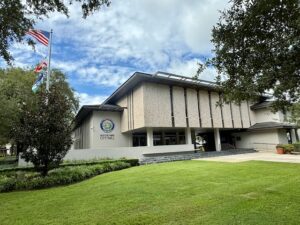
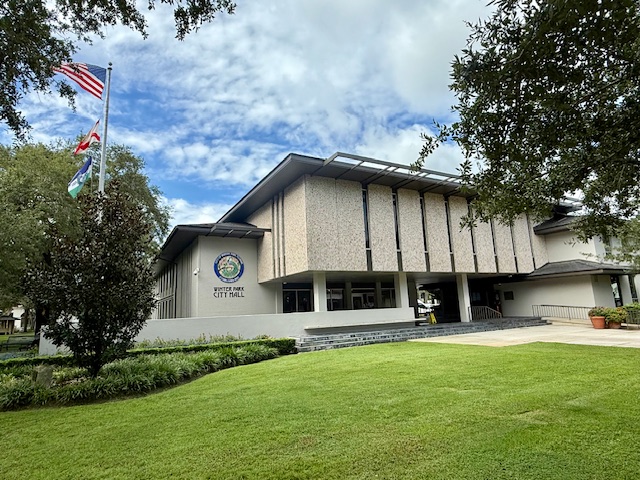
Winter Park City Hall
Winter Park collected $19.8 million in 2025 from homesteaded properties. If voters approve the proposed increase to the homestead exemption from $50,000 today to $250,000 in 2028 then those collections would drop to about $14.2 million, according to Randolph’s projections. The reduction would first be felt, to a lesser extent, by cities and counties in 2027 when the homestead exemption would jump to to $150,000 before increasing to the full $250,000 the following year.
So that’s a loss of $5.6 million based on today’s numbers or a 28% reduction in collections on homesteaded properties. The overall hit to the city’s tax roll appears closer to 12% because stormwater fees ($6.3 million), tangible property taxes ($1 million on equipment and furnishings in businesses or rental properties) and non-homesteaded property taxes ($21.2 million) aren’t affected by the change to homestead exemptions.
How big of a deal is that $5.6 million loss?
Well, thumb through this year’s Winter Park budget and you can get an idea of what $5.6 million means in real terms:
- This year the city spent $5 million more just to cover basic cost-of-living and 3% merit raises for city staff, including more competitive wages for police and additional emergency call center staff as the city took on dispatch duties for Maitland.
- The entire capital improvement budget for the Community Development Agency, which is funded entirely through property taxes, totaled $5.7 million. That included $3.2 million to fix drainage and infrastructure problems on West Fairbanks Avenue, Canton Avenue and the MLK Park basin. Another $2.5 million went to the Park Avenue Refresh project, which includes new street lighting, sidewalks, landscaping, underground infrastructure and other work.
- The rebuilding of Fire Station 62 on Lakemont Avenue is estimated at $5.8 million, a project the city put off again this year because it didn’t have the funds.
Mayor Sheila DeCiccio predicted noticeable cuts will be made if the new proposal goes into effect.
“This will be devastating,” DeCiccio said after the Legislature’s vote. “We will be assessing what services the city may have to cut.”
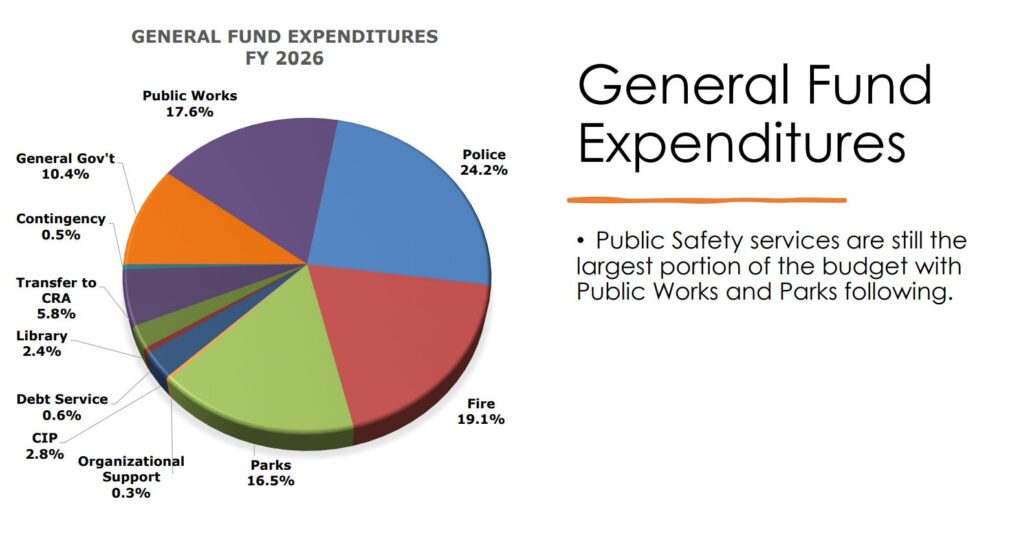
The entire city budget is $233 million this year. That includes the two utilities that fund themselves with a combined nearly $100 million in what customers pay for water and electric service.
Beyond that, the single biggest source of revenue for the city is property taxes.
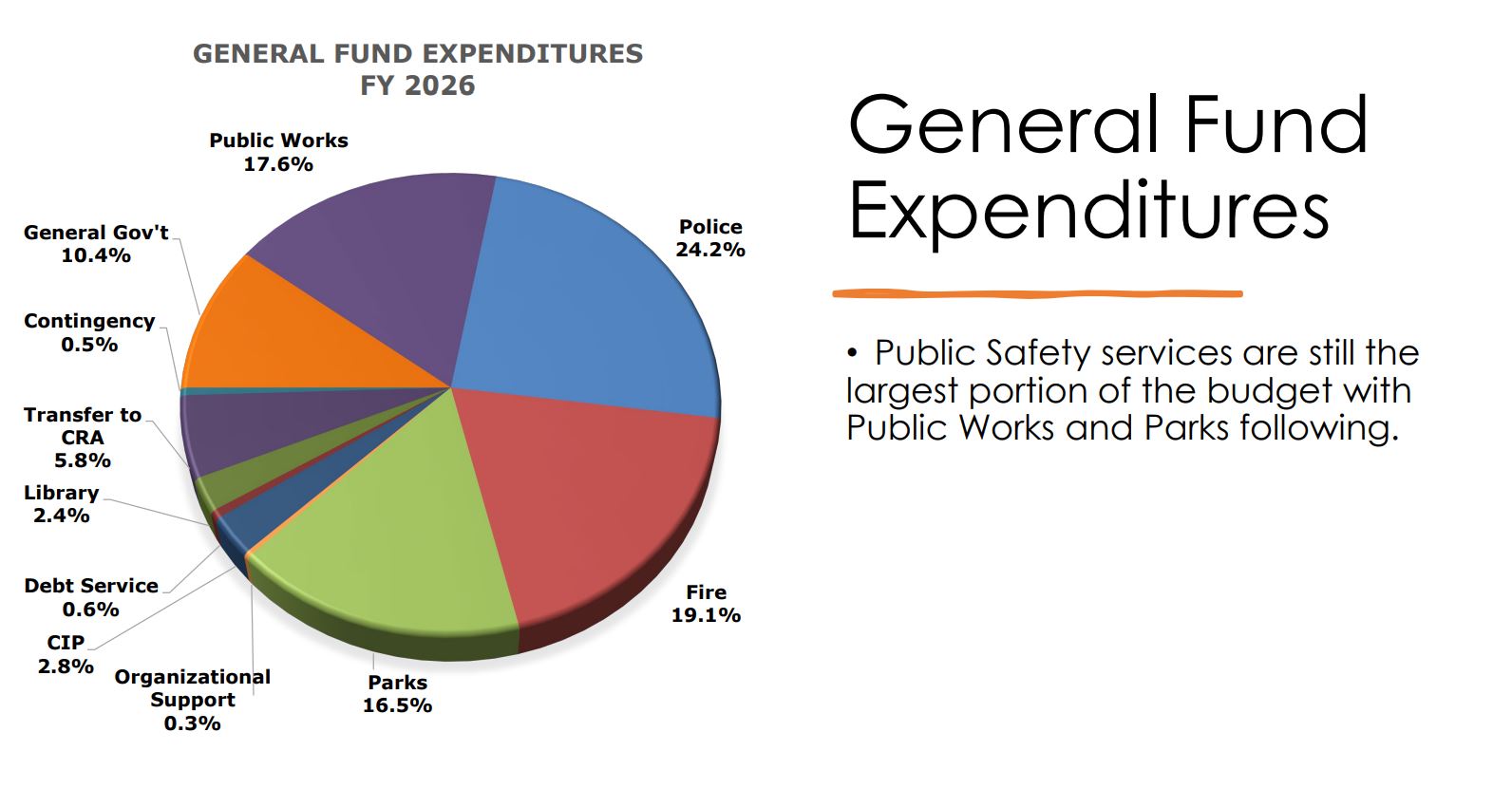
Those taxes are the biggest contributor to the city’s almost $90 million general fund, which is responsible for all of the front-line services like police and fire rescue (the two biggest expenses), parks and recreation and public works.
“Property taxes are continuing to row the boat for the city’s fiscal picture, rising 7.6% and accounting for 44% of General Fund revenue,” reads the budget document from last year. “This stabilizing force is what keeps most city services humming. Its rate of growth is sufficient to support the existing level of city services, but it is limited in what it can provide in excess of just staying on course.”
So is that all?
No. There’s more. The ballot amendment would also hamstring cities and counties by limiting future growth in the amount of taxes collected on non-homesteaded properties.
The cap on annual assessment increases for those properties — anything from a Publix grocery store to an Amazon warehouse to a vacation home — would drop from 10% to 5%.
That represents future savings for billion-dollar corporations and less future revenue for local governments to use for police, fire rescue, roads and everything else property taxes pay for.
Growth in property values is how a city like Winter Park, which has enjoyed a brisk real estate market for years, has managed to increase its budget without raising the tax rate for 18 years.
A little more than half of the city’s total ad valorem collections or about $21.2 million come from non-homesteaded properties owned by everyone from small business owners to deep-pocketed corporations who will save money as a result of the new cap.
The exact amount of future unrealized growth is hard to quantify, city officials say.
But this chart from the budget shows the importance of the increase in assessed values year to year: 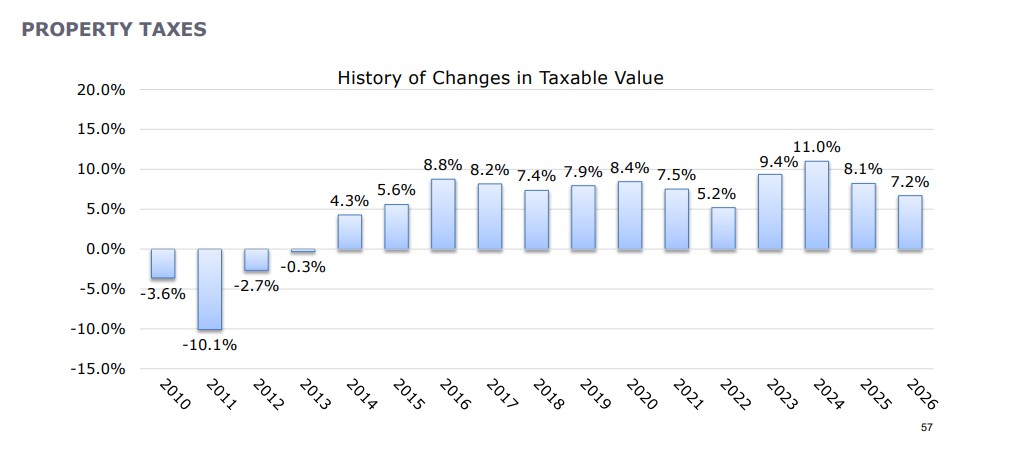
But even before the new ballot amendment was in play, city officials were beginning to warn of a softening in that growth and the need for belt-tightening.
“The General Fund is seeing continued increases in property tax revenue due to increasing valuations in existing real estate which has traditionally been the primary support of the majority of the growth in revenues over time,” the budget reads. “However, this revenue source is continuing its slowing trend and could indicate tighter years ahead.”
If approved, the new cap will exacerbate that picture.
What else does the ballot amendment do?
In addition to reducing revenue cities and counties have to work with, the measure would also restrict how that money is spent.
Property taxes would only be able to pay for items that fall in one of the following buckets, according to a Senate press release:
- Public safety, including law enforcement, fire service, and emergency medical service
- Education and public schools (additional funds beyond operational expenses covered by school board taxes)
- Road and bridge construction and maintenance, stormwater control, and other infrastructure projects
- Natural resource projects, including flood control measures
- Retirement benefits of local government employees
- Bond obligations
- Operations and administration of county officers and commissioners and municipalities, and approved expenditures
Assistant City Manager Michelle del Valle, who will be in the top role next year when the changes begin to take effect after City Manager Randy Knight retires, said city staff is already starting to assess what may or may not fit into those categories. Some items in question, she said, are considered core services that residents have come to expect.
“The biggest one that we’re going to have to start working on is Parks and Recreation,” she said. “But also the library … all of our cultural partnerships.”
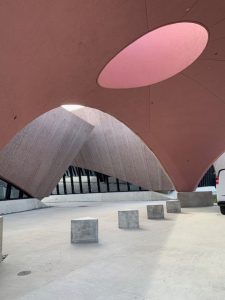
The Winter Park Library & Events Center.
This year the Parks budget is nearly $15 million. The city spent about $2.4 million on its library this year. And more than $500,000 went to cultural and nonprofit organizations through the general fund and the CRA such as Mead Botanical Gardens, Winter Park Historical Association, Winter Park Day Nursery, United Arts, Blue Bamboo, Polasek Museum, Enzian Theater, Heritage Center, Welbourne Day Nursery and Winter Park Playhouse.
DeCiccio said the attempt to cut local budgets is an extension of a longstanding effort by Tallahassee to chip away at the power of local governments.
“Where are people supposed to go?” DeCiccio asked. “Are they supposed to go to the state to complain about potholes in the roads? It’s very, very frustrating.”
The proposed ballot amendment, she said, strips voters of a layer of autonomy and accountability to closest to where they live.
It’s more often the city and county commissioners vs. state officials who run into residents at the grocery store or in the school pick-up line and hear their frustrations about uneven sidewalks or broken streetlights, a desire for more shade trees or a plea to help the arts.
“What about libraries? What about playgrounds? They are taking away our ability to fund these items,” DeCiccio said. “We have the No. 1 children’s library in the state that’s now open seven days a week. How are we going to keep paying for that?”
What can cities do in response?
Even before the proposal to cut property taxes, cities like Winter Park began raising prices on everything from after-school programs run by the parks department to stormwater fees and electric rates to compensate for rising costs in recent years.
For example, at the most recent City Commission meeting, commissioners approved a contract extension for Waste Pro, which provides garbage collection. The city doesn’t make money off the contract — it’s a pass through — but residents’ monthly rates have shot up from $14.99 in 2022 to $22.22 in 2025.
And residents could pay more in other ways.
Cities and counties could choose to increase the millage rate on properties — something Winter Park has avoided for 18 years — to blunt the effect of the proposed changes.
“If county and municipal governments raise millage rates to recoup the lost revenue, that would result in higher property taxes on the portion of the value of homestead properties that remains taxable, as well as on the many properties that do not qualify for the substantially higher exemption, including the properties of new Florida residents and second homeowners, commercial properties (including apartment complexes), and industrial and agricultural properties,” reads an analysis from the conservative-leaning Tax Foundation. “This would make Florida’s property tax system far less neutral and disincentivize the purchase of certain classes of property.”
Or, the foundation argues, policymakers could choose to increase the sales tax to help make up for lost property taxes.
“Since Florida’s tax structure includes no individual income tax, sales taxes and property taxes are the primary sources of state and local tax revenue,” the group said. “Replacing the lost property tax revenue with sales tax revenue would require substantially higher local and/or state sales tax rates, a sweeping expansion of the sales tax base (likely to more than just final personal consumption), or a combination of these approaches.”
Winter Park doesn’t set the sales tax or the local gas tax. That’s done by a combination of state and county officials. But it does share in sales and gas tax revenue, though that revenue is far less than property tax revenue for the city.
Winter Park’s 2026 budget included $5.6 million from sales tax and just under $1 million from the local option gas tax, a fraction of the more than $41 million it received in property taxes.
What happens next?
As with any ballot amendment, there is likely to be litigation and fights over the ballot language.
But once it makes the November ballot, at least 60% of voters must approve it in order for it to pass. That’s a heavy lift in Florida.
In 2024, there were six constitutional amendments on the Florida ballot and all but two failed to capture the required 60% approval. That was the year an amendment to legalize recreational marijuana and to limit government interference with abortion received 56% and 57% of the vote, respectively, but fell short of the 60% threshold.
But an amendment related to property tax exemptions passed with 66% of the vote. It provided for an annual inflation adjustment for the value of the homestead property tax exemption that applies to non-school taxes.
Two years earlier, though, a 2022 amendment to increase the homestead exemption for public service workers including teachers, law enforcement officers and others failed with 59% of the vote.
What about Winter Park’s next budget?
City officials say they still plan to present a proposed budget to the City Commission in July on the typical schedule.
The next budget is based on the 2026 tax roll and would not be impacted by the proposed changes, which aren’t set to take effect until next year if they win voter approval.
But officials say they are cognizant of what potentially lies ahead and are taking that into account.
At the recent commission meeting, for example, DeCiccio balked at spending a few thousand dollars on a historic preservation consultant, at least for now, because of the potential cuts.
The City Commission usually begins to hear public input on the budget in August and must adopt it by the end of September before the start of the next fiscal year in October.
WinterParkVoiceEditor@gmail.com
To comment or read comments from others, click here →
by Beth Kassab | Oct 20, 2025 | Arts and Culture, City Commission, Library, News
How Should City Commission Give Dollars to Nonprofits?
The City Commission will consider this week a new system for awarding nonprofit grants and also discuss if the Parks & Rec department should sell ads and sponsorships
Oct. 20, 2025
By Beth Kassab
Each year the city of Winter Park, like many local governments, doles out a portion of public dollars to help nonprofits like Mead Botanical Gardens, Winter Park Day Nursery, the Winter Park Library and Blue Bamboo Center for the Arts.
But this year, amid economic and budget uncertainty, the City Commission held back $140,000 — and didn’t renew one-time grants to the Winter Park Institute and Men of Integrity — with the intent of formalizing the grant process and determining who is eligible.
This week commissioners are slated to finally have that discussion on Thursday in a workshop.
The conversation comes about amid major cuts to arts and nonprofit funding on the state level and efforts by Gov. Ron DeSantis’ administration to showcase what it deems as “wasteful” local government spending through its “DOGE Team.” The administration is targeting cities and counties with audits and press conferences that it claims are highlighting “waste, fraud and abuse” such as a tree inventory program at the city of Orlando or programs for LGBT youth services in Orange County.
City staff are proposing the creation of a temporary committee each year that would evaluate grant requests and make recommendations for 10 recipients of $10,000 each for “relevant, and meaningful, arts, science, history, social services, and educational experiences of value to the local community.” The committee members would consist of people who already serve on other city advisory boards such as Parks & Recreation and Historic Preservation.
To be eligible, nonprofits must serve Winter Park and can not support a political cause or candidate, can not be connected to a for-profit business and can not already be receiving more than $10,000 in funding from the city, according to the proposal.
The money for the grants comes from .25% of the gross revenue from each of the city’s three major funds — the general fund, electric and water and wastewater.
That generates about $442,000. Some organizations already receive a yearly allotment from that pool. The new policy would address new requests totaling about $100,000.
Those that receive yearly funding, including the Winter Park Library, are:
- Mead Botanical Gardens: $102,000
- Winter Park Historical Association: $97,000
- Winter Park Day Nursery: $42,500
- United Arts: $20,000
- Blue Bamboo: $12,500
- Polasek Museum: $28,000
- Winter Park Library: $2.1 million
The staff report also noted that state government has targeted the ability of Community Redevelopment Agencies to support nonprofits, though so far, there have been no changes to the law. In the future, however, CRAs may be prohibited from making such grants.
Winter Park’s CRA makes the following contributions, according to the 2026 budget:
- Enzian Theater: $10,000
- Heritage Center: $50,000
- Welbourne Day Nursery: $43,000
- Winter Park Playhouse: $49,300
- Depugh Nursing Home: $24,000 (This group recently announced it’s closing)
Ads at Parks?
Commissioners will also discuss on Thursday a plan that city staff estimates could generate $100,000 a year by selling ads and sponsorships at city parks or events.
The effort would mostly focus on the city’s two golf courses, the tennis center and other parks with high foot traffic. Central Park, the highest-profile public green space along Park Avenue, would be off limits to advertisers, according to the proposal.
Some examples of places where the city could sell ads to raise extra funds: interior fencing at tennis courts, golf course scorecards, banners in gymnasiums or fields or t-shirts for adult athletic leagues or summer camps. Sponsorships could be sold for city events such as the Fourth of July celebration, Weekend of the Arts and Dinner on the Avenue or programs such as Movies in the Park or the rotating art installations set to begin next year in Seven Oaks Park.
“Today, financial and in-kind support is even more critical as the investment needed to sustain and improve the parks, facilities, and programs continues to rise,” reads a memo about the proposal. “Like other park and recreation departments across the nation, the parks and recreation department is pursuing more sophisticated business partnerships with the for-profit and non-profit sectors, in the form of events, programs, projects, and site sponsorship along with limited advertising.”
WinterParkVoiceEditor@gmail.com
To comment or read comments from others, click here →
by Beth Kassab | Jul 11, 2025 | City Commission, Library, News, Uncategorized
Winter Park has a Long List of Complaints over Library and Events Center Construction
City officials and the contractor are meeting to try to resolve the problems
July 11, 2025
By Beth Kassab
Note: This story has been updated to include a statement from the contractor received on Saturday.
During the nearly four years since the more than $42 million Library and Events Center opened, Winter Park officials have compiled a list of what they say are construction concerns such as fracturing glass in some of the large panoramic windows, roof leaks, problems with the elevator and even the port-cochere, the grand covered entrance to the structure.
City Manager Randy Knight recently told the City Commission that the city is frequently meeting with representatives from contractor Brasfield & Gorrie to resolve the problems.
“Right now, we think they are going to resolve these issues,” Knight said. “But we’re going to go ahead and preserve our rights” before the statute of limitations runs out on filing a lawsuit over the claims.
This week the city notified the construction company and insurers of what it considers to be a “default” on the job to preserve the city’s right to sue if the problems aren’t fixed.
A spokeswoman for Brasfield & Gorrie, a national construction firm with offices in eight states that reported $6.4 billion in revenues last year, confirmed on Saturday that the firm is in talks with the city.
“We are discussing the city’s concerns and seeking resolution,” said a statement from the company.
Voters narrowly approved a bond referendum for $30 million in 2016 to pay for the project designed by British architect David Adjaye. Then, in 2020, the City Commission approved spending $41.7 million on the project. But, so far, the final tally is even higher at $42.3 million after the city added another $300,000 in 2022 from the American Rescue Plan Act, the federal stimulus package spurred by the pandemic.
The letter to the contractor lists 12 items that “has not been performed per plans and specifications” from the doors, lighting, air-conditioning and even the bathroom faucets along with the doors, windows, roof leaks and other concerns.
City spokeswoman Clarissa Howard said on Friday the contractor is continuing to meet with the city and working to resolve the matter.
WinterParkVoiceEditor@gmail.com
To comment or read comments from others, click here →
by Beth Kassab | Jul 10, 2025 | City Commission, Library, News, Uncategorized
Winter Park Approves Limits on Protests and Activity at Library and Events Center
In a split vote, the City Commission approved a new ordinance that they claim is based on complaints over photo shoots and one small protest at the public buildings
July 10, 2025
By Beth Kassab
The Winter Park City Commission on Wednesday voted 3-2 to approve an ordnance that draws a boundary around the Library and Events Center as essentially a new “no protest” or gathering zone.
Mayor Sheila DeCiccio and commissioners Craig Russell and Kris Cruzada voted in favor of the ordinance. Commissioners Warren Lindsey and Marty Sullivan voiced strong objections to the change and voted against it.
DeCiccio and city staff say the ordinance is needed to protect groups and individuals who rent space in the buildings for weddings, corporate meetings and other events from disruptions from people who may want to stage protests or use the $41 million complex’s unique architecture as a backdrop for extensive photo shoots or other gatherings.
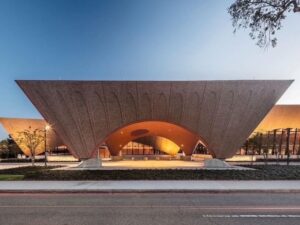
The Winter Park Events Center opened in late 2021 and was designed by British architect David Adjaye.
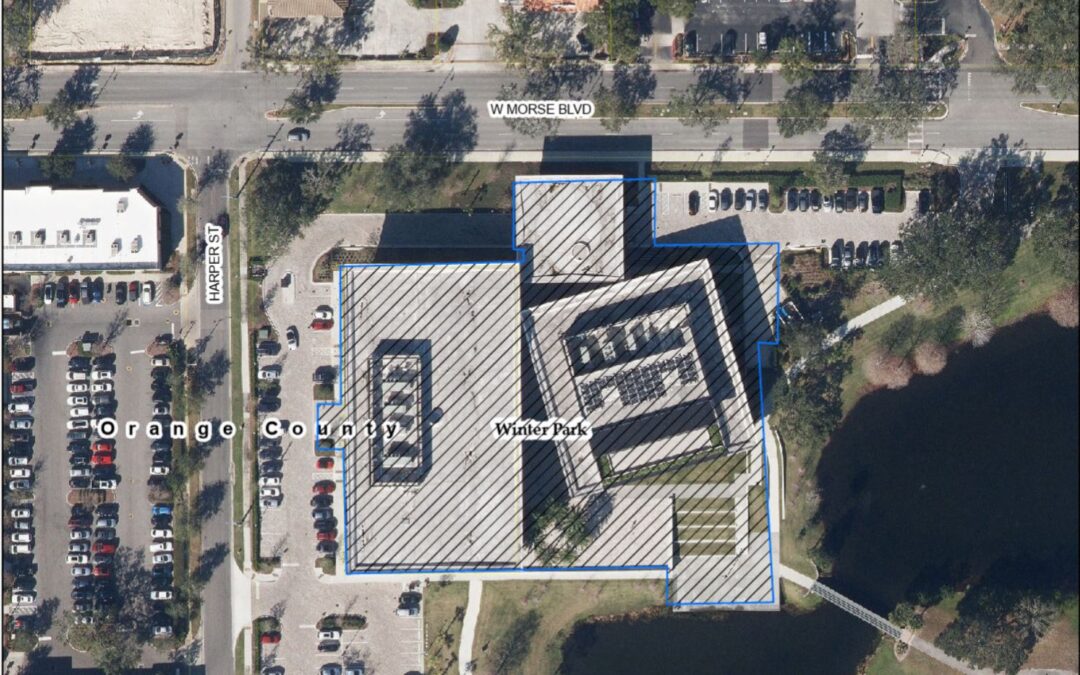
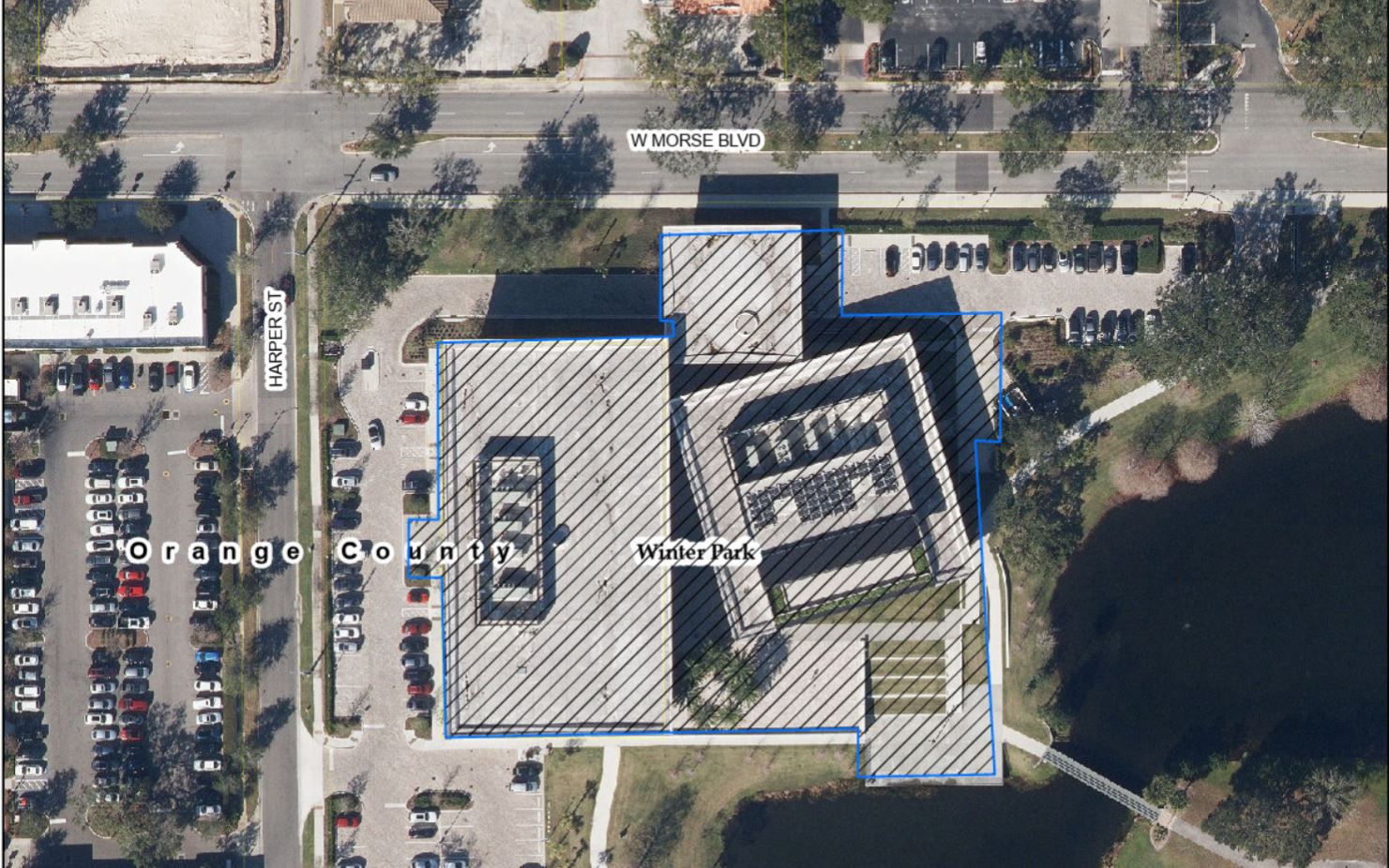
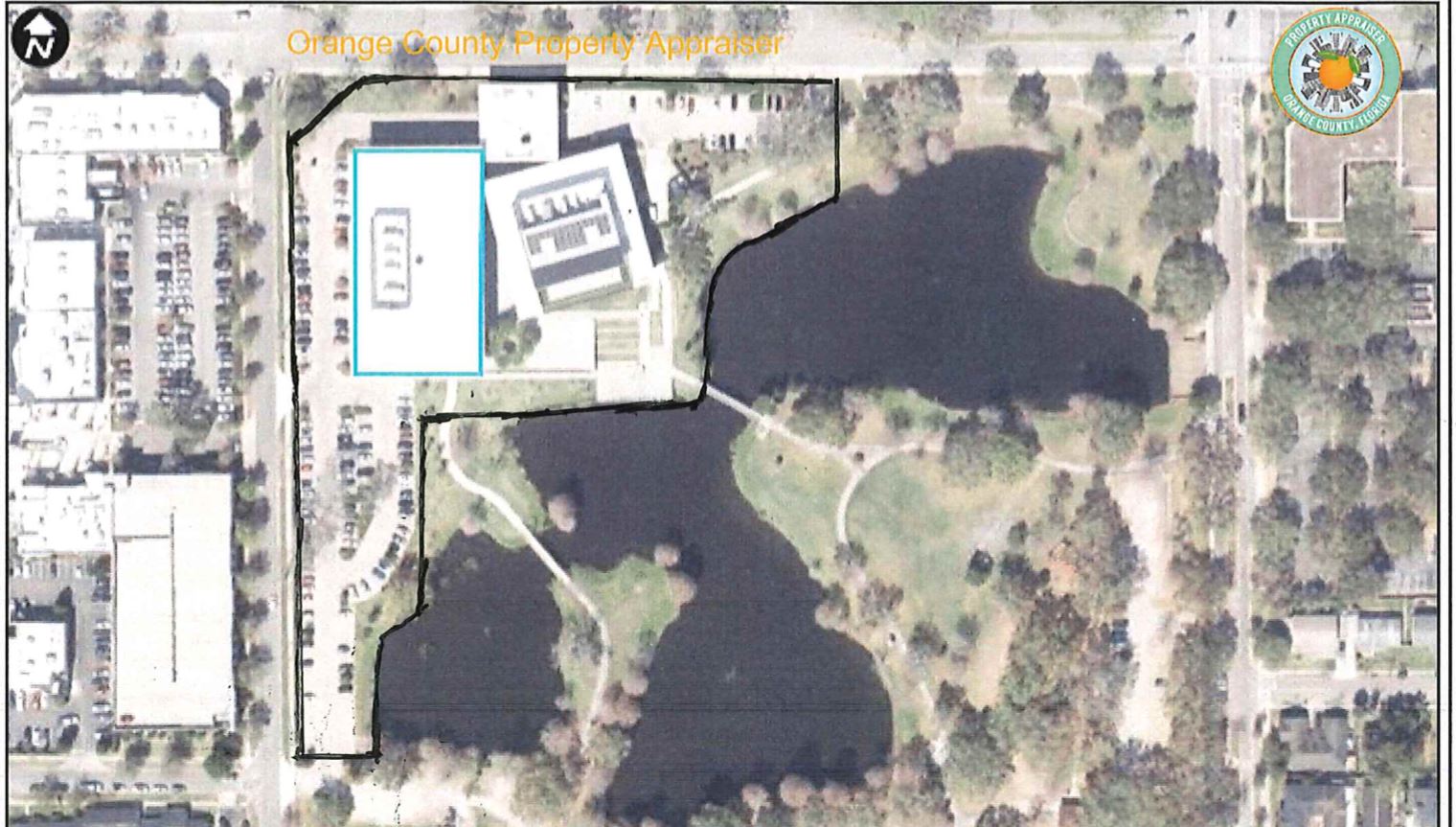
The new “no protest” area — the blue line drawn around the complex in the image above — mostly hugs the outline of the buildings, but also includes a large amount of outdoor space on the southeast corner of the building, which has large windows looking out onto Martin Luther King Jr. Park.
Lindsey, a criminal defense attorney, noted the irony of the city imposing what he views as First Amendment restrictions on the same week Winter Park plans to dedicate its commissioned larger-than-life bronze statue of King at an installation in the park known as Unity Corner.
“I think it’s interesting that this coming up Saturday we are going to be dedicating the statue … probably within 200 or 300 yards of the restricted areas,” he said, noting that the monument includes the words “courage is the power of the mind to overcome fear.” “I think a lot of times there a temptation that because we’re fearful of something we will overreact and Martin Luther King Jr. provided us instruction on that.”
He called the ordinance an “unnecessary use of government power.”
“We should be very, very careful how we use our power, especially how we use our police power,” he said. “And the only real argument for passing this thing is to deal with a hypothetical problem that has not occurred … that is something we should be very careful about doing.”
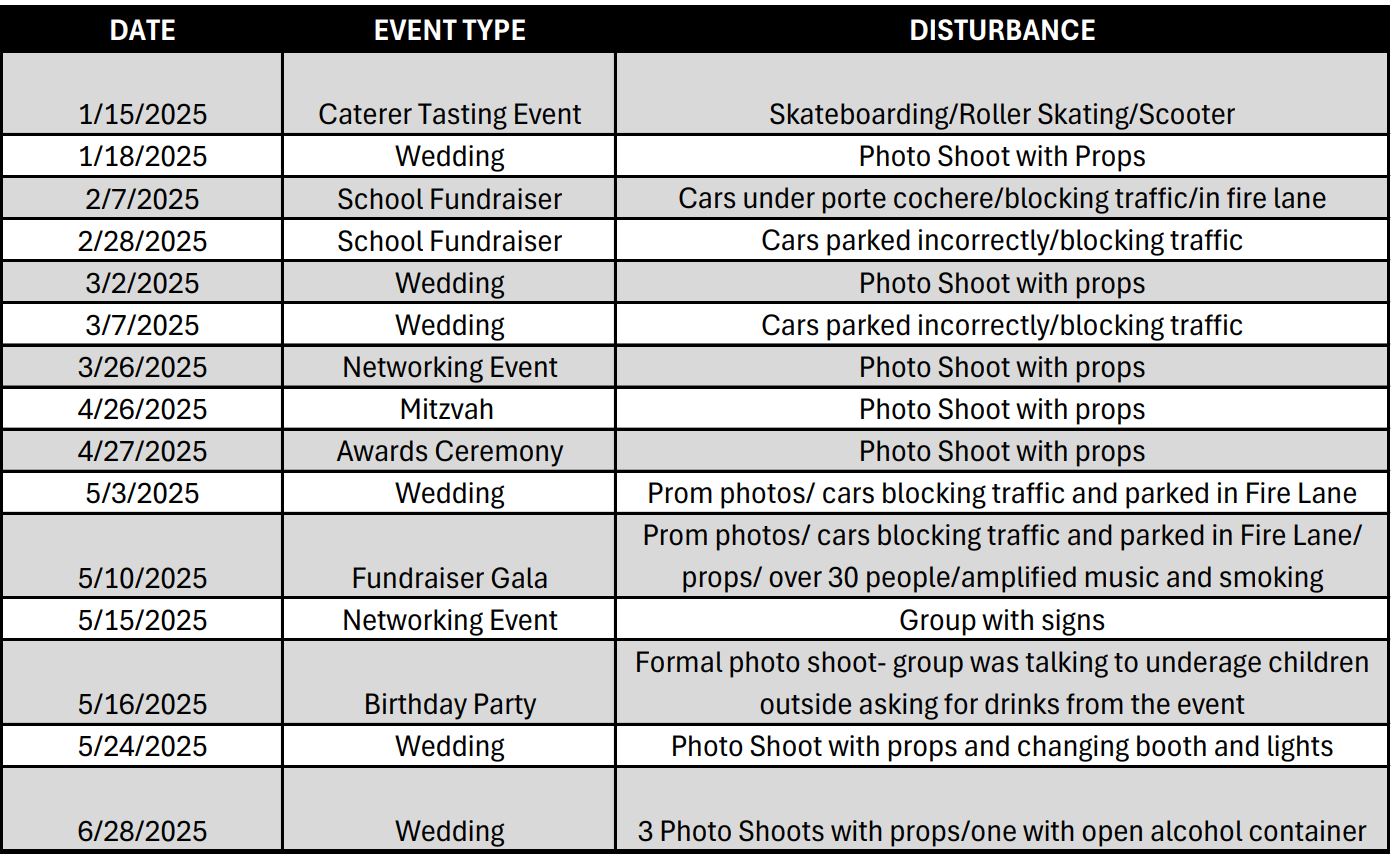
A list of 15 “disturbances” since the beginning of this year provided by the city is not enough justification for the ordinance, Lindsey and Sullivan argued. Of those, 10 are described as “photo shoot with props” or “prom photos.” One noted a “changing booth” and “lights.”
The other disturbances were listed as “cars blocking traffic” or “skateboarding/rollerblading/scooter.” Only one was listed as “group with signs” or anything resembling a demonstration or a protest.
A police dispatch call log noted someone called police just after 6 p.m. on May 15 to report “6-7 people outside on the south side near the lake, holding up signs protesting.”
About the same time the police arrived, the caller called back to report “her boss says they are allowed to be there.”
At the time, the events center was being rented by the Orlando Lawyers Chapter of the Federalist Society for an event featuring Josh Blackman, who was recently appointed by President Donald Trump to the Religious Liberty Commission’s advisory board of legal experts. Blackman is a constitutional law professor at South Texas College of Law Houston.
Winter Park attorney Michael Sasso is the president of the Orlando chapter.
Sullivan said people should be required to pull permits for elaborate photo shoots and that there are laws on the books already to address cars blocking traffic or disorderly conduct. But the kind of demonstration that occured on May 15 should not be limited.
“I have it from a reliable source there were four people at 5:30 in the afternoon standing there with small signs,” he said. “To me, that should be an allowable public gathering and that in my mind illustrates how this [ordinance] goes beyond what is needed … this prohibits activities that in my mind are permitted First Amendment activities.
City Attorney Daniel Langley argued that the city is allowed to put more restrictions on the library and events center because it’s not “traditional public forum” because it’s rented out and used by other entities.
He said that perimeter is drawn tightly around the buildings and, in many cases, “they could move two feet into the parking lot and continue that activity.”
The ordinance calls for a warning to be issued before people are trespassed from the area and potentially given a fine.
Commissioner Craig Russell said he is in favor of the ordinance because it’s about safety and protecting the space for those renting the venue.
“… We’re also not trying to recreate Tiananmen Square either as a city, so I think this is a very reasonable measure,” he said, referring to the 1989 crackdown on protests by the Chinese government. “Out of all the green spaces we have in the city, why there? It’s a unique space and we have the responsibility to protect it … I truly believe it’s not about stifling rights or anything of that nature.”
DeCiccio, also an attorney, cited a U.S. Supreme Court case over a municipal bandshell that she said allows the city to put restrictions in place.
She said the ordinances “does not silence voices,” but sets aside a “relatively small area” to be protected from potential disruptions.
WinterParkVoiceEditor@gmail.com
To comment or read comments from others, click here →
by Beth Kassab | Jul 8, 2025 | Arts and Culture, City Commission, Library, News
What Sparked Proposed Protest Ban at Library & Events Center? Mostly photo shoots
Records show photo shoots account for most of the reported disruptions at the Library and Events Center, a popular TikTok backdrop with its sharp angles and vaulted rooflines
July 8, 2025
By Beth Kassab
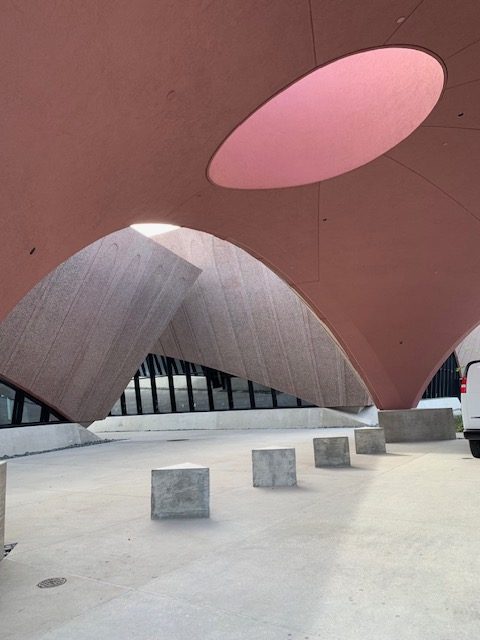
Winter Park ordered up a spectacle with a more than $41 million Library & Events Center by British architect David Adjaye featuring rose-tinted concrete of sweeping angles and a complex of vaulted pavilions.
The Winter Park Events Center. Photo courtesy of the city of Winter Park.
And that’s exactly what it got based on the reasoning for a proposed new ordinance to limit protests and other gatherings at the public space that opened in late 2021 at Martin Luther King Jr. Park.
“Because of current unrest that is being experienced around the country as well as recent event-related interruptions that have been reported at the Library and Events Center, the city felt this ordinance was necessary,” City spokeswoman Clarissa Howard said in an email. “The Library and Events Center has become a very popular rental venue for weddings, reunions, and other special events. It also architecturally lends itself to serve as a beautiful backdrop for professional and amateur photographers and all types of video productions/recordings. This ordinance would clearly outline the areas in which these types of activities can co-exist balancing public safety and free speech. It is a proactive measure to prevent potential hazards to pedestrian and vehicular traffic.”
A list provided by Howard includes 15 “disturbances” since the beginning of this year. Of those, 10 are described as “photo shoot with props” or “prom photos.” One noted a “changing booth” and “lights.”
The other disturbances were listed as “cars blocking traffic” or “skateboarding/rollerblading/scooter.” Only one was listed as “group with signs” or anything resembling a demonstration or a protest.
The city provided law enforcement call logs for some of the incidents. No one was cited or arrested and the logs appear to indicate the person who called in the complaint dropped the matter or the people or vehicles who were the subject of the complaints moved or left the area when asked.
A search of TikTok and Instagram posts tagged with the library or events center address yielded a handful of users posting photo shoots, wedding videos and other content.
After the first proposal was heavily criticized by two commissioners as potentially unconstitutional last month, the City Commission on Wednesday will consider a revised ordinance that includes a more narrow boundary around the buildings than first presented.
The revised version also includes a lower fine — from a maximum of $500 per day to $200 for the first infraction — for violations referred to Code Enforcement. The new wording also explicitly exempts political activities during elections, which is governed by state law — particularly because the library is a popular early voting site.
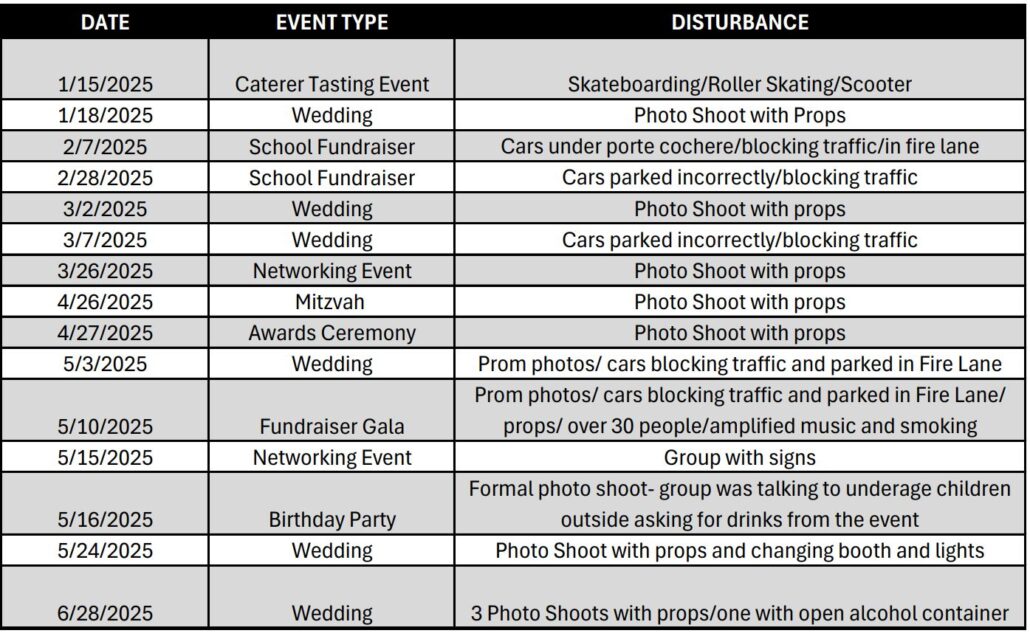
A list provided by the city of Winter Park shows disturbances logged at the Library and Events Center in 2025.
Commissioners Warren Lindsey and Marty Sullivan objected to the new rules last month, citing free speech and other concerns.
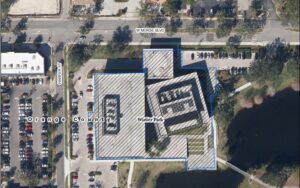
The blue line represents the new proposed boundary around the Library and Events Center to be considered this week.
“It’s not just just speech,” Lindsey said. “It’s also the right to assembly.”
He said the ordinance is a “solution looking for a problem” and that there are other rules on the books in Winter Park such as a noise ordinance and statutes against disorderly conduct that could apply to the concerns in question.
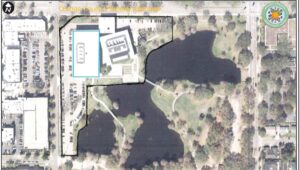
This image shows the original boundary drawn around the no-protest zone at the Library and Events Center considered on June 25.
All of the incidents on the list took place on a day or time while the Event Center, the city’s highest money-maker when it comes to venue rentals, was rented for a wedding, fundraiser or other private event.
The venue brings in $650,000 to $700,000 each year, according to the city budget. There have been 165 events through May at the venue, mostly for weddings and non-profit or corporate events. Repeat clients include Orlando Health, AdventHealth, the League of Women Voters and City Year Orlando, the budget stated.
WinterParkVoiceEditor@gmail.com
To comment or read comments from others, click here →
by Beth Kassab | Dec 5, 2024 | City Commission, Historic Preservation, Library, News, Uncategorized
New Public Art Collection map reveals hidden treasures
The project catalogs Winter Park’s vast collection, which includes every “Best of Show” piece from the annual Sidewalk Art Festival
Dec. 5, 2024
By Beth Kassab
For the first time, the city’s collection of more than 90 pieces of art is searchable through a detailed catalog that provides photos, descriptions and an interactive map.
The new database, which is the handiwork of the Public Art Advisory Board and the city’s communications staff, provides the most comprehensive and publicly accessible ways of finding and viewing — in-person or online — Clyde Butcher’s photography, Albin Polasek’s sculptures and dozens more artists who create everything from jewelry and tapestry to watercolors and woodwork.

This photograph called “Ochopee” by Clyde Butcher taken in the Florida Everglades is part of the city’s public collection.
“The advisory board has been working on this for about a year,” said Craig O’Neil, the board’s liaison and assistant director of communications.
O’Neil said he couldn’t venture a guess as to the dollar value of the city’s collection, but that it would be an interesting figure to track down.
A number of pieces are undoubtedly valuable. For example, the public collection includes five sculptures by Polasek, whose former Lake Osceola home is now a museum, and whose work has sold at auction for tens of thousands of dollars.
A little less than a decade ago, city leaders decided to dub Winter Park the “City of Arts & Culture” and lean in to its identity as the place recognized for sidewalk art festivals, at least six museums, historic homes and a liberal arts college known for its music and theater programs.
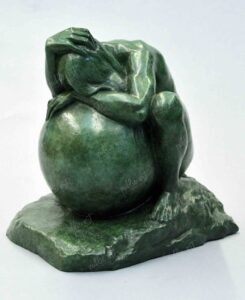
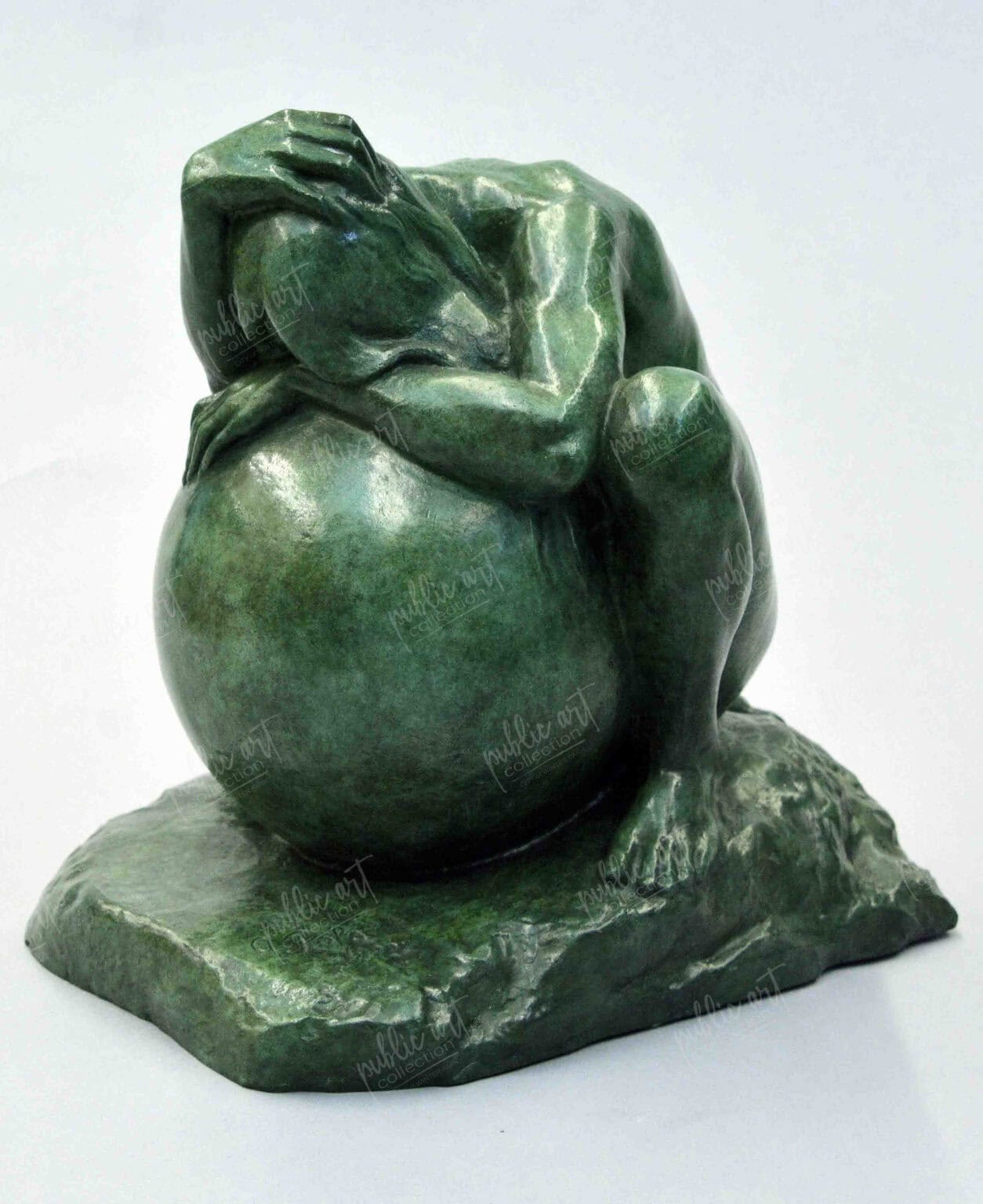
“Mother Crying Over the World” is a sculpture by Albin Polasek in the city’s collection.
That effort also includes the formation of the Arts & Culture Alliance, which aims to market Winter Park as an arts destination.
O’Neil said the hope is that more people will utilize the map and catalog to take more notice of the art in public spaces such as local parks, City Hall (where the current “Best in Show” winner is displayed) and the library and events center. Most of the former “Best in Show” winners dating back to 1969 are housed in the library.
The city is actively accepting donations to its collection. And there are more public acquisitions in the works.
Leaders are planning to put out a call to artists for works to be installed at Seven Oaks Park, which is under construction. The Public Art Advisory Board would lead that process.
Last year the City Commission unanimously approved a plan to dedicate 10% of any increase in the Unassigned General Fund each year to the board, it’s first-ever dedicated funding source. That’s the same formula the city uses to devote money to the acquisition of park land, a plan that has raised about $1 million since it went into place in 2003 at an average of more than $50,000 a year, according to city estimates at the time of the approval.
You can search the collection catalog and map here.
WinterParkVoiceEditor@gmail.com
To comment or read comments from others, click here →

Recent Comments