City Hall Should Put the Well-Being of Homeowners First
City Hall Should Put the Well-Being of Homeowners First
As High-Density Development Accelerates, Our Quality of Life Suffers
|
|
|
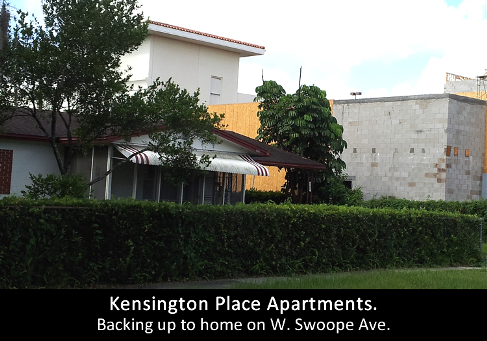
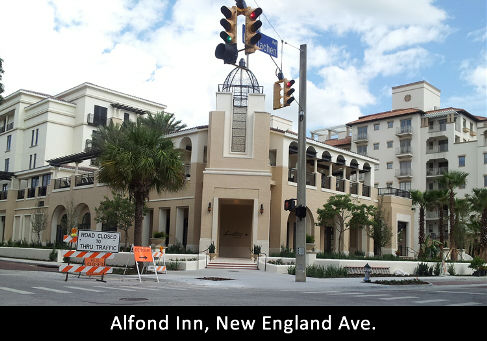
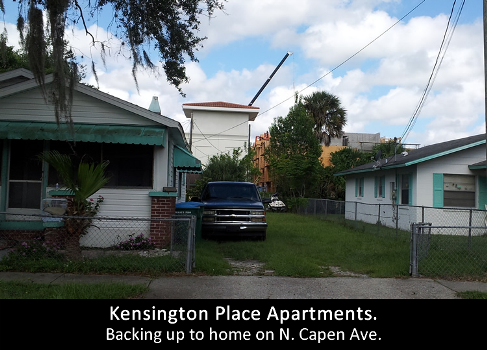
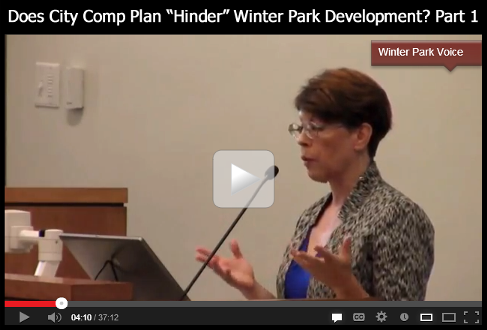 Story Update: Story Update:In the first half of the joint EDAB/P&Z workshop held on August 15, WRT consultant, Silvia Vargas, explained her study of Winter Park’s Comprehensive Plan and Land Development Code — and the numerous changes the study proposes.The City-commissioned study summarizes the purpose of the Comp Plan and Land Development Code (LDC) this way: “If the comprehensive plan is, essentially, the ‘what we want to do’ of the community, the LDC is the ‘how we are going to do it.’” Details of the study are published in the 8/15/13 Voice story that follows this update. Images below show some of the close-in commercial properties permitted and developed under the current Comp Plan and LDC.Orange County Development Codes : A Model for Winter Park Development? The WRT study is seen by some city residents as laying the groundwork for elimination of City regulations that serve as a check on developer over-reach in the City. Others see the study’s recommendations as a road map to streamlining City codes that they believe are hindering economic development. Peter Gottfried, a member of the City’s Planning and Zoning Board, illustrated the latter view by pointing out the development strategy pursued by developer Dan Bellows, who obtained less-restrictive building approvals in Orange County before having his Ravaudage development annexed into Winter Park: “The perfect example of that is a developer who decides to go develop a large piece of property and decides to go through the Orange County development approval process rather than go through the Winter Park process – and that’s Dan Bellows’ project at Lee Road.” 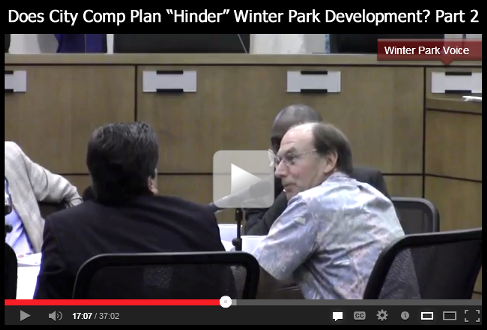 Mr. Gottfried appeared to compare Winter Park’s approval process unfavorably with Orange County’s process, flatly stating: “. . . I think Orange County provides a fair and equitable [ process ] – even though you might not like their rules . . . I think as we move forward we need to decide how we’re going . . . to tackle revising some of these things that need to be revised . . .” (Video, Part 2 – 16:15)Another view of the contrast between Orange County and Winter Park development regulations is illustrated in an analysis written by P&Z board member, Pete Weldon – also a proponent of regulatory overhaul in the City. In his analysis of Ravaudage development (obtained by the Voice in a public records search), Mr. Weldon concludes that Orange County development regulations enabled Mr. Bellows to potentially build out Ravaudage at significantly higher density, “. . . Having accepted the terms of the annexation that include operating under Orange County codes and entitlements . . . the city approved Ravaudage densities somewhere in the range of 50-100% more favorable for the developer than would have been available under city code.” Mr. Weldon’s analysis can be viewed by clicking the button below. Mr. Gottfried appeared to compare Winter Park’s approval process unfavorably with Orange County’s process, flatly stating: “. . . I think Orange County provides a fair and equitable [ process ] – even though you might not like their rules . . . I think as we move forward we need to decide how we’re going . . . to tackle revising some of these things that need to be revised . . .” (Video, Part 2 – 16:15)Another view of the contrast between Orange County and Winter Park development regulations is illustrated in an analysis written by P&Z board member, Pete Weldon – also a proponent of regulatory overhaul in the City. In his analysis of Ravaudage development (obtained by the Voice in a public records search), Mr. Weldon concludes that Orange County development regulations enabled Mr. Bellows to potentially build out Ravaudage at significantly higher density, “. . . Having accepted the terms of the annexation that include operating under Orange County codes and entitlements . . . the city approved Ravaudage densities somewhere in the range of 50-100% more favorable for the developer than would have been available under city code.” Mr. Weldon’s analysis can be viewed by clicking the button below.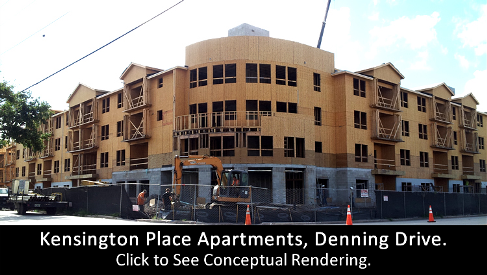 An increase in allowed building density as noted above is among the most hotly debated issues whenever significant changes to Winter Park’s land development regulations are proposed.Other regulatory policies – like the City’s “Conditional Use” standards that allow certain kinds of development if prescribed conditions are met and approved – were questioned during the hearing. EDAB board member, Steve Flanagan, criticized the standard saying, “. . . as a ‘recovering’ developer, I have to tell you it scares the living daylights out of me every time I think of it – because as a developer, you come into a community hoping that you can understand the rules and that if you obey them, you can get your project done.” (Video, Part 2 – 11:20)Mr. Flanagan also questioned use of Floor Area Ratio (FAR) standards – particularly in the Fairbanks corridor – asserting that development is “stymied” by current FAR regulations that limit bigger buildings on limited-size parcels. An increase in allowed building density as noted above is among the most hotly debated issues whenever significant changes to Winter Park’s land development regulations are proposed.Other regulatory policies – like the City’s “Conditional Use” standards that allow certain kinds of development if prescribed conditions are met and approved – were questioned during the hearing. EDAB board member, Steve Flanagan, criticized the standard saying, “. . . as a ‘recovering’ developer, I have to tell you it scares the living daylights out of me every time I think of it – because as a developer, you come into a community hoping that you can understand the rules and that if you obey them, you can get your project done.” (Video, Part 2 – 11:20)Mr. Flanagan also questioned use of Floor Area Ratio (FAR) standards – particularly in the Fairbanks corridor – asserting that development is “stymied” by current FAR regulations that limit bigger buildings on limited-size parcels.
Will High-Density Buildings Reduce “Sprawl” and Lower Residential Property Taxes?
Ms. Vargas appeared to question the use of sprawl as a rationale for higher density development, pointing out that “It’s just kind of difficult to talk about sprawl in a community that is mature, developed and land-locked the way that Winter Park is.” Vargas did agree that the sprawl rationale might be more appropriately applied to parking in Winter Park’s major corridors – an apparent reference to construction of “land-efficient” parking structures. (Video, Part 2 – 14:25) Consultant: Purpose of Regulations is to “Provide Predictability” for Developers and Keep Factories Out of Neighborhoods. In response to questions about “Conditional Use” policy, Ms. Vargas stated: “I understand the nature of the Conditional Use . . . there need to be parameters . . . the whole purpose of your future land use map and Conditional Use is a mechanism that has been used by the City to regulate the approval of businesses seeking to locate here. One example of this use is regulation of what types of businesses can locate on the Park Avenue. P&Z Board Member Johnston: Are We Scrutinizing Rollins College Development Plans? New P&Z Board member, Ross Johnston, asked Ms. Vargas about her view of the “public-private relationship” vis-à-vis education – considering Ms. Vargas’ prediction of 5,000+ new residents being added to Winter Park’s population in coming years. Mr. Johnston also asked Ms. Vargas whether she has analyzed the city’s interaction with Rollins College, pointing to the college’s interest in developing “. . . big chunks of land going to softball fields and lacrosse fields across different parts of the town now.” (Video, Part 2 – 8:30)
Toward the end of the workshop, the discussion turned toward questions of process – how the City plans to proceed in its review of the Comp Plan and LDC. Chamber of Commerce CEO, Patrick Chapin noted the phrases and characterizations used in the WRT study: “In Conflict”, “Highly Unusual”, “Contradictory”, “Onerous” and pressed the panel to consider the process: “I want to understand how this process – when this Comp Plan was developed – what was the mechanism? What was the plan? Did a group sit around the table like this?” (Video, Part 2 – 17:10) P&Z Members Gottfried & Sacha: We Need Independent Facilitator to Get This Done Right. Peter Gottfried responded with a brief history lesson – telling stories of past conflict, a Comp Plan committee being fired and a generally disjointed process. Mr. Chapin asked whether an arbitrator was used. Gottfried replied that the prior Comp Plan committees did not use the services of a professional facilitator, then pointed to Ms. Vargas as a person who could fulfill that role: “I think that’s what we have right here. I think that’s going to be a real value as we move forward . . .” Gottfried expressed confidence that Ms. Vargas could help keep the process “consistent” and “legal . . . I think that’s what we need.” (Video, Part 2 – 19:55)
Following Ms. Vargas’ comments, P&Z board member, Tom Sacha, spoke up saying he “totally agreed” with Ms. Vargas’ approach, adding that Ms. Vargas could ”. . . bring [ the process ] to common ground . . . and facilitate us to where we need to be, going forward.” (Video, Part 2 – 21:40) Consultant Vargas: We Need Lots of Public Input.
EDAB member, John Caron, offered an opinion somewhat at odds with Ms. Vargas’ “public input” model – asking Vargas: “You have stated that ‘Vision is lacking’ . . . Who authors the vision? Where does that come from? . . . My sense is that usually it’s a smaller group with vision, versus a consensus-type of approach.” (Video, Part 2 – 23:20) In response, Ms. Vargas reiterated her view that the City should ”. . . go to the community first – and we go to them repeatedly until we get it right . . .” Ms. Vargas countered Mr. Caron’s view with the assertion that “. . . when you have that vision that becomes the cornerstone of the plan – that comes from the residents . . . you are able to take the politics out of it, because this is the vision of the citizens.” (Video, Part 2 – 24:00)
Director Stone promised one public board hearing that would be part of an overall review process that will be finally decided by the City Commission. Ms. Stone estimated that the process could take as long as three months to complete. Peter Gottfried asked Stone to consider allowing the boards to make more substantial recommendations – putting “more meat on the bones” – before the study is presented to the Commission. P&Z Board Chair, James Johnston, differed with Mr. Gottfried, arguing that the study already gets “the point across” – the point being that “There’s some inconsistency – there’s some problems – there’s some things that could be a hindrance on development . . . I think this report shows that.” (Video, Part 2 – 29:15) P&Z Chair James Johnston: Current Regulations “Could be a Hindrance on Development.” Gottfried disagreed with Johnston’s characterization of the report stating that “If the premise of this thing is that there’s a hindrance to development – all you’ve got to [ do ] is look around [ in ] the city of Winter Park. We’ve got a lot of construction going on and . . . people, residents are going to say ‘What do you mean we have a hindrance to development?’ I think we have to be careful how we say that.” (Video, Part 2 – 31:00)
As Dori Stone offered her final remarks and ended the meeting, it was unclear whether she intends to implement Silvia Vargas’ suggestion that the City should”. . . go to the community first – and we go to them repeatedly until we get it right . . .” Ms. Stone offered to include public and board comments sent to her via email at dstone@cityofwinterpark.org in her presentation to the Commission. Consultant Vargas: We Need to Get Community Opinion and ”. . . go to them repeatedly until we get it right . . .” We contacted Ms. Stone in the days after the workshop attempting to learn more about her interest in using Ms. Vargas as a continuing independent facilitator as suggested by some board members – and whether she will schedule – or ask city officials to authorize – multiple public meetings as suggested by Ms. Vargas. Ms. Stone would not speak directly with the Voice, but ultimately did respond to multiple requests for comment. Her written responses are excerpted below: In response to our question asking how the city plans to use Ms. Vargas’ services from this point forward — and/or whether there are any plans for significant facilitation by a person who is not a city employee, Ms. Stone responded: “The scope of work associated with the contract with WRT included the preparation of and presentation of a review and evaluation of the Comprehensive Plan and LDC. Any new work that the City Commission may wish to pursue based on the recommendations in the study is outside the scope of this contract. Should the City Commission direct staff to implement any of the recommendations and staff decides consultant services may be needed, we would begin the appropriate process in creating a new scope of work for the required tasks, request Commission approval and follow the City’s process for hiring consultant services. This will be a decision of the City Commission and any recommendations by staff would be premature at this time.” In response to our question asking how Ms. Stone sees the review process moving forward – and whether she is planning multiple public “visioning” sessions that would give Winter Park residents the opportunity to offer input on changes to the city’s Comp Plan and related development codes, Ms. Stone responded: “At this point in time, the report with recommendations will be presented to the City Commission. The evaluation of the Comprehensive Plan and LDC substantially completes the scope of work outlined in the contract with WRT. The consultant intends to finalize the report prior to the City Commission presentation. Implementation of this study is not included in the scope of work and would need City Commission approval and direction.” In response to our follow-up questions asking for clarification of her initial response, Ms. Stone responded: “I have asked the City Manager to bring up the concept of a workshop to discuss the findings of the study. That is the remaining public meeting regarding this contract. The City Commission will decide what the next steps will be regarding this project . . . I have not formulated a staff recommendation to the City Commission yet regarding the next steps. I’m waiting to hear what direction the City Commission gives staff about the report.” Winter Park Voice will update this story and provide continuing coverage of related hearings.
|
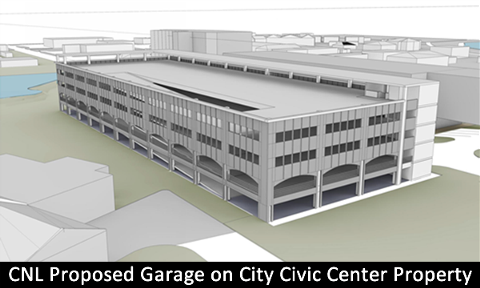 Monday’s City Commission hearing did not go well for CNL. A fundamental disagreement between CNL and the City Commission was whether the City should expect some compensation in return for allowing CNL to build a large parking structure on the City’s Civic Center parking lot – a property valued at $1 to $2 million.The workshop started on a sour note – with CNL’s Paul Ellis standing firm on his position that CNL should pay nothing and that the City should be happy with the increased / accelerated tax and fee revenue it would receive when CNL develops the property. Monday’s City Commission hearing did not go well for CNL. A fundamental disagreement between CNL and the City Commission was whether the City should expect some compensation in return for allowing CNL to build a large parking structure on the City’s Civic Center parking lot – a property valued at $1 to $2 million.The workshop started on a sour note – with CNL’s Paul Ellis standing firm on his position that CNL should pay nothing and that the City should be happy with the increased / accelerated tax and fee revenue it would receive when CNL develops the property.
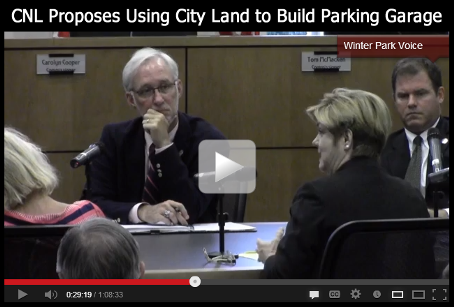
CNL’s ask for City help – and the implication that prime 17-92 real estate might not otherwise attract significant developer investment – bore a striking similarity to claims made by Dan Bellows in his long campaign to share millions of dollars in City tax and fee revenues. The appearance of some strategic nexus between the two developers was further strengthened by the scheduling of “dueling workshops” held on the same afternoon on July 22. In yesterday’s CNL workshop, Commissioner Cooper rubbed Paul Ellis the wrong way by referring to CNL’s controversial 2011 Progress Point land swap deal with the City. Cooper complained about CNL’s current approach to the City, saying that ” . . .it is indefensible to me, to face other developers in this community and say to them ‘Yes, CNL is at the trough for a second time’ . . . My phone has been ringing off the hook . . . if we are going to give away City land to subsidize commercial development, it needs to be equitable and fair . . .” Click the video image below to view the workshop.
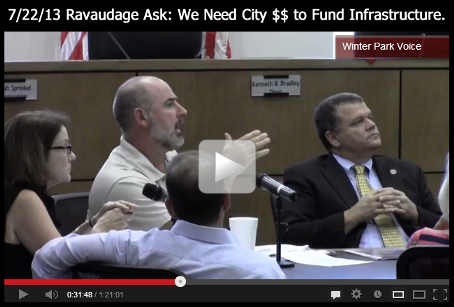
First, a bit of history on the project: In late July, as noted above, the usual end-of-month City Commission meeting was bookended by two separate workshops – held on behalf of CNL and Ravaudage developers – both of whom did their best to convince the City to hand over City treasure in return for enhanced development along the 17-92 corridor. First up was Dan Bellows and Ravaudage CDD representatives, asking for City tax revenues and fee sharing to help build out $60 to 70 million in Ravaudage infrastructure – some of which would also serve areas beyond Ravaudage. As with past requests for taxpayer assistance, Mr. Bellows ran into skepticism on the Commission. However, Mayor Bradley did indicate some interest in the proposal when he pointed out that some part of the millions required to create infrastructure in the area could conceivably be paid by the City anyway – if Ravaudage did not exist and that part of the city developed piecemeal over time. The Mayor offered his opinion that “…at some point, I think there is some responsibility for the City to do something.” Click the video image below to view the Ravaudage workshop. Ravaudage CDD Attorney: City $$ Not Used Unless Builder Performs, But . . . Builder May Be Unable to Perform Without City $$ Guarantee.
Commissioner Sprinkel: Giving Ravaudage City $$ “palatable to me because it’s all new money.” Commissioner Sprinkel reiterated a point mentioned in past discussions that future City revenues shared with Ravaudage is “not money we would have had otherwise – so it’s new money that is coming to us to develop this area to make it better . . . it’s palatable to me because it’s all new money.” Commissioner McMacken took a different tack – butting heads with Bellows, asking how the developer could come to the Commission asking for millions of dollars in assistance: “Dan, we’re working with your plan. This isn’t a City plan. This is a private developer that comes to the City and says, ‘In order to do this, I have a $63 million shortfall.’ McMacken confessed that he was “stumped” by Bellows request, considering the benefits and concessions Bellows and Ravaudage have already received, saying that “if CNL were here right now, they’d be salivating.” Even though Mr. Bellows left the workshop less than satisfied with the Commission’s response, both he and Mr. McMacken were well aware that CNL was, in fact, waiting in the wings for their own shot at the City Commission that same afternoon. Mr. Bellows attended the CNL workshop, observing the proceedings from start to finish. Click the video image below to view the July CNL workshop. Unlike Mr. Bellows, CNL’s Paul Ellis used his afternoon workshop time to ask for land – not money. Ellis’s bid follows on the heels of his successful pitch in 2011 that persuaded the Commission to swap a piece of CNL land on the Orange Avenue railroad tracks for the City-owned State Office Building at Morse and Denning. CNL’s Paul Ellis: Our Parking Garage on City Property = More, Bigger, Better, Quicker Development + Extra Taxes and Fees for City. The Mt. Vernon purchase contract is contingent on Ellis’s ability to win over the Commission one more time – and, according to Ellis, CNL needs an answer quickly. However, as confirmed by City minutes of the July workshop, “Mr. Ellis explained that at this time a final decision has not been made on the type of redevelopment that will take place on the Mt. Vernon site.“ CNL Wants Quick Answers. Promises $4.1 Million City Gain if Garage is Approved. Mr. Ellis also was unable to answer questions concerning planned building density during the July workshop. CNL’s attorney, Becky Wilson, claimed that construction of the large garage could enable growth throughout the Morse Blvd./Orlando Avenue area and even potentially triple bookings at the Rachel Murrah Civic Center. As quoted by the City’s minutes of the workshop, Ms. Wilson laid out CNL’s proposed timing of the City approval process this way: “. . . CNL will have to submit a site plan and description by the middle/end of August to the Planning Department. The first week of September City wide notices will be sent out; the first week in October, CNL will present the project to the Planning & Zoning Board for approval; the fourth week in October, CNL will present to the Commission the request for a comprehensive plan amendment and rezoning (first reading) and conditional use; it will come to the Commission at the second week in November for second reading.” CNL’s proposal, which was explored again at Monday’s 2:00pm workshop, is illustrated in a PowerPoint presentation that can be viewed by clicking the button below.
The City’s Agenda Package includes a financial analysis that projects a $4.1 million (NPV) gain for the City if it allows CNL to use City land to develop the garage and Mt. Vernon site as planned. Questions posed by Winter Parkers interviewed by the Voice, workshop participants and by the Agenda document itself are shown below. What is the increased value of the Mt. Vernon property if the garage is approved? Is the current 356,472 square ft. project, as contemplated, appropriate and desirable for 17-92? Does the City see benefit in using City land, already designated for parking, to enhance desirable development along 17-92? CNL says that its proposed garage will enable significant new development throughout the adjacent area. If CNL controls use of the garage, will it have the power to influence nearby development? Will the garage and increased project density enhance or degrade use of MLK Park and the Civic Center? How will it affect pedestrian and automobile traffic? Commissioners Unimpressed With CNL Offer. Sprinkel: “Highly Disappointed.” Leary: “Less Than a Non-Starter.” McMacken: “Deal-Breaker.” An in-depth analysis of these issues was, to some extent, sidetracked by the Commission’s strongly-voiced objections to the deal as currently constituted. CNL and its proposal were characterized as “presumptuous” by Commissioner Sprinkel who stated she was “. . . highly disappointed in this.” Commissioner Leary called parts of the proposal “Less than a non-starter.” Commissioner McMacken agreed, saying he considered CNL’s cash-free offer to be a “Deal-Breaker.” On The Other Hand, Here Are Some Ideas We like . . . CNL’s vision of a high-end business hotel near Morse and 17-92 – and the possibility of a deal that might fund the refurbishing the “very dated” Civic Center proved to be a tantalizing prospect for the Mayor and Commissioners. Comments by officials on the City side of the table painted a clear path to a successful negotiation – if CNL is willing to tread that path and bring with them a strong package of incentives to sweeten the deal. However, at the close of the workshop, Paul Ellis and his attorney offered no additional incentives and, in the Commission meeting that followed the workshop, CNL’s proposal was dropped from the agenda by unanimous consent. Winter Park Voice will update this story and provide continuing coverage of the city’s hearings, if any, on CNL’s proposal.
|
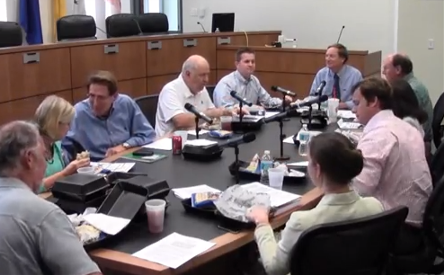 On Tuesday, August 6, Winter Park’s Planning and Zoning board sent a significantly reworked restaurant zoning proposal on to the City Commission.The board voted unanimously to support the proposal that was put together by an informal Task Force comprised of Chamber of Commerce officials, local merchants and Frank Hamner, the attorney for the Holler family, whose real estate holdings include significant Park Avenue retail space. On Tuesday, August 6, Winter Park’s Planning and Zoning board sent a significantly reworked restaurant zoning proposal on to the City Commission.The board voted unanimously to support the proposal that was put together by an informal Task Force comprised of Chamber of Commerce officials, local merchants and Frank Hamner, the attorney for the Holler family, whose real estate holdings include significant Park Avenue retail space.
Mr. Hamner led the presentation in Thursday’s hearing, covering much of the same ground he covered in the prior week’s P&Z restaurant ordinance workshop. One notable modification that was made in the week that transpired between the workshop and the hearing was the inclusion of a “three month rule” that requires Park Avenue corridor landlords to re-lease vacated restaurant space within three months or risk being subjected to more stringent regulation and potential loss of the full package of regulatory benefits and designations enjoyed by the previous restaurant tenant – a key benefit being the possibility that a quickly re-leased space could include a non-fine dining restaurant that might otherwise not be permitted. Mr. Hamner illustrated his presentation with PowerPoint slides, each of which can be viewed below in our initial 8/6/13 coverage of the P&Z workshop. A significant change being proposed is the outright ban of fast food chain restaurants. Discussions among P&Z members and Task Force participants revealed broad support for the ban, which has been strongly – and vocally – advocated by Winter Parker residents. Mr. Hamner echoed the sentiments of City Planning Director, Jeff Briggs, stating that past attempts to create ordinance changes that resolved conflicting views among city officials, city residents, merchants and others had been largely unsuccessful. The City’s own P&Z staff report laid out the multiple failed attempts by the City to resolve the issue. The staff report language can be viewed below in our 8/6/13 coverage of the P&Z workshop, or by clicking the button below.
Early in the hearing, Mr. Hamner stressed that his group was “not assigned this responsibility” by the Mayor or the City. While Hamner stated that his group is not an official “City Task Force,” he did confirm that “this collaboration grew out of a conversation with the Mayor, a couple of Commissioners, Patrick [ Chapin, Chamber of Commerce CEO ], Lambrine [ Macejewski , restaurateur/Chamber member] and myself and Daniel [ Butts, Battaglia Group CEO & Chamber Board Chair ].” An important element of the proposed ordinance is the imposition of quotas or caps on certain types of restaurants. Mr. Hamner laid out the proposed “cap” formula – which would apply to non-fine dining restaurants – as follows: “The number of non-fine dining restaurants shall not exceed 20% of the available first-floor store fronts on . . . any particular side of the block . . . and there’s an overall cap of 15% of the total number of businesses in the Park Avenue corridor.” Hamner said that this formula would, as of now, permit an “additional seven or so non-fine dining restaurants” in the Park Avenue corridor. The proposed cap generated much discussion at the hearing and motivated board member Pete Weldon to send in a detailed response to the proposal via email. Mr. Weldon’s email can be viewed by clicking the button below.
However, as noted above, the discussion at the prior week’s P&Z workshop covers most of the same ground and – due to the less formal format of the meeting – the exchange between the board and the Task Force is more detailed – yielding probing and insightful comments and questions from the board, including new members Ross Johnston and Sheila De Ciccio. Click the button below to view 7/31/13 Workshop Video.
Part one of the 7/31 workshop video (click image below) shows Planning Director Jeff Briggs’ introduction to the workshop wherein he updates board members with a concise summary of City business.
Winter Park Voice will update this story and provide continuing coverage of the city’s hearings on restaurant ordinance revisions. |
|

 your zoning map is to provide predictability – not just for the developer, but also for the residents – for someone who’s going to buy a house and can be assured that across the street there’s not going to be . . . a factory.” (Video, Part 2 – 14:53)
 Ms. Vargas admitted that she did not look closely at the Rollins/Winter Park relationship, but did say that she recommends keeping education “concurrency” in City codes – a policy that that ties future development to increases in the City’s educational resources.


 Patrick Chapin quickly jumped in supporting Gottfried’s point: “I really disagree with ‘the hindrance of development’.“ Instead, Chapin suggested his interpretation of the study’s message as promoting the “economic well-being” of the community.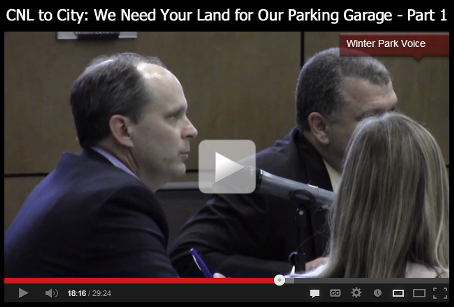
Recent Comments