WP Comp Plan/Codes “Impediments to Economic Development?”

WP Comp Plan/Codes “Impediments to Economic Development?”

Part 2 / Gottfried: Be Careful. . . Residents know there’s “a lot of construction going on.”

Story Update:
In the first half of the joint EDAB/P&Z workshop held on August 15, WRT consultant, Silvia Vargas, explained her study of Winter Park’s Comprehensive Plan and Land Development Code — and the numerous changes the study proposes.
The City-commissioned study summarizes the purpose of the Comp Plan and Land Development Code (LDC) this way: “If the comprehensive plan is, essentially, the ‘what we want to do’ of the community, the LDC is the ‘how we are going to do it.’” Details of the study are published in the 8/15/13 Voice story that follows this update. Images below show some of the close-in commercial properties permitted and developed under the current Comp Plan and LDC.Orange County Development Codes : A Model for Winter Park Development?

The WRT study is seen by some city residents as laying the groundwork for elimination of City regulations that serve as a check on developer over-reach in the City. Others see the study’s recommendations as a road map to streamlining City codes that they believe are hindering economic development.

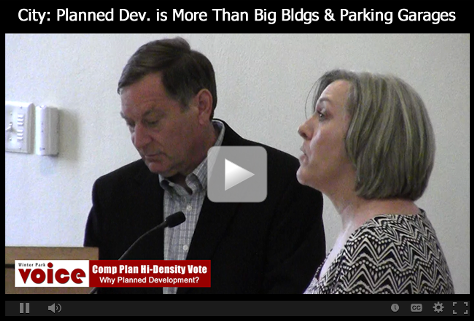
Peter Gottfried, a member of the City’s Planning and Zoning Board, illustrated the latter view by pointing out the development strategy pursued by developer Dan Bellows, who obtained less-restrictive building approvals in Orange County before having his Ravaudage development annexed into Winter Park: “The perfect example of that is a developer who decides to go develop a large piece of property and decides to go through the Orange County development approval process rather than go through the Winter Park process – and that’s Dan Bellows’ project at Lee Road.” Mr. Gottfried appeared to compare Winter Park’s approval process unfavorably with Orange County’s process, flatly stating: “. . . I think Orange County provides a fair and equitable [ process ] – even though you might not like their rules . . . I think as we move forward we need to decide how we’re going . . . to tackle revising some of these things that need to be revised . . .” (Video, Part 2 – 16:15)Another view of the contrast between Orange County and Winter Park development regulations is illustrated in an analysis written by P&Z board member, Pete Weldon – also a proponent of regulatory overhaul in the City. In his analysis of Ravaudage development (obtained by the Voice in a public records search), Mr. Weldon concludes that Orange County development regulations enabled Mr. Bellows to potentially build out Ravaudage at significantly higher density, “. . . Having accepted the terms of the annexation that include operating under Orange County codes and entitlements . . . the city approved Ravaudage densities somewhere in the range of 50-100% more favorable for the developer than would have been available under city code.” Mr. Weldon’s analysis can be viewed by clicking the button below. Weldon Ravaudage Analysis An increase in allowed building density as noted above is among the most hotly debated issues whenever significant changes to Winter Park’s land development regulations are proposed.Other regulatory policies – like the City’s “Conditional Use” standards that allow certain kinds of development if prescribed conditions are met and approved – were questioned during the hearing. EDAB board member, Steve Flanagan, criticized the standard saying, “. . . as a ‘recovering’ developer, I have to tell you it scares the living daylights out of me every time I think of it – because as a developer, you come into a community hoping that you can understand the rules and that if you obey them, you can get your project done.” (Video, Part 2 – 11:20)Mr. Flanagan also questioned use of Floor Area Ratio (FAR) standards – particularly in the Fairbanks corridor – asserting that development is “stymied” by current FAR regulations that limit bigger buildings on limited-size parcels.

Will High-Density Buildings Reduce “Sprawl” and Lower Residential Property Taxes?

Mr. Flanagan and others on the panel implied that allowing more in-fill development of larger and/or more numerous commercial buildings confers important benefits on the city that include prevention of “sprawl” and an increase in the City’s commercial tax base. (Video, Part 2 – 10:00)

Ms. Vargas appeared to question the use of sprawl as a rationale for higher density development, pointing out that “It’s just kind of difficult to talk about sprawl in a community that is mature, developed and land-locked the way that Winter Park is.” Vargas did agree that the sprawl rationale might be more appropriately applied to parking in Winter Park’s major corridors – an apparent reference to construction of “land-efficient” parking structures. (Video, Part 2 – 14:25)

Consultant: Purpose of Regulations is to “Provide Predictability” for Developers and Keep Factories Out of Neighborhoods. 

In response to questions about “Conditional Use” policy, Ms. Vargas stated: “I understand the nature of the Conditional Use . . . there need to be parameters . . . the whole purpose of your future land use map and your zoning map is to provide predictability – not just for the developer, but also for the residents – for someone who’s going to buy a house and can be assured that across the street there’s not going to be . . . a factory.” (Video, Part 2 – 14:53)

Conditional Use is a mechanism that has been used by the City to regulate the approval of businesses seeking to locate here. One example of this use is regulation of what types of businesses can locate on the Park Avenue.

P&Z Board Member Johnston: Are We Scrutinizing Rollins College Development Plans?

New P&Z Board member, Ross Johnston, asked Ms. Vargas about her view of the “public-private relationship” vis-à-vis education – considering Ms. Vargas’ prediction of 5,000+ new residents being added to Winter Park’s population in coming years. Mr. Johnston also asked Ms. Vargas whether she has analyzed the city’s interaction with Rollins College, pointing to the college’s interest in developing “. . . big chunks of land going to softball fields and lacrosse fields across different parts of the town now.” (Video, Part 2 – 8:30)

Ms. Vargas admitted that she did not look closely at the Rollins/Winter Park relationship, but did say that she recommends keeping education “concurrency” in City codes – a policy that that ties future development to increases in the City’s educational resources.

Toward the end of the workshop, the discussion turned toward questions of process – how the City plans to proceed in its review of the Comp Plan and LDC. Chamber of Commerce CEO, Patrick Chapin noted the phrases and characterizations used in the WRT study: “In Conflict”, “Highly Unusual”, “Contradictory”, “Onerous” and pressed the panel to consider the process: “I want to understand how this process – when this Comp Plan was developed – what was the mechanism? What was the plan? Did a group sit around the table like this?” (Video, Part 2 – 17:10)

P&Z Members Gottfried & Sacha: We Need Independent Facilitator to Get This Done Right.

Peter Gottfried responded with a brief history lesson – telling stories of past conflict, a Comp Plan committee being fired and a generally disjointed process. Mr. Chapin asked whether an arbitrator was used. Gottfried replied that the prior Comp Plan committees did not use the services of a professional facilitator, then pointed to Ms. Vargas as a person who could fulfill that role: “I think that’s what we have right here. I think that’s going to be a real value as we move forward . . .” Gottfried expressed confidence that Ms. Vargas could help keep the process “consistent” and “legal . . . I think that’s what we need.” (Video, Part 2 – 19:55)

After hearing expressions of support from the board for ongoing mediation, Ms. Vargas laid out her view of how the process could be effectively – and responsively – managed: “I very strongly believe that the community vision process is important . . . It doesn’t work for every community – not every community needs it – but, it seems to me that this community does.” Ms. Vargas acknowledged Mr. Gottfried’s statements concerning problems with past negotiations and offered a plan for a community-based process where “. . . the whole community could bring their opinion about the future – the aspirations for Winter Park twenty years from now, their concerns.” Ms. Vargas advocated a “consensus process whereby perhaps, not everybody agrees on every idea – but everybody agrees that at the end, these are things that are good for the whole community.” (Video, Part 2 – 20:25)

Following Ms. Vargas’ comments, P&Z board member, Tom Sacha, spoke up saying he “totally agreed” with Ms. Vargas’ approach, adding that Ms. Vargas could ”. . . bring [ the process ] to common ground . . . and facilitate us to where we need to be, going forward.” (Video, Part 2 – 21:40)

Consultant Vargas: We Need Lots of Public Input.
EDAB Member Caron Suggests “Smaller Group with Vision, Versus a Consensus-Type of Approach.”

Several other board members shared a mix of opinions, including remarks by Peter Gottfried – who referenced Winter Park’s political landscape: “You learn when you deal in the political world that there’s five Commissioners – or four Commissioners and the Mayor. You learn to count to three . . . that’s the reality of it.” (Video, Part 2 – 22:55)

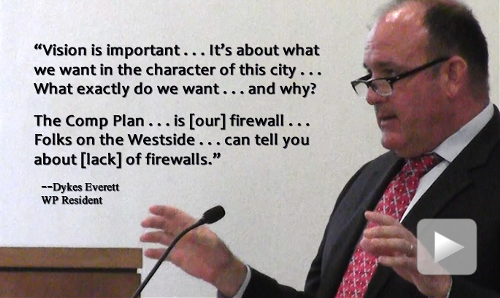
EDAB member, John Caron, offered an opinion somewhat at odds with Ms. Vargas’ “public input” model – asking Vargas: “You have stated that ‘Vision is lacking’ . . . Who authors the vision? Where does that come from? . . . My sense is that usually it’s a smaller group with vision, versus a consensus-type of approach.” (Video, Part 2 – 23:20)

In response, Ms. Vargas reiterated her view that the City should ”. . . go to the community first – and we go to them repeatedly until we get it right . . .” Ms. Vargas countered Mr. Caron’s view with the assertion that “. . . when you have that vision that becomes the cornerstone of the plan – that comes from the residents . . . you are able to take the politics out of it, because this is the vision of the citizens.” (Video, Part 2 – 24:00)

As Ms. Vargas ended her statement, Dori Stone, Director of Planning & Community Development, stepped to the podium to wrap up the workshop. Ms. Stone spoke about her plan for advancing the WRT study through the City review process: “We are going to complete this study with Silvia’s recommendations.” Stone assured board members that they would have the opportunity to review and recommend changes to the Comp Plan and Land Development Code. (Video, Part 2 – 25:00)

Director Stone promised one public board hearing that would be part of an overall review process that will be finally decided by the City Commission. Ms. Stone estimated that the process could take as long as three months to complete.

Peter Gottfried asked Stone to consider allowing the boards to make more substantial recommendations – putting “more meat on the bones” – before the study is presented to the Commission. P&Z Board Chair, James Johnston, differed with Mr. Gottfried, arguing that the study already gets “the point across” – the point being that “There’s some inconsistency – there’s some problems – there’s some things that could be a hindrance on development . . . I think this report shows that.” (Video, Part 2 – 29:15)

P&Z Chair James Johnston: Current Regulations “Could be a Hindrance on Development.”
Gottfried: “Residents are going to say ‘What do you mean we have a hindrance to development?’ … We’ve got a lot of construction going on . . .”

Gottfried disagreed with Johnston’s characterization of the report stating that “If the premise of this thing is that there’s a hindrance to development – all you’ve got to [ do ] is look around [ in ] the city of Winter Park. We’ve got a lot of construction going on and . . . people, residents are going to say ‘What do you mean we have a hindrance to development?’ I think we have to be careful how we say that.” (Video, Part 2 – 31:00)

Patrick Chapin quickly jumped in supporting Gottfried’s point: “I really disagree with ‘the hindrance of development’.“ Instead, Chapin suggested his interpretation of the study’s message as promoting the “economic well-being” of the community.

As Dori Stone offered her final remarks and ended the meeting, it was unclear whether she intends to implement Silvia Vargas’ suggestion that the City should”. . . go to the community first – and we go to them repeatedly until we get it right . . .” Ms. Stone offered to include public and board comments sent to her via email at dstone@cityofwinterpark.org in her presentation to the Commission.

Consultant Vargas: We Need to Get Community Opinion and ”. . . go to them repeatedly until we get it right . . .”
EDAB/P&Z Director Dori Stone: “The City Commission will decide what the next steps will be regarding this project . . .”

We contacted Ms. Stone in the days after the workshop attempting to learn more about her interest in using Ms. Vargas as a continuing independent facilitator as suggested by some board members – and whether she will schedule – or ask city officials to authorize – multiple public meetings as suggested by Ms. Vargas.

Ms. Stone would not speak directly with the Voice, but ultimately did respond to multiple requests for comment. Her written responses are excerpted below:

In response to our question asking how the city plans to use Ms. Vargas’ services from this point forward — and/or whether there are any plans for significant facilitation by a person who is not a city employee, Ms. Stone responded:

“The scope of work associated with the contract with WRT included the preparation of and presentation of a review and evaluation of the Comprehensive Plan and LDC. Any new work that the City Commission may wish to pursue based on the recommendations in the study is outside the scope of this contract. Should the City Commission direct staff to implement any of the recommendations and staff decides consultant services may be needed, we would begin the appropriate process in creating a new scope of work for the required tasks, request Commission approval and follow the City’s process for hiring consultant services. This will be a decision of the City Commission and any recommendations by staff would be premature at this time.”

In response to our question asking how Ms. Stone sees the review process moving forward – and whether she is planning multiple public “visioning” sessions that would give Winter Park residents the opportunity to offer input on changes to the city’s Comp Plan and related development codes, Ms. Stone responded:

“At this point in time, the report with recommendations will be presented to the City Commission. The evaluation of the Comprehensive Plan and LDC substantially completes the scope of work outlined in the contract with WRT. The consultant intends to finalize the report prior to the City Commission presentation. Implementation of this study is not included in the scope of work and would need City Commission approval and direction.”

In response to our follow-up questions asking for clarification of her initial response, Ms. Stone responded:

“I have asked the City Manager to bring up the concept of a workshop to discuss the findings of the study. That is the remaining public meeting regarding this contract. The City Commission will decide what the next steps will be regarding this project . . . I have not formulated a staff recommendation to the City Commission yet regarding the next steps. I’m waiting to hear what direction the City Commission gives staff about the report.”

Winter Park Voice will update this story and provide continuing coverage of related hearings.


To comment or read comments from others, click here →

CNL’s Ask for Free City Land for Parking Garage is “D.O.A.”

CNL’s Ask for Free City Land for Parking Garage is “D.O.A.”

Commission: Who’s Doing Who a Favor Here?

Monday’s City Commission hearing did not go well for CNL. A fundamental disagreement between CNL and the City Commission was whether the City should expect some compensation in return for allowing CNL to build a large parking structure on the City’s Civic Center parking lot – a property valued at $1 to $2 million.The workshop started on a sour note – with CNL’s Paul Ellis standing firm on his position that CNL should pay nothing and that the City should be happy with the increased / accelerated tax and fee revenue it would receive when CNL develops the property.

CNL’s ask for City help – and the implication that prime 17-92 real estate might not otherwise attract significant developer investment – bore a striking similarity to claims made by Dan Bellows in his long campaign to share millions of dollars in City tax and fee revenues. The appearance of some strategic nexus between the two developers was further strengthened by the scheduling of “dueling workshops” held on the same afternoon on July 22.

In yesterday’s CNL workshop, Commissioner Cooper rubbed Paul Ellis the wrong way by referring to CNL’s controversial 2011 Progress Point land swap deal with the City.

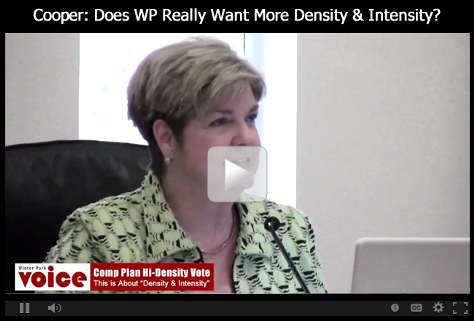
Cooper complained about CNL’s current approach to the City, saying that ” . . .it is indefensible to me, to face other developers in this community and say to them ‘Yes, CNL is at the trough for a second time’ . . . My phone has been ringing off the hook . . . if we are going to give away City land to subsidize commercial development, it needs to be equitable and fair . . .” Click the video image below to view the workshop.

Commissioner Cooper was not the only Commissioner complaining to Ellis. At various points during the workshop, each Commissioner offered criticism of CNL’s offer. More about that later . . .

First, a bit of history on the project: In late July, as noted above, the usual end-of-month City Commission meeting was bookended by two separate workshops – held on behalf of CNL and Ravaudage developers – both of whom did their best to convince the City to hand over City treasure in return for enhanced development along the 17-92 corridor.

First up was Dan Bellows and Ravaudage CDD representatives, asking for City tax revenues and fee sharing to help build out $60 to 70 million in Ravaudage infrastructure – some of which would also serve areas beyond Ravaudage. As with past requests for taxpayer assistance, Mr. Bellows ran into skepticism on the Commission.

However, Mayor Bradley did indicate some interest in the proposal when he pointed out that some part of the millions required to create infrastructure in the area could conceivably be paid by the City anyway – if Ravaudage did not exist and that part of the city developed piecemeal over time. The Mayor offered his opinion that “…at some point, I think there is some responsibility for the City to do something.” Click the video image below to view the Ravaudage workshop.

Ravaudage CDD Attorney: City $$ Not Used Unless Builder Performs, But . . . Builder May Be Unable to Perform Without City $$ Guarantee.

After Commissioner Cooper pointed out that a key reason that CDDs are set up is to allow developers to raise their own infrastructure funding in the bond market, Dan Bellows and the Ravaudage CDD attorney, Jan Carpenter, countered that their funding request is “performance” based and that City dollars would only be spent as development of the land actually proceeds. Carpenter asserted that development of Ravaudage “won’t happen – or it won’t happen quickly” if the City does not agree to provide the millions of dollars in assistance being requested.

Commissioner Sprinkel: Giving Ravaudage City $$ “palatable to me because it’s all new money.”

Commissioner Sprinkel reiterated a point mentioned in past discussions that future City revenues shared with Ravaudage is “not money we would have had otherwise – so it’s new money that is coming to us to develop this area to make it better . . . it’s palatable to me because it’s all new money.”

Commissioner McMacken took a different tack – butting heads with Bellows, asking how the developer could come to the Commission asking for millions of dollars in assistance: “Dan, we’re working with your plan. This isn’t a City plan. This is a private developer that comes to the City and says, ‘In order to do this, I have a $63 million shortfall.’ McMacken confessed that he was “stumped” by Bellows request, considering the benefits and concessions Bellows and Ravaudage have already received, saying that “if CNL were here right now, they’d be salivating.”

Even though Mr. Bellows left the workshop less than satisfied with the Commission’s response, both he and Mr. McMacken were well aware that CNL was, in fact, waiting in the wings for their own shot at the City Commission that same afternoon. Mr. Bellows attended the CNL workshop, observing the proceedings from start to finish. Click the video image below to view the July CNL workshop.

Unlike Mr. Bellows, CNL’s Paul Ellis used his afternoon workshop time to ask for land – not money. Ellis’s bid follows on the heels of his successful pitch in 2011 that persuaded the Commission to swap a piece of CNL land on the Orange Avenue railroad tracks for the City-owned State Office Building at Morse and Denning.

CNL’s Paul Ellis: Our Parking Garage on City Property = More, Bigger, Better, Quicker Development + Extra Taxes and Fees for City.

This time around, CNL Commercial Real Estate has a contract to purchase the Mount Vernon Inn at Morse and Orlando Avenue and convert it into a mixed-use complex of multi-family apartments, restaurants and a 100+ room business hotel – if the City will allow CNL to build a large parking garage on the adjacent Civic Center parking lot. CNL is proposing a “Public-Private Partnership” to build the multi-story parking garage on the City-owned parking lot. Like Mr. Bellows, Mr. Ellis paints a picture showing the City largesse he requires being amply rewarded by bigger, better, denser and quicker development that will pour tax and fee revenue into City coffers – development he claims cannot proceed without City help.

The Mt. Vernon purchase contract is contingent on Ellis’s ability to win over the Commission one more time – and, according to Ellis, CNL needs an answer quickly. However, as confirmed by City minutes of the July workshop, “Mr. Ellis explained that at this time a final decision has not been made on the type of redevelopment that will take place on the Mt. Vernon site.“

CNL Wants Quick Answers. Promises $4.1 Million City Gain if Garage is Approved.

Mr. Ellis also was unable to answer questions concerning planned building density during the July workshop. CNL’s attorney, Becky Wilson, claimed that construction of the large garage could enable growth throughout the Morse Blvd./Orlando Avenue area and even potentially triple bookings at the Rachel Murrah Civic Center. As quoted by the City’s minutes of the workshop, Ms. Wilson laid out CNL’s proposed timing of the City approval process this way: “. . . CNL will have to submit a site plan and description by the middle/end of August to the Planning Department. The first week of September City wide notices will be sent out; the first week in October, CNL will present the project to the Planning & Zoning Board for approval; the fourth week in October, CNL will present to the Commission the request for a comprehensive plan amendment and rezoning (first reading) and conditional use; it will come to the Commission at the second week in November for second reading.”

CNL’s proposal, which was explored again at Monday’s 2:00pm workshop, is illustrated in a PowerPoint presentation that can be viewed by clicking the button below.

CNL PowerPoint Presentation

The City’s Agenda Package includes a financial analysis that projects a $4.1 million (NPV) gain for the City if it allows CNL to use City land to develop the garage and Mt. Vernon site as planned. Questions posed by Winter Parkers interviewed by the Voice, workshop participants and by the Agenda document itself are shown below.

What is the increased value of the Mt. Vernon property if the garage is approved?

Is the current 356,472 square ft. project, as contemplated, appropriate and desirable for 17-92?

Does the City see benefit in using City land, already designated for parking, to enhance desirable development along 17-92?

CNL says that its proposed garage will enable significant new development throughout the adjacent area. If CNL controls use of the garage, will it have the power to influence nearby development?

Will the garage and increased project density enhance or degrade use of MLK Park and the Civic Center? How will it affect pedestrian and automobile traffic?

Commissioners Unimpressed With CNL Offer. Sprinkel: “Highly Disappointed.” Leary: “Less Than a Non-Starter.” McMacken: “Deal-Breaker.”

An in-depth analysis of these issues was, to some extent, sidetracked by the Commission’s strongly-voiced objections to the deal as currently constituted. CNL and its proposal were characterized as “presumptuous” by Commissioner Sprinkel who stated she was “. . . highly disappointed in this.”

Commissioner Leary called parts of the proposal “Less than a non-starter.” Commissioner McMacken agreed, saying he considered CNL’s cash-free offer to be a “Deal-Breaker.”

On The Other Hand, Here Are Some Ideas We like . . .

CNL’s vision of a high-end business hotel near Morse and 17-92 – and the possibility of a deal that might fund the refurbishing the “very dated” Civic Center proved to be a tantalizing prospect for the Mayor and Commissioners. Comments by officials on the City side of the table painted a clear path to a successful negotiation – if CNL is willing to tread that path and bring with them a strong package of incentives to sweeten the deal.

However, at the close of the workshop, Paul Ellis and his attorney offered no additional incentives and, in the Commission meeting that followed the workshop, CNL’s proposal was dropped from the agenda by unanimous consent.

Winter Park Voice will update this story and provide continuing coverage of the city’s hearings, if any, on CNL’s proposal.


To comment or read comments from others, click here →

Proposed Park Ave. Restaurant Zoning Bans Fast Food

Proposed Park Ave. Restaurant Zoning Bans Fast Food

Chamber Task Force Asks City to Ban Fast Food Chains & Limit Others

On Tuesday, August 6, Winter Park’s Planning and Zoning board sent a significantly reworked restaurant zoning proposal on to the City Commission.The board voted unanimously to support the proposal that was put together by an informal Task Force comprised of Chamber of Commerce officials, local merchants and Frank Hamner, the attorney for the Holler family, whose real estate holdings include significant Park Avenue retail space.

Mr. Hamner led the presentation in Thursday’s hearing, covering much of the same ground he covered in the prior week’s P&Z restaurant ordinance workshop. One notable modification that was made in the week that transpired between the workshop and the hearing was the inclusion of a “three month rule” that requires Park Avenue corridor landlords to re-lease vacated restaurant space within three months or risk being subjected to more stringent regulation and potential loss of the full package of regulatory benefits and designations enjoyed by the previous restaurant tenant – a key benefit being the possibility that a quickly re-leased space could include a non-fine dining restaurant that might otherwise not be permitted.

Mr. Hamner illustrated his presentation with PowerPoint slides, each of which can be viewed below in our initial 8/6/13 coverage of the P&Z workshop.

A significant change being proposed is the outright ban of fast food chain restaurants. Discussions among P&Z members and Task Force participants revealed broad support for the ban, which has been strongly – and vocally – advocated by Winter Parker residents.

Mr. Hamner echoed the sentiments of City Planning Director, Jeff Briggs, stating that past attempts to create ordinance changes that resolved conflicting views among city officials, city residents, merchants and others had been largely unsuccessful. The City’s own P&Z staff report laid out the multiple failed attempts by the City to resolve the issue. The staff report language can be viewed below in our 8/6/13 coverage of the P&Z workshop, or by clicking the button below.

Staff Report

Early in the hearing, Mr. Hamner stressed that his group was “not assigned this responsibility” by the Mayor or the City. While Hamner stated that his group is not an official “City Task Force,” he did confirm that “this collaboration grew out of a conversation with the Mayor, a couple of Commissioners, Patrick [ Chapin, Chamber of Commerce CEO ], Lambrine [ Macejewski , restaurateur/Chamber member] and myself and Daniel [ Butts, Battaglia Group CEO & Chamber Board Chair ].”

An important element of the proposed ordinance is the imposition of quotas or caps on certain types of restaurants. Mr. Hamner laid out the proposed “cap” formula – which would apply to non-fine dining restaurants – as follows:

“The number of non-fine dining restaurants shall not exceed 20% of the available first-floor store fronts on . . . any particular side of the block . . . and there’s an overall cap of 15% of the total number of businesses in the Park Avenue corridor.”

Hamner said that this formula would, as of now, permit an “additional seven or so non-fine dining restaurants” in the Park Avenue corridor. The proposed cap generated much discussion at the hearing and motivated board member Pete Weldon to send in a detailed response to the proposal via email. Mr. Weldon’s email can be viewed by clicking the button below.

Weldon Email

Winter Park Voice video of the P&Z hearing and vote can be viewed by clicking the video image below. This video also features public comment during the hearing.

However, as noted above, the discussion at the prior week’s P&Z workshop covers most of the same ground and – due to the less formal format of the meeting – the exchange between the board and the Task Force is more detailed – yielding probing and insightful comments and questions from the board, including new members Ross Johnston and Sheila De Ciccio.

Click the button below to view 7/31/13 Workshop Video.

Workshop Video

Part one of the 7/31 workshop video (click image below) shows Planning Director Jeff Briggs’ introduction to the workshop wherein he updates board members with a concise summary of City business.

Mr. Briggs’ presentation reveals an occasional inside view of City business, including a frank assessment of the politics of Florida Hospital’s recent withdrawal of its request for approval of a new parking garage planned at Winter Park Hospital.

Winter Park Voice will update this story and provide continuing coverage of the city’s hearings on restaurant ordinance revisions.

To comment or read comments from others, click here →

Developers Should Not Be Financed by Taxpayers

Developers Should Not Be Financed by Taxpayers

On Monday at 4:00 PM the Mayor and Commissioners will hold a workshop on the request to form the Ravaudage Community Development District. A vote on this request must take place by April 8th, as there will be no opportunity for public input at Monday’s meeting. As the Mayor and Commission consider the Ravaudage Community Development District, they need to consider the impact, long term and potential challenges in its approval.

Many developments in Winter Park and Central Florida have been successful without CDD’s, so a question: Would the development be successful or be able to obtain the financing to complete without this? A commitment to this developer now will set a precedent others may expect.

There are 600 CDD’s in Florida which have issued $6.5 billion in Municipal Bonds to finance their infrastructure. Of the 600, 168 or 28% have defaulted on $5.1 billion or 78% of the bonds. Consider the track record of the developer requesting the CDD in Winter Park – a record which includes foreclosure, unfinished or partially completed projects. (Source: Florida Community Development District Report)

No one can convince me that the development of 48 acres will not require additional city services and infrastructure. You as commissioners have already taken on that obligation though annexation. The developer, investors, present and future owners should not benefit or be underwritten by the rest of the property owners and taxpayers of Winter Park.

Just reading Governor Scott’s Executive Order Number 12-10 (Review of Special Districts) http://www.floridacddreport.com/Scott.pdf is enough of a red flag for me.

Many folk in the City of Winter Park wonder and some believe that the developers of projects in Winter Park get what they want from the City and Commissioners; there is a history of Winter Park approving projects which we were later on sorry we approved, and in some cases paid millions to undo.

Development should be able to stand on its own and if planned and done well benefits all. The City of Winter Park has no business being a “partner” in development when the potential for benefit is to the developer and not the City. I can only hope that the Mayor and City Commissioners have the courage to do the right thing: Deny the application for the Ravaudage Community Development District. Developers and development, especially in the City of Winter Park should not be funded or underwritten by its citizens and taxpayers.

Jack Miles


To comment or read comments from others, click here →

Proposed Fine Dining Ordinance “Dangerous & Hypocritical”? Ordinance Tabled (Again)

Proposed Fine Dining Ordinance “Dangerous & Hypocritical”? Ordinance Tabled (Again)

5/19/13 Story Update: Last Monday’s Commission discussion of fast food and fine dining standards generated plenty of dire predictions and hypotheticals, but no ultimate resolution.

In an effort to keep fast food restaurants from overrunning Park Avenue, the Commission ran over the City’s proposed ordinance time and again trying to make sense of it. After a long, exhaustive discussion, the ordinance was tabled – on life support once again – awaiting an infusion of new ideas from city staff, attorneys, concerned citizens and merchants.

P&Z Director Jeff Briggs opened the hearing on the proposed Fine Dining ordinance with a brave gesture – a summary of the Firehouse Subs “Fine Dining” policy created just for Park Avenue: “There is a Firehouse Subs business that’s going in next to BurgerFi and they are going to be – have committed to be – the only Firehouse Subs franchise in America that is going to offer table service . . .” Then, Briggs got to the point of the new ordinance language, admitting that “we never thought that any of the fast food franchises such as McDonalds, Burger King, etc. would ever try to fit under the definition of fine dining.”

Mr. Briggs indicated that fast food/fast casual restaurants are treated differently because the city believes that they are not significant contributors to the Avenue’s economic development and cautioned that “just . . . having a waiter or waitress or two working [at these fast casual restaurants] doesn’t change that.” He explained that the city encourages fining dining restaurants because the city and Park Avenue merchants believe that these upscale restaurants are “key to the continued economic development of Park Avenue.”

Bradley & Commission Wrestle With How to Include High-End Franchises While Excluding Others.

Time and again, Mayor Bradley noted that franchise restaurants like Ruth’s Chris and Olive Garden would face barriers to entry to Park Avenue if the new regulations were passed as proposed.  Mr. Briggs conceded that – under the proposed rules – an upscale restaurant like Ruth’s Chris, which is franchised nationwide, would not be permitted to locate on Park Avenue unless they were granted a Conditional Approval by the City Commission. Mayor Bradley wondered aloud whether it was the Commission’s role to pass judgment on which restaurants should be on the Avenue. He expressed his concern that favoring one restaurant brand over another is “a very dangerous place to be.”

Both Commissioner Leary and Commissioner McMacken were less reluctant than Mayor Bradley in their willingness to rule on Conditional Use applications by restaurants. Commissioner Cooper argued for banning all non-fine dining restaurants from Park Avenue.

Even though there were points of agreement among the Commissioners, patience in the chamber wore thin at times. Shortly before the Fine Dining ordinance discussion began, Mayor Bradley and Commissioner Cooper had a brief dust-up in a prior discussion concerning Ravaudage that triggered a momentary walkout by Ms. Cooper. Both Cooper and Bradley recovered quickly, however.

Leary: “Quality Establishment Like a BurgerFi” Needs Opportunity to Request Entry to Park Avenue.

Monday’s Fine Dining discussion remained civil, but spirited. Mayor Bradley continued to characterize parts of the new ordinance as “dangerous.” Sarah Sprinkel was exasperated by mistakes and ambiguities in the ordinance language. Tom McMacken recalled his displeasure when he first learned that BurgerFi was flouting its table service pledge and Commissioner Cooper lobbied hard for banning fast food from Park Avenue altogether. In response to Cooper’s advocacy of a complete ban on fast food, Commissioner Leary commented that “the problem with that is that a quality establishment like a BurgerFi does not even have the opportunity to come forward through a Conditional Use process . . .You need to have the opportunity to allow these things . . .”

City Policies Designed to Discourage the “Food Courting” of Park Avenue.

Jeff Briggs recalled that, in the past, there have been concerns about non-food retail franchises on the Avenue – concerns about the “Malling” of Park Avenue. Briggs noted that, despite these misgivings, some merchants believe that franchise retailers like the Gap increase shopping on the Avenue overall. However, Briggs noted that too much fast casual dining could lead to the “Food Courting” of Park Avenue which is “not our character.”

By the end of the discussion, the Commission had not moved significantly closer to consensus. Any sense that they were edging in that direction was strongly challenged by Frank Hamner, attorney for the Holler family, whose retail tenants include both BurgerFi and Firehouse Subs.

Holler Attorney: You Can Take This “Hypocritical” Ordinance and . . . Re-do It.

Hamner spared no feelings and few words in his characterization of the city’s new ordinance as poorly written, confused and “hypocritical.” He criticized city staff for “rushing” the rewriting of the ordinance and urged the city to “start over.”

After Hamner’s passionate critique of the city’s proposal, Mayor Bradley interrupted the Public Comment period and asked City Attorney Brown whether there were problems with the ordinance as written. Brown confirmed that there were errors and began to describe how the errors could be rectified. At that point, City Manager Knight interrupted and suggested to Mayor Bradley that the ordinance be tabled in order for staff “to get it right before it comes back to you.”

Mayor Bradley immediately moved to table the ordinance; Commissioner Leary seconded the motion and the Commission voted unanimously in favor of the motion.

Chapin: “Heartburn Happens” When Fine Dining Rules Not Enforced at Restaurants Like BurgerFi.

After the vote, Mayor Bradley allowed other citizens to continue the Public Comment portion of the hearing. Patrick Chapin from the Chamber of Commerce and Lambrine Macejewski, President of the Park Avenue Merchants Association were among the commenters. Neither supported the proposed ordinance as written.

Once the meeting adjourned, a small group gathered in the back of the chamber to discuss the ordinance. Included in the group were Frank Hamner, Patrick Chapin, Lambrine Macejewski, Jeff Briggs and Commissioner Leary. After a short discussion, the group left the public area and walked together back toward Jeff Briggs’ office in the Planning and Zoning Dept.

Cooper: Let’s Stop All Restaurant Approvals Until We Vote on New Restaurant Rules.

In the days following the hearing, Commission Carolyn Cooper asked City Manager Knight to convene a meeting of Commissioners to discuss enacting a moratorium on issuing permits for future restaurants on the Avenue. The point of the moratorium would be to give the city time to work out its new policy without risking another application by a fast food restaurant attempting to come onto the Avenue by promising Firehouse Subs-style “Fine Dining” table service.

Documents obtained by the Voice lead to the conclusion that no one other than Commissioner McMacken was willing to meet with Commission Cooper to discuss the issue. Cooper and McMacken will meet in the Chapman Room (Room 200) next to the Commission chambers this Wednesday, May 22, immediately following the Commission’s 3:00pm Ravaudage work session. Click the button below to view documents pertaining to Commissioner Cooper’s meeting request.

Cooper Meeting Request

Read & Input Comments


5/13/13 Story:

It took ten months, but the city has resurrected last year’s debate about what kind of businesses – specifically restaurants – are welcome on Park Avenue. On Monday, May 13, the City Commission will consider modifying the ordinance that defines which types of restaurants are acceptable.

Last July, City Hall was abuzz with concern about the half-empty block on Park Avenue between Comstock and Fairbanks. The Holler family owned most, if not all, of the vacant space on that block. That same month, the Holler’s attorney, Frank Hamner, testified in support of an effort by city staff to provide relief in the form of special zoning concessions for these properties. The concessions would have enabled a broader range of businesses to occupy first floor retail space.

BurgerFi & City Face Off Over Table Service Agreement.

Within days of last year’s Commission hearings on Park Avenue zoning changes, BurgerFi opened on the Avenue just north of Fairbanks. Earlier that year, BurgerFi persuaded the city to approve its building application by promising to provide table service as required by the city’s “Fine Dining” ordinance language. However, less than one year later, relations between the restaurant and the city have soured. City’s staffers confirm that the city believes that BurgerFi is not keeping its “Fine Dining” promise. More about that later.

During last summer’s Commission hearings, some Commissioners worried that long-vacant store fronts on the block spelled danger for the Avenue. There appeared to be support on the Commission for zoning modifications and creative interpretations of existing regulations. However, many Park Avenue merchants were skeptical, suggesting that property owners on the block could revitalize the area without special concessions and fast food restaurants. Ultimately, community and merchant opposition forced the tabling of the special concessions.

Today, the block is flush with new businesses bracketed by a new Viking appliances showroom on one end and by BurgerFi on the other.

Firehouse Subs Gains Foothold on Avenue with Promise of Full “Fine Dining” Table Service.

Despite the block’s newfound prosperity, new zoning language has once again come before the Commission – at the same time that a new fast food restaurant, Firehouse Subs, is making plans to occupy another Holler-owned store front. And, once again, the Park Avenue Merchants Association appears to be highly antagonistic to any move that will encourage franchise-style, fast food eateries on Park Avenue.

The city’s acceptance of Firehouse Subs’ February 26 building permit application seems to validate merchant concerns that allowing BurgerFi to gain a foothold on the Avenue would open the door to more fast food in downtown Winter Park. However, new “Fine Dining” language being proposed by the city actually appears to be an attempt to discourage future applications from these restaurants.

City Ordinance Changes Make Future Fast Food Openings More Difficult, but Gives Commission Right to Override New Standards for Benefit of City “Economy.”

In an interview with the Voice last week, Planning and Zoning Director, Jeff Briggs revealed that the city looked to an historic shopping district in south Florida as inspiration for the city’s new “Fine Dining” guidelines: “The new ordinance language being proposed for the city’s definition of permitted fine dining and fast casual restaurants is modeled on the standards established for the historic Worth Avenue district in Palm Beach, Florida.

The new language, if approved, includes a clause that prohibits future fast food, fast casual formula, franchise-style restaurants from opening on Park Avenue, unless a restaurant of that type applies for and is approved on a Conditional Use basis by the City Commission.”

This is the staff summary of the city’s rationale for making the change:

“The City’s C-2 zoning code, in effect along Park Avenue and New England Avenue, makes “fine dining” restaurants a permitted use. Other restaurants (not meeting that definition) are conditional uses which require the provision of parking in order to create a new restaurant location. In effect, “fine dining” restaurants are given a ‘free pass’ or parking variance if they meet that definition. The intent was to allow, as has occurred, for new restaurants such as Luma, Prato, Paris Bistro, Cucina 214 and Nelore Steakhouse to start up on Park Avenue without having to provide parking.

Unfortunately the only differentiator for “fine dining” versus other restaurants is table service versus counter service. Burger King or McDonald’s could come to Park Avenue if they offered table service.

The proposed definition change tightens the rules to accomplish the original intent as well as clarify what meant by table service. Not the option for table service to be available but the requirement for it in all instances. The proposed definition change is also patterned after Worth Avenue in Palm Beach that prohibits “formula restaurants” with more than three locations in the nation, which in our case will be more than three in the Orlando Metro area.”

Proposed ordinance language includes this clause:

“Fine dining restaurants may provide for ordering and payment at a counter/cashier only and exclusively to accommodate take-out orders but if such food or meals is intended for on-site consumption then such food or meals orders, service and payment must be done for customers at their tables by waiter/waitresses and full table service by waiter/waitresses must be available at all times. Fine Dining does not include any restaurant with a fast casual operational format or any formula restaurant of name or brand or franchise with more than three (3) locations in the greater Orlando metropolitan area or whose most common business model for their restaurants includes a majority of locations with drive-thru or predominately take-out food service, unless approved by the City Commission as providing an economic enhancement to the city’s central business district or hannibal square commercial district.”

Coffee shops and other non-destination establishments that do not generate high parking demand are exempted from the proposed restrictions. For more details on the proposed modifications, click the button below to see the Commission Agenda document that lays out the changes.

Fine Dining Ordinance Changes

Will the Proposed Changes Calm Merchant Fears that a New Fast Food Era is Beginning on the Avenue?

The Merchants Association won’t officially speak on the matter until their meeting this Monday, the day of the Commission meeting. However, last week the Voice interviewed Merchants Association President Lambrine Macejewski and VP Steven McElveen. Ms. Macejewski and Mr. McElveen, speaking for themselves, expressed opposition to fast food franchises on the Avenue – whether or not these businesses conform to the “Fine Dining” model that includes servers taking orders at tables and delivering food and drink as traditional restaurants do.

Ms. Macejewski, who owns a Tex-Mex restaurant on East Welbourne Avenue, commented that the city’s approval of Firehouse Subs to open on the Avenue “has upset a lot of merchants . . . they’re concerned about the integrity of the Avenue.” Ms. Macejewski promised that merchants will attend the Commission meeting to learn more about – and possibly comment on – the city’s intentions.

Mr. McElveen, whose business is directly across from City Hall, told the Voice that merchants are worried about “the gates opening” for more fast food businesses on the Avenue – and are hoping that the Commission “will write the code in such a way that that doesn’t happen.”

Whether or not the city Commission approves the new regulations, the city must depend on BurgerFi and Firehouse Subs (who are governed by the current ordinance) to keep their promises to provide fine dining-style table service. Firehouse Subs has submitted a letter to the city pledging to “Provide full table service to everyone who wishes to be seated . . . A dedicated and sufficient wait staff will be hired to greet and serve guests in the dining room.” Firehouse will also post prominent signage that will “. . . invite the restaurant guest to be seated for table service.”

Click the Button below to read the Firehouse Subs letter.

Firehouse Subs “Fine Dining” Pledge


Enjoying this Article?
Our Investigative Reporting, In-Depth Research and Video Coverage are Giving Our Readers a Clearer, Deeper View of City Policies & Issues.
We’ve Made a Commitment to Keep You Informed.
Please Consider Supporting our Journalism.
Click to Contribute, Now.

The language in the Firehouse letter appears to satisfy city staff that Firehouse will provide fine dining table service as currently defined in the city ordinance. However, because the letter specifies that customers may order at the counter if they wish, Firehouse’s promise does not conform to the new fine dining standards being proposed by Planning and Zoning.

The new city rules would prohibit restaurants from offering counter service to customers who choose to dine on the premises. Nevertheless, it appears that Firehouse has been approved to open on the Avenue. City staff tells the Voice that the Firehouse table service agreement passes muster because they applied for their building permit under current rules several months ago.

If Current Zoning Rules Prohibit “Sub Shops” from Opening on the Avenue, How Did Firehouse Subs Get Approved?

In his response to the Voice, Mr. Briggs explained that “That sentence in the fine dining definition uses ‘sandwich shops’, ‘sub shops’ and ‘fast food business’ as illustrative examples of ‘restaurants where ordering and payment is done at a counter/cashier’. Every fine dining restaurant on Park Avenue serves sandwiches but they are not a sandwich shop because the ordering and payment is not done at the counter/cashier.“

Briggs was less charitable toward BurgerFi, which appears to be ignoring assurances they gave the city. According to Briggs, BurgerFi has responded to city concerns about their table service policy by offering to submit a written guarantee to the city that full table service is available to customers who request it – and to prominently post signage informing customers of the policy. Mr. Briggs sees that offer as an attempt to get the city to bless BurgerFi’s current policy, which, so far, has resulted in very few diners taking advantage of full table service.

BurgerFi May Face Code Enforcement Crackdown if Table Service is Not Upgraded.

Briggs is clearly unhappy with BurgerFi’s response, and the long lines of customers waiting to place orders at the counter day-after-day: “That was their offer to get us to deem them in compliance. To me that is insufficient.” It appears that nothing less than a dedicated wait staff and a stronger commitment to making table service a reality will satisfy the city. Barring that, city staffers in Code Enforcement may soon be visiting the restaurant to issue citations that could result in daily fines.

The Voice asked Code Enforcement officials how this process would play out if fines are assessed and are not paid by the restaurant. We were told that standard procedure at the city is to ultimately foreclose on property where fines have remained unpaid.

How Fine is BurgerFi’s “Fine Dining” Table Service? Here’s What We Found:

This past week, the Voice dined at BurgerFi during lunch hour. I stood in line like everybody else and, before ordering, asked the cashier whether table service was available. I was informed that table service was available, but “not during BurgerFi’s busy times.” During lunch I did not see any table service other than meals being delivered to tables after diners had ordered at the counter. Also, just like any at fast food franchise, diners were getting themselves soft drinks out of self-serve machines, pumping their own condiments, dumping food wrappers into waste receptacles and depositing dirty trays into a rack. I did not observe any signage that offered a full table service option.

The next morning I visited the restaurant again at 11:00AM and sat down at a table on the patio waiting for a server to take my order. No other customers were in the restaurant, which appeared to be fully staffed in anticipation of the upcoming lunch rush. BurgerFi’s general manager, Don Clemence, kneeled down at a table nearby making some sort of repair. After five minutes I was approached by an employee who offered to take my order. Instead, I asked to interview the manager. Mr. Clemence, who’s been with the franchise for two months, confirmed that BurgerFi does have a policy of offering table service to anyone who asks, but was unaware of any discussion of providing signage to let customers know that a table service policy exists. Mr. Clemence acknowledged that only a small percentage of customers take advantage of BurgerFi’s full table service option.

Winter Park Voice requested comment from all City Commissioners and the Mayor. As of press time, the Voice received no reply except for this statement submitted by Commissioner Carolyn Cooper:

“Thank you for an opportunity to comment on the proposed change to this important ordinance governing what uses are and are not permitted on Park Avenue. I believe we all understand the economic importance of protecting the character of Park Avenue and appreciate the staff’s effort to tighten up the definition of ‘fine dining.’

Unfortunately, while the ordinance requires ‘non-fine dining restaurants’ to obtain conditional use approval, it stops short of restricting ‘non-fine dining restaurants’ from Park Avenue. I believe this ordinance, as proposed, does not provide the Park Avenue brand the protection it deserves.

There are lots of locations in Winter Park where we can grab fast food. The question is, should those locations include Park Avenue? It is time for us to have a conversation regarding this critical topic. Hope you will join the discussion.”


To comment or read comments from others, click here →

Mica on P.O./Central Park Deal: Last Time, “All Hell Broke Loose.” This Time, Citizens Must Be United.

Mica on P.O./Central Park Deal: Last Time, “All Hell Broke Loose.” This Time, Citizens Must Be United.

On Monday, April 15, during a commission-sponsored work session, Congressman John Mica shared his views on how the city might finally convince the US Postal Service (USPS) to move the Winter Park Post Office farther north on New York Avenue – thereby freeing up land that could be used to expand Central Park. The USPS has, so far, shown no interest in moving the WP post office or reducing its footprint.

The USPS has rebuffed the city’s recent requests to obtain Right of First Refusal if the property is put up for sale, stating in a 8/6/12 letter to City Manager, Randy Knight, that, “At this time, the property is not available for sale, nor do we anticipate that the property will become available in the foreseeable future.” (Click button below to see letter.)

P.O. Says “No Right of First Refusal.” Insists on Getting True Market Value for Its Property.

In his letter to the city, Tom Samra, USPS Vice President, Facilities, justifies USPS unwillingness to grant the city Right of First Refusal due the Postal Service’s duty to “generate adequate market exposure of the property and competition among all interested parties, to meet our obligation to secure best value to the Postal Service . . . A Right of First Refusal to the City of Winter Park would impair our ability to assure the Postal Service has maximized the property’s overall value . . .”

City Manager, Randy Knight started Monday’s meeting with a summary of the city’s efforts to buy – or obtain the Right of First Refusal to buy – the WP Post Office site when and if the site is put up for sale by USPS. Despite the city’s failure to raise enough money to buy the site when it was available for sale several years ago – and varying opinions among commissioners as to how to develop the PO site – Mr. Knight said there is unanimity on this point: “One opinion that everybody agrees with is we would like for this to ultimately be in the City Commission’s hands to control what happens on that property, versus in private development hands.” (Click button below to see city resolution to develop site as parkland.)

Bradley/Knight: City Wants “Perpetual Right of First Refusal.” Keep P.O. Out of Developers’ Hands.

Knight admitted that, at this time, the city has no “right to purchase under any kind of agreement.” He later acknowledged of USPS that “they want to be in the core . . . they didn’t want to be more than a mile away from the existing site, and they really didn’t want to separate distribution from retail [walk-in PO facilities]. Though they did finally agree that that could happen, it was not their preference.”

Mayor Bradley questioned whether the city was ever in a position financially to pay the cost of acquiring the PO property, “I don’t know that we were ever in a place to be able to spend 6, 10, 12 million dollars – even in spite of public fund raising – to acquire that . . .” Mr. Bradley did point out, however, that “First and foremost, having a perpetual Right of First Refusal . . . I think is certainly our first goal.”

After Randy Knight’s summary, Congressman Mica pulled his microphone closer. Then, like the seasoned politician he is, Mica drew a laugh from the audience by comparing the city’s USPS dealings with a root canal. Rep. Mica then got down to business – presenting his view of how federal, local and political realities have shaped – and will continue to shape – negotiations on the post office property.

Congressman Mica Remembers When “All Hell Broke Loose” During Carlisle Debate.

Rep. Mica recalled an early re-development proposal for the site where “some people from the city and some developers came to Washington some years back” with a plan to re-do the post office area, expand the park and add a parking garage “across the tracks.” Mica said that he found the plan “attractive” then noted that sometime later – after the city took over the project – the city “came up with a quite different plan – which was pretty extensive – all hell broke loose. When something like that happens, you know, I run like a scalded dog . . . the community was pretty divided on the issue – and I wasn’t touching it with a 10 foot pole.”

Mica: Postal Service is Broke. May Be Ready to Deal Now.

Mr. Mica acknowledged the Postal Service’s rejection of the city’s proposal, but noted that the USPS may be more open to negotiating now, “. . . a lot of things have changed . . . since their rejection [of the city’s proposal]. They’re in dire, dire straits . . . they are taking proposals that can save money . . . they’re not going to entertain anything that will cost them money . . . it’s got to be cost neutral.”

Mr. Mica then reminded the commission a second time that lack of community consensus could undermine any negotiation with USPS: “. . . you can’t have a divided community. If you have a divided community, they’ll run away from it, too.”

Mica Claims USPS “Devoid of Brain Power . . . An Embarrassment . . . Lipstick on a Pig.”

Mica did not hesitate to criticize USPS management at the federal and local level, charging that upper management is “. . . devoid of any brain power and creativity” and revealing that the poor upkeep of Winter Park’s own post office has, in the past, been an “embarrassment.”

Despite efforts by commissioners to credit a post office landscaping makeover sponsored by local residents, Mica characterized P.O. revitalization efforts as “Lipstick on a pig . . . I don’t see any hope – it is not the architectural highlight of Winter Park . . . But we’ve got to have a good plan if we’re going to do it. Everybody’s got to be on board.”


Enjoying this Article?
Our Investigative Reporting, In-Depth Research and Video Coverage are Giving Our Readers a Clearer, Deeper View of City Policies & Issues.

We’ve Made a Commitment to Keep You Informed.
Please Consider Supporting our Journalism.
Click to Contribute, Now.


The congressman ended on a note of cooperation, telling the commissioners ,“You set the priorities and I will follow up as best I can” – leading to the conclusion that Winter Park’s best approach to dealing with the post office property might be to rely on Congressman Mica to persuade Post Office authorities to move their distribution operation out of the city center – then build a new walk-in “retail” post office north of its current location within the same large parcel of land it now shares with city park land.

Bradley on P.O. Site: “Time to Start New Chapter.” Let’s “Brainstorm” New Library, Other Options.

Mayor Bradley closed the meeting with a suggestion: “I think that the congressman has brought us a new page. I think we ought to embrace that new page. . .this has a lot of history. I think it’s probably time to start a new chapter – a new fresh chapter that really attacks this in a very positive and upbeat way . . . We’ve brainstormed around park – maybe we should brainstorm again around library. Maybe we should brainstorm again around some other regional good. I think it’s a great opportunity for us to kind of re-look at this.”

Congressman Mica also briefly touched on SunRail and other projects. His comments can be viewed by clicking WPV video image above.

Winter Park Voice requested comment from all City Commissioners, Randy Knight and Rep. Mica. No comments were received as of press time.

Work Session Documents    Letters & Resolutions    8/6/12 USPS Letter

To comment or read comments from others, click here →