by Beth Kassab | Feb 28, 2024 | City Commission, News, Uncategorized, Zoning and Development
Rollins presses pause on request for faculty apartments
The controversial project, which would have provided accessible housing to faculty and staff near the liberal arts campus, drew criticism from neighbors
Feb. 28, 2024
By Beth Kassab
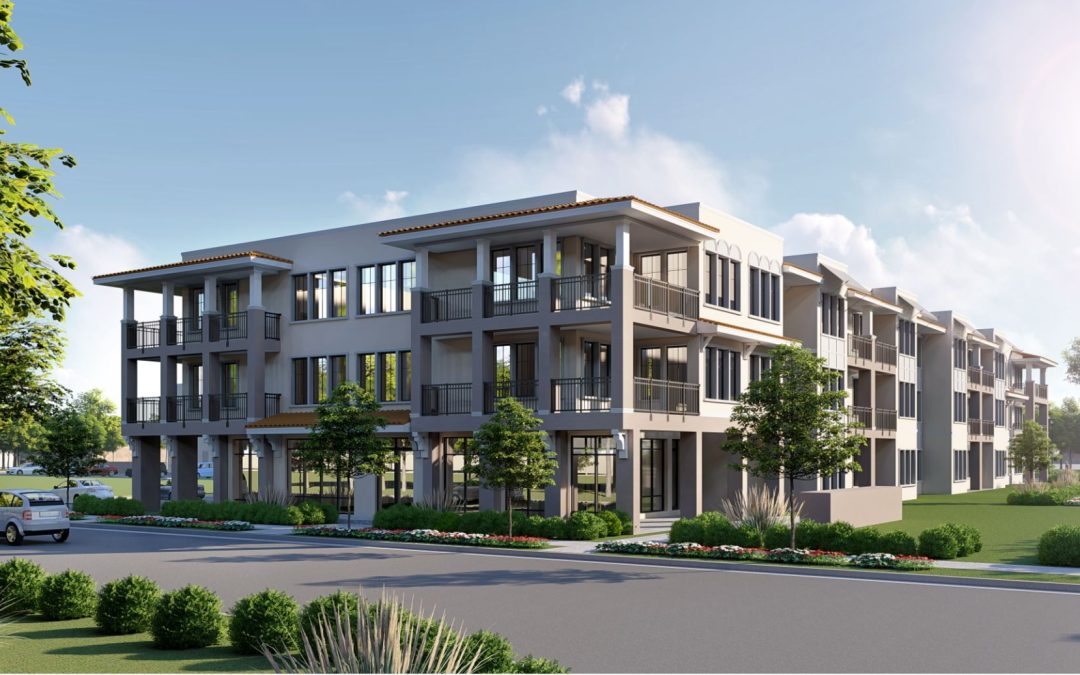
Rollins College withdrew its request to build faculty apartments a few blocks from Park Avenue after an outcry from neighbors and concerns from commissioners that the building wouldn’t fit in the neighborhood.
“College leadership has talked with each commissioner over the past several weeks, seeking input and feedback on accommodations while striving to preserve the integrity of the project,” Rollins administrators said in a statement. “This project remains a strategic priority of the college. We will take time to explore our options and come back with a project that benefits the College and the City’s Central Business District.”
President Grant Cornwell has said the college needs to be able to offer attainable housing to recruit younger faculty because housing prices in Winter Park are often $1 million or more.
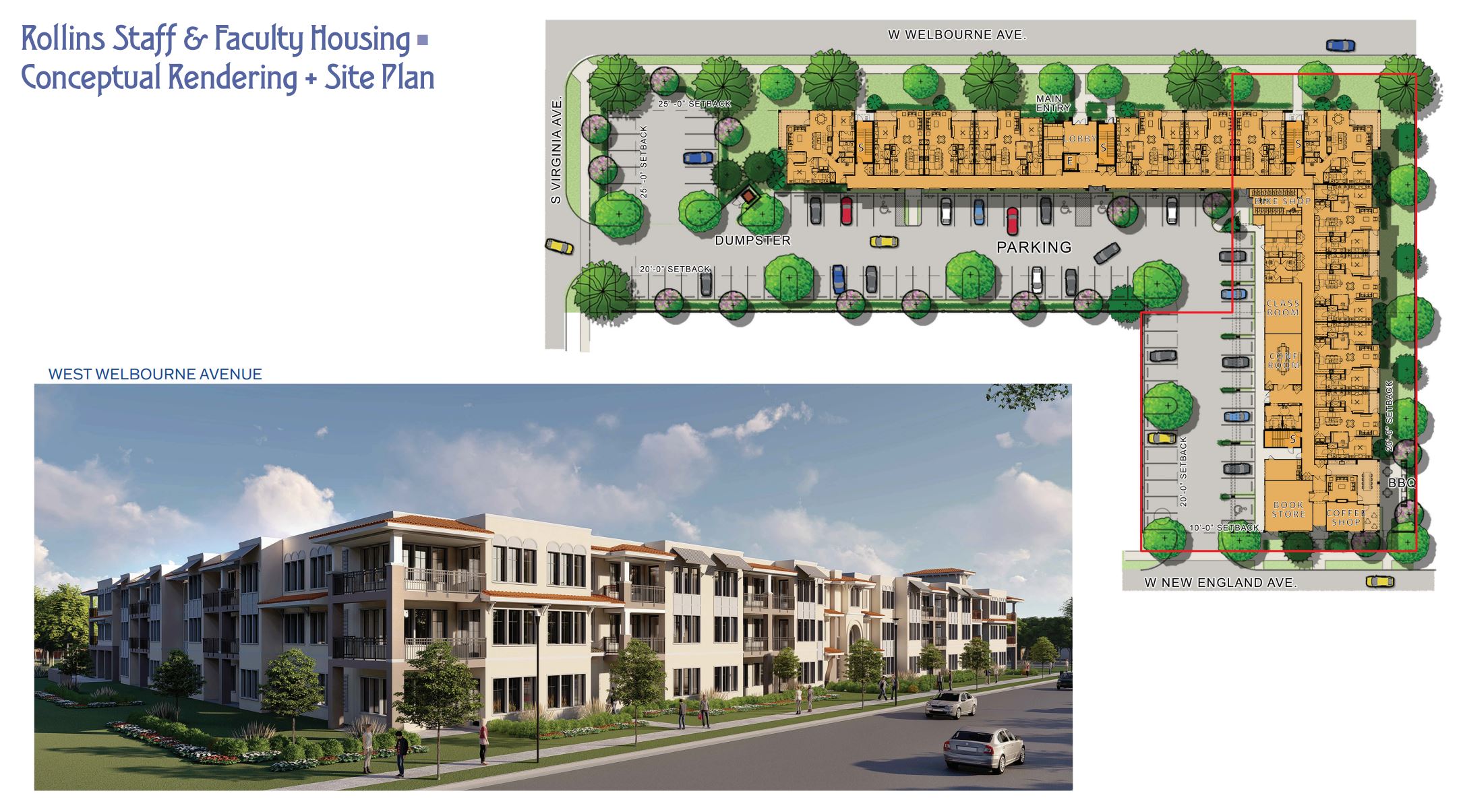
A rendering shows a faculty and staff apartment project proposed by Rollins College.
Workforce housing and affordable housing are often thrown around as priorities of the City Commission, particularly in the context of expanding the city’s Community Redevelopment Agency.
But the Rollins project quickly became a target for neighbors to shoot down, asserting the building would decrease their property values.
In January, Rollins attempted to appease some of those concerns by lowering the number of proposed units from 48 to 39 and reducing the size and length of the building along Welbourne Avenue.
The proposal was for a three-story 72,933-square-foot building with 104 parking spaces, which meets code requirements, according to a memorandum from city staff.
A number of residents of the Douglas Grand condominium building said they feared their own units will drop in value because of Rollins’ planned framed construction with what they called too few architectural details to emulate the Spanish-Mediterranean style the main campus is known for.
“Please consider whether or not you would purchase a $1 million residence across the street from what would be at best an average maintained, subsidized apartment complex,” read one email to commissioners from a resident.
“It is the appearance of the rental facility that makes it even more distasteful,” read another.
“Not to sound snotty, but this is the type of apartment better suited for cities like Fern Park or Casselberry,” a resident wrote.
In it’s statement, Rollins did not say when it expected to try again to seek approval for the project, but signaled it would do so eventually.
“We remain committed to ongoing dialogue with commissioners as we continue to refine the proposal,” the statement said. “We are grateful to the many Winter Park residents and community members who have shown support for this initiative aimed at addressing the college’s workforce housing needs.”
WinterParkVoiceEditor@gmail.com
To comment or read comments from others, click here →
by Beth Kassab | Feb 24, 2024 | City Commission, News, Orange Avenue Overlay, Uncategorized, Zoning and Development
News & Notes: Rollins apartments, McCraney property and leaf blowers
The developer of the first new building in the Orange Avenue Overlay is bringing significant changes back to the City Commission for consideration
Feb. 24, 2024
By Beth Kassab
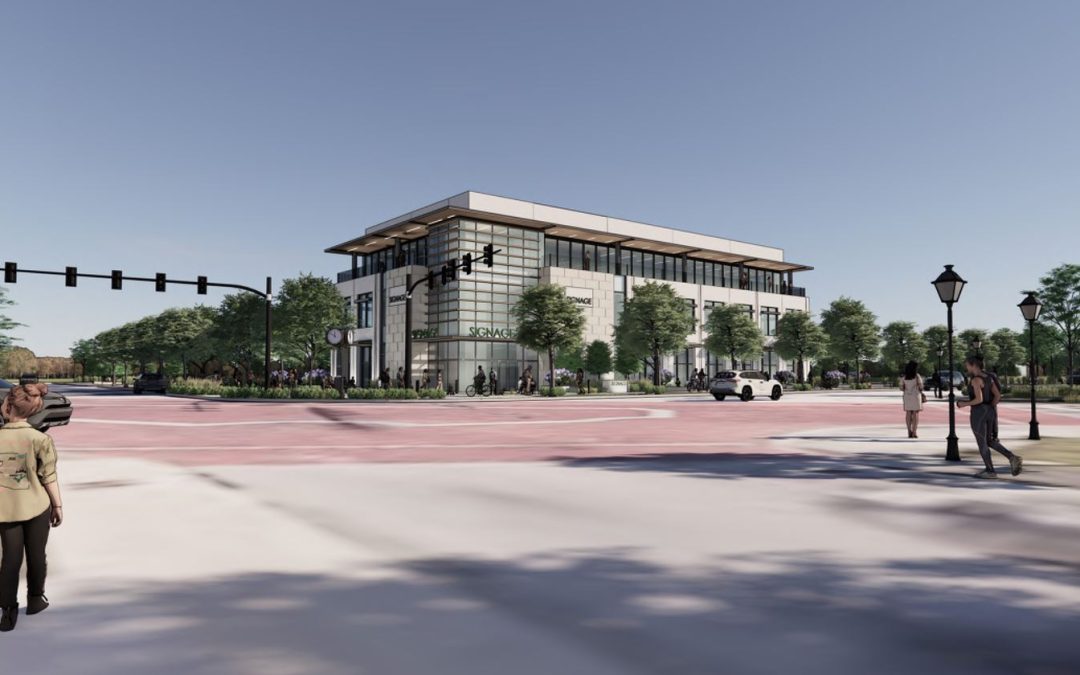
The City Commission on Wednesday will hear a list of proposed changes for the three-story office building slated to be developed next to Seven Oaks Park along Orange Avenue.
The changes are the result of a lengthy public hearing two weeks ago during which a number of residents spoke both for and against the building.
Commissioners criticized the building’s height, which exceeded the limit, as well as its single-use purpose as an office building among other concerns.
Since then, Steve McCraney, the developer who wants to use the building, in part, as his corporate headquarters, has submitted the following changes:
- The building will no longer be used exclusively for offices and now will be a mixed-use project. The other uses proposed weren’t immediately clear.
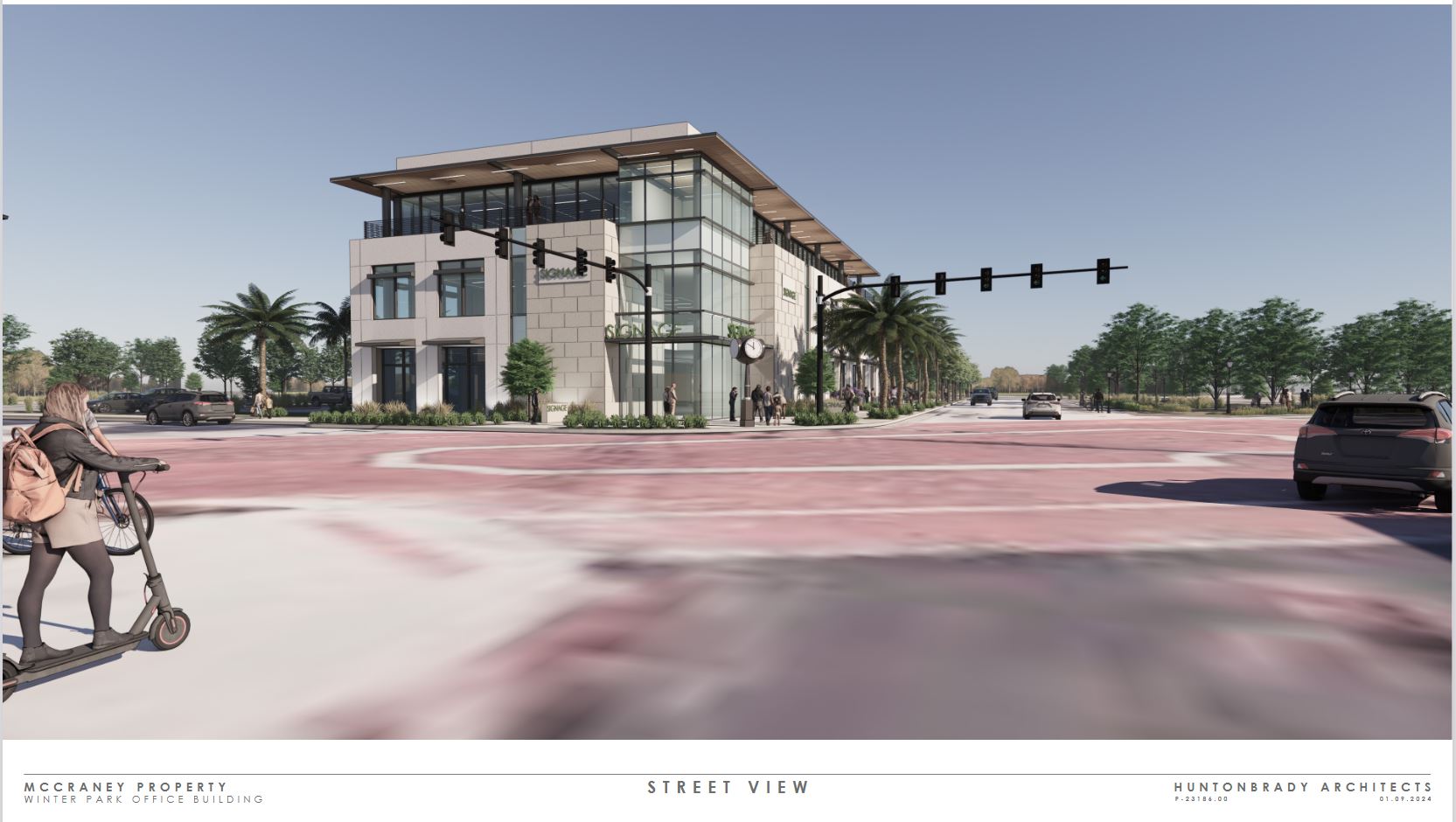
- The building’s architecture has been updated (see rendering above).
- The screen wall on the roof of the building intended to shield the air-conditioning unit and other equipment from view will now be shorter.
- The green space planned in front of the building along Minnesota and Denning is adjusted, though the building will still provide more than the required number of parking spaces in the back.
After a first hearing, which didn’t require a vote on Feb. 14, commissioners are expected to take a vote on the project after the second hearing on Wednesday.
Rollins seeks approval for apartments
The liberal arts college that has helped define central Winter Park is expected to come back to the board for approval of new faculty apartments after pausing its request earlier this month.
Neighbors and commissioners have asserted the plan, which is intended to provide attainable housing close to campus exclusively for Rollins faculty and staff, doesn’t fit with the neighborhood and will decrease property values.
At the end of January, Rollins attempted to appease some concerns by lowering the number of units from 48 to 39 and reducing the size and length of the building along Welbourne Avenue.
The proposal is now for a three-story 72,933-square-foot building with 104 parking spaces, which meets code requirements, according to a memorandum from city staff.
Will residents vote on leaf blower ban?
In what has proven to be just as explosive of a topic as development in Winter Park, Commissioners could take a step this week in quieting — once and for all — the noise over leaf blowers.
Commissioners are expected on Wednesday to vote on an ordinance that could allow voters to decide if gas-powered leaf blowers should be banned.
The ordinance comes after Sen. Jason Brodeur threatened to pass a law to prohibit Winter Park and other cities from enforcing their own rules on the matter.
Brodeur demanded the city delay implementing the ordinance, which was originally passed on Jan. 12, 2022, until June 1, 2025, which would allow voters to first have a say on the March 11, 2025 ballot. Voters would be asked whether the gas powered devices, which many consider a nuisance both as noisemakers and air pollutants, should be banned.
Commissioners are expected to vote on doing just that. At the last meeting, Marty Sullivan and Todd Weaver signaled they were against meeting the senator’s demands while Phil Anderson and Kris Cruzada said they were open to it. Sheila DeCiccio, who is running for mayor in the March 19 election, is expected to be the swing vote.
WinterParkVoiceEditor@gmail.com
To comment or read comments from others, click here →

by Beth Kassab | Feb 23, 2024 | City Commission, Election, News, Uncategorized, Zoning and Development
Seat 2 campaigns intensify over development, public safety claims
The three-way race appears focused on one of Winter Park’s most asked questions: How will growth look in the future?
Feb. 22, 2024
By Beth Kassab
Election mailers and the accusations that come along with them are flying in Winter Park as three candidates compete for the seat on the City Commission vacated by Sheila DeCiccio, who is running for mayor.
The issue taking the most attention? Growth and development — Winter Park’s perennial dog fight.
At stake is how Orange and Fairbanks avenues as well as U.S. 17-92 look over time as major property owners begin to redevelop their land along with continuing redevelopment across the city’s western neighborhoods.
The person who is elected to the open seat will likely have significant influence over those projects and two of the candidates, Jason Johnson and Craig Russell, are clearly differentiating themselves on the matter. A third candidate, Stockton Reeves, appears to be focusing on taxes and inflation as well as claims about public safety.
A mailer to residents from the Winter Park Chamber of Commerce’s Political Action Committee somewhat crystalizes what is emerging as a defining issue in the race: Whether development codes should be more lenient.
“Did you know?” the mailer asks is large type. “Park Avenue would be prohibited from being built today under current city code.”
The mailer goes on to say that the code “blocks Winter Park’s iconic charm from enhancing other parts of the city.”
The chamber endorsed Russell, a teacher and coach at Winter Park High School, who was the only candidate at the chamber election forum who said he was open to revisiting the original Orange Avenue Overlay rules that allow for taller buildings and higher density. Those rules were overturned by the City Commission in 2020 and the city won a lawsuit filed by major property holders over that decision.
Russell is also the only candidate who said he was open to the chamber’s proposal to do away with the city’s parking codes that require developers provide a certain number of spaces based on the type of development.
“Current codes limit commercial land owners from creating new mixed use venues of a similar size and aesthetic to Park Avenue because of the onerous and outdated parking requirements,” Betsy Gardner, chamber president and CEO, said in a statement. “Small concessions have been made over time for tenants in the Central Business District, but any new development in the city faces parking mandates that leave businesses overparked, creating empty lots, visual blight and a less walkable and more car-centric environment.”
Russell, who did not respond to a request for comment, has said at previous public forums that he would “listen to the experts” for guidance on growth and development issues. One recent mailer from Russell’s own campaign said he wants to “promote smart growth, opposing irresponsible high-density developments.”
Johnson, who opposes tossing out parking codes and emphatically said he did not agree with returning to the original OAO rules, questioned whether Russell would speak for residents or business interests when it comes to new development.
“The comment about ‘listening to the experts’ is a deflection and a way of saying if an expert comes in on behalf of a developer and says something, we should just listen to that rather than what the residents think,” he said.
Johnson, an attorney who has made maintaining Winter Park’s charm a central element of his campaign, sent out an email to voters this week that emphasized, “I am NOT endorsed by the Winter Park Chamber’s PAC, which endorsed a candidate who supports development of large out-of-scale buildings near Park Avenue, and doing away with parking requirements for future commercial developments.”
Reeves, who did not show up at the public candidate forums, has sent at least eight mailers to voters so far — the most of the three candidates.
One of his pieces exclaims “higher prices and inflation aren’t the only things out of control” and says “our property taxes are going up too!” He accused the commission of increasing taxes by 7% in 2022 and nearly 9% in 2023.
His claims are based on the idea that commissioners could have adopted the “rollback rate” or lowered the city’s milage rate to collect the same tax revenue as was collected the prior year.
Instead, commissioners kept the tax rate the same, but collected more taxes because property values have increased. That means each property owner paid a higher assessment based on their increased value.
During budget meetings last year, commissioners noted the need to increase police and fire budgets as inflation and other factors, have driven up wages and equipment costs. Police and fire make up the largest portion of the city’s general fund expenses followed by parks and public works.
In a separate mailer, Reeves asks “Quick question – How many ambulances does Winter Park have for over 30,000 resident?”
“It is shocking to me that we only have 2 full-time ambulances,” the piece stated.
City officials said a third ambulance is already being staffed part-time and that is set to increase over the coming year.
“Winter Park Fire Department uses the ‘right-sized’ approach, which has proven world-class and credible as WPFD is five-times fire accredited and four-times EMS accredited,” said a statement from the department. “We have already phased in a third rescue/ambulance at Station 64 during select periods. This will continue with the adoption of the [2025] budget, which already includes the hiring of additional personnel.”
Reeves told the Voice that staffing the third ambulance should happen sooner, “I am not satisfied with this and believe it should be staffed full time.”
But considering Reeves also says he supports adopting a rollback tax rate and wants to collect less revenue for the city, it’s unclear where he would find the money to continue to keep up with the costs of public safety.
He did not respond to a question from the Voice seeking details of his plan.
WinterParkVoiceEditor@gmail.com
To comment or read comments from others, click here →

by Beth Kassab | Feb 10, 2024 | City Commission, News, Orange Avenue Overlay, Uncategorized, Zoning and Development
News & Notes: What's happening with Rollins apartments and more
Plus Super Bowl Sunday and the latest on the McCraney office tower
Feb. 11, 2024
By Beth Kassab
First, it’s Super Bowl Sunday and we all expect Winter Park-adjacent resident Donna Kelce (she lives in Baldwin Park) will be in attendance to cheer on Taylor Swift’s boyfriend (also known as her son, the Kansas City Chief’s Travis Kelce).
Could it be just a coincidence that only months after Donna Kelce posted a big shout out to Winter Park and the city’s famous boat tour that Swift announced there will be a song titled “Florida!!!” on her new album “The Tortured Poets Department” set to release in April?
Yes. It is definitely a coincidence. The song is most certainly not about that. But a city can dream, right?
On to a look ahead for the week:
Rollins proposal for faculty apartments
For those looking to speak for or against the plan by Rollins College to build faculty housing, you’ll have to wait a few extra weeks. The proposal was on Wednesday’s agenda, but has been postponed at the request of the college until Feb. 28.
At the last meeting, Rollins reduced the number of units it plans to build from 48 to 39 and the city postponed a decision on the matter that residents have complained won’t fit in with the surrounding area along New England Avenue.
McCraney Property next to Seven Oaks Park
After an initially chilly reception, members of the Planning & Zoning Board unanimously approved a proposal for a three-story, 29,500-square-foot office tower at 1100 Orange Avenue next to where Seven Oaks Park is underway.
Now the City Commission is set to consider the project on Wednesday. The Orange Avenue Overlay board approved the concept last month. 
Steve McCraney, who is planning to building the space for his development company’s corporate headquarters, made changes to the original plans and is now offering right-of-way to the city that could be used in the future for a traffic roundabout on Orange Avenue.
“In order for a roundabout to actually be realized at this corner, there will be a much larger and timely community discussion, but this trade-off ensures that the City is not missing an opportunity for the roundabout,” according to a staff memorandum on the project. “Furthermore, the immediate effect of this right-of-way dedication, is a much larger setback than what was previously proposed, which helps reduce the impact of this three-story building at this corner.”
WinterParkVoiceEditor@gmail.com
To comment or read comments from others, click here →
by Beth Kassab | Jan 25, 2024 | City Commission, News, Uncategorized, Zoning and Development
Commission postpones decision on Rollins faculty apartments
The liberal arts college offered a concession right out of the gate by reducing the number of units from 48 to 39, but commissioners wanted more
Jan. 25, 2024
By Beth Kassab
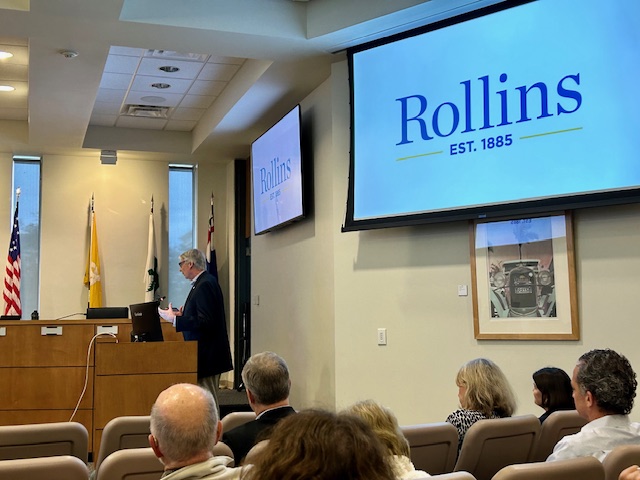
The City Commission on Wednesday postponed a decision on a request from Rollins College to build faculty apartments a few blocks north of Fairbanks Avenue from the liberal arts campus despite a significant reduction in units and new project renderings.
Rollins President Grant Cornwell immediately acknowledged nearby residents’ discontent over the proposal and offered to reduce the number of units from 48 to 39.
“We’ve heard the concerns about parking and we’ve heard concerns about density so we come here to you today prepared to build a smaller project than we originally proposed,” he said, explaining that he sees faculty apartments as “strategic” to the college’s mission and “nobody is making any money here … this isn’t a business deal.”
But that did little to quell concerns and several commissioners presented lists of additional demands and questions from the length of time Rollins must maintain the project as faculty and staff housing, to what defines faculty, the materials used to construct the building, potential mandatory solar power to the building’s aesthetics.
The number of stories and whether the roof is sloped or flat emerged as perhaps the biggest sticking point of the night. Typically buildings along that stretch of Welbourne Avenue are restricted to 2.5 stories with a sloped roof and dormer windows. But Rollins is asking for three story vertical construction with a flat roof, which is allowed just blocks away in the city’s Central Business District.
Becky Wilson, an attorney from Lowndes who represents Rollins, explained that the dormer windows would not work because the third level needs to be used for full units and sloped walls would interfere in the design.
“We also worked a little on the renderings,” she said, nodding to concerns expressed by residents at last week’s Planning & Zoning Board meeting about the architecture.
She emphasized that Rollins will continue to own and control the building and would prohibit tenants from draping items over the balconies or making them unsightly in other ways.
Some of the residents’ concerns conjured images of a fraternity house versus up to three-bedroom units for new professors and their families. A number of residents of the Douglas Grand condominium building said they feared their own units will drop in value because of Rollins’ planned framed construction with what they called too few architectural details to emulate the Spanish-Mediterranean style the main campus is known for.
“Please consider whether or not you would purchase a $1 million residence across the street from what would be at best an average maintained, subsidized apartment complex,” read one email to commissioners from a resident.
“It is the appearance of the rental facility that makes it even more distasteful,” read another.
“Not to sound snotty, but this is the type of apartment better suited for cities like Fern Park or Casselberry,” a resident wrote.
Wilson clarified that the apartments would not be restricted by income, but the college plans to charge rents based on affordability for people who earn up to 120%, or perhaps even more, of the area median income.
Cornwell has said he envisions tenure-seeking faculty who are early in their careers to utilize the units so they can afford to live near campus, where many home prices easily exceed $1 million.
As the meeting went on, it became clear there weren’t enough votes for Rollins to win approval, particularly after Mayor Phil Anderson said he wasn’t comfortable with a three-story building and other factors.
“For me, compatibility is less about intensity and more about what the building is going to look like,” he said.
Anderson urged residents to understand that whether the college pays property taxes on the property or not is up to federal and state rules governing tax-exempt organizations and a determination by the county property appraiser. Typically, non-profit groups — even big-monied ones like hospital systems AdventHealth and Orlando Health and major universities — don’t pay property taxes when the land is used to further the group’s mission.
City Attorney Kurt Ardaman said there is case law to support faculty housing as a purpose that would qualify for an exemption.
The City Commission voted unanimously to table a decision until its next meeting on Feb. 14.
WinterParkVoiceEditor@gmail.com
To comment or read comments from others, click here →
by Beth Kassab | Jan 23, 2024 | City Commission, Election, Library, News, Uncategorized, Zoning and Development
Two commission candidates offer views on growth, old library, Rollins apartments and more
Monday’s forum at the Winter Park Library was the first of the election season
Jan. 22, 2024
By Beth Kassab
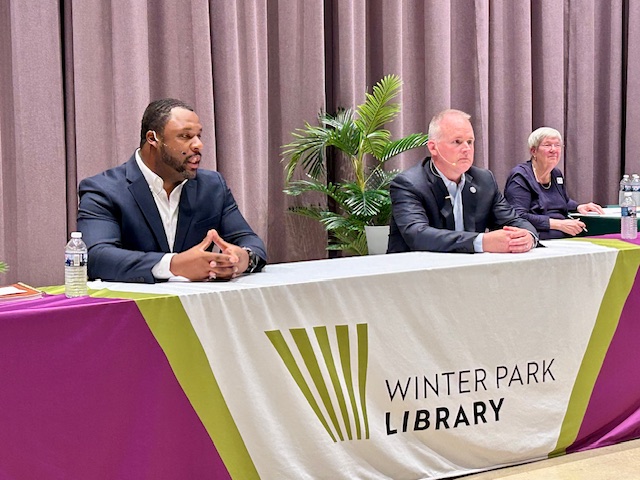
Commission Seat 2 candidates Jason Johnson and Craig Russell faced off at a forum Monday night at the Winter Park Library, revealing some clear, if subtle, differences in their philosophies on questions such as what to do with the old library building, a proposal for Rollins College faculty apartments and the future of development in Winter Park. (Watch a recording of the event here.)
Stockton Reeves, the third candidate in the race, did not attend the forum. Carol Foglesong, the moderator from the Orange County League of Women Voters, announced Reeves was “caught out of town on his job and was not able get back … so it’s not that he didn’t show it’s that the job got in the way for tonight.”
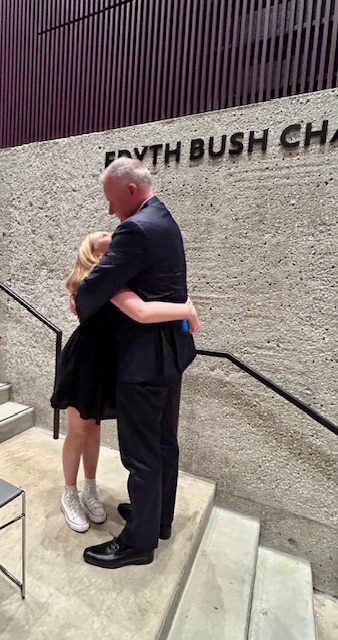
Jason Johnson shares a hug with his daughter after the forum.
That raised some confusion, however, because Reeves met in person on Monday with Winter Park residents involved in the Fix 426 effort at an Orlando office. He did not immediately respond to a question from the Voice about whether he was out of town during the forum, though he previously told the Voice he had a work conflict during the event that he was trying to reschedule.
Russell and Johnson, both first-time candidates for public office, showcased their knowledge and experience in the local community.
Both credited their children and families as their biggest accomplishments and appeared to agree on issues like examining how the city’s Community Redevelopment Agency, a special downtown tax increment district that the current City Commission is trying to expand, could play a role in providing more affordable housing.
They also agreed that recent increases in pay for police officers have made the department more competitive in hiring.
Neither expressed a firm opinion when asked whether Winter Park should let voters decide whether to adopt single-member districts or carving the city into sections that each elect a representative to the City Commission. Russell, who is Black, nodded to the merits of diversity several times during the forum. Winter Park has not elected a Black commissioner in more than 130 years.
“There isn’t enough data for me to answer,” said Russell, a teacher and coach at Winter Park High who also serves on the city’s Parks and Recreation Advisory Board and as a trustee for the Winter Park Library. “If there’s true representation that kind of solves that problem.”

Craig Russell poses with students who came out to support him at the candidate forum.
Johnson, an attorney and current chairman of the city’s Board of Adjustments, said he’s “always in favor of allowing voters to decide” and noted single-member districts have positives and negatives and he would want more information.
While both candidates largely described their future vision of Winter Park as keeping the look and feel of the city much the way it is today, some differences emerged.
On the Rollins College proposal for 48 new apartments aimed at providing attainable housing for faculty closer to campus, Russell signaled a willingness to find a way to make it happen.
“How do we make it work?” Russell asked of the project on New England Avenue that has drawn complaints from neighbors about its density, architecture and potential shortage of parking. “I don’t think the immediate answer is no … Rollins historically has been a good neighbor to us and it’s an opportunity for something we haven’t done here in Winter Park and I’m very open to hear more about it.”
Johnson said he didn’t want to express a firm viewpoint, but seemed more skeptical.
“I do think there is a need for housing for faculty and staff in the city, so I understand why Rollins wants to do it,” he said. “But I also understand some of the residential concerns.”
On the matter of the old library building, which continues to pose a conundrum for city officials since the City Commission recently rejected a second round of proposals that came in to redevelop the parcel, Johnson said he opposed selling the land. A sale has been brought up multiple times to raise revenue for other projects.
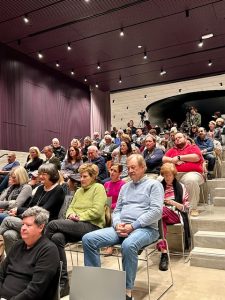
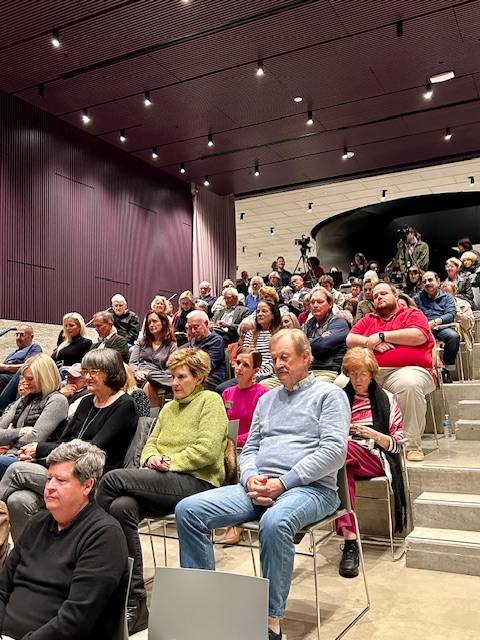
A packed crowd listens to candidates for Commission Seat 2 at the Winter Park Library.
He said a sale is on the “bottom of my list of priorities,” because “it’s a gateway and it’s too valuable of an asset to sell off for a few dollars today. I wouldn’t’ support that right now.”
Later in the forum, Johnson brought up one idea that’s been discussed, which is to turn the land into a small park space.
Russell said he would “have to lean on a bunch of contacts that I have to learn more about that situation” and expressed concern about the building falling into disrepair.
When it comes to a general growth philosophy, Johnson appeared to express a bit more skepticism there, too.
“I think there’s a certain segment that would have you believe we need greater balance between residential and commercial tax bases,” he said. “I don’t know that I share that belief. I want to protect our neighborhoods from commercial encroachment, but I do think there are ways we can improve both the neighborhoods and the commercial vitality. We need to make sure our infrastructure is better improved and maintained.”
Russell said he wanted to talk to experts about the possibility of growth.
“We have to be able to open to listen to the possibility of growth,” he said. “We have to be open to listen to the experts who can tell us how can we solve this problem. I don’t know all the answers. I know where we can find the answers … I know there are generations that want to come back here and I’m open to listen to all ideas.”
WinterParkVoiceEditor@gmail.com
To comment or read comments from others, click here →


Recent Comments