Commission to Consider Racquet Club Expansion This Week
Also up for consideration is the city manager’s evaluation and salary
Oct. 20, 2025
By Beth Kassab
A controversial expansion planned by the exclusive Winter Park Racquet Club will look to the City Commission this week for final approval.
Some residents in the neighborhood known as “the Vias,” a posh enclave between the shores of Lake Maitland and Temple Drive, oppose the changes at the club, which they say already lights up their quiet street like a “Walmart” or “McDonald’s” at night with pickleball courts, tennis courts and events.
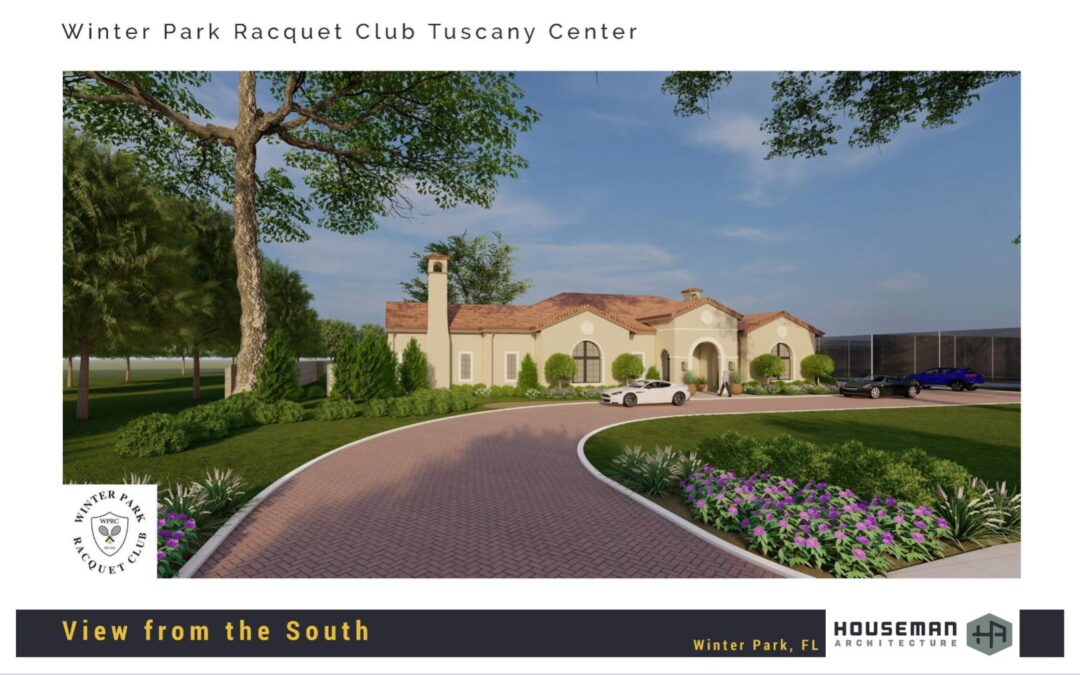
The meeting on Wednesday is likely to feature debate on the plans, with call for the white-columned two-story home at 2111 Via Tuscany to be torn down and replaced with a larger one-story building to house a new fitness center, locker rooms, tennis shop and offices for the club. The proposal was approved earlier this month by the Planning & Zoning Board in a 5-1 vote.
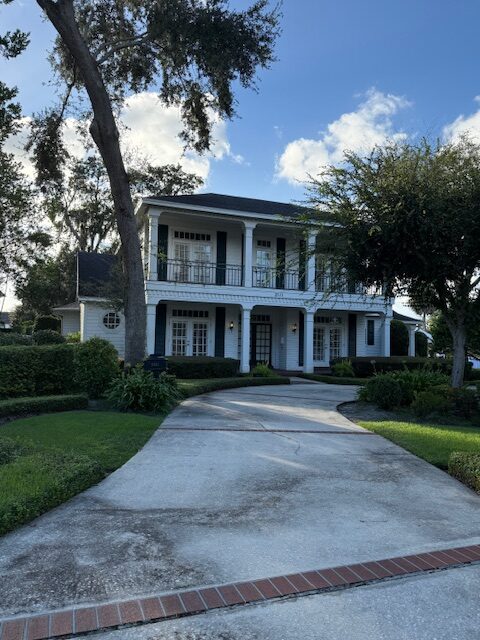
This home on Via Tuscany will be demolished if the Racquet Club’s plans are approved to make way for the proposed building pictured above.
Conditions of the approval by P&Z include the following, according to the staff report:
- The driveway on Via Tuscany will be an entrance-only access point.
- WPRC can not increase its membership.
- Hours of operation of the new building will be limited to 7 a.m. to 8 p.m. daily,
including deliveries. - No new lighting will be provided in the grass parking lot behind the new building.
- All non-required lights for safety purposes be shut off by 10:00 p.m. daily.
- As part of the tree removal permit for the 25 and 27-inch oaks, double the required
compensation shall be required, at four six-inch canopy trees, subject to Urban Forestry
approval and be planted at least 15-feet from the southern property line
wall or fence. - Narrow the proposed driveway to 12 feet at the entrance on Via Tuscany and
the exit onto Tom Gurney Drive. The width of the middle portion of the driveway may be a maximum of 14 feet. - Conduct a comprehensive photometric analysis of the entire WPRC campus to confirm that all lighting is fully shielded at the property boundaries and implement any necessary measures to eliminate light spillover onto adjacent properties.
- Shut off all pickleball lights by 8 p.m., instead of the current cutoff of 9 p.m., daily.
The City Commission has the ability to accept, reject or change any of the conditions when it meets on Wednesday.
Raise for City Manager?
The Commission on Wednesday will also take up its annual evaluation of City Manager Randy Knight, who oversees the day-to-day operations of the city and its 500 employees.
Knight, who has worked for the city for more than 30 years and as city manager for 18 years, earns $274,393 and is eligible for up to a 3% merit increase.
Commissioners gave him an average rating of 3.8 on 4-point scale of leadership and performance metrics, according to city documents.
On a list of other cities with a city manager form of government provided to commissioners, Knight was the highest earner in Central Florida with the exception of the Villages, which isn’t actually a city but a collection of unincorporated retirement communities with more than 80,000 residents. It pays its district manager $324,000, according to the document.
The city of Winter Park has about 30,000 residents.
Several South Florida cities on the list such as Miami Beach (pays $298,000 with 83,000 people), Naples (pays $325,000 with 20,000 people), Cape Coral (pays $330,000 with 223,000 people) and Ft. Lauderdale (pays $350,000 with 190,000 people) also boasted higher salaries.
Knight has said he plans to retire in early 2027.
WinterParkVoiceEditor@gmail.com
I support the raise as Mr. Knight has led the city for a very long time. He is retiring soon so why not show him our thanks. It is a difficult job and he has always been respectful and courteous when I interacted with him-even when I wasn’t.
The City Commission should have the WP Racket Club sign a development agreement stipulating that the Club will not increase its membership.
This is actually one of the conditions set by the P&Z board that the club must agree to in order to move forward. The people representing the club have stated multiple times there are no plans to increase membership.
I have very little sympathy for folks who move next to clubs, airports, schools, heavily travel roads etc. and then complain about noise, traffic, lighting etc. I’m glad to see the Racquet Club doing well and is currently maxed out with its membership. I’m also glad that they are trying to be good neighbors.
Funny that some of those neighbors complaining built or bought very large homes where much smaller ones once occupied those lots.
For context, some people who live in the Vias are in favor of the Racquet Club’s proposal and say they enjoy riding their bikes to the club. However, I also interviewed someone who lives very close to the club and who says that while the club has existed in the neighborhood since the 1950s, the changes over the last 10-20 years have turned it from barely noticeable to very noticeable as activities have inched closer and closer to Via Tuscany with pickleball courts, purchase of the residence etc. Also comparing a private lakefront club on an otherwise exclusively residential street to an airport or heavily traveled roads just doesn’t hold up in the court of common sense lol Those are very different situations.
A big concern for the neighborhood is commercial creep. I’d prefer to see the Racquet Club request be denied and told to renovate what they have or use the back end of the property on the lake. If they are granted the right to build this new building, then they should sign agreement that there will be no further expansion after this.
Dumb question, but could the club “sell” and the new ownership (which is just a legal name rebrand) be free of the prior ownership’s commitments to the commission? In other words… do these agreements remain with the property or just the entity signing the agreement?
This is a “conditional use” request, which generally means conditions can be enforced by the city in exchange for the applicant gaining approval for uses/zoning outside what is typically allowed on the property. I believe the use is tied to the property and not simply to a specific owner/operator. The Racquet Club is actually a nonprofit so it can’t be “sold” outright, though new leadership could come in over time. It could theoretically sell its assets such as property but the new owners would also need approval if they were to seek some kind of change in use.