
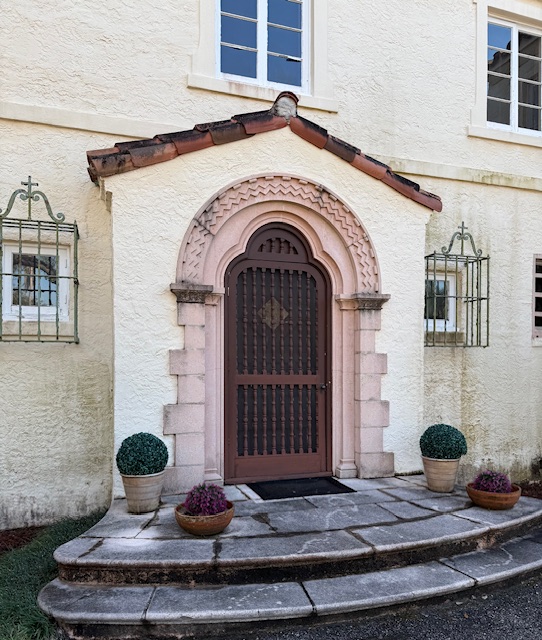
Commission Approves Merrywood Lot Split on Lake Osceola
The owners and prospective buyer agreed to hold off on demolishing the estate until a required second vote by the City Commission likely later this summer
June 25, 2026
By Beth Kassab
The owners and prospective buyer of Merrywood, the nearly 90-year-old estate on Lake Osceola at the center of Winter Park’s latest historic preservation debate, agreed to hold off on demolishing the property until a required second City Commission vote that would make it possible for the large lot to be split in two.
The commission voted 3-2 on Wednesday to change the comprehensive plan to allow for a split that would only apply to 1020 Palmer Ave. but added conditions: the combined total of two new homes that could be built on the lots would not exceed 30,000 square feet and at least one be fashioned in a style adjacent to architect James Gamble Rogers II, the local architect who built Merrywood and is known for helping to shape the city’s aesthetic character.
The city’s rules typically prohibit lakefront lot splits, which is why the prospective buyer, Tara Tedrow, asked for a special exception in the form of a plan amendment.
While a permit is already in place would allow for the home to be bulldozed any day now, the owners and Tedrow, who has the property under contract, verbally agreed to hold off on demolition until the second reading of the comprehensive plan change — likely in about two months.
Tedrow has said she would like to build a home for her family on a portion of the nearly 4-acre lot while the other half is sold to someone who would restore Merrywood or tear it down to make way for new construction. The land is estimated to be worth more than $10 million as the single largest lot on Winter Park’s highly-sought after Chain of Lakes.
People from the community provided conflicting opinions at the meeting about whether or not the house could be restored or was beyond the point of saving. And whether the additional time agreed to on Wednesday would make a difference.
Cathy Gilmer, who owns the home with her brother, told the commission her mother lived in Merrywood from the mid 1970s until she died there about a year ago.
She was adamant that a local historic preservation designation, which would allow the city to stop demolition of the property, “isn’t ever going to be pursued.”
“No one wants to or is able to pay for it,” Gilmer said of her family home that she said is now in disrepair. “This is an unfair position to put us in, especially given the efforts over the past year to find someone to preserve the house.”
But advocates such as Friends of Casa Feliz, another Gamble Rogers showpiece that was moved, restored and now a popular destination and public venue, did not begin outreach to the preservationist community or help market the property until earlier this year.
“Casa Feliz had our first conversations with Ms. Tedrow and Mr. Mick Night [Gilmer’s real estate agent] in late January of this year and I’d say our efforts began in earnest, trying to put the word out in February of this year, so a few months,” Betsy Owens, executive director of the group and granddaughter of the architect, told the commission.
The property was considered a pocket listing, not uncommon for exclusive homes, and was never broadly advertised on the MLS or the Multiple Listing Service used by real estate professionals.
She also corrected Tedrow’s claim that Gamble Rogers grew up in a cabin that now stands preserved in her parents’ backyard, a story Tedrow has told multiple times to demonstrate her personal interest in historic preservation.
“My grandfather actually didn’t grow up in a cabin in Winter Park,” Owens said. “He grew up in Winnetka, Illinois, and moved here when he was 29.”
But Owens’ main point to commissioners is that they could resurrect the city planning staff’s recommendation to allow for a lot split on the condition that the home is designated as historic.
Planning & Zoning Director Allison McGillis based the recommendation on a previous comprehensive plan change that allowed for a lot split on New York Avenue that involved designating another lakefront Gamble Rogers house as historic while carving out a new lot from the property that is not on the lakefront. McGillis said in the case of that property, the sale of a new home on the newly created lot helped finance the restoration of the historic home.
Owens noted that city commissioners recently tasked the Historic Preservation Board with coming up with ways to encourage more people who own eligible homes to list them on the local register. There are fewer than 30 true examples of Gamble Rogers’ work remaining in Winter Park.
“Creating a valuable buildable lakefront parcel, but in return, ensure that the historic resource is not demolished … I can not imagine a more powerful preservation incentive than this,” she said. “To say we want incentives and then to reject this opportunity would be inconsistent. I also want to be fair. No one can guarantee that Merrywood will be saved if the lot split is denied. But Merrywood has never truly been tested on the open market as a preservation opportunity.”
The Planning & Zoning Board, which heard Tedrow’s proposed comprehensive plan earlier this month, opted to approve it and rejected the staff proposal that included a condition that the home be designated as historic.
The city attorney indicated the comprehensive plan change wasn’t advertised publicly as including the historic designation condition, meaning the process would potentially need to start over again.
Several commissioners said they viewed private property rights as a key issue in the debate.
Mayor Sheila DeCiccio said there is no hope to save the house and said it would be “punishing” to attempt to require it to be designated as a condition of the lot split approval.
“They have done everything they can to try to help make it happen. It has not happened … Now we want to punish them and say, well, because you wouldn’t agree to it [historic designation] we’re not going to allow the lot split … You can’t make the policy so punishing,” DeCiccio said. “When these people built the house, I’m sure in their wildest dreams they didn’t think that someone would come forward 50 or 60 years later and say, because I’m a descendant of the architect, this house needs to be designated. You can’t do that. People have a right to designate it or not. They grew up in it.”
Commissioners were also persuaded by the idea that if the lot was sold as is the house could be torn down and replaced with what would be the largest single home in the city — up to 56,000 square feet based on the acreage and city code.
DeCiccio along with commissioners Kris Cruzada and Craig Russell voted in favor of the plan to allow the lot split. Commissioners Warren Lindsey and Elizabeth Ingram voted against it.
WinterParkVoiceEditor@gmail.com
Ardent preservationists are notorious for being incredibly unaware of other people’s private property rights.
The good news is the last 3 lakefront homes built on Lk. Virginia have been super-traditional. I am no fan of most boxy new builds. These 3 look great!
Pitt, I am well aware of property rights. What you and others don’t understand The owner did not have the property right to split this lot. The city has a policy that Lakefront lots cannot be split. So until the Commission changed the policy they didn’t have that right. They voted to change it last night for this one lot. Now it can be split for better or worse it is done.
The white box collection homes you speak of are just… blah. The colorless interiors… equally blah. Homes were once an extension of your unique personality. Now it’s a contest to see who can have the least character and look the most like any generic big city hotel lobby. Boring!
My point had nothing to do with the lot split. “They have done everything they can to try to help make it happen. It has not happened … Now we want to punish them and say, well, because you wouldn’t agree to it [historic designation] we’re not going to allow the lot split … You can’t make the policy so punishing,” DeCiccio said.”
Sally, the city commission has the authority and the right at any time to change whatever land use rules they want to.
How could anyone expect to be limited in 2026 to a 15,000 square foot residence when they are spending that much for their lot? I feel claustrophobic just thinking about it. /s
It is sad to lose yet another part of Winter Park’s past . But even sadder is the fact that the city could apparently allow a 56,000 square foot house to be built on a lake lot , complete with noisy green boxes . Excessively large houses are visually the equivalent of building an apartment building or office building in a residential neighborhood.
Isn’t it time to revisit city code before Winter Park is irreparably harmed .?
It is popular to assert that a property owner should be able to build whatever they want on their property . However people who feel this way should perhaps consider living out in the country where their choices won’t negatively impact their neighbors and their town .
When you live in a city you both implicitly and explicitly enter into agreements with the city . You follow the rules in order to have the services and amenities of the community. These rules should protect the residents and the neighborhoods as well as the general character of the city itself . Wake up Winter Park !
Note To Mayor – Congratulations on your PW endorsements! I’m proud for you.
I will never understand the draw to historic communities by people who demolish the very assets that brought them there in the first place.
It’s akin to American policy of launching wars to strengthen the enemy’s financial well-being and global status while diminishing America.
Peter, I agree completely that the commission can vote anytime to make changes to any land use rule or any policy.
Thanks to the 2 brave commissioners that cast a no vote. I am glad I voted for you and donated to your campaign. As for the other 3, I seriously regret my vote. Shame on all of you. Rules are rules and you have betrayed the people of Winter Park. Hopefully you will be termed out soon.