
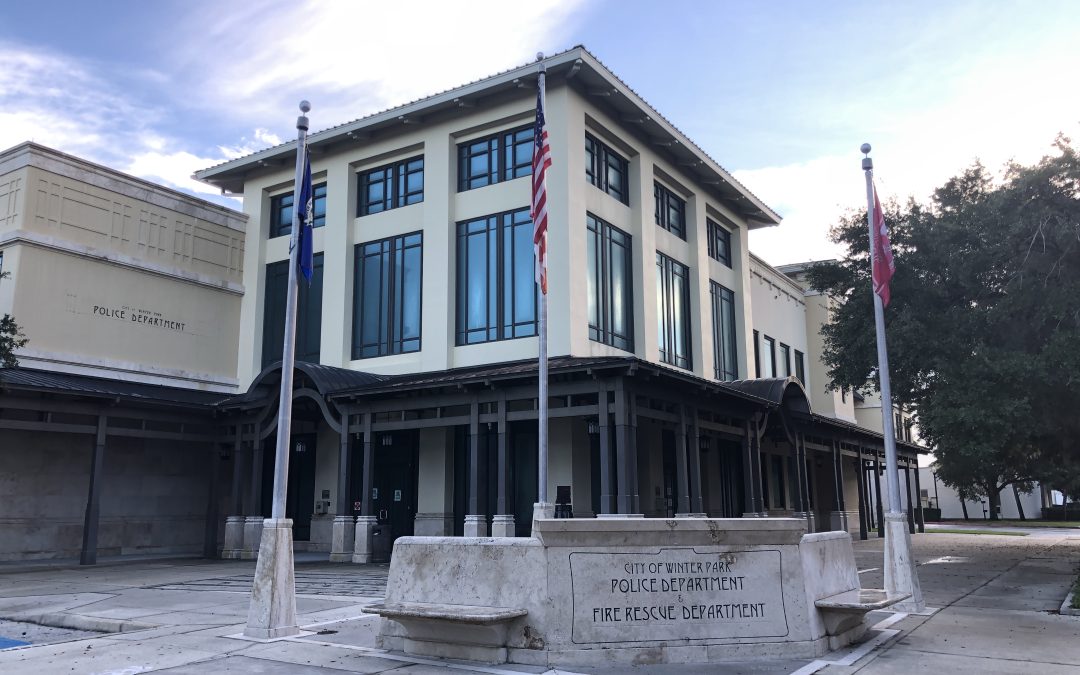
Winter Park Considers More Red Light Cameras
Police Chief Tim Volkerson said the cameras help enhance safety and could bring extra revenue for the department
Aug. 11, 2026
By Gabrielle Russon
Winter Park Police are looking to double the number of red light cameras in the city, a move that the police chief said would enhance safety as well as bring in new revenue amid talk of cutting the department’s budget as the state is pushing local governments to tighten their belts.
Last year, eight cameras posted at six intersections caught 24,400 violations– from blowing through a light to rolling right-on-red turns without a complete stop – and brought in $3.8 million in revenue.
Police Chief Tim Volkerson wants to add eight more red light cameras at the same six intersections, but facing different directions from the existing cameras.
“For example, Fairbanks and Orlando (Avenue) has a red light camera for westbound traffic,” Volkerson said. “It does not have a red light camera for eastbound traffic and it does not have a red light camera for north or southbound traffic.”
That intersection proved to be the third busiest of Winter Park’s red light cameras when it comes to issuing violations with nearly 3,600 tickets last year, according to police data analyzed by the Voice.
The camera on southbound Orlando Avenue at Lee Road resulted in nearly one-third of all the red light camera tickets last year. The second highest offending intersections were eastbound Lee and Orlando Avenue with 6,260 tickets.

Winter Park’s newest red light camera is at Phelps and Aloma is an intersection with a history of significant crashes, Volkerson said. That camera resulted in issuing about 1,600 red light violations last year.
Most of the violations caught on camera throughout the city are related to right-on-red turns. According to a state-required report that Volkerson is scheduled to deliver to the City Commission on Wednesday, nearly 70% of citations or 17,300 out of 25,000 violations during the 2025-26 fiscal year were for improper right turns on red signals.
Volkerson said safety is more important than money when it comes to adding red light cameras. But the topic came up at a recent City Commission work session as Volkerson presented his department’s budget, which includes keeping a community services position vacant next year to help reduce costs.
The proposed 2027 police department budget is $23.2 million, up from $14.9 million in 2020, largely the result of adding six full-time staff positions since then and higher costs and wages for officers.
Adding new red light cameras could bring in an additional $750,000 in revenue, according to a spreadsheet city officials prepared as part of a budget exercise.
“Anyone that has lived in Winter Park would agree that the volume of cars that we have traveling through our city has increased,” Volkerson said. “The more important thing is for us to reduce crashes and even more importantly our goal is always to have zero fatalities.”
People speeding past red lights are most likely to cause T-bone or angular crashes that can have catastrophic results, Volkerson added. And Winter Park roads are active with cyclists heading out on the trails and early-morning runners training on the city streets every Saturday pre-dawn for Track Shack’s MarathonFest.
“If a byproduct is that it brings in revenue, that’s a good thing too, but that can never be and never should be the justification for doing it,” Winter Park City Commissioner Warren Lindsey told the Voice. “I would never ever support something just because it was a revenue producer when it wasn’t emphatically and primarily done for purposes of safety of motorists and pedestrians.”
A typical red light camera fine is $158 and the city of Winter Park collects $75 of that total with $2 going to police training and $73 to help fund the police budget. The rest of the money goes to the state for general revenue, health funds, and helping people with spinal cord injuries.
Volkerson is analyzing crash data to determine which intersections have the most cars passing through and the most crashes. The state requires cities to pass an ordinance in order to add new cameras and provide a reasoning for the locations.
“There has to be a nexus for us putting them there. We can’t just decide we’re going to put one at Park and Morse. We have to justify to the state why this is going there,” he told city officials at the budget work session.
Volkerson added he was not looking at school zones since those areas don’t generate enough traffic volume and are often already patrolled by officers.
Winter Park’s potential red light camera expansion comes as Floridians will be deciding whether or not to approve an overhaul of local property taxes in November.
Recently, the Florida State Fraternal Order of Police and the Florida Sheriffs Association came out strongly against the property tax ballot initiative, arguing the increase in homestead property tax exemptions could result in fewer dollars for essential services like public safety.
Volkerson declined to comment on personal stance on the ballot amendment.
“It’s up to each person to decide and vote,” Volkerson said.
Some, like Orange County Commissioner Kelly Martinez Semrad, fear that Amendment 3 will shrink funding for local governments.
“No matter how you shake it or how you roll the dice, property tax reform has an impact on the services that any municipality will be able to provide,” said Semrad, whose district includes Winter Park.
Semrad brought up whether red light camera tickets could help supplement the Orange County Sheriff’s budget if Amendment 3 passes as county officials held their own budget workshops last month.
“Ultimately we will have less revenue than than we do now … and we need to look for strategies to fill [revenue gaps]. So red light cameras might be an option,” she told the Voice. “I would rather tax somebody who made a mistake, did something wrong, ran a camera – than finding ways to tax others.”
Lindsey, the Winter Park commissioner who is also a criminal defense lawyer, said the presence of a red light camera has a real effect on drivers to make them more aware of their driving habits.
“The other thing is they’re less expensive to maintain than a police officer obviously,” Lindsey said. “You’re able to have them up there 24/7.”
Lindsey also liked that people who get cited have a process to contest their tickets and not get penalized on their driving records if they pay the civil fines.
According to the city’s report, nearly 74% of people who receive the notice of violations pay them.
In those cases, “It doesn’t affect you in the grand scheme of things on your record,” Lindsey said.
About 16% of civil violations result in a uniform traffic citation being issued because it wasn’t paid. Some drivers contest the citations in court, but the city did not report having any dismissed by a judge, though eight cases are currently pending, according to the city’s report.
There is one way to avoid the hassle altogether, Volkerson said.
“It’s really easy,” Volkerson said. “All you have to do is stop and not run the red light.”
WinterParkVoiceEditor@gmail.com
Money makes the world go around
The world go around
The world go around
Money makes the world go around
It makes the world go ’round.
A mark, a yen, a buck, or a pound
A buck or a pound
A buck or a pound
Is all that makes the world go around,
That clinking clanking sound
Can make the world go ’round.
The takeaway is they are increasing policing and spending and then try to scare us into saying no to 3. They are gonna spend either way and then expect us to pay for even more police. Not less. Technology is supposed to make things more efficient not spend money to make money.
Interesting way to increase revenue. Couple of questions-Will there be signs warning of the red light cameras so drivers might stop appropriately rather than run the light and get a ticket? Second, if the property tax amendment fails, will the city still go through with the additional cameras? Finally, it would be nice to actually know the crime trends in Winter Park over the past five years or so and break it down by types of crimes so we know what is going on.
Drivers should stop and look before they roll regardless of it there is a sign or not…..
The message I hear is that the cameras are not about safety, they are about income.
Question to ask before installing cameras would be: is there an unusual rate of accidents at this location? Not if we can irritate the public to make a buck.
May God Bless the Bureaucracy! Rather than simply meet the fiscal challenges of reducing their operating budgets which in the history of the City has NEVER occurred, simply continue to jack their customers!
Unbelievable!!!
Why don’t you invest in adaptive traffic signal control technology to improve our local infrastructure instead. We currently have traffic congestion and the existing timed traffic lights often leave drivers waiting at empty intersections leading to unnecessary delays and driver frustration. Updating to smart traffic lights that use real-time data, sensors, and AI would adjust signal timing based on actual traffic flow. This investment would make our streets safer than investing in more traffic cameras.
I agree with Lisa P. (See her above comment.) Winter Park will see more and more traffic congestion as more folks will live in apartments since fewer folks can afford a house. You can squeeze a lot more apartments into and around Winter Park than you can houses, and every one of those apartments will be home to at least one person who most likely owns a vehicle.
Thank you, Lisa P! Anyone who frequents the intersections at Park and Fairbanks, New York and Fairbanks, or the Orange/Pennsylvania/Fairbanks intersection can testify to the need for better signal controls.
This is a great idea! Chief Volkerson is doing a great job, and I appreciate how he is focusing on public safety and public costs. I wish that more of the department shared the Chief’s careful and thoughtful nature.
The other option at all intersections is to slightly increase the yellow light timing which can give drivers more warning and cause a dramatic reduction in red light running and can be done today at no cost to the city.
Brilliant suggestion. But that would be too simple and much less a combo platter of the Draconian and Machiavellian.
If the police department was interested with increasing revenue then why do they refuse to write tickets to vehicles blocking driveways, parked on wrong side of the street, cars parked all the way up on stop signs, cars not obeying parking signs? Living on the side of Winter Park near Corrine Dr., especially when the businesses block off their few parking spots to invite all vendors it creates havoc on the local streets for residence. Employees, vendors and visiting patrons have to park working our community and do so in the most disrespectful ways.
Many of our neighbors call the police and they do nothing, which means the abuse continues and gets worse for us event after event.
On a side note, how much are these cameras going to cost? How much is the MONTHLY membership going to cost? We know this is not a one and done payment- memberships will be applied to these devices. At the end of the day, it all gets dished out to tax payers. If there is an issue at an intersection, why not personally patrol it with the $$ spent on personal payroll? Or there are other great suggestions already mentioned.
It is a shame if a primary objective of the police department is raising revenue. I can’t think of a better way to DECREASE trust in the department. It would be interesting to see statistics on accidents at the intersections with cameras where violations caught by the cameras were the primary cause. The so far unanswered question is whether or not there are reliable statistics that show that the cameras reduce accidents and increase public safety.
According to this report, more than half of the red light running offenses occurred at the intersection between Lee Road and Orlando Avenue (17-92). The obvious problem is that intersection and not the red light runners. Something needs to be done to make the yellow lights longer or to add an additional lane to turn left when going east. The traffic gets backed up there and the weights are very long frustrated. Drivers will run red lights more often than non-frustrated drivers. The problem is the Lee Road – Orlando Avenue intersection.
The fact that this is the intersection responsible for more than half of the tickets only highlights the fact that this is simply a revenue generation effort. The City placed a “Stop Here on Red” sign for no other reason than to be able to defeat the rolling right turn on red that’s allowed by Section 316.0083 (1)(a), Florida Statutes. That law specifically provides that “[a] notice of violation and a traffic citation may not be issued for failure to stop at a red light if the driver is making a right-hand turn in a careful and prudent manner at an intersection where right-hand turns are permissible.” They only added the “Stop Here on Red” sign to be able to claim that “right hand turns are not permissible at this intersection without stopping first.” This, of course, defeats the entire purpose of the law … but it sure does allow for the writing of a lot more tickets!
Exactly how many crashes have the red light cameras caught on video? If none, then it did nothing for safety and was only revenue-generating.
With the preponderance of comments to the editor opposing this, I wonder how opinions might change if a loved one were killed by someone running a red light.
The statistics are just that—statistics. Common sense tells us that fewer people will run red lights when they know there is a real chance of getting a ticket.
If red-light cameras make my loved ones and everyone else on the road safer, while also generating a few dollars for the city from people who choose to break the law, I have a hard time seeing the downside.
John, I watch folks run redlights each and every day where it is common knowledge there is a redlight camera at that intersection, Waze or Google Maps etc tells you that one is ahead and/or the cameras are in plain sight. Those running redlights generally aren’t thinking about anything other than hurrying along to get where they are going.
Granted, you only have to get a ticket once to stop turning right on red at Lee Rd and 17-92! This one is a total revenue generator and nothing else.
John Skolfield said it all. What else needs to be considered?
Well said!!!
If there is a follow-up report on this topic, would like to know…
– Science, relative to posted speed limit, for timing of traffic lights?
– Length of “yellow” and “red-to-crossing traffic green delay” at intersections with cameras versus the science?
– Before and after statistics of accidents at the intersections with cameras?
– Have rear end collisions increased at intersections with cameras?
– Accidents caused by red-light-runners versus rolling-right-turners?
– Tickets for red-light-runners versus rolling-right-turners?
– PSA for determining stop versus proceed when light turns yellow?
I think red-light cameras ARE saving lives, and installing more at major intersections would be a good thing.
Our Son was Killed 20 months ago, when another motorist failed to brake at a red light, resulting in a T-bone collision. Afterwards the on-line press published several people stating that “people run that red light all the time, and it’s never enforced”. I was amazed that this major intersection (in GA) did not have a red-light camera.
As painful as it is to talk about this, I think it’s OK for our family’s tragedy to be part of this conversation. It’s too late for our son, but I would like to see our traffic laws enforced better so that others are safer. I think it is even possible that 8 additional red-light cameras in WP could help spare you or your loved ones’ lives. How will we ever know?
Many people don’t realize it’s Russian roulette when they stupidly gun it through an intersection, after yellow turns to red. I think it’s important to at least fine the driver who does that. A red-light camera is a deterrent, and appear to be strongly associated with (responsible for?) a 14% decline in crashes where they are installed (see link below). Red-light cameras only take a picture or video when a traffic violation happens. That’s a lot different than Flock cameras, which record everyone.
https://ncsrsafety.org/red-light-cameras-florida-save-lives/