
Winter Park Contends with Higher Police and Fire Costs and How to Maintain Roads
The city’s proposed 2027 budget is also cautious of future cuts to property taxes if voters approve a measure on the November ballot. Winter Park homeowners would save less than $2,000 a year, but the city could ‘lose some of the things that make it feel extra special’
July 22, 2026
By Beth Kassab
The Winter Park City Commission is poised today to adopt the same property tax millage for the 19th year in a row, but the steady rate belies an increasingly complex financial picture for one of the region’s most high-profile cities as it contends with soaring costs for its police and fire departments, a demand from residents for better roads, increasing prices for electric and water customers and a governor and state Legislature looking to slash property revenues.
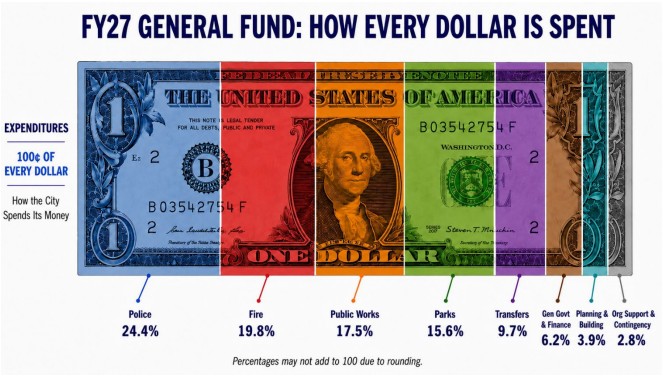
The All-Funds Budget, which includes the General Fund as well as the utilities and other funds, is proposed to increase this year by nearly 6% to $247 million. The General Fund, which pays for essential services such as police, fire, parks, public works and administration, is growing by about 5% to $94.6 million.
The growth in money collected by the city is being driven by higher bills for electricity, water and stormwater — the result of policy decisions in recent years and up for debate again this year by a City Commission facing big expenses to prevent storm flooding and to continue to underground all of the power lines for the city-owned electric utility. Property taxes remain a driver of growth in the general fund, where the taxes make up just under half of the revenue pie.
City Manager Randy Knight cautioned that a measure on the November ballot initiated by Gov. Ron DeSantis and the Florida Legislature to significantly alter how local governments are funded by reducing property owners’ tax bills could eat into the kinds of services the city provides by 2028, when it is set to take effect if it passes with the required 60% approval from voters.
City officials are forecasting a hit of at least $5.4 million in the first year. Translated into savings for individuals residents, homesteaded property owners would pay about $818 less per year to Winter Park. The total tax savings per year for Winter Park homeowners if the ballot measure passes would be $1,783, including the reduction paid to the city as well as the reductions in taxes paid to Orange County and St. Johns River Water Management District. (Taxes paid to schools would remain unchanged under the tax proposal on the ballot.)
“It will have an impact on city services that will be felt,” Knight said in his annul budget memorandum to the City Commission. “Winter Park will still be able to provide essential services, but the city may lose some of the things that make it feel extra special … A loss of over $5 million is like losing almost half of the Parks Department, so it will not be a small issue to determine how best to prioritize spending, but it is likely that a combination of service reductions and revenue increases will end up balancing the budget in future years.”
With just six months to go before his retirement after decades at the helm of the city and 36 years since he helped prepared his first budget in 1990 as the city’s finance director, Knight was reflective in his final budget memo of past challenges.
“As we face potential impacts from the so-called tax reform, I want to remind you that we have faced tough times before and always endured,” Knight wrote. “The 2004 hurricane season cost approximately $18 million for recovery and wiped out our reserves. The 2008 housing bubble coupled with tax reform resulted in a huge hit on city revenues. The Pandemic shuttered businesses and locked down communities, but we survived and thrived. Today Winter Park is the envy of the region, with commercial properties with the lowest vacancy rates and highest asking rents, exceptional schools, and beautiful walkable residential communities and amenities. Over 3 million visitors come to the crown jewel of downtown Park Avenue each year and our financial reserves have grown to over $24 million.”
But the budget document also described in stark terms how expenses for basic needs like police and fire are simply outpacing revenues.
Record-high pension costs for police officers and firefighters as well as a new labor contract with the Fire Union that included a 12% pay increase in 2026 will account for 70% of new costs in the proposed 2027 budget.
“Of the $4 million in the increase in personnel wage and benefit costs in the General Fund estimated for the next fiscal year, almost a third (30%) is due to increases in public safety pensions for police and fire
retirement plans,” according to the budget proposal.
The city will have to spend $1.2 million more on the pensions, according to the document, the result of “changes in actuarial tables, the addition of new employees and the weak 2022 stock market year that still affects their formulas.”
“Staff is reviewing the possibility of making adjustments to the pension plan in the future to attempt to mitigate this growing cost,” the document said. “With property tax reform on the horizon, having a quarter of the entire annual growth in revenue going solely to public safety pensions, is not sustainable.”
Police pay has increased by nearly 50% in Winter park in recent years and the proposed 2027 police department budget is $23.2 million, up from $14.9 million in 2020. The department will keep a community services position vacant next year to help reduce some costs, according to the proposal. The city has 121 full-time police staff and three part-time staff slated for 2027, up from 115 full-time staff and 13 part-time staff in 2023.
The budget for the fire department is up from $13.2 million in 2020 to a proposed nearly $19 million for next year. The department has grown from 81 full-time staff and two part-time staff in 2023 to 84 full-time staff and three part-time staff.
Winter Park is not alone in what has amounted to an arms race in public safety pay across Florida as departments have struggled to recruit and keep candidates for jobs that require personal risk, physical stamina and no work-from-home privileges in a post-pandemic world where many offices have emptied out.
For example, the pay for a starting deputy at the Orange County Sheriff’s office in 2020 was $49,296, according to the office. By 2025 it was $62,566. That’s in addition to increases in bonuses, the number of paid holidays and minimum compensation for off-duty pay and longevity pay.
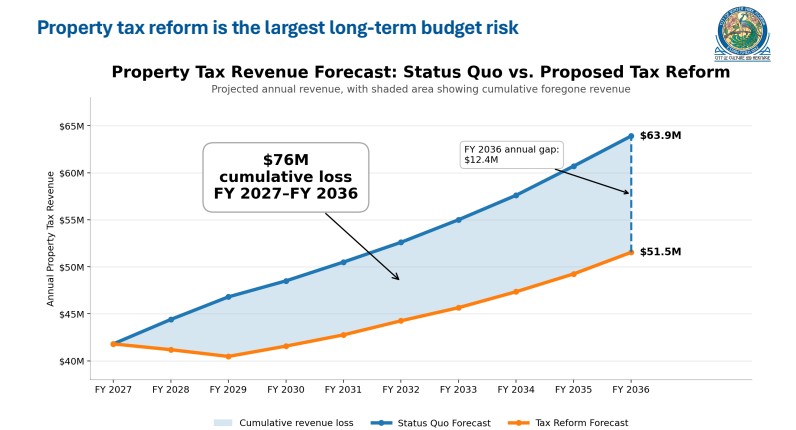
A graphic from the city’s budget presentation shows the potential cumulative effect of the property tax measure on this November’s ballot.
In addition to public safety costs, roads emerged as Winter Park’s other main budget priority this year.
That’s the result of a survey of residents with about 800 responses that identified the quality of both brick and asphalt streets as a major need for improvement.
“This has been an area in which funding has been added in the past, but it has been insufficient to keep pace with the level of street deterioration and the cost of repairs,” read the budget memorandum.
The budget includes more money for contractors to resurface roads and doubles the amount for road materials with an additional $500,000. Winter Park has fallen short of its own goal of redoing 9 lane miles o road each year, typically completing just 4 or 5 lane miles with the exception of in 2025. The new goal will be to achieve repaving of 7.5 lane miles each year.
City Commissioners are slated to vote on the property tax rate this afternoon. More discussion and debate over the full proposed budget is scheduled for August with a final budget vote in September before the start of the new financial year in October.
WinterParkVoiceEditor@gmail.com
What about home rule? This whole idea of abolishing property tax in a state with no income tax is nuts. Where will the small towns and unincorporated areas get funds for their public safety and fire services? All of this lost income will be made up by sales tax? I’m tired of balancing budgets on the backs of workers who spend their entire paychecks, while second home owners will be able to put more in the bank. Common sense, people. The funds have to come from somewhere!
Maggie: Don’t jump! Keep passing the open windows. Second homes do not qualify for the additional exemption; only primary residences will qualify. The new exemption will not abolish property taxes. Property taxes will continue. Those living paycheck to paycheck in a home with a lower relative value would see the most significant relief.
I would just like to see our power lines buried like most others have. It seems to move further into the future every year. When they first were going to get it done in our neighborhood, I had a full head of black hair. Now I’m almost bald and grey.
Let’s be clear, the proposed amendment does not “abolish property taxes”, it simply increases the homestead exemption thereby reducing non-school taxes on homestead property. All other properties, including residential properties that are not owner occupied, will continue to pay taxes with no change. Let’s also be clear that while cities and counties boast that they have not raised the tax rate (millage) for many years, the actual tax revenue received and the taxes paid by every property owner has increased every year, usually from 3% to 10%. Winter Park and Orange County have enjoyed decades of steady growth in property values which funds ever growing budgets. I am not aware of any Central Florida city or county that rolled back the millage rate the past 20 years. Instead they all spend more money every year while pretending that taxes have not been increased. I am not a fan of this amendment but even if it does not pass I hope it is a wake up call to local government.
I smile when I read that taxpayers saving their money spent on taxes as a “cumulative loss” and a “budget risk” to WP. Who is losing and who is at risk?
By the way, Sanford, Florida has 67,000 residents and 130 sworn police officers. WP has 30,000 residents and 121 full-time police staff. hmmm….
The thought of no property tax is totally absurd. The money for all things besides or underpaid police and firemen won’t be there. Who’s going to take care of our parks and other common property. Who will get paid to collect trash and pave our roads mow city grass. What about street lights the list goes on and on what are people willing to do without.
The city’s budget has almost doubled since 2019, from $49.4M to $94M for 2027. This has far outpaced CPI (29%) and I’m sure
the wages of city employees. The projected $5.4M reduction is less than 6% of the general fund budget. I find it hard to believe the city can’t figure out how to reduce expenses by less than 6% on a budget that has almost doubled in the past 8 years. This is the very reason the governor is putting pressure on local municipalities. Their taxable property values have doubled and municipalities are spending all this extra money vs. being more prudent with their budgets.
I was on the fence on whether or not I was going to vote for the proposed property tax reductions until the municipalities started whining about how it would impact the services they provide, etc. It wouldn’t take a financial genius to figure out how to cut 6% from a budget that has doubled in the past 8 years. I did that for a living in private industry and I’d do it for free for The City of Winter Park.
The following quote from the article is significant: “With property tax reform on the horizon, having a quarter of the entire annual growth in revenue going solely to public safety pensions, is not sustainable.” Unlike many other things, public safety, police and fire are core government functions and I am a huge proponent of law enforcement and our fire department. But I am starting to wonder if these pension costs are out of line. This is a valid area of inquiry. I would support a leaner municipal budget and believe reasonable reductions in spending are possible. The budget has been far from spare, and they still can’t/won’t even fix the roads. WP spending and the pace of that spending have been robust. Government has few legitimate functions. Do those things well and spend less on the fluff.
What roads can’t/won’t be fixed? I drive every day, mostly in the southern part of the city. I call the streets dept whenever I see a big pothole. It’s fixed pretty quick. Public works budget has increased over 70% since 2020. What roads need to be fixed?
I am one of those considering relocating to WP. In my research I did notice a steady increase in property taxes more than doubling in the last ten years, mirroring what they do in Texas where I used to reside. I also did notice on my very recent exploratory visit many roads needing some TLC, especially some of the brick roads. If Paris, France, where I am from, can still have proper cobble stone streets still as beautiful as ever, how can a small community like WP not be able to handle a small task like that? Like some have questioned here, why is suck a large evidently expensive police force necessary for WP? I hardly (didn’t) noticed any of their presence in my recent visit. Why have city budgets more than doubled in the last ten years? Have your personal expenses and income also doubled accordingly? The library is beautiful but also worthy like the one in Austin, TX, a slight difference in size city. How are seniors treated with respect to local city property taxes?
Great comment Mark, I also had to address material cost/expenses in several fortune 50 firms. Painful, yes but have never seen an organization where a 15% reduction was not possible.
There is also the issue of unfunded pension liabilities. Commissioners don’t like to talk about this, when asked they often say they have a plan….yup close the gap. Does not help when adding police and fire staff….pensions are expensive.
I was surprised to read the incoming City manager will receive a $750 a month car allowance…..what happened to reimbursement for legitimate business miles?
When change is happening it’s always gloom and doom, seldom materializes.
Really Jack! You are worried about a car allowance for the senior most executive for the City of Winter Park? Good lord man, that is nothing compared to what a similar position in the private sector would expect in their overall compensation package.
I’m always curious when a corporate higher-up makes such a statement as, “…never seen an organization where a 15% reduction isn’t possible”, whether or not the commenter’s compensation or retirement funds where also cut 15% at the same time.