Is City Hall Favoring Developers Over Its Own Citizens?

Is City Hall Favoring Developers Over Its Own Citizens?

Denning-Area Neighbors Question City Priorities

City Residents Speak Out

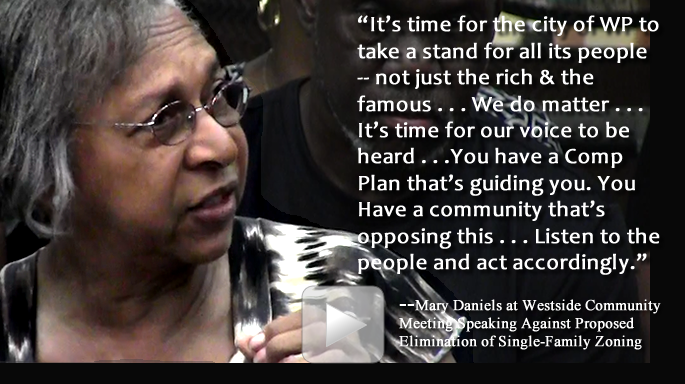
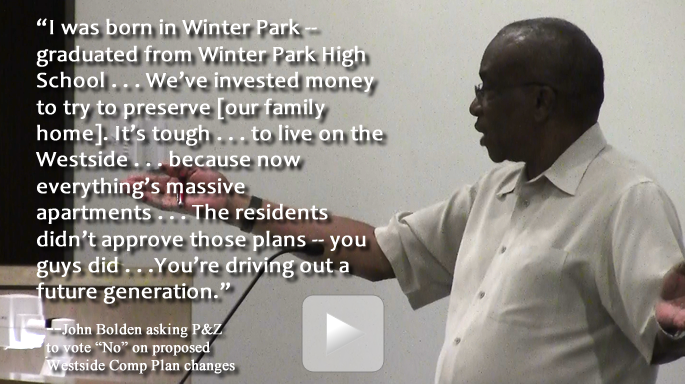
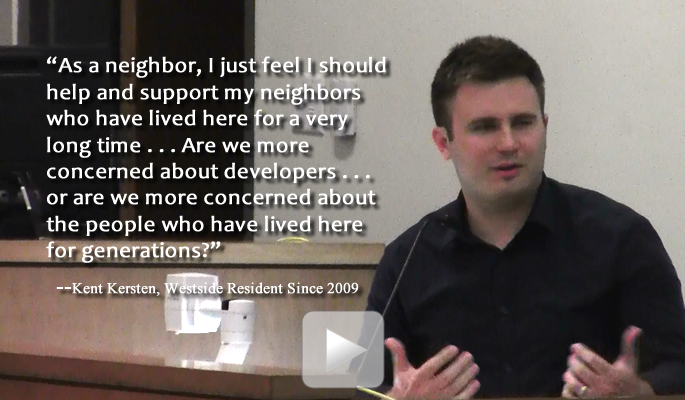
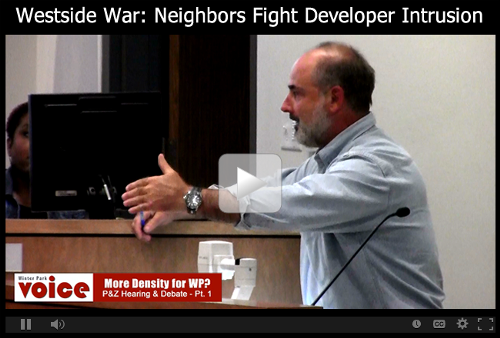
One evening in early April, residents of Winter Park’s Westside showed up in force at City Hall. In a strong showing of neighborhood solidarity, Westsiders attended the April 8 Planning and Zoning (P & Z) meeting to oppose another attempt by developer Dan Bellows to change the character of their neighborhood.

The neighborhood’s forceful response was triggered by a request from Bellows to modify City regulations to transform a group of single family residential lots into a high-density, high-priced residential development.

Denning Area Neighborhoods On Edge as Fear of Encroachment Spreads

Winter Park residents in other neighborhoods near Denning Drive are also becoming concerned about the impact of area development on their neighborhoods. Mary Randall, who lives on Kentucky Avenue near the proposed baseball stadium — just off Denning Drive — urged the city to reconsider its stance on area development:

“There’s so much at stake here . . . We are a small town . . . You’re turning this into something that no one envisioned it to be . . . When will it end? When will we stop taking away our single family neighborhoods?”

–Mary Randall, WP Resident Since 1987

Mayor Bradley has characterized Denning Drive as a “Hot” development corridor. Bradley has been generally supportive of developer initiatives that have put city residents on edge. Bradley’s employer, Florida Hospital, has made large investments in hospital-related development throughout Central Florida.

City Too Cozy with Developers?

Westside residents have long decried what they see as a too-cozy alliance between the City and developers — an alliance that is transforming their historic family neighborhood into a target-rich development zone for profit-seekers. Two of the highest-profile proposals recently considered by the City are the Lee Road Cut-Through on one end of Denning and the Rollins/Manatees Baseball Stadium on the other. Wealthy backers of the Stadium project are working with the City to tap taxpayer dollars that are earmarked for redevelopment of the Westside.  There is strong support inside City Hall for the Stadium and the Cut-Through.

Residents: Enough!

Westside residents and those from nearby neighborhoods have recently begun to organize resistance to projects like the Cut-Through and the Baseball Stadium. Recent hearings and community meetings have been roiled by strong protests by citizen groups.

Westsiders, who have, for years, lived with the threat – and the consequences – of City-enabled development, are leading the way for other neighborhoods who feel that new and proposed development may gridlock their city streets, crowd the skyline with towering buildings and permanently degrade their quality of life.

Has City Abandoned Its Community Plan for Affordable Neighborhoods?

In 1999, A Westside Community Plan entitled “A Report by the Westside Neighborhood Housing Task Force, 1998-1999” outlined what the community wanted to see in the 21st century. One of the goals stated in the report is “To increase the desirability and variety of residential housing opportunities for Westside residents by rehabilitating existing, viable dwellings, refining the city’s Affordable Housing Program and by attracting market-rate residential development that would be appealing to moderate-income families. The needs of current residents, including elders, shall be a priority.” (page 8 “Moving into 2000: Westside Community Plan).

Fourteen years into this century, some of the goals have been achieved, but the vision to preserve affordable single family homes may be fading. With the nation’s economy now emerging from a period of stagnation, developers’ requests to transform this neighborhood are now high on the agendas of the Planning and Zoning Board and City Commission.

Low-Density, Low-Traffic Community Plan Undermined by Developer Interest in More Profitable Higher-Density “Products”

Rather than regarding this section of Winter Park as preserved for affordable housing, some developers see the neighborhood and adjacent areas as a prime location for upscale development “products” that would appeal to a new wealthier clientele who want to live close to downtown Winter Park.

Unicorp, the developer of the new “Lakeside” retail center at Morse and 17-92, also has indicated interest in building a mixed-use (commercial/residential) project between Denning and 17-92 on the site of the Mt. Vernon Motel.

Casto Properties, developer of Winter Park Village, is completing construction of a multi-story (200+) luxury apartment complex (including parking garage) on Denning next to the Village — and is reportedly eyeing the VoTech property on Denning next to the proposed Lee Rd. Cut-Through.

Bellows Moves to Revise the Comp Plan

Developer Dan Bellows’ April 8 request to change the Comprehensive Plan to allow rezoning and consolidation of 8 lots from single family residence (R-1) to high density multi-family homes (R-3 and R-4) would affect land on the Westside bordered by Canton, Capen, Swoope and Denning.

If Bellows’ request is granted, the allowed density would increase from 8 free-standing single family homes to something between 20 and 32 attached units. Although the exact number of units has gone back and forth during discussion, if the project is approved, the end result would significantly change the character of that part of the Westside.

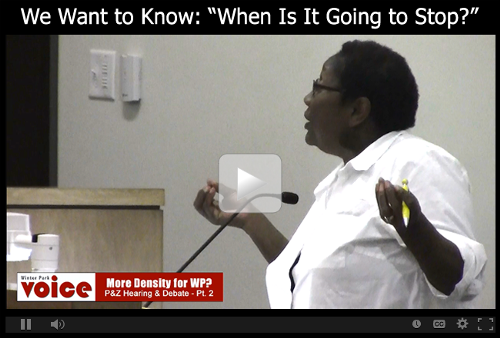
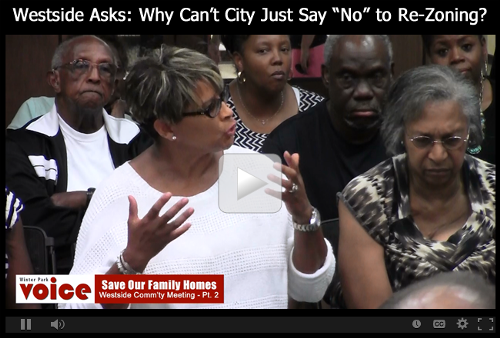
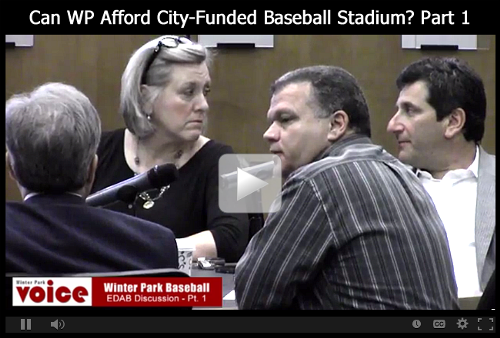
(Click video image above for Part 1 of P&Z hearing. Click video images below for Parts 2 & 3) 

The proposed changes would require the City to make three revisions to the Future Land Use Policies in the Comprehensive Plan. Policy 1-3.8.4 states, “The City shall encourage single family detached homes as opposed to apartments and condominiums by strongly discouraging Future Land Use Map amendments.”

Bellows’ Sydgan Corp. has requested this provision be amended to read, “unless such development is abutting (“abutting” shall include property separated by a right-of-way or alley) or within 100 feet of a parking garage or commercial building.” Bellows built a parking garage on the adjacent property in 2007. The Atlantic Housing Senior Living Facility — a commercial rental property — also sits on the bordering property.

Comprehensive Plan Policy 1-4.1.H-3 reads: “This policy is a part of Planning Area H: Hannibal Square Neighborhood. Restrictions on Multi-family Development. The City shall strongly discourage Comprehensive Plan Amendments from Low-Density to Medium-Density or High-Density Residential Future Land Use Map designations.”

Rather Than Deny Bellows’ Request, City Staff Recommends High-Density Compromise

When Director of Planning Administration Dori Stone explained these requests to the P&Z Board, she reported that the staff had recommended a compromise. City staff thought building a single family home next to a parking garage would be “a hard sell,” so they recommended the property adjacent to the garage be rezoned to R-3 rather than R-4, and that a “step-down” approach in height requirements be allowed — three-story buildings “in the shadow of the garage,” but stepping down to two-story R-2 zoning along Canton and maintaining the R-1 zoning along Capen. In this scenario, density would change from 8 single family homes to 20 townhomes (P&Z video part 1 – 6:00).

Bellows Claims Garage Justifies Comp Plan Revisions — Westside Residents Disagree

During the April 8 hearing, Westside residents argued that the presence of the parking garage in no way justified the proposed changes. Canton Avenue resident Mary Daniels explained that the parking garage replaced single family homes (P&Z video part 2 – 21:05) asking, why, when there were single family homes on the properties, did the current R-1 zoning not prevent the approval of the garage?

Linda Walker Chapell strongly criticized the City for considering Bellows’ request saying “The staff recommended that this property . . . be allowed to have a zoning change because of the garage . . . We didn’t want that garage . . . We told [ the City ] that we didn’t want it.”

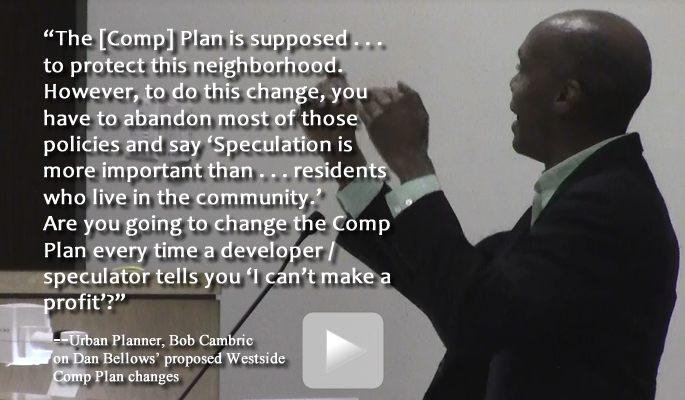
Bob Cambric, a former Westside resident who earned a Master’s Degree in Urban & Regional Planning and has 25 years’ experience in the field, spoke on behalf of his hometown neighbors. He argued the City should not alter its Comprehensive Plan in this piecemeal fashion. He said, “Winter Park is one of the best planned communities of the 472 cities in the state of Florida. You have a plan that has gotten you there.”

Cambric explained that the policies in place are there to protect the Hannibal Square Community, but if the proposed changes are approved, the City must abandon those policies. (P&Z video part 2 – 00:00)

A source close to the development community told the Voice that developers have interest in building multi-story town houses on Canton all the way from Denning to Park Ave.

Developer’s Westside Story: We Want to Build $500,000 Townhomes
— Single Family “Doesn’t Work” For Us

In an attempt to gain P&Z board support for his proposed development, Mr. Bellows’ called on Kevin Kramer, a representative of David Weekley Homes, to describe the “product,” that is, the type of home they intend to build.

Although Kramer did not show any elevations or images of the proposed “product”, he explained that feedback they have received from realtors is that high-density attached townhomes would appeal to empty nesters who would like to live near the Winter Park Village and the downtown area. They have planned accordingly for a series of 2,000- to 2,500- square-foot town homes, each with a two-car garage, in the price range of $400,000 to $600,000 (and up). (P&Z video part 1 – 41:11).

P&Z Tells Bellows & Westsiders to Resolve Differences

In response to community opposition, the P&Z Board concluded the meeting by tabling the proposal and directing the interested parties to meet to discuss their issues. P&Z board member Tom Sacha asked the residents to develop an alternative to Bellows’ plan so that the property in question does not remain vacant for an indefinite period of time. Mr. Bellows promised to attend and to bring illustrations/elevations showing the townhomes he wants to build.

Westside Holds Meeting to Discuss Differences: Bellows a No-Show

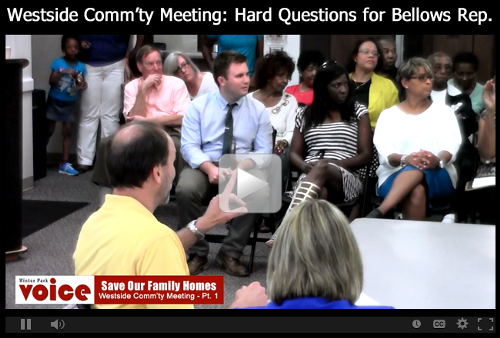
A special meeting between Dan Bellows’ Sydgan Corp. and Westside residents was held on April 24 at the Winter Park Community Center.

Westside residents attended — along with Dori Stone and Jeff Briggs from the City. Mr. Bellows, however, did not attend. Instead, he sent his lawyer and the representative from David Weekley Homes to represent him. His representatives did not have the drawings of the proposed townhomes Bellows promised. Bellows’ failure to appear and his failure to produce the promised drawings angered Westside attendees.

Bellows Submits a New Plan

At a subsequent April 29 P&Z Board work session, Ms. Stone reported that Bellows had submitted a new set of plans. She made it clear, however, that in light of the community’s strong opposition to any departure from R-1 zoning, she doubted that Mr. Bellows’ new plan would mitigate Westsiders’ fear of the impact it will have on their neighborhood.

Requested Comp Plan Revision Could Spell Trouble for Rest of Winter Park

If Bellows’ request is granted, revisions to the Comprehensive Plan would be permissible wherever a parking garage is built. For instance, if a parking garage were added to the YMCA facility on Lakemont, the Comp Plan changes requested by Bellows could be used to justify the building of high-density townhomes on the properties adjoining the YMCA along Palmer and Lakemont.

If a minor league baseball stadium is approved for Harper-Shepherd Field on Denning, City officials are planning to fund a parking garage as part of the stadium project. Mr. Bellows’ requested Comp Plan changes could open the door to developer interest in building similar high-profit, high-density housing “products” near a new stadium garage – a scenario envisioned by Urban Planner, Bob Cambric. During his testimony at the April 8 P&Z hearing, Mr. Cambric asked: “Who else’s neighborhoods are going to be in jeopardy because they happen to have a parking garage nearby?”

“Which side are you going to be on?”

Another Westside resident asked P&Z board members: “When is it going to stop?” As she named streets in Winter Park’s wealthier neighborhoods, she asked board members to consider how they’d feel if multi-family projects were built in their neighborhoods. She then appealed to the board to communicate citizen concerns to the City Commission, concluding: “We all live in Winter Park . . . It’s not a matter of the Haves or the Have-Nots. I ask which side are you going to be on?”

To comment or read comments from others, click here →

Lee Road “Punch-Through” Travels a Long and Winding Road

Lee Road “Punch-Through” Travels a Long and Winding Road

In response to citizens’ questions about the planned extension of Lee Road through to Denning Avenue, the Mayor, Commissioners and City Manager maintain that the decision is “out of their hands” and will be decided by the Florida Department of Transportation (FDOT).

The Lee Road extension has languished on FDOT’s priority list since 2004. With developments popping up like mushrooms in northwest Winter Park, however, there is renewed interest in reconfiguring the intersection of Lee Road and 17-92 and extending Lee Road through to Denning Drive.

MetroPlan Orlando, City Officials, Experts & Citizens Guide FDOT Decisions

FDOT Public Information Specialist Jessica Keane was willing to shed some light on how this process works, explaining that the planning process begins not with FDOT, but with MetroPlan Orlando (MPO), the “metropolitan planning organization for Orange, Osceola and Seminole Counties – the Orlando Urban Area — and provides the forum for elected officials, their staff, citizens, and industry experts to work together to improve transportation in Central Florida.” FDOT only adds projects to its priority list which are first recommended to them by MPO.

MetroPlan Website

The MPO Board is made up of 25 mayors, commissioners and various officials from transportation agencies. Serving on the current board are the mayors of Altamonte Springs, Apopka, Kissimmee, Orlando, Orange County, and Sanford. While Winter Park has no representation on the MetroPlan board, Mayor Kenneth W. Bradley, with City Manager Randy Knight as his alternate, sits on the 15-member MPO Municipal Advisory Committee, which makes recommendations to the MPO for their consideration.

MetroPlan Advisory Committee

Lee Road #10 on the Priority List

The MPO creates a Prioritized Project List for the FDOT. The current list, dated September 11, 2013, puts the Lee Road extension at #10. The components of the project currently unfunded include the preliminary engineering design, construction and right of way acquisition.

MetroPlan Project List

Frank J. O’Dea, P.E., Director of Transportation Development, Florida Department of Transportation, District 5, provided the Voice a copy of the 2004 Project Development and Environmental Study (PD&E) concerning the Lee Road extension. The 2004 PD&E contains the history of this road extension proposal, and it makes clear that the City of Winter Park was a full partner in the decision to add this project to the priority list.

City Gave Thumbs-Up to Punch-Through 10 Years Ago

According to Mr. O’Dea, officials of any city are actively involved in decisions concerning a road project that will directly affect that city.

For example, the 2004 PD&E includes a June 2, 2004, Memorandum of Understanding between the City of Winter Park and FDOT, signed by then Mayor Kenneth Marchman, which states, “. . .the parties hereto mutually agree that the extension of Lee Road to Denning Drive and the improvements to 17-92 from Norfolk Avenue to Monroe Street, will benefit the traveling public and will enhance the transportation system in the area.”

City/FDOT Memo of Understanding

O’Dea explained, “Since the PD&E is several years old, the Department would need to update the traffic reports that formed the basis of the PD&E to see if the assumptions made at that time revealed the same conclusions. Since there is some renewed interest in this project, the Department is moving ahead with the traffic reevaluation.”

Large Turn-Out for 2003 Hearings

According to the 2004 document, public workshops and hearings were held to give residents and businesses an opportunity to voice their opinions. The first public workshop, held April 23, 2002, was attended by 41 people who expressed no opposition to the project. At a second Public Workshop on May 8, 2003, however, at which 81 residents were present, “Opposition to the Lee Road extension was voiced by several members of the communities located near and north of Park Avenue and Denning Drive.”

On November 13, 2003, a formal Public Hearing was held, “which approximately 85 persons attended.” Written comments were submitted as part of the official public record, but those were not included in the PD&E provided to the Voice by FDOT.

FDOT PD&E Report

Ms. Keane acknowledged that turnouts, respectively, of 81 and 85 people are significant for a Public Hearing for a road project.

Controversy “Minimized”

Despite residents’ dissent, the conclusion drawn in 2004 through the Public Involvement portion of the study states: “FDOT developed the proposed project with input and consensus from representatives from local government agencies including MetroPlan Orlando, and the City of Winter Park, as well as from the general community. As a result of this extensive public involvement program, potential public controversy was minimized.”

Ten years later, MetroPlan Orlando Executive Director Harold Barley wrote in an email, “We have a long-standing interest in addressing the traffic congestion on US17-92 between Webster Avenue and Lee Road. The current Webster Avenue-Lee Road configuration is the cause of the problem and earlier work concluded that the only effective fix was the Lee Road extension.

MetroPlan Director: New WP Development Is “Good Reason” to Consider Accelerating Punch-Through

“At the rate things are going with federal and state funding for projects such as this, it’s going to take a number of years to get to this one. I’m not aware of any current activity on the project — but the new development that’s underway on both sides of US17-92 in that area gives us a good reason to dust off plans and to bring some people together to see where things stand, how current development plans fit with earlier work . . . and to see if things might possibly be accelerated.”

Sprinkel Opposes Lee Road Extension

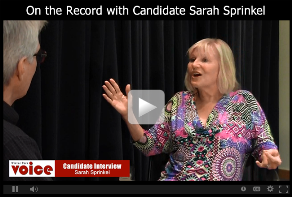
In a recent interview with the Voice, Commissioner Sarah Sprinkel stated, “I don’t support a punch-through. . . I don’t want to make it easy to have a big flow-through there [ at Denning ].” (See Video @ 14:00)

McMacken Calls for Public Workshop

At the March 24, 2014, Commission Meeting, Commissioner Tom McMacken said that FDOT had stated their intention not to conduct a new PD&E. McMacken called for the city, the city’s traffic consultant and FDOT to hold a public workshop to inform citizens about the status of the Lee Road extension and to provide a forum for their comments. The commissioners did not reach any decision on the subject of a public meeting.

UP Developer Will Help Pay for Punch-Through If Necessary

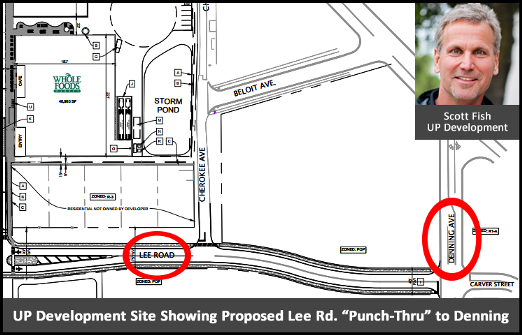
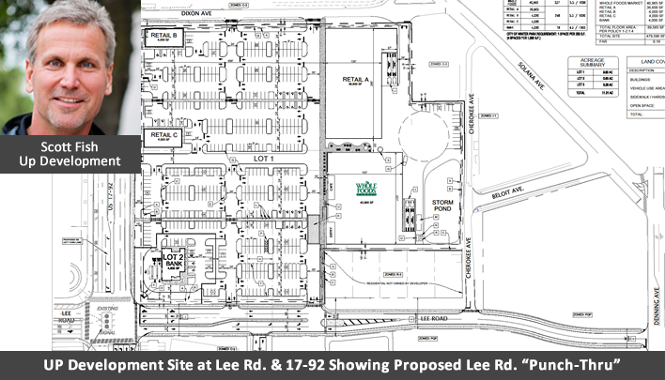
Asked whether he intended to donate right of way or funds to facilitate the process, UP Development’s Scott Fish wrote that his company “will provide any assistance necessary to provide proper access and circulation to this project [ UP Development at Webster and US 17-92 ] including the acquisition of ROW [ right of way ] and contributions to road construction cost.”

City Manager Randy Knight wrote that discussions with Mr. Fish about UP Development’s involvement in the road extension “are still ongoing.”

To comment or read comments from others, click here →

Commissioner Sprinkel Re-Elected

Commissioner Sprinkel Re-Elected

Tonight’s Vote Count: Sprinkel 2,549, Womble 1,571


3/11/14 — Winter Park City Clerk Cindy Bonham reminds citizens that these are “unofficial” results — adding that “Any provisional ballots that cannot be handled the night of the election will be made part of the official results at the time of certifying on Thursday, March 13.”

 March 6 Winter Park Library Debate (click image for video)
 
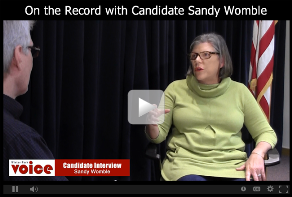
Exclusive One-On-One Candidate Interviews (click image for video)


Website (click image)

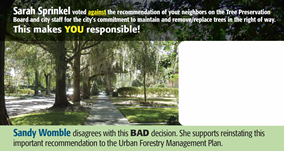
Why Sarah Sprinkel? (from campaign website)


“I have decided to run for reelection to the Winter Park City Commission-Seat 2 to continue my leadership in the Winter Park Commission. I have been a strong leader in the Winter Park community as commissioner for three years, and the last three years have been very rewarding for me and for Winter Park. As a city, we are financially sound, and I would like to continue to improve our services while not raising your taxes. I ran three years ago to create a more cohesive atmosphere with people and programs, and successfully achieved this vision. With your help, we can achieve this vision for another three years.”

Website (Click image)

Why Sandy Womble? (from campaign website)


“Sandy Womble is committed to putting community first. She is an independent thinker whose priorities are to make sound decisions for Winter Park. She believes in applying the rules fairly and being a disciplined steward of your tax dollars . . . Sandy is committed to maintaining Winter Park’s unique charm. She understands our community character is the end result of thoughtful regard of our homes and tree canopy. She brings fresh ideas and balance to the dais. As an independent thinker, her priority will be to make decisions representative of the community.”


Campaign Video

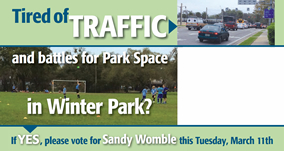
Campaign Mailers & Palm Cards


Sprinkel Platform
(provided to Voice by candidate/campaign)


Statement from Sarah Sprinkel
“I’ve learned over last 3 years serving as a city commissioner . . . that it’s not about me- it’s about our community and a collective us. While I may have strong ideas about a certain topic, the overall health of our city is always first.

My personal goal is to continue working with the city and the community to make information and goals more accessible so that the picture of our entire city is easy to understand, see, and evaluate. I want all we do to fit into a schema so that our success can be measured and noted.”

Statement from Campaign
Sarah stands on her record as Commissioner where she has studied each issue carefully, listened to citizen input, and made thoughtful decisions based on what she determined was in the best interest of the City. She supports: Holding the line on taxes; Dynamic business community; Sound fiscal management; Protecting the City-wide tree canopy; Preservation of the quality of life in Winter Park; and Strong citizen boards who study issues and make recommendations to Commission.

Womble Platform
(excerpted from campaign website)


Urban Design
Community Character
–I support good urban design that promotes both economic growth and management of our historic resources. **
–I support the view that Preservation & Growth are friends, NOT rivals. **
–I support conducting a public hearing of the Professional Historic Preservation Consultant’s findings and upgrading our historic preservation ordinances.
–I support our Comprehensive Development Plan that guides development within Winter Park and evens the playing field between developers.

**Bland Report Submitted to the City of Winter Park, November, 2013.

Park Avenue & City Wide Merchants
–I support the development of corridors leading into Winter Park in alliance with our independent businesses. (Fairbanks/Aloma, New England, Lee Road, Hwy 17-92, Denning and Morse Avenues).
–I support that independent storefronts and eateries are Winter Park’s unique trademark, especially along Park Avenue.

Family Safety
Bike & Pedestrian Friendly City
–I support seeking out private, state and federal funding to grow our pedestrian walkways and bike lanes.
–I support partnering with citizen driven initiatives like the Cady Way bike lane improvement.
–I support the Sustainability Action Plan devised by City staff. It is our road map for future sustainable initiatives.

Central Florida Commuter Rail
–I support our regional partnership for the CFCR initiative.
–I support implementing the best equipment for public safety and quiet zones.

Environment
Greener Winter Park
–I support our diverse tree canopy and the promotion and planting of city orchards.
–I applaud the rebirth of Mead Gardens and I support building on their energy. Let’s implement community gardens throughout the city on unused city property. I’d like to explore using the Hannibal Land trust to purchase land for gardens. –I support the green roofs initiative.

Fleet Peeples Park
As many know, I was a defender of the dog park. A small group of us successfully fought to keep the park’s dog friendly status. This park is one of the finest in the country; a true community spirit exists here.

Comprehensive Plan
I respect our Comprehensive Plan and support sensible development inside our boundaries. We have plenty of unfinished projects and more to come. Being mindful of our comprehensive plan when making policy decisions on growth is paramount.

Campaign Finance Reform
I support opening the playing field for future candidates. Let’s encourage residents to run for office.

The costs to run a campaign are ridiculously out of control in Winter Park. Why should a candidate have to spend $50,000 for a campaign? I am interested in studying the feasibility of restricting business donations to broaden the public arena of decision-making. Corporations and banks aren’t people.

Transparency
–I support Commissioner Bridges’ policy to list on the city website her private meetings. I think it’s a sound transparency policy and I intend to copy her.
–I support providing an easily accessible means for citizens to view proposed and passed city ordinances as well as commissioner votes on such ordinances.

Transportation & Downtown Parking
–I support another public/private partnership like the Park Place garage to offset parking.
–I support upholding the concurrency requirements for parking in our Comprehensive Plan.

Citizen Advisory Boards
Good Government
–I support Winter Park instating a Certified Local Government (CLG) status to enable us to compete successfully for limited funds available only to CLG cities. To achieve this status we must reinstate professional qualifications for certain boards.
–I support an application process that assures board membership of qualified electors and full-time residents of the city (unless there is a statute that requires otherwise) at the time of appointment and during their entire incumbency. –I support that all members of Boards making quasi–judicial decisions that bind the city sign a conflict of interest form.


To comment or read comments from others, click here →

From Budgets to Baseball: Candidates’ Debate Covers It All in 60 minutes

From Budgets to Baseball: Candidates' Debate Covers It All in 60 minutes


Click Image Below for Debate Video.
 
by Anne Mooney

Despite the dreary weather and with less than a week to go before next Tuesday’s decision on who will occupy Commission Seat #2, concerned Winter Park citizens filled the Public Library community room on Thursday to hear candidates Sarah Sprinkel and Sandy Womble hammer the planks into their respective platforms. After the candidates’ opening remarks, moderator Laura Turner presented questions from the audience and each candidate had 90 seconds in which to respond.

Although audience participation was robust and there was no shortage of 3 x 5 index cards being handed to Turner and her helpers, the questions seemed to center on the same six issues — historic preservation, tree maintenance, the city budget, civility at city hall, whether baseball is appropriate for Winter Park, and the quality of life as it is impacted by development, density and the resulting traffic.

Predictably, both candidates vowed they would not raise taxes and would be scrupulous about fiscal responsibility; there was no discussion of whether there are any Winter Park citizens who might be willing to pay a little more if it would make their lives more quiet and less congested.

There did seem to be some divergence on the subject of historic preservation. Asked about the recent consultant’s report about the Historic Preservation ordinance that is currently on the books, Sprinkel stated that she did not want to “take away [ people’s ] right to vote,” implying that a stronger historic preservation ordinance might restrict the rights of property owners. Womble, on the other hand, stated that she would like to see the ordinance strengthened and that she thought members of the Historic Preservation Advisory Board should all be Winter Park citizens.

Based on the performance at the library, it seemed each candidate would independently vote her conscience, each would protect the tree canopy, protect park land, foster citizen participation in city government and promote civility at City Hall. The question seems to be:  three years’ experience on the dais at City Hall, or a fresh perspective? The answer will reveal itself on Tuesday, March 11.


To comment or read comments from others, click here →

Will Winter Park Play Ball?

Will Winter Park Play Ball?

Possible Stadium Deal Has Potential to Fast-Forward Development of NW Winter Park – including Lee Rd. “Punch-Thru” to Denning Dr.

Minor League Baseball, in the form of the Brevard County Manatees, is being batted around the City Commission Chambers once again.

On January 21, the Economic Development Advisory Board (EDAB) joined Mayor Bradley and city officials in an in-depth discussion of stadium-building and related development in and around Denning Drive and 17-92.

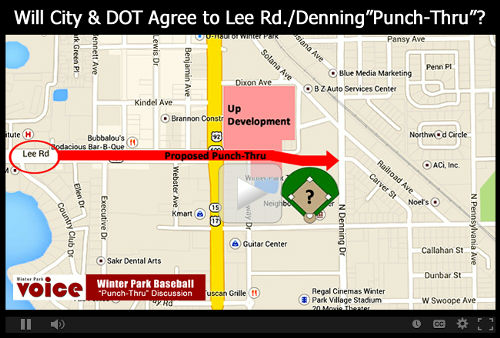
Included in the discussion was the possibility of a developer-driven revival of the Dept. of Transportation’s long-planned “Punch-Thru” of Lee Road to Denning Drive. Click video image below to see the “Punch-Thru” excerpt from the 1/21 EDAB hearing.

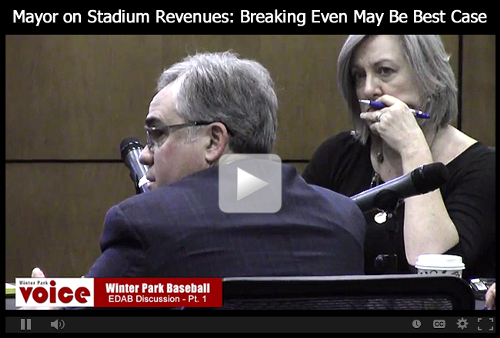
Mayor Bradley opened the discussion by characterizing the proposed baseball stadium as a “generational opportunity” for Winter Park. Mr. Bradley, City Manager Knight, Economic Development Director Stone, EDAB Chair Reicher and Chamber CEO Chapin were prominent participants in the discussion. Click the video image above to see the entire baseball discussion (parts 1 & 2).

The Manatees, or the “Tees,” as they are affectionately known, are currently using the 8,100-seat Space Coast Stadium in Viera, which is too large, both for the intimate nature of minor league baseball and for the declining wealth and population in Brevard County brought on by the withdrawal of the NASA space program.

The Manatees are an “Advanced A” or “High A” level team that is part of the 12-team Florida State League. Their major league affiliate is the Milwaukee Brewers.

The ‘Tees are now looking inland to greater Orlando which, according to the Madison Consulting Group, who prepared a Facility Assessment study for the City of Winter Park, “is currently the largest market in the country without regular season-affiliated professional baseball.” While the market area is Central Florida, Winter Park is squarely in the cross-hairs for targeting a stadium location.

Madison Group Stadium Facility Assessment

At the January 13, 2014, City Commission meeting, City Manager Randy Knight requested and the Commission authorized a 45-day period to further study the feasibility of bringing minor league baseball to Winter Park.

City Staff: Give Us Five Months to Negotiate Best Deal for City.

As the 45-day review period draws to a close, the Commission has scheduled a 4pm workshop meeting for Monday, February 17, to consider a newly-released staff report that recommends moving forward with negotiations. City staff envisions a 5-month evaluation process ending in August, at which time “staff hopes to be in the position to make recommendations that will include whether or not moving forward makes sense and if so, a ranking of the sites, how the stadium project could be funded, proposed deal terms/agreements and who should throw out the first pitch.”

Staff Baseball Stadium Analysis

Rollins’ Harper Shepherd Field Back in Play as Possible Stadium Site.

Earlier this year, Rollins College was negotiating possible equity partnership in the minor league baseball effort, but the Rollins Board of Trustees voted to withdraw because of the expense of reorienting and enlarging Harper Shepherd Field and because they felt unable to meet the Manatees’ schedule requirements of a 2015 opening. Rollins subsequently expressed interest in “becoming a tenant” if a new stadium is built. But now, Rollins has re-emerged as a possible partner to the City and the Manatees. The new city staff report acknowledges that “after discussion with Rollins representatives, the Harper Shepherd Field site was added back as a potential site.”

City “Tree Farm” on Lee Rd. Eliminated as Stadium Site.

While suggesting that “other sites could surface as feasible during the next phase of the study if we proceed,” city staffers reversed course on the tree farm – eliminating the city-owned property “as a potential stadium site at this time” explaining that “lack of good access, visibility and the neighborhood impacts led staff to remove that site from current consideration.”

Stadium Economics 101: What Are Costs/Benefits?

As of now, the current “short list” of sites includes Martin Luther King, Jr., Park on Denning, the Ravaudage development on Lee Road, the current site of the VoTech school on Webster & Denning and Harper Shepherd field.

The city staff report’s cursory financial analysis of each site indicates that the “Funding Gap” in each case – the funds needed to develop a site in addition to the dollars contributed by the principals – ranges from $11 million (Harper Shepherd) to $35.5 million (Ravaudage).

During the 1/21 EDAB workshop, Mayor Bradley commented on possible stadium “income streams” including ticket sales, naming rights, concessions, lease revenue and event revenue among others.

He summed up the project’s net benefit by concluding that “First and foremost, the economic benefit that comes from a place like this is outside the park . . . I think if most municipalities figure out a way to have some return and/or break even for the amenity, they probably are ahead of the game.” Click video image above to see EDAB discussion of potential stadium revenues.

Are MLK Park and Votech at Webster & Denning the Most-Favored Stadium Sites?

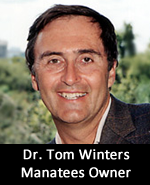
The “team” of major players that is beginning to coalesce around the Manatees’ relocation to Winter Park includes Manatees owner and local orthopedic surgeon, Dr. Tom Winters; Scott Fish, principal of Nashville-based UP Development – developer of the Lee Rd./17-92 Corporate Square site which will include the new Whole Foods Market; Tennessee native David S. Freeman, part owner of the Nashville Predators hockey team; Rollins College; and, the city of Winter Park.

In his January 30 email to Scott Fish, City Manager Randy Knight updates the developer on stadium funding progress and negotiations with Orange County concerning acquisition of the VoTech site:

“We have made some additional progress since our last discussion. We have explored a few different ways to plug our funding gap and while we don’t have it all figured out yet we have learned a lot. I have had conversations with the Orange County School board employee in charge of facilities and he has committed to me that he would let me know by the end of next week what the options would be to acquire the property as well as what the process would be.”

Knight/Fish Email

>>Click UP Development image below to see full site plan.

Will Developer Interest in Lee Rd. “Punch-Thru” Influence DOT Plans?

On February 12, Randy Knight responded to questions from the Winter Park Voice, explaining the City’s approach to UP Development and clarifying ownership of the Manatees – including Mr. Freeman’s possible involvement.
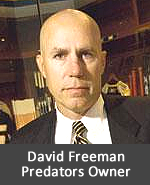
In his emailed response, Knight wrote, “I am the one who pitched the idea to Mr. Fish about considering a stadium as part of his development . . . Dr. Tom Winters continues to be the owner. A gentleman by the name of David Freeman has an option to buy a portion of the team from Dr. Winters.”

Dr. Winters and potential owner David S. Freeman appear to favor locating the stadium either in MLK Park or on the present Votech school site. Mr. Freeman wrote in an email to Mayor Bradley and City Manager Knight, “First, Tom is supportive and enthusiastic regarding the “school” site. Thus, as long as the City can acquire title to the site without any strings attached, we would be happy on that site.”

Freeman Email to City

Déjà Vu All Over Again: Predators & UP’s Scott Fish Partnered In Nashville-Area Stadium Project.

David Freeman and Scott Fish may have an opportunity to team up again if Winter Park chooses to build a stadium on the VoTech site next to Fish’s Up Development site. In recent years, Fish and investor David Freeman’s Predators worked together to keep the Franklin, Tennessee A-Game Sportsplex near Nashville afloat. Freeman also poured millions into the Predators hockey franchise. The Predators play at Bridgestone Arena in downtown Nashville, a few miles from the Grand Ole Opry.
As reported by Tennessean online news in April 2012, David Freeman “spearheaded the purchase of the team in 2007 to prevent it from being sold to a Canadian businessman intent on moving the Predators out of Nashville, [ and ] remains a member of the ownership group. Click to read Tennessean article.

Scott Fish’s WordPress blog describes his arena-saving investment in the A-Game Sportsplex as one of his “most significant accomplishments” explaining that the arena was “was losing around $30,000 per month. The 110,000-square-foot facility was on the verge of closing down, so I purchased it for $6 million . . . My daughter’s hockey team, along with a handful of others, was playing there. With the looming shutdown, all those players would have had to find a different home base. I also saw that the arena could be turned into something that benefited the entire community.”

Click HERE and HERE to read more about Scott Fish $6 Million A-Game Sportsplex investment.

UP Development’s Scott Fish Expands His Orlando-Area Real Estate Holdings.

Mr. Fish specializes in rehabilitating distressed properties and has acquired under-performing Orlando-area properties in recent years, including the Fashion Square Mall, Toys-R-Us and the Robb & Stucky store in Altamonte Springs – a property he recently sold to the Florida Conference of Seventh-day Adventists, who will relocate their Winter Park headquarters there.

UP Development’s website describes the company as a “premier retail developer focused predominately in the Southeastern United States. With over 20 years of experience. UP Development has positioned itself as a go to shop for developers, financiers, and owners with troubled assets that require creative and unique workout solutions.”

Click to see UP Development website.

Local Sports Enthusiasts See Minor League Baseball & Venue Events as “Affordable” Family Entertainment.

In an interview with the Voice, Bob King, Head Baseball Coach of Winter Park High School whose son Stephen has been playing in the minor leagues since 2006, observed that the minor league games provide affordable entertainment for families – often drawing crowds by including interactive events such as Bring Your Dog Night, or nights when kids in the audience are invited to come down on the field and run the bases. On off season evenings, minor league fields are often used for other cultural events, Coach King explained, like a symphony playing “Mozart on the Mound.”

Joey DiFrancesco, the Assistant Baseball Coach at Winter Park High, is also a big fan of minor league baseball. “As a teacher,” he told the Voice, “I am priced out of the Magic games for me and my kids . . . but if we had a minor league team, I would be the first in line.”

Winter Park Voice will expand its coverage of the UP development site on 17-92 and other Denning area developments – including the proposed stadium site search & negotiations – in future stories.

To comment or read comments from others, click here →