Will Winter Park Play Ball?

Will Winter Park Play Ball?

Possible Stadium Deal Has Potential to Fast-Forward Development of NW Winter Park – including Lee Rd. “Punch-Thru” to Denning Dr.

Minor League Baseball, in the form of the Brevard County Manatees, is being batted around the City Commission Chambers once again.

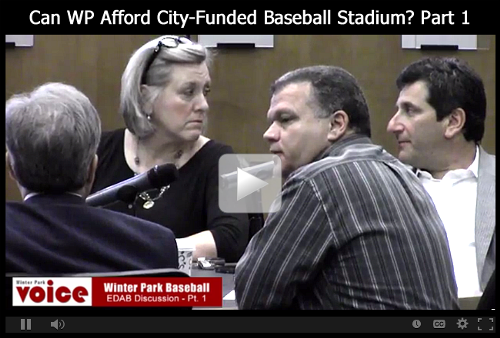
On January 21, the Economic Development Advisory Board (EDAB) joined Mayor Bradley and city officials in an in-depth discussion of stadium-building and related development in and around Denning Drive and 17-92.

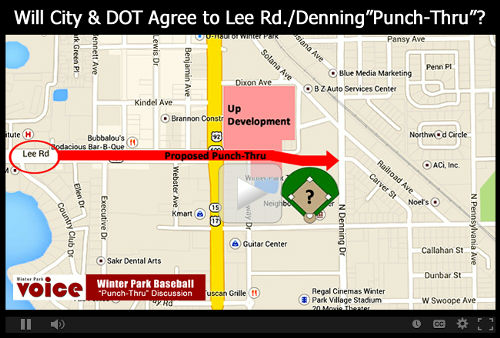
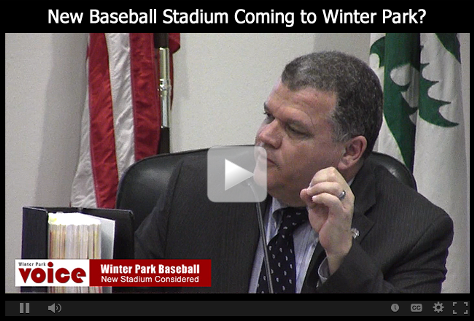
Included in the discussion was the possibility of a developer-driven revival of the Dept. of Transportation’s long-planned “Punch-Thru” of Lee Road to Denning Drive. Click video image below to see the “Punch-Thru” excerpt from the 1/21 EDAB hearing.

Mayor Bradley opened the discussion by characterizing the proposed baseball stadium as a “generational opportunity” for Winter Park. Mr. Bradley, City Manager Knight, Economic Development Director Stone, EDAB Chair Reicher and Chamber CEO Chapin were prominent participants in the discussion. Click the video image above to see the entire baseball discussion (parts 1 & 2).

The Manatees, or the “Tees,” as they are affectionately known, are currently using the 8,100-seat Space Coast Stadium in Viera, which is too large, both for the intimate nature of minor league baseball and for the declining wealth and population in Brevard County brought on by the withdrawal of the NASA space program.

The Manatees are an “Advanced A” or “High A” level team that is part of the 12-team Florida State League. Their major league affiliate is the Milwaukee Brewers.

The ‘Tees are now looking inland to greater Orlando which, according to the Madison Consulting Group, who prepared a Facility Assessment study for the City of Winter Park, “is currently the largest market in the country without regular season-affiliated professional baseball.” While the market area is Central Florida, Winter Park is squarely in the cross-hairs for targeting a stadium location.

Madison Group Stadium Facility Assessment

At the January 13, 2014, City Commission meeting, City Manager Randy Knight requested and the Commission authorized a 45-day period to further study the feasibility of bringing minor league baseball to Winter Park.

City Staff: Give Us Five Months to Negotiate Best Deal for City.

As the 45-day review period draws to a close, the Commission has scheduled a 4pm workshop meeting for Monday, February 17, to consider a newly-released staff report that recommends moving forward with negotiations. City staff envisions a 5-month evaluation process ending in August, at which time “staff hopes to be in the position to make recommendations that will include whether or not moving forward makes sense and if so, a ranking of the sites, how the stadium project could be funded, proposed deal terms/agreements and who should throw out the first pitch.”

Staff Baseball Stadium Analysis

Rollins’ Harper Shepherd Field Back in Play as Possible Stadium Site.

Earlier this year, Rollins College was negotiating possible equity partnership in the minor league baseball effort, but the Rollins Board of Trustees voted to withdraw because of the expense of reorienting and enlarging Harper Shepherd Field and because they felt unable to meet the Manatees’ schedule requirements of a 2015 opening. Rollins subsequently expressed interest in “becoming a tenant” if a new stadium is built. But now, Rollins has re-emerged as a possible partner to the City and the Manatees. The new city staff report acknowledges that “after discussion with Rollins representatives, the Harper Shepherd Field site was added back as a potential site.”

City “Tree Farm” on Lee Rd. Eliminated as Stadium Site.

While suggesting that “other sites could surface as feasible during the next phase of the study if we proceed,” city staffers reversed course on the tree farm – eliminating the city-owned property “as a potential stadium site at this time” explaining that “lack of good access, visibility and the neighborhood impacts led staff to remove that site from current consideration.”

Stadium Economics 101: What Are Costs/Benefits?

As of now, the current “short list” of sites includes Martin Luther King, Jr., Park on Denning, the Ravaudage development on Lee Road, the current site of the VoTech school on Webster & Denning and Harper Shepherd field.

The city staff report’s cursory financial analysis of each site indicates that the “Funding Gap” in each case – the funds needed to develop a site in addition to the dollars contributed by the principals – ranges from $11 million (Harper Shepherd) to $35.5 million (Ravaudage).

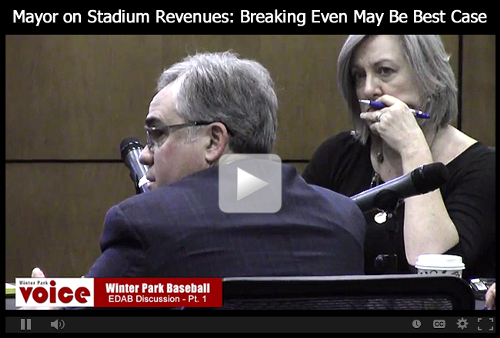
During the 1/21 EDAB workshop, Mayor Bradley commented on possible stadium “income streams” including ticket sales, naming rights, concessions, lease revenue and event revenue among others.

He summed up the project’s net benefit by concluding that “First and foremost, the economic benefit that comes from a place like this is outside the park . . . I think if most municipalities figure out a way to have some return and/or break even for the amenity, they probably are ahead of the game.” Click video image above to see EDAB discussion of potential stadium revenues.

Are MLK Park and Votech at Webster & Denning the Most-Favored Stadium Sites?

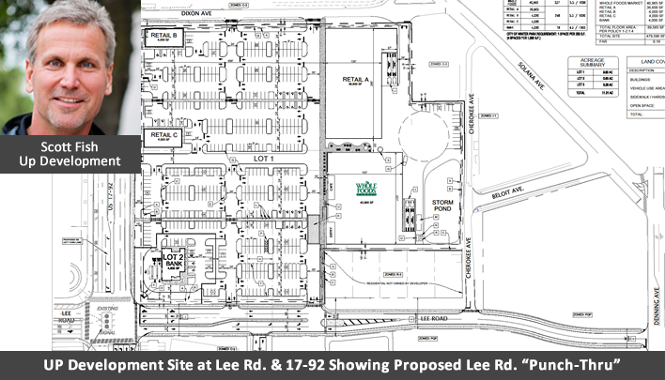
The “team” of major players that is beginning to coalesce around the Manatees’ relocation to Winter Park includes Manatees owner and local orthopedic surgeon, Dr. Tom Winters; Scott Fish, principal of Nashville-based UP Development – developer of the Lee Rd./17-92 Corporate Square site which will include the new Whole Foods Market; Tennessee native David S. Freeman, part owner of the Nashville Predators hockey team; Rollins College; and, the city of Winter Park.

In his January 30 email to Scott Fish, City Manager Randy Knight updates the developer on stadium funding progress and negotiations with Orange County concerning acquisition of the VoTech site:

“We have made some additional progress since our last discussion. We have explored a few different ways to plug our funding gap and while we don’t have it all figured out yet we have learned a lot. I have had conversations with the Orange County School board employee in charge of facilities and he has committed to me that he would let me know by the end of next week what the options would be to acquire the property as well as what the process would be.”

Knight/Fish Email

>>Click UP Development image below to see full site plan.

Will Developer Interest in Lee Rd. “Punch-Thru” Influence DOT Plans?

On February 12, Randy Knight responded to questions from the Winter Park Voice, explaining the City’s approach to UP Development and clarifying ownership of the Manatees – including Mr. Freeman’s possible involvement.

In his emailed response, Knight wrote, “I am the one who pitched the idea to Mr. Fish about considering a stadium as part of his development . . . Dr. Tom Winters continues to be the owner. A gentleman by the name of David Freeman has an option to buy a portion of the team from Dr. Winters.”

Dr. Winters and potential owner David S. Freeman appear to favor locating the stadium either in MLK Park or on the present Votech school site. Mr. Freeman wrote in an email to Mayor Bradley and City Manager Knight, “First, Tom is supportive and enthusiastic regarding the “school” site. Thus, as long as the City can acquire title to the site without any strings attached, we would be happy on that site.”

Freeman Email to City

Déjà Vu All Over Again: Predators & UP’s Scott Fish Partnered In Nashville-Area Stadium Project.

David Freeman and Scott Fish may have an opportunity to team up again if Winter Park chooses to build a stadium on the VoTech site next to Fish’s Up Development site. In recent years, Fish and investor David Freeman’s Predators worked together to keep the Franklin, Tennessee A-Game Sportsplex near Nashville afloat. Freeman also poured millions into the Predators hockey franchise. The Predators play at Bridgestone Arena in downtown Nashville, a few miles from the Grand Ole Opry.

As reported by Tennessean online news in April 2012, David Freeman “spearheaded the purchase of the team in 2007 to prevent it from being sold to a Canadian businessman intent on moving the Predators out of Nashville, [ and ] remains a member of the ownership group. Click to read Tennessean article.

Scott Fish’s WordPress blog describes his arena-saving investment in the A-Game Sportsplex as one of his “most significant accomplishments” explaining that the arena was “was losing around $30,000 per month. The 110,000-square-foot facility was on the verge of closing down, so I purchased it for $6 million . . . My daughter’s hockey team, along with a handful of others, was playing there. With the looming shutdown, all those players would have had to find a different home base. I also saw that the arena could be turned into something that benefited the entire community.”

Click HERE and HERE to read more about Scott Fish $6 Million A-Game Sportsplex investment.

UP Development’s Scott Fish Expands His Orlando-Area Real Estate Holdings.

Mr. Fish specializes in rehabilitating distressed properties and has acquired under-performing Orlando-area properties in recent years, including the Fashion Square Mall, Toys-R-Us and the Robb & Stucky store in Altamonte Springs – a property he recently sold to the Florida Conference of Seventh-day Adventists, who will relocate their Winter Park headquarters there.

UP Development’s website describes the company as a “premier retail developer focused predominately in the Southeastern United States. With over 20 years of experience. UP Development has positioned itself as a go to shop for developers, financiers, and owners with troubled assets that require creative and unique workout solutions.”

Click to see UP Development website.

Local Sports Enthusiasts See Minor League Baseball & Venue Events as “Affordable” Family Entertainment.

In an interview with the Voice, Bob King, Head Baseball Coach of Winter Park High School whose son Stephen has been playing in the minor leagues since 2006, observed that the minor league games provide affordable entertainment for families – often drawing crowds by including interactive events such as Bring Your Dog Night, or nights when kids in the audience are invited to come down on the field and run the bases. On off season evenings, minor league fields are often used for other cultural events, Coach King explained, like a symphony playing “Mozart on the Mound.”

Joey DiFrancesco, the Assistant Baseball Coach at Winter Park High, is also a big fan of minor league baseball. “As a teacher,” he told the Voice, “I am priced out of the Magic games for me and my kids . . . but if we had a minor league team, I would be the first in line.”

Winter Park Voice will expand its coverage of the UP development site on 17-92 and other Denning area developments – including the proposed stadium site search & negotiations – in future stories.

To comment or read comments from others, click here →

Baseball Stadium Plans Still Being Considered in Winter Park

Baseball Stadium Plans Still Being Considered in Winter Park

Special Alert for WPV Subscribers Only

Commission Stays in the Game. Rollins Benched?
 
On Monday night, the City Commission voted unanimously to give City staff 45 days to study potential sites for a new stadium and determine whether minor league baseball could be good for Winter Park.
The stadium has been under consideration for over a year now, but many details of the negotiations have been kept out of the the public eye. The news blackout was requested by Rollins College to protect the interests of the principals and — per the Rollins request — has been treated as “exempt” from public records disclosures by the City.
City Manager Randy Knight indicated that currently there are “four sites on the table” being considered. Ravaudage appears to have been resurrected as one of the sites — after being scratched from the list earlier this year. Martin Luther King Jr. Park on Denning Avenue is another site being considered.
Mr. Knight pointed out that bringing minor league baseball to the City may yield a multi-million dollar benefit to Winter Park. He also noted that the Orlando area may be the largest metro area in the U.S. “. . . that does not have some form of professional baseball.” Commissioner Cooper asked for a careful cost/benefit analysis by the City.
The Commission’s entire baseball discussion can be viewed by clicking the video image above.


To comment or read comments from others, click here →

Sprinkel Draws Opponent in Commission Race. Leary Wins New Term — Unopposed

Sprinkel Draws Opponent in Commission Race. Leary Wins New Term -- Unopposed

Special Alert for WPV Subscribers Only

Earlier today – as of the noon deadline for filing candidate qualifying papers – Commissioner Sarah Sprinkel learned for sure that she will face Sandy Womble in a race for City Commission seat 2.
The City’s municipal election for Commission seats 1 & 2 is scheduled for Tuesday, March 11. Winter Park Voice will cover the campaign in its entirety and follow this special alert with an expanded story that will include qualifying papers filed by Sprinkel, Womble and Leary.
Ms. Sprinkel formally announced her candidacy almost two months ago at her “Re-Election Announcement” event on November 19 at Palmano’s on Park Avenue. Tonight, at 5 p.m., her campaign held its “Re-Election Campaign Kick-Off” at the Kummer-Kilbourne House in Winter Park. 
Sandy Womble is a Winter Parker who has been active in causes as varied as Historic Preservation and development of the Fleet Peeples dog park.

Ms. Womble completed her qualifying paperwork today in the midst of gearing up her campaign to unseat Ms. Sprinkel. According to campaign associates, Ms. Womble has lived in Winter Park for over ten years.
Commissioner Steve Leary automatically qualifies for a second term by virtue of his unopposed status.
 
By today’s noon filing deadline, no prospective candidate had filed to challenge him for City Commission seat 1.


To comment or read comments from others, click here →

City Tree Preservation Board Jumps the Gun

City Tree Preservation Board Jumps the Gun

Saves Developer $12,375

Several weeks ago, in the thick of election season, Winter Park’s Tree Preservation Board delivered its own October Surprise.

The board had proposed significant changes to the city’s Tree Preservation Ordinance earlier this year, and had been waiting for months – through hearings, workshops and citizen testimony — for the changes to be finally approved.

But then, in early October something happened that tested the board’s willingness to wait for final Commission approval of the ordinance changes:  A local developer filed an appeal, hoping to overturn a $12,375 tree removal fee required by the city’s current ordinance — an appeal that mirrored the Tree Board’s own desire to significantly reduce tree fees and replanting standards.

Tree Board Overturns Current Preservation Standards in Appeal Case

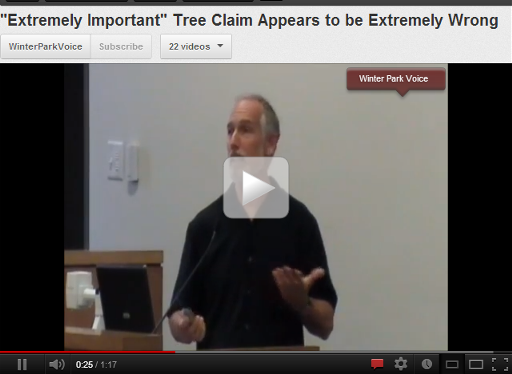
The developer’s appeal was heard by the Tree Board on October 18. On that day, in less than thirty minutes, the Tree Board overturned provisions of the city’s current tree ordinance and instead, voted to substitute their own proposed ordinance changes — just 3½ weeks before the City Commission would have an opportunity to vote on the changes. While discussing  their motion to waive the fee and the standards mandated by the city’s current ordinance, the board cited provisions of its own proposed ordinance changes in reaching their decision.[Video]

City Claim re Historic Trees that “We’re Not Allowing Removal” Proves False

Nine days before the Tree Board appeal hearing, the city sponsored a Tree Ordinance Workshop where citizens debated the board’s proposed changes in anticipation of upcoming Commission hearings on the matter. At least two members of the Tree Board attended the October 9 workshop. These members and many city residents witnessed George Wiggins, head of the WP Building Department, offer a strongly worded assurance to citizens who might question the intent of the proposed changes:

“There’s an extremely important point here that I cannot over-emphasize. When you’re looking at a historic tree . . . we [city staff] have never issued a permit to remove a historic tree . . . So when you see these drastic differences [between the proposed ordinance and the current ordinance] I’m not sure that it matters much, because we’re not allowing the removal. “

However, documents obtained by the Voice reveal that two weeks before the workshop, Mr. Wiggins’ Code Enforcement department approved a permit application to do just that – remove a healthy live oak – a 39” diameter heritage tree; The same tree that would later be at issue in the October 18 Tree Board appeal. 

WPV contacted Mr. Wiggins, asking him to clarify the timing of the permit approval. He commented that his workshop statement “. . . was based on info I received from our arborist that must have pre-dated that permit. In addition it would be impossible to build the new home with the location of the tree in the middle of the lot.”

Historic Live Oak Blocks Developer Plan to Build New Home 3x Size of Current Home

Public records obtained by the Voice show that once the tree removal permit was approved, the permit applicant, Rex-Tibbs Construction Company, filed an appeal on October 4 asking the city to waive payment of a $12,375.00 fee into the Tree Fund.  The fee Rex-Tibbs was hoping to avoid is owed by property owners when they receive a permit to remove a large, healthy tree. (Fees are not owed when a sick or declining tree is removed.) The staff report prepared for the appeal hearing defines the city’s requirement in this case:

“As a Historic Tree, the compensation requirement becomes 3” of replacement to 1” removed or replanting of one 4.5” minimum caliper shade tree and compensation of $110.00 per inch not replanted. Assuming the minimum was replanted, this leaves a balance of 112.5” and a balance due of $12,375.00.”

Other documents obtained by the Voice include a Purchase Contract for the residential property on which the oak stands – a lot in an established neighborhood on Rockwood Way in south Winter Park. In an apparent bid to develop an investment property, Rex-Tibbs Construction is contracted as the sole buyer of the Rockwood property. The property contract is scheduled to close in mid-November.

Rex-Tibbs submitted building plans to the city indicating that they intend to replace the existing 1600 sq. ft. home on the lot with a new two-story 4,500 sq. ft. home. The new building footprint covers the spot now occupied by the historic oak. Winter Park Voice contacted Donney Rex and requested comment and/or clarification of the information obtained in our Public Records Request. As of press time, Mr. Rex did not respond to our request for comment.

During the appeal hearing in front of the Tree Preservation Board, the city’s arborist, Alan Lee, conceded that the size of the historic tree’s canopy creates significant difficulty for construction of a new home on the lot. However, Mr. Lee also pointed out that the historic oak is physically and structurally “in good shape,” adding that he expected the historic oak to live “another hundred years or more.” [Video of Full Hearing]

Did City Miss Opportunity to Replace Ailing Trees on Winter Park Road?

During the hearing, board members learned that the property on Rockwood is very close to Winter Park Road — a few hundred yards from the spot where the city pruned deep v-cuts into multiple oak trees along the roadway. City officials have stated that the trees were pruned this way due to the declining health of the trees.

Current city code would have allowed Rex-Tibbs to plant or possibly even “donate” multiple trees as a way to significantly reduce the fee they owed the city. A review of the Rockwood Way documents does not show evidence of any alternative building plans or off-site tree replacement strategies requested by the city or offered by the builder.

At the Tree Preservation Board hearing, Donney Rex of Rex-Tibbs construction presented his case to the board members, noting that he has planted many trees during his years as a home builder. Mr. Rex was not opposed to planting a few replacement trees on the property, but did ask the board to waive the $12,375.00 fee. Options including modifying the building plan and/or applying for setback variances to enable the home to be moved away from the tree were not discussed at the hearing. Board members and the city arborist agreed with the builder that the historic tree would have to be removed to enable the proposed new home to be built, as currently designed, inside the current setback envelope.

Board Members Explain Decision/Rejection of Current City Code

Soon after Mr. Rex finished his presentation, board member Richard Simpson made a motion to waive the entire fee. Mr. Simpson’s rationale for approval appeared to be largely based on the more lenient Tree Preservation Ordinance provisions his board has recommended to the City Commission. Simpson explained

“I know that the City Commission has not adopted our proposals to revise the tree code, but . . . if we adopted the proposed code — notwithstanding that it hasn’t been approved yet by the City Commission — and approved this with a two tree replacement requirement, we’d be consistent, at least, with the amendments to the code that we [proposed earlier this year].“
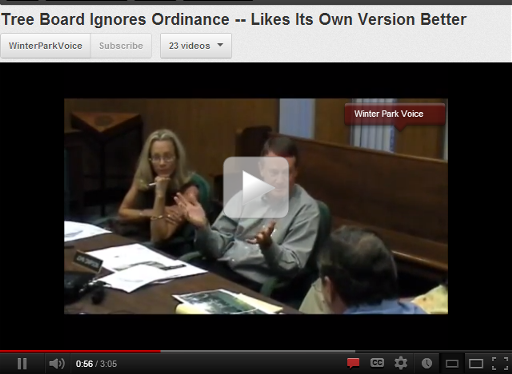
Simpson’s motion was quickly seconded by board member Christine Menkin. Just before the board voted, board chair Woody Woodall assured the board members that he had attended the October 9 Tree Ordinance workshop and observed that “There was really only one person that dramatically opposed our [proposed changes].”

Immediately following Mr. Woodall’s comment, city staff recorded a board vote of “All in Favor” to waive the $12,375.00 fee and require Rex-Tibbs to replace the 39” diameter live oak with two 4.5” trees.

Related Tree Workshop Videos:

Winter Park Voice requested comments from all Tree Preservation Board members who were present at the hearing, including Anthony Gray, Phil Eschbach, Woody Woodall, Christine Menkin and John Simpson. As of press time, we did not receive any comment on the proceedings, except from John Simpson, who commented via email to the Voice,

“I have no comment regarding the actions taken at the October 18 meeting. The video and minutes speak for themselves. As I am not the chairman of the TPB, it is not my place to speak for the Board.

Regarding the Board’s proposed changes to the ordinance, I suggest that you seek comment from Pete Weldon as he was the member primarily responsible for the proposed changes. As you know, these changes were discussed and revised at several Board meetings and were then adopted by the Board and sent to the City Commission for consideration. I voted in favor of these proposed changes, but recognize that others may have different views and priorities. My intent was to encourage the retention and planting of trees within the City while reducing the financial hardship imposed on property owners seeking to improve or enhance their homes.”

To comment or read comments from others, click here →