How Today's City Commission Meeting Will Hit Your Wallet
Winter Park is poised to raise fees for everything from a round of golf to after-school programs along with a portion of your power bill
Sept. 24, 2025
By Beth Kassab
Winter Park Commissioners are set to vote Wednesday afternoon on the city’s $230 million budget, which includes an electric rate increase — though lower bills for the time being — and higher prices for everything from cemetary plots, off-duty police, rounds of golf and after-school programs.
The new fee schedule, which is slated to be adopted today along with a second and final vote on the 2026 budget, will take effect Oct. 1.
Some examples:
Fire department detail for special events (with at least 10 days notice): From $47 per hour (for a minimum of three hours) to $60 an hour.
Off-duty police officer (with at least seven days advance notice): From $57 per hour to $58 (with a four hour minimum); holiday pay for off-duty officers will move from $82 to $83 per hour.
Fees for adult sports teams fees will jump from $500 for flag football and softball to $550.
Youth after-school programs will increase from $50 to $55 monthly for residents and from $90 to $100 for non-residents.
A single resident space at Palm Cemetery will jump from $5,800 to $6,950.
Greens fees at the Winter Park Nine for residents on Friday through Sunday will increase from $22 to $26. Electric cart rental will go from $12 to $14 and from $10 to $12 for seniors.
Rental of the Winter Park Events Center on a Saturday will change from $5,50 to $5,775.
The city’s budget proposal discussed how slower growth forecast in the economy means “adding new services and projects will only be possible in the context of the growth rate of traditional revenue sources such as the millage rate, fees and customer rates.”
The document even went so far as to make clear that fees for services have already become a critical piece of the budget as City Commissions have decided against raising the millage rate (which determines how much residents and businesses pay in property taxes, which make up the largest portion of the city’s general fund). And how future increases are likely:
“As the second largest component of the general fund at 20%, and as one of the few revenue sources that the city has direct control over, charges for services is likely to increase over time as fees and prices for activities and services will have to continue to be raised to support operations. In many municipal circles this is being called the pay-to-play form of providing services to residents and businesses and will only be more crucial if property tax revenue growth rates begin to slow.”
A portion of resident’s electric rates will also climb in October, though total bills will decrease.
That’s because the electric bill includes multiple fees, charges and taxes with some going up and one going down.
The non-fuel portion of electric rates based on how much each customer uses will increase by about 7%. That equates to a monthly jump from $91.46 to $98.26 for a home using 1,300 kwh, according to an estimate provided by the city.
But the charges customers pay for fuel (mostly natural gas in Winter Park) are going down from $49.20 to $29.61, resulting in a lower monthly bill.
Fuel charges, however, are variable and could rise again.
The Winter Park Chamber offered a zoning history lesson at its annual Outlook luncheon and set the stage for a contested city commission race with Michael Carolan likely to run against Elizabeth Ingram
Sept. 19, 2025
By Beth Kassab
Winter Park Chamber of Commerce President and CEO Betsy Gardner called on city leaders and residents to rethink zoning laws that she says have protected anti-development interests and blunted the opportunities for new housing in Winter Park.
Gardner said the city’s desire to remake Fairbanks Avenue near Interstate 4, now part of the Community Redevelopment Agency, is Winter Park’s next chance to prevent more strip centers and encourage the kind of growth that will attract families and new residents.
“This conversation about land use is also a conversation about who gets to belong,” she said, though she added, “We do not support the replication of the density we see in Maitland.”
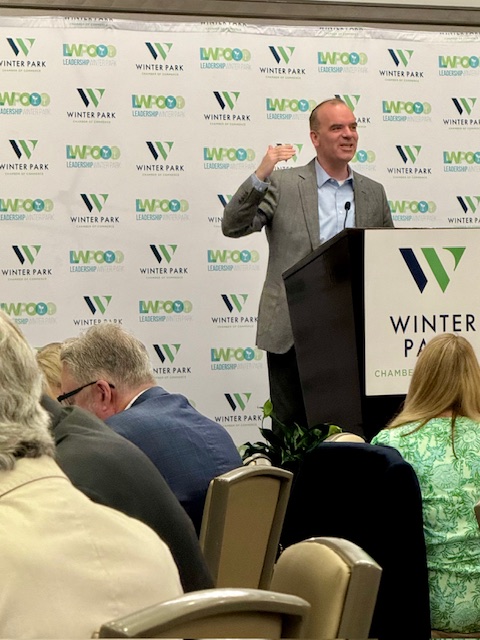
Yoni Appelbaum, pictured above, spoke at a lunch hosted by the Winter Park Chamber of Commerce on Friday.
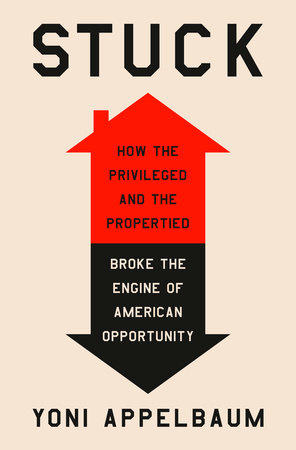
Gardner’s remarks came at the chamber’s annual Outlook lunch, which explores topics related to economic development. This year’s keynote speaker was Yoni Appelbaum, who wrote, “Stuck: How the Privileged and the Propertied Broke the Engine of American Opportunity.”
Appelbaum, also deputy executive editor of The Atlantic and a historian, discussed how Americans “invented a profound human freedom” known as upward mobility. For more than a century, people were free to move beyond the station in life they were born into and toward prosperous city centers with jobs, social currency and a solid supply of housing stock.
That meant families moved many times, each time upgrading the kind of home they lived in.
But that’s not the case today, he said, as housing is often unaffordable and hard to come by in the places considered most desirable because of proximity to jobs and lifestyle amenities. (Case in point: Winter Park, where the median housing price is $700,000 or more, according to some sources.)
“Americans have stopped moving to the most prosperous places. People now move away from those places and to where the housing is cheap,” Appelbaum said. “Many have the sense that something has gone wrong in their lives .. that some element of the American promise has been broken.”
That’s the kind of loss of community and disenfranchisement credited with sweeping President Donald Trump into office and remaking the focus of the Republican Party.
Appelbaum stayed away from politics in his talk, but said the root of that shift dates back to the beginnings of zoning laws that came about as a way for those already settled in a place — mostly rich and white homeowners — to keep out others who were new and different.
He pointed to early laws in Modesto, CA that segregated Chinese laundry workers into what ultimately became known as “Chinatown” because white homeowners did not like that the workers were also living in their places of business. In 1885, Modesto outlawed laundry facilities “except within that part of the city which lies west of the railroad track and south of G Street,” the book reads.
And zoning laws, often dictating where certain types of businesses could operate, were born.
Later came height caps on buildings in New York City to drive up prices and push sweatshops farther to the outskirts. And historic preservation laws in Charleston, S.C. that he says served to stunt the city economically in the name of preserving a past that depended on enslaved people.
“What I find useful about the past is the ability to imagine different presents and different futures,” he said. “I am not here to tell you to abandon historic preservation or abandon zoning. What I do want for us to all think about is what we’re all after.”
In one passage of his book he discusses how he can see three large apartment buildings going up out his own window that will combine to a couple thousand new units, including more than a fifth described as “affordable.”
“Like all new developments, it leaves a good deal to be desired,” he wrote. “The architecture strikes me as blandly corporate. Local regulations, historic preservation and participatory planning have combined to limit the development on the site to just a fraction of what it might have held … Although I have little affection for cookie-cutter six-story apartment buildings, I don’t want to repeat Veiller’s error of mistaking my own aesthetic judgments for the public good.”
Those apartments, he noted, will mean upward mobility for some families.
Gardner said what happens in the Fairbanks corridor is up to residents and called on attendees — which included Mayor Sheila DeCiccio and commissioners Craig Russell, Marty Sullivan and Warren Lindsey along with city administrators — to use their power in the voting booth in March when two city commission seats are on the ballot.
At a recent workshop commissioners discussed potential rule changes, including lowering transportation impact fees, to encourage development. There appeared to be support for “quality, mixed-use development with a multi-family, workforce housing component, and to develop a comprehensive approach with the Planning and Zoning Board and Economic Development Advisory Board,” according to minutes of the meeting.
In a brief interview after the program, Gardner told the Voice that many people “lost trust” in the public process after the original development guidelines for the Orange Avenue Overlay were overturned, in part by DeCiccio and Sullivan.
Asked who she would support in the March election, she introduced attorney Michael Carolan, chairman of the real estate department at Winderweedle, Haines, Ward and Woodman, as a candidate for Seat 1 on the commission to replace Sullivan, who is retiring after two terms.
Carolan, who was chairman of the chamber board in 2020 and has also served on the board of the Coalition for the Homeless in Central Florida, said he plans to run but has not yet made it official by turning in paperwork to the city clerk.
Elizabeth Ingram is also seeking Sullivan’s seat and officially launched her campaign this week with an email to residents that said she is committed to “protect the qualities that make Winter Park special — its historic charm and small-town character, parks and recreation, and strong sense of community — while planning responsibly for the future.”
The trained opera singer currently serves on the Public Art Advisory Board and led the Dommerich Elementary Parent Teacher Association and is the only person who has officially opened a campaign account so far.
Russell, who serves in Seat 2, has said he plans to seek re-election.
The official qualifying period for the election runs from Dec. 1 to Dec. 8.
Florida Debut of 'Stripped for Parts' Highlights Urgency to Support Local News
In a note to readers, Voice Editor Beth Kassab writes about the value of access to local news in our communities
Sept. 18, 2025
Dear Reader,
Thank you for being part of our Winter Park Voice community! If you are here, then you probably share my interest in local news and believe in its value when it comes to understanding the place where you live and work. Our mission at the Winter Park Voice is to deliver stories that you can’t find anywhere else about your city — like why electric rates are going up or down, who is influencing the county redistricting maps, how the police are doing their jobs or who’s running for local office and who is funding their campaigns (just to name a few recent stories).
The film tells the story of “a secretive hedge fund that is plundering what is left of America’s newspapers, and the journalists who are fighting back.”
Alden Capital purchased Tribune Publishing, which included the Orlando Sentinel, in 2021.
Since then, the Sentinel newsroom has continued its disappearing act that started long before this acquisition. That means fewer journalists to cover the stories that are most important to all of us. The Sentinel Guild is sponsoring Sunday’s screening.
“For us, this is a story we know all too well,” Cristóbal Reyes, a Sentinel reporter and the guild’s unit chairman, told me. “We’ve been on the front lines of this since we formed our union.”
Reyes said the numbers tell a startling story. When a group of reporters and photographers formed the guild in 2020, they had 54 members. Today there are just 26 left.
As one of the people who had the privilege of working at the Sentinel for 20 years, I can tell you there was no place more exhilarating than a newsroom humming on all cylinders. That old windowless second story expanse over Orange Avenue didn’t have a lick of natural sunshine. But its people with their grimey keyboards and notebooks and rolodexes channeled their energy into a bright light across Central Florida everyday in the form of a broadsheet and digital product.
Beth Kassab
To be clear, my motivation at the Voice in 2025 isn’t nostalgia for the past — though I have plenty. The industry has changed. Hard stop. And we must move forward and find the best and most effective ways to serve our readers today.
Because what hasn’t changed is the need for access to news about your city, your neighborhood, your school and your workplace. You can take your pick of sources when it comes to scrolling headlines about national politics or the national economy.
But who is going to City Hall to listen to a debate about how much of your tax dollars go to police and how much go to preventing the next post-hurricane flood? Who is going to ask questions about the latest historic building scheduled for demolition? How will you know who is making those decisions and who paid for the campaigns that got them into office?
The Winter Park Voice is one of hundreds of small nonprofit news sites that have sprouted up across the county aiming to do that work and fill the gaps left by our shrinking regional newspapers. The Voice is part of a national network of those sites through the Institute for Nonprofit News.
And the Voice is proud to be part of the News Collaborative of Central Florida, which includes the Sentinel, Central Florida Public Media, Oviedo Community News, WKMG, VoxPopuli and more. This group, born just last year, is finding ways to partner where it makes sense to deliver more stories that otherwise might not be told.
I want to be clear about something else: The people who remain at the Sentinel and these other organizations are still doing amazing work despite the odds. I see it on their pages every single day. There just aren’t enough of them.
The Voice is trying to be part of the solution. We are working to meet the problem of a dwindling news landscape with the urgency and doggedness it demands and deserves. We provide our content for free without a paywall and subsist solely on community donations.
So if you care about stories about your community that are vetted for facts, context and history then take a moment to learn about this film or support one of the local nonprofit news organizations. We need you.
All my best,
Beth Kassab
Editor, Winter Park Voice
P.S. For more information about tickets to the film click here. The Orlando Sentinel’s Scott Maxwell will moderate a Q&A following the screening with the filmmaker and Judith Smelser, president and general manager of Central Florida Public Media. Proceeds from the event will benefit Central Florida Public Media.
WinterParkVoiceEditor@gmail.com
Hedge fund Alden Global Capital is quietly gobbling up newspapers across the country and gutting them, but no one knows why– until journalist Julie Reynolds begins to investigate. Her findings trigger rebellions across the country by journalists working at Alden-owned newspapers. Backed by the NewsGuild union, the newsmen and women go toe-to-toe with their “vulture capitalist” owners in a battle to save and rebuild local journalism in America. Who will control the future of America’s news ecosystem: Wall Street billionaires concerned only with profit, or those who see journalism as an essential public service, the lifeblood of our democracy?
Kelly Semrad Says She is Undecided on Redistricting Maps
Winter Park is making a hard push to move out of Semrad’s district as Orange County redraws the boundaries for how the County Commission is elected
Sept. 16, 2025
By Gabrielle Russon
Where Winter Park will land on a new map of Orange County Commission districts is still unclear as county leaders are divided on which map to pick with Kelly Martinez Semrad, who represents the city on the board, saying she is now undecided.
The commission met Tuesday in a workshop but isn’t scheduled to take a final vote until Oct. 14 on the new boundaries that are being redrawn to grow the board from six to eight commissioners elected by district. The mayor also has a vote on the board and is elected by the entire county.
Mayor Sheila DeCiccio speaks at the 2025 State of the City event.
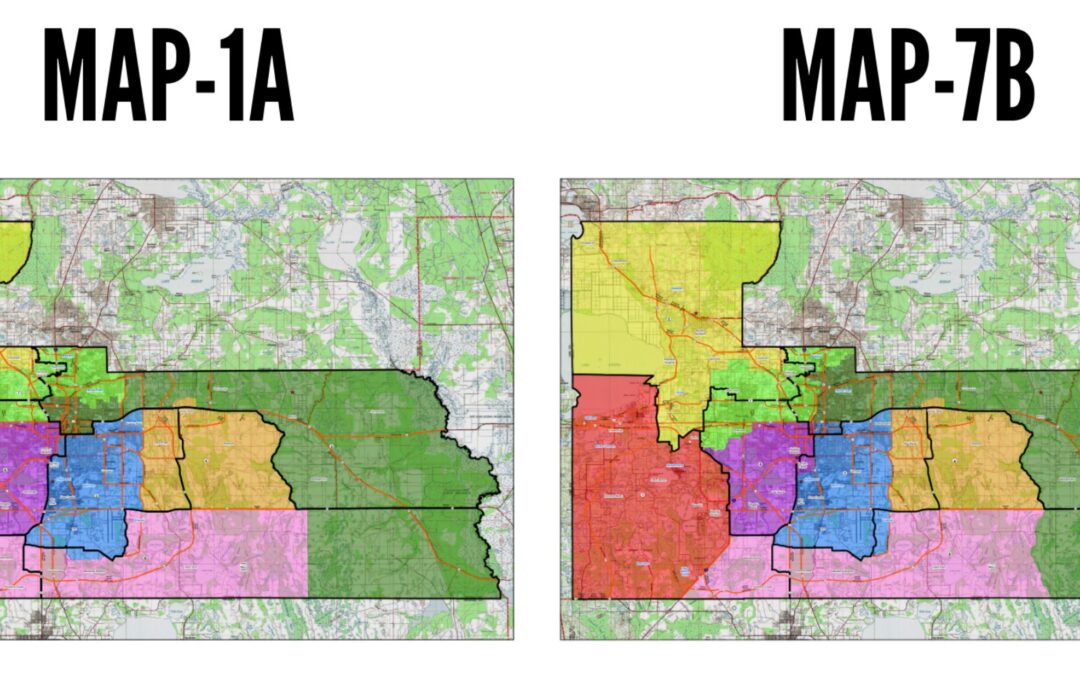
Winter Park city officials continue to lobby in force for the county to put the city in the newly drawn District 7 along with its neighbors Maitland, Eatonville and Pine Hills, an unincorporated neighborhood in Orange County. That option is Map-1A.
The other option, Map-7B, would keep Winter Park in the current District 5 along with rural eastern Orange County represented now by Semrad.
A redistricting advisory committee that spent months getting public feedback and looking at different options presented Map-1A and Map-7B as the final two proposals to the county board Tuesday. But the advisory committee wouldn’t go as far as picking which one it liked best, leaving that decision up to the county commissioners.
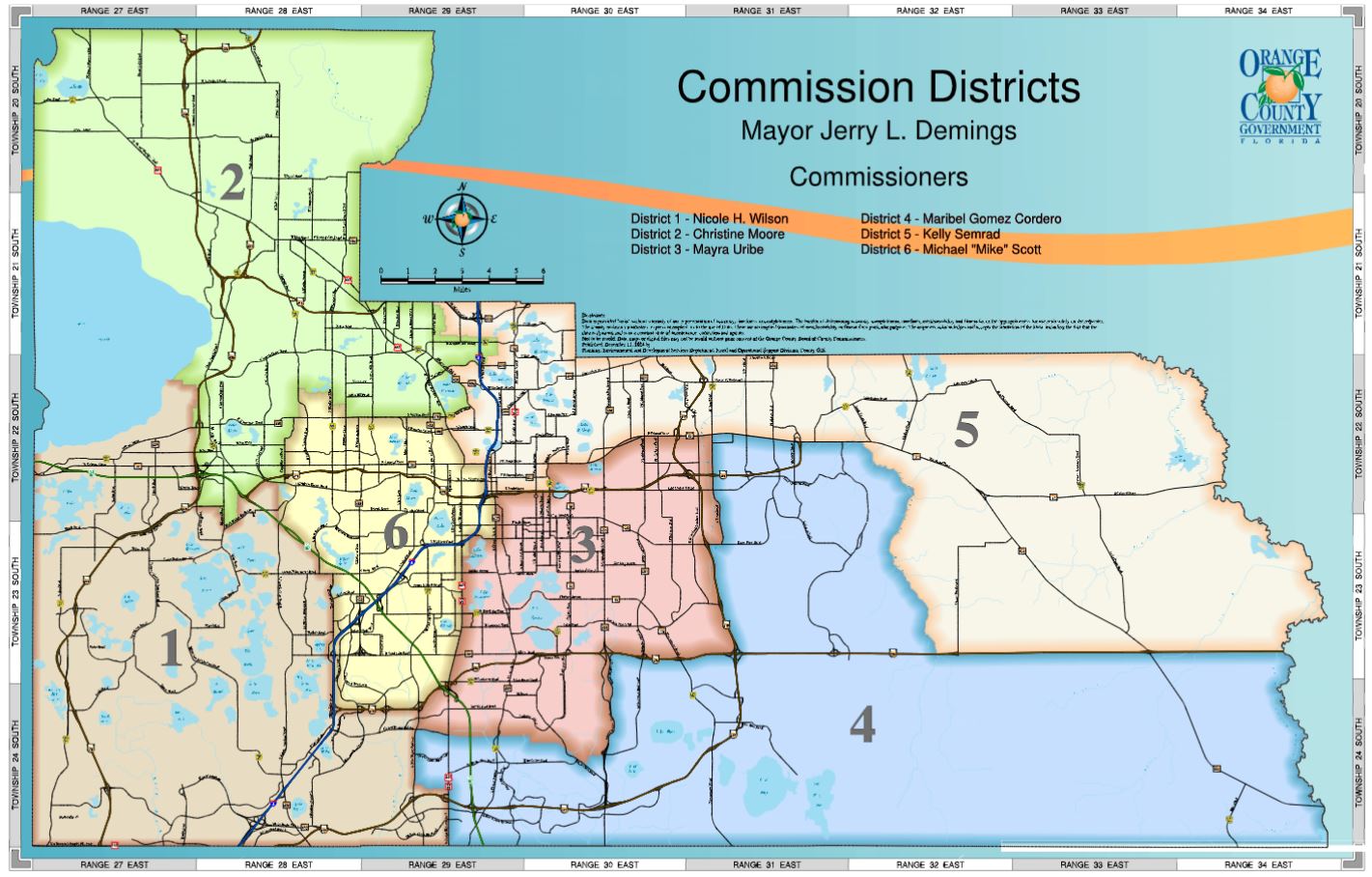
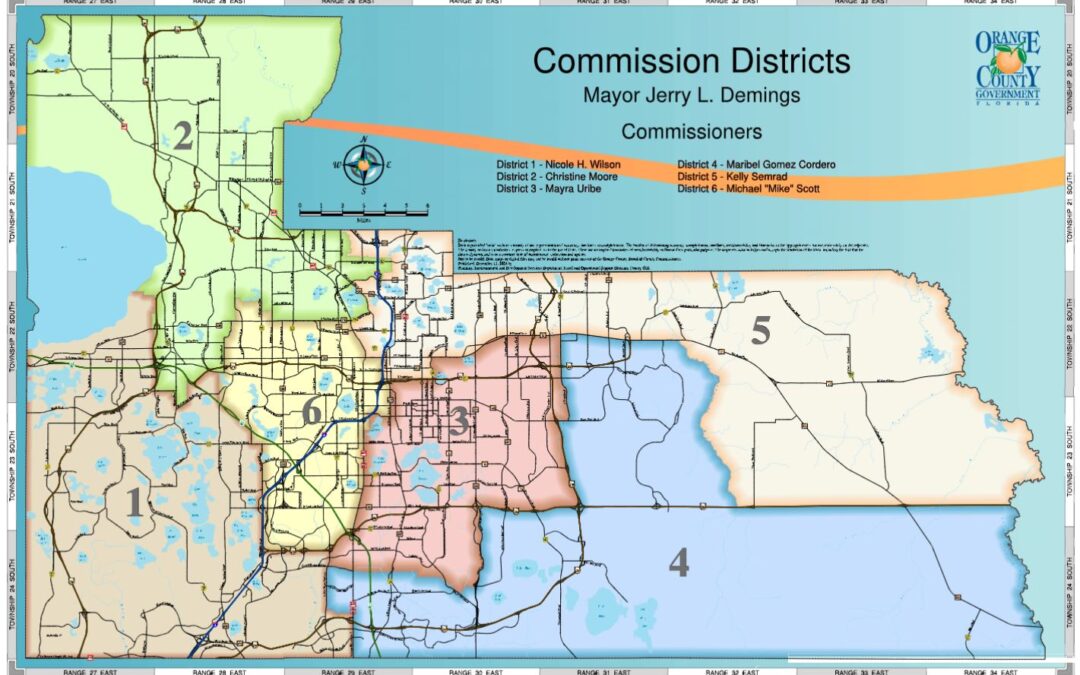
This map shows the way the five county districts stand today with Winter Park in western-most section of District 5. The above maps show the proposed changes.
Three commissioners said they supported Map-1A while two others endorsed Map-7B. Orange County Mayor Jerry Demings said he supported whatever the majority wanted.
That left Semrad — a potentially key vote and the commissioner whose district is caught up in most of the debate.
At a redistricting advisory committee meeting earlier this summer, Semrad said she initially supported a map similar to 7B to leave Winter Park in her district with the rural east and balance out the unincorporated areas with the municipalities. But Tuesday, Semrad backtracked and said she wasn’t ready to make a decision yet as she got a flurry of last-minute public feedback.
On the day of the county workshop, Semrad said she received 100 emails and hadn’t had time to review them all yet.
“I have the people in the east who really want to stay with Winter Park because they look at it as more suburban and that they have nothing in common with downtown and then I have people from Winter Park not seeing compatibility with the rural area,” Semrad said.
Kelly Semrad
“Does that sound like you can go with either map?” Demings asked her.
“That is the case,” Semrad said.
A delegation from Winter Park has attended the committee meetings and also spoke at Tuesday’s workshop.
Stating her case again, Winter Park Mayor Sheila DeCiccio argued her city should be districted with its Eatonville and Maitland neighbors.
They often work together, she said, pointing to Winter Park and Maitland sharing an elementary school boundary or Winter Park handling Maitland’s emergency calls. Winter Park is also working with Eatonville on a grant for new sidewalks and crosswalks.
“We have no contiguous borders with east Orange County. The gerrymandering and Map-7B to include Winter Park would make Texas proud,” she said. “There is absolutely no compatibility, collaboration, contingent border, or community between us.”
From the public, the county heard a mix of the public’s concerns as some wanted to keep the small cities together in Map-1A while others said Map 7-B made more sense.
Some people feared Pine Hills might get overpowered by Winter Park, so they preferred Map 7-B to keep Winter Park separate from the rest of the urban areas.
One Winter Park resident supported Map-7B for “a pretty selfish reason.”
“I love my county commissioner. I love Kelly Semrad,” the resident said. “During the last election cycle, we had so many people knock doors in Winter Park to understand who Kelly is and why she was a candidate for county commissioner.”
And Ella Wood, a Winter Park resident who is the political director for Unite Here Local 737 representing hospitality workers, argued Map-7B was closest to preserving the historic county boundary lines.
“It helps to maintain people’s connection, people’s engagement, and maintaining their community interests,” Wood said.
Meanwhile, Winter Park already has a city government to advocate for itself. “That’s not what we need the county commissioner to do,” Wood said.
Even though the city of Winter Park runs its own police department and handles its own infrastructure needs, city leaders still believe it’s important to get a voice on the county commission.
DeCiccio pointed to potential rail expansion, a new state law taking away local control for growth which some communities are fighting against as well as a contract with Visit Orlando — an agency that DeCiccio is not a fan of — as some of the countywide issues that Winter Park wants to advocate on at the county level. In addition, DeCiccio also brought up the Community Redevelopment Agency, or CRA, which the county allowed Winter Park to expand last year to control more tax dollars that would otherwise go to the county for projects like post-Hurricane Ian flood prevention.
“There will finally be an opportunity for someone from Winter Park, Maitland, Eatonville, College Park, or Pine Hills if Map-1A is adopted … to have a seat at the table,” she said, joined by Commissioner Craig Russell and City Manager Randy Knight to appeal to county commissioners Tuesday.
County staff and commissioners answered back at people’s concerns.
“I hear folks saying… ‘we don’t have anything in common with this group or that group of people,’” said District 6 Commissioner Mike Scott, who reminded residents they are all part of Orange County.
And would Winter Park,with its considerable wealth and tax base,dominate whatever district it ultimately lands in?
Demings looked around his board — commissioners of different races and some who had upset victories to defeat better-funded opponents or represented wealthier areas of the county.
Semrad, for example, was a political newcomer who won the seat last year against former Winter Park Mayor Steve Leary who raised significantly more money than her.
“If you’re the right candidate at the right time,” Demings said. “You can get elected.”
Winter Park Lobbies to Change County Commission Districts
Two new seats on the county board mean a potentially new elected position for a Winter Park candidate
Sept. 15, 2025
By Gabrielle Russon
Winter Park city leaders are lobbying Orange County to get redistricted with Eatonville and Maitland in a new district as the county redraws its boundaries to add two more commissioners.
The fate of Winter Park is expected to be decided in the coming weeks.
“We deserve not to be gerrymandered into oblivion,” said Winter Park Mayor Sheila DeCiccio as she has regularly spoken at the county’s redistricting advisory committee meetings this summer. “Give us the opportunity to have a voice.”
Last year Orange County voters approved a charter amendment to expand the 6-district board plus the mayor to eight, which set off the redistricting process.
Right now, Winter Park’s lines are in District 5 that includes rural east Orange County, such as Bithlo and Christmas— which DeCiccio argues is not a good fit.
A redistricting advisory committee is proposing two maps after drawing up nearly 30 different options. The Orange County Board of Commissioners will decide which map ultimately gets chosen.
For Map-1A, a newly created District 7 would put Winter Park with the cities of Eatonville and Maitland, as well as other communities, including the Pine Hills and Fairview Shores neighborhoods in unincorporated Orange County.
The other option is Map-7B that would leave Winter Park where it stands now in District 5 with Orange County’s rural east and the University of Central Florida.
“Currently, Winter Park is part of rural East Orange County, which we have nothing in common with. It takes a commissioner over one hour to drive from one end of the county to the next,” she said at a redistricting meeting. “This is about representation and Winter Park has different needs.”
DeCiccio also argued it’s also important to be included with its urban neighbors since Winter Park will be handling Maitland’s fire and police calls.
Both Maitland and Winter Park have sent letters to the county asking to be districted together.
“If Map-7B is modified by the BOCC, Winter Park would like to be shifted to District 7,” DeCiccio wrote.
Meanwhile, Martinez Semrad prefers the other option, keeping Winter Park in District 5 with the rural east.
At a public meeting last month, Semrad’s legislative aide said Semrad liked a map similar to 7B because it aligned with the traditional boundaries, the aide said.
Semrad was mindful about the balance between having incorporated cities versus more unincorporated areas that require more service needs and infrastructures to overburden commissioners, the aide said.
Semrad did not respond to an interview request for this story.
Other Winter Park residents have spoken out during the county redistricting meetings too.
District 5 looks like the top of Florida — a long skinny panhandle connecting into a large base.
“Right now our district stretches as far east as Brevard County all the way to West Maitland, cutting across nearly 60% of the county in a long horizontal shape,” Hattie Bryant, a Winter Park resident and the Orange GOP Precinct Committee Woman. “That is simply crazy wacky.”
What happens next is the county commissioners will discuss the two map choices at a Tuesday workshop.
The county board is scheduled to vote on the final map next month.
Orange County Mayor Jerry Demings has praised the redistricting advisory committee’s work and said he hopes the county board doesn’t have to redo the map drawing significantly.
Going from six districts to eight districts (with Demings as the at-large vote) means shrinking the current district size from about 240,000 people to around 180,000 in each district, said Scott Skraban, Orange County Deputy Director of Planning, Environmental, and Development Services who has been involved in the redistricting process.
We Depend on your support, make a tax-deductible donation here.
Mission
The Winter Park Voice is a trusted nonprofit journalism site that covers our City Hall and beyond. We endeavor to engage, inform and connect citizens on all sides of issues affecting the quality of life in Winter Park.

Recent Comments