by Beth Kassab | Mar 28, 2025 | City Commission, News, Zoning and Development
Residents Fear Noise from Pickleball Courts Planned Behind Homes
The racket sport is wildly popular but its addition to the Ravaudage development, neighbors say, could bring a near constant drone of ball whacks
March 28, 2025
By Charles Maxwell
Residents who live behind the Ravaudage development where a Life Time Fitness is constructing at least 10 pickleball courts say the city and developers aren’t doing enough to blunt noise and other impacts from the project.
The complex of indoor and outdoor pickleball courts are part of the new 85,000-square-foot health club facility, an estimated $48 million project, slated to open in 2026. The mixed-use development off Lee Road and U.S. 17-92 already includes a Miller’s Ale House, a hotel and other office and retail space.
“Pickleball is a great sport, but it does have a very bad byproduct,” Mark Russell, who has lived in the Park Green Place townhomes for more than 25 years, told the City Commission at a meeting last month. “The hit of the ball on the paddle creates about an 1100-hertz spike, that’s about 70 to 95 decibels, equivalent to a vacuum cleaner to a subway train.”
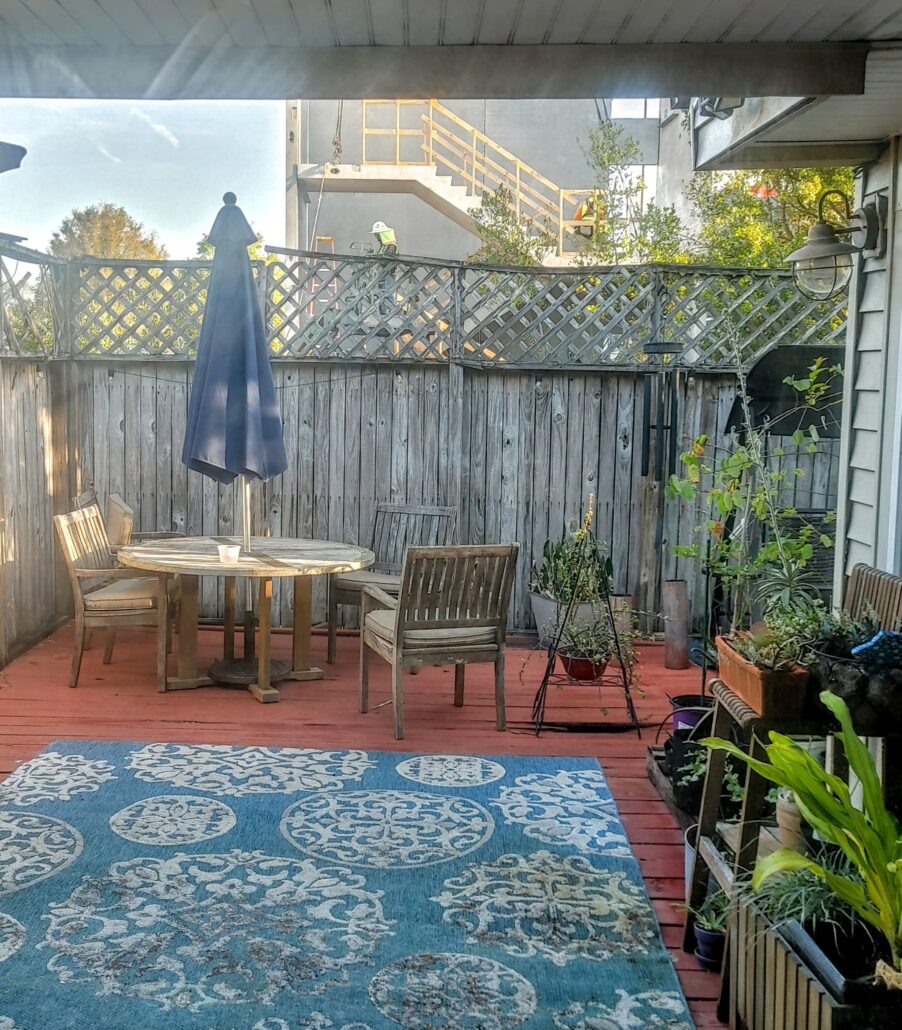
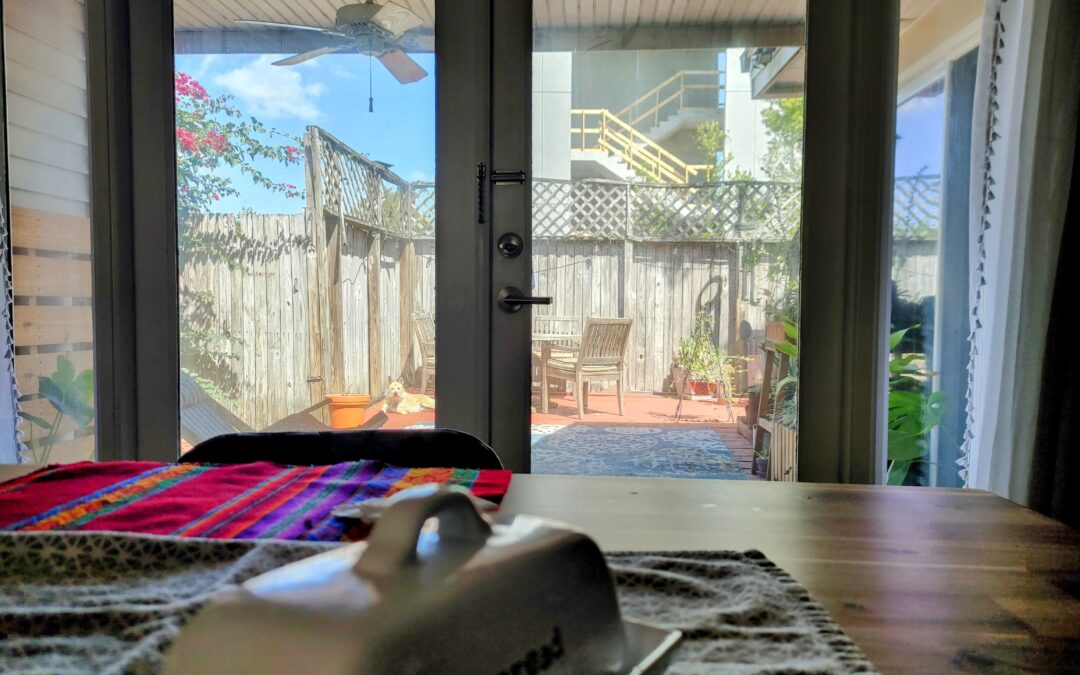
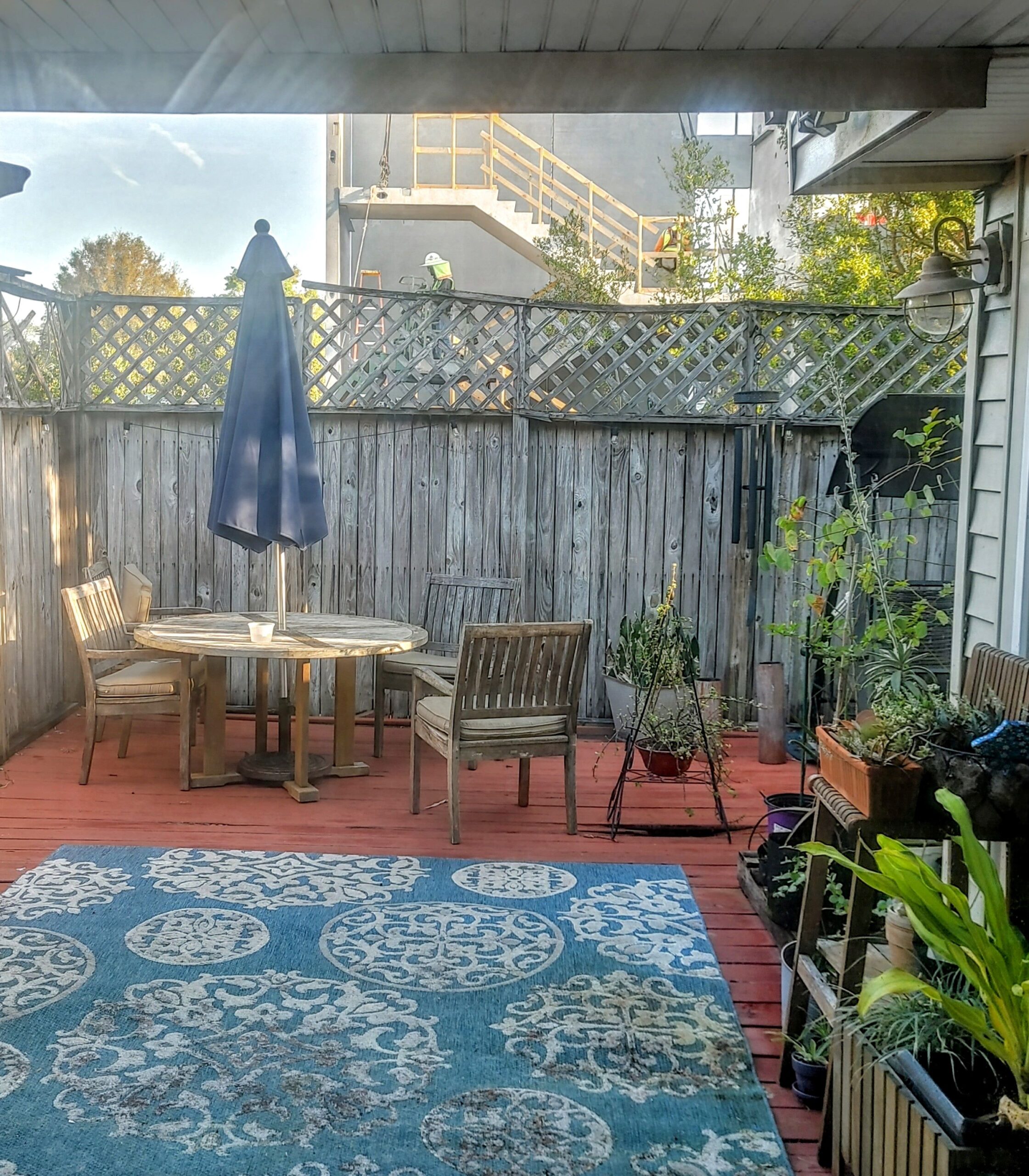
The views from David Adhira’s patio and dining room table (above) show the staircase of a parking garage under construction at the Ravadauge development. (Photos courtesy of David Adhira)
Russell cited an article from the New York Times in which a York, Maine resident who lives across the street from a private pickleball club said that “having a pickleball court in your backyard is like having a pistol range in your backyard. It’s a torture technique… living here is hell.”
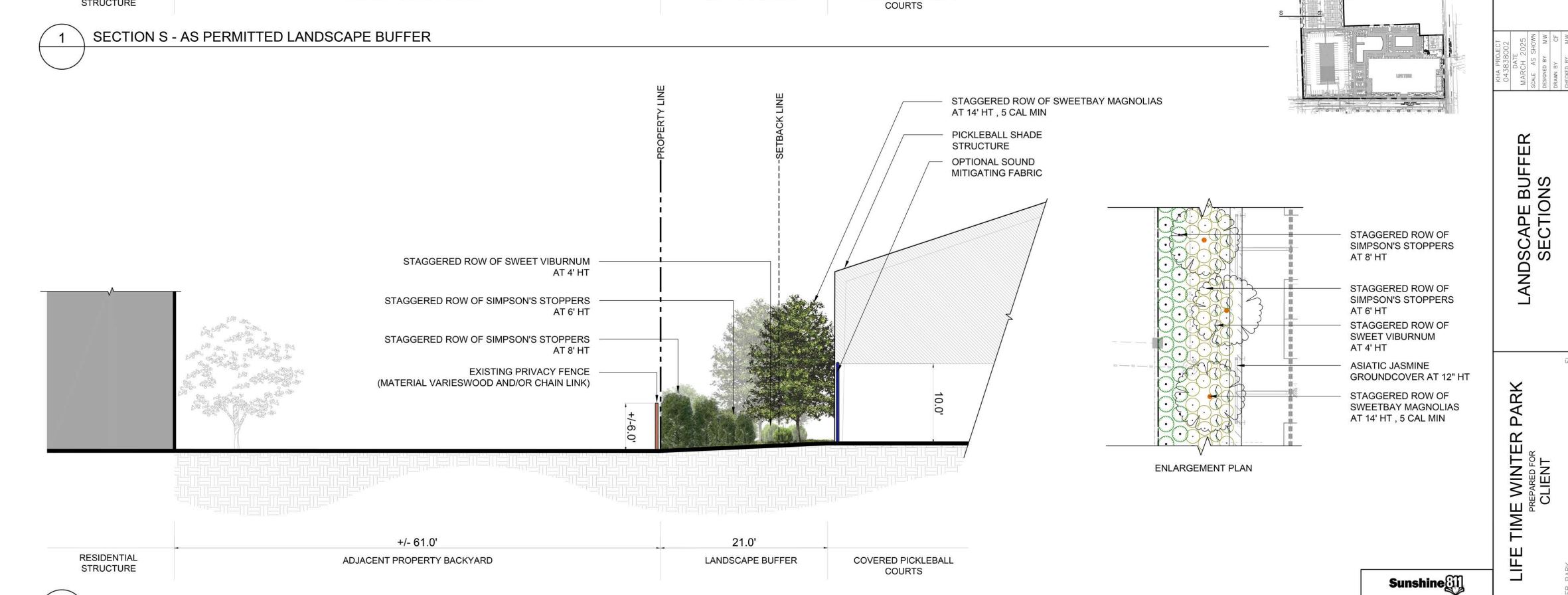
David Adhira, another resident of Park Green Place, said plans show the courts will be just 50 feet from his home. Photos taken from his dining room table and patio show a portion of a staircase for a new parking garage that appears just over the fence from his property line. He told commissioners he’s worried about the toll of the sound from the pickleball courts. He worries about listening fatigue, stress, anxiety, sleep disruption and poor concentration.
Adhira said the construction behind his home is already disrupting his daily life.
“I have observed and documented tangible structural damage to my ceilings, while kitchen plates and glassware shuddered, doors and floors vibrated, and keyboards rattled on our desks,” he said. “I’ve been woken up countless times by the noise, vibrations, and screaming from the construction site, resulting in poor sleep for weeks on end. Even worse may be phantom noise, or auditory hallucinations.”
Commissioners asked Planning & Zoning Director Allison McGillis to meet with residents and the developer to consider solutions.
She told the Voice that the developer shared updated landscape plans for the south side of the Life Time facility, which borders Park Green Place.
The plans include additional layers of shrubs and trees to help reduce the noise and light expected to be produced by the facility.
“They are not proposing additional sound barriers at this time, but have stated that if additional measures are needed once they are operational, an option would be to install an outdoor acoustical barrier such as Acoustifence on the court fencing.” McGillis said. “Staff is going to propose a ‘check-in’ at 90 days and 180 days after they are operational to determine if the additional acoustical barrier is needed.”
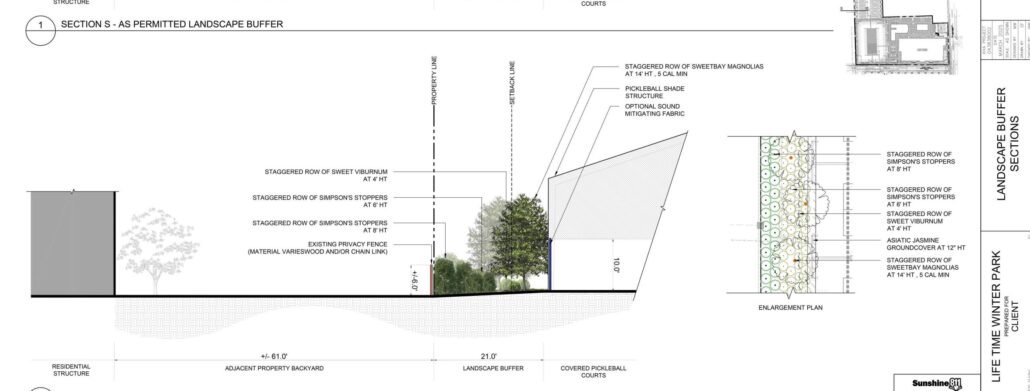
A section of plans shows the proximity of the courts to the homes and the proposed landscape buffer.
Adhira said he reached out to commissioners and Mayor Sheila DeCiccio in an email on March 17 because he is not satisfied with the changes proposed by the developer. But he has yet to hear a response.
“An acoustic-fence and a scattering of bushes will not counteract the level of noise projected from these courts,” he wrote. “Waiting three to six months after the facility opens to collect obvious data and possibly consider changes, as though this were an experiment with no legal precedents, is either incredibly naïve or cruel.”
WinterParkVoiceEditor@gmail.com
Charles Maxwell graduated from Winter Park High School and Florida Atlantic University with a BA in Multimedia Studies. His work has appeared in the South Florida Sun Sentinel and The Boca Raton Tribune, and he is a contributing writer for Keeping it Heel on the FanSided network.
To comment or read comments from others, click here →
by Beth Kassab | Mar 27, 2025 | City Commission, Election, News
Kris Cruzada and Warren Lindsey Sworn In for New Commission Terms
The commissioners took office and got down to city business
March 26, 2025
By Beth Kassab
Commissioners Kris Cruzada and Warren Lindsey took the oath of office on Wednesday before turning to regularly scheduled city business.
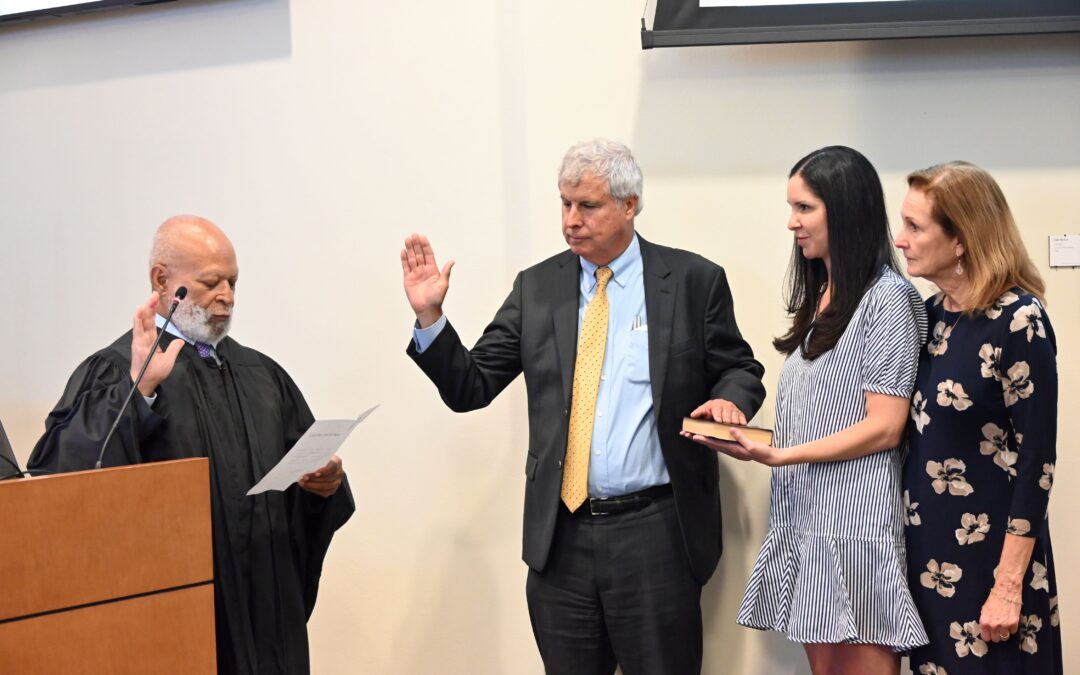
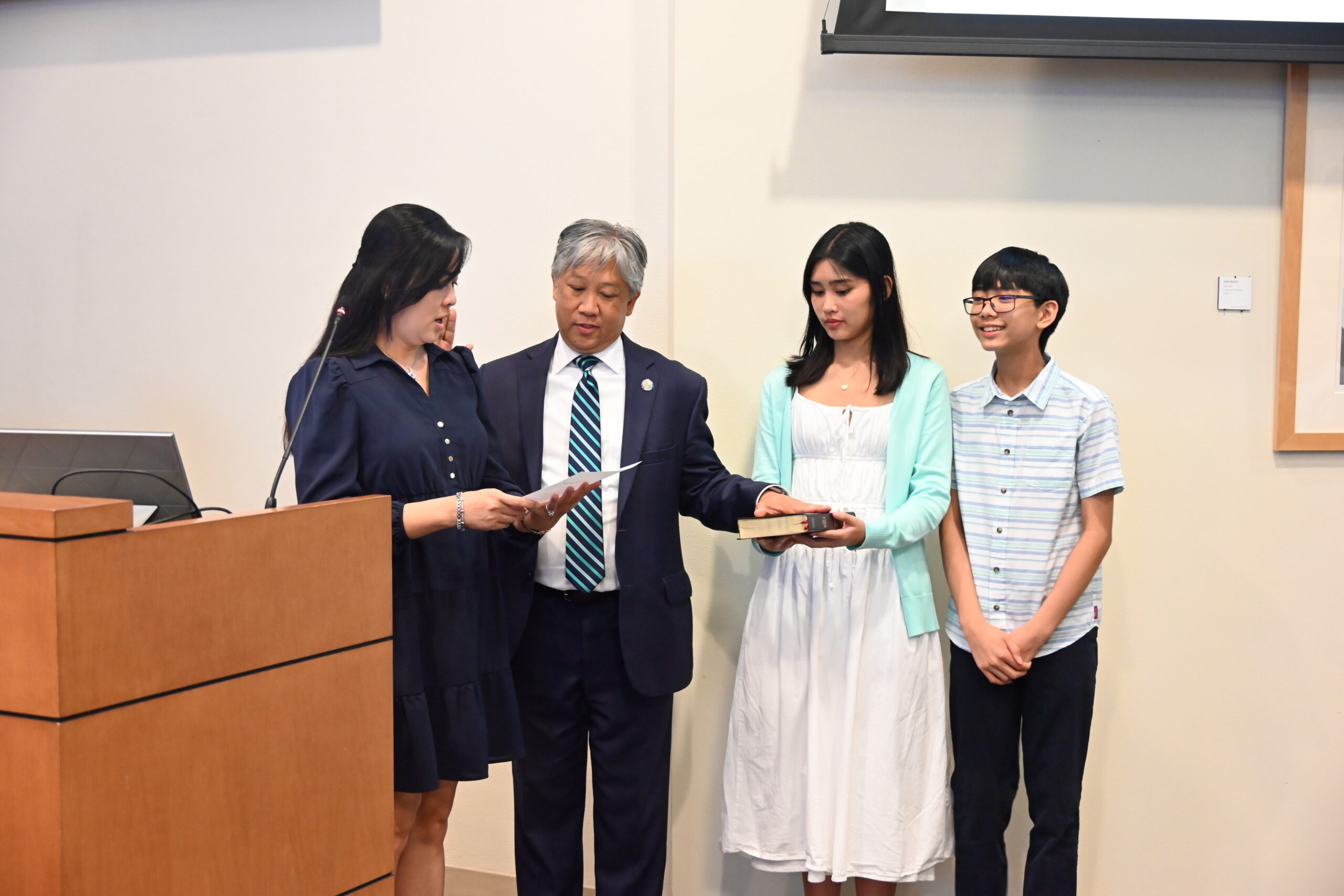
Lindsey, a first-time commissioner who was automatically elected after no one ran against him to take over Todd Weaver’s seat, took the oath with his wife and daughter by his side. Senior Judge Emerson Thompson, who previously served as chief judge for the circuit and served on the Fifth District Court of Appeals, swore in Lindsey, a longtime criminal defense attorney.
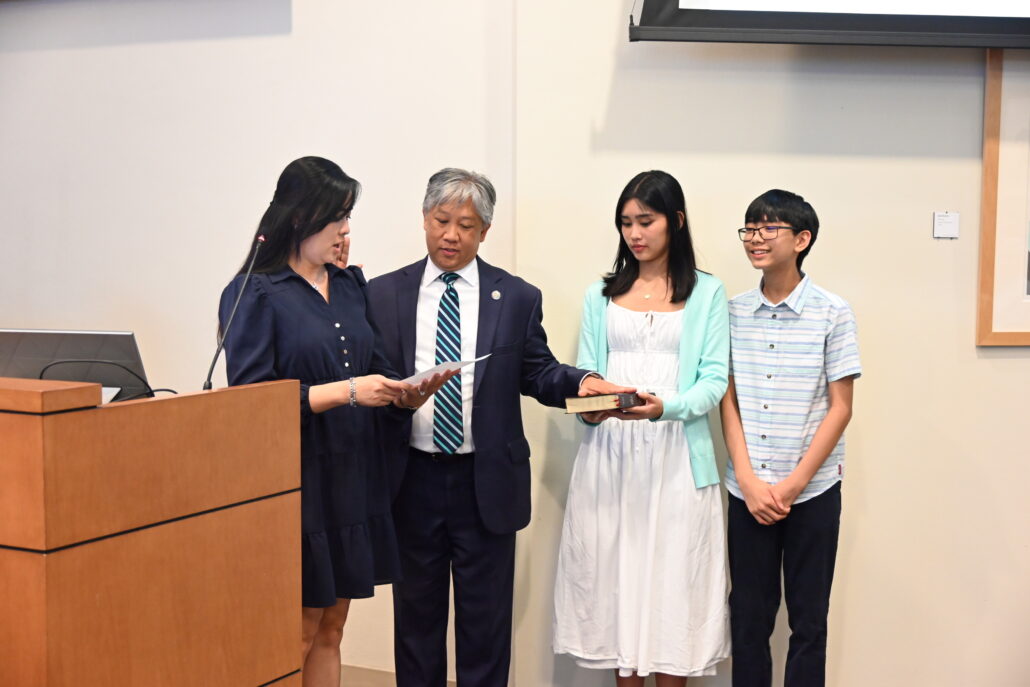
Kris Cruzada takes the oath of office for his second term with his family by his side.
Lindsey appointed Weaver, who decided not to run for election again after two terms, to the city’s Utilities Advisory Board.
Cruzada, who started his second term after winning by a large margin earlier this month, had his wife and children by his side and his parents and brother in the audience.
After the brief ceremony, the commission moved on to scheduled business including the approval of about $30,000 for wider sidewalks and other improvements for children who walk to Hungerford Elementary School just across the city border in Eatonville, known as the oldest incorporated historically Black town in the United States.
While the nearly one-mile stretch of improvements are technically in the city of Maitland, the main beneficiaries are Winter Park residents who live just over the border in the Margaret Square area.
Winter Park, with a population of about 30,000, is the largest of the three jurisdictions with Maitland tallying about 20,000 residents and Eatonville fewer than 3,000.
One resident stood up to object to the city spending money for improvements outside of its borders.
“I’m not really understanding why we are doing it,” said Gigi Papa, who frequently speaks at commission meetings. She questioned why sidewalks aren’t being improved near Lakemont Elementary in Winter Park. “Winter Park must first address the needs of its own residents.”
City staff explained that residents using the route do live in Winter Park and that a number of residents “are excited about the project” that came about after Orange County Public Schools rezoned neighborhoods years ago.
Commissioner Craig Russell, who grew up in the city and was elected last year as the first Black commissioner in more than 100 years, noted that Margaret Square is a historically Black neighborhood next to Eatonville and Maitland that deserves attention and a safe route to school.
“The important thing is we are serving Winter Park residents,” he said. “… The school zones were changed. Those students go to Edgewater (High) and live in Winter Park.”
The 5-0 vote in favor of the improvements is conditioned on another entity picking up any cost overruns if the project exceeds the nearly $30,000 estimate.
The board also voted 5-0 to annex 13 lots on Stonehurst Road off Glenridge Way. The single-family homes, some of which have sold at $2 million or more, will add to the city’s tax base and resolve the problem of two different jurisdictions — the city and the county — providing services on the street.
WinterParkVoiceEditor@gmail.com
To comment or read comments from others, click here →

by Beth Kassab | Mar 24, 2025 | Opinion
Steaming Piles of Art: Commentary
Eat it, it’s good for you
Editor's Note: Articles written by citizens reflect their own opinions and not the views of the Winter Park Voice.
By Bob Morris
That beautiful image you’re looking at is the official poster for the Winter Park Sidewalk Art Festival which took place over the weekend just down the street from where I live.
No, despite its name, this is not a festival featuring art drawn on sidewalks.
Although that sounds like fun, doesn’t it? And I hear it’s a thing in some cities where chalk artists convene to show off their skills on concrete.
I’ve never attended such an event, but I can only imagine that when festival-goers want to buy something they have to use jackhammers to remove the slab of concrete, haul it home in front-end loaders and hope like hell the hangers they bought at the hardware store will do the job.
Yes, art endures. But their walls won’t.
***
The Winter Park Sidewalk Art Festival —”one of the oldest, largest and most prestigious in the country,” according to its website—has been calling itself that since it started 66 years ago.
These days, it draws so many people you can’t even find the sidewalks.
I’m talking tens of thousands of people, spilling out from the sidewalks and onto our quaint, bumpy brick streets, which exist mostly to keep local muffler shops in business.
I find it encouraging that there are so many art lovers here in Florida, which is too often portrayed as a place where culture goes to die.
This is absolutely not true.
As I write this, there are vast throngs of Floridians consuming art in Winter Park.
Then again, my definition of “art” extends to funnel cakes. And festival-goers are consuming a whole lot of those.

***
Many of the artists at the festival felt compelled to post an official “Artist’s Statement” outside their booths. Apparently such statements are necessary to explain what drives the artists to unleash their creations on an unsuspecting public.
And trust me, from what I saw, some of them have a whole lot of explaining to do.
Here is an actual statement I read outside a booth where a bunch of glass bowls were on display: “I find inspiration at the intersection of humanity and compassion, nourished by the synergy of color and fecundity, and reflecting the common denominators of resilience and spirituality.”
Having read that, I looked at the display again, hoping to spot some fecundity or synergy that might have eluded me at first glance. But no, it still looked like a bunch of glass bowls.
The funnel cake stand didn’t have a statement, but if I were a funnel cake artist, which is becoming more and more appealing, my statement would read: “I find inspiration by pouring batter into hot grease, frying it and sprinkling sugar on top. That’ll be seven dollars.”
***
The first day of the festival, my lovely wife and I took a stroll downtown to expose ourselves to art (I am happy to report that art did not press charges. Ba-dum, ching …)
We stopped at an official art festival booth that was selling this year’s poster, along with t-shirts and coffee mugs and other stuff emblazoned with the poster’s image.
My wife asked the young volunteers working the booth: “Do you have stationery?”
Long pause.
Young volunteer #1: “What’s stationery?”
Young volunteer #2 (light bulb going on in his head): “Oh, you mean like pens and things to write with? No, we don’t have any of that.”
My wife, for the record, is the World’s Foremost Writer of Notes. If you’ve ever met her and you have a birthday or an anniversary or are celebrating an engagement or a bar mitzvah or an appendectomy or whatever, then you will get a sweet and thoughtful handwritten note from her. For what she spends on stationery each year, we could treat the whole world to funnel cakes.
We eventually did find a booth that sold stationery and my wife bought a box of it. The moment we got home, she said: “I should have bought more.”
That meant I had to return to the festival with my wife the next day and risk exposing myself to more art. Thankfully, our first visit had built up my immunities and I survived. Still, I had a hard time finding a front-end loader to bring all the stationery home.
***
This is a good place to credit the artist who createdthis year’s festival poster.
His name is Andrew Spear and since I am not paying him for using his art here, I figured I would at least pimp his website.
Here’s one of his t-shirts. It carries a powerful message.

“Thou Shalt Not Care About the Opinions of Others.”
***
I should probably tell you that my wife will no longer allow me to attend the Winter Park Sidewalk Art Festival unless she accompanies me.
That’s because several years ago I wandered off from her, found a piece of art I really liked and bought it.
It shows a flock of sandhill cranes (one of my favorite Florida birds) flying over Paynes Prairie (one of my favorite Florida places.) Here it is:

My wife hates it. And when she found out how much I paid for it, she immediately went out and bought hundreds of dollars worth of stationery in retaliation.
Still, my wife loves me. And she let me hang this beautiful artwork on one of our walls. That the wall is right outside the downstairs bathroom and there’s not enough light to see it very well does not in any way diminish the love she has for me.
But it does bring us to Today’s Poll!
WinterParkVoiceEditor@gmail.com
This commentary originally appeared on Bob Morris’ Substack. A former newspaper columnist and magazine editor, Bob is author of the Zack Chasteen series of mysteries set in Florida and the Caribbean, along with several non-fiction books and collections of essays. A fourth-generation Floridian, he lives in Winter Park.
To comment or read comments from others, click here →
by Beth Kassab | Mar 16, 2025 | City Commission, News, Taxes, Uncategorized
More commissioners signal interest in raising property taxes
At the board’s first budget work session of the year, city staff pitched a targeted increase to cover transportation or public safety costs
March 16, 2025
By Beth Kassab
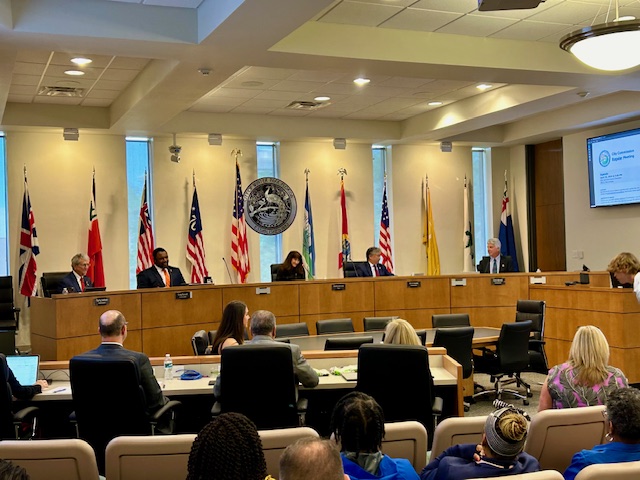
With costs for police and fire, transportation and other city services continuing to rise amid stubborn inflation, commissioners discussed last week the idea of increasing how much residents pay in property taxes by a quarter mil.
The talks took place at the Commission’s first budget work session of the year where the elected officials heard an overview of anticipated revenue and costs for next year.
Warren Lindsey, who will be sworn in as a new commissioner in Todd Weaver’s seat later this month, attended alongside Weaver.
Commissioner Craig Russell voiced a willingness to consider a tax increase and pondered ways to get residents on board with the idea.
“It’s just a matter of telling the story,” Russell said. “We still have unfunded projects” and expressed concern about a decline in city services “where we won’t be a destination anymore, we’ll just be run-of-the-mill.”
Russell, who was backed by the Winter Park Chamber of Commerce and is up for re-election next year, said commissioners must talk about the needs with residents and “agree on whether we can market it so that the messaging is cohesive across the board with the public.”
Commissioner Marty Sullivan, who is also up for re-election next year and who proposed a property tax increase recently in a written message to residents, responded, “Craig, you stole my thunder.”
Sullivan said he didn’t mind if an increase is unpopular with voters. He said a .25 mil increase for many residents would be about $8 or so a month or “not much more than a cup of coffee at Barnie’s.”
“I’m OK with people hating me for it,” he said. “If 10 or 20 years from now they say they’re glad we did it.”
Commissioner Kris Cruzada, who was just re-elected last week and is often one of the more fiscally conservative voices on the board, said some older residents are “aging in place” and could be more concerned with increased costs.
He said he encountered a variety of viewpoints on the matter when he canvassed door-to-door ahead of the election.
“Some are more concerned,” he said. “I did get other residents who said, ‘I wouldn’t mind paying a little bit more,’ to make sure key performance indicators can be met,” such as police and fire response times.
“So it is a bit of a mixed bag with some of the residents,” Cruzada said.
City Manager Randy Knight said commissioners will be asked to set a tentative millage rate in July, the city’s typical practice. Then, in September when the budget must be approved, the board can lower the rate if there is negative feedback or if revenue estimates change.
Mayor Sheila DeCiccio recalled how the board attempted to push the rate higher in 2020 in response to the pandemic.
“And there was a public outcry and we brought it down,” she said.
Winter Park’s millage rate is 4.0923 and is the only local city that has not increased its tax rate “since the 2009 Great Recession,” according to last year’s budget document. The rate equals about $4.09 in taxes for every $1,000 of a property’s taxable value.
City Management and Budget Director Peter Moore told the group that potential new costs in the city’s more than $214 million budget could total as much as $5.6 million, but potential new revenues under the status quo could reach just $3.5 million.
The potential new costs include: $900,000 in general fund operating costs; $700,000 for public safety positions; $250,000 for equipment replacement, which he said could face increasing costs as a result of federal tariffs; $300,000 more in the general fund for building projects; $150,000 for IT software and $140,000 to update the parks master plan.
He said the property tax base for Winter Park is expected to remain strong, though growth could slow or at least level out.
He added that he expects harder-to-come-by federal and state grants and higher electric utility costs down the road.
“We’ve seen cities target specific things,” Moore told the group such as raising taxes specifically for transportation or police as some other local governments have done. “Allocating a quarter point to public safety would help.”
At the City Commission meeting earlier in the week the board voted to pause offering more money for local nonprofit grants until later in the year as they wait to get a better picture of the budget numbers and after DeCiccio raised that federal and state grants will likely dry up.
WinterParkVoiceEditor@gmail.com
To comment or read comments from others, click here →

by Beth Kassab | Mar 15, 2025 | City Commission, Election, News
On a parting note, Todd Weaver questions WP Chamber's political activity
At the commissioner’s final meeting, he asked whether the chamber can or should continue to operate its political action committee from a city-leased building
March 15, 2025
By Beth Kassab
At the end of his final meeting this week, Todd Weaver suggested the city could terminate or buy out the Winter Park Chamber of Commerce’s 99-year lease on a city building and questioned whether the group’s political action committee violated the lease agreement.
Weaver said he is unhappy with the group’s political activities and the city is in need of more space for staff and could use 151 W. Lyman Avenue, the city-owned building across from City Hall occupied by the chamber. He also questioned the quality of the Welcome Center the chamber operates in the building as part of its agreement.
“For me, the chamber should be promoting all commerce in the city … they’ve lost sight of our residents,” Weaver said. “… I’m not thrilled that the chamber is actively working against the commission. They backed another person against someone who is an incumbent … I’ve gone over the lease with the city manager and I’ll let them talk about the pitfalls, but something we as a commission should think about for economic reasons is for the city to allow the chamber of commerce to operate as they have, but elsewhere.”
The move came on the heels of Tuesday’s election, which saw a heated contest for Seat 3 with the chamber’s PAC spending more than $30,000 in an attempt to defeat incumbent Kris Cruzada and support challenger Justin Vermuth.
Cruzada, an attorney who was first elected in 2022, won big — taking nearly 63% of the vote — despite being significantly outraised by Vermuth, a lobbyist for the timeshare industry who collected $94,000 and spent $91,000, according to the most recent finance reports. Cruzada raised $36,000 and spent $27,000.
The PAC was created last year with attorney Brian Mills named as chairman and has raised $85,000 and spent $67,000 during the 2024 and 2025 election cycles. In 2024, the group backed Commissioner Craig Russell, who narrowly defeated Jason Johnson to fill a seat left open by Sheila DeCiccio when she ran for mayor.
City attorney Kurt Ardaman said in response to Weaver’s questions at Wednesday’s meeting that it did not appear the city had the ability to buy out the chamber from its lease unless the chamber had sublet a portion of the building without notifying the city or unless the city negotiated a new arrangement with the chamber.
Ardaman said the lease started in 2005 and runs through 2104. In exchange for the century-long lease without monthly rent, the chamber spent about $900,000 to redevelop the site, he said.
Chamber President and CEO Betsy Gardner said through a spokeswoman that the chamber had not sublet any portion of the building to any individual or entity.
Winter PAC lists its address as the chamber’s address and Gardner is listed as its registered agent in documents filed with the city last year.
According to a “Frequently Asked Questions” sheet sent to the Voice, the PAC is operated separately from the chamber itself.
“The Chamber Board and CEO do not control Winter PAC,” the FAQ reads. “While the organizations are associated and aligned with the tenets of the Chamber’s Prosperity Scorecard, they are separate entities with separate bank accounts and independent boards of directors.”
Commissioner Marty Sullivan, whose term is up next year, said, “I believe it deserves a deeper look,” in response to the questions brought up by Weaver.
Cruzada, who will be sworn in for his second term later this month, said, “I wouldn’t mind an inquiry to see if there is a provision in the lease they may be violating.”
Russell, the only current commissioner who had the backing of the chamber and who will also be up for re-election next year, said “nothing from me” when his turn came to speak and then questioned the timing of the discussion.
“Why now?” he asked.
Weaver, who opted not to run for re-election this year, responded that the the PAC was formed after the lease went into effect.
“I get it,” Russell responded. “I’m not interested.”
But with three commissioners — Weaver, Sullivan and Cruzada — signaling interest, the city attorney was asked to research the matter further to determine if there are any concerns related to the lease.
BusinessForce, a political action committee based in Orlando, split from the former Orlando Regional Chamber of Commerce years ago after starting out as an affiliated organization similar to Winter PAC.
PACs are routinely used in Florida politics to infuse races with more money than a candidate can often raise through a campaign account alone. That’s because individuals can give unlimited contributions to political committees while candidates are limited to accepting no more than $1,000 per individual or entity each election.
The catch is that, under Florida election rules, political committees can not coordinate activities with a candidate.
The chamber’s own FAQ sheet spells out the rules this way: “The primary purpose of a Political Committee (PC) is to support or oppose any candidate or issue. A PC may also make an independent expenditure, meaning it can spend money to expressly advocate for the election/defeat of
a candidate/issue as long as it is not controlled by, coordinated with, or made upon consultation with any candidate, political committee or agent of such.”
Throughout Vermuth’s campaign, Winter PAC reported multiple expenses labeled as “independent expenditure regarding a candidate” for mail pieces.
For example, two appear on the most recent report filed: one for nearly $8,000 and one for $2,300. All such expenditures on Winter PAC’s reports were paid to MDW Communications LLC at 7765 Lake Worth Road, Suite 210 in Lake Worth.
MDW Communications is a political advertising firm that, according to its website, designs “digital and direct mail strategies that have helped over 150 progressive campaigns and causes win since 2014.”
Vermuth, on his own candidate financial reports, listed a number of expenses for polling, palm cards, mail pieces and paid calls to a group called “Claughton Consulting” that also lists as its address 7765 Lake Worth Road, Suite 210 in Lake Worth.
Searched on a map, the address appears to be in or near a Publix shopping plaza, just east of the Florida Turnpike in Palm Beach County.
The Voice asked Vermuth for information about Claughton Consulting in February and he declined to answer the question. He did not respond to emails seeking comment about the election this week.
An email address on a web site found for Claughton Consulting is invalid. No response was received to questions submitted through a form on the web site.
Only one other local candidate has used Claughton Consulting, according to a search of the state campaign finance database and a search of Orange County campaign finance records.
Steve Leary, the former Winter Park mayor and unsuccessful candidate last year for Orange County Commission, paid the firm through his campaign as well as through his political committee. Neighbors for a Sensible Orange County paid the firm $65,000 last year. Leary’s own campaign account paid Claughton $105,000 last year, according to finance records.
Gardner said the chamber did not recommend Claughton to Vermuth.
“Winter PAC did use MDW for its communications in this cycle,” she said. ” MDW had done a fantastic job on another project for the Chamber. We did not recommend Claughton Consulting to Mr. Vermuth’s campaign.
MDW Communications did not immediately respond to e-mailed questions about why MDW’s address appears as the same address for Claughton on campaign reports filed separately by Winter PAC and Vermuth’s campaign.
MDW is frequently used by mostly Democratic candidates across the state. The firm has been paid more than $16 million going back to 2013, according to the state campaign finance database. Multiple addresses are listed for the firm in the database, including the one in Lake Worth.
Orange County elections records show the firm has taken in more than $100,000 dating back to 2020 for work in local races.
WinterParkVoiceEditor@gmail.com
To comment or read comments from others, click here →



Recent Comments