by Beth Kassab | Nov 4, 2025 | Arts and Culture, City Commission, News
No Takers to Develop Portion of Seven Oaks Park
Developers like East End Market’s John Rife says the park first needs stronger programming. Green space advocates are happy the park will remain untouched
Nov. 4, 2025
By Beth Kassab
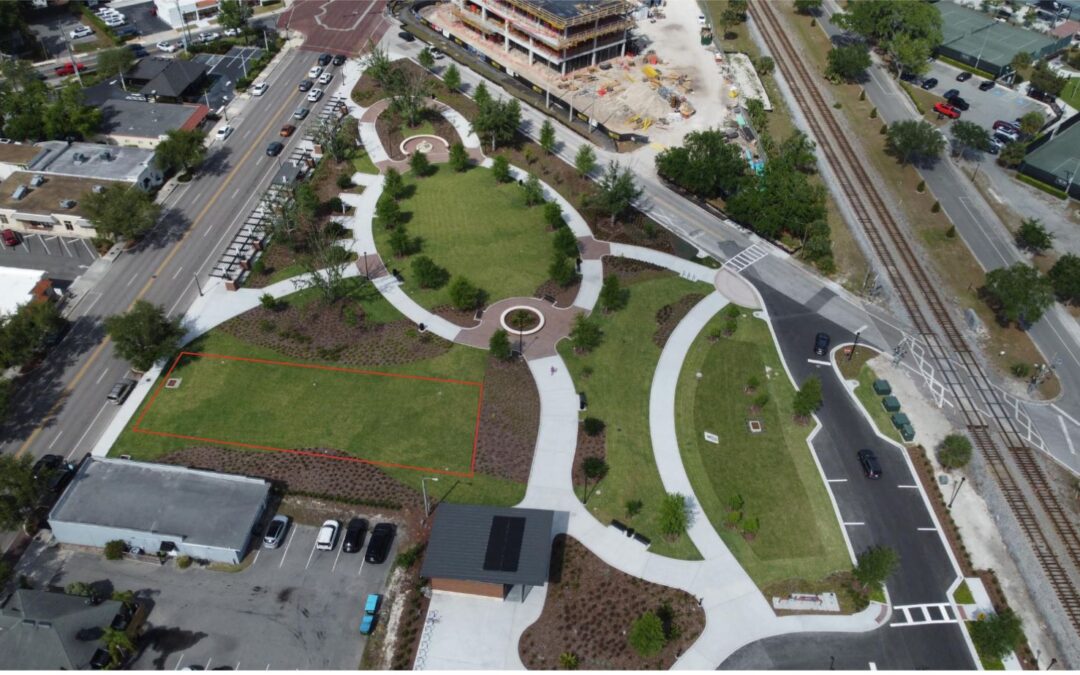
There were no eligible responses on the city’s request for developers to submit ideas to build a cafe, shop or other concept at Seven Oaks Park, the new 2.4-acre open space at North Orange Avenue and South Denning Drive.
With hardly any interest, the city closed the request for negotiations to develop a portion of the park (red outline in above photo at top of page). The city rejected the single response it received and would not answer questions about it, citing a public records exemption that keeps the response inaccessible to the public for up to 12 months.
City spokeswoman Clarissa Howard said the City Commission could decide to try again to solicit interest, but no date has been set for a discussion.
Mayor Sheila DeCiccio advocated to push forward with a plan to “activate” the park, which opened earlier this year, because she said nearby business owners “desperately” wanted to see something happen there.
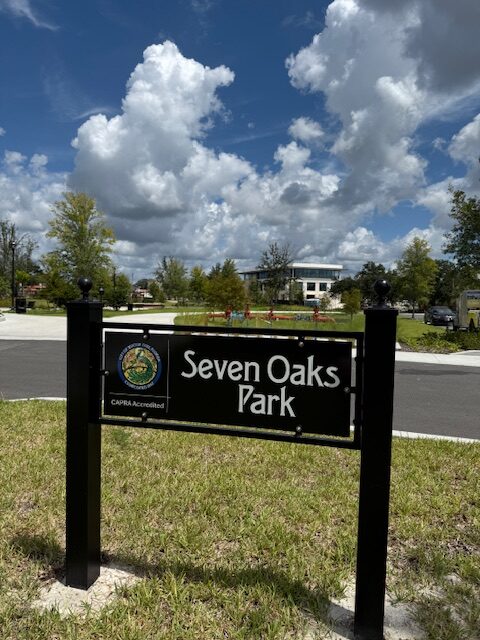
The sign that welcomes visitors at Seven Oaks Park.
The park opened in February, a culmination of an effort by the city to purchase the land and transform it into a public open space in the middle of a busy urban corridor. But critics have noted that the park is often empty and offers little refuge from the sun because the oaks planted there have yet to mature enough to provide shade.
On many days, the parking lot that accompanies the park is busier than the park itself with patrons finding a spot there to visit Foxtail Coffee, Buttermilk Bakery and a number of other popular businesses in the area.
John Rife, who developed East End Market on Orlando’s Corrine Drive, said he was interested in the property but the economics don’t make sense for now. The city’s request to negotiate on the project required the developer would pay a ground lease to the city.
“I did East End Market not because I hoped people would show up, but because we had already been nurturing a bunch of purveyors,” in the Audubon Park neighborhood, said Rife, who opened the market 12 years ago.
He said the city might generate more interest if it first establishes good temporary programming in the park that “serves the needs of the neighborhood first.”
For example the corridor has at least a half dozen interior design businesses within a few blocks.
So perhaps, he said, a “design pop-up” could occupy the park for a weekend. It could be a way to nurture new talent that can’t afford permanent Winter Park rents.
“If your mission is to incubate cool upcoming stuff then you have to subsidize it,” said Rife, who is a Winter Park resident. “Is this a top dollar thing? Or is a thing for the betterment of the community? I think it’s hard to do both.”
He suggested one key step would be for the city to make it as easy as possible for people to pitch ideas and host temporary programming in the park to generate activity.
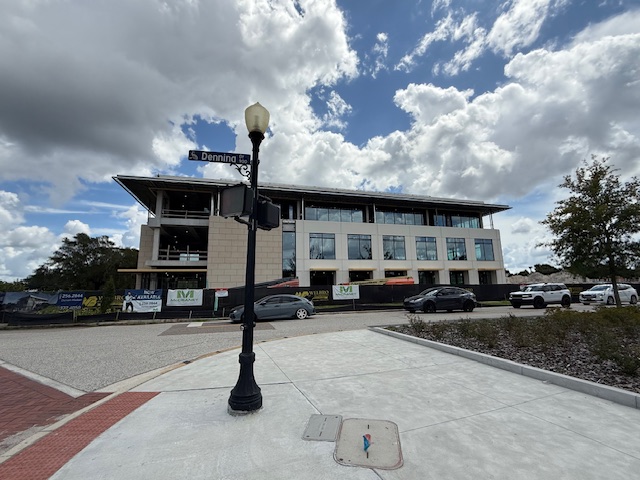
The McCraney office building is under construction across Denning Drive from Seven Oaks Park.
Winter Park moved its popular Farmer’s Market to Seven Oaks one day last month rather than close it during the weekend of the Autumn Art Festival. The Farmer’s Market will be held at Seven Oaks again on Nov. 15 to avoid a conflict with the annual Cows ‘N Cabs charity event.
Not everyone in Winter Park was on board with the plan to develop a piece of the park.
Leslie Kemp Poole, a member of the Winter Park Land Trust and a professor of environmental studies at Rollins College, said Seven Oaks needs more time for residents to discover it. She noted the foresight of city leaders to protect the land as green space rather than see it developed into another office building as an investment in Winter Park’s future.
“There are complaints that the Seven Oaks isn’t being ‘activated’ or used enough,” Poole said in an email. “Judging it in 98-degree Florida summers hammered by daily lightning storms is hardly fair. Now, with cooler weather, residents are beginning to discover and enjoy it.”
WinterParkVoiceEditor@gmail.com
To comment or read comments from others, click here →
by Beth Kassab | Oct 27, 2025 | County News, Election, News
Did you mean to sign that ballot amendment petition?
A new Florida law requires Supervisors of Elections to mail letters to petition signers to give them the chance to deny the signature
Oct. 27, 2025
This story is part of the News Collaborative of Central Florida, a group of 10 local news outlets working towards a more informed and engaged region. It was originally published by VoxPopuli.
By Norine Dworkin
If you’re a prolific petition signer, don’t be surprised if you receive a letter from the Orange County Supervisor of Elections asking about the petitions you signed to put amendments on the November 2026 ballot. Is that your signature on this petition? Did you really mean to sign it? Do you want to change your mind?
According to the new Florida law HB 1205 (aka Initiative Petitions for Constitutional Amendments), passed on May 2 and signed by Gov. Ron DeSantis that same day, supervisors of elections are now required to mail out letters to every person who signed a petition for a ballot measure — say for legalizing recreational marijuana— to inform them that a petition with their signature was received by their office, confirm that voters intended to sign it and provide an opportunity to revoke the signature. (The law does not require supervisors to contact signers whose petitions were rejected, however.)
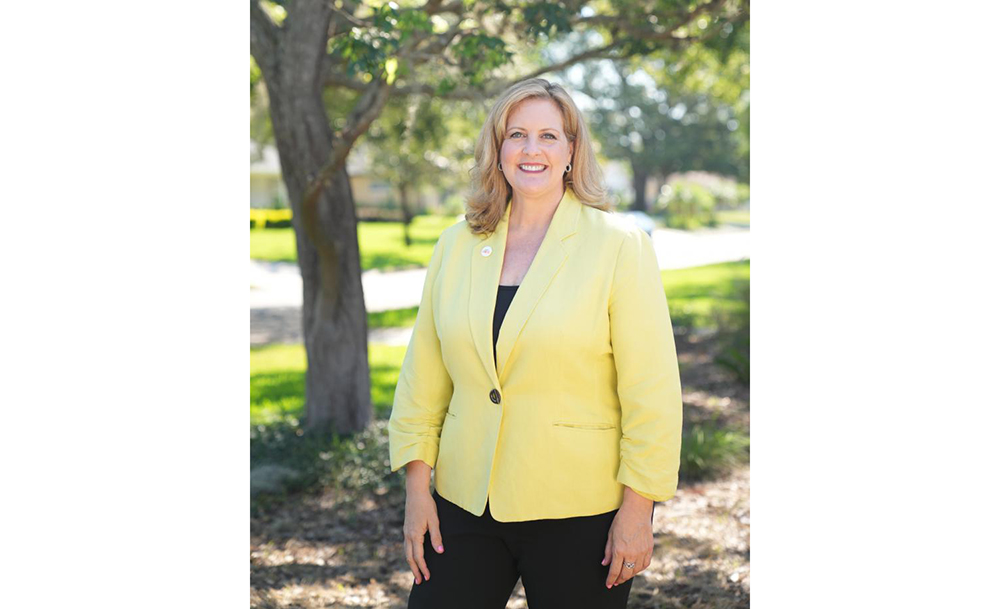
The Orange County Supervisor of Elections office is still fine-tuning the letters to be mailed out, Supervisor of Elections Karen Castor Dentel (pictured above) told VoxPopuli in a brief interview Wednesday. Voters can expect to receive letters in mid-November. If their signatures are fine, simply ignore the letters, Castor Dentel said.
“There is nothing for you to do. You don’t have to respond,” she said. “People have asked me if their signature was verified on a petition and they get this letter, if they don’t send it in or if everything was okay, will their petition still count? And it will. They’ll still count the petition … But just in case this [signature] isn’t yours, you have a second chance to deny it.”
Under the new law, voters who believe the signature is not theirs or who simply change their minds, can check one of two boxes on the letter, indicating the signature is misrepresented or fraudulent or that they wish to revoke their support for an issue. Those letters will then be mailed to the Office of Election Crimes and Security, which will conduct a preliminary investigation and if necessary report findings to the statewide prosecutor or appropriate state attorney for prosecution.
Still, Castor Dentel worries that even though the letters will contain the title of the petition signed, the added layer of bureaucracy may lead to voter confusion and mistrust.
“Many voters may not expect to receive a governmental letter asking whether they really signed something they know they signed, which could make them question the legitimacy of of the petition or even worry that they did something wrong,” she said. “Others might mistake the letter for a scam or think they need to take action when they don’t.
“Hopefully people will remember signing,” she continued, “and they’ll go Yes! I did that!, and this won’t create many letters going on to Tallahassee [to the Office of Election Crimes and Security].”
WinterParkVoiceEditor@gmail.com
To comment or read comments from others, click here →

by Beth Kassab | Oct 27, 2025 | Arts and Culture, City Commission, News, Police and Public Safety, Taxes
Fearing Property Tax Cuts by State, WP Opts Against Giving Extra to Nonprofits
Florida voters could be asked next year to cut their property taxes. That already has cities like Winter Park reeling over how they will fund essential services like police, fire and flood prevention.
Oct. 27, 2025
By Beth Kassab
City Commissioners met late last week to consider a plan to give out about $100,000 that once went to the Dr. Phillips Performing Arts Center each year to 10 local nonprofits in the form of $10,000 grants.
The conversation quickly reached consensus among city leaders that even $100,000 out of a $230 million budget couldn’t be spared amid proposals by Gov. Ron DeSantis and the Legislature to dramatically cut property taxes — a move they fear would kneecap local governments.
Budget Director Peter Moore said he was waking up at night thinking about what those proposals would mean on the doorsteps of residents who rely on the city government for essential services such as quick police and fire response times, clean drinking water, safe roads and sidewalks that don’t flood during storms and reliable electricity.
“I can’t even comprehend how we would wrap our brain around how that would even work,” he told commissioners during the Thursday work session. “But there’s five different proposals out there, which makes me think something is going to end up on the ballot.”
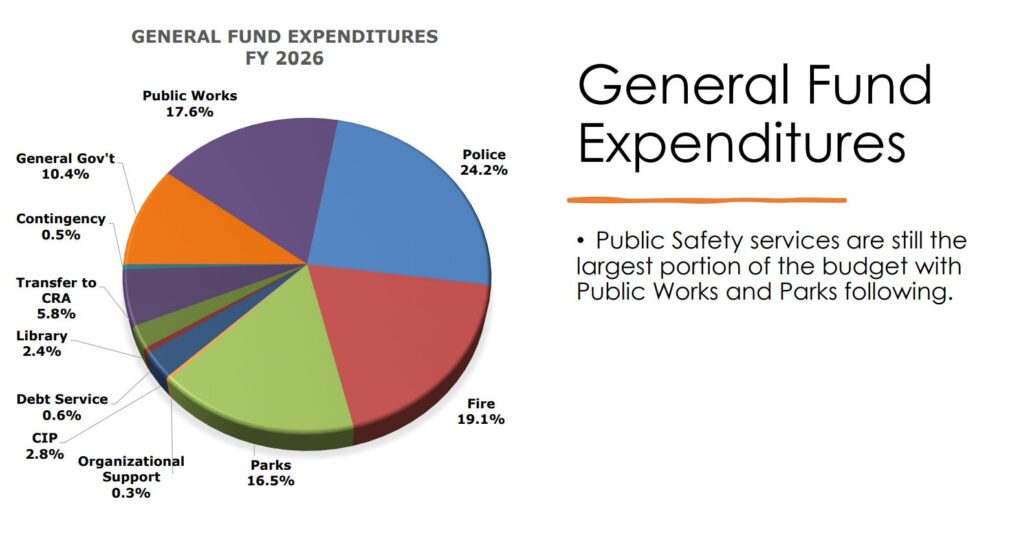
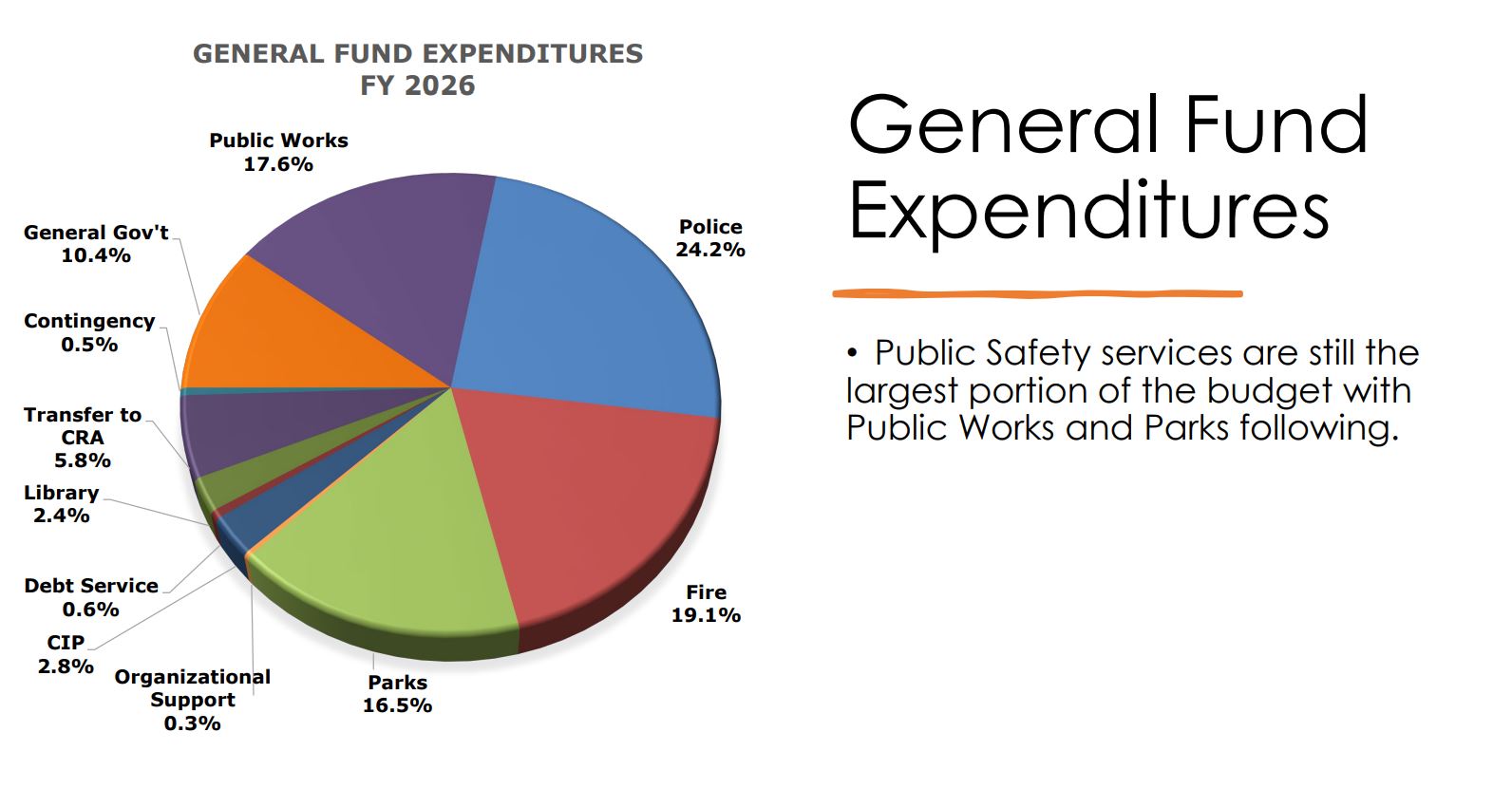
Property tax collections make up the largest source of dollars in the city’s General Fund, which pays for police, fire, parks, roads and other government services, including cyber security for public data.
The General Fund is about $90 million in the 2026 budget and city property taxes account for about $39 million or about 44% of that total. The money from property taxes is so significant it’s enough this year to cover the two largest expenses in the general fund: the police department ($21.9 million) and the fire department ($17.1 million).
“I’ve lost sleep over what’s going to happen,” said Commissioner Warren Lindsey. “I don’t know what they are doing up in Tallahassee. They have no idea how a local municipality and a county is run in terms of the things they’ve said and done.”
Proposals from the Florida House so far range from raising the homestead exemption to $100,000 to eliminating or phasing out non-school designated property taxes.
When a Winter Park property owner pays taxes, about 27% of that money goes to the city while 44% goes to Orange County Public Schools, 28% goes to Orange County government and 1% goes to the St. Johns River Water Management District, according to city budget documents.
DeSantis said last week he was unsatisfied with the House’s work, which would potentially put more than one tax-cutting measure on the November 2026 ballot. That could make it difficult for any single proposal to gain enough support to pass.
“Placing more than one property tax measure on the ballot represents an attempt to kill anything on property taxes,” DeSantis said on X. “It’s a political game, not a serious attempt to get it done for the people.”
The Legislative session begins on Jan. 13, earlier than usual because it’s an election year.
DeSantis’ administration is touring the state in an attempt to make a public spectacle out of his “DOGE” efforts to audit cities and counties. A Winter Park spokeswoman said the city has not received additional requests from Florida’s DOGE office beyond the requests that went to all local governments earlier this year.
State officials are pointing to the increase in property tax collections as property values have soared as largesse in local government.
For example, property tax collections in Winter Park have jumped from $27.5 million in 2022 to about $39 million in the current budget, a 41 percent increase. The growth is the result of a hot housing market as the city’s tax rate has remained the same for 16 years.
But local governments like Winter Park argue that costs have also soared during that time. The city spent $16.3 million on the police department in 2022 and now spends $21.9 million, largely the result of competition across the state to raise law enforcement pay. The fire department cost $13.4 million in 2022 and now costs $17.1 million, also a result of pay and other cost pressures.
Those two departments alone account for $9.3 million of the additional $11.5 million in property taxes collected by Winter Park due to rising property values since 2022.
Commissioners noted the potential “bad optics” of providing even small grants to nonprofits after Moore suggested it was the kind of expenditure that “could get picked up in a news article.”
Mayor Sheila DeCiccio said the city would continue to give grants to the nonprofits that are regularly funded in each year’s budget. But, she said “we will probably” be able to reallocate the money for Blue Bamboo Center for the Arts, which is undergoing a leadership transition after founder Chris Cortez was recently diagnosed with brain cancer and the county is reviewing its $1 million grant.
Jeff Flowers, who is taking over the management of Blue Bamboo, said the group is growing and remains sustainable.
The money for the nonprofit grants comes from .25% of the gross revenue from each of the city’s three major funds — the general fund, electric and water and wastewater.
The electric and water and wastewater funds, which the city calls enterprise funds, account for even larger increases in the city’s budget than property taxes. Those funds, which charge residents and businesses for service based on a combination of flat fees and prices tied to the amount of water and electricity consumed, have grown to a combined $100 million this year.
City Commissioners have raised those prices in recent years to account for increased costs of maintaining the utility systems and what the city says are soaring prices to finish a citywide project that will underground all overhead power lines.
The funds “must support their operations through the revenues they generate, operating like a conventional private business,” the budget notes.
The quarter of a percent from those three funds — the general fund, electric and water — generates about $442,000. Those that receive yearly funding, including the Winter Park Library, which also receives additional dollars, are:
- Mead Botanical Gardens: $102,000
- Winter Park Historical Association: $97,000
- Winter Park Day Nursery: $42,500
- United Arts: $20,000
- Blue Bamboo: $12,500
- Polasek Museum: $28,000
- Winter Park Library: $2.1 million
During the same work session about whether to hand out an additional $100,000 to nonprofits, commissioner also discussed a plan by the Parks & Recreation Department to formalize a policy to sell sponsorships or advertising opportunities at is facilities to raise additional new revenue.
Staff estimates such transactions could generate $100,000 or more a year.
City commissioners indicated support for the plan so long as ads or sponsorship plaques or banners are “tasteful” and major deals would come before the commission for approval. Commissioners must also still approve the policy for the new revenue stream.
The effort would mostly focus on the city’s two golf courses, the tennis center and other parks with high foot traffic. Central Park, the highest-profile public green space along Park Avenue, would be off limits to advertisers, according to the proposal.
Even before talk of property tax cuts heated up to its current white-hot level, city staff was warning of slower times ahead for the city government.
“While this budget does not assume a recession in FY26, there are concerns on the horizon and visible weakening in the economy,” the budget proposal released in the early summer stated. “This could just mean a return to normal growth after the post-Pandemic spike, or this could portend something worse.”
Adding new services and projects will only be possible in the future by raising property taxes or raising the fees customers pay for services, according to the budget analysis.
With the governor and Legislature poised to try to take property tax increases off the table, that leaves the prices residents pay for everything from the use of athletic fields and after-school programs to the cost of building permits and water and electricity as the primary ways for the city to generate dollars.
WinterParkVoiceEditor@gmail.com
To comment or read comments from others, click here →

by Beth Kassab | Oct 25, 2025 | Arts and Culture, City Commission, News
Blue Bamboo Founders Step Away After Recent Diagnosis
Chris and Melody Cortez led the remake of the old Winter Park Library into a music hub. Board Chairman Jeff Flowers will now take the lead as Chris Cortez faces brain cancer
Oct. 25, 2025
By Beth Kassab
The Blue Bamboo Center for the Arts opened this summer in the old Winter Park Library, a long-sought triumph for the nonprofit music venue in search of a new stage and for a city government looking for someone to remake the vacant building.
Now Chris Cortez, an accomplished musician, is stepping back from managing the group he started in 2016 with wife Melody, a visual artist, after he was diagnosed this month with glioblastoma, an aggressive brain cancer.
Cortez will retain “emeritus status” at the organization while board Chairman Jeff Flowers — chemist and arts philanthropist who operated environmental testing firm Flowers Chemical Laboratories and served two stints on the Maitland City Council — is taking the day-to-day leadership role.
“While Chris will no longer be involved in operations, his artistic vision and legacy continue to guide our mission and inspire our work,” Flowers said in a letter to the City Commission.
Flowers said he wants to assure the community that the Blue Bamboo “remains strong, active and sustainable.”
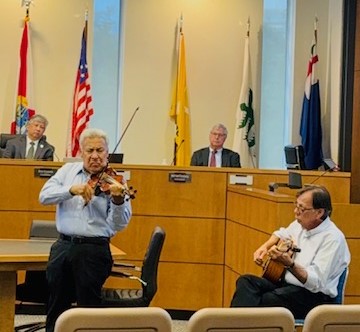
Blue Bamboo Founder Chris Cortez plays guitar with famed violinist Alvaro Gomez at a City Commission meeting in September. Above photo: Jeff Rupert, director of jazz studies at UCF and Blue Bamboo board member, plays at the Blue Bamboo in June with sons Preston and Django.
“Our board now meets monthly to review operations, finances and construction progress, and to provide guidance and accountability,” he said in the letter. “Directors have taken on leadership in operational, financial and technical areas ensuring that our transition is booth smooth and effective. We have also added staff to handle essential functions in sound, video production and hospitality services.”
Just before Cortez’s health challenge surfaced, the Blue Bamboo was facing another difficult transition when Central Florida Vocal Arts said it could not reach a lease agreement with Blue Bamboo and walked away from the project.
Theresa Smith-Levin, founder and executive director of CFVA and Opera del Sol, was a key partner in the effort to secure the support of the city along with a $1 million Tourist Development Tax grant from Orange County for construction.
Now the grant, which has not yet been paid out, is being reviewed by Orange County.
Smith-Levin’s group, which stages a variety of musicals and operas, was slated to occupy the second floor as teaching, rehearsal and office space and about $200,000 was designated from the grant for construction for those needs. Her group was also helping Blue Bamboo raise $500,000 in required matching funds and would have contributed half the rent on the building to the city, which is set to increase next year.
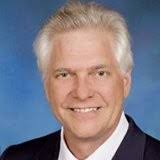
Jeff Flowers
Flowers said he has new matching funds identified and is working with another nonprofit to occupy space in the building.
Flowers also runs another nonprofit called Performing Arts Matters, which he and his wife founded two decades ago to fund groups such as the Orlando Contemporary Chamber Orchestra, which performed at Blue Bamboo over the summer.
The first floor of the building now features two performing spaces — a main stage with 182 seats and a smaller stage with a seating capacity of about 60.
“Looking ahead, we are expanding our programming to include classical performances,” Flowers’ letter said. “The Maitland Symphony Orchestra and Bravo Chamber Orchestra are planning their first concerts at the Blue Bamboo in 2026, following this past summer’s successful appearance by the Orlando Contemporary Chamber Orchestra — one of our best-attended events to date.”
One of the Blue Bamboo’s signature weekly events known as the Free Thursday Night Hang will continue, he said. Cortez started the event with a vision for professional jazz artists to share the stage with students or others emerging on the scene — part of his “stage for all” philosophy.
“With that mindset, the Boo became a go-to place for collaborative projects,” Cortez wrote on his website. “Big bands of all kinds, jam sessions, and what-if scenarios, all leading to a healthy environment for creativity. Audiences might attend a conservative, classical recital one day, and the next, a reimagining of Led Zeppelin as a latin salsa band. (That actually happened!)”
Flowers said the Blue Bamboo is planning a show Thursday night that will feature Cortez on the guitar, possibly his final time on the Blue Bamboo stage. The concert will be a tribute to Cortez and his contributions to the local music scene.
WinterParkVoiceEditor@gmail.com
To comment or read comments from others, click here →

by Beth Kassab | Oct 23, 2025 | City Commission, News, Zoning and Development
New Racquet Club Building Approved With Even More Conditions
Also approved: New Jewett Ortho Building and a Raise for the City Manager
Oct. 23, 2025
By Beth Kassab
The Winter Park Racquet Club won approval for a new building in the residential enclave off Lake Maitland known as the Vias after a contentious debate with neighbors that included a final-hour meeting before Wednesday’s vote that led to additional conditions imposed on the 72-year-old private club.
Commissioners voted 4-1 to allow the demolition of a two-story house on Via Tuscany and construction of a new single-story fitness center, tennis shop and offices with 12 new conditions on top of the nine rules recommended by the Planning & Zoning Board. Commissioner Warren Lindsey, who said he was a former member of the club, was the only dissenting vote.
The sentiment of the people who live in the neighborhood was mixed with several residents who live closest to the club still urging commissioners to vote against the project.
Dr. Scott Greenberg, a recently retired plastic surgeon who lives directly across the street from the club, said he was part of the meeting that resulted in the new conditions.

“We felt we had to agree to them because we didn’t have a choice,” said Greenberg, who asked commissioners to cast a “no” vote and said there was a “culture of mistrust” because he was led to believe the home at 2011 Via Tuscany would be left as it when the club purchased it in 2015.
Marci Greenberg told the Voice that the club was hardly noticeable when she and her husband moved to their home, but has since grown significantly with more traffic, noise and lights from the tennis and pickleball courts.
Hillary Turner, who lives nearby and whose mother lives directly next to the club, echoed that point in front of the commission on Wednesday.
“When we moved to this property in 1980 most of the hosuess didn’t have pools,” she said. “They didn’t need them because everyone swam at the racquet club. The racquet club, at that time, was a neighborhood club. It has now transformed into a club within a neighborhood.”
She said the club’s size over the years has more than doubled to 500 members and many don’t live in the neighborhood.
Clay Coward is a member of the club who lives less than a mile away and said he supported the club’s plans and noted the number of times smaller homes in the area have been torn down and replaced by large “mansions.”
He showed the commission several photos of homes along Via Tuscany, including one he called “Hotel California” because he said it’s reminiscent of the Eagles album cover. The house is about 9,000 square feet, has eight bathrooms and what appears to be a six-car garage — not unusual attributes for the lakefront neighborhood of multi-million dollar homes.
Coward suggested the club’s redo of the house at 2011 Via Tuscany into a 6,300-square-foot mediterranean style building would fit right in.
Rob Carter, one of the club officers who has led the project, said he has tried to work and collaborate with the neighbors.
“This has been a long road,” he said, noting that the club has “readily agreed” to multiple conditions.
He said the current house could not be renovated because its age, old windows, low ceilings and a pool in the backyard the club would not want to use made it cost prohibitive.
The new building he said will provide not only a new small gym and locker rooms for members but, for the first time, a separate area for staff to eat meals and staff restrooms.
“Right now there’s no break room or segregated bathrooms,” he said.
The club agreed to following new conditions on top of the nine already set by Planning & Zoning.
- Keep or replace the existing podocarpus hedge at the front of the property and added additional hedges to fill in the property line.
- Cars cannot be parked in the circular driveway off Via Tuscany except for special events, which will be limited to five cars.
- No parking can occur on the lot before construction begins.
- The club can not host large events for non-members unless it’s member-sponsored.
- The size of events must be capped to eliminate the need for on-street parking.
- Must plant podocarpus hedge on the northern property line adjacent to the home at 2175 Via Tuscany.
- Must add glare shields to the lights on the pickleball courts.
- Must turn off lights on tennis and pickleball courts when not in use.
- Must cap membership at the current 500 members.
- Eliminate existing ads for event space online or in print publications.
- Must allow the podocarpus hedge in front of the pickleball courts to grow to the height of the fence surrounding the courts.
- Compliance with the conditions will be monitored with the typical code compliance procedures.
During the commission meeting the additional conditions were added: there must be blinds or curtains on the new gym window facing Via Tuscany, the club must establish a neighborhood relations committee and the club can not add signs to the front of the building (which it wasn’t proposing to do).
New Jewett Building for Orlando Health
Orlando Health won approval on Wednesday to build a new Jewett Orthopedic Institute on Gay Road and Trovillion Avenue not far off U.S. 17-92 across from Winter Park Village.
The 27,000-square-foot, two-story building will combine five lots that are mostly vacant today and will replace the longtime Jewett offices 1285 Orange Avenue.
Jewett became part of the Orlando Health hospital system in 2020 and also has a large office in downtown Orlando near the hospital’s main campus.
In 2019, the commission approved an office development for the property, but the development never happened. That approved plan included a 6-foot masonry perimeter wall and lush landscape to buffer the development next to the Chateaux du lac and
Killarney Bay condominiums.
The new conditions call for a perimeter fence and a perimeter hedge along those property lines.
Raise for City Manager
The board also approved a 3% merit raise for City Manager Randy Knight and thanked him for his longtime dedication to the job.
Knight, who has worked for the city for more than 30 years and as city manager for 18 years, earns $274,393. He plans to retire in 2027.
WinterParkVoiceEditor@gmail.com
To comment or read comments from others, click here →

Recent Comments