by Beth Kassab | Oct 9, 2025 | City Commission, News, Zoning and Development
P&Z Board Approves Racquet Club Expansion with Multiple Conditions
The plans must still win approval from the City Commission
Oct. 9, 2025
By Beth Kassab
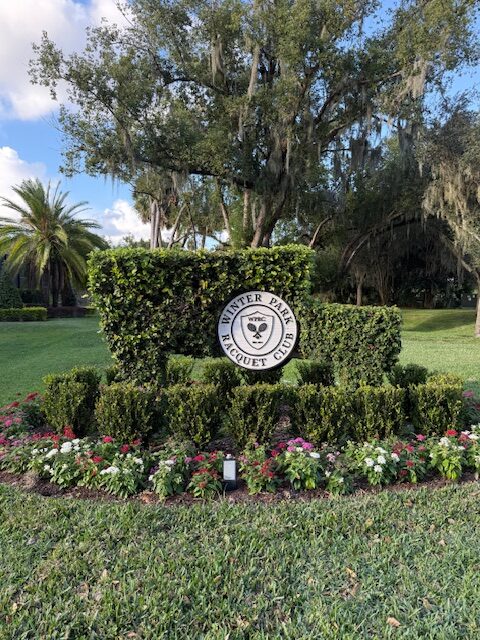
The Winter Park Racquet Club made it over the first hurdle this week toward an expansion in the neighborhood known as “the Vias,” one of the city’s poshest enclaves between Lake Maitland and Temple Drive.
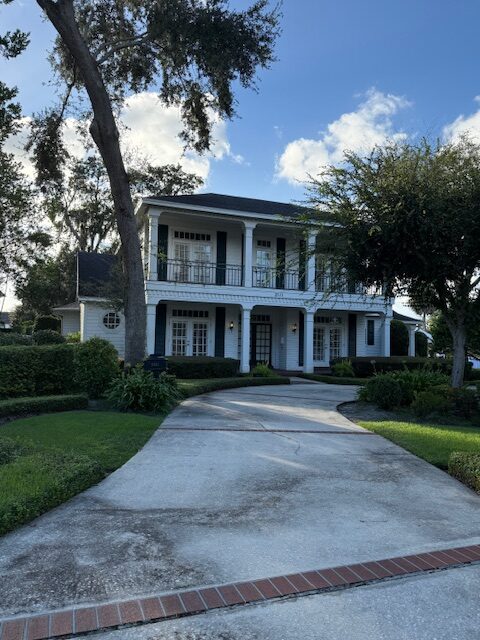
In a 5-1 vote, the Planning & Zoning Board approved plans with three new conditions to tear down the white-columned two-story home at 2111 Via Tuscany and allow the private club to build a larger one-story building to house a fitness center, locker rooms, tennis shop and offices.
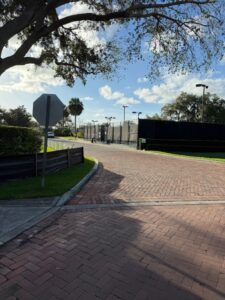
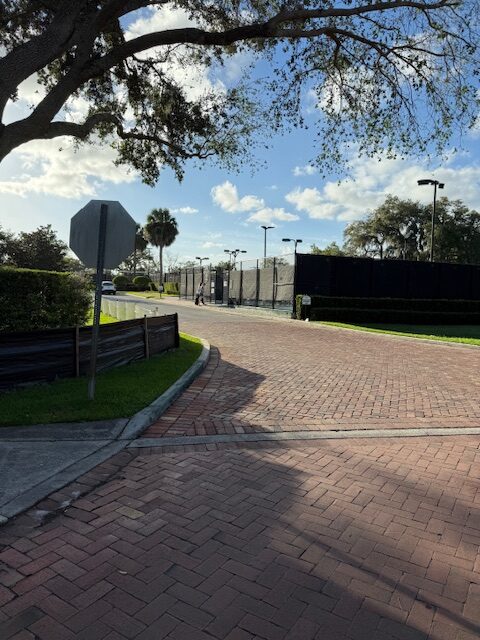
A view of the club’s pickle ball courts from Via Tuscany.
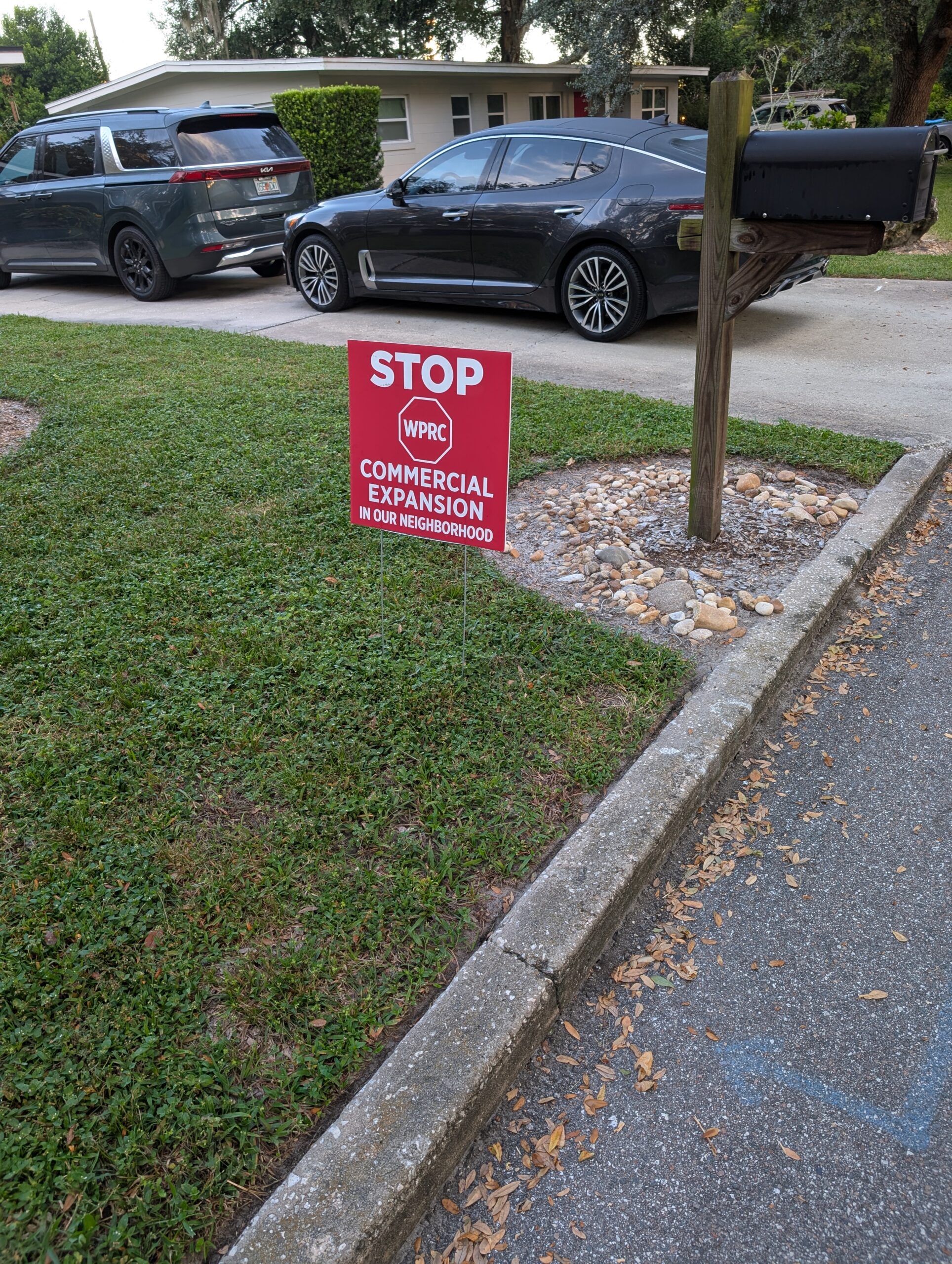
A crowd of neighbors — some who have planted red signs that say “Stop WPRC Commercial Expansion in our Neighborhood” in their front yards — attended to meeting to speak against the project with some comparing the tenor of the lights and activity at the club to a “Walmart” or “McDonald’s.”
Chairman Jason Johnson was the lone dissenting vote. Vashon Sarkisian, Charles Steinberg, David Bornstein, Alex Stringfellow and Michael Dick voted in favor. Bill Segal was absent.
Johnson said the changes appear as “commercial creep” in a residential area and said the term “sprawling campus” is “probably not an inaccurate description of what has happened with the club” that dates back to 1953.
“Is that to be expected?” Johnson asked. “Maybe, I guess? But this does sit in the middle of a residential neighborhood and at some point you’ve got to say I think it’s enough.”

A rendering shows what the new Winter Park Racquet Club building will look like at 2011 Via Tuscany. The white home pictured above will be torn down.
The project and conditions must ultimately be approved by the City Commission.
Planning & Zoning members added the following conditions:
- The circular driveway in front of the new building will be limited to 12-feet wide at the entry and exit points and 14 feet in the interior. That’s a reduction from the 20-foot driveway proposed by the club after neighbors and board members expressed concern the space would essentially serve as a parking lot. The club’s original proposal called for striped parking in front of the new building, but it revised those plans after hearing concerns last month.
- The club must conduct a photometric study or an analysis of the lights emitted by the club, including pickleball and tennis courts, to make sure it’s compliant and does not interfere with nearby homes.
- Play on the pickleball courts, which sit closest to Via Tuscany, must end at 8 p.m. instead of the current 9 p.m. cutoff.
City staff also called for additional conditions such as the driveway access on Via Tuscany be an entrance-only; the club can not increase its membership; hours of operation for the new building will be 7 a.m. to 8 p.m. for the new building; no new lighting can be added in the grass parking lot and the new paved section must use “low-scale bollard fixtures rather than traditional pole-mounted lights;” all non-safety required lights be off by 10 p.m. daily and the removal of two oak trees result in double the typical compensation.
 The club’s general manager did not immediately return a call for comment on the new conditions.
Rob Carter, the club’s volunteer president, said at the meeting that the club serves mostly Winter Park families, many who live in the neighborhood and walk or bike there. The home that will be torn down, he said, is outdated and will be replaced with a “safer one” that is compatible with the neighborhood and will not increase the intensity of the club’s operations.
“I do take some offense to the idea that we’re not trying to be a good neighbor,” he told the board, emphasizing that he incorporated residents’ feedback into the latest proposal and has offered to meet with people who live nearby and have concerns.
Demolition on Isle of Sicily
The P&Z board also approved plans by owners Kamran and Mina Khosravani for a new 10,400-square-foot home at 3 Isle of Sicily, meaning the current house originally built by famed local architect James Gamble Rogers II will be torn down.
The original home known as Four Winds dates to 1930 and sat at just 1,800-square-foot in the French provincial style. But the home had been altered significantly over the years and Jack Rogers, an architect and son of Gamble Rogers, said the damage to its integrity and history had been done long ago.

A rendering shows the proposed new home at 3 Isle of Sicily.
The project was approved unanimously by the board with little discussion and no public comment.
Over the years the number of Gambles Rogers homes in Winter Park has dwindled from about 50 to 15 or 20, Rogers said.
WinterParkVoiceEditor@gmail.com
To comment or read comments from others, click here →

by Beth Kassab | Oct 7, 2025 | City Commission, Historic Preservation, News, Zoning and Development
Upcoming Demolitions: At Racquet Club, a Gamble Rogers House and Park Ave Apartments
Two city advisory boards will consider the three projects this week
Oct. 7, 2025
By Beth Kassab
One of Winter Park’s most exclusive hang-outs wants permission to demolish a 5,400-square-foot two-story building at the front of its property and build a larger one-story structure to house a fitness center, locker rooms, tennis shop and offices.
The Planning & Zoning Board will consider the proposal Tuesday evening by the Winter Park Racquet Club, a private club that dates back to the early 1950s on Lake Maitland that offers swimming, dining, pickleball and tennis with initiation fees that run upwards of $22,500, according to one document that advertised a job posting there.
The changes at 2111 Via Tuscany have drawn criticism from neighbors on the residential street who say they are worried about commercial-like development, traffic and noise. As a result, the proposal has gone through revisions since the concept was tabled at the Sept. 2 Planning & Zoning Board meeting.
“The style will add cohesion to the rest of the club buildings, including the original clubhouse which was designed by [local architect James] Gamble Rogers,” read a description submitted by the club. “It will also mimic the aesthetics of neighboring homes, and the intent is for people driving by to assume that it is a residence that has been here all along.”
Residents expressed concerns about the disruptions to be caused by construction, light pollution, parking and other issues, according the minutes of a neighborhood meeting.
“I am extremely concerned that this project continues to seek to convert this house into a commercial multi-use facility,” Marci Greenberg, who lives across the street, wrote to the city, one of a number of emails received about the project. “With the new plans, there will still be a significant increase in traffic, parking in front of the building (as the new circular drive is 20 ft wide which is as wide as Via Tuscany) and an increase in noise. The current house, as such, contributes to the character and ambiance of the neighborhood. The proposed building looks commercial and detracts from our residential neighborhood.”
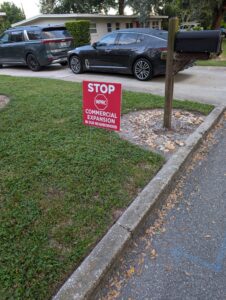
A sign in the neighborhood near the Racquet Club opposes changes there.
The club manager did not return a call for comment, but documents say the club is on a “membership waitlist” and is not accepting new members, meaning the project is not intended to allow any growth or expansion of services.
In response to concerns, the club has removed from the plans new parking that was to be added in front of the building and replaced it with a circular driveway.
City staff is also requesting other conditions such as the hours of operation remain the same, no new lighting be added and most exterior lights (other than for safety purposes) be turned off by 10 p.m.
Noise issues are also being addressed, according to the staff report.
“[The club] is proposing a six-foot acoustic sound barrier behind the eight-foot podocarpus hedge in front along Via Tuscany to screen the parking and buffer the noise concerns raised by the neighborhood,” it said. “This sound barrier will be the same barrier used to buffer the pickleball courts that is designed to reduce noise levels in outdoor settings and is made of a dense, soundproofing composite, and unlike a solid and rigid concrete wall, it both blocks and absorbs sounds more effectively.”
Another Gamble Rogers House Likely Gone
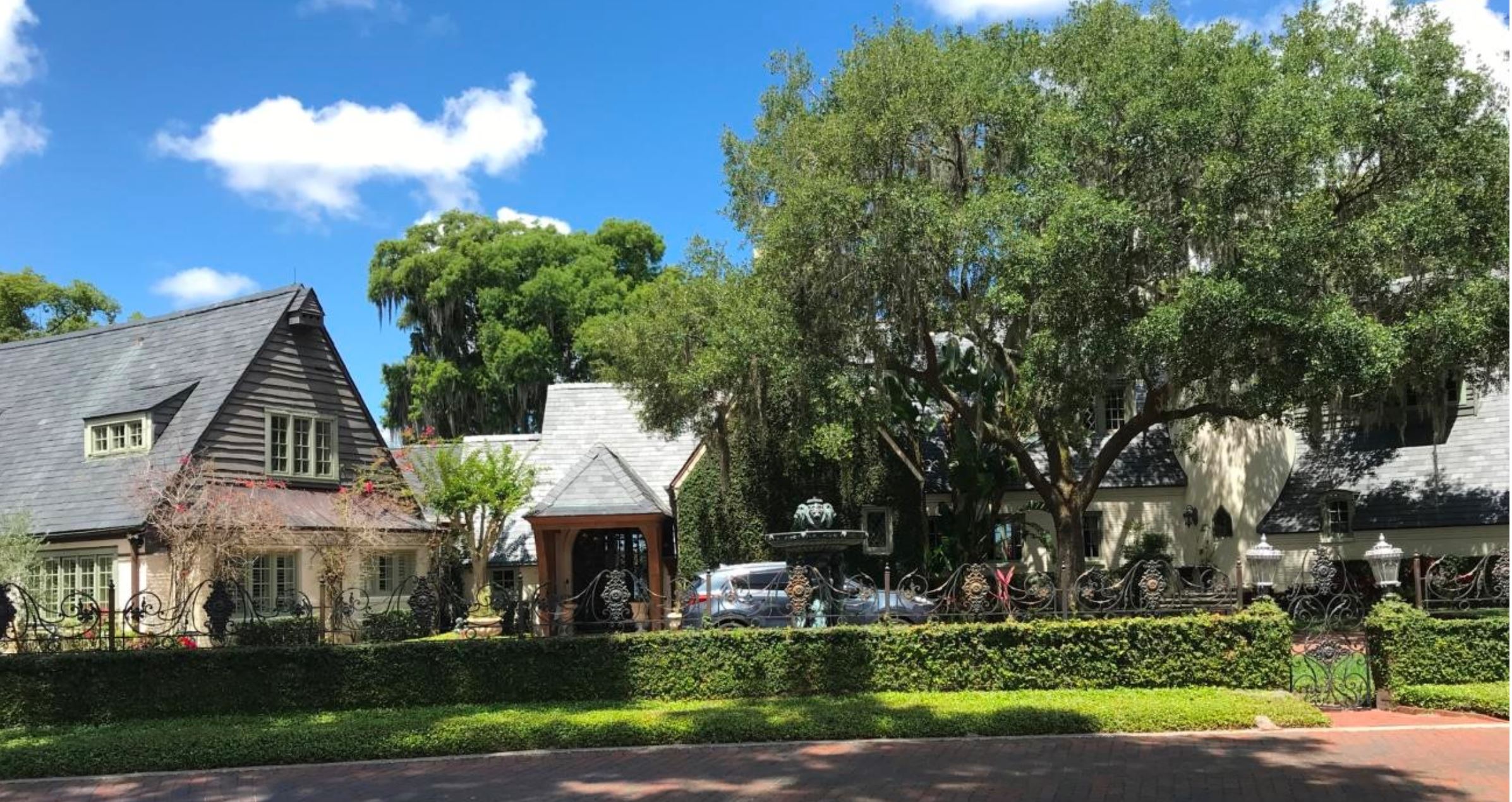
Not far from the Racquet Club is a secluded peninsula that stretches into Lake Maitland from its eastern shore called the Isle of Sicily — one of the city’s richest streets. James Gamble Rogers II, who also designed the racquet club, constructed the first home on the isle about 1930, an 1,800-square-foot French provincial home known as Four Winds that the famed architect lived in with his family until 1949.
Now the house at 3 Isle of Sicily is likely to be torn down as part of a plan to builder a larger home on the property.
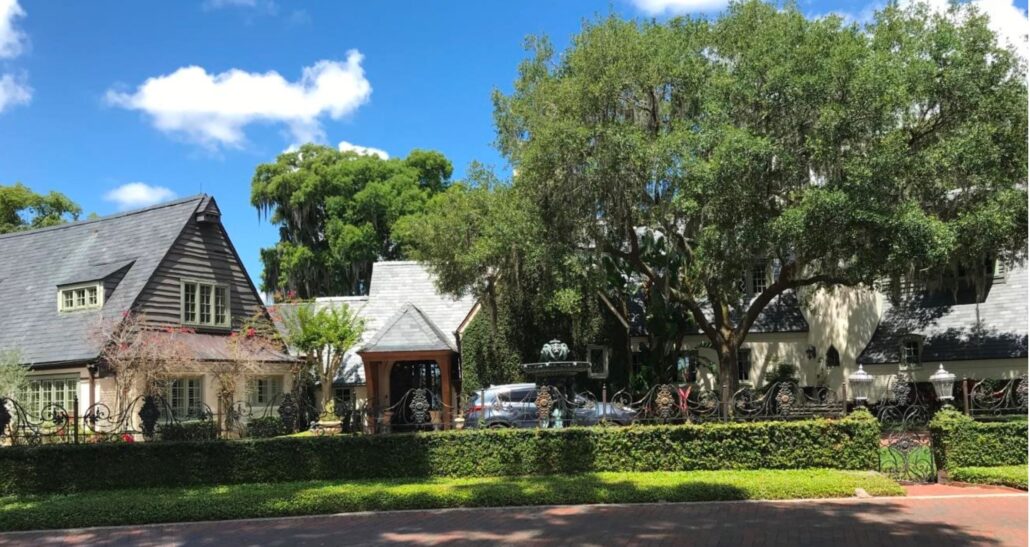
A view of the home at 3 Isle of Sicily today as recorded by the Orange County Property Appraiser.
Over the years, the house was renovated extensively and now sits at more than 7,000-square feet.
Owners Kamran and Mina Khosravani, who acquired the property in 2011, are looking to build a new home that will top 10,400 square feet.
The home is not on the city’s historic register so the owners don’t need permission to demolish it, but will ask the P&Z Board today for approval of the new lakefront construction.
A rendering shows proposed new construction at 3 Isle of Sicily.
Jack Rogers, architect and son of Gamble Rogers, said he’s sorry to see the house come down, but it hasn’t looked like the original in decades.
“Unfortunately, the damage was done 50 or more years ago,” Rogers said. “The original house is completely gone.”
His father, who is also known for the Florida State Supreme Court Building in Tallahassee and the Olin Library on the Rollins College Campus, built about 50 houses in Winter Park, he said. His papers and plans are preserved at the Winter Park Library.
“There’s probably 15 or 20 left and eight or 10 are absolutely precious and we seem to be losing them at the rate of one or two a year,” Rogers said. “We still have several wonderful examples.”
Park Ave Apartments Face Demo for Townhomes and Synagogue
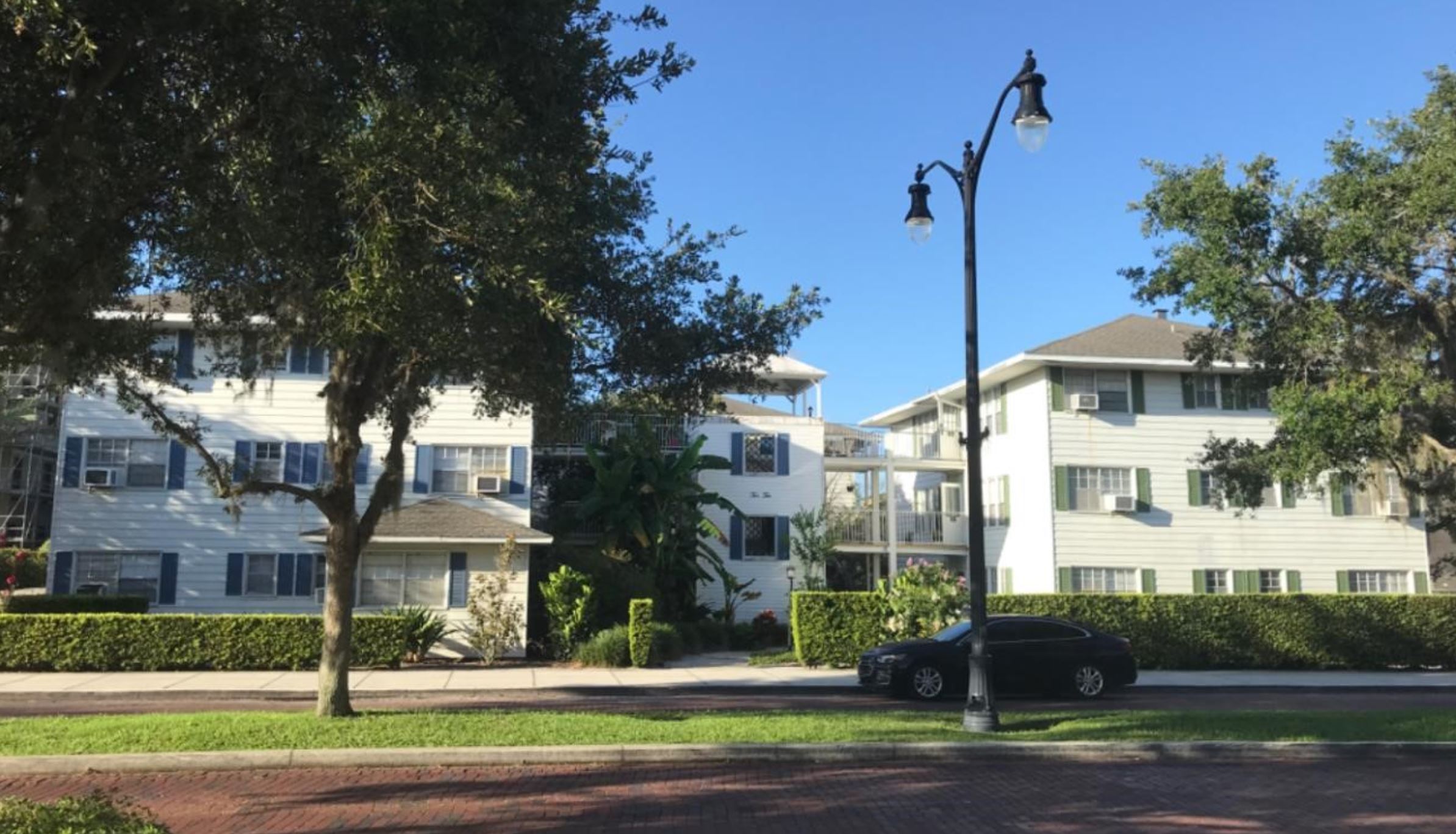
The apartment buildings dating back to 1922 known as El Cortez could be demolished to make way for new townhomes and a new synagogue if the Historic Preservation Board approves a proposal up for consideration on Wednesday.
The board tabled the request at its Sept. 10 meeting in order to see if the developer could save one of the three buildings at 210 E. Morse Blvd. that are part of the Interlachen Avenue Historic District. The property is also the last R-4 zoned land just off Park Avenue that has yet to be redeveloped.
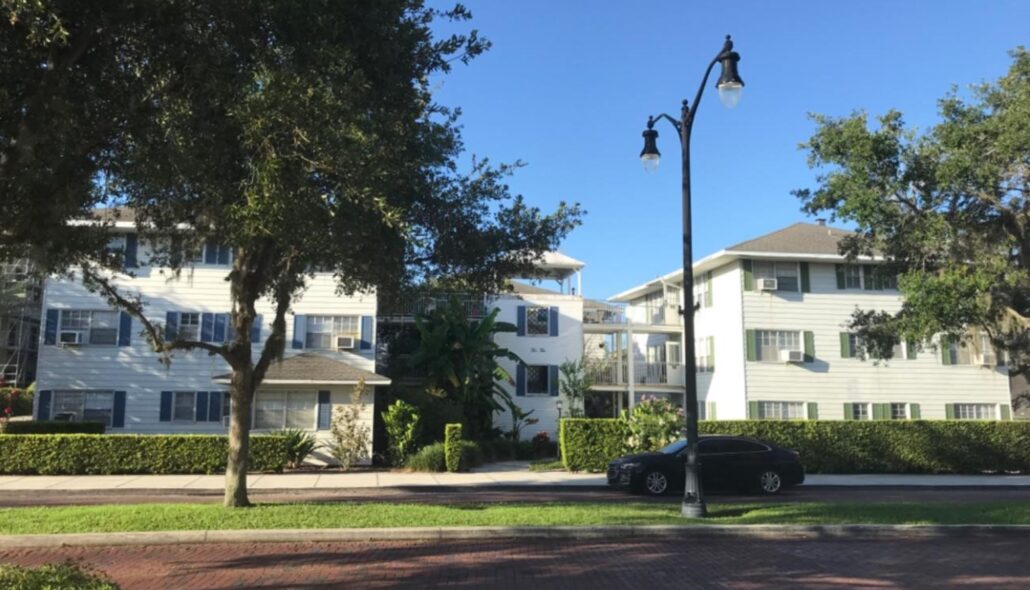
The El Cortez Apartments along Morse Boulevard.
The city discourages demolition of so-called “contributing structures” to historic districts such as El Cortez, but does approve knock-downs when preservation isn’t feasible.
The property owner and applicant for the project, a company called El Cortez LTD and managed by AGPM founder Scott Zimmerman, said the buildings represent a “frame vernacular style,” but have been significantly altered over time with no original exterior materials or features remaining.
The new development would create townhomes on Morse and a synagogue along Knowles Avenue. Staff received 32 letters in support of the project and one against, according to documents related to the meeting.
In the 1920s the building were constructed as upscale apartments amid growing demand for more housing in downtown Winter Park and near Rollins College. Over the years, a number of notable people lived there, according to National Register of Historic Places documents, such as “physician Benjamin Hart; Christopher Honaas, director of the Rollins College Conservatory of Music; Flora Magoun, secretary to the Conservatory; Margaret Windau, district director of the Florida Welfare Board; Helen Drinker, proprietress of a women’s fashion shop on Park Avenue North; and William Stein, a Romance Languages professor at Rollins College of Jewish descent who had recently immigrated from Austria to avoid Nazi persecution.”
Rogers said his dad told him he also stayed at El Cortez while Windsong, the Isle of Sicily property also likely set for demolition, was being constructed.
City staff is recommending approval of the project with the following conditions: A historic marker be placed there to commemorate the historical significance of the property and that the demolition not occur until the owner has a building permit from the city to ensure development plans don’t change between the time of the tear-down and new construction.
New Historic Survey Considered
The Historic Preservation Board will also on Wednesday consider a contract with Orlando-based KMF Architects for $75,000 to survey the city’s historic assets.
The proposal calls for updating the 2001 and 2013 surveys and will include an evaluation of Mid-Century Modern architecture (1950s-1970s), a era that hasn’t previously been surveyed citywide.
The work on Mid-Century Modern work will include a focus on Orwin Manor “to support the city’s consideration of a potential historic district designation.”
Four historic districts already exist in Winter Park — Downtown, College Quarter, Virginia Heights East and Interlachen Avenue — and those will be evaluated to determine if any non-contributing buildings now meet criteria for contributing status.
The survey will update records and remove properties on previous surveys that have since been demolished to produce a detailed report with photos that is both “informative and user-friendly,” according to the architects’ proposal.
WinterParkVoiceEditor@gmail.com
To comment or read comments from others, click here →
by Beth Kassab | Oct 2, 2025 | Arts and Culture, News, Uncategorized
Park Avenue District Names Interim Executive Director
The new appointment comes just in time for the holiday season as the city’s Christmas lights are set to turn on Nov. 13
Oct. 2, 2025
By Beth Kassab
The Park Avenue District on Wednesday named Allison Chandler as interim executive director of the organization that will coordinate Winter Park’s signature holiday decor as well other events focused on one of Central Florida’s premier dining and retail corridors.
Chandler, who comes with other nonprofit experience, will help steer the organization as Christmas lights turn on next month along the avenue and the city government embarks early next year replacing streetlights, wiring, landscaping other infrastructure as part of a project known as the “Park Avenue Refresh” that could be disruptive at times to merchants.
Alan Chambers, president of the district’s board, said the group has recently gone through some “growing pains” since it took on the role of coordinating the city’s holiday decor last year.
“We went from 0 to 60 so quickly with taking on the holidays and how much money came in and events,” said Chambers, who is the vice president of operations for the John Craig Clothier family of eight stores across Florida, including two on Park Avenue.
Earlier this week the group announced the departure of Executive Director Carina Sexton along with three board members.
“Over the past six months, the district has navigated growing pains that led to the departure of several key board members, and with Chandler at the helm, the organization is eagerly and actively focused on mending, building, and rebuilding relationships across the community,” a news release stated.
The group, which formed in 2019 to intensify focus on promoting and supporting the Park Avenue area, began spearheading the city’s holiday decorations in 2024 and called the festivities “Christmas on Park” instead of “Hometown Holidays,” a name the city had used for years.

Allison Chandler
This year the city, which contributed $200,0000 in public funds last year and $90,000 this year to the project, asked the name be changed to Holidays on Park to include Hanukkah and Kwanzaa.
The long-held individual traditions in Winter Park that begin next month and run through January will remain the same such as the Christmas Parade, Tuba Christmas and Christmas on the Park. Only the overarching website name is set to change.
But that prompted outrage from some in the community who wanted to frame the request as an assault on Christmas. A resident started a petition that collected more than 1,000 signatures even though some information on the petition was inaccurate.
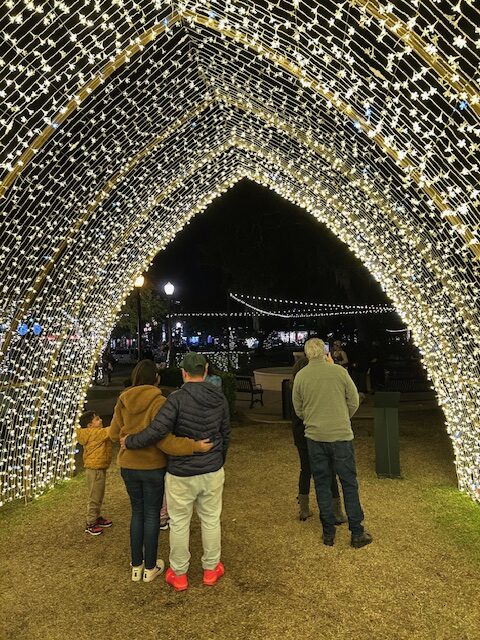
Chambers said the Park Avenue District spent about $400,000 on holiday festivities last year, most of it from private donations to fund new additions such as a carousel in front of City Hall and a walk-through Cathedral of Lights in Central Park.
Some of the decor purchased last year will be used again this year, though a portion of the new lights was lost to squirrels.
Sarah Grafton, founder of the Park Avenue District and partner at Grafton Wealth Management, said in the news release that she is confident the group will continue to grow its work with Chandler in her new role.
“Her proven leadership in the nonprofit sector will ensure we build on the district’s success, uniting businesses and residents while positioning us for an even stronger future,” Grafton said in the release. “I am proud to be a part of this collaborative board of directors that has made such a positive impact on our community.”
Chandler, a graduate of Leadership Winter Park, has experience in other nonprofits such as development director and interim executive director at PACE Center for Girls, program manager at Plug and Play Tech Center, and founder and president of MPACT Events Co., according to a news release.
“Living in Winter Park, I have seen firsthand the unique spirit and beauty of Park Avenue,” Chandler said in the release. “I am thrilled to help guide the Park Avenue District through its next chapter – building programs, partnerships and celebrations that reflect the heart of our community”.
WinterParkVoiceEditor@gmail.com
To comment or read comments from others, click here →

by Beth Kassab | Sep 29, 2025 | News, Uncategorized
How Many Winter Park Students are Vaccinated? Good Luck to Parents Who Want to Know
Florida no longer publishes vaccine rates for individual schools, leaving the public without data to identify areas vulnerable to outbreaks
Sept. 29, 2025
Note: This story originally appeared in the Orlando Sentinel with reporting contributed by the Winter Park Voice. The Voice and the Sentinel are part of the News Collaborative of Central Florida, a group of 10 local news outlets working towards a more informed and engaged region.
By Annie Martin, Orlando Sentinel
Florida is no longer publishing vaccination rates for individual public school campuses, leaving the public without a key piece of information to protect children as state leaders say they intend to end longstanding requirements for students to get shots.
While vaccination data is still available county by county, the state’s failure to provide more localized numbers could mask geographic pockets where immunization rates are particularly low, putting people in those areas at risk from an outbreak, public health experts say.
“When it comes to vaccine-preventable diseases, what really matters is the community that your child is in every day,” said Jason Salemi, a professor at the University of South Florida’s Department of Epidemiology, explaining the value of school-level vaccination data.
It’s not clear why the Florida Department of Health, which previously compiled and published this data, no longer makes it available. The most recent data available is from January 2023, just after Gov. Ron DeSantis was elected to his second term. The health department did not respond to an inquiry from the Orlando Sentinel.
But the reporting change comes as Florida county and state vaccination rates have been dropping for years. Parents have increasingly obtained religious exemptions that allow their children to avoid requirements to obtain key vaccinations in order to attend school.
DeSantis and Ladapo said on Sept. 3 they want to jettison vaccine requirements altogether, though eliminating some of the required shots will require action from the Legislature and it’s not clear whether DeSantis and Ladapo will get the support they need.
Last school year, less than 89% of Florida public and private school kindergarteners were fully immunized, continuing a steep decline since the pandemic. That rate is well below the 95% level, sometimes referred to as herd immunity, which makes it unlikely that a single infection will spark a disease cluster or outbreak.
School-age children who aren’t vaccinated risk transmitting disease not only to their classmates at school but people in other public areas they frequent, such as grocery stores and parks. Areas with low vaccination rates can be particularly risky for children too young to be vaccinated, the elderly and immunocompromised people, said Dr. Jennifer Takagishi, the vice president for Florida’s chapter of the American Academy of Pediatrics.
The campus-level data is especially important for parents choosing where their children should attend school, she said.
“If we want parents to make informed decisions about their child and their risk, they need to have the information to make those kinds of decisions,” said Takagishi, who is based in Tampa. “If their school has a very low vaccination rate, that’s maybe not going to be the right school for their child anymore.”
When an Orlando Sentinel reporter recently requested school-by-school vaccination data from health officials in Central Florida counties, agency spokespeople offered nearly identical responses, saying the state provides only countywide rates and suggesting the reporter contact the local school districts for data on individual campuses.
But when the reporter requested school-level data from four Central Florida districts, only Lake County provided the vaccination and exemption rates for each campus for the current school year. Public information officers for the Orange, Osceola and Seminole school districts said they didn’t have this data, though parents currently must submit proof that their child is up-to-date on vaccines or has obtained an exemption when they register for school.
Though vaccination has become a political issue across Florida, with mostly Republicans pushing to end state-mandated shots, Health Department data shows parents in right-leaning counties are not necessarily more likely to obtain exemptions than their counterparts in more liberal areas of the state. In rural Taylor County, for example, where 64% of voters are registered as Republicans, 97% of last year’s kindergartners were vaccinated. And one of the state’s bluest areas, Broward County, reported one of the lowest vaccination rates, with just 82% of children starting kindergarten with all of their shots.
But campus-level data from the Lake school district illustrates how reporting only countywide rates can mask pockets where vaccination rates are particularly low.
At Leesburg Elementary School, for example, more than 95% of students were fully vaccinated. But at Astatula Elementary, just 82% had received their shots, according to the data provided by the district. That campus, in a rural area south of Tavares, has 17% of its students claiming exemptions, meaning they didn’t need to provide proof of immunization to register for school.
Researchers, public health workers and school administrators all have good reasons to want to know whether most students on an individual campus have received their shots, Salemi said.
“The goal of data like this would not be to single out or ostracise parents or schools or children,” he said. “It’s just about prevention.”
Overall, kindergarteners in nearly every Central Florida county were less likely to be vaccinated than the state average. Orange posted the lowest rate in the Central Florida region, with slightly more than 85% of kindergartners having all their shots, four percent below the state average.
Andrea Rice’s children, ages 3 years and 5 months old, are still years away from starting school, but Florida’s stance on vaccines has already prompted her to consider leaving the community where she grew up. She said she thinks people have forgotten about the dangers of once-common diseases like measles and polio because they were eliminated by vaccines.
Now measles has made a comeback, with more than 1,500 cases reported across the country this year and she fears other viruses could, too. Whooping cough, for example, often results in hospitalization or even death in infants.
And knowing how many kids at her children’s schools would provide a valuable piece of information, the Winter Springs mom said.
“Data saves lives and it has gotten us to where we are, to where the first time ever, the majority of kids reach adulthood,” Rice said.
Winter Park Voice Editor Beth Kassab contributed to this report.
To comment or read comments from others, click here →
by Beth Kassab | Sep 29, 2025 | Arts and Culture, News, Uncategorized
Executive Director and Three Board Members Exit Park Avenue District
The changes come in the wake of a controversy over whether “Christmas” should be in the title of the city’s holiday decor the group is tasked with overseeing
Sept. 29, 2025
By Beth Kassab
Carina Sexton, executive director of the Park Avenue District, announced Monday she is stepping down, part of a leadership shakeup at the nonprofit that promotes economic development along the city’s historic retail corridor and coordinates the city’s annual holiday lights display.
The changes, which include the resignations of three board members, come in the wake of a controversy over what the group would call the holiday decor with some residents expressing anger that Winter Park city government, which is providing $90,000 this year for the project, requested the name be changed from Christmas on Park to Holidays on Park.
Alan Chambers, the district’s board president, said Sexton and the board “mutually agreed to conclude her tenure” and “wish her the very best in her next chapter.” He did not give a specific reason for the departure other than to say the changes had been in the works for a while and that it wasn’t related to the holiday decorations.
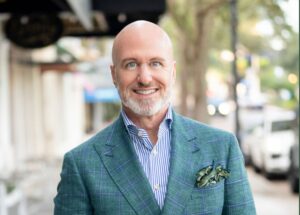
Alan Chambers
“We appreciate all that Carina has done for Park Avenue and her role in this important and inaugural position,” said Chambers, who is vice president of operations for John Craig Clothier, which operates eight Florida stores, including two on Park Avenue. “Our mission remains at the heart of everything we do: Fall in love with the charm, sophistication and the history of the Park Avenue District.”
Sexton said the decision was not the result of disagreement over the title of the holiday decor, and listed the Christmas line-up as one of her key accomplishments.
“The website and the design of Christmas on Park would not have been possible without the incredible time and talent of Tracy Brand-Liffey, whose creativity has left a lasting mark on the District,” she wrote in her resignation letter. “I would also like to express my gratitude to the mayor and city commissioners for their vision, funding, and cooperation in helping to create and move the district forward. Their support has been instrumental in ensuring the success and growth of this organization.”
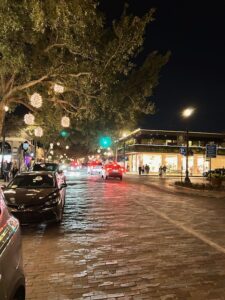
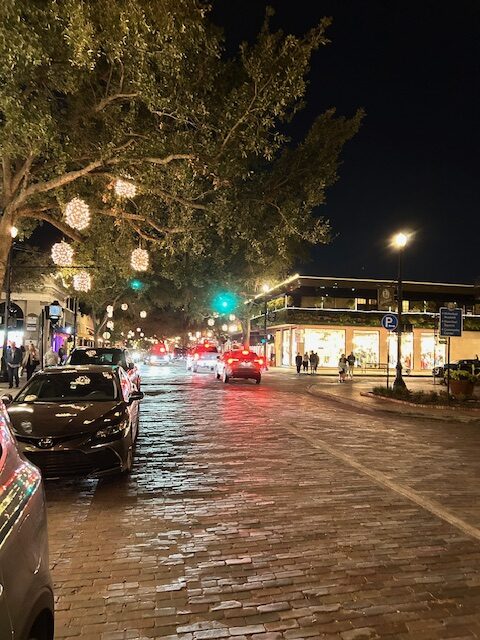
Holiday orbs light up Park Avenue, a familiar feature of the city’s Christmas decor.
Brand-Liffey, who owns New General Cafe on New England Avenue, confirmed to the Voice hat she has left the Park Avenue District’s board, a decision she attributed to personal and professional reasons.
“This was not an easy decision, but the timing feels right given recent personal and professional changes, coupled with the robust challenges this organization faces and the political constraints that have limited our ability to advance initiatives in the way I once envisioned,” she wrote in a resignation.
She declined to elaborate on what she meant by “political constraints.”
Chambers said the group will change the title of the decor and district website that highlights the line-up of events from Christmas on Park, which was first used last year, to Holidays on Park at the request of the city. Some promotional materials that were done in advance, however, won’t be changed in time.
Before the Park Avenue District took over coordination and fundraising for the signature decorations last year and added new features such as a children’s carousel in front of City Hall and a walk-through “Cathedral of Lights” in Central Park, the city called the decor and event line-up “Hometown Holidays.”
It requested a more inclusive overall name this year because the festivities also include celebrations for Hanukkah and Kwanzaa.
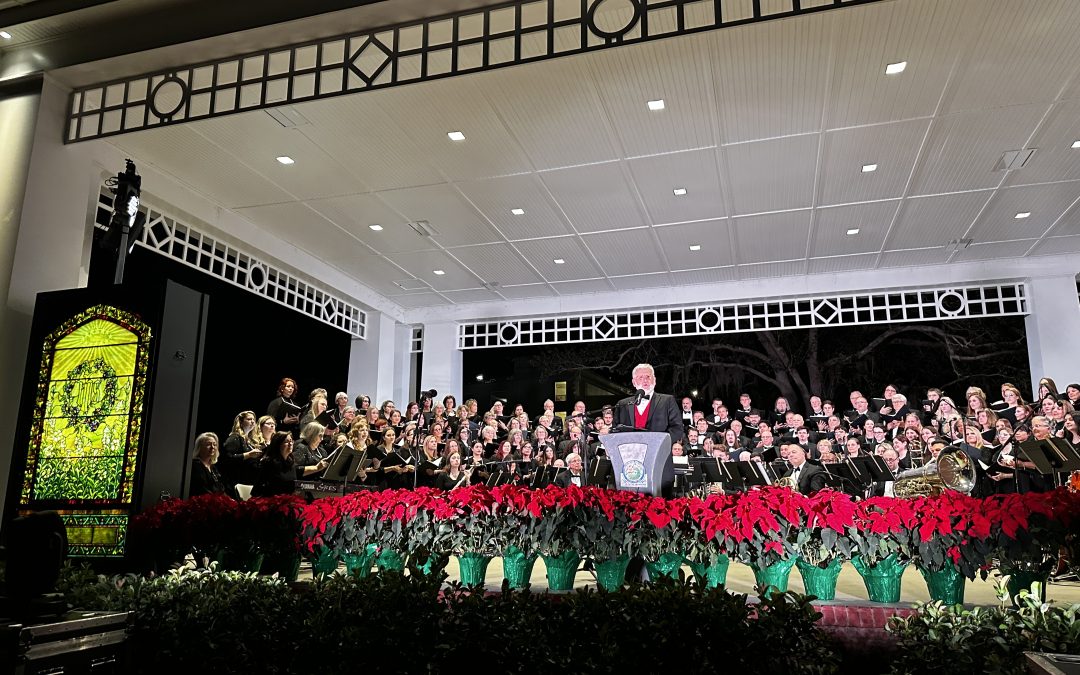
But the line-up of events, some of which are led by the Winter Park Chamber of Commerce, still include multiple Christmas celebrations such as the Christmas Parade, Christmas in the Park (which features and outdoor display of Tiffany windows from the Morse Museum and the Bach Festival Society choir) and Tuba Christmas. None of those names or traditions are changing nor did the city request any changes to them.
But as word got out about the request to change the overarching title, a resident started a petition that claimed the city was threatening to put Christmas traditions “at risk.” It made multiple inaccurate claims such as how the city’s Christmas tree would only be referred to as a “holiday tree” and also falsely stated that the annual tree lighting event has been “rebranded as ‘Winter on the Avenue,’ intentionally avoiding any mention of Christmas.”
“Winter on the Avenue” is an event put on by the Chamber of Commerce and the name has been used for years. The chamber’s own web page about the event uses the words “Christmas tree” in the description: “Winners of the Holiday Art Competition will be recognized, Rabbi Dovid Dubov of Chabad Orlando will do a menorah lighting ceremony ushering in the season of Chanukah, and Winter Park Mayor Sheila DeCiccio will lead us in a countdown as we light the Christmas Tree.”

Carina Sexton
The resident, who frequently uses the public comment portion of City Commission meetings to advocate for conservative causes, has refused to acknowledge factual inaccuracies in the petition, which now has more than 1,000 signatures, though it’s unclear how many of the signers live in Winter Park.
Chambers said Tracy Klingler, who owns the boutique Frank, and Ginny Enstad, of Ginny’s Orchids, are also leaving the board, but along with Brand-Liffey will remain involved in helping to steer the organization.
Theresa Smith-Levin, the founder and executive director of Central Florida Vocal arts, is the district’s treasurer and Sarah Grafton, managing partner at Grafton Wealth Advisors, remains advisory board chairwoman. Also on the board are Ricci Culver, who owns Through the Looking Glass boutique; Meredith Gardner, who owned The Grove; Tim Noelke, operating partner at Prato as well as Luke’s; Nora Miller, an attorney at GrayRobinson; Sheila Wyatt, founder of Sheila & Co Moving and Chris Southern, owner and vice president of Bosphorous Turkish Cuisine.
The lights will turn on Nov. 13 and the line-up of events will run through the new year.
Chambers said the group is still fundraising for the decor, which will this year focus on Park Avenue rather than extend to the side streets and Hannibal Square as it did last year.
“We do have some more fundraising to do,” he said. “We have the ability to pay for it, but we are always looking to cover those expenses rather than those things coming out of our general budget.”
WinterParkVoiceEditor@gmail.com
To comment or read comments from others, click here →


 The club’s general manager did not immediately return a call for comment on the new conditions.


Recent Comments