Can Winter Park afford to finish burying power lines by 2030?
A rate increase, taking out more debt in the form of bonds or both are up for debate in the final weeks before the City Commission must approve the 2026 budget
Aug. 27, 2025
By Beth Kassab
Just two months ago, city officials extolled hitting the 20-year mark since Winter Park won ownership of its electric utility from what is now Duke Energy.
With a mini documentary and celebratory events, the city lauded the anniversary of the hardfought acquisition and its accomplishments — namely delivering on the promises to provide high reliability, low rates and underground all overhead power lines in the city.
In the background, though, a debate was already brewing over how the city would be able to continue to deliver on those pledges to residents, who voted in 2003 to purchase the electric grid.
Now that debate is reaching a boiling point with a vote by the City Commission on Winter Park’s $233 million budget for 2026 just weeks away and a recent 5-1 vote by the Utilities Advisory Board against a recommendation by city staff to raise electric rates for the first time since 2019.
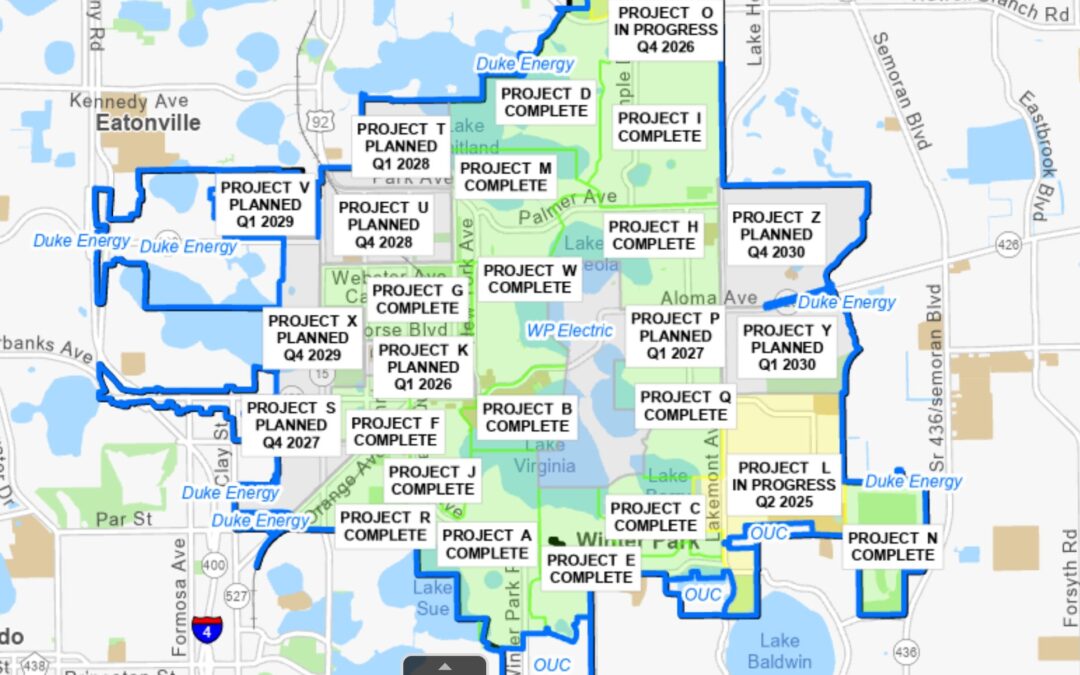
The proposal to increase customers’ electric bills by 10% starting in October is largely on the city’s plan to finish burying the remaining 20% of overhead power lines by 2030, the target leaders announced three years ago when it moved the date back from 2026. (See map above and at this link to track the status the project by neighborhood.)
But critics say that increase will be just the beginning of more significant increases to come because the price the city pays for the electricity it sells to residents and businesses will likely go up in the coming years as contracts are up for renegotiation and as Winter Park is also planning additional big expenses to replace aging substations as well as install new streetlights.
“I’m all for undergrounding, but I can’t see charging my fellow residents [more] this year and then keep doing it in following years because it’s going to get higher and higher,” said Michael Poole, an advisory board member who is leading the charge against the rate increase, at a recent meeting with commissioners.
Poole, an investment banker who has served on the advisory board since 2020, said the purchase of the electric utility “was one of the greatest things the city has ever done.”
But the promise of finishing the undergrounding project by 2030 is unrealistic without taking out debt through bonds and spreading the cost out over a longer period of time.
“Undergrounding is a monumental pledge … we’re restringing every street,” he said. “That’s just an astonishing capital cost.”
Very few cities across the United States have undergrounded their entire grids because of the cost and time required.
City staff has said the proposed increase for a customer who uses 1,000 kilowatt hours will result in a $15 monthly increase and generate an extra $4.8 million in revenue. But homes and businesses in Winter Park typically use nearly double that amount of electricity so the actual impact to people’s wallets will be higher.
The cost of burying power lines, which looks cleaner and is heralded as a way to keep the system safer and more reliable, especially during storm season, has more than doubled from about $4 million a near to more than $9 million, according to city documents.
So far nearly 104 miles out of 128 total miles — as measured in overhead lines — that serve Winter Park’s 15,000 customers are now underground.
But work has slowed on those last 24 miles as well as the connections from feeder lines to individual homes.
The utility fell short of its goal this year and last year to complete five miles a year because there isn’t enough money to fund the projects.
“I could very easily meet that goal if I had funding to support that,” said Jamie England, director of the electric utility.
England has also said the 2030 target is for the main overhead lines and that finishing the connections to individual homes will likely take a couple extra years. Initially, the city charged residents for those connections but in 2022 decided to take on those costs as part of the overall project, which added to the pricetag and the time required.
Poole has said the city’s current “pay as you go” policy for financing the work is problematic because it puts too heavy of a burden on current customers.
City Manager Randy Knight has also discussed issuing bonds or doing so in combination with a rate increase.
But Knight has also taken exception to some of Poole’s figures and said in a recent meeting that some of the statements Poole made in a memorandum to the City Commission “defy logic.”
A memorandum prepared by Wes Hamil, director of finance, weighed the pros and cons of financing the project through bonds.
“The main advantage of borrowing is the ability to accelerate some capital improvements and reduce the necessary rate increase now,” the document said. “The main disadvantages of borrowing are the cost of interest on the debt ($28M) in the scenario presented which means customers pay more in the long-term. Flexibility is also reduced because rate revenue dollars committed to servicing debt cannot be used for other purposes.”
City spokeswoman Clarissa Howard said the latest recommendation is still being finalized ahead of a meeting Thursday scheduled for commissioners to talk about changes to the budget ahead of the first of two required budget votes on Sept. 10.
Knight has emphasized that Winter Park’s electric rates are lower than average among municipal-owned utilities in Florida and far lower than the prices charged by Duke Energy.
A comparison chart shows Winter Park charged just higher than $120 per 1,000 kilowatt hours for power in July, according to the Florida Municipal Electric Association. That was about even with the Orlando Utilities Commission and just under the average bill of $126.81 among the 32 municipal utilities.
By comparison, Duke charged customers more than $180 per 1,000 kilowatt hours in July, higher than the average of $160.86 among investor-owned utilities.
Winter Park last tried to raise electric rates in 2022 but backed away from the plan after upset among residents and concerns that the Russian invasion of Ukraine could send fuel costs higher.
Commissioners are also considering paying a consultant up to $109,000 to produce a new study on the city’s rates and, potentially, justification for future rate changes.
WinterParkVoiceEditor@gmail.com
Raise the electric rate(s), the increase is permanent and compounds over time. There are options.
An alternative funding approach is a temporary surcharge added to bills to be used solely for the undergrounding. There would be a start date and finish date. Once completed the surcharge sunsets. Must be clear the funds can only be used for the ADDITIONAL costs to underground.
As for a study, there was a cost of service study conducted some time ago. The Utility Advisory Board and Commissioners should look at that report and determine what more info they need.
Past commissions have made many commitments to the community on the completion of undergrounding; the commitment dates came and went, most were missed. And yes there were reasons/excuses but it comes down to accountability. Isolated funds and the periodic tracking on the progress is a sound approach.
My utility bill has at least doubled over the last number of years. Rates increased significantly after the 2015 peak in oil prices through surcharges, etc. While oil peaked over $100/bbl again in January ’22 the pricing has retreated again back to $60ish/bbl. Yet there has been no relief in utility costs to consumers. Further, the plan was to use the Duke Energy profit margin to fund the undergrounding. I’m assuming that the City has maintained that profit margin (perhaps too generous an assumption). If so, there should be funds available to complete the undergrounding. I don’t think there is any justification for a rate increase to fund further undergrounding, and heaven forbid we waste money on hiring a consultant to try to justify a future increase.
Even if some remain with OUC and Duke we shouldn’t at least get o our power lines buried since mine is causing a rat issue and my pest control has said taking the line off the house is the only way to stop the issue. At least they can clean up OUCs power lines or have them do it!
sorry for the awful spelling I was driving in my car but thank you for the response
Why should why should we be surprised that OUR City wants to continue raising our utilities rates as well as property tax valuation increases? They are a bureaucracy of 1400 employees that basically sub contract most of the infrastructure up grade or structure repairs!
When have the bureaucracy ever submitted a budget in this town or any town that actually looked at cost cutting and increases in efficiency ! Zero!
As in DC ,the well know dogmas is to spend ever dime so they can argue for continual increases!
We have what I believe is a 6million dollar reserve for energy cost increase! Why can’t these funds be tapped?
Furthermore, staff’s arguments that we only completed 104 mikes of underground utilities out of 125 committed miles representing 15,000 customers simply dosen’t hold water. Our community is only 30,000 soles and 15,000 represents 50% of our population?? I don’t think so! We have completed 83% of our mileage commitments and most likely the remaining 17% most likely are commercial or low income expansions!
With 233 million dollar budget for services to 30,000 customers represents $7.766. 00.city expense pre person to serve our needs! Anybody think that’s a tad bit high??
Civil Servants should NOT be setting the agenda and hiring $ 108,000. Dollar consultants to justify their spending addictions!! At some point citizens are going to rise up mad as hell to take back control of our budget process!
Newt,
Oh my! 1400 City of WP employees? You rounded up by almost 1000. Where in the world did you get that number?
Yes, for the record there are just under 600 city employees per the budget.
I was going to say something like have those that have undergrounding pay for those that don’t since those without paid for their undergrounding over the years. But, being a person of open mind, I think Jack Miles’ idea above is the way to go and thank him for better insight than I have on this.
You are entitled to to your view point, I respect this process! Thanks to the Voice your reporting continues to spotlight important issues for thoughtful discussions.
Your reporting is head and shoulders above over the Orlando Sentinel!
I don’t want to pay for under-grounding and recurve no benefit as i’m sure other feel the same! If you are OUC or Duke you don’t get the convenience or benefit form the tax.
Since my street was undergrounded, I have had two power interruptions that lasted only a few hours. I did not lose power the past several hurricanes when others did. It’s glorious. In my opinion, moving money from niche cultural or vanity projects and applying it to undergrounding benefits everyone in the city instead of a select few. So let’s trim some fat before we raise rates.
As someone who has been paying (since the beginning by the way) for your undergrounding and has not gotten mine I suggest it would be unfair to stop or slow this down any longer. Someone had to be at the end of the line to be sure as we are. In our neighborhood I would like to see this gets done for us as soon as possible myself. Right now in our neighborhood it looks like they are at least halfway to completion. If it takes paying more per month to get this done for all then I am all for it and will pay my share just like we have all these years. End rant!
This was “sold” to us to reduce costs; not as costs we would bear. The advisory board does not approve of the suggested increase and neither do we. I appreciate Jack Miles insight and with clear evidence that funding is needed it may be appropriate to have some small, temporary surcharge rather than a permanent increase. That would make more sense after new contract considerations or as substation upgrades happen – not for the undergrounding promised and not completed. The burden should not be placed on homeowners, especially not those of us who have received no benefit. Our neighborhood has been torn up for ages and it often appears that nothing is happening for weeks and months at a time. It has already been delayed. As one of the long time homeowners who are at the end of the line already, dragging it out will certainly not make me want to foot the costs.
If we can afford fancy arches for Park Avenue, let’s not cry poor.
Let’s get done what was promised.