by Beth Kassab | Sep 3, 2024 | City Commission, News, Uncategorized, Zoning and Development
Developers could catch a break on parking rules if changes approved
The P&Z board will tonight hold the first hearing on changes designed to avoid large, mostly empty lots
Sept. 3, 2024
By Beth Kassab
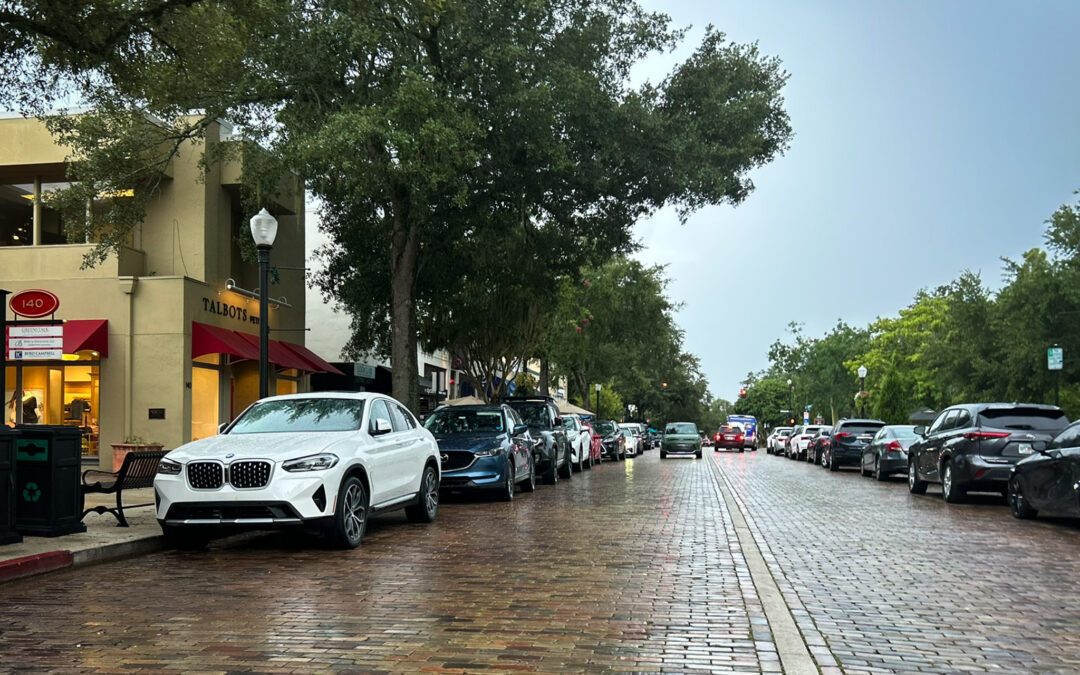
Developers could soon face less strict parking requirements in Winter Park if recommended changes are approved to reduce the number of spaces required for shops, offices and apartments.
The Planning & Zoning Board will hear the proposal for the first time on Tuesday night at 6 p.m.
Last year the Winter Park Chamber of Commerce brought in the author of “Paved Paradise: How Parking Explains the World” to advocate for loosening the number of required spaces for new development.
Henry Grabar argues that all over America, cities are underhoused and overparked. Valuable real estate is taken up by too many unused parking spaces. And that, he says, drives up the cost of construction and pushes sprawl.
Onerous parking codes also offer a way for residents to oppose new affordable or denser housing projects.
“Badmouthing the poor was a little unseemly,” he wrote. “But complaining about parking was morally unimpeachable.”
In fact, parking became a focus in the recent debate over Rollins’ proposal to build 30 units that it plans to rent below market rate to its faculty and staff. The City Commission approved the project last week, ultimately, with a compromised parking arrangement and a pledge from Rollins to give over some land for more on-street parking.
The parking standards used in that project are aligned with the proposed changes from city staff.
Among the proposed changes outlined in the memorandum:
- Unify the parking code requirement for non-medical office and retail city-wide to one space per 333 square feet versus the current rule of one space per 250 square feet. According to the staff report, the standard is already one space for 333 square feet in the Central Business District, the Hannibal Square neighborhood and the Orange Avenue Overlay. This is a 25% decrease in parking required for retail or non-medical office.
- Reduce parking at large office buildings, which have the largest parking surpluses, according to the report. Combined with the change above this would further reduce the parking requirements to one space per 400 square feet for any building larger than 15,000 square feet. “For example, a 30,000 square foot office building now needs 120 parking spaces,” the staff report explained. “With the two changes together (1 per 333 for the first 15,000 square feet and 1 per 400 for next 15,000 square feet), the parking required is 83 spaces. This is a 30% reduction in required parking.”
- For apartments of three or more units, the standards would be 1.25 spaces for a one-bedroom unit; 2 spaces for a two-bedroom unit and 2.5 spaces for a three-bedroom unit. This is the same standard that exists now for properties within the Orange Avenue Overlay. For townhouse and condo projects with larger units, the current rule would remain of 2.5 spaces if the unit is larger than 2,000 square feet.
- The maximum parking provision could be no more than 150% of the code requirement.
During the discussion about the Rollins faculty apartments, some commissioners indicated they may not be on board with the changes.
Commissioner Todd Weaver, who voted against the project, said he would “never vote for decreasing parking in our downtown because there’s no mass transit.”
That has been a key criticism of Grabar’s philosophy — that not every city has the local buses, shuttles or other options in place to wean residents off of their dependence on cars.
Winter Park boasts one of the most successful SunRail stops on the commuter rail’s line, but rail system along with the Lynx bus system lack a regional dedicated funding source to keep up with demand.
The city staff report, however, argues there are reasons unrelated to the transportation debate to reduce parking requirements, especially among office buildings.
“Office floor plans have evolved over the years with larger offices, fewer open-air cubicles and more amenity space,” the report said. “Additionally, the nature of most office businesses has changed so that fewer clients need to visit with the use of email and electronic communication. It also is prudent to have a unified city-wide parking rate for office and retail versus different geographic parking rates, thus the proposal for one per 333 square feet city-wide.”
WinterParkVoiceEditor@gmail.com
To comment or read comments from others, click here →
by Beth Kassab | Aug 23, 2024 | City Commission, News, Uncategorized, Zoning and Development
Rollins proposes payment equivalent to some taxes on faculty apartments
The liberal arts college is often exempt from property taxes as a nonprofit educational institution. The agreement now before the City Commission would be a first for the city.
Aug. 23, 2024
By Beth Kassab
In a first-of-a-kind deal for Winter Park, Rollins College is proposing it pay a fee equal to a portion of the city property taxes it would owe on a faculty housing project up for City Commission approval next week.
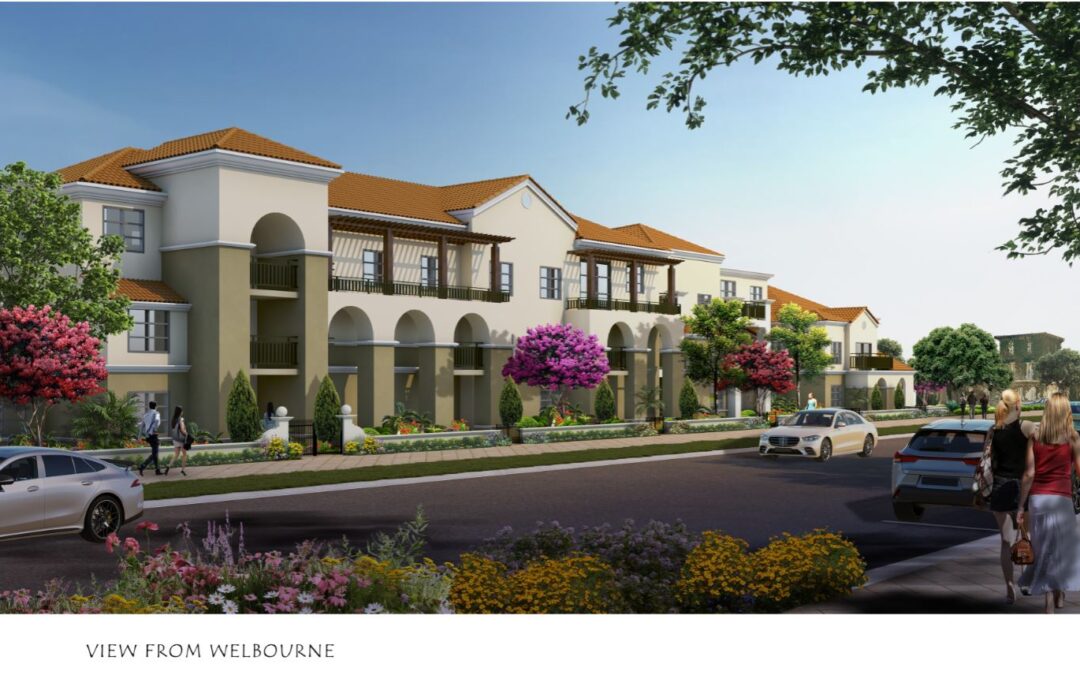
The potential agreement comes after months of back-and-forth with city officials and residents over the liberal arts college first unveiled plans to build 48 apartments on land it already owns at Welbourne and Virginia avenues.
College administrators say the apartments, which would be rented to faculty and staff below market rate, will serve as a recruiting tool for early-career professors who would otherwise likely live much farther from campus as a result of the high cost of rent in Winter Park, where homes routinely sell for more than $1 million.
But criticism over the architecture of the project, lack of commercial space on a portion that once fronted New England Avenue, parking concerns and the college’s typical exemption from property taxes contributed to major revisions of the plans.
The project now contains 30 units vs. 48, a pocket park, additional parking and no longer includes a building fronting New England Avenue.
In what appears to be an effort to satisfy calls from the Planning & Zoning Board to contribute to funds for city services, the college says it will enter into a Payment in Lieu of Taxes or PILOT agreement with Winter Park if the typical exemption for nonprofit educational institutions is granted on the land.
The payment would equal about 50% of the taxes owed to the city or about 2 mills. Rollins estimated the payment at between $18,000 to $20,000 a year, though an exact figure won’t be available until it is built and assessessed by the Orange County Property Appraiser.
“The PILOT payment is intended to offset the costs of emergency services for the multi-unit residential project,” the college said in the language it submitted to the city.
“Currently, we have 14 units on the site, and we pay no taxes,” said college spokeswoman Jo Marie Hebeler. “So this is a significant commitment and contribution from Rollins.”
Rollins uses an older building on the site for graduate student housing, but that would be torn down as part of the new project.
The private college, known for its lakefront Spanish-Mediterranean campus and tuition and fees totaling more than $76,000 a year, had resisted such an agreement in previous meeting, citing what it said was already significant contributions toward city services such as allowing the police and fire departments to use old buildings for training and argued such a deal would set a bad precedent.
Much of Rollins’ property holdings in the city are exempt from the tax rolls and some residents have voiced concerns that the college is growing too far outside of its main campus and should contribute more toward the cost of development.
The college does pay taxes on some of its land that doesn’t qualify as exempt such as on The Alfond Inn, a luxury hotel it runs as a for-profit business. The college owes $767,000 in taxes this year on the inn, which is assessed at nearly $50 million, according to property appraiser records.
Jeff Briggs, the city’s longtime planning director, said this is the first time a nonprofit group has reached a PILOT agreement with the city. The deal will likely be closely watched by other nonprofits across the region including hospitals such as AdventHealth and Orlando Health and other colleges and universities.
The City Commission will take up the project at its meeting on Wednesday, Aug. 28.
WinterParkVoiceEditor@gmail.com
To comment or read comments from others, click here →
by Beth Kassab | Aug 16, 2024 | City Commission, News
Blue Bamboo wins zoning change for old library
The City Commission also approved new hours for Sunday alcohol sales and endorsed a sales tax renewal for public schools
Aug. 15, 2024
By Beth Kassab
Blue Bamboo Center for the Arts is another step closer to turning the old library into a performance venue after City Commissioners voted 3-1 to approve a zoning change for the property.
Mayor Sheila DeCiccio voted against the measure after questioning the fairness of a special carve out in the zoning code solely for city-owned properties.
“I am uncomfortable with this change just for city,” DeCiccio said. “I know I’m in the minority on that.”
While the high profile building on the corner of New England and Aloma avenues was used as a library for decades until 2021, the property was technically zoned for multi-family residences.
The move recommended by the Planning & Zoning board and now approved by the commision, changes the land to PQP, or “public, quasi-public.” An additional change also altered the definition of PQP to include “performance art venues together with ancillary gallery, educational, rehearsal, recording studios and offices to support the like, within a city- owned building.”
Commissioners Marty Sullivan, Craig Russell and Kris Cruzada voted in favor. Commissioner Todd Weaver was absent. No one from the public spoke on the issue.
If the lease between the city and Blue Bamboo to use the property is terminated, the land would revert back to R-4 zoning.
New Sunday alcohol sales
The commission also finalized new rules to allow earlier sales of beer, wine and cocktails on Sundays beginning at 7 a.m.
Those sales had been prohibited until 11 a.m. on Sundays until complaints from grocery managers who hear from inconvenienced residents brought the matter to the commission.
Two hearings and votes are required for the change and the second vote was the same as the first with Russell the only no vote.
He said he wanted to clarify his comments from the first vote last month when he said, “I have a belief that Sunday is a day of rest. I say leave it alone … I wouldn’t look to compromise my principles on agreeing to something like this.”
During the second vote he said, “People are under the impression that I had some kind of religious motivation.”
He said he did not take exception to the change on a religious basis, but because he did not believe people are inconvenienced by the Sunday hours and because not all residents drink responsibly. Russell, a teacher and coach at Winter Park High School, said he has witnessed students attend school or events drunk and has referred them for discipline.
“What does that tell to our kids and family about how we conduct ourselves?” he asked. “So if we have limitations to make the city a little safer then … It’s not me imposing my moral code.”
School sales tax wins city endorsement
Orange County Public Schools is asking voters in November to renew the half-cent sales that goes toward school construction and maintenance.
Last week, Commissioners agreed to write a letter urging residents to support the tax after a presentation by schools Chief Communications Officer Scott Howat.
“We get zero dollars from the state for construction and maintenance,” he said, noting that visitors and tourists pay about half the sales tax in the county.
He said the district, which now has about 208,000 students, has built more than 60 schools and eliminated 3,000 portables since voters first approved the tax in 2002 and renewed it once before in 2014.
He estimated some 75 schools will be at least 25 years old by 2035, including Winter Park’s Lakemont Elementary. That milestone, he said, is an indicator of when schools will require construction dollars.
Russell said he viewed the tax as an investment in overall education, not just buildings.
“The learning environment is so impactful to students,” he said. “It’s money toward learning. Period.”
Cruzada disagreed and said he did not endorse a letter the city plans to send in support of the tax.
“I just don’t feel it would be prudent especially considering a lot of what’s going on in the economy right now with increasing costs,” he said, suggesting that an increased ad valorem tax rate for the school board or finding another source for the funds would be better.
WinterParkVoiceEditor@gmail.com
To comment or read comments from others, click here →
by Beth Kassab | Aug 10, 2024 | City Commission, News, Zoning and Development
Rollins wins P&Z recommendation for apartments -- with conditions
The board is pushing the City Commission to require the college pay a fee in lieu of taxes because it is exempt as a nonprofit educational institution
Aug. 10, 2024
By Beth Kassab
In what is certain to be a closely-watched case among nonprofit institutions across Central Florida, pressure continues to mount for Rollins College to cover some costs of city services related to its latest development proposal.
The Planning and Zoning board voted unanimously last week to recommend the City Commission approve the 30-unit, 2-and-3 story project on the corner of Welbourne and Virginia avenues, but only with multiple conditions attached including a pilot program that calls for the small private liberal arts college to pay fees in lieu of taxes.
Rollins, which charges about $76,000 a year in tuition, housing and food costs, according to its website, qualifies for a tax exemption on much of its property as a nonprofit educational institution, meaning that it doesn’t pay typical ad valorem taxes on its assessed land values, other fees or sales taxes.
But increasingly vocal residents in Winter Park are crying foul — arguing that Rollins should pay more of its share for basic services like police and fire rescue, flood control, roads and parks.
Dykes Everett, a local business owner, was just one of a handful of people who attended the meeting to encourage the board to push for a special payment program.
“I’m here in support of holding the line on a fee in lieu of taxes,” Everett said. “A private citizen would have to pay for police and fire … The impact is real and it’s just the same as every other citizen would have.”
Rollins attorney Rebecca Wilson argued against such a requirement for a payment.
“At this time, the college is not willing to agree to that,” Wilson said, noting Rollins pays more than $1.1 million in taxes on its unexempt property and partners with the police and fire departments to allow them to run drills in empty buildings on campus. “We believe Rollins has been a great partner to the city.”
The project, which has undergone a series of architectural revisions and is now smaller than originally proposed last year, is intended to provide below market rate housing for faculty and staff in a city with soaring home prices and to help the college recruit new hires.
She also said she isn’t aware that the city has asked any other nonprofits to make such payments.
Among the largest of those would be AdventHealth Winter Park, which operates a growing nonprofit hospital and its one of the city’s largest employers.
A Rollins spokeswoman suggested Rollins may reconsider such an agreement, but did not respond to a follow-up question from the Voice asking for details.
“We are working internally to accommodate the full motion approved by P&Z,” said Jo Marie Hebler, a Rollins spokeswoman. “We expect to have a mutually beneficial plan that will be on the Aug. 28 City Commission agenda.”
City Planning Director Emeritus Jeff Briggs said he was unaware of the details of such a plan.
The City Commission has the option of accepting the P&Z board’s recommendations in total or in part or of rejecting the proposal all together.
The recommendation for approval by Warren Lindsey includes the following conditions:
- The apartments will be built with 60 parking spaces.
- No student housing or classroom instruction space is allowed.
- Rollins agrees to own and operate the faculty and staff housing for 30 years.
- If Rollins wants to amend the agreement it must wait at least five years and the change must go through the P&Z process.
- If Rollins receives a state tax exemption on the property it must enter a pilot program with the city to pay the equivalent of city taxes and stormwater fees.
Members Jason Johnson, Bill Segal, Michael Spencer, Jim Fitch, Alex Stringfellow and David Bornstein all voted in favor.
WinterParkVoiceEditor@gmail.com
To comment or read comments from others, click here →

by Beth Kassab | Aug 9, 2024 | City Commission, Library, News, Uncategorized, Zoning and Development
Old library undergoing rezoning for Blue Bamboo
The performing arts center’s director said construction could begin as soon as November
Aug. 9, 2024
By Zoey Thomas
Blue Bamboo Center for the Arts is a step closer to opening in the old Winter Park Public Library building.
Planning and Zoning board members approved changing the property’s classification from residential to PQP, or “public, quasi-public,” at a meeting on Aug. 6. The City Commission already voiced their approval of the change and is scheduled to formally vote on the matter on Wednesday.
“Functionally, it’s kind of a box check,” said Alex Stringfellow, a Planning and Zoning board member, at the meeting.
In order for Blue Bamboo to function as a public property, the board also had to approve changing the definition of a PQP itself to include “performance art venues together with ancillary gallery, educational, rehearsal, recording studios and offices to support the like, within a city- owned building.”
All members voted in favor of the changes except Bill Segal, who said he voted against it for “technical” reasons — he didn’t appreciate the way the issue came before the board, he said.
The zoning change will come back to city commissioners for final approval and public comment before Blue Bamboo can submit its official drawings for the building and get things “up and running,” said Chris Cortez, the center’s director.
Cortez told the Voice he feels confident the final steps will go “according to plan.” Two commissioners would have to flip their votes to block the zoning change from passing, which he said he doesn’t anticipate.
“No one has expressed to me that we’ve lost any of their support for this project,” he said. “There is a long shot chance that everything could change, and we would all feel like we wasted a lot of time, but it doesn’t seem very likely.”
Rather than losing support, Cortez said the monthslong process of winning the building over Rollins College, hammering out the lease and navigating zoning changes has only drawn more support from the community.
That includes from sponsors who have reached out to Cortez about offering the center money in exchange for advertisements and promotion, he said.
If the zoning vote at the City Commission on Wednesday turns out in Blue Bamboo’s favor, Cortez predicts construction will begin in November at the earliest.
Commissioners were initially hesitant to take away the property’s residential zoning classification for fear of setting a precedent that could upset people living in the area.
One person, Jess Bailes, spoke against the change at the planning and zoning meeting. He said his neighborhood near the library building already faces traffic and parking issues stemming from the Alfond Inn, which will only be made worse once Blue Bamboo, which he called was “almost a bar,” opens.
As the executive vice president of ABC Fine Wine & Spirits, the Florida-based alcohol chain store that originally opened as a bar, Bailes said he understood the problems that could be caused by serving liquor.
“I had a hundred bars at one point, and we have zero now for a reason,” he said.
Cortez said he wants to be a “good neighbor” to residents living near the building. He hopes to look into options to reduce traffic flow, including offering discounts to visitors who use ride share platforms like Lyft or letting Alfond Inn use his parking lot for overflow parking during Blue Bamboo’s off hours, he said.
“I really want to be given an opportunity to be a man of my word,” he said. “I say I’m going to address parking concerns and traffic, I really intend to do that. So I’m going to have to get in there and prove myself to these people.”
WinterParkVoiceEditor@gmail.com
To comment or read comments from others, click here →
by Beth Kassab | Aug 3, 2024 | City Commission, Historic Preservation, News, Uncategorized
City dedicates Shady Park Pioneer Memorial
The busts honor Black residents central to the history of Winter Park and the Hannibal Square community
Aug. 3, 2024
By Charles Maxwell
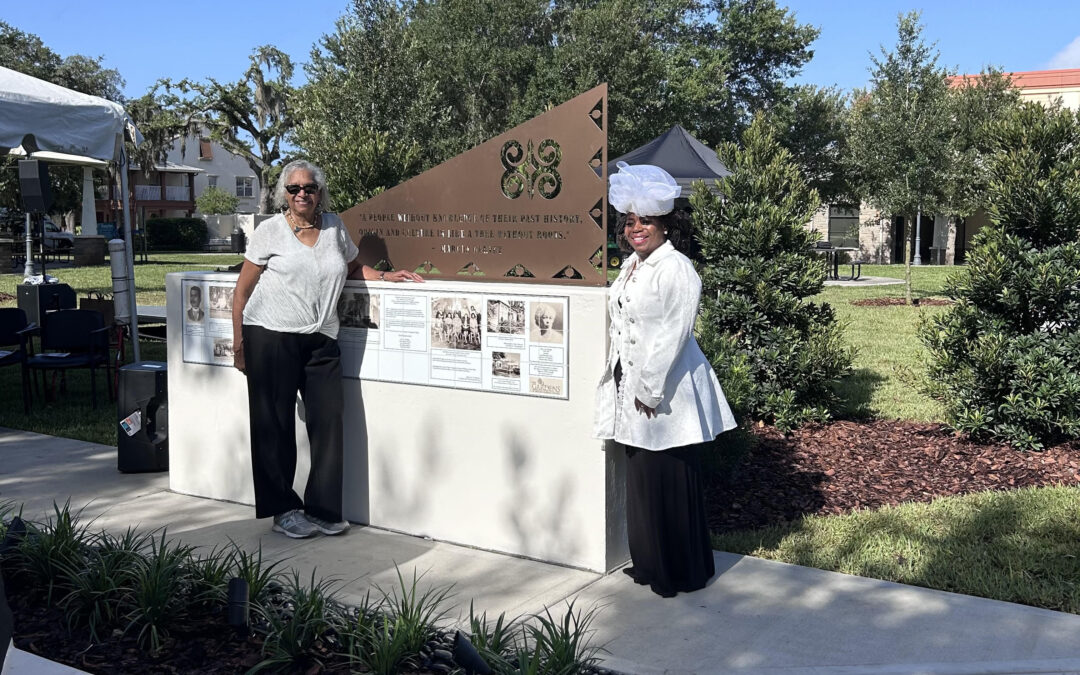
Winter Park on Saturday dedicated the Shady Park Pioneer Memorial, which honors central Black figures in the city’s origin and development and underscores the significance of the Hannibal Square community.
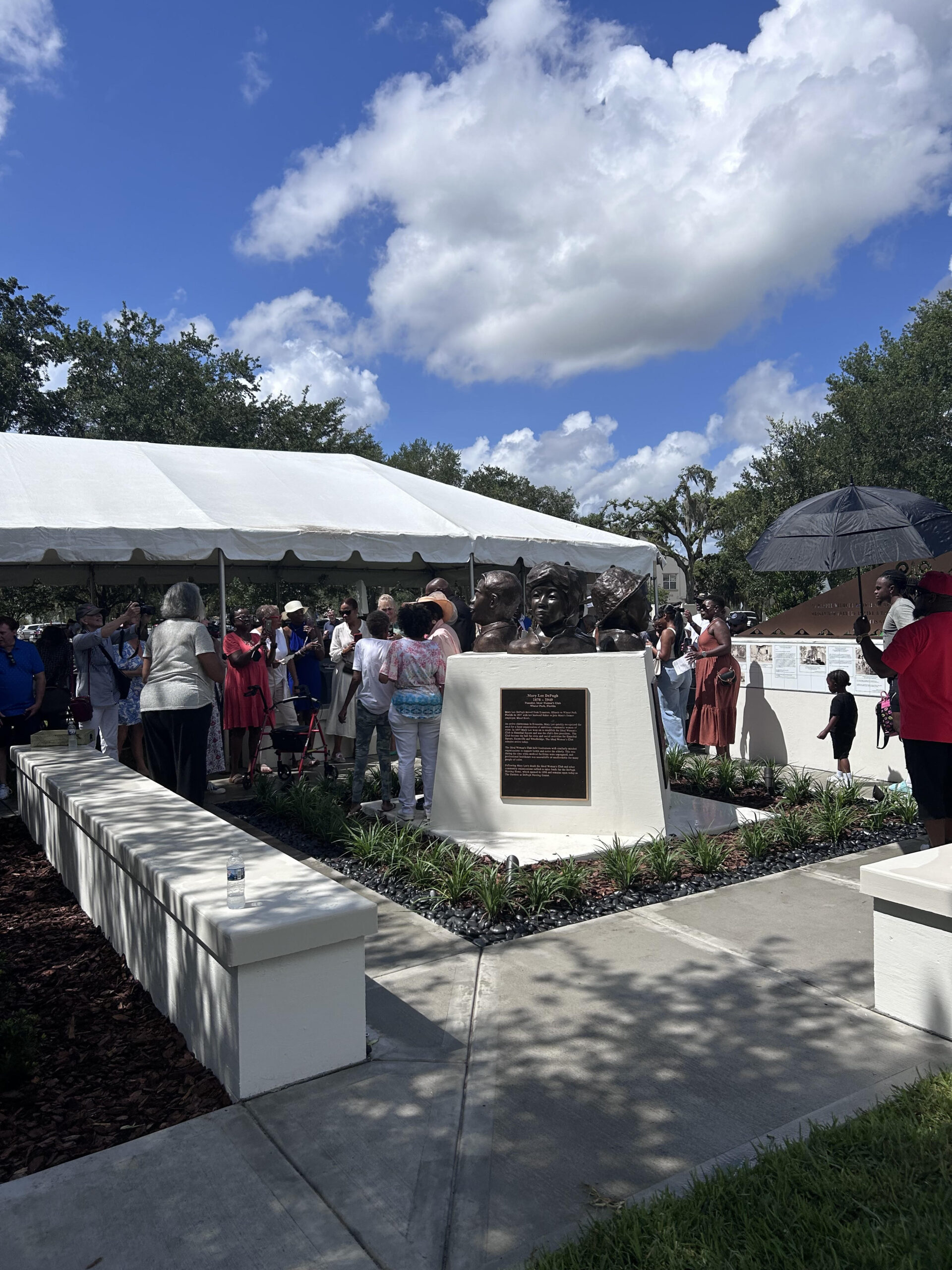
The memorial, which is next to Winter Park Community Center on New England Avenue, represents the endurance of Hannibal Square with four busts of key historical figures: Mary Lee Depugh (1878-1949), founder of the Ideal Woman’s Club;, Gustavus Christopher “Gus” Henderson (1862-1917), activist and founder of The Advocate and Frank R. Israel (1848-1925) and Walter B. Simpson (1859-1915) who both served as town aldermen.

The new Pioneer Memorial at Shady Park honors Black residents central to the city’s history. (Photo by Charles Maxwell)
Behind the busts is a pyramid with a small sculpture of elephant tusks, which signify Hannibal Square, said memorial artist George Gadson.
“The elephants represent symbols of strength, wisdom, and longevity,” Gadson said. “Their ability to overcome obstacles perfectly resembles these pioneers.”
Today the black population in Winter Park has shrunk as the city’s west side has largely been redeveloped. But advocates say that makes the history lesson highlighted by the memorial even more relevant.
“It’s crucial for everybody to know their history, where they come from,” said Maria Olivia Bryant, who grew up in the Winter Park and Eatonville area and has long pushed for the memorial. “It’s especially important for children to know and learn about their own culture, and that’s what the memorial is here for … If you know your history, it aligns you with your purpose.”
Founded in 1881, just 14 years after Florida reentered the Union after seceding and co-founding the Confederate States in 1861, Hannibal Square was home to free black families who provided labor and services to wealthy white residents.
Across from the busts in Shady Park is a history wall with the stories of the pioneers and a timeline of the community’s history. The memorial is set at the former site of Hannibal Square Elementary School, which was the very first public school for African American children in the Winter Park area, founded in 1883.
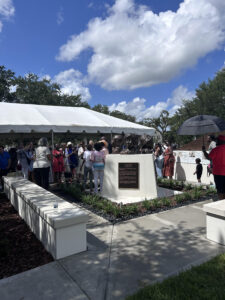
A crowd gathered Saturday at the memorial dedication at Shady Park.
Saturday’s dedication ceremony was crowded with local leaders and relatives of the pioneers. Mayor Sheila DeCiccio expressed her gratitude to community members who worked to make the memorial a reality.
“This has been a long time coming,” said DeCiccio.
Mary Daniels, a longtime resident and community leader who represented the MLK and Shady Park planning committee, gave remarks as well.
During the ceremony, Bryant led a historic dramatization that told the stories of the pioneers.
She noted how the idea for the memorial started more than 10 years ago, but it wasn’t until 2022 when a plan was really set into motion.
“For the past 20-25 years, there were conversations, promises and denials … through working, and coming together, it was finally brought back up.”
Bryant credits the City Commission in 2022 with pushing the concept forward.
When we brought it back up at that meeting, the commissioners and [former] Mayor [Phil] Anderson heard us,” Bryant said. “Actually, they didn’t just hear us. They felt us, they understood us.”
Anderson, who attended the ceremony Saturday, said he was just a part of the process that started before he was even in office.
“We had the opportunity to allocate certain funds… about half a million dollars to Shady Park as well as the MLK Jr. Park memorial,” said Anderson. “The committee that ran with it has been working on this for a long time. I don’t know if I’ve seen a prouder moment in Winter Park.”
WinterParkVoiceEditor@gmail.com
To comment or read comments from others, click here →


Recent Comments