by Beth Kassab | Sep 9, 2023 | City Commission, News
Commissioners to take first vote this week on new Winter Park budget
The more than $200 million proposed budget includes changes to address commission priorities
Sept. 9, 2023
By Beth Kassab
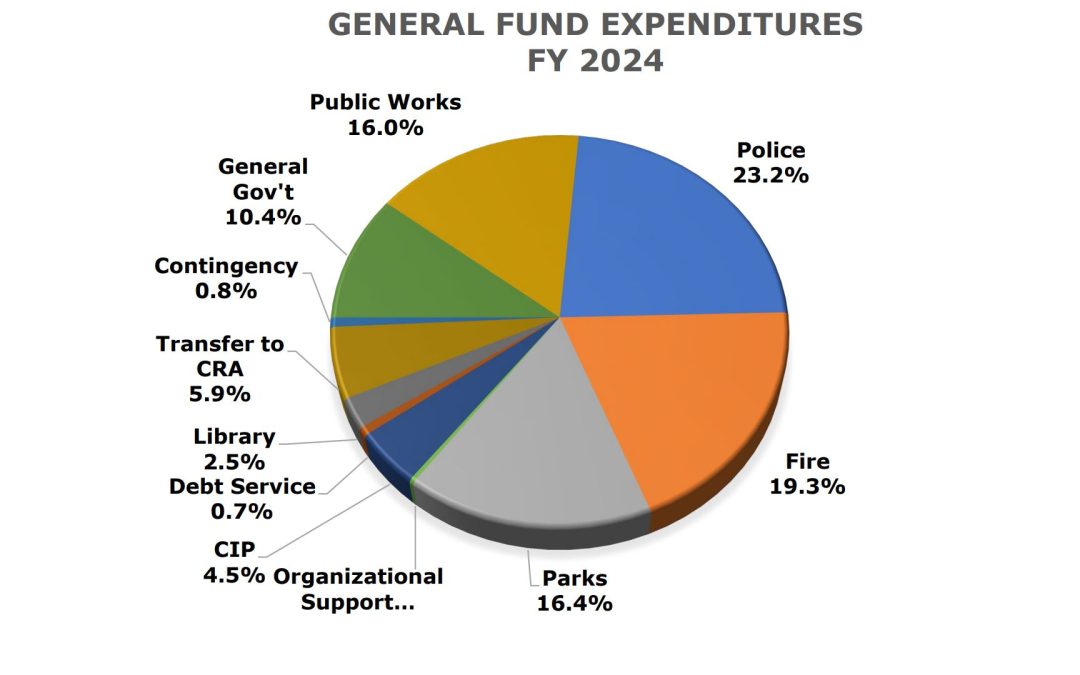
City Commissioners will vote Wednesday on the more than $200 million city budget and settle some key questions such as how much to set aside for flood prevention, whether the Winter Park Library will have enough money to open on Sundays, and if the city will acquire a bank-owned parcel to expand Seven Oaks Park.
A budget memorandum prepared by city staff notes changes made to the proposal in recent weeks, which now contains a contingency fund of nearly $700,000 as a result of revised revenue estimates from the state. Changes include:
- An additional $350,000 for the Winter Park Library, which will allow expanded hours and programming, including on Sundays. The money will come from the Community Redevelopment Agency’s budget and is planned to continue on an annual basis.
- At least $1.5 million is set aside, also from the CRA budget, for stormwater improvements such as flood prevention on the city’s west side, which makes up the CRA.
- $200,000 will go toward projects that are part of the Transportation Master Plan.
- $150,000 in the general fund is set aside as a potential matching grant for the Mead Garden Trails project.
- About $150,000 will be devoted from the general fund to create a new construction manager position within Public Works.
- About $113,000 will be devoted to a new community services officer civilian role for Winter Park Police.
- About $1 million over two years to make improvements to Aloma Avenue and S.R. 426 as part of the Fix 426 initiative. Staff noted that more funds may be needed, but that the nearly $700,000 in contingency funds as well as $19 million in the city’s reserve funds could serve as bridge funding.
Questions or comments? Email the editor at WinterParkVoiceEditor@gmail.com
To comment or read comments from others, click here →
by Beth Kassab | Sep 2, 2023 | City Commission, News, Uncategorized
Former Mayor Joe Terranova remembered for service and mentorship
Current commissioners say they will miss his wise counsel and humor
Sept. 2, 2023
By Anne Mooney
Winter Park lost a leader and a friend this week. Former Mayor Joe Terranova, who was known as a champion for the city’s charm and status as a “premier urban village” died Monday. He was 98.
Terranova, who served as mayor from 1997 to 2000, was also a driving force behind the Center for Independent Living, a Winter Park-based nonprofit that promotes inclusion and accessibility for people with disabilities and served on the committee that helped create the Charles Hosmer Morse Museum of American Art, a cultural centerpiece of the city.
“Joe was a valuable counselor to all of us who serve the city,” said Mayor Phil Anderson. “He had a zest for living that took him around the globe serving his country and brought him back to Winter Park to serve his community. I will remember Joe’s smile and his understanding that the government is there to serve its citizens.”
He was a past president of the University Club and chaired the ad hoc committee responsible for extensive renovations to the Club and was a member of the Winter Park Historical Association and the Winter Park Library Board of Trustees.
Terranova was also an active member of St. Margaret Mary Catholic Church.
Commissioner Kris Cruzada recalled that he met the former mayor while he was campaigning for his own seat.
“He was a very dynamic and accomplished individual,” Cruzada said. “He’s the one who introduced me to Winter Park’s vision of being the premier urban village for our region – a concept I always felt while growing up in Central Florida, but was never able to articulate until he mentioned it to me.”
Commissioner Todd Weaver also met Terranova while campaigning and said he possessed a rare combination listening skills and the ability to dole out sage advice.
“We became instant friends,” Weaver recalled. “I don’t know many people who are as wise as Joe, or who can deliver a short answer with such humor and friendliness.”
Terranova grew up in the Washington, D.C. area. After completing high school, he went into the Army during World War II. He was stationed in Europe, where he served in the 14th Armored Division, 25th Tank Battalion.
He returned to Washington in 1948 and entered Benjamin Franklin University to study accounting. In order to take the CPA exam, however, he found it necessary to transfer to George Washington University where he studied economics and successfully completed the CPA exam.
After graduation, Terranova worked at a couple of private CPA firms in D.C., but said he found the work dull. When the opportunity to join the Foreign Service presented itself, he jumped at it and thus began a distinguished career in the service of his country, according to his own account from a 1992 interview by the Winter Park History Museum.
His assignments took him all over the world. He went from Libera to Spain to Yugoslavia and back to Washington, D.C. The State Department had formed an audit team, and since Terranova was one of the few foreign service officers who was a CPA, he was asked to join.
After four years in D.C. he was back overseas, this time in Pakistan and from there to Paris. Asked during the museum’s interview what he liked best about Paris, Joe replied, “. . . I like to eat . . . and there is no greater place to be than Paris because that really is the capital of food as far as I’m concerned. There is no city or no country that has such an exquisite choice of food . . . and I took full advantage of it.”
The year was 1965, so it was not long before Terranova had to abandon his beloved Paris for a post in the American Embassy in Vietnam. Of his tour in Vietnam, Joe remarked, “Well, it was a most unusual way to conduct a civilian operation . . . while you’re fighting a full-blown war.”
He returned to the states for a sabbatical at the Navy War College in Newport, R.I. Toward the end of his tour there, he received a call from a friend asking if he wanted to return to Paris. “Well, I thought about that for about one-tenth of a second,” said Joe, “and said Yes! Back to the food!”
Terranova’s last assignment before he retired was at the Foreign Service Institute, an in-house training department for the State Department.
As he neared retirement, Joe and his wife decided they would like to end up in Florida. A close friend recommended Winter Park, and in 1981, the Terranovas came to Winter Park.
“Joe will be remembered for his service as mayor, his good humor, his willingness to listen, his time as a mentor and his warm and enduring smile,” said Vice Mayor Sheila DeCiccio. “He will be missed, but not forgotten.”
Special thanks to the Winter Park History Museum for access to the transcript of an oral interview with Joe Terranova from Sept. 27, 1992.
Questions or comments? Email the editor at WinterParkVoiceEditor@gmail.com
To comment or read comments from others, click here →
by Beth Kassab | Aug 25, 2023 | City Commission, News
Hefty increases for library and flood prevention included in CRA budget
The Winter Park Library will likely be able to add Sunday hours under the proposal that still needs final approval next month
Aug. 24, 2023
By Beth Kassab
An extra $5 million for flood prevention on the west side of Winter Park over three years along with $350,000 more for the Winter Park Library squeaked into the Community Redevelopment Agency’s annual $8 million budget on a split vote.
Mayor Phil Anderson, Vice Mayor Sheila DeCiccio, Commissioner Kris Cruzada and Orange County Representative Hal George voted in favor of the funding increases while Commissioners Marty Sullivan and Todd Weaver dissented.
The spending plan for the special district that covers downtown Winter Park still needs final approval by the board in September, when the city’s overall $200 million budget will come up for approval.
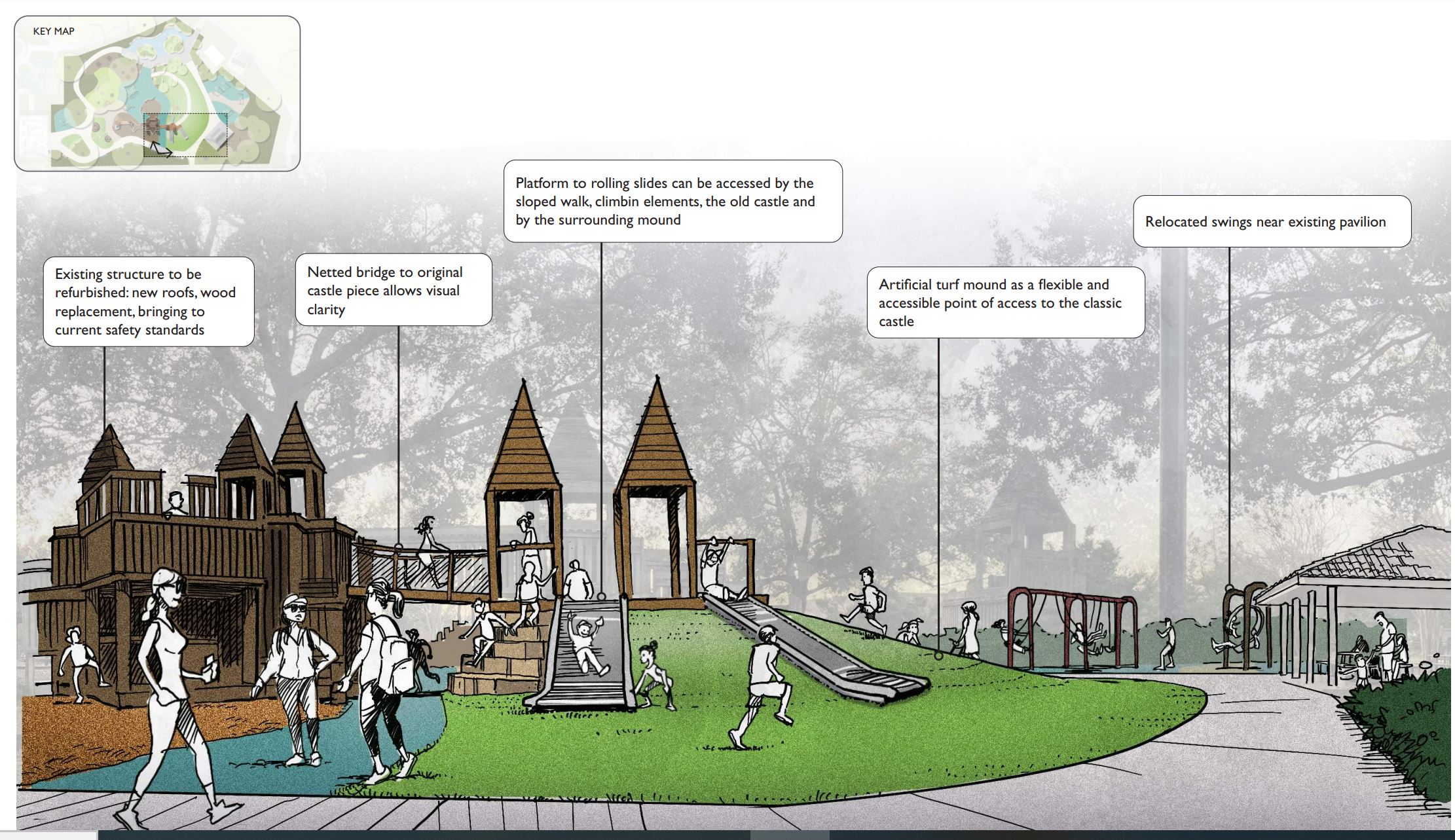
The plan also includes major upgrades for the playground at MLK Park near the library as well as permanent seating and restrooms in the West Meadow of Central Park that will serve the Farmer’s Market and other events.
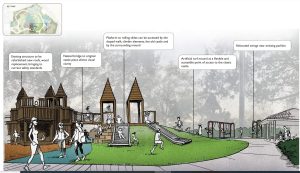
A city of Winter Park rendering shows improvements to MLK Park.
The $5 million for stormwater improvements to help fix the drainage problems caused by Hurricane Ian last year will be diverted from money set aside to purchase the Post Office — an acquisition so far rejected by the U.S. Postal Service.
Anderson said the city could consider selling the old library on New England Avenue to raise cash if the Post Office ever came up for sale in the future.
Weaver made a motion to lower the amount taken from the CRA for infrastructure improvement from $5 million to $2 million. Weaver, Sullivan and George voted for the reduction, while DeCiccio, Anderson and Cruzada were opposed. The motion failed on the tie vote.
Commissioners say the money will now be available to address flooding as soon as repairs and projects are identified by an engineering study now underway.
The $350,000 increase in library funding will allow the facility to make significant additions in personnel, add hours on Sunday and grow the amount of programming offered to the public, Executive Director Melissa Schneider said at a recent commission meeting.
Weaver pressed Schneider on the library’s reported average monthly attendance figures, asking if people heading to the adjacent Events Center, but walking through the library, were being counted as library visitors.
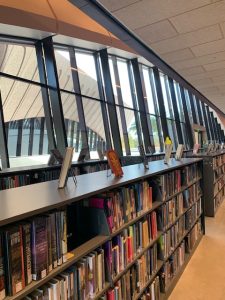
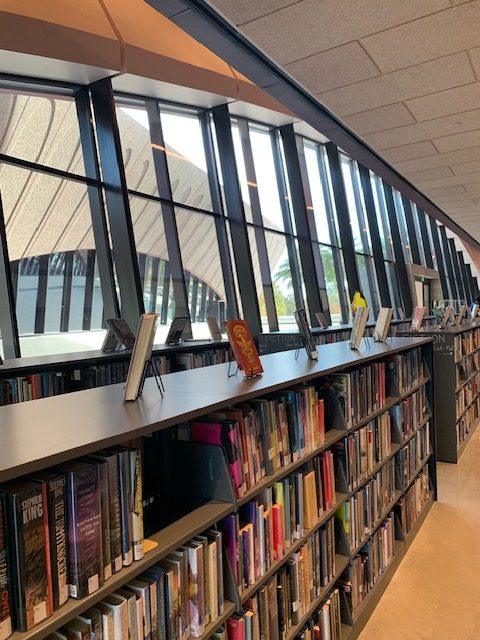
A view of the stacks inside the Winter Park Library.
Schneider insisted the increase from 10,000 monthly visitors in 2018 to 13,000 at the new library today are likely undercounted and that she is careful not to include foot traffic associated with the Events Center in the library’s totals.
Questions or comments? Email the editor at WinterParkVoiceEditor@gmail.com
To comment or read comments from others, click here →
by Beth Kassab | Aug 25, 2023 | City Commission, News
City purchase of Bank of the Ozarks land moves a step closer
A decision by commissioners to continue negotiations is the latest sign a deal could happen
Aug. 24, 2023
By Beth Kassab
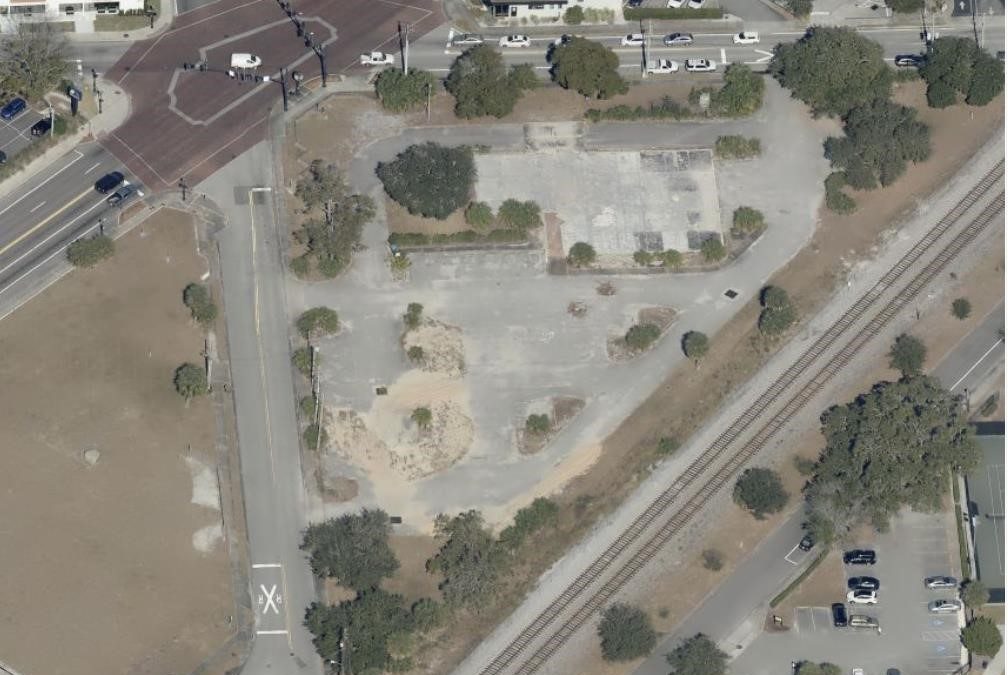
Winter Park Commissioners kept alive the potential for the $6 million purchase of of a two-acre vacant lot owned by the Bank of the Ozarks that could nearly double the size of Seven Oaks Park and link it to the nearby tennis courts and Mead Botanical Gardens.
While some commissioners expressed reservations about how to pay for the land and objected to selling the old library to raise the money, the general consensus was that such a purchase is possible and even desirable. The bank is in talks with Dan Bellows’ Ravaudage mixed-use development to construct a branch there instead.
Acquiring the property would not only add greenspace, but could provide space for underground stormwater treatment along with the flexibility to use some of the parcel for traffic improvements along Orange Avenue in the future, commissioners said.
“I think there’s a lot of good things from buying the property,” said Mayor Phil Anderson. “I think the stumbling point has always been the funding. I’m actually in agreement with Commissioner [Todd] Weaver that the old library is not really currency for this transaction.”
Anderson said he would rather see the city hold on to the old library and sell it later if the need came about such as to build up a fund to buy the Post Office. Commissioners diverted money from that line item in the Community Redevelopment Agency’s budget to flood prevention efforts because so far the Post Office has been unwilling to sell.
About $1 million is available in the parks acquisition fund and the board of trustees at the Winter Park Land Trust has pledged $500,000 toward the Ozarks property. Anderson suggested the remainder could come from reserves or by floating bonds. Anderson suggested that if the private donations don’t come through, the city could put the land back on the market.
“I’m struggling with need vs. want,” said Commissioner Kris Cruzada. “… $6 million is an awful lot and I don’t necessarily want to use our reserves to do it.”
The matter is likely to come up again at the next meeting in September.
Questions or comments? Email the editor at WinterParkVoiceEditor@gmail.com
To comment or read comments from others, click here →

by Beth Kassab | Aug 19, 2023 | City Commission, News
Four of five Winter Park commissioners own EVs or a hybrid
Board sets environmental policy for the city while members vote with their own wallets
Commissioner Kris Cruzada bought a Tesla this summer, making him the fourth person on the five-person Commission to drive an electric or hybrid vehicle.
“I do like it,” he said. “I’m not having to go fill up at Costco and wait 15 minutes. I’m just charging at home.”
He said the move was as much a financial one as it was reducing his own personal reliance on fossil fuels. It costs about $20 to charge his car’s battery, he said, vs. a $60 or $70 tank of gas.
Cruzada joins commissioners Todd Weaver and Marty Sullivan, who also drive Teslas, and Vice Mayor Sheila DeCiccio, who drives a hybrid SUV.
Weaver, who was the first to buy a Tesla about two years ago and has also installed solar panels on his roof, said he’s thrilled to see his fellow commissioners invest in electric vehicles.
“I’m very tickled about that,” he said. “I’ll never buy another gasoline car.”
He recently towed his pontoon boat behind his Tesla to Florida from a weeks-long sailing trip in the Lake Champlain area in Vermont.
“I wanted to show it could be done,” he said. “I had to charge a lot, but I can get about 150 miles with about 15 minutes of charging.”
He used Tesla’s network of supercharging stations at hotels and stores along major highways.
Weaver operates the administrative side of his business, TruGrit Traction, out of his house and is set to be recognized by the City Commission this week as a “platinum level green business.” The company engineers special wheels to carry cameras through sewer pipes during inspections.
Mayor Phil Anderson drives a gas Subaru, though he says an electric vehicle or a hybrid are “under consideration,” noting that he’s eyed the Solterra, Subaru’s electric SUV.
If he makes the change, it’s possible Winter Park would be the first city commission in Central Florida go 100% EV.
Questions or comments? Email the editor at WinterParkVoiceEditor@gmail.com
To comment or read comments from others, click here →
by Beth Kassab | Aug 19, 2023 | City Commission, News
What to know about the city budget this week
Contingency fund doubles to $1 million after new state contribution estimates
By Beth Kassab
An estimated $500,000 addition to the city’s contingency fund, which comes from the city’s share of state dollars along with local gas and communications taxes, could help the Winter Park City Commission balance next year’s more than $200 million budget — though an additional $18.1 million worth of projects must still find funding over the next five years.
Wednesday will mark the last City Commission meeting before the two final budget hearings September 13th and 27th.
Debate is likely to center on how to fulfill a number of priorities laid out by the commission. Those include:
- Mayor Phil Anderson has requested a new line item in the Community Redevelopment Agency’s budget devoted to stormwater and flood prevention projects. The exact dollar amount is still unknown because the city is just now hiring consultants to evaluate which infrastructure improvements are needed and when. Three consultants will be paid a combined $600,000 to study water runoff and flow. The mayor is pushing for some dollars to be included in the CRA budget now so that the most important projects can be tackled as soon as they are identified, rather than wait until the studies are complete.
- Vice Mayor Sheila DeCiccio is championing expanding offerings at the Winter Park Library with nearly $400,000 in additional funding that would allow the library to be open on Sundays and provide more programming. At least a portion of those dollars is also likely to come from the CRA, which includes the library.
- DeCiccio is also pushing for $150,000 for the city to hire a construction manager to help City Hall grow its in-house expertise, as a number of construction projects are underway. She is also asking for $75,000 to add a second Community Service Officer position to the Winter Park Police Department.
- Commissioner Marty Sullivan is advocating for $6 million to purchase land owned by the Bank of the Ozarks to expand Seven Oaks Park. It’s not clear where the dollars would come from, though some are advocating the city raise the money by selling the old Winter Park Library.
City staff have laid out multiple scenarios for how the local government can fund $100 million in transportation projects over the next 20 years, an estimated $20 million worth of stormwater improvements and two new fire stations.
Questions or comments? Email the editor at WinterParkVoiceEditor@gmail.com
To comment or read comments from others, click here →
Recent Comments