Residents face higher electric and water rates in new proposed budget
The draft $233.5 million city spending plan represents a nearly 9% increase over last year
July 7, 2025
By Beth Kassab
Winter Park residents will start to pay higher electric and water bills later this year if higher rates proposed in the 2026 budget are approved by the City Commission.
The Commission will begin on Wednesday to consider the draft budget for $233.5 million across all funds, an 8.9% or $19 million increase over this year amid widespread uncertainty about the national economic outlook and signs of slowing growth.
About half of the city’s budget increase is driven by the cost of undergrounding electric wires — a popular multi-year project that cuts down on outages — and other improvements to the city’s water and wastewater systems, which prompted staff to push for increases in the rates that utility customers will pay.
This year the city celebrated the 20th anniversary of its acquisition of the electric utility from the former Progress Energy, now Duke Energy, in a landmark deal that promised better reliability and lower rates.
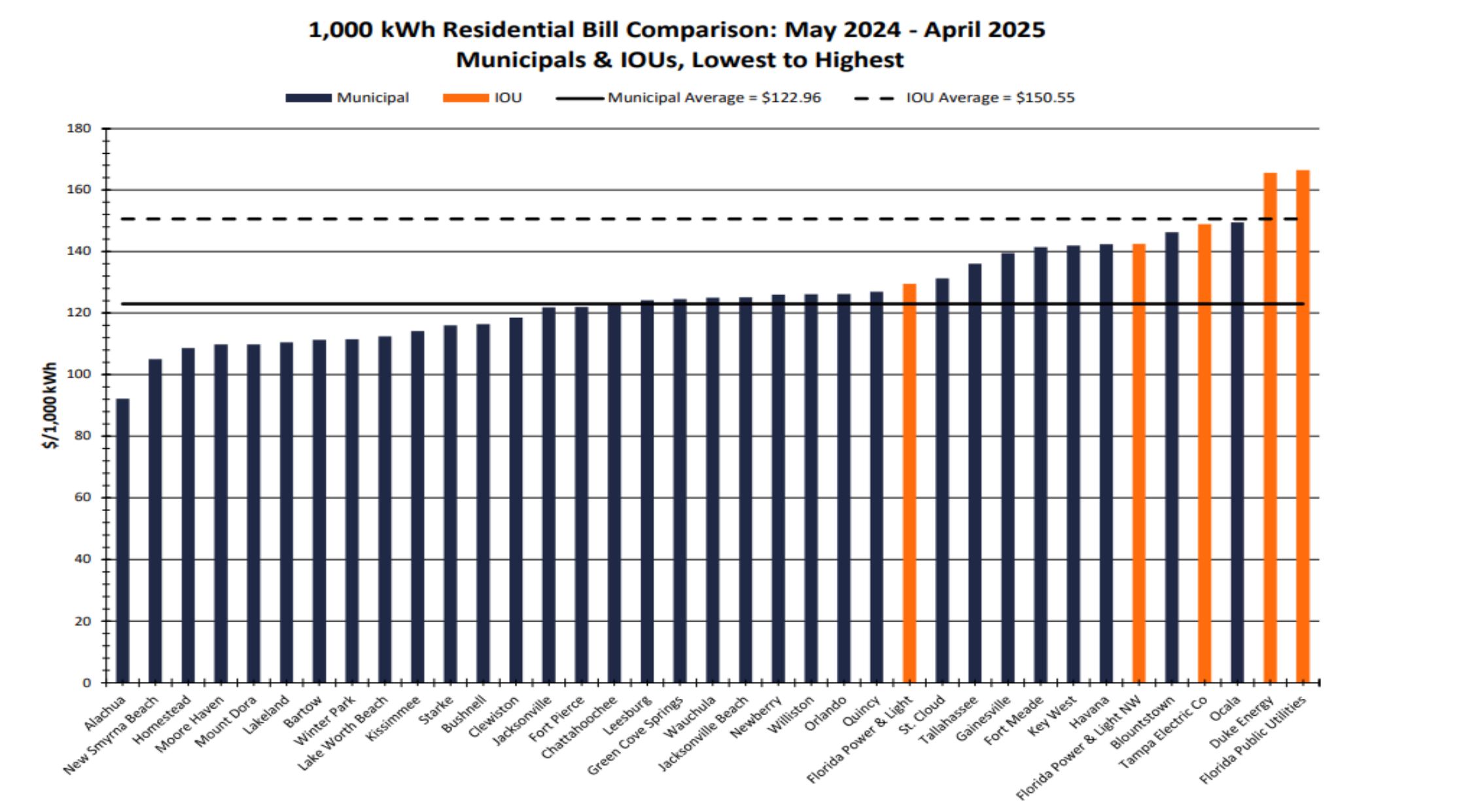
Winter Park, which has about 30,000 residents, often boasts of providing customers with one of the lowest electric bills in the state .Over the most recent 12-month period, the city’s rates were about 10% below the average for municipal-owned utilities in Florida and 33% below Duke Energy.
A chart from the draft 2026 budget proposal shows how Winter Park’s electric rates compare across the state. Above image: A crew from the city’s electric utility works outside of a resident’s home. (Photo courtesy of Winter Park Budget Proposal)
But the cost of the undergrounding project, which is now set to be complete by 2030, on top of persistent inflation means expenses are outpacing the current rate structure and, as the proposal noted, “the ability to continue to hold rates but still provide safe and reliable electricity has ended.”
The proposal calls for a 10% increase or about $15 more per month on a 1,000 kWh customer bill. The higher rates will fund the undergrounding project, substation and facility improvements and meter replacement, according to the budget document.
“While this is higher than would have been preferred, not having an annual index or policy for raising rates gradually leaves the utility with making periodic dramatic increases when outside shocks such as inflation and tariffs, affect the ability to maintain the current level of service,” reads the draft proposal. “It is actually surprising that the utility has not had to raise its non-fuel rates for years and is a testament to the extremely good power agreements and low-cost operation of the utility.”
Staff is proposing an additional 2% increase on water bills on top of the 2.23% increase set by the state Public Service Commission, which regulates utilities. The total adjustment would mean a $3.41 increase per month on the average 8,000 gallon customer.
The additional money would help the water utility keep up with capital expenses and stop using reserves to fund its obligations to help improve regional wastewater treatment plants.
Stormwater rates are also set to increase about $4 a month, according to the draft, based on a rate structure the City Commission put in place last year to increase rates by one penny per each property’s impervious square foot, each year, for three years. Those dollars go toward flood prevention, including setting into motion the results of recent basin studies, which identified the most urgent needs.
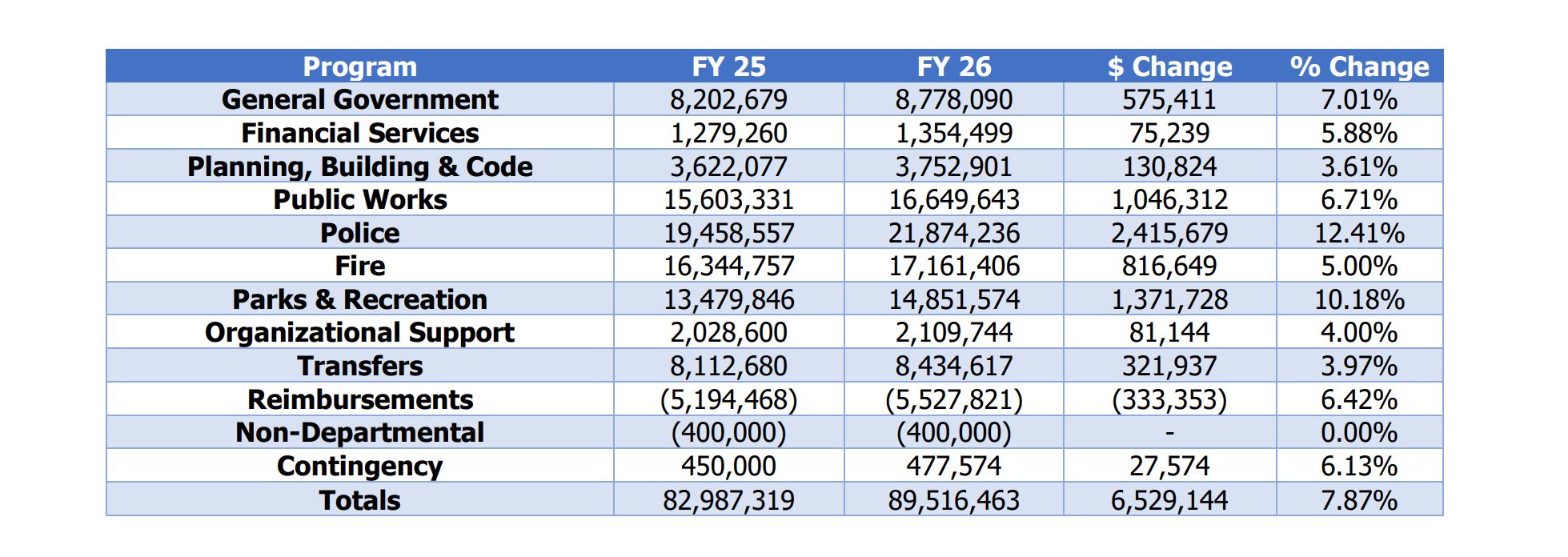
A chart from the draft proposal breaks down Winter Park’s General Fund, which makes up the largest portion of the city’s budget.
On top of those increases that will hit residents directly in the wallet each month, the budget proposal emphasized the need to balance an uncertain economic climate with political and other pressure to increase wages for police office officers.
“We are entering our 5th year of elevated inflation,” the budget draft states. “The long-vaunted U.S. economy is showing some concerning cracks as job growth is slowing, the number of home buyers vs home sellers has been dropping, retail sales are down, businesses have reduced hiring, creating the largest difference in unemployment between recent college graduates and the general workforce in years. All this points to a slowing economy that is likely going to remain at an elevated new normal of inflation around 3%. This means that the city will be experiencing slowing revenue growth while still facing an elevated inflation rate.
The draft noted that city governments often see a lag of about 18 months between signs of weakness in the economy and when the city begins to feel the downturn.
The budget keeps the city’s property tax rate the same — at 4.2991 mills, including debt service — though revenue will increase as property values increase. Each mill generates $1 for every $1,000 in the assessed value of a property.
“Property taxes are continuing to row the boat for the city’s fiscal picture, rising 7% and accounting for 44% of General Fund revenue,” the draft states. “This stabilizing force is what keeps most city services humming. Its rate of growth is sufficient to support the existing level of city services, but it is limited in what it can provide in excess of just staying on course.”
But even that steady revenue source is being threatened as Gov. Ron DeSantis and the Florida Legislature are looking to cut property taxes while putting pressure on local governments to increase police pay.
DeSantis announced proposed pay increases of 25% for state public safety workers, which pushing cities to set higher wages for their own police and fire personnel to stay competitive.
Winter Park plans to spend an additional $700,000 on public safety pay next year so that the starting salary for Winter Park police officers will reach about $65,000. At the same time, public safety pension costs will rise by $671,000.
Overall, the city employs 555 people and is budgeting for 2% cost of living raises plus an additional merit increase of up to 3%. The city is the fourth largest employer in Winter Park after AdventHealth, Orange County Schools and Rollins College. Publix rounds out the Top 5.
Other budget highlights include a warning that the capital improvement budget is tight and some projects may be deferred, particularly in the area of Parks & Recreation.
The current proposal calls for $885,000 for the following:
$410,000 for ball tracking technology at the Winter Park Pines driving range and bunker improvements at the Winter Park Nine
$200,000 through a grant application to replace eight hard courts at the Tennis Center
$75,000 for LED lighting at athletic fields and tennis courts
$150,000 for the landscaping office
$50,000 for general parks maintenance
“The ability to fund new capital projects and priorities is diminished and doing anything new outside of identifying new revenue sources or grant opportunities will be difficult without cutting other services,” the proposal stated. “City services are only as reliable as the people, equipment, and infrastructure that deliver them.”
The city also expects its reserve funds to decline when measured as a percent of reoccurring expenses in the General Fund. Winter Park officials have stated their goal is to maintain reserves equal to about 30% of those costs and have reached that in recent years.
The new budget proposes $478,000 in contingency funds, which would bring the total reserves to about $22.3 million by the end of 2026, or about 26% of expenses. It would take another $3.6 million in savings to get to the 30% mark.
“It should be noted that even though the percentage is slipping, the total balance in the reserves is increasing,” the draft said.
Wednesday will kick off budget discussions in front of the City Commission. Time is set aside for public input on the budget during the City Commission meetings on Aug. 13 and Aug. 27. The first of the two required Commission votes on the budget is scheduled for Sept. 10.
The nonprofit music venue recently secured a $1 million grant from Orange County and is counting down to its debut show in the old library
June 17, 2025
By Beth Kassab
Chris Cortez says the old Winter Park Library is buzzing with final construction and preparation this week before the space debuts this weekend as the city’s newest performing arts venue with two sold-out shows of the Orlando Jazz Orchestra on Sunday.
The opening of Blue Bamboo Center for the Arts, more than a year in the making, comes on the heels of a $1 million construction grant awarded to the organization from Orange County.
“You’ve got to believe it’s possible or you can’t get anything moving at all,” Blue Bamboo founder Cortez said this week of the once long-shot odds of the venue taking over the old city building that was favored to go to Rollins College. “It’s contagious.”
The City Commission pivoted last year from a pitch that would have allowed Rollins to transform the building at the corner of New England and Aloma avenues into a new art museum and instead signed a lease with Blue Bamboo and rezoned the property to accommodate a venue space.
Cortez, a musician, and his wife Melody Cortez, a visual artist, started Blue Bamboo in 2016. They were on the hunt for a new space after the rent soared at their old location off Fairbanks Avenue at the same time city officials were still trying to figure out how to best use the 33,000-square-foot and three-story former library on New England Avenue.
Jeff Flowers, president of Blue Bamboo and a former Maitland City Council member who grew up in Winter Park, said the building has been transformed.
“This drab library was not very inviting and now it’s just … wow,” said Flowers, who noted the old oculus, the circular opening between the first and second floors that spanned 13 feet in diameter was once home to an indoor tree, is now closed.
The first floor features two performing spaces — a main stage with 182 seats and a smaller stage with a seating capacity of about 60.
Flowers said the nonprofit Performing Arts Matters, which he and his wife founded two decades ago to fund groups such as the Orlando Contemporary Chamber Orchestra, will have office space in the building.
Central Florida Vocal Arts also plans to take over space on the second floor once construction is done there, said Theresa Smith-Levin, founder and executive director. About $200,000 of the county grant is designated for the group to build out teaching, rehearsal and office space. Central Florida Vocal Arts may use the first floor stages for some of its opera productions.
Cortez said the money from Orange County, which divvys out a small portion of the Tourism Development Tax to local arts groups, will be crucial to completing changes to the building.
He credited contractor Walker & Company with working diligently to help Blue Bamboo secure a certificate of occupancy sometime this week and open by its Sunday deadline.
Winter Park Celebrates Pride, Juneteenth and its 'Flip of the Switch'
Despite local and national agitation against LGBTQ rights, Winter Park moved forward with a proclamation for Pride Month and looked back on its long battle for its own city electric utility
June 12, 2025
By Beth Kassab
Winter Park had a lot to celebrate Wednesday: Pride Month, upcoming Juneteenth events and the 20-year anniversary of the flip of the switch from the former Progress Energy to its own electric utility.
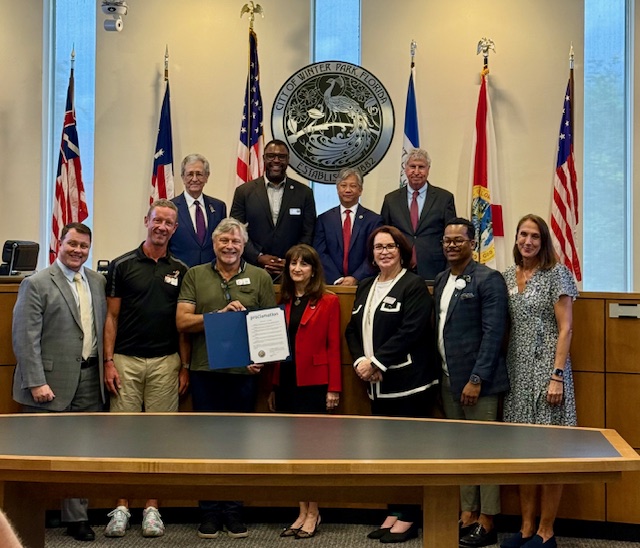
Mayor Sheila DeCiccio read a proclamation to honor Pride Month that noted the ninth anniversary today of the shooting at Pulse in Orlando, where 49 people died during a night of Latin dancing at the LGBTQ club, and the 59th anniversary on June 28 of the protests after police raided the Stonewall Inn, a gay bar in New York City.
She said the city is dedicated to fostering compassion, inclusion and safety.
“Let’s continue to build a welcoming Winter Park,” she said, as part of Winter Park’s first official proclamation for Pride Month, which comes two years after a battle over the rainbow peacock Pride flags they city flew during the month of June.
Thor Falk, founder of the Winter Park Pride Project, thanked the mayor for what he called a “bold” decision to recognize the LGBTQ community at a time when diversity and inclusion is being politicized across the nation. The Florida board that oversees the university system, for example, last week rejected the University of Florida’s pick as its new president because he previously showed too much willingness to embrace diversity and inclusion as president of the University of Michigan.
“Having this proclamation today validates what I have believed all along,” said Falk, who runs a campaign each June to provide Pride flags to businesses and residents. “Thank you so much for making this bold decision. It means a lot and it means a little … it’s sometimes these gestures that can make a difference in someone’s day and in how they feel about themselves when they know they are welcome in a community.”
Three residents spoke against the proclamation in Winter Park on Wednesday, including one man who said “pride” is associated with a man’s “downfall or ruin.”
Gigi Papa, a resident who frequently speaks at public meetings, said she is against the Pride Month proclamation and referenced Winter Park’s decision in 2023 to stop flying Pride flags on city light poles during the month of June.
Some members of the City Commission considered that message overtly political. The language proposed by the resident aligned with the language often used by the Christian anti-abortion movement.
The U.S. Supreme Court had just ruled the year before that the city of Boston was wrong to deny a group’s request to fly a “Christian flag” outside of City Hall because the flagpole had been used by other groups as a forum for private speech, which would include religious speech. The court explicitly noted that Boston could change its rules so that the flags are only a vehicle for city-endorsed speech.
As a result, Winter Park changed its rules for the light pole banners to only allow for banners to promote city-sponsored events or certain nonprofits who meet criteria for a longstanding presence in the city.
That meant the end of Pride banners as well as the rejection of the “choose life” banner.
Papa, who also stood up during the approval of a contract agreement for the Rollins softball field to ask if the college allows “trans sports,” said residents “should have some say” in proclamations.
But proclamations are already driven by resident requests and the city has clear guidelines, which say the topics can’t be political or ideological but can support arts and culture, recognize a national occasion and create public awareness among other criteria.
Winter Park has issued recent proclamations for Irish-American Heritage Month, Kwanzaa, Women in Construction, Arbor Day, Bleeding Disorders Awareness Month and Purple Week, which recognizes and promotes acceptance of people with disabilities.
Two residents stood up to speak in favor of the Pride Month proclamation as well as the proclamation to recognize Juneteenth, considered the day of emancipation for enslaved Black Americans. The city posted a schedule of Juneteenth events here.
“I am very pleased as a person who was born here in Winter Park that we celebrate Juneteenth and Pride Month … keep up the good work,” said Lee Rambeau Kemp.
Falk, with the local Pride Project, said this weekend’s Peacocks & Divas Drag Brunch at Mead Gardens is sold out. The event will raise money for students in Winter Park seeking technical careers.
DeCiccio said after the meeting that she wasn’t surprised by the negative comments and the numerous negative emails she has received about the proclamation.
“Winter Park is strongest when everyone feels safe and valued,” she said after the meeting. “Exclusion runs counter to our nation’s values — and Winter Park prides itself on being an inclusive community.”
Power Switch
City leaders also celebrated the 20-year mark since they took over their own utility from then-Progress Energy — and what is now Duke Energy — by showing a 13-minute documentary that detailed how the hard-fought decision came about.
The battle between Winter Park and Progress turned bitter and divisive.
The city said it could offer more reliable electric service to its residents and pledged to underground wires and keep rates low. Those against the change warned that Winter Park wouldn’t be able to deliver on such promises and would falter after storms.
Residents overwhelmingly approved the purchase in a landslide vote and the documentary points out all the ways Progress’ ominous warnings of Winter Park’s failure never came to be.
Winter Park is considered one of the most reliable utilities in the state by industry associations and boasts the fourth lowest rates in Florida.
The short film even points out how, with a little time and reflection, some who were so against the public conversion of the electric grid softened their views and changed their minds — a 180-degree flip that seemed inconceivable two decades ago given the acidic dialogue in the community at the time.
Resident Ray Renfo, who was interviewed for the documentary and recently saw his own wires undergrounded, said he’s changed his mind “100 percent.”
He said he’s confident entering this year’s storm season that he won’t be stranded in the dark and feeling “better than we have in years.”
Public golf courses swing for revenue as upgrades continue
The city has spent more than $750,000 on changes in recent years at Winter Park Pines and the Winter Park Nine
June 4, 2025
By Charles Maxwell
The nine-hole Winter Park Golf Course and the 18-hole Winter Park Pines Golf Club are undergoing upgrades this year, part of more than $750,000 Winter Park has spent in recent years on the city-owned courses.
The goal, said Parks and Recreation Director Jason Seeley, is to keep the courses profitable, as other courses across the region have closed or fallen into disrepair.
The Winter Park Nine saw an increase in rounds played last year to 52,000 as well as a jump in revenue from membership and greens fees, according to city records. But the Pines saw a decrease in rounds played in 2024 to 33,000 as well as a drop in greens fees, though membership revenue increased compared to 2023.
Improving the Pines course, which the city purchased in 2022 for $8 million after the private owner pushed to redevelop the land or else allow the manicured fairways to grow wild, remains a top priority, said Jason Seely, director of parks and recreation.
He said the city is exploring the idea of adding tracking technology to the driving range that could draw more people to the sport. Options like Trackman Range could turn the Pines into a Topgolf-like hang-out in Winter Park with virtual golf games and realistic course simulations.
“It would bring a whole different vibe to the facility,” Seeley said. “It goes from being just a golf course, which is great for golfers, to also being a place where anybody in the community might use it.”
Seeley recently traveled to Clermont National Golf Course to learn more about theirinrange system, similar to Trackman.
He said Clermont National’s driving range now “does better than the actual golf course… Not only does the range create its own revenue, it also completely changed the dynamics as far as their food and beverage. They’re no longer selling food and beverages a little bit in the morning and a little bit at lunch… they’re are selling all night long.”
While the Pines has shown an operating profit since the city bought it, Winter Park has also invested heavily in upgrades.
The city has spent about $600,000 on improvements so far, using money from the bonds issued to purchase the 18-hole course visible from Semoran Boulevard near Hanging Moss Road.
Changes include lengthening the course and increasing the par from 69 to 72, renovations to the clubhouse and restrooms, an outdoor patio and beer garden, a new driving range surface and automated ball dispenser, planting new pine trees and other landscaping and replacing or repairing three bridges on the course.
While the number of rounds played at the Pines dropped in 2024, which included two weeks of rain closures, the course still showed an operating profit. Revenue decreased by about $90,000 to $1.7 million from 2023 to 2024, according to city records, and operating expenses totaled about $1.6 million.
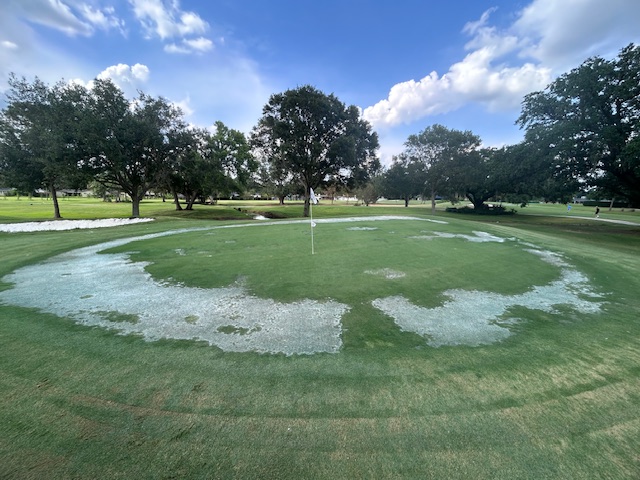
A recent photo shows a patchy green at Winter Park Pines, the 18-hole golf course purchased by the city in 2022. (Photos by Charles Maxwell)
Although the course’s revenues have not covered the interest on the debt from the purchase, the city defends the decision to rescue the course.
In a recent email to residents, Mayor Sheila DeCiccio said the Pines “is not just a golf course. It is permanently protected parkland.”
Winter Park is not the only local government to buy a course after owners threatened to build more homes or condos over the green spaces.
Oviedo bought the Twin Rivers Golf Club in 2017 for more than $5 million to prevent the land from being redeveloped. In 2021, Seminole County purchased Deer Run Golf Club in Casselberry and Wekiva Golf Club in Longwood for nearly $14 million. The county is turning Deer Run into a passive park, but Wekiva is still being operated as a course.
The Winter Park Nine, which is nestled between the commercial district centered on Park Avenue and the neighborhood along the shores of Lake Osceola, is also showing a smaller profit despite nearly 52,000 rounds played last year compared to 42,000 in 2022.
Profit fell from about $205,000 to $106,000 over the same two-year period as improvements continued on the course that dates back to 1914.
The city has operated the nine-hole Winter Park Golf Course for more than three decades.
The city purchased the course in the mid-1990s after operating it for years. In 2016 it underwent a major renovation.
Since then, the city has spent about $150,000 on recent additional upgrades such as the patio space outside the clubhouse and expansion of the first tee box, along with a new rain shelter near hole four and an updatedThor Guardlightning prediction system.
Players at the nine-hole course will begin to notice this fall a new maintenance facility, along with new bunker liners to keep the sandtraps structurally sound during storm season and minimize future maintenance costs.
WinterParkVoiceEditor@gmail.com
Charles Maxwell graduated from Winter Park High School and Florida Atlantic University with a BA in Multimedia Studies. His work has appeared in the South Florida Sun Sentinel and The Boca Raton Tribune, and he is a contributing writer for Keeping it Heel on the FanSided network.
Beef over Today Show visit, no more flouride and what to do over private pickleball noise
The City Commission also approved a new lease for the Benefit Shop at its most recent meeting
May 29, 2025
By Beth Kassab
Winter Park has had it up to the top of the Knowles Chapel steeple with giving away free publicity to the neighboring city of Orlando.
Earlier this month the Today Show filmed its third hour from Central Park as small crowd gathered to watch.
The city waived the park rental fee for Visit Orlando, the tourism marketing agency that coordinated the Today Show’s visit and that receives more than $100 million in taxpayer dollars intended to benefit the region.
Mayor Sheila DeCiccio said she was surprised that the show never thanked or even mentioned Winter Park on air. She said Visit Orlando representatives told the city the reason is because the show was an Orlando event intended to promote Orlando.
“I propose on a go forward basis that visit Orlando gets nothing from Winter Park for free unless credit is given to Winter Park or they can pay fees like anyone else renting the park,” DeCiccio said.
“They didn’t say at all they were in Winter Park?” asked Commissioner Craig Russell.
“Not one word,” DeCiccio responded.
“Oh, no you can’t … no …,” Russell said back.
“And they stayed at the Alfond Inn, too,” DeCiccio said, referring to the luxury hotel owned by Rollins College just off Park Avenue.
The segment featured an interview with Michael James Scott, the Broadway actor known for playing the Genie in Disney’s musical version of Aladdin who grew up in Central Florida and attended Dr. Phillips High School in Orlando, as well as chefs from three Orlando restaurants.
The Today Show snub comes on the heels of the New York Times’ “36 Hours in Orlando,” which recommended readers actually spend many of those hours in Winter Park and featured a large photo of Winter Park’s Scenic Boat Tour.
Fluoride to leave city water
City Manager Randy Knight told commissioners that the city would stop adding fluoride to its water system by July 1 in order to comply with a recently passed state ban.
He said it’s possible fluoride will be out of the water system before July because the city’s supply may run out before then and the utility did not order more because of the new state law.
At a Utilities Advisory Board meeting earlier this week, Water Utility Director David Zusi said the concentration of fluoride in Winter Park’s water was low and the additive does not affect the taste or water softness or hardness. As a result, residents won’t be able to detect the change, he said.
Alison Yurko, a member of the advisory board, said she wanted to make sure customers know that the change is a result of state law rather than local policy.
“I think this is going to have a very unfortunate effect on kids at the lower income level who don’t go to the dentist,” she said.
The American Dental Association and the American Academy of Pediatrics support using fluoride to help prevent cavities in children, especially in underserved communities. They also cite a lack of evidence for health harms when fluoride is at the current low levels used in most community water systems in the U.S.
The Florida Legislature and Gov. Ron DeSantis backed the state ban in the wake of renewed scrutiny over the additive driven by Robert F. Kennedy Jr., national secretary of Health and Human Services, who has called fluoride an “industrial waste,” citing its potential health risks.
Public health studies conclude that risks related to fluoride exposure are generally associated with receiving either too much or too little and do not apply to the low concentrations found in most public water systems.
Private pickleball? Commissioners worry over noise
There’s been a change of plans for a prominent corner near Park Avenue that may lead to new city regulations for private pickleball courts.
But Jon Phelps’ idea for the property has changed said City Planning & Zoning Director Allison McGillis. Plans now call for a one-story building that still includes a Storyville Coffee, but also a swimming pool and pickleball court to go along with the private residence portion of the building.
Commissioner Warren Lindsey raised concerns about potential noise from the courts so close to other businesses.
“I think we need to proactively address private pickleball courts,” he said.
McGillis said the city’s codes include regulations related to tennis courts, but not pickleball courts, and said noise complaints related to pickleball are common.
Commissioners asked her to come back to the group with recommendations for how to revise the city’s rules to address noise and any other concerns.
New lease for Benefit Shop
At the previous City Commission, members voted to pursue a 3-year lease with the Benefit Shop, a thrift store that once operated out of City Hall and raises money for local charities by re-selling household goods and clothes.
But on Wednesday the Commission voted 3-2 to change the term to five years with Commissioners Marty Sullivan, Kris Cruzada and Craig Russell in favor.
The shop, a longtime fixture in Winter Park, wanted a 35-year lease to move to the Lake Island Park building in MLK Park. But commissioners felt that was too long and limited future commissions who might need to consider additional uses for the building at some point.
Debbie Glaser, a co-manager of the shop, said it plans to re-open on Fridays and Saturdays from 9:30 a.m. to 2 p.m. at the new location beginning this week. She said the shop now has more than 20 volunteers and hopes to add additional hours in the future.
Winter Park city officials also said they were attempting to help Austin’s Coffee relocate and will try to negotiate a new lease with the Benefit Shop
May 15, 2025
By Beth Kassab
The City Commission approved changes to the historic preservation ordinance that are designed to discourage unapproved demolitions with clear potential consequences and to ensure homeowners don’t deviate from plans approved by the Historic Preservation Board.
Commissioners voted 4-1 to pass “Version 1” of the changes that say owners who knock down or dramatically alter historic structures without permission after going through the certificate of review process can be required to build the structure back exactly as it was, including using authentic exterior materials. In addition, they could lose any variances the historic board granted that allowed the project to move forward.
Commissioner Marty Sullivan was the only dissenting vote because, he said, he wanted “Version 2” of the proposed changes, which included the option of a financial penalty for such unauthorized demolitions capped at 30% of the building’s county assessed value — though Sullivan suggested the cap increase to 60%.
“I think 30% is way too little,” Sullivan said.
The debate over the ordinance, which had been delayed from earlier this year, centered on whether or not to include the monetary penalty, which drew fierce opposition from some in the city’s historic districts who viewed it as far too punitive.
But the version approved by the commission is potentially even more punitive when you consider the cost of losing variances on setbacks or other building rules.
Variances, or exceptions to the usual building code, are viewed as a clear benefit for historic owners to encourage them to preserve the outside architecture of buildings. For example, if the typical required buffer between a home addition and the property lot line is 20 feet, historic owners might be allowed to build to 10 feet.
As a result, losing those variances, as the ordinance says could happen in the case of an unauthorized demolition, is a “huge deal,” said John Skolfield, a builder who was elected earlier on Wednesday to serve as chairman of the Historic Preservation Board.
“If you think about the house in question that started all of this … we approved a beautiful design that brought it to 7,200 square feet,” he told the commission. “You have to build back without the variances, that’s a $500,000 to $800,000 ding.”
Last year, however, all but a small portion of the first floor and the chimney was torn down. The contractor agreed to pay $100,000 to make amends for the mistake and the project was allowed to go forward.
The episode set off a major debate and led to the ordinance changes.
Winter Park has about 400 historic structures including the College Quarter and Virginia Heights districts and individually designated homes and commercial buildings.
The historic board only has a say when it comes to major exterior alterations of buildings, not minor changes or repairs or interior projects. Window and door replacements or roof replacements, for example, are not required to come before the board so long as they stay consistent with the architectural style and must only follow the typical building permit process.
The new ordinance also requires additional checks on construction plans to make sure what the contractor does matches approvals given by the board. And it requires additional due diligence to make sure owners and contractors are aware earlier in the process if there is a part of the structure they won’t be able to save.
The city purchased the property rented by Austin’s and other businesses last year and the coffee shop has known for at least a year that the lease will end so that the city can use the property to add a turn lane on Fairbanks Avenue and make drainage improvements.
City Manager Randy Knight said the city has hired a broker to help Austin’s find a new location, will allow the owners to take anything from the property that they wish to take and will also return the security deposit.
But for Austin’s loyal supporters, that isn’t enough.
Speaker after speaker bashed the city for taking away a place that they said is considered a “sanctuary” by many in the arts community.
Mayor Sheila DeCiccio said she was frustrated by the misinformation she heard.
“We are not evicting Austin’s … they have had over a year to find a new space,” she said. “… We are paying a Realtor to help them.”
She explained that the intersection at Fairbanks and Denning is busy and accident prone and residents deserve a solution. They also deserve a fix, she said, to the drainage and flooding problems that occur in the area.
“Please take that into consideration when you criticize this commission,” she said.
Benefit Shop lease uncertain
The city is attempting to negotiate a new lease with the Benefit Shop, a thrift store that raises money for local charities by selling used household goods and clothes.
The group operated in City Hall for years but the space is now needed by city staff. The Benefit Shop is interested in moving to a small building at MLK Park where the city just spent $10,000 to fix the air-conditioning system.
But the Benefit Shop wants a lease that extends to 35 years with the city covering all major costs such as maintenance and insurance.
DeCiccio and other commissioners said that term was too long and could prohibit future commissions from additional uses of the building. The commission voted to attempt to negotiate a three-year lease for $1 each year at the Lake Island Park building. The Benefit Shop would be responsible for the insurance beginning in its second year.
A final deal, if reached, will come back to the commission for approval.
We Depend on your support, make a tax-deductible donation here.
Mission
The Winter Park Voice is a trusted nonprofit journalism site that covers our City Hall and beyond. We endeavor to engage, inform and connect citizens on all sides of issues affecting the quality of life in Winter Park.





Recent Comments