Public golf courses swing for revenue as upgrades continue
The city has spent more than $750,000 on changes in recent years at Winter Park Pines and the Winter Park Nine
June 4, 2025
By Charles Maxwell
The nine-hole Winter Park Golf Course and the 18-hole Winter Park Pines Golf Club are undergoing upgrades this year, part of more than $750,000 Winter Park has spent in recent years on the city-owned courses.
The goal, said Parks and Recreation Director Jason Seeley, is to keep the courses profitable, as other courses across the region have closed or fallen into disrepair.
The Winter Park Nine saw an increase in rounds played last year to 52,000 as well as a jump in revenue from membership and greens fees, according to city records. But the Pines saw a decrease in rounds played in 2024 to 33,000 as well as a drop in greens fees, though membership revenue increased compared to 2023.
Improving the Pines course, which the city purchased in 2022 for $8 million after the private owner pushed to redevelop the land or else allow the manicured fairways to grow wild, remains a top priority, said Jason Seely, director of parks and recreation.
He said the city is exploring the idea of adding tracking technology to the driving range that could draw more people to the sport. Options like Trackman Range could turn the Pines into a Topgolf-like hang-out in Winter Park with virtual golf games and realistic course simulations.
“It would bring a whole different vibe to the facility,” Seeley said. “It goes from being just a golf course, which is great for golfers, to also being a place where anybody in the community might use it.”
Seeley recently traveled to Clermont National Golf Course to learn more about theirinrange system, similar to Trackman.
He said Clermont National’s driving range now “does better than the actual golf course… Not only does the range create its own revenue, it also completely changed the dynamics as far as their food and beverage. They’re no longer selling food and beverages a little bit in the morning and a little bit at lunch… they’re are selling all night long.”
While the Pines has shown an operating profit since the city bought it, Winter Park has also invested heavily in upgrades.
The city has spent about $600,000 on improvements so far, using money from the bonds issued to purchase the 18-hole course visible from Semoran Boulevard near Hanging Moss Road.
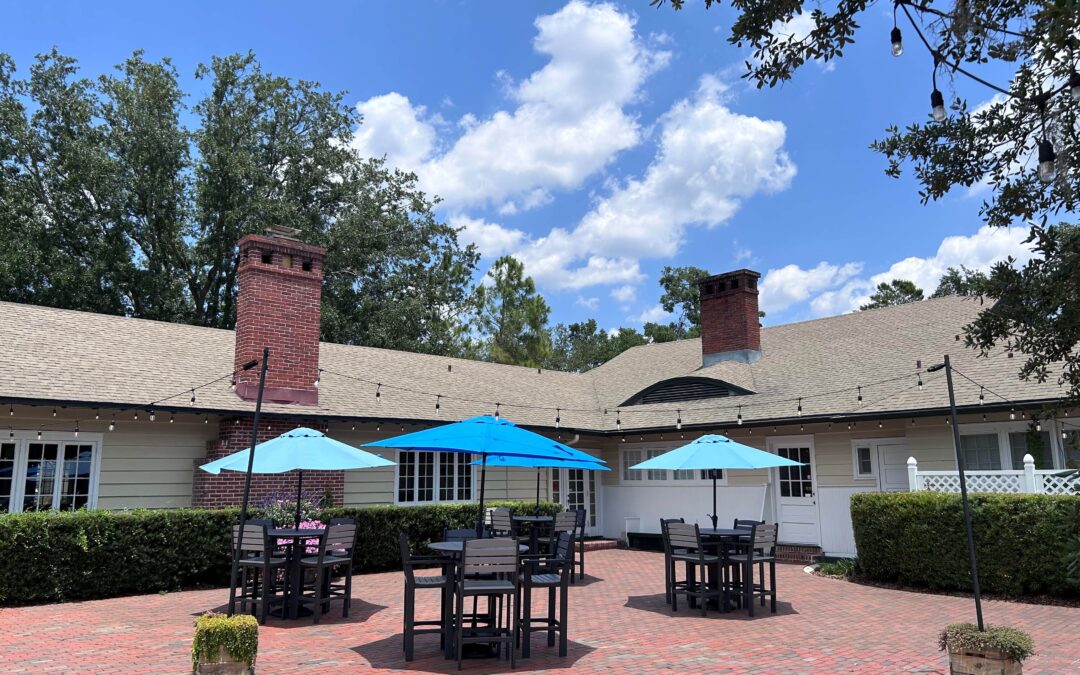
Changes include lengthening the course and increasing the par from 69 to 72, renovations to the clubhouse and restrooms, an outdoor patio and beer garden, a new driving range surface and automated ball dispenser, planting new pine trees and other landscaping and replacing or repairing three bridges on the course.
While the number of rounds played at the Pines dropped in 2024, which included two weeks of rain closures, the course still showed an operating profit. Revenue decreased by about $90,000 to $1.7 million from 2023 to 2024, according to city records, and operating expenses totaled about $1.6 million.
A recent photo shows a patchy green at Winter Park Pines, the 18-hole golf course purchased by the city in 2022. (Photos by Charles Maxwell)
Although the course’s revenues have not covered the interest on the debt from the purchase, the city defends the decision to rescue the course.
In a recent email to residents, Mayor Sheila DeCiccio said the Pines “is not just a golf course. It is permanently protected parkland.”
Winter Park is not the only local government to buy a course after owners threatened to build more homes or condos over the green spaces.
Oviedo bought the Twin Rivers Golf Club in 2017 for more than $5 million to prevent the land from being redeveloped. In 2021, Seminole County purchased Deer Run Golf Club in Casselberry and Wekiva Golf Club in Longwood for nearly $14 million. The county is turning Deer Run into a passive park, but Wekiva is still being operated as a course.
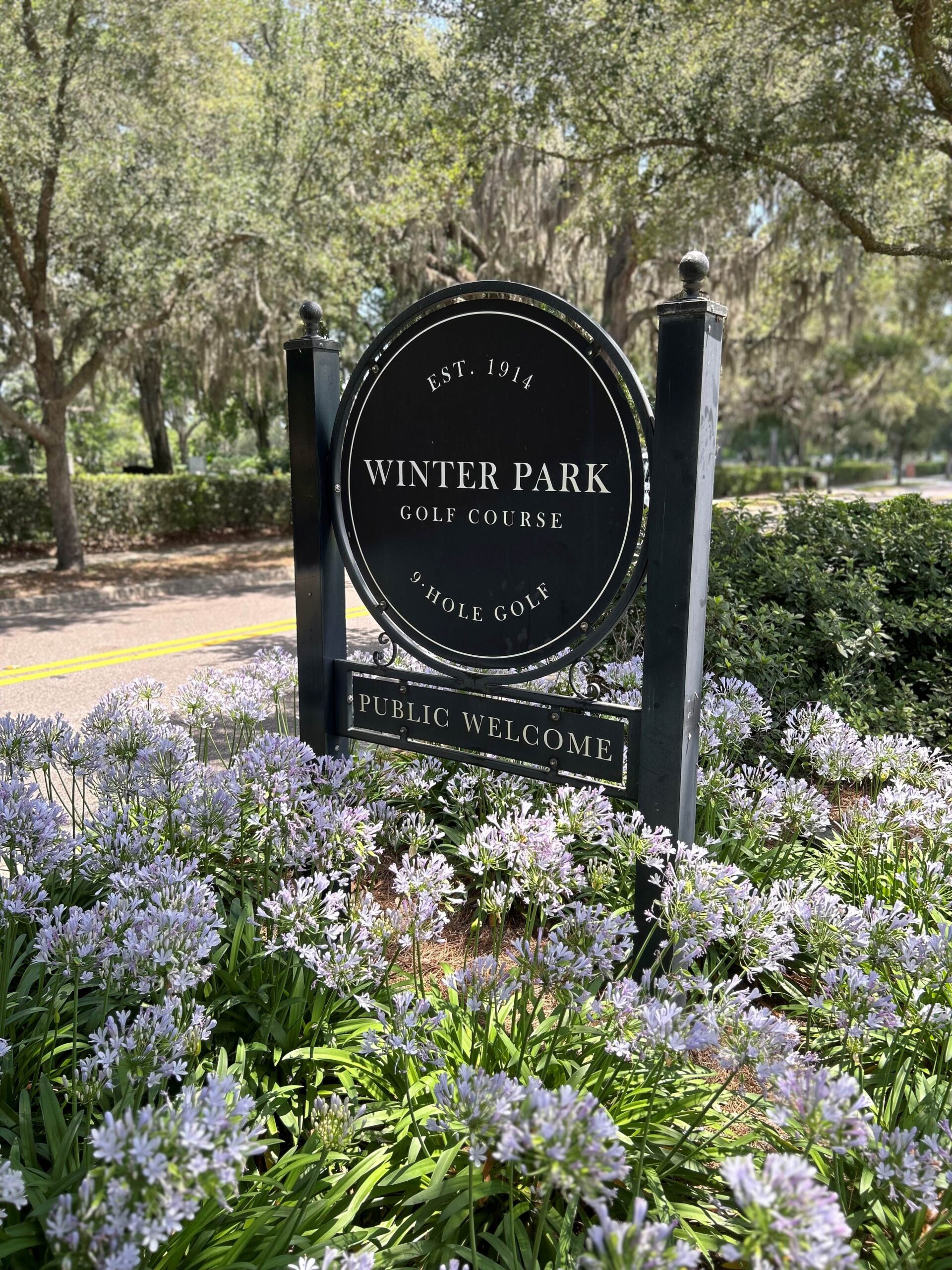
The Winter Park Nine, which is nestled between the commercial district centered on Park Avenue and the neighborhood along the shores of Lake Osceola, is also showing a smaller profit despite nearly 52,000 rounds played last year compared to 42,000 in 2022.
Profit fell from about $205,000 to $106,000 over the same two-year period as improvements continued on the course that dates back to 1914.
The city has operated the nine-hole Winter Park Golf Course for more than three decades.
The city purchased the course in the mid-1990s after operating it for years. In 2016 it underwent a major renovation.
Since then, the city has spent about $150,000 on recent additional upgrades such as the patio space outside the clubhouse and expansion of the first tee box, along with a new rain shelter near hole four and an updatedThor Guardlightning prediction system.
Players at the nine-hole course will begin to notice this fall a new maintenance facility, along with new bunker liners to keep the sandtraps structurally sound during storm season and minimize future maintenance costs.
WinterParkVoiceEditor@gmail.com
Charles Maxwell graduated from Winter Park High School and Florida Atlantic University with a BA in Multimedia Studies. His work has appeared in the South Florida Sun Sentinel and The Boca Raton Tribune, and he is a contributing writer for Keeping it Heel on the FanSided network.
Beef over Today Show visit, no more flouride and what to do over private pickleball noise
The City Commission also approved a new lease for the Benefit Shop at its most recent meeting
May 29, 2025
By Beth Kassab
Winter Park has had it up to the top of the Knowles Chapel steeple with giving away free publicity to the neighboring city of Orlando.
Earlier this month the Today Show filmed its third hour from Central Park as small crowd gathered to watch.
The city waived the park rental fee for Visit Orlando, the tourism marketing agency that coordinated the Today Show’s visit and that receives more than $100 million in taxpayer dollars intended to benefit the region.
Mayor Sheila DeCiccio said she was surprised that the show never thanked or even mentioned Winter Park on air. She said Visit Orlando representatives told the city the reason is because the show was an Orlando event intended to promote Orlando.
“I propose on a go forward basis that visit Orlando gets nothing from Winter Park for free unless credit is given to Winter Park or they can pay fees like anyone else renting the park,” DeCiccio said.
“They didn’t say at all they were in Winter Park?” asked Commissioner Craig Russell.
“Not one word,” DeCiccio responded.
“Oh, no you can’t … no …,” Russell said back.
“And they stayed at the Alfond Inn, too,” DeCiccio said, referring to the luxury hotel owned by Rollins College just off Park Avenue.
The segment featured an interview with Michael James Scott, the Broadway actor known for playing the Genie in Disney’s musical version of Aladdin who grew up in Central Florida and attended Dr. Phillips High School in Orlando, as well as chefs from three Orlando restaurants.
The Today Show snub comes on the heels of the New York Times’ “36 Hours in Orlando,” which recommended readers actually spend many of those hours in Winter Park and featured a large photo of Winter Park’s Scenic Boat Tour.
Fluoride to leave city water
City Manager Randy Knight told commissioners that the city would stop adding fluoride to its water system by July 1 in order to comply with a recently passed state ban.
He said it’s possible fluoride will be out of the water system before July because the city’s supply may run out before then and the utility did not order more because of the new state law.
At a Utilities Advisory Board meeting earlier this week, Water Utility Director David Zusi said the concentration of fluoride in Winter Park’s water was low and the additive does not affect the taste or water softness or hardness. As a result, residents won’t be able to detect the change, he said.
Alison Yurko, a member of the advisory board, said she wanted to make sure customers know that the change is a result of state law rather than local policy.
“I think this is going to have a very unfortunate effect on kids at the lower income level who don’t go to the dentist,” she said.
The American Dental Association and the American Academy of Pediatrics support using fluoride to help prevent cavities in children, especially in underserved communities. They also cite a lack of evidence for health harms when fluoride is at the current low levels used in most community water systems in the U.S.
The Florida Legislature and Gov. Ron DeSantis backed the state ban in the wake of renewed scrutiny over the additive driven by Robert F. Kennedy Jr., national secretary of Health and Human Services, who has called fluoride an “industrial waste,” citing its potential health risks.
Public health studies conclude that risks related to fluoride exposure are generally associated with receiving either too much or too little and do not apply to the low concentrations found in most public water systems.
Private pickleball? Commissioners worry over noise
There’s been a change of plans for a prominent corner near Park Avenue that may lead to new city regulations for private pickleball courts.
But Jon Phelps’ idea for the property has changed said City Planning & Zoning Director Allison McGillis. Plans now call for a one-story building that still includes a Storyville Coffee, but also a swimming pool and pickleball court to go along with the private residence portion of the building.
Commissioner Warren Lindsey raised concerns about potential noise from the courts so close to other businesses.
“I think we need to proactively address private pickleball courts,” he said.
McGillis said the city’s codes include regulations related to tennis courts, but not pickleball courts, and said noise complaints related to pickleball are common.
Commissioners asked her to come back to the group with recommendations for how to revise the city’s rules to address noise and any other concerns.
New lease for Benefit Shop
At the previous City Commission, members voted to pursue a 3-year lease with the Benefit Shop, a thrift store that once operated out of City Hall and raises money for local charities by re-selling household goods and clothes.
But on Wednesday the Commission voted 3-2 to change the term to five years with Commissioners Marty Sullivan, Kris Cruzada and Craig Russell in favor.
The shop, a longtime fixture in Winter Park, wanted a 35-year lease to move to the Lake Island Park building in MLK Park. But commissioners felt that was too long and limited future commissions who might need to consider additional uses for the building at some point.
Debbie Glaser, a co-manager of the shop, said it plans to re-open on Fridays and Saturdays from 9:30 a.m. to 2 p.m. at the new location beginning this week. She said the shop now has more than 20 volunteers and hopes to add additional hours in the future.
Winter Park city officials also said they were attempting to help Austin’s Coffee relocate and will try to negotiate a new lease with the Benefit Shop
May 15, 2025
By Beth Kassab
The City Commission approved changes to the historic preservation ordinance that are designed to discourage unapproved demolitions with clear potential consequences and to ensure homeowners don’t deviate from plans approved by the Historic Preservation Board.
Commissioners voted 4-1 to pass “Version 1” of the changes that say owners who knock down or dramatically alter historic structures without permission after going through the certificate of review process can be required to build the structure back exactly as it was, including using authentic exterior materials. In addition, they could lose any variances the historic board granted that allowed the project to move forward.
Commissioner Marty Sullivan was the only dissenting vote because, he said, he wanted “Version 2” of the proposed changes, which included the option of a financial penalty for such unauthorized demolitions capped at 30% of the building’s county assessed value — though Sullivan suggested the cap increase to 60%.
“I think 30% is way too little,” Sullivan said.
The debate over the ordinance, which had been delayed from earlier this year, centered on whether or not to include the monetary penalty, which drew fierce opposition from some in the city’s historic districts who viewed it as far too punitive.
But the version approved by the commission is potentially even more punitive when you consider the cost of losing variances on setbacks or other building rules.
Variances, or exceptions to the usual building code, are viewed as a clear benefit for historic owners to encourage them to preserve the outside architecture of buildings. For example, if the typical required buffer between a home addition and the property lot line is 20 feet, historic owners might be allowed to build to 10 feet.
As a result, losing those variances, as the ordinance says could happen in the case of an unauthorized demolition, is a “huge deal,” said John Skolfield, a builder who was elected earlier on Wednesday to serve as chairman of the Historic Preservation Board.
“If you think about the house in question that started all of this … we approved a beautiful design that brought it to 7,200 square feet,” he told the commission. “You have to build back without the variances, that’s a $500,000 to $800,000 ding.”
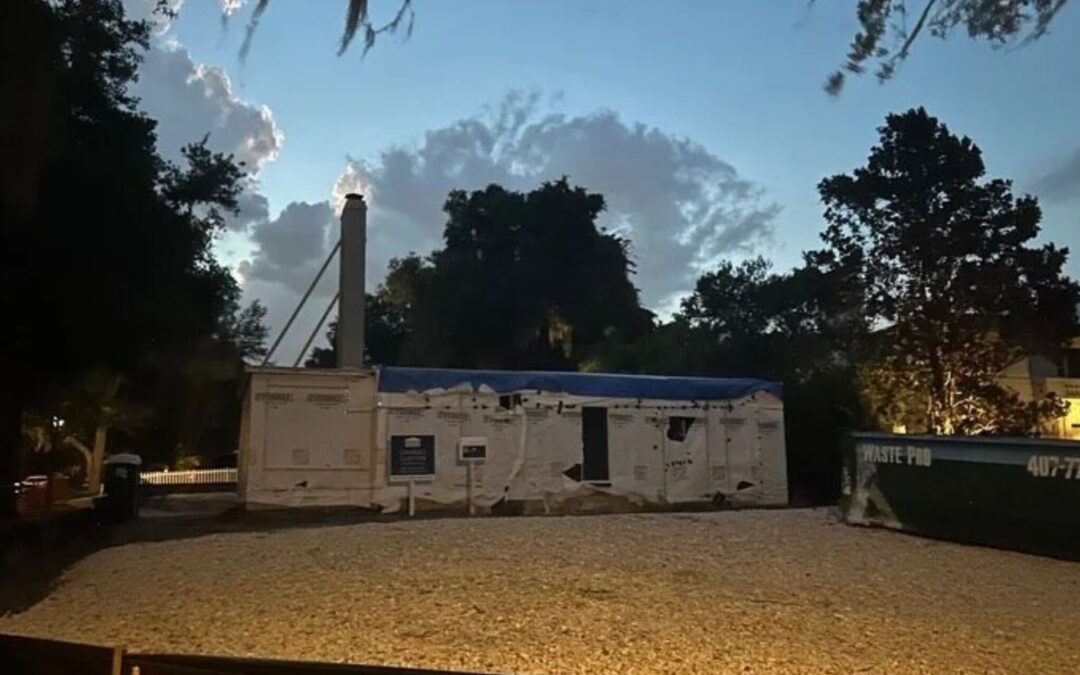
Last year, however, all but a small portion of the first floor and the chimney was torn down. The contractor agreed to pay $100,000 to make amends for the mistake and the project was allowed to go forward.
The episode set off a major debate and led to the ordinance changes.
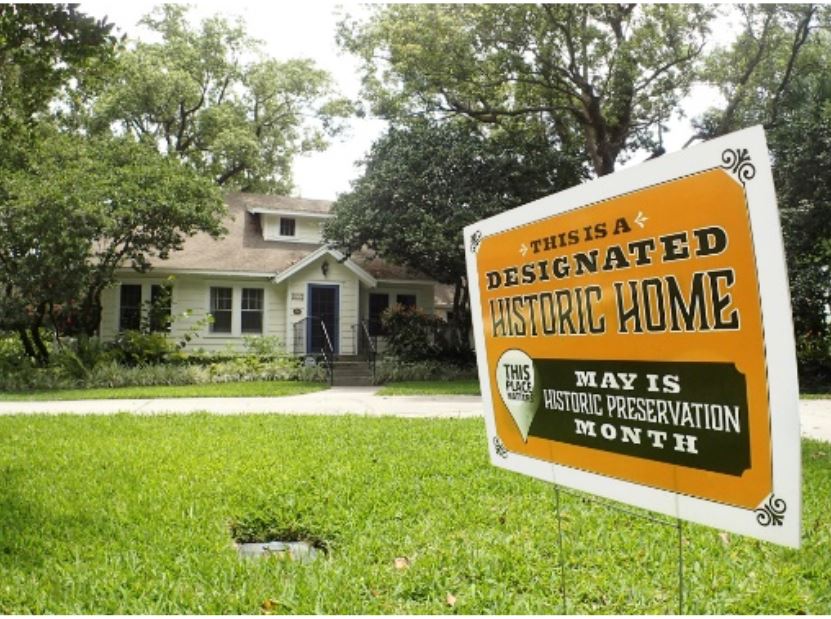
Winter Park has about 400 historic structures including the College Quarter and Virginia Heights districts and individually designated homes and commercial buildings.
The historic board only has a say when it comes to major exterior alterations of buildings, not minor changes or repairs or interior projects. Window and door replacements or roof replacements, for example, are not required to come before the board so long as they stay consistent with the architectural style and must only follow the typical building permit process.
The new ordinance also requires additional checks on construction plans to make sure what the contractor does matches approvals given by the board. And it requires additional due diligence to make sure owners and contractors are aware earlier in the process if there is a part of the structure they won’t be able to save.
The city purchased the property rented by Austin’s and other businesses last year and the coffee shop has known for at least a year that the lease will end so that the city can use the property to add a turn lane on Fairbanks Avenue and make drainage improvements.
City Manager Randy Knight said the city has hired a broker to help Austin’s find a new location, will allow the owners to take anything from the property that they wish to take and will also return the security deposit.
But for Austin’s loyal supporters, that isn’t enough.
Speaker after speaker bashed the city for taking away a place that they said is considered a “sanctuary” by many in the arts community.
Mayor Sheila DeCiccio said she was frustrated by the misinformation she heard.
“We are not evicting Austin’s … they have had over a year to find a new space,” she said. “… We are paying a Realtor to help them.”
She explained that the intersection at Fairbanks and Denning is busy and accident prone and residents deserve a solution. They also deserve a fix, she said, to the drainage and flooding problems that occur in the area.
“Please take that into consideration when you criticize this commission,” she said.
Benefit Shop lease uncertain
The city is attempting to negotiate a new lease with the Benefit Shop, a thrift store that raises money for local charities by selling used household goods and clothes.
The group operated in City Hall for years but the space is now needed by city staff. The Benefit Shop is interested in moving to a small building at MLK Park where the city just spent $10,000 to fix the air-conditioning system.
But the Benefit Shop wants a lease that extends to 35 years with the city covering all major costs such as maintenance and insurance.
DeCiccio and other commissioners said that term was too long and could prohibit future commissions from additional uses of the building. The commission voted to attempt to negotiate a three-year lease for $1 each year at the Lake Island Park building. The Benefit Shop would be responsible for the insurance beginning in its second year.
A final deal, if reached, will come back to the commission for approval.
An unapproved demo, a $100k penalty and hours of debate
How a demolition in College Quarter led to proposed changes to Winter Park’s Historic Preservation rules, which will be up for a vote Wednesday by the City Commission
May 13, 2025
By Beth Kassab
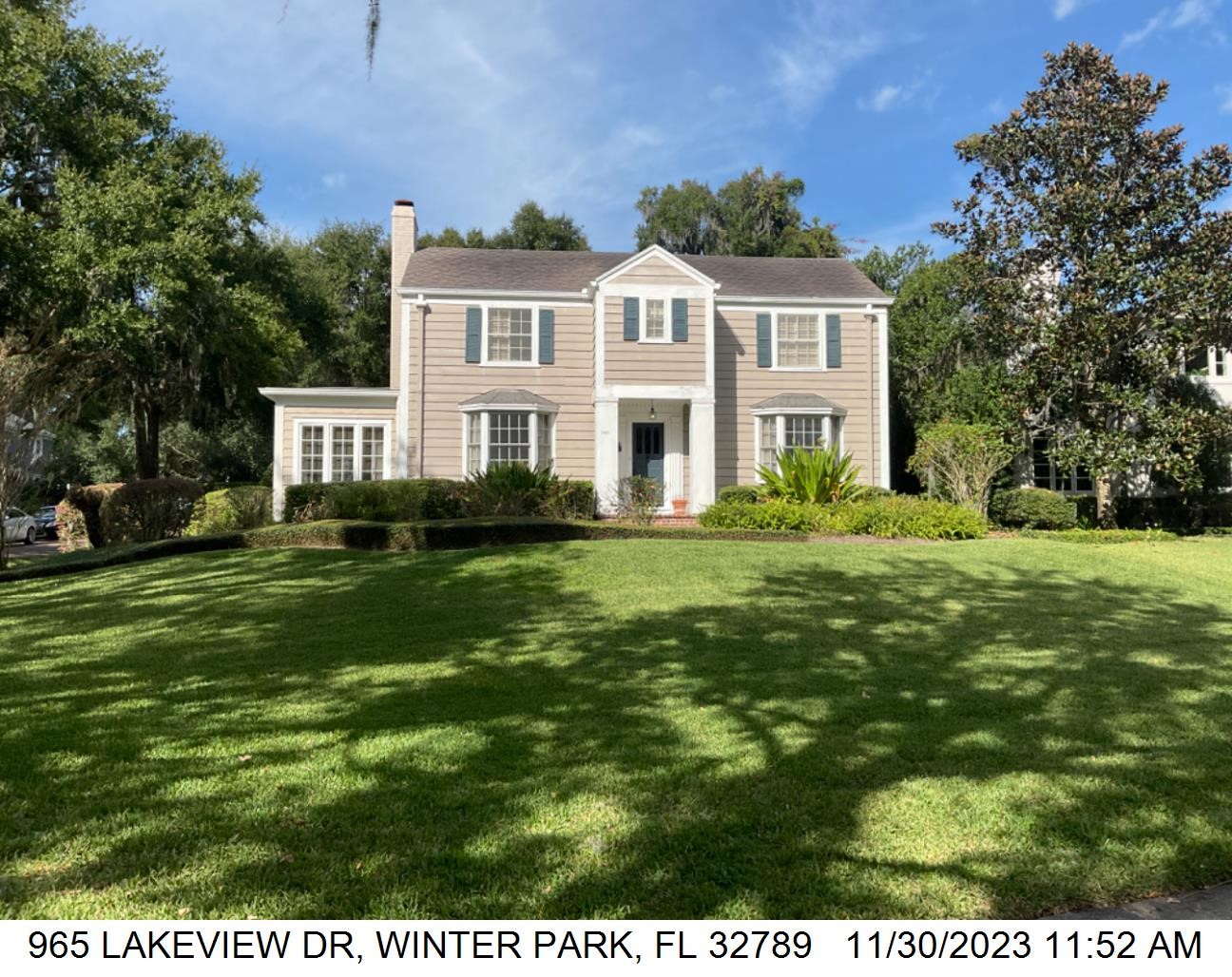
A year ago, custom builder Charlie Clayton stood before the Historic Preservation Board and apologized, offering to make amends for the unauthorized demolition of a large portion of 965 Lakeview Drive, a 1936 home overlooking Lake Virginia in the College Quarter Historic District.
“I can’t take back what happened,” Clayton told the board on May 8, 2024. “… My interest is not to decimate the resources of the city … I’m not a guy who goes in and tries to destroy the town. I don’t get in trouble like this, but I’m in trouble now.”
Clayton said he even went door to door in College Quarter, one of the largest collections of near-century-old homes in the region, to explain how the second floor of the house was torn down, leaving just the chimney and a small portion of the first floor standing.
The board had only approved the demolition of a garage behind the house and the city ordered work to stop on the project when it learned of the demolition.
Clayton blamed miscommunication with his crew on the site and told the Historic Preservation Board he was prepared to pay $25,000 toward the city’s Historic Preservation Fund and complete the project in a way that would deliver the same end result — a new face on the front of the house that adds additional second-story windows and removes historically inaccurate columns added before the current historic preservation rules were in place.
A photo from the Orange County Property Appraiser shows how the home at 965 Lakeview Drive looked in 2023. The above image shows what the home looked like last year after demolition.
Ultimately, the historic preservation board and staff negotiated the payment to $100,000 and allowed the project to continue. Clayton paid the money the next day.
The board, though, could have issued what some preservationists argue would have been a harsher penalty: Require the homeowner and contractor to reconstruct the home exactly as it was and take back the building variances granted to the project that allowed the homeowner to add square footage to the home.
That choice — a financial penalty or a requirement to build back what was lost and lose valuable variances — will be at the center of the debate expected Wednesday when the City Commission considers proposed changes to the Historic Preservation ordinance touched off by what happened at the Lakeview house.
Commissioners will decide if they want the ordinance to explicitly offer the option of a payment (capped at 30% of the structure’s assessed value) in the event of an unauthorized demolition. Or if they will lean more heavily on the threat of removing variances and requiring reconstruction of an improperly demolished building.
The proposals follow a year of intense debate over the demolition and the historic preservation board’s response.
Ryan Phillips, who owns the home, recorded a conversation with a board member on the sidewalk in front of his house without the board member’s permission and used that to allege he was threatened and treated unfairly.
He spoke at multiple public meetings to allege impropriety over the city’s request that Clayton pay the penalty and lodged state ethics complaints against members of the historic preservation board, a city attorney and former Planning Director Jeff Briggs.
The Florida Commission on Ethics dismissed all eight of those complaints on April 30 because of a “lack of legal sufficiency.”
Phillips and Clayton did not respond to messages seeking comment for this story.
The variances Phillips was allowed to keep for his new construction after the demolition allowed for the home to grow from its original size.
Such variances are key perks for homeowners in historic districts, which enforce architectural standards for the exterior of homes.
Members of Winter Park’s Historic Preservation Board, along with city staff, say they have a job to do: maintain the historic character and authenticity of some 400 properties in the city’s resident-approved historic districts and individually-designated sites.
Their job is not, as retired Planning Director Jeff Briggs once put it, to be the “Historic Replica Board” — or one expected to sign off on every requested demolition or ignore violations of the city’s code. That would render the group a toothless overseer of new construction.
“Basically, it opens the door for everyone to ask for forgiveness and not permission,” Briggs said of violations that harm or destroy historic structures without the board’s approval.
And while the Lakeview house is a recent example of an unauthorized demolition. It’s not the only one.
At the historic preservation meeting last month member Lee Rambeau said changes to the ordinances are needed and she was in favor of adding explicit language about fines.
“I’ve seen a number of properties come before us and the final outcome did not look like what we approved,” she said.
Proposed changes to the ordinance also include stricter application requirements and add a “pre-application” review by the board so that property owners can receive early design feedback before spending a lot of money on detailed renderings. The changes also would require property owners to give more detailed information about the materials they will use and architectural elements.
The change also attempts to cut down on unexpected requests for demolitions after a project starts by requiring applicants to submit a “due diligence assessment” identifying all proposed demolitions or alterations in advance.
A number of historic property owners, including Clayton, spoke out at a community meeting earlier this year against including fines as part of the proposed changes.
At the Historic Preservation meeting in April the board ultimately voted to recommend the version of the ordinance without the fines.
Aimee Spencer, who recently rotated off the board, said that version is potentially harsher on homeowners.
In the case of the Lakeview house, she said, the board attempted to “exercise empathy and kindness” and not penalize the homeowner for work done by the contractor without his knowledge. The project was allowed to proceed as planned rather than have its variances revoked.
But the case became one of what she saw as a “sore winner,” she said.
Wade Miller, who until last month served as board chairman, also said he saw the rebuild requirement and loss of variances as a harsher penalty.
But members of the public and board members spoke against including the fines in the ordinance.
“If that is what I am hearing from the community and members of the board, then so be it,” he said. “… we will see how that plays out … and I think it ultimately will become a much more severe outcome in the future for homeowners of historic properties.”
Betsy Owens, executive director of Casa Feliz, one of Winter Park’s most prominent preservation stories, said a fine could be viewed by some property owners as a cost of doing business rather than a preservation incentive. A requirement to rebuild a demolished structure is considered a best practice in other cities that also value historic preservation such as Coral Gables or Charleston, she said.
“I think the best way to make things right is to have you rebuild what you knocked down,” she said. “Losing variances is a stronger disincentive than a fine.”
Dispute over private lakefront park roils Virginia Heights
The owners of two large homes next to the park filed a lawsuit against another neighbor and want limited hours and kayaks removed
May 9, 2025
By Beth Kassab
The owners of two large homes on Lake Virginia filed a lawsuit last week against another neighbor over “filthy” kayaks and other issues related to a private neighborhood park visible from their backyards.
Escalating tensions over who can do what at the green space platted more than 100 years ago to provide all homeowners in Virginia Heights lake access is roiling one of Winter Park’s oldest neighborhoods known for its mix of architectural styles and picturesque views of the Spanish-Mediterranean buildings of Rollins College.
The path to the Virginia Heights private neighborhood park.
Residents say Eric and Diane Holm and Brian and Caryn Albertson, who own the homes on either side of the park and filed the lawsuit, have demanded changes to the park, installed cameras and floodlights and are using legal action to intimidate others from using the space that has long been the gathering spot for neighborhood holiday parties, Halloween costume contests and more.
“It’s creating a chilling effect of people going into the park,” said Stephanie Guss, who lives nearby and, so far, is the only named defendant in the lawsuit. “People walking into the park feel like they are trespassing even though they know they are not.”
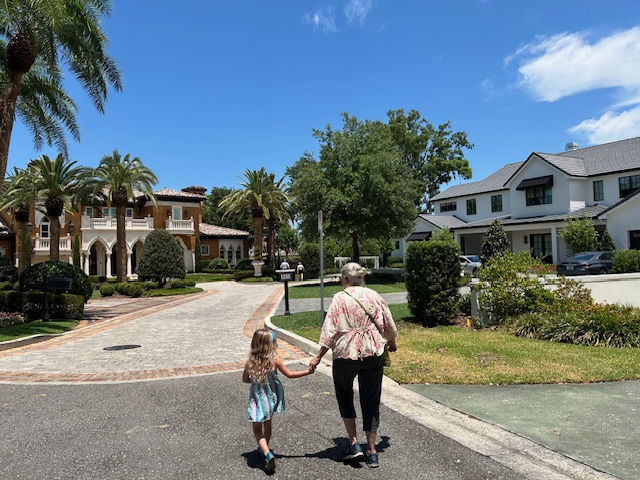
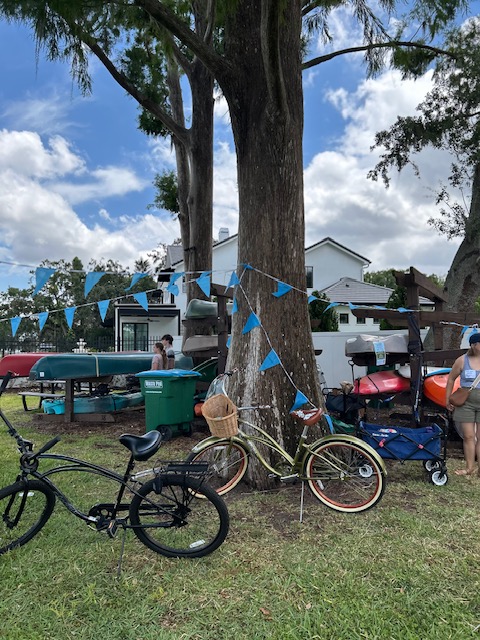
Residents must walk across pavers that appear to be part of the Holms’ driveway and meander down a five-foot-wide path between a black iron fence and a large wall that separates the Holms’ property from the Albertsons’. The path opens to a lakefront green with a dock, a rack for kayaks and canoes and a pair of picnic tables surrounded by the Holms’ and Albertsons’ backyards.
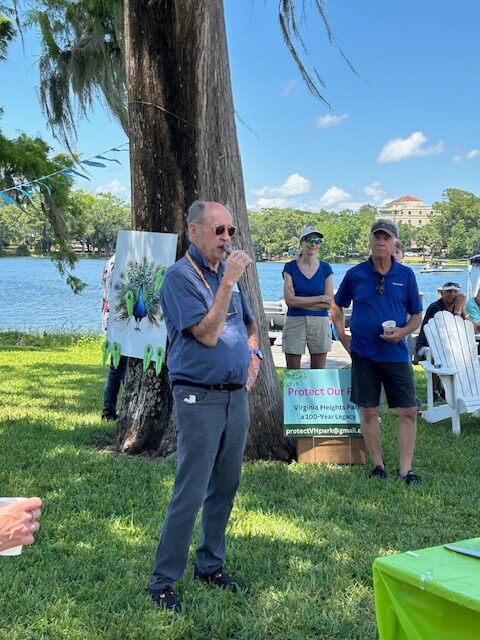
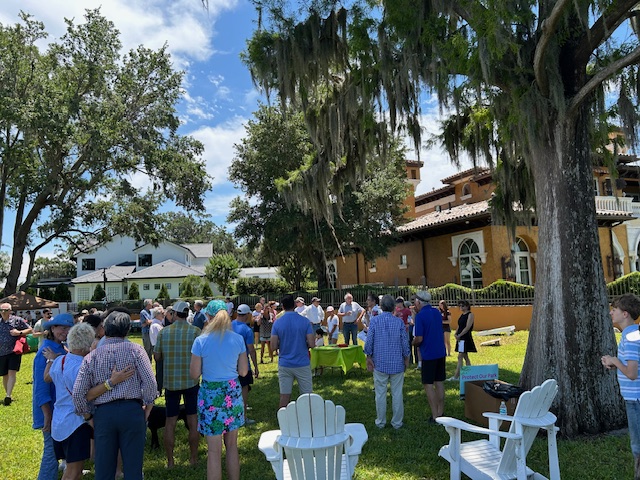
In a rally of support for the park that was part ice cream party and part defiance, more than 100 people gathered there Sunday for treats, games, boat rides and speakers that included former United States Poet Laureate Billy Collins, who owns a home down the street.
“I’ve used this park a lot … there’s usually not many people here,” he told the crowd before reading from one of his works.
Former U.S. Poet Laureate Billy Collins speaks at the Virginia Heights Park.
Guss is named in the lawsuit because, according to the filing, she “helps handle inquiries for the use of the boat rack.”
Before filing the lawsuit last week, Holm and Albertson filed a legal proceeding in November against Guss to try to find out the names of the kayak owners, financial information related to the park and other details. That case is still ongoing.
While the new lawsuit filed in Orange County Circuit Court does not dispute that more than 200 homeowners in Virginia Heights have equal access to the park, it refers to the kayak and canoe owners as “co-conspirators” and argues that the boat rack and shrubs planted by residents deprives the Holms and Albertsons of use of a portion of the greenspace.
Eric Holm, one of the nation’s largest Golden Corral franchisees who lives in the 10,000-square-foot home just west of the park, told the Voice that he and his neighbor aren’t trying to intimidate anyone and that the cameras and lighting are no different from the typical security measures many homeowners take.
“If someone is not engaging in inappropriate or unlawful behavior, there should be no reason to feel intimidated by their presence,” he said in an email. “Our intent has never been to intimidate anyone—only to follow the law and ensure the park remains a safe, shared space.”
Guss said she stopped assisting with the kayak rack last fall. She said she originally got involved because of complaints from the adjacent homeowners about the canoes and kayaks being left on the grass.
“I was trying to keep the peace by getting everybody to be good neighbors and keep their kayaks on the rack,” she said. “And they came back and sued me.”
Neighbors gathered on a recent Sunday at Virginia Heights’ private park with homes belonging to Brian Albertson and Eric Holm in the background.
Holm, a major Republican donor who hosted Vice President J.D. Vance for lunch at his home last year and a philanthropist who operates multiple Golden Corral, Peach Valley Cafe and Jersey Mike’s Subs locations, said he has growing concerns about safety and liability. He bought his property in 2008 for $3.1 million.
The park, Holm told the Voice in an email, “is not maintained by a homeowners association and has no security or formal oversight. Over time, this lack of structure has led to growing safety concerns — including underage drinking at night and, more recently, vagrants sleeping in the canoes stored there.”
The lawsuit argues that the kayaks and canoes on racks are not permitted and the people using the racks “seem to look at the park as a storage area for items they do not wish to store at their own residence.”
“Many of the kayaks in and around the racks are filthy, showing no signs of use within the last year or more and are covered in dust, dirt, and mildew,” the lawsuit states.
The kayak racks at Virginia Heights park.
Albertson, who paid $3.1 million for his property in 2020 and built his house last year, said he also has concerns about liability and safety.
“We need to take steps to reduce after-hours loitering, including drinking, drug use, and vagrancy,” he told the Voice in an email.
He said he has not reported any incidents to the police.
In a letter dated Jan. 17 signed by Albertson and posted in the park he alerted neighbors that he relocated the park trash cans “while we determine the legality of the placement of trash cans or any other item in the park.”
“We maintain a sincere desire to find an equitable resolution to this situation,” the letter said. “Should there be any criminal mischief or vandalism inflicted against our property we will be seeking criminal charges. Please be advised all movements are monitored by cameras” and invited residents to email him to make arrangements for him to “release the trash cans.”
In February, Holm and Albertson sent a letter to Virginia Heights homeowners explaining that they have tried to discuss solutions with neighbors, but “a handful of self-appointed individuals have attempted to dictate park policies” and “placed obstacles like bushes and trash cans in ways that obstruct views and limit fair use of the space.”
The letter also said all kayaks or other personal property must be removed immediately and asked for signs to be posted that declare the park closed between dusk and dawn. The letter also asserted that the homeowners are not allowed to take up a collection for park maintenance as they have done in the past.
“Rather than escalating this into a long legal dispute, we hope that our neighbors will voluntarily remove their personal property from the park and respect the shared nature of this space,” read the letter, according to a copy provided to the Voice.
Albertson told the Voice that a gate could potentially be installed at the entrance of the park as a security measure to limit access to homeowners. He also suggested that “perhaps we could consider a few well-maintained kayaks for shared community use.”
He said he wants to make sure there is insurance coverage in place “to protect all homeowners in case of any incidents.”
“Given that these concerns affect everyone, I’m a bit puzzled as to why this dispute has persisted for so long,” Albertson said in an email. “We have tried to amicably address this situation for two-plus years. I hope we can come together and find practical solutions that reflect the best interests of the entire community.”
Neighbors say kayaks and the racks have existed at the park in some form or another for 20 years and they object to limited park hours for those who like to watch night rocket launches from the dock, stargaze or just seek a few moments of solitude.
“The park has always been for the use and enjoyment of the neighbors and, to my understanding, has been collaboratively shared without incident,” said Hannah Miller, who also lives in the neighborhood. “What’s changed now has been this attempt to assert power and control over the park.”
Some in the community have taken exception to changes Albertson has made to the park, too, saying he trimmed park trees to enhance the lake view from his backyard. In a court filing last year, Guss wrote that Albertson told a meeting of about 30 neighbors in 2023 that the trimming was done to improve his view of Rollins College.
“We have spent significant money de-mossing and pruning trees on our property and the oak tree in the park,” Albertson said in an email, adding that the work was needed after hurricane damage and done with city approval. “At no time did we trim any trees or branches to improve our view.”
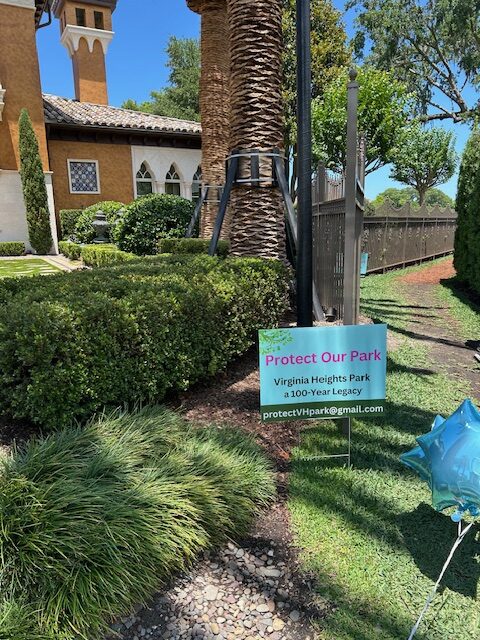
A sign hangs at the Virginia Heights park during a recent gathering.
This isn’t the first time the park has been the subject of a legal debate.
A 1971 court judgement ordered the former owners of the properties now occupied by Holm and Albertson to take down wire fencing and landscaping they put in the park after they were challenged by Virginia Heights residents.
The judgement said that the property owners who abut the park are not allowed to build, plant or place anything on the park land.
Holm said he believes that rule extends to all Virginia Heights homeowners.
“While the judgment does reference the previous owners of the two properties adjacent to the park — now owned by myself and the Albertsons — it clearly states that no structures or improvements of any kind may be erected in the park,” he told the Voice. “We believe the intent of the court was to protect the integrity of the entire green space for the benefit of all 220 homeowners in Virginia Heights, not to single out just two properties.”
But other homeowners in Virginia Heights read the order as a protection from the adjacent property owners taking over the park. They said the ruling doesn’t prevent the neighborhood from collectively beautifying the area such as new bald cypress trees planted at the shore line at the recent ice cream party, where neighbors also took turns making video recordings of their memories of the park.
“These unfortunate circumstances have forged a stronger and more vibrant community in Virginia Heights and, for that, I am thankful,” Guss said.
The high-tech light poles are part of the first major overhaul of the city’s central business district in more than 25 years
April 24, 2025
By Beth Kassab
Commissioners approved nearly $1 million from the Community Redevelopment Agency budget for new high-tech street lights along Park Avenue as part of the commercial corridor’s “Refresh” project.
The city will purchase about 100 light poles at $9,300 each that will include “dark sky” lamp fixtures that cast LED lights downward and include two wi-fi receivers, electric hook-ups for cameras and speakers and internal sprinklers for potted plants that will hang from the fixtures.
Commissioner Marty Sullivan asked if the poles could also mist passersby to help keep the avenue cooler during the hot summer months like the mist sprayers often seen at the theme parks. Architect Alex Stringfellow said the idea was considered, but there were already too many features in the light poles and there were concerns among businesses along the avenue about the sprayers interfering with food service on sidewalk tables.
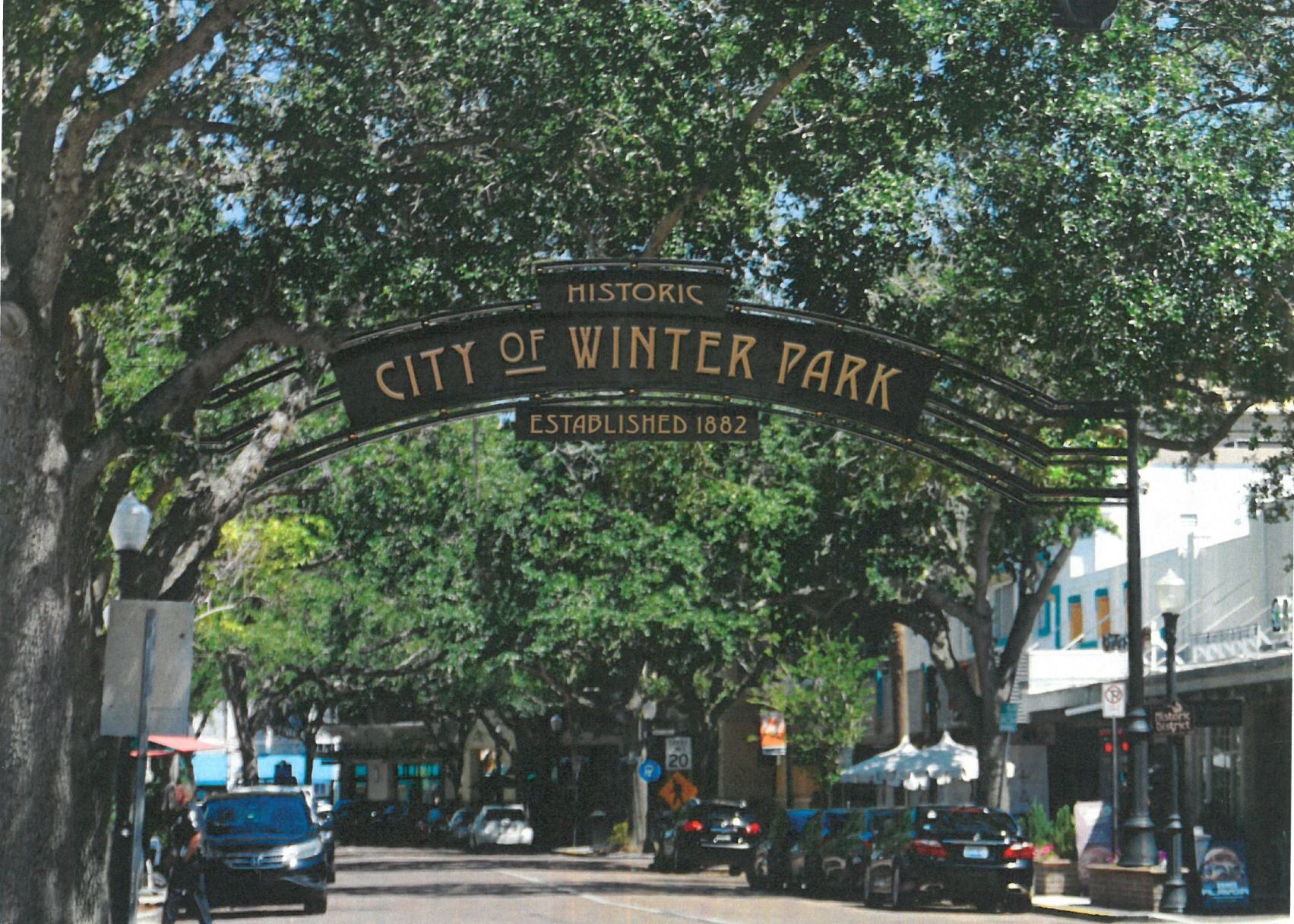
New archway historic signs will bookend the north and south sides of Park Avenue.
Mayor Sheila DeCiccio noted that there is money set aside in the CRA for the project. She said when the city’s electric utility completes its years-long project to underline power lines there will be additional money in the utility’s budget to upgrade light poles across the city.
“Park avenue is clearly an economic engine and in need of a refresh,” she said.
The new streetlights along the avenue will be installed in three phases. The lights in place today are 26 years old and were installed when the street was bricked in 1999.
“They are not only antiquated, they are also internally filled with a variety of unnecessary cords and tubing that have been used for many purposes over the years, have become unreliable in some areas, and use an outdated light fixture,” according to a staff report.
The overall refresh project will also include drainage projects, new landscaping and planters and the installation of historic gateway signs that will stretch across both ends of the avenue. Work on the new signs will likely begin at the end of May.
Earlier this month, commissioners also agreed to a “mobility hub” with Mount Dora-based Optimus Energy Solutions that will include a central rideshare drop-off and pick-up area with covered seating, electric car chargers and electric bike chargers. Optimus will pay for construction and operating costs, according to the agreement, and the hub is expected to be in place this summer.
The total cost for construction related to the refresh project as whole is expected to be discussed in August.
We Depend on your support, make a tax-deductible donation here.
Mission
The Winter Park Voice is a trusted nonprofit journalism site that covers our City Hall and beyond. We endeavor to engage, inform and connect citizens on all sides of issues affecting the quality of life in Winter Park.






Recent Comments