Winter Park Steps Out Front to Challenge Status Quo on Tourist Taxes
Will other cities follow a call to push Orange County and lawmakers to use the public money for transit and other needs?
Sept. 8, 2026
By Beth Kassab
UDPATE: This story has been updated to include a comment from Winter Garden City Manager Jon Williams.
Mayor Sheila DeCiccio and others on the City Commission are already on the record saying they want to see Orange County use its gargantuan pot of tourist tax dollars to solve local problems that come along with welcoming masses of visitors each day such as fixing crowded roads and improving the local bus and rail systems.
The question the Winter Park Commission seems to be asking now is: “Who’s with us?”
On Wednesday, the Commission will take up a resolution that solidifies its position that local governments should “explore every avenue to expand alternative uses of the tax, including but not limited to transportation and affordable housing, adding additional pennies, and lowering the 40% threshold for tourism promotion, and to make this a legislative priority.”
Such an action would not only serve as a message to the Orange County Commission, and particularly whoever is elected in November as the next Orange mayor, but also as a call for other cities to follow suit.
Michael Poole, the local investment banker who DeCiccio appointed as the city’s representative to Orange County’s latest citizen task force on the tourism development tax, put the political juggernaut that is changing the status quo in stark terms to Winter Park officials.
“You know, it’s hard to do it from behind the curtain,” Poole told city commissioners at a meeting last month. “ButIthinkifyouguyswouldlead,Ithinkothercities …Imetotherrepresentatives … theyalltalkthesamewaythatwe’retalking.Thatweneedmoneyfordifferentthings,especiallytransportation … Ithinkothercitieswouldfollowyourlead,especiallyifyoucalledthemupandsaid, ‘Hey,let’sdothistogether.'”
Leaders in neighboring Maitland told the Voice they would consider a similar resolution.
“I can see the case for it,” said Scot French, the Maitland council member who will take over as interim mayor in November when John Lowndes resigns because he is seeking a state Senate seat. “We’ll certainly have a louder voice if we’re speaking in concert on these issues … My sense is there is a great deal of support for broadening the areas in which these funds can be spent to include transportation and county-wide problems.”
Winter Garden City Manager Jon Williams said his city, which has a population of about 46,000 people on the west side of the county, has not taken a formal position, but generally supports expanded uses of the tax.
Officials in Orlando, Apopka and other cities in Orange County did not immediately respond to questions about the uses of TDT from the Voice.
DeCiccio has emerged as an outspoken voice in favor of using the 6% tax levied on hotel rooms for infrastructure projects. She said she is grateful Winter Park-based groups such as the Rollins College art museum and the Winter Park Playhouse have received grants in recent years from a portion of TDT set aside for arts and sports organizations, but sees a greater need that still isn’t being fulfilled.
“I’m a firm believer we need to get a train from the airport to the attractions to I-Drive and to Winter Park,” DeCiccio said. “And affordable housing is so necessary right now,” she said pointing to Killarney Elementary, which serves a portion of Winter Park and lists 20% of its students as homeless, often because they are living in motels or doubling up with another family.
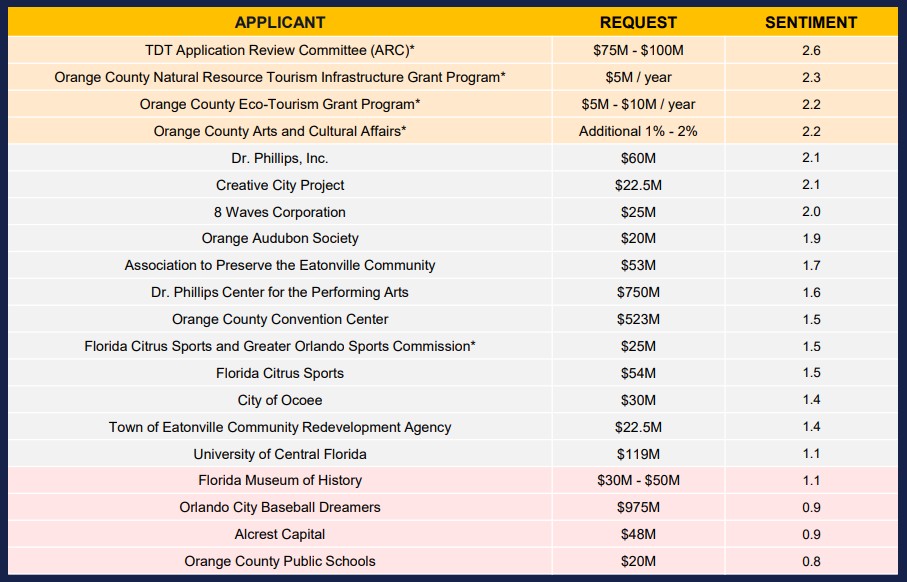
The projects related to the Orange County Convention Center, Florida Citrus Sports, the University of Central Florida as well as the bottom four projects on the above list were NOT recommended by the citizen task force.
Orange County collects the largest haul in all of Florida when it comes to hotel taxes — a record $385 million last year. The money is primarily used to pay off debt related to the convention center as well as support its operations and maintenance along with paying to subsidize advertising and promotion for the tourism industry and pay debt for the city of Orlando on the arena used by the Orlando Magic.
County officials have long pointed to a state law that governs the tax and limits its uses as the reason why the pot of dollars can’t be used to pay for mass transit, public safety, affordable housing or other essential needs.
But, to be clear, other counties have succeeded in carving exceptions into the law when they have made a deliberate lobbying push.
For example, some beachfront counties are now allowed to use tourist tax dollars to fund lifeguards and law enforcement services “which are needed to address impacts related to increased tourism and visitors to an area.” And in 2024 the Legislature allowed local governments in the Florida Keys to use a portion of the money to purchase or build affordable housing.
The current law also says if a county that spends at least 40% of its tourist tax revenue on tourism promotion then it can spend a portion of the tax dollars on transportation, sewer, water or “pedestrian facilities.”
Some members like Poole have suggested that, depending on how the figure is counted, Orange County might already meet the threshold.
Orange County says it’s spending 26% to 30% on tourism advertising, according to Poole, but he also said he doesn’t have the calculation for how that figure was determined.
“All I know is people have asked for it and we haven’t gotten it. Maybe people you know might be able to get it,” he told DeCiccio at a city meeting.
“I’ve tried,” she responded. ” I don’t have that much pull. I wish I did.”
The resolution Winter Park will vote on this week is based, nearly word-for-word, on one of the recommendations made last month by Orange Mayor Jerry Demings’ TDT Citizen Advisory Task Force.
DeCiccio and others including County Commissioner Kelly Semrad, who represents Winter Park, urged Demings to expand representation on the group to more people who understand what it is like to live in different parts of the county rather than be focused on a group of people who mostly represent the interests of the major hotels, theme parks and the convention center.
Tourism companies are known for pumping hundreds of thousands of dollars into political campaigns for local offices.
“In looking at the proposed makeup of the Task Force, it appears to be heavily weighted toward those who currently benefit from how TDT funds are allocated,” DeCiccio wrote in a letter to Demings in June. “I respectfully request the Task Force makeup be weighted more to the entities that represent the people of Orange County and the entities that must provide the needed infrastructure.”
As a result, Demings allowed each county commissioner to appoint two people from their districts instead of just one to serve on the task force. Each city was allowed to appoint one person to the group.
Lowndes, the current mayor of Maitland, sent Demings a letter in July urging a broader scope for the task force than evaluating capital proposals like a convention center expansion or new museums. He called on Demings to help “fairly distribute the burden” of supporting low-wage tourism workers across the county.
“Tourism is, of course, the prime engine of Central Florida’s economy,” wrote Lowndes, who is challenging Sen. Jason Brodeur for a district that includes parts of Orange and Seminole counties. “It demands strong infrastructure: roads, mass transit for tourists and tourist-corridor workers, robust public safety, and affordable housing for thousands who work in the industry, many at modest wages. The residents of Orange County now shoulder much of this burden through our property taxes. Certainly, the community benefits from tourism, but it is time to fairly distribute the burden.”
A snapshot of promotional materials on the website for Visit Orlando, which receives dollars from the TDT to subsidize industry advertising.
Together, Maitland and Winter Park represent about 50,000 people, including about 35,000 registered voters who are close to evenly split between Republican and Democrat, according to the latest voter roll statistics. That’s a small piece of the voter roll for all of Orange County, which tallies about 813,000 registered voters who lean Democrat (39%) over Republican (28%) with the remainder without a party affiliation or registered to a third party (33%).
But there is evidence the sentiment in Winter Park and Maitland is present elsewhere given the actions of the committee led by former Orange Mayor Linda Chapin and Lift Orlando President Eddy Moratin.
The 34-member task force spent much of its time evaluating 20 applications for a combined $3 billion dollars to build everything from a Zora Neale Hurston museum in Eatonville to another expansion of the convention center at a proposed $523 million and a nearly $1 billion expansion of the Dr. Phillips Center for the Performing Arts.
Ultimately, the group did not include the convention center among it’s list of recommended projects — a notable shift from a similar task force that convened just three years ago.
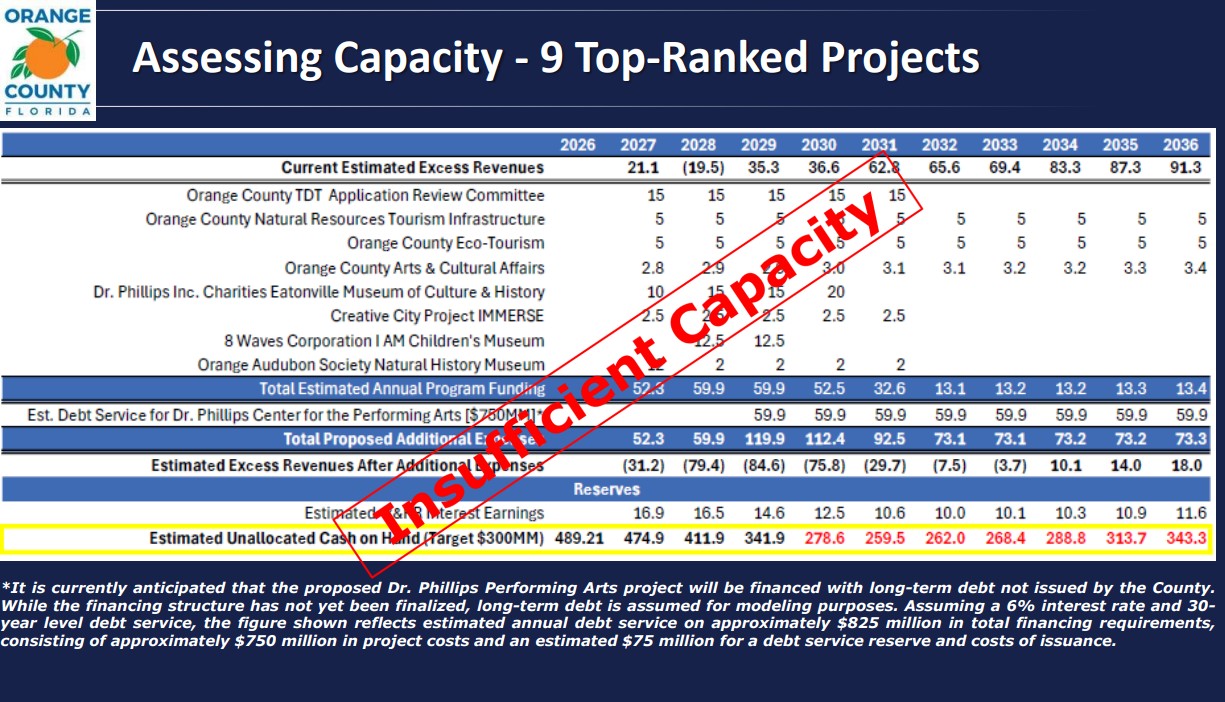
A chart from Orange County shows reserves (bottom line) dipping below the recommended $300 million by 2030 if the Top 9 projects are funded in the above scenario.
Chapin, who led the county from 1990-1998 and has a theater named for her in the convention center after overseeing previous expansions, noted that since the inception of the tourist development tax more than $3 billion was spent on the building. This time around, she said, she couldn’t support a motion to approve another addition.
“Giventheopportunitieswehavetobenefitmoreofthecommunityanddifferentkindsofvisitors,” she told the group. “Theideaofmovingthisforwardwhenitisstillunderconstructionfromthelastamounttheyweregranted … whatIwouldliketoseeisthatwevotethemotiondown,expectthe County Commissiontorequestareviewofallthat’sbeendonewhentheprojectiscompleted,andthendecide,dependingonwhatthecircumstancesareatthatpointintime,toeithermoveforwardwithmoreornot. SoIwon’tbesupportingthemotion.”
And the group took extra time to discuss and include a recommendation that Orange County expand its uses of the tax — the one Winter Park is now looking to formalize in a resolution.
That motion was made by Chapin and seconded by Doug Gomber, who was the city of Ocoee’s representative to the group. Chris Mueller, a Hilton executive who represented the International Drive Chamber of Commerce and Jacqueline Bozzuto, a Lowndes law firm attorney who works with hospitality clients and represented the Central Florida Hotel & Lodging Association, voted against the recommendation.
Central to the discussion now is whether enough political will exists among leaders in Orange County to follow through with that recommendation and ask the Legislature when it convenes again next year for an exception similar to the way other areas in the state have received special permission for certain needs.
Also in question is how much money from hotel collections would be left — if any at all — for mass transit or affordable housing if the County Commission approves all or even some of the projects that the task force recommended move forward. The task force was not told how much money they had to work with so they didn’t put dollar figures to their recommendations, though those asking for the money listed a dollar figure in their requests.
The Dr. Phillips Center for the Performing Arts, for example, is asking for $750 million for new theaters and a parking garage and other improvements at its downtown Orlando campus. If the entire amount was funded it would leave little to nothing for new uses like transportation improvements sought by Winter Park and others.
“Ifthemoneyforalltheseprojectsispaidoutforthenext10years,therewon’tbeanyextramoney.So,howwillwebeabletopayfortransportationthen?” DeCiccio asked at a recent City Commission meeting, noting Dr. Phillips’ request to build 11 more theaters struck her as “a little excessive.”
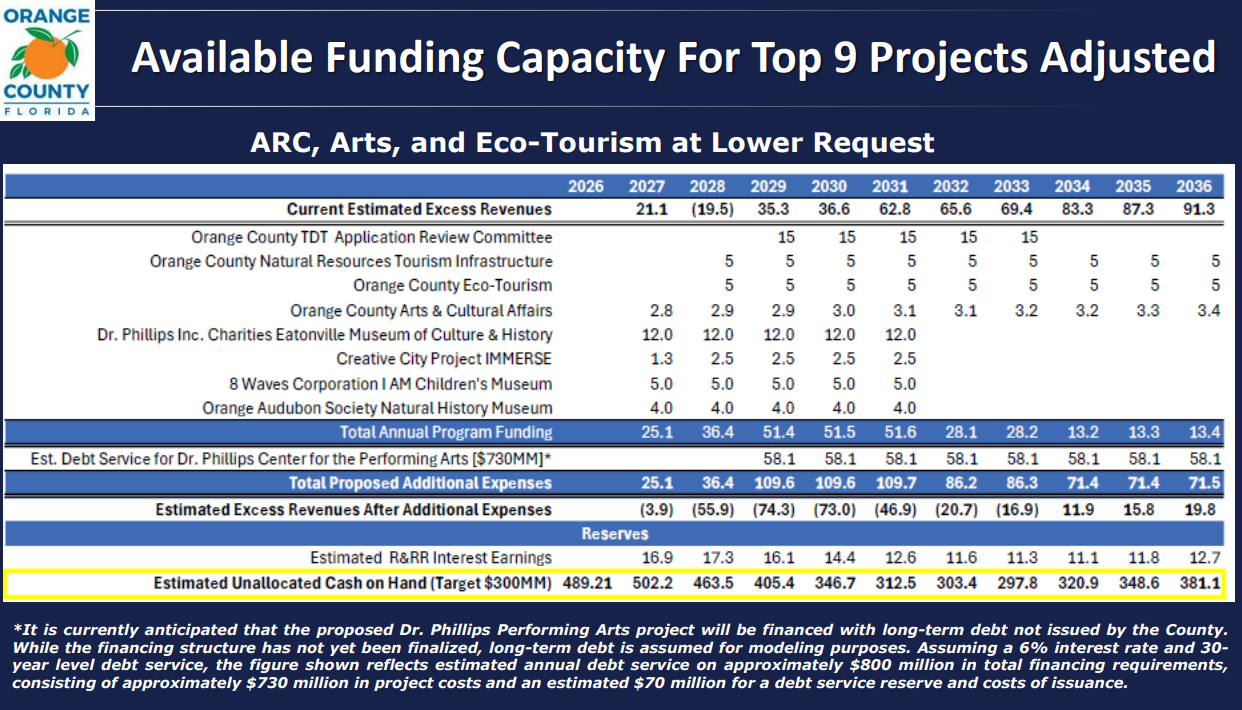
Under a different fund scenario, a chart provided by Orange County, shows how the projects can be funded and mostly maintain reserves. Multiple scenarios were presented at the county meeting on Aug. 25.
The County Commission accepted the task force’s recommendations late last month, but did not give an official a thumbs up or thumbs down to any of the projects on the list. At least two county commissioners said they even wanted to reconsider more projects, which means the convention center or Camping World Stadium could still receive funding.
Semrad, who was elected in 2024 after running on a platform of expanding the uses of TDT and refusing to take any campaign contributions from the tourism industry, called the process rushed and said she was disappointed there wasn’t more clarity surrounding how much money will be available.
A county spokeswoman said the comptroller is working on the question of exactly how much funding can be used and the timing of that funding. Then the County Commission will made a decision on who gets money and who doesn’t and whether the group will back a push to use the dollars for more community needs.
“[The Legislature]pretty much gives the changes when cities ask for them,” DeCiccio told the Voice. “We want to do it but we aren’t strong enough to do it alone. We need Orange County.”
The county commission appears to support the comptroller’s plan to keep at least $300 million from TDT reserves in case of an economic downturn so that figure is factoring into the discussion about what money is available and when.
Commissioners Propose Cuts and New Spending Ahead of Budget Vote
The first vote on the total $247 million budget is scheduled for Wednesday
Sept. 4, 2026
By Beth Kassab
In response to political pressure from state government to reduce expenditures, the Winter Park City Commission appears poised to spend less money maintaining its tree canopy as well as on code enforcement and parks programs and reduce a proposed increase to the library. But it is considering a new $45,000 payout to a local nonprofit called Men of Integrity that aims to mentor youth.
The commission is also in favor of raising more revenue for the city by adding red light cameras, starting a new program to charge non-residents for parking at the dog park at Lake Baldwin and Dinky Dock and charge credit card convenience fees on transactions with the city based on discussion at a recent work session.
The $247 million all-funds budget will be heard at the next commission meeting on Wednesday when the board is scheduled to take it’s first of two votes on the spending plan for the financial year that will begin Oct. 1. The city is expected to adopt the same property tax rate for the 19th consecutive year, though revenues from taxes have increased as a result of growing property values.
At least one commissioner pushed for more cuts to spending. Commissioner Warren Lindsey said he would prefer to reduce raises for city employees from 4% to 3.5%, but did not get consensus from other commissioners.
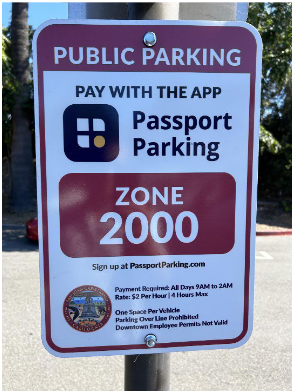
A photo of what parking signs could look like when the city begins charging for public parking in select areas to raise more revenue. The photo was included in city documents related to the program that will look to charge non-residents for parking.
Lindsey said he viewed a smaller raise as part of the “painful reality” of local governments facing significant reductions in property tax revenue if Amendment 3 passes in November.
“My recommendation is that we do it this coming year and not wait until November,” he said. “I feel it’s the responsible thing to do.”
But Mayor Sheila DeCiccio and others said they didn’t feel comfortable with reducing staff raises and pointed to an ongoing hiring freeze that will help conserve funds.
The group agreed to keep open a vacant code enforcement position ($75,000), freeze two vacant fire positions ($200,000) and cut back winter hours at city pools, which would reduce part-time parks staff ($100,000).
Commissioners said they would review the open positions mid-year and determine if there was a need to add any of them back into the budget.
In addition, the city appears poised to cut back significantly on its tree program by removing from the budget a vacant tree specialist position ($73,680); axing the vacant tree permitting position ($60,000) and cutting a watering truck as well as new tree plantings (approximately $270,000).
City Manager Randy Knight said the city is no longer saving many trees on private properties that owners or developers want to cut down because of changes lawmakers made to state law. It’s another example of pre-emption by state government to limit how local governments can make decisions.
While the city forestry department typically plants hundreds of trees per year on city right-of-way, the city is running out of public land for those plantings, Knight said.
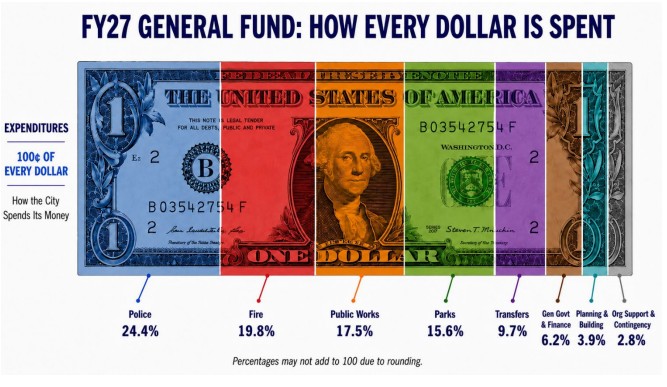
This graphic, included in city budget documents, shows how the city’s nearly $95 million general fund will be spent in the coming financial year to begin Oct. 1. The Winter Park Voice’s coverage of this year’s budget deliberations also includes the following stories linked below:
Also on the chopping block is $25,000 in funding for the library, $12,000 for an appreciation event typically held for people who serve on city boards, some Halloween and Easter events put on by the parks department some postage and printed materials that go to utility bill customers.
Even with a $25,000 reduction, the Winter Park Library is still slated to receive nearly $50,000 more than last year in support from the main city budget as well as the Community Redevelopment Agency budget for a total of $2.5 million.
Each year the city spends a quarter of one percent of gross revenues from the general fund, electric utility fund and water utility fund — or about $480,0000 total — on nonprofit community groups. This year those expenditures are proposed as:
$105,000 for Mead Botanical Gardens, a $3,000 increase over last year
$99,900 for the Winter Park Historical Association, also about a $3,0000 increase
$43,800 for Winter Park Day Nursery, a $1,300 increase
$20,000 for United Arts representing no change from last year
$45,000 for Men of Integrity, which had not received any funding since $18,000 two years ago
Men of Integrity is a nonprofit that operates out of the Winter Park Community Center and serves about 24 boys, including 10 in high school and 14 under the age of 12, said Antwon Carter, the group’s leader. Many of the kids attend Winter Park schools but some travel from outside the city to attend the weekly program.
Carter’s group is the only nonprofit commissioners proposed adding to the budget after wrote to the city in August and asked for the money to support his mentoring program that provides help with college readiness, STEM activities, financial literacy, fieldtrips and a hot meal during weekly meetings among other services.
An administrator for the program provided the Voice with a copy of Men of Integrity’s most recent tax form that show’s the group’s revenues are typically less than $50,000.
The group said it mostly relies on volunteers and out-of-pocket expenditures by Carter.
“This mission is also deeply personal to me,” Carter said in an email to the Voice. “I grew up in Winter Park, and I understand firsthand what can be produced when a young person is given a strong foundation. For generations, programs centered around the Winter Park Community Center have played an important role in youth development. Whether young people came directly from the surrounding neighborhood or were brought there by their parents, the Center provided a place where they could experience mentorship, structure, opportunity, and the positive influence of the broader community.”
Carter, who said he now lives in Apopka, appeared at the budget work session and told commissioners the $45,000 would provide a needed infusion of dollars to reduce the group’s need to ask for more in the future.
Some commissioners, including Lindsey and Kris Cruzada, questioned if the group should receive the full amount of its request without providing more information to the city.
But there appeared to be enough commissioners in favor of the expenditure to move it ahead to a vote on Wednesday as part of the overall budget.
The nonprofit organizations slated to received money from the city’s CRA budget are:
$14,000 for the Enzian Theater, a $4,000 increase
$51,500 for the Heritage Center, a $1,500 increase
$44,300 for the Welbourne Day Nursery, a $1,300 increase
$50,800 for the Winter Park Playhouse, a $1,500 increase
$398,610 for the library, part of it’s overall $2.5 million in city funding
When it comes to raising more funds for the city government, red light cameras and credit card convenience fees are among the top projected generators.
Police Chief Tim Volkerson said the city is still considering where additional cameras could be placed and, if they are approved by the state, they likely would not be up and running until May or so and could generate some $750,000.
Credit card convenience fees could yield $1.2 million for the city when people buy permits, pay bills or conduct other business at City Hall.
And a pilot program to charge non-city residents to park at Dinky Dock or the dog park at Baldwin Park could bring in an estimated $100,000 or more when it begins as early as the spring.
Paid parking has long been a controversial topic in Winter Park, which offers free parking throughout the city including along busy Park Avenue. If the pilot is successful, city officials said program could expand to other areas and, once again, be aimed at non-residents.
Police Chief Tim Volkerson said the cameras help enhance safety and could bring extra revenue for the department
Aug. 11, 2026
By Gabrielle Russon
Winter Park Police are looking to double the number of red light cameras in the city, a move that the police chief said would enhance safety as well as bring in new revenue amid talk of cutting the department’s budget as the state is pushing local governments to tighten their belts.
Last year, eight cameras posted at six intersections caught 24,400 violations– from blowing through a light to rolling right-on-red turns without a complete stop – and brought in $3.8 million in revenue.
Police Chief Tim Volkerson wants to add eight more red light cameras at the same six intersections, but facing different directions from the existing cameras.
“For example, Fairbanks and Orlando (Avenue) has a red light camera for westbound traffic,” Volkerson said. “It does not have a red light camera for eastbound traffic and it does not have a red light camera for north or southbound traffic.”
That intersection proved to be the third busiest of Winter Park’s red light cameras when it comes to issuing violations with nearly 3,600 tickets last year, according to police data analyzed by the Voice.
The camera on southbound Orlando Avenue at Lee Road resulted in nearly one-third of all the red light camera tickets last year. The second highest offending intersections were eastbound Lee and Orlando Avenue with 6,260 tickets.
Chief Tim Volkerson
Winter Park’s newest red light camera is at Phelps and Aloma is an intersection with a history of significant crashes, Volkerson said. That camera resulted in issuing about 1,600 red light violations last year.
Most of the violations caught on camera throughout the city are related to right-on-red turns. According to a state-required report that Volkerson is scheduled to deliver to the City Commission on Wednesday, nearly 70% of citations or 17,300 out of 25,000 violations during the 2025-26 fiscal year were for improper right turns on red signals.
Volkerson said safety is more important than money when it comes to adding red light cameras. But the topic came up at a recent City Commission work session as Volkerson presented his department’s budget, which includes keeping a community services position vacant next year to help reduce costs.
“Anyone that has lived in Winter Park would agree that the volume of cars that we have traveling through our city has increased,” Volkerson said. “The more important thing is for us to reduce crashes and even more importantly our goal is always to have zero fatalities.”
People speeding past red lights are most likely to cause T-bone or angular crashes that can have catastrophic results, Volkerson added. And Winter Park roads are active with cyclists heading out on the trails and early-morning runners training on the city streets every Saturday pre-dawn for Track Shack’s MarathonFest.
“If a byproduct is that it brings in revenue, that’s a good thing too, but that can never be and never should be the justification for doing it,” Winter Park City Commissioner Warren Lindsey told the Voice. “I would never ever support something just because it was a revenue producer when it wasn’t emphatically and primarily done for purposes of safety of motorists and pedestrians.”
A typical red light camera fine is $158 and the city of Winter Park collects $75 of that total with $2 going to police training and $73 to help fund the police budget. The rest of the money goes to the state for general revenue, health funds, and helping people with spinal cord injuries.
Volkerson is analyzing crash data to determine which intersections have the most cars passing through and the most crashes. The state requires cities to pass an ordinance in order to add new cameras and provide a reasoning for the locations.
“There has to be a nexus for us putting them there. We can’t just decide we’re going to put one at Park and Morse. We have to justify to the state why this is going there,” he told city officials at the budget work session.
Volkerson added he was not looking at school zones since those areas don’t generate enough traffic volume and are often already patrolled by officers.
Winter Park’s potential red light camera expansion comes as Floridians will be deciding whether or not to approve an overhaul of local property taxes in November.
Recently, the Florida State Fraternal Order of Police and the Florida Sheriffs Association came out strongly against the property tax ballot initiative, arguing the increase in homestead property tax exemptions could result in fewer dollars for essential services like public safety.
Volkerson declined to comment on personal stance on the ballot amendment.
“It’s up to each person to decide and vote,” Volkerson said.
Some, like Orange County Commissioner Kelly Martinez Semrad, fear that Amendment 3 will shrink funding for local governments.
“No matter how you shake it or how you roll the dice, property tax reform has an impact on the services that any municipality will be able to provide,” said Semrad, whose district includes Winter Park.
Semrad brought up whether red light camera tickets could help supplement the Orange County Sheriff’s budget if Amendment 3 passes as county officials held their own budget workshops last month.
“Ultimately we will have less revenue than than we do now … and we need to look for strategies to fill [revenue gaps]. So red light cameras might be an option,” she told the Voice. “I would rather tax somebody who made a mistake, did something wrong, ran a camera – than finding ways to tax others.”
Lindsey, the Winter Park commissioner who is also a criminal defense lawyer, said the presence of a red light camera has a real effect on drivers to make them more aware of their driving habits.
“The other thing is they’re less expensive to maintain than a police officer obviously,” Lindsey said. “You’re able to have them up there 24/7.”
Lindsey also liked that people who get cited have a process to contest their tickets and not get penalized on their driving records if they pay the civil fines.
According to the city’s report, nearly 74% of people who receive the notice of violations pay them.
In those cases, “It doesn’t affect you in the grand scheme of things on your record,” Lindsey said.
About 16% of civil violations result in a uniform traffic citation being issued because it wasn’t paid. Some drivers contest the citations in court, but the city did not report having any dismissed by a judge, though eight cases are currently pending, according to the city’s report.
There is one way to avoid the hassle altogether, Volkerson said.
“It’s really easy,” Volkerson said. “All you have to do is stop and not run the red light.”
On the Chopping Block: Police, Fire, Community Groups, Trash Collection
This week, in an email to residents, Mayor Sheila DeCiccio asked what should be cut in the city budget as a result of state-ordered reductions
Aug. 7, 2026
By Beth Kassab
After years of stripping power from locally elected mayors and commissions when it comes to everything from regulating where apartments can be built and how tall to whether cities can ban gas-powered leaf blowers or plastic straws, state leaders have reached a new level of micro-managing local governments: mandatory lists of budget fat.
Cities and counties will be required to publish those lists starting next year as a result of a new law (HB1329) signed by Gov. Ron DeSantis this summer.
But Winter Park is getting a jump on the exercise.
With potential property tax cuts looming in the form of Amendment 3 on the November ballot, city managers asked each department to lay out cuts to reduce their budgets by 10% (This exercise will be mandatory for local governments next year as a result of the new law.)
The results?
Here’s just a sample of what’s on the budget fat list in City Hall:
Eliminate a code enforcement officer position that is currently vacant ($75,000)
Eliminate funding for the Public Art Advisory Board ($15,000)
Eliminate the mailed printed version of quarterly Winter Park Update newsletter and monthly inserts in utility bills ($71,900)
Eliminate the use of accepting cash for city services like permits or other needs at the City Hall windows ($50,000)
Eliminate two vacant firefighter positions ($200,000)
Close a Fire Rescue engine company ($1.25 million)
Begin closing the library every Monday ($210,000)
Reduce garbage collection to one day per week ($300,000)
Reduce tree plantings, canopy maintenance and eliminate residential tree permits among other changes ($600,000 combined)
Eliminate the Historic Preservation Grant Program ($100,000)
Eliminate four police detectives, one traffic officer, one community service officer and two officers dedicated to homeless outreach ($1.15 million)
Eliminate body-worn cameras and live crime center for the police department ($300,000)
Reduce funding to community organizations such as the Winter Park History Museum, the Albin Polasek Museum & Sculpture Gardens, Mead Botanical Garden, Blue Bamboo and more. ($243,500)
You get the idea. And that’s not the complete list.
Also, to be clear, the spreadsheet of potential cuts provided by City Hall included about 45 items. Some of those were ways to increase revenue for the city (such as adding more red light cameras, which could result in $750,000 in new revenue). Even so, the total did not add up to $9.5 million or about 10% of the proposed budget’s nearly $95 million general fund. The proposed all-funds budget, which includes the utilities and other funds, is up to $247 million.
The Voice totaled the spreadsheet to about a $7.8 million overall reduction (including some revenue gains proposed).
“As you can see, getting to a budget cut of 10% would not be painless,” Mayor Sheila DeCiccio told the community in an email she sent out this week. “It could mean fewer police officers and detectives, longer emergency response times, reduced park maintenance, one-day a week trash collection, and fewer community programs.”
She asked residents in the email what they prefer to cut, explaining, “I’m writing this email because I believe you, our Winter Park residents, deserve to see the potential cuts that are being discussed. As always, I’m committed to full transparency.”
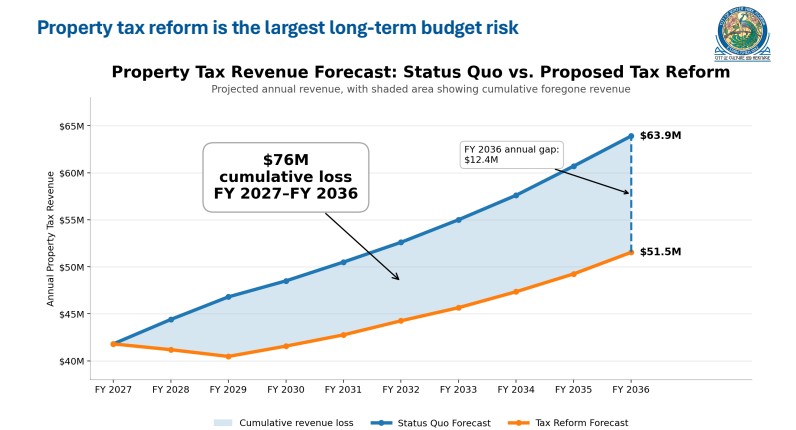
Winter Park staff estimates Amendment 3 would require cuts of $3.4 million in 2028 and $6.7 million in 2029. So far shy of the 10% exercise. But not far off once a few years into the new tax structure if it wins by the required 60% of voters in November.
The Voice has heard from some readers who appear to be under the impression that police and fire or other “essential services” can not be cut under Amendment 3, which would increase the homestead exemption ultimately to $250,000.
But that’s not the case. Cities and counties will still provide emergency services, to be sure, but at what level?
Florida House Republicans approved language that would ban local governments from reducing money for law enforcement, firefighters, and first responders below the level in either fiscal year 2025-26 or 2026-27, whichever was higher. But the Senate never approved that version and it died during the Legislative session.
That’s why police and sheriffs’ organizations have spoken out about the potential impact of the amendment and cuts that could result from it.
“The Florida Sheriffs Association is significantly concerned with Constitutional Amendment 3, which potentially allows Tallahassee to control your local budgets, creates longer law enforcement response times, limits communities’ abilities to provide road repairs and stormwater removal — these are a few things voters deserve to be aware of,” the organization said this week on Facebook.
And the soaring cost of police and fire service is a main driver of the growth in the budget the City Commission will consider this month.
Record-high pension costs for police officers and firefighters as well as a new labor contract with the Fire Union that included a 12% pay increase in 2026 will account for 70% of new costs in the proposed 2027 budget.
In 2021, for example, the starting salary for a Winter Park police officer was $22.84 an hour or about $48,000 a year. Today it’s $30.34 an hour or more than $63,000 a year.
Police Chief Tim Volkerson has said the increases are the result of pressure on wages from other departments who have raised pay as they have struggled to hire and retain officer.
The city has 121 full-time police staff and three part-time staff slated for 2027, up from 115 full-time staff and 13 part-time staff in 2023.
The budget for the fire department is up from $13.2 million in 2020 to a proposed nearly $19 million for next year. The department has grown from 81 full-time staff and two part-time staff in 2023 to 84 full-time staff and three part-time staff.
Translated into savings for individuals residents, homesteaded property owners would pay about $818 less per year to Winter Park. The total tax savings per year for Winter Park homeowners if the ballot measure passes would be $1,783, including the reduction paid to the city as well as the reductions in taxes paid to Orange County and St. Johns River Water Management District. (Taxes paid to schools would remain unchanged under the tax proposal on the ballot.)
The City Commission is slated to hear public input and consider portion of the budget at this meetings this month on Aug. 12 and Aug. 26 before final adoption of the budget by the end of September.
Winter Park Contends with Higher Police and Fire Costs and How to Maintain Roads
The city’s proposed 2027 budget is also cautious of future cuts to property taxes if voters approve a measure on the November ballot. Winter Park homeowners would save less than $2,000 a year, but the city could ‘lose some of the things that make it feel extra special’
July 22, 2026
By Beth Kassab
The Winter Park City Commission is poised today to adopt the same property tax millage for the 19th year in a row, but the steady rate belies an increasingly complex financial picture for one of the region’s most high-profile cities as it contends with soaring costs for its police and fire departments, a demand from residents for better roads, increasing prices for electric and water customers and a governor and state Legislature looking to slash property revenues.
The All-Funds Budget, which includes the General Fund as well as the utilities and other funds, is proposed to increase this year by nearly 6% to $247 million. The General Fund, which pays for essential services such as police, fire, parks, public works and administration, is growing by about 5% to $94.6 million.
The growth in money collected by the city is being driven by higher bills for electricity, water and stormwater — the result of policy decisions in recent years and up for debate again this year by a City Commission facing big expenses to prevent storm flooding and to continue to underground all of the power lines for the city-owned electric utility. Property taxes remain a driver of growth in the general fund, where the taxes make up just under half of the revenue pie.
City Manager Randy Knight cautioned that a measure on the November ballot initiated by Gov. Ron DeSantis and the Florida Legislature to significantly alter how local governments are funded by reducing property owners’ tax bills could eat into the kinds of services the city provides by 2028, when it is set to take effect if it passes with the required 60% approval from voters.
City officials are forecasting a hit of at least $5.4 million in the first year. Translated into savings for individuals residents, homesteaded property owners would pay about $818 less per year to Winter Park. The total tax savings per year for Winter Park homeowners if the ballot measure passes would be $1,783, including the reduction paid to the city as well as the reductions in taxes paid to Orange County and St. Johns River Water Management District. (Taxes paid to schools would remain unchanged under the tax proposal on the ballot.)
“It will have an impact on city services that will be felt,” Knight said in his annul budget memorandum to the City Commission. “Winter Park will still be able to provide essential services, but the city may lose some of the things that make it feel extra special … A loss of over $5 million is like losing almost half of the Parks Department, so it will not be a small issue to determine how best to prioritize spending, but it is likely that a combination of service reductions and revenue increases will end up balancing the budget in future years.”
With just six months to go before his retirement after decades at the helm of the city and 36 years since he helped prepared his first budget in 1990 as the city’s finance director, Knight was reflective in his final budget memo of past challenges.
“As we face potential impacts from the so-called tax reform, I want to remind you that we have faced tough times before and always endured,” Knight wrote. “The 2004 hurricane season cost approximately $18 million for recovery and wiped out our reserves. The 2008 housing bubble coupled with tax reform resulted in a huge hit on city revenues. The Pandemic shuttered businesses and locked down communities, but we survived and thrived. Today Winter Park is the envy of the region, with commercial properties with the lowest vacancy rates and highest asking rents, exceptional schools, and beautiful walkable residential communities and amenities. Over 3 million visitors come to the crown jewel of downtown Park Avenue each year and our financial reserves have grown to over $24 million.”
A graphic from Winter Park’s proposed budget document shows how money in the General Fund is spent.
But the budget document also described in stark terms how expenses for basic needs like police and fire are simply outpacing revenues.
Record-high pension costs for police officers and firefighters as well as a new labor contract with the Fire Union that included a 12% pay increase in 2026 will account for 70% of new costs in the proposed 2027 budget.
“Of the $4 million in the increase in personnel wage and benefit costs in the General Fund estimated for the next fiscal year, almost a third (30%) is due to increases in public safety pensions for police and fire
retirement plans,” according to the budget proposal.
The city will have to spend $1.2 million more on the pensions, according to the document, the result of “changes in actuarial tables, the addition of new employees and the weak 2022 stock market year that still affects their formulas.”
“Staff is reviewing the possibility of making adjustments to the pension plan in the future to attempt to mitigate this growing cost,” the document said. “With property tax reform on the horizon, having a quarter of the entire annual growth in revenue going solely to public safety pensions, is not sustainable.”
Police pay has increased by nearly 50% in Winter park in recent years and the proposed 2027 police department budget is $23.2 million, up from $14.9 million in 2020. The department will keep a community services position vacant next year to help reduce some costs, according to the proposal. The city has 121 full-time police staff and three part-time staff slated for 2027, up from 115 full-time staff and 13 part-time staff in 2023.
The budget for the fire department is up from $13.2 million in 2020 to a proposed nearly $19 million for next year. The department has grown from 81 full-time staff and two part-time staff in 2023 to 84 full-time staff and three part-time staff.
Winter Park is not alone in what has amounted to an arms race in public safety pay across Florida as departments have struggled to recruit and keep candidates for jobs that require personal risk, physical stamina and no work-from-home privileges in a post-pandemic world where many offices have emptied out.
For example, the pay for a starting deputy at the Orange County Sheriff’s office in 2020 was $49,296, according to the office. By 2025 it was $62,566. That’s in addition to increases in bonuses, the number of paid holidays and minimum compensation for off-duty pay and longevity pay.
A graphic from the city’s budget presentation shows the potential cumulative effect of the property tax measure on this November’s ballot.
In addition to public safety costs, roads emerged as Winter Park’s other main budget priority this year.
That’s the result of a survey of residents with about 800 responses that identified the quality of both brick and asphalt streets as a major need for improvement.
“This has been an area in which funding has been added in the past, but it has been insufficient to keep pace with the level of street deterioration and the cost of repairs,” read the budget memorandum.
The budget includes more money for contractors to resurface roads and doubles the amount for road materials with an additional $500,000. Winter Park has fallen short of its own goal of redoing 9 lane miles o road each year, typically completing just 4 or 5 lane miles with the exception of in 2025. The new goal will be to achieve repaving of 7.5 lane miles each year.
City Commissioners are slated to vote on the property tax rate this afternoon. More discussion and debate over the full proposed budget is scheduled for August with a final budget vote in September before the start of the new financial year in October.
Winter Park Residents to Pay More for Electricity and Water in Proposed Budget
Higher electric bills for Winter Park are likely to be a trend in the coming years, according to projections
June 23, 2026
By Beth Kassab
Winter Park residents and business owners will pay more for water and electricity under budgets approved by the city’s Utilities Advisory Board on Tuesday.
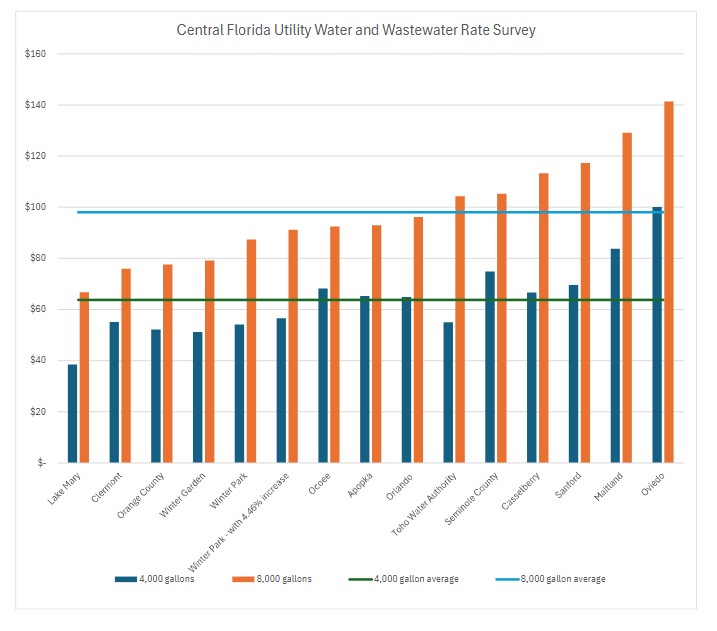
The proposed budgets, which require ultimate approval by the City Commission by the end of the summer, call for the non-fuel portion of electric rates to increase 7.7% beginning at the start of the new financial year in October while water rates will increase 4.46%.
Translated to dollars on utility bills, Winter Park residents who use about 4,000 gallons of water per month pay roughly $54 today and that would go up to about $57 (an estimated $2.49 increase), still below the regional average of just higher than $60.
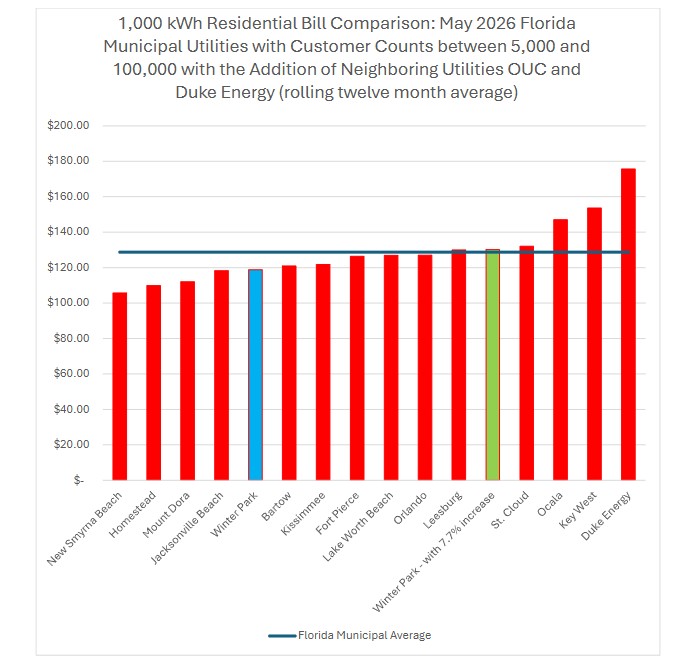
But for electricity, the price change would put Winter Park above the average for municipal utilities in Florida with fewer than 100,000 customers.
Winter Park would become the fourth most expensive with rates at just under $141 or so per 1,000 kilowatt hours or an increase of about $7. The rate today is just under $134 and is 10th most expensive.
Higher rates don’t just support the utility, but also help prop up the city’s general fund responsible for paying for police, fire, parks and other essential services. The city collects a 6% franchise fee on electric bills so when rates go up so does the amount of dollars transferred to the general fund. The proposed budget for 2027 shows a $256,000 increase to $3.2 million transferred to the general fund.
In the case of both the city’s water and electric utility the cost of providing services is going up faster than the city’s revenues, Finance Director Wes Hamil told the advisory board.
For about 20 years, the city has had an ordinance that called for water rate increases to mirror the increase allowed by the Florida Public Service Commission, which this year is 2.46%
“However, those rates have not been adequate to cover the cost increases being experienced,” read Hamil’s presentation to the board.
The picture is even more stark on the electric side where projections show a series of rate increases will be needed in the coming years. Higher rates are necessary, according to the documents, to keep up with the rising cost of providing power to the city and projects such as undergrounding electric lines and paying off the debt the city took on to purchase the utility from Duke Energy (then Progress Energy) 20 years ago.
Winter Park has enjoyed years of providing some of the lowest costs in the region.
“It’s a little unrealistic to expect that will always be the case because we’re doing things others aren’t,” Hamil said, pointing to debt from the purchase and undergrounding.
By 2030, there is projected to be a nearly $10 million gap between the amount of revenue brought in by rates and the amount that will be required to run the operation, according to a preliminary cost of service study discussed by the board on Tuesday.
The study projected that rates will need to rise an average of 6.3% for each of the next five years to balance the budget.
The city of Winter Park doesn’t generate it’s own power and relies on contracts from other utilities like OUC and Florida Municipal Power Association.
The OUC contract expires at the end of this year and FMPA ends the following year. Costs are expected to go up as those contracts are renegotiated.
Also up for debate will be the city’s net metering policy or how it pays customers who generate power through their own rooftop solar panels.
More than 200 customers do so in Winter Park and that number has been rising in recent years, according to the presentation.
At issue is whether Winter Park will continue to credit them at what is known as the “retail rate” or the lower “wholesale avoided energy cost” or some combination of the two.
Budget hearings will begin at the City Commission next month.
Update: A previous version of this story has been updated to reflect more exact numbers provided by the city of Winter Park of electric bill averages before and after the proposed rate increase.
We Depend on your support, make a tax-deductible donation here.
Mission
The Winter Park Voice is a trusted nonprofit journalism site that covers our City Hall and beyond. We endeavor to engage, inform and connect citizens on all sides of issues affecting the quality of life in Winter Park.



Recent Comments