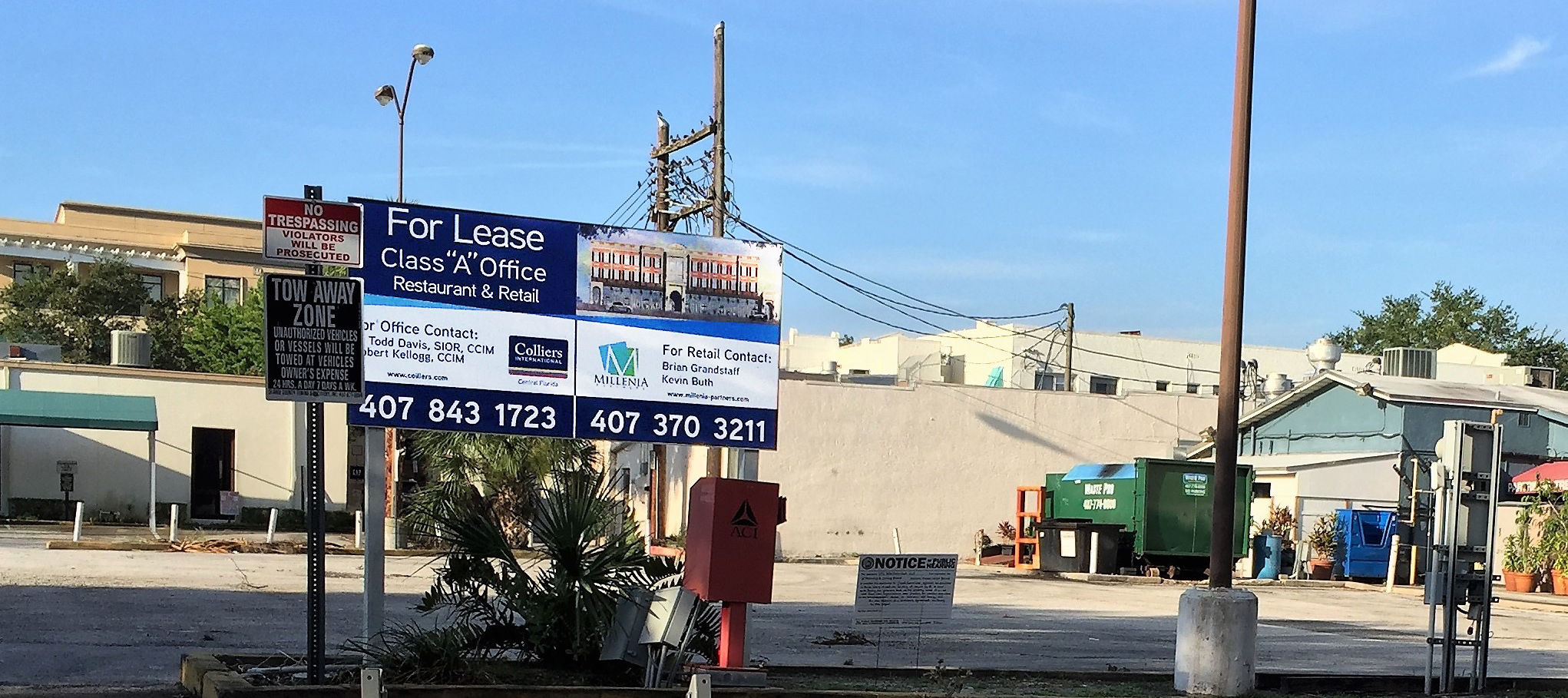
On a 5-0 vote last night, the Commission denied BFC Holdings’ application to build a 52,600 square-foot mixed use complex at 158 E. New England Ave.
Fuzzy Parking Math Still Not Cleared Up
The basis for denial was the applicant’s failure to offer sufficient mitigation for the 80- to 100-space parking deficit (the exact number depends on who’s counting and how). Even though the City was prepared to grant an unprecedented concession of requiring three parking spots per 1,000 square feet of office/retail space – all other Class A office buildings in Winter Park are required to provide four spaces per thousand – BFC Holdings still came up short.
CBD Parking Study Now in Progress
When this project was tabled at the March 27 Commission meeting, Planning Director Dori Stone observed that the City’s parking studies needed updating. The City has since hired a consultant, Kimley-Horn, who is now in the midst of a parking assessment of the Central Business District (CBD). Commissioners suggested that allowing this project to go forward with such a large parking variance before they have the study results would be premature.
If the Parking Code is Wrong, Why Is It Still In Place?
Commissioner Sarah Sprinkel objected to the Commission being asked to grant what amounts to a change in the parking code for a single applicant. “Why is the code still in place, even when you are now telling us it shouldn’t be?” asked Sprinkel.
‘Class A Office in the CBD Is Different’
At the March 27 Commission meeting, Planning Director Dori Stone asserted that Class A office space in the CBD operated differently from Class A office space in any other part of Winter Park and could, therefore, be supported by three spaces per 1,000 square feet.
‘What Is Class A Office, Anyway?’
At the July 10 meeting, Planning Manager Jeff Briggs stated that staff “was having difficulty coming up with an agreed-upon definition of Class A office space.” Parameters for size and other characteristics of everything from hallways to conference rooms, which would set ‘Class A’ apart from Classes B or C, apparently do not exist.
Can Valet Parking Promise Be Enforced?
Referring to the applicant’s assurances that all visitors to the new complex would be required to use valet parking, either in the New England Avenue building garage or in the Bank of America garage across the street, Commissioner Greg Seidel questioned how the requirement to use valet parking would be enforced.
Unless the applicant enforces the valet parking, it probably will not be enforced at all, since Winter Park employs only one parking enforcement officer for the entire City.
Time to Close This Chapter
Commissioners asked the applicant for compromise. “The building is lovely,” they all agreed, “but it’s too big.” Commissioner Peter Weldon said he thought it was time to “close the chapter” on the application in its current form, and he moved to deny. The other four Commissioners agreed.
Duck the Summer Heat & You’ll Miss All the Fun
BFC Holdings is Back with New England Ave. Project
July 8, 2017 / by Anne Mooney
BFC Holdings will return to the Commission on Monday, July 10, with their proposal to build a 52,600 square-foot mixed use building at 158 East New England Avenue.
BFC Wants Big Variances
The proposal came before Planning & Zoning and then the Commission in March of this year. Neither body was able to reach a decision regarding the project, which requests variances for building height, third-floor setbacks and a significant parking deficit.
P&Z Can’t Decide
After hearing the application on March 7, P&Z was evenly divided, with a 3-3 vote. Rather than tabling again – as they had at the November 7, 2016 meeting — or denying the application, P&Z kicked it forward to the Commission.
Commission Can’t Decide
On March 27, the Commission couldn’t decide either. They were okay with the variance for 45 feet of building height, rather than the 40 feet permitted in C-2 zoning. They were also willing to go along with a vertical façade along Knowles Avenue with no setback or terracing on the third floor to break up the vertical mass of the 45-foot-high wall. But they just couldn’t solve the applicant’s fuzzy parking math. See Winter Park Sings the Parking Blues.
‘Back to the Drawing Board’
Concluding a meeting that lasted well beyond 10:00 p.m., the Commission unanimously voted to table the application, advising the applicant their project “was not ready for prime time,” and to “work things out” regarding the parking variances.
What’s Changed Since March 27th Meeting?
According to the July 10 Agenda Packet, City staff has “discussed parking issues and suggested changes with the applicant based on comments made by individual commissioners at the public hearing. However, the application is unchanged since the March 27th meeting.”
Only the Weather Has Changed
Apparently, the only things that have changed are the weather and the requirement for public notice. According to City Code, after a tabling the only people required to receive notice in the mail of a public hearing are property owners within 1,500 feet of the subject property. The hearing is, however, publicly advertised, as are all public meetings.
Form, Not Content
The application contains a draft Developer’s Agreement that was not included in the March 27th application. According to the Agenda Packet, the agreement incorporates approvals needed and commitments from the applicant made at the March 27th meeting. The draft, however, contains changes recommended by the City Attorney only “as to form but not content.”
Two Hearings Required for Approval
Since no decision was reached at three previous hearings, BFC still has to clear the hurdles. As a request for Conditional Use for a three-story building within the Central Business District, BFC’s application requires two more hearings. A July 10 Commission decision to approve the project would result in a second hearing July 24.
Editor's Note: Articles written by citizens reflect their own opinions and not the views of the Winter Park Voice.
Guest Columnist — Charley Williams
At a June 15 Parks and Recreation Advisory Board workshop, the attending parks consultant stated that Rollins College and the City were contemplating moving the Rollins softball stadium out of MLK Park. Communications Director Clarissa Howard told the Voice that Rollins officials had indicated “a willingness to discuss the possibility,” though she could not confirm that such discussions are currently underway.
Whether these discussions occur now or in the future, if it turns out the stadium can be removed from its present location, a primary reason for relinquishing the bowling alley property would also be removed.
Commissioner Sarah Sprinkel wrote in a June 14, 2017, email: “The perpetual agreement Rollins has for the 3 million dollar (their money) lease for the softball stadium is not an attractive structure to view and disallows a long range view of the park. That is not within our purview to undo and would make extremely costly space.”
Costly or not, the stadium has outlived its usefulness. It is no longer regulation size and cannot support sanctioned play or host tournaments.
From Bowling Alley to Grand Allee
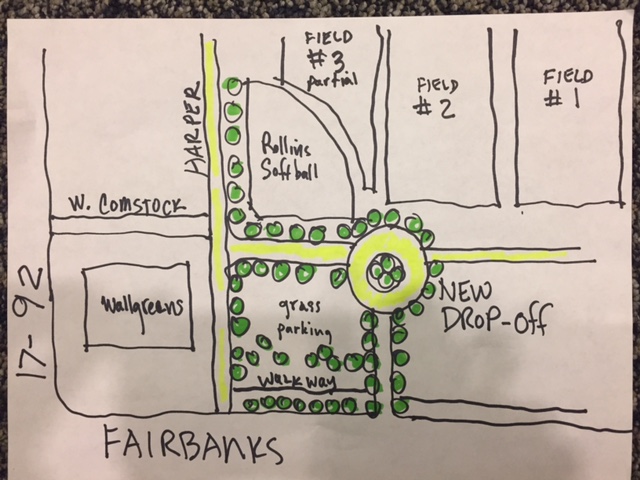
The possibility of removing the stadium opens up a whole new dynamic for MLK Park. If the bowling alley property were retained and added to the mix, it would create unobstructed sight views — a dramatic ‘view-shed’ from the planned library/events center on the north end of the park all the way to Fairbanks on the south. Winter Park would have a gateway feature with a Grand Allee, leading to a world-class library-event structure with green space in between.
I hope the Mayor, Commissioners and City Manager do engage in discussions with Rollins to remove the stadium from the MLK footprint, and that they will reconsider the opportunity to create that unobstructed view through the park.
In the presence of such a possibility, would it not be wise to slow things down, to assume a wait-and-see stance? That kind of game changer would be a win for everyone.
Editor's Note: Articles written by citizens reflect their own opinions and not the views of the Winter Park Voice.
One week ago, the Winter Park City Commission voted 3-2 to move forward with the sale of a gateway property contiguous to one of the city’s benchmark parks: MLK Park, future site of the new Library/Events Center complex. The 1.5 acre parcel, known as the Bowling Alley property, could have become a functional green space entranceway to our city. But a gateway argument did not capture this Commission’s imagination.
Illustration Courtesy of Michael Planning
Citizens are now left with serious questions about how all our expensive studies, workshops and summary reports can come together to form a cohesive plan for parks, ball fields, green space, partnerships, trails and connectivity, supported with the necessary implementation budget.
Our Parks Masterplan (2008 Wade-Trim) is now 10 years out of date. This is the document which should be guiding our next steps, not only with current decisions surrounding MLK Park, but all our future parks discussions. First things first. Let’s hope the City Commission adopts a budget for this badly needed roadmap (estimate: $120,000) and expedites implementation. We are coming late to this party.
Other questions which merit attention: Will Winter Park have a “Great Park” one day? Where is that plan? What is the vision? What green space parcels has the City acquired in the past 2 years? 4 years? 6 years? Are we keeping pace with need and more importantly, with our required 10 acres of park space/per 1,000 resident formula, now that our population has reached 30,000?
The 2008 Parks Masterplan states that “seventy-nine (79) acres of additional parkland are required by 2028 (note: that’s in 10 years) to meet existing and projected demand for parks and recreational facilities” (Recommendation 3.1).
Where will this new park land come from? At what price?
According to Wade-Trim, “The estimated cost to meet projected demand for parkland by 2028 is $41.3 million. This would require approximately $13.1 million of land acquisition every 5 years, or approximately $2.6 million annually.” (Section 7.2, Estimated Costs Associated with Projected Demand)
The report also highlights an 8 multi-purpose playing field deficit for our children by 2028. (Recommended Action 3.4)
And let’s not forget this recommendation. “City of Winter Park Parks and Recreation Masterplan should be updated at least every 5 years to reflect any shift in development trends and desires of the community.” (Recommended Action Step 3.5)
It would appear that we are making decisions in a vacuum. The budget for the MLK Park future usage exercise with GAI consultants is in the range of $50,000 in CRA monies. Yet there is apparently no cross-reference with our own Winter Park Parks Masterplan needs and capacity issues, because it is 10 years out of date.
Interesting as well, our Winter Park Vision plan was submitted on June 9, 2016, and has been sitting on a shelf for the past year. Why pay $200,000 for a plan we are not going to fund or implement? Are these exercises meant to be moot?
Said the Cheshire Cat to Alice, “If you don’t know where you are going, any road will take you there.”
From ‘Alice in Wonderland’
By Charles Lutwidge Dodgson writing under the pseudonym Lewis Carroll.
Charley Williams provides the marketing for a local civil engineering firm working on such infrastructure projects as Sunrail, Wekiva Parkway, I-4 and the new South Terminal at Orlando International Airport. He has been a Winter Park resident for twelve years.
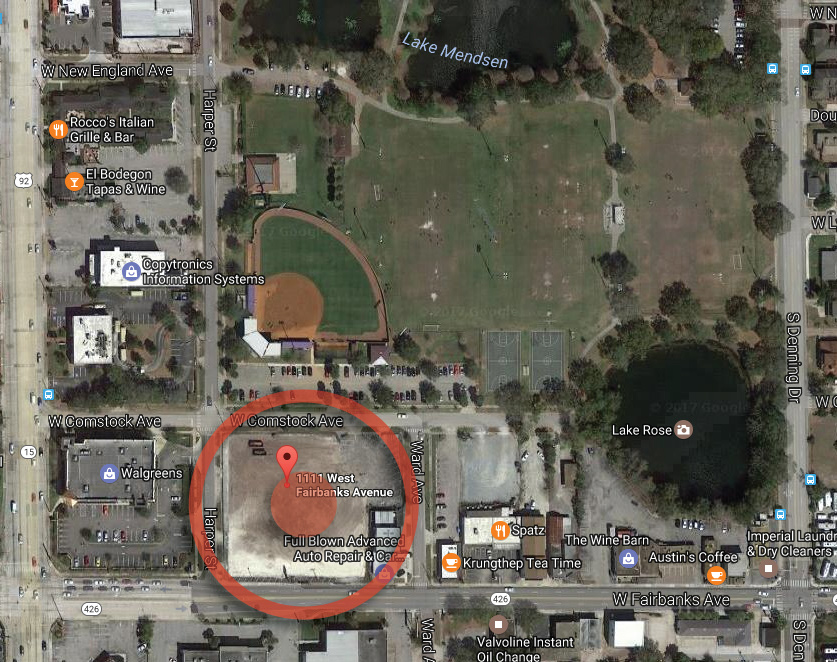
Pleas of the Parks & Recreation Advisory Board and the citizens to move more slowly fell on deaf ears Monday night as Commissioners voted 3 to 2 to put up the For Sale sign on the bowling alley property at 1111 W. Fairbanks.
A 20-foot setback along Fairbanks will be retained to build a turn lane onto 17-92. The property is zoned C-3 commercial. According to Planning Director Dori Stone, the City will exclude proposals for banks, fast-food restaurants and automobile services (gas stations, repair shops, etc.) at this location.
City ‘Pre-Marketing’ the Property
The Notice of Disposal (NOD) will be publicly advertised, and bids are due 30 days from the publication date. The city realtor, Bobby Palta from CBRE, noted there was already considerable interest in the property, and that the City had been doing some “pre-marketing for the past couple of weeks” with various developers.
The property is appraised at $2.96 million, which will be the minimum bid price – $60,000 more than the City paid when they bought it from Rollins in 2016. The Commissioners will, however, maintain flexibility in their choice, giving preference to plans that include less tangible assets like tree planting and additional green space.
Skipping Steps in the Process
Commissioner Carolyn Cooper expressed her discomfort with the process by which the Commission arrived at the decision to sell. She noted the process had gone from the public GAI workshops to the Commission without first going through the advisory boards. During the GAI public meetings, the bowling alley property was not supposed to be part of the discussion, but actually played a prominent role in the discussion that occurred at both meetings. Cooper suggested the decision to sell the land be tabled and returned to the Parks & Recreation Advisory Board so they could bring their recommendations back to the Commission at a later date.
‘There’s Still Much We Don’t Know’
Cooper enumerated new pieces of information which the Commissioners had not had a chance to factor into their decision. As examples, she cited the GAI public workshops and the letter from the Parks & Rec Board requesting the City not move to sell the property. P&R letter
She noted other information the City doesn’t have yet, like an evaluation of the storm water retention requirements that will be created by the new library-event center, and new corridor design standards for West Fairbanks, which have yet to be completed.
Premature Decision
“From my perspective,” said Cooper, “we are premature, we have not utilized our boards and we are not listening to the requests of our citizens.”
Involve DOT
Commissioner Greg Seidel proposed Commissioners delay the sale to give them time to involve the Florida Department of Transportation (DOT). Instead of assuming an extra turn lane is the best solution, FDOT could do an intersection control evaluation at Fairbanks and 17-92 to give the City the benefit of their expertise. Seidel argued that the City could work to persuade DOT to prioritize a determination about what technology would be most appropriate at that location.
Cooper’s motion to table, for no time certain, failed for lack of a second. Greg Seidel then moved to table for a time certain of three months. His motion was seconded by Cooper, but failed on a 3-2 vote.
‘What’s the Rush?
Public comment, with one exception, opposed selling the property before there was a chance to weigh the consequences of this action. Former Mayor Joe Terranova pointed out, “We don’t need that cash money now. You’re going to make payroll the next time it comes around.”
Terranova went on to note, “We still don’t know what the 800-pound gorilla in the northwest section of the park is going to do,” referring to the library-event center for which there are, as yet, no plans. “How can we say what the rest of the park is going to be like, and that we don’t need that piece of land?”
‘Just How Serious Are You?’
Beth Hall argued for the aesthetics of a major City gateway. “I wish I could count the number of times I have heard the Commissioners discuss their desire to improve the Fairbanks corridor and the western gateway to the city,” said Hall. “Your efforts have run the gamut from spending large sums to improve sewer and utilities on the artery to making zoning changes to encourage development. I’d like to ask: just how serious are you?”
Don’t Resign it to Mediocrity’
“Wouldn’t converting this site to parkland further your mission?” she asked. “Adding the land to the park would signal a paradigm shift in the way our City views this gateway. Don’t resign it to mediocrity. Elevate it. Please reverse your decision to sell the land.”
‘Commercial Land — Never Meant to be a Park’
In an email sent the day following the Commission meeting, Commissioner Sarah Sprinkel explained the rationale behind the vote to sell the bowling alley property. “The city purchased the property for the turning lanes,” she wrote, “did not use park acquisition dollars and never intended to turn that piece of commercial property into parkland.”
Need to Build Back the Reserves
In answer to the question of why the Commission had not sought the input of the Parks & Recreation Advisory Board Sprinkel wrote, “The boards have a charge and since this was commercial property used for traffic alleviation it was not considered part of their [Parks & Rec] charge. The 3 million dollars returned to the fund [the City’s General Fund] will allow wp [sic] to continue their strong 20-25% reserves,” reserves that may play an important role in the next election cycle.
MLK Park Master Planning Still Underway
Bob Bendick pointed out that the City is in the midst of creating a Master Plan for MLK Park, and that the decision to sell land that is contiguous to the park is premature.
“Thinking has also evolved about parks planning,” said Bendick, “including the need to go beyond direct recreation needs and to better integrate parks, open space and pedestrian and bicycle transportation into the fabric of communities.”
Missed Opportunity
Bendick noted a reasonable desire among some Commissioners to recoup funds spent to purchase the bowling alley property, but cautioned that once sold for commercial development, the opportunity to incorporate the land into the park would likely be gone forever.
A May 30 letter from Parks & Recreation Advisory Board Chair Carl E. Creasman, who wrote on behalf of all the board members, makes an eloquent plea to the Mayor and Commissioners not to sell the bowling alley property at 1111 W. Fairbanks.
Parks & Rec Surprised
The letter states that the proposed sale of the property, which is adjacent to Martin Luther King, Jr. Park, came as a surprise to the Parks & Rec Board at their May 24 meeting.
“We write to you now to urge the City Commission to reopen this decision for review,” states the letter. “The MLK Master Planning process provides the perfect opportunity to determine the best usage of that land.”
The letter continued, “Even if the property were merely turned into expanded parking and beautification for the entrance to the city along Fairbanks, that would be a better use of the land than selling the property.”
Commissioner Peter Weldon responded to Creasman in a post on his Winter Park Perspective blog. In an apparent effort to reassure Creasman, Weldon wrote, “The vote to put the bowling alley up for sale is not the same as voting to sell the property.”
Weldon went on to explain, “The bowling alley was purchased from Rollins in 2016 based on being able to provide greater right of way on Fairbanks and, potentially, finding a use as incremental park space. In other words, the purchase decision was opportunistic, not strategic.”
To see the entire content of Commissioner Weldon’s response, click here.
Commission Meets June 12
Further discussion of the final disposition of this property will likely occur at the June 12 Commission Meeting. Stay tuned.
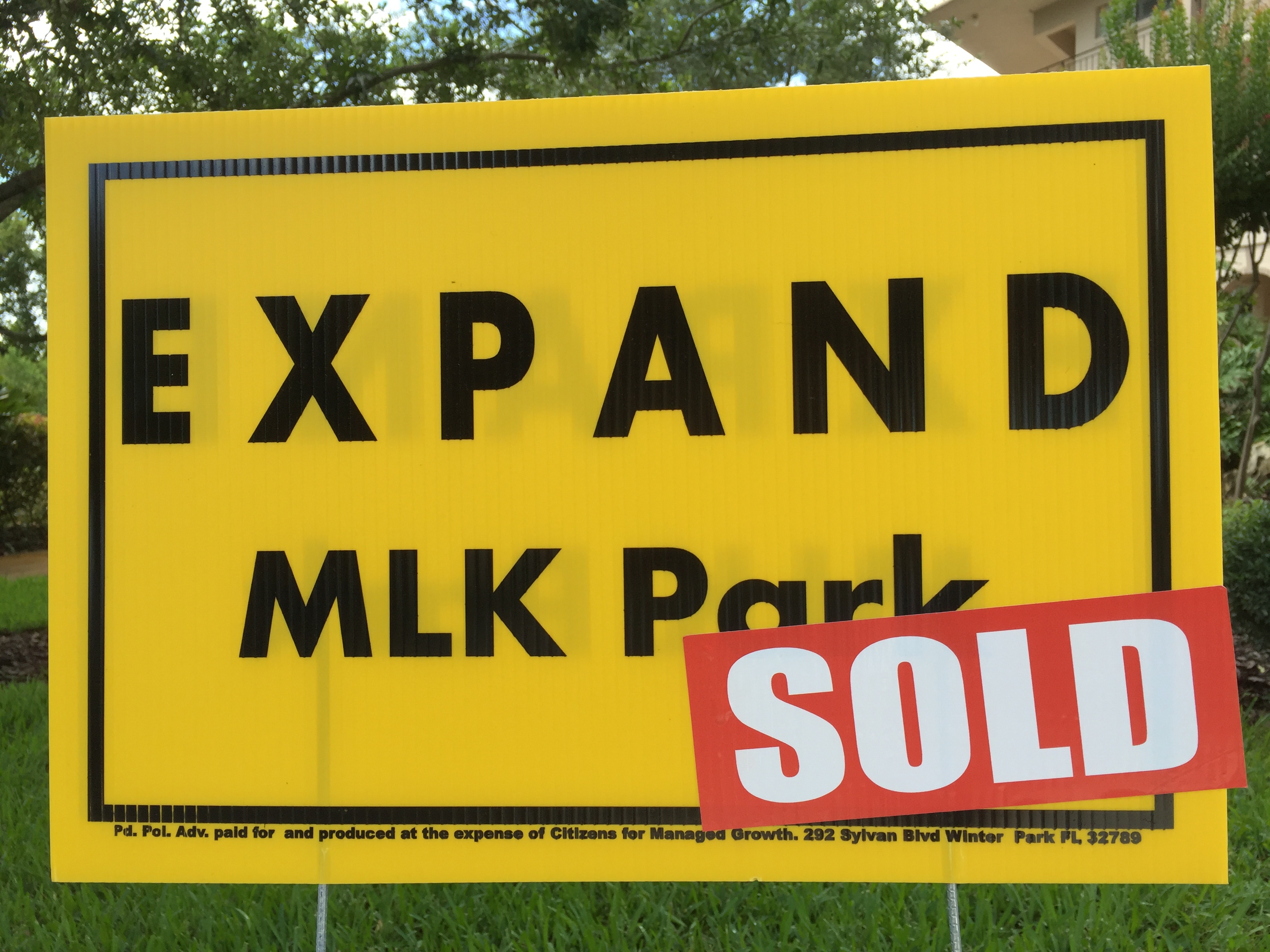
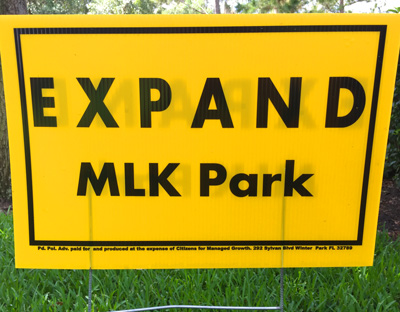
Yellow signs are popping up everywhere, urging the City not to sell the bowling alley site at 1111 W. Fairbanks, rather, to use it to expand Martin Luther King, Jr., Park.
Final Decision June 12
The final vote will likely be at the Commission meeting on June 12. The meeting begins at 3:30. Public comment is usually taken around the 5:00 hour. Click here for the meeting agenda.
Bowling Alley Background
The old bowling alley property has a checkered history. In late spring 2013, Rollins purchased the property when it looked like Harper-Shepherd Field would become a Minor League baseball stadium and no longer would be available to Rollins teams. Being contiguous with Martin Luther King, Jr., Park, the property was ideal for Rollins to expand their playing fields.
Editor’s Note: According to Communications Director Clarissa Howard, Rollins purchased the bowling alley property for use as a lacrosse practice field. She said the purchase was unrelated to Minor League baseball at Harper-Shepherd Field.
When it became clear that baseball would not be coming to Winter Park, however, Rollins no longer needed expansion room and put the property up for sale. UP Developments, LLC, contracted to buy the property from Rollins.
But the City wanted the property, too. At the time, they had their own ideas about expanding MLK Park and mitigating some of the traffic problems on Fairbanks and 17-92. In the fall of 2014, Scott Fish of UP Developments, LLC, agreed to assign his contract with Rollins to the City, so that the City could buy the property from Rollins.
That deal didn’t work out, and Rollins ended up keeping the property until 2016, when the City bought it for $2.9 million.
Editor’s note: Ms. Howard pointed out that the City did not use park acquisition funds, but instead took money from the CRA and general fund reserves, thereby avoiding any requirement that the land be used as a park.
People Want Trees & Grass – They’re Being Ignored
In the meantime, plans for the new library-event center took shape, the City created yet another vision of itself and the Comprehensive Plan underwent its seven-year cycle of massage and manipulation. The City organized plenty of public discussion around each of these activities.
Missing in these discussions was a consideration of the city’s assets as a whole – as a system. This was nowhere more evident than in the discussions about the City’s parks and greenspace — which brings us back to those yellow signs.
MLK Needs a Plan?
While the City was visioning and planning, the turf and facilities at the playing fields on south end of the MLK Park were deteriorating, and the bowling alley property stood vacant. Since the bowling alley was creating something of an eyesore on a major gateway artery, someone decided the City should have a plan — so GAI Consultants were retained to create one.
At the April 10 meeting of the Community Redevelopment Agency (CRA), which is made up of the Commissioners and a representative from Orange County, Hal George, GAI made a presentation about their plans for creating a Master Plan. At that meeting, the Commissioners also decided to sell the bowling alley property, retaining only a right-of-way for a turn lane on Fairbanks.
Well, Part of MLK Needs a Plan
In light of the fact that the City was in the process of retaining an architect and landscape architect for the new library-event center, and they were now planning to dispose of the bowling alley property, GAI was advised that their MLK Park Master Plan should include only those parts of the park that did not include the library-event center or bowling alley areas.
Why Sell the Bowling Alley?
According to Commissioner Peter Weldon at the April 10 meeting, “Selling the bowling alley property now gives us the opportunity to do things that are much more tangible and beneficial to the City,” – like a third story on the new library-event center parking garage, or a parking garage downtown. “For one-third the money we have into [the bowling alley] land today, we could provide 100 parking spaces to expand the parking for MLK Park,” said Weldon.
Property Sale on Consent Agenda
At the next Commission meeting, April 24, the bowling alley property sale appeared on the Consent Agenda as Item C. Items on the Consent Agenda do not require discussion or public comment. Commissioners Seidel and Cooper pulled Item C off the Consent Agenda for discussion.
Commissioner Greg Seidel said the proposed sale needed more public discussion. Commissioner Carolyn Cooper agreed, requesting the item be tabled until there had been opportunity both for public discussion and for consideration by the Parks & Recreation Advisory Board, which had not had a voice in the decision to sell.
She pointed out that the City seldom had access to land contiguous with an existing park – and in this case, the City already owns the land. Once the land is gone, we can’t get it back.
Commission Votes to Sell the Bowling Alley
The motion to table, or postpone the sale, failed on a 3-2 vote, with Cooper and Seidel dissenting.
Cooper made a second motion to approve the sale contingent upon completion of the designs for the library and for MLK Park. That motion also failed on a 3-2 vote.
The motion to approve the sale of the property, minus the right-of-way for the turn lane, passed on a 3-2 vote, with Cooper and Seidel dissenting.
MLK Master Plan Rolls Out the Next Day
The next night, April 25, close to 100 people gathered at the Rachel Murrah Civic Center to discuss the Master Plan for part, but not all, of MLK Park. The GAI consultants explained that the bowling alley property and the new library-event center were not part of the discussion. Groups of people gathered around tables and used maps of the park and construction paper cutouts representing different types of public spaces to illustrate their visions of the park.
“Fix the Park and Don’t Sell the Bowling Alley”
As the various tables prepared to report out to the group as a whole, two things became clear. First, each table said they wanted the existing park facilities, especially the playing fields and water features, to be cleaned up and repaired. It would be okay, they said, to leave the rest of the park alone – just fix what’s there. “And don’t fill it up with shiny new stuff,” they said.
Second, participants opposed the sale of the bowling alley property. “Wait,” they said. “We don’t even have a completed design for the new library. What if we need that land? It’s too soon to decide what to do with it.”
Did the Master Plan Take a Wrong Turn?
GAI held a second meeting at the Civic Center on May 2. Only 25 to 30 people came, many of whom had attended the April 25 meeting. Again, the over-arching themes included the desire to repair existing park facilities and opposition to the sale of the bowling alley.
Asked if the outcomes of the two meetings would be reported back to the City, the GAI consultant replied that they “hadn’t heard from everyone yet.”
Additional meetings were to have been held in May, with a final plan due in July. According to Communications Director Clarissa Howard, the schedule for public meetings has been revised, and the next public meeting will be sometime in July.
Howard reported that GAI has, however, held focus group meetings that included “moms, sport coaches, daycare nurseries, realtors, staff and other professions.” These meetings were not public, said Howard, nor was public notice required.
“GAI will compile this input from the public forums and the focus group meetings into preliminary conceptual rendering to be presented at the meeting and on site walk planned in July,” wrote Howard.
Plans Minus Funding = Toothless Tigers
Comments opposing the sale of City land are too numerous to count, but there were some articulate ones on the subject of MLK Park and the bowling alley sale. While commenters were respectful, their comments indicated an underlying disconnect between Winter Park’s citizens and their elected officials.
In a letter to the Mayor and Commissioners dated May 10, Winter Park resident Bob Bendick wrote: “Winter Park has tended to discuss each of its parks in isolation . . . . Far more functional, and a characteristic of communities with the most successful public open spaces, is to think in terms of a system of parks and greenways that meets active and passive recreational needs and forms a green framework for the city’s future.”
Bendick went on to propose “that Winter Park move quickly to integrate its parks, lakes, greenspace, pedestrian and bicycle planning into a single document that describes a connected network . . . .” The plan will only be worthwhile, wrote Bendick, “if there is reliable funding to carry it out. And this is where Winter Park can do better.”
Bring Parks & Rec into the Loop
It is worth noting that at the May 24 meeting of the Parks & Recreation Advisory Board, Vice Chairman Julio de Arcos asked Parks & Recreation Director John Holland if anyone had sought his input on selling the bowling alley property. Holland replied that no one had. Advisory Board members expressed their opinion that the land should not be sold at this time.
Members of the public attending the Parks & Rec meeting requested the board write to the Mayor and Commissioners to express their concern about the sale of the property. According to an email from John Holland to one of the attendees, “The Parks and Recreation Board Chair has written a draft letter to the City Commission and we are currently getting approvals on format and verbiage.”
Still Time for Action
The sale of public land requires two votes by the Commission. The bowling alley sale will likely come up at the next Commission meeting on June 12. Any one of the Commissioners on the winning side of the vote to sell – Leary, Sprinkel or Weldon – can re-introduce the matter for the purpose of changing their vote. Click the email address to let your elected representatives know how you feel about stewardship of public land. MayorandCommissioners@cityofwinterpark.org
We Depend on your support, make a tax-deductible donation here.
Mission
The Winter Park Voice is a trusted nonprofit journalism site that covers our City Hall and beyond. We endeavor to engage, inform and connect citizens on all sides of issues affecting the quality of life in Winter Park.



Recent Comments