When Zoning Gets Creative
When Zoning Gets Creative
Zoning rules experienced a creative twist at the July 23 Commission meeting..
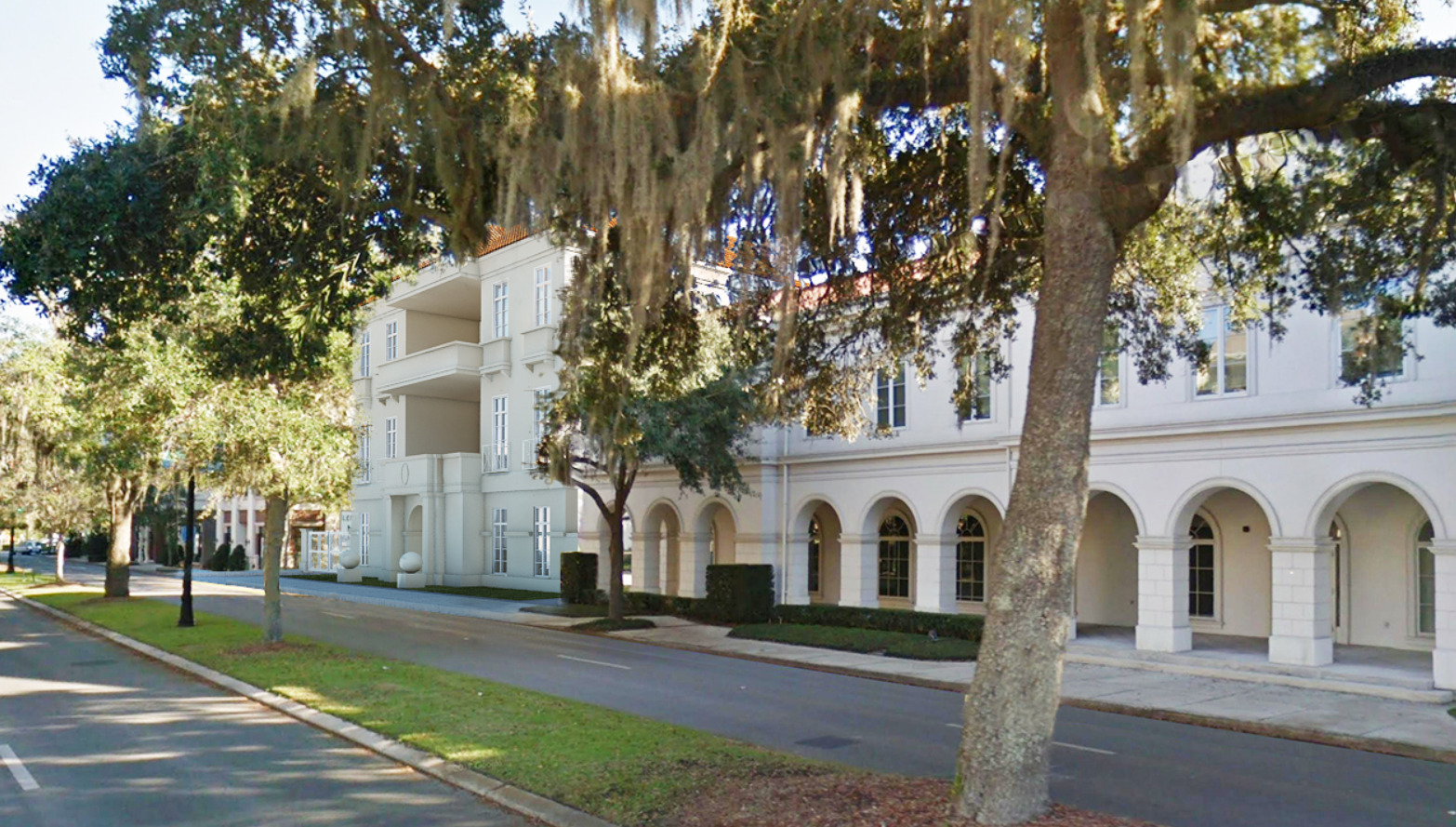
Smith Barney Building Will Convert to Condos
Developer Dan Bellows, representing Greenhouse Partnership Ltd., had a simple enough request. He sought to convert the Smith Barney office building at 338 W. Morse Blvd. into condominiums.
But Greenhouse didn’t want to rezone the property from office to medium-density residential to accomplish that. It wanted C-2 commercial zoning, even though no commercial use is contemplated at the site.
The owner got its wish, with a 4-1 Commission vote.
Why Commercial Zoning?
C-2 commercial zoning, it turns out, entitles the owner to much more than R-3 residential ever could. Building intensity can be almost twice what R-3 allows. The developer even could pave over the entire parcel — although Bellows assured commissioners that was not his intention. C-2 also would let the owner avoid the pesky city rule prohibiting short-term rentals such as VRBO or Airbnb.
Bellows said the office building will be converted to five residential condominiums, each with an attached garage that will have a second-floor guest suite. He also plans to build a new three-story building with three residential condominiums in the parking lot next to the existing building.
According to the City Planning Staff report, Greenhouse Partnership Ltd. wants the zoning change to make the property more economically viable, Even though the exclusively residential project could just as easily achieve economic viability if it were zoned medium-density residential R-3.
Staff’s Not Sure Why It’s Still Zoned Office – Except, It’s an Office
The existing two-story office building was built in 1998 and was leased to Smith Barney. In keeping with its intended use, the building was zoned O-2 for office. After Smith Barney merged with Morgan Stanley in late 2012, they moved their offices to a different location. Another tenant leased the first floor, but the second floor has remained vacant.
According to the staff report presented at the meeting: “For whatever reason, this property on Morse Blvd. was excluded from being eligible for CBD [Central Business District] future land use and C-2 zoning. The staff has no specific recollection of the rationale but assume that the authors felt the property was developed with the Smith Barney office building and did not envision another redevelopment scenario.”
The Guy across the Street Got Commercial
But right across the street, architect-developer Phil Kean is completing a townhome development that is designated CBD and C-2, although it is not clear if any of that development will include commercial use. In fact, all of the other properties on Morse, from New York to Capen, are eligible for C-2 zoning. Of course, all those properties include some commercial use, except for Park West condos, which are residential.
Staff’s Not Sure Why It Shouldn’t Be Residential
The staff report stated: “It is interesting that this project, while requesting commercial designations, is actually an R-3 multi-family project, with two variances. Unless the condo owners are planning to use their units for Air B&B’s (sic) or VRBOs, this could just as easily be done via R-3 zoning with no changes to the Comp Plan or Zoning text.”
But if Phil Kean could get CBD/C-2, Dan Bellows thought he should get it, too.
The Commission voted to change the zoning along with the Comprehensive Plan for Future Land Use, with Commissioner Carolyn Cooper casting the dissenting vote.
Discussion Resumes at the End of the Meeting
Even though they had reached a final decision, commissioners rehashed the project again in their discussion period at the end of the meeting.
Commissioner Carolyn Cooper was concerned that, by approving C-2 zoning for a residential project, the Commission had just created future entitlements that far exceed the scale and character appropriate for that section of Morse Blvd.
Commissioner Peter Weldon pointed out the need for the Commission to remain flexible to see where the market forces might take us. “The market drives to what, in the end, becomes the result,” said Weldon. ”And we, as a commission, have to be flexible to recognize where the market realistically addresses the character we’re all trying to create.”
Mayor Steve Leary also did not share Cooper’s concerns, and stated, “I believe we should have the flexibility to hear from our property owners on every one of their applications and not create any barriers to them asking the question.”
Commissioner Cooper’s response is worth watching.
Mixed Use Zoning
Mixed Use Zoning
Coming Soon to Orange Avenue
Orange Avenue may be in line for a major facelift. There is even a chance we will finally see some progress at Progress Point. What’s going on?
Commissioners met early on the morning of July 10 to discuss Mixed Use zoning on Orange Avenue. The discussion was led by Planning Director Dori Stone. The purpose of the meeting, said Stone, was to “discuss . . . the development of a Mixed Use Future Land Use category and companion zoning district.”
City Codes Already Permit Mixed Use Development.
Mixed Use districts are not new to Winter Park. Successful examples are Park Avenue, Hannibal Square and Winter Park Village. These districts are low intensity, a product of historic development patterns and are of walkable pedestrian scale. All have some form of shared parking. And what draws people to all three areas and persuades them to leave their cars for a while is open, visible, accessible green space with park amenities and plenty of trees.
So, why not stick with what we have?
Presently, Mixed Use zoning is allowed in certain areas — mostly downtown. The Commission’s discussion was about gateway corridors that are not part of the downtown Central Business District. The main gateway corridors — 17-92 from the north and south and Aloma / Fairbanks from the east and west – are crying out for Mixed Use. As they are now, these roads are better suited to fast cars than they are to foot traffic. To accommodate those cars that do occasionally stop, surface parking consumes a large, usually over-heated area – again, not friendly to folks on foot. Would the City be better served to create incentives in these areas for developers who would like to show some love to these unlovely corridors and create some attractive human-scale development that would draw some pedestrian and bicycle traffic?
Why Not Start with West Fairbanks?
After all the millions spent on sewers, lighting, repaving and undergrounding on West Fairbanks, wouldn’t this be the logical place for a Mixed Use pilot program? Instead, the City has chosen to tackle a more manageable corridor – Orange Avenue. According to Florida Department of Transportation (FDOT) figures, Orange Avenue carries about 15,600 cars each day. Compare that with Aloma, which carries as many as 46,000 cars a day. FDOT website notes these figures are 10 years old – so today’s counts are possibly higher.
Orange Ave. Property Owners Have Repeatedly Approached the City
When she was asked why the City chose Orange Avenue for what will probably become a Mixed Use pilot project, Planning Director Dori Stone wrote in an email, “Staff has done quite a bit of work on Orange Avenue already and it seems a natural choice with large property owners along the Orange Avenue corridor that are interested in working with the city.”
According to Stone, over the past 18 months or so, the City has been working with property owners like Mary Demetree, Roger Holler, Jewett Orthopaedic, Lumber Yard LLC and, not least, the City of Winter Park to determine what can be done to create a ‘sense of place’ along Orange Avenue that would make it compatible with the rest of Winter Park.
Developers Seek ‘Flexibility’ Beyond Current Limits
In a memorandum prepared for the July 10 Commission work session, Stone wrote, “Many of the larger property owners would like to see the flexibility to move beyond the commercial development limits of an FAR (floor-area ratio) of 45 to 60 percent.” She continued: “. . .several of them are interested in making improvements that would provide infrastructure and open space improvements along the corridor that may not be limited to their property, but would benefit the entire city.”
‘Trickle Down’ Development
The theory is that if the City grants these developers greater density and intensity, in return they would cooperate with one another to create a pedestrian-friendly environment with more open green space and park amenities, improved traffic circulation and shared parking within the zone of the pilot project. In this way, substantial benefit would accrue to all the citizens.
Mixed Use Overlay
Stone is suggesting a Mixed Use zoning category called an ‘Overlay.’ The Overlay zoning would “sit on top of the current zoning.” In essence, this would enable a developer who wants Mixed Use to build it, while a present or future landowner whose property does not conform to Mixed Use and who does not want to redevelop could continue to operate within the existing zoning guidelines.
“The City Needs to Take the Lead”
Stone pointed out that the main reason Hannibal Square is so successful is that at the outset, there was a professionally produced master plan. She urged the City to engage an urban designer to create such a master plan for Orange Avenue – before any code is written or any development is approved.
Stone noted that both Hannibal Square and Winter Park Village had a single developer, so there is a certain homogenous quality to them that would not be present on Orange Avenue, which has several large landowners. Nonetheless, this is an opportunity to create another district within the City that has a distinct identity. Rather than approving projects one-by-one on a piecemeal basis, here is a chance to create a neighborhood with continuity and its own sense of place.
Comfort Zone is 10,000-Sqare-Feet
As the City embarks on formulating standards for Mixed Use, we should not lose sight of the fact that currently, any building over 10,000 square feet requires Conditional Use approval. The City’s comfort level with the size of a building has a well-defined limit – and the body politic has felt strongly enough to articulate it in the Comprehensive Plan and to require a developer to participate in a public hearing process to obtain approval to build anything that exceeds that limit.
How Far are We Willing to Move Out of Our Comfort Zone?
That Conditional Use provision has identified our comfort level. Will we be able to reconcile mixed use standards that allow buildings that large or larger as a matter of entitlement — without public hearing or input? Depending on how it is written, Winter Park’s Mixed Use overlay can end up looking like Winter Park Village – or it could look like Mills 50, both of which are successful Mixed Use developments.
From the Winter Park Comprehensive Plan:
Sec. 58-61, Establishment of Districts, article (a) (5)
“The city has developed over the years as a city with a unique character and environment. Since a primary goal of the city is to retain this environment as much as possible, this article must impose certain extraordinary restrictions on the use of land within the corporate limits of the city to insure that future development is in keeping with the existing development.“
Aloma Townhome Development Reverts to Single Family
Aloma Townhome Development Reverts to Single Family
Ansaka LLC Does a Graceful Pivot
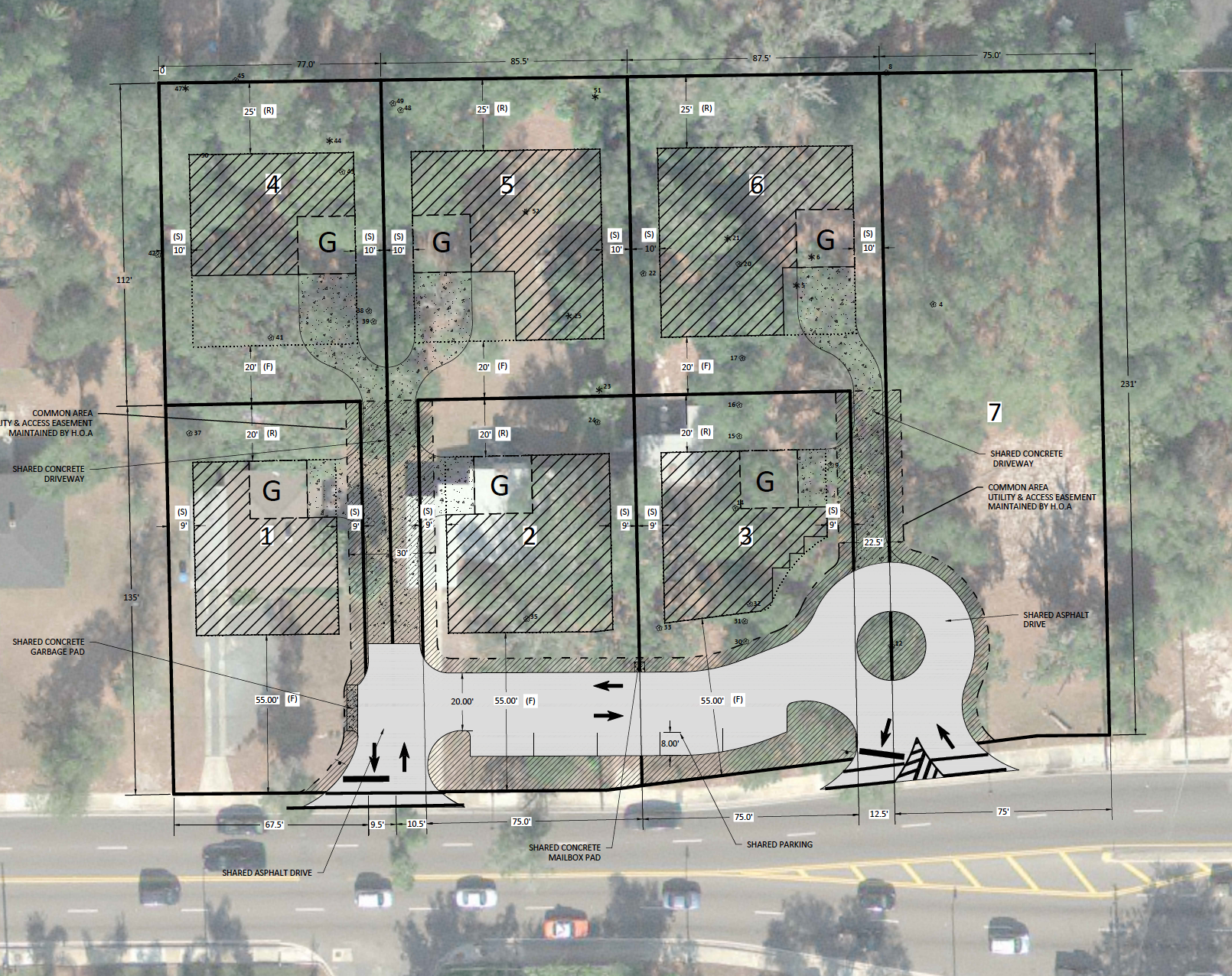
Ansaka LLC, the developer who made bright yellow ‘No Density’ signs sprout like daffodils from lawns along Aloma last April, returned to P&Z July 10 with a request to subdivide 1.45 acres of the property into six single-family building lots.
Neighbors Balk at 18 Townhomes
In April, Ansaka appealed to the City for Comprehensive Plan future land use and zoning changes to build 18 residential townhouses on the north side of Aloma Avenue between Lakemont and Phelps. City staff and the Planning & Zoning Board gave the project a thumbs up. When the project came before the Commission on April 9, however, neighbors’ concerns had manifested in the form of bright yellow “No Density” signs, and 24 residents spoke in opposition to the project. The Commission voted to table the item, giving the developer, Andrew Ryan, time to regroup.
Application Tabled
Ryan subsequently met individually with each Commissioner and with the design team to come up with an alternate plan. Ryan also heeded neighbors’ concerns in coming up with what he called “the most conservative pivot plan available.”
Graceful Pivot to Plan B
Ansaka now proposes to replat the entire property, which includes 1.45 acres zoned R1A, single family, and approximately 17,700 square feet of land zoned O2, office. The R1A portion of the property, measuring 250’ x 250’, will be subdivided into six single-family building lots. The office zoned portion will be developed at a later date, but was included in the replat so that future users would have access to the common drive, which provides safe access to Aloma.
The six-lot single-family subdivision will have three lots to the south, toward Aloma, and three lots directly behind them to the north. The lots will have shared driveways and parking.
Approval Recommended
The City Planning staff recommended approval of the redesigned development, stating it will be “. . .good for Winter Park, its residents and the neighboring community.” The plan maintains current zoning, allows an access easement for the commercial property to improve future traffic patterns, preserves existing heritage live oak trees and incorporates street trees that will enhance the Aloma frontage.
In the next step, Ansaka will request approval from the Winter Park City Commission.
Local Developers Make Good Neighbors
This is the second developer this year – the other being Zane Williams of Z Properties — to run the gamut of public scrutiny and come to the City with an application that takes into account the needs and wishes of the entire community. Served well are the neighborhoods in which they seek to build, the neighbors, the City, the Comprehensive Plan – and the developers themselves. Both developers are Winter Park residents who exhibit an understanding for and sensitivity to what Winter Park is all about.
See the entire plan here. Graphic above is on page 32.
Recent Comments