
How Many Winter Park Students are Vaccinated? Good Luck to Parents Who Want to Know
Florida no longer publishes vaccine rates for individual schools, leaving the public without data to identify areas vulnerable to outbreaks
Sept. 29, 2025
Note: This story originally appeared in the Orlando Sentinel with reporting contributed by the Winter Park Voice. The Voice and the Sentinel are part of the News Collaborative of Central Florida, a group of 10 local news outlets working towards a more informed and engaged region.
By Annie Martin, Orlando Sentinel
Florida is no longer publishing vaccination rates for individual public school campuses, leaving the public without a key piece of information to protect children as state leaders say they intend to end longstanding requirements for students to get shots.
While vaccination data is still available county by county, the state’s failure to provide more localized numbers could mask geographic pockets where immunization rates are particularly low, putting people in those areas at risk from an outbreak, public health experts say.
“When it comes to vaccine-preventable diseases, what really matters is the community that your child is in every day,” said Jason Salemi, a professor at the University of South Florida’s Department of Epidemiology, explaining the value of school-level vaccination data.
It’s not clear why the Florida Department of Health, which previously compiled and published this data, no longer makes it available. The most recent data available is from January 2023, just after Gov. Ron DeSantis was elected to his second term. The health department did not respond to an inquiry from the Orlando Sentinel.
But the reporting change comes as Florida county and state vaccination rates have been dropping for years. Parents have increasingly obtained religious exemptions that allow their children to avoid requirements to obtain key vaccinations in order to attend school.
DeSantis and Ladapo said on Sept. 3 they want to jettison vaccine requirements altogether, though eliminating some of the required shots will require action from the Legislature and it’s not clear whether DeSantis and Ladapo will get the support they need.
Last school year, less than 89% of Florida public and private school kindergarteners were fully immunized, continuing a steep decline since the pandemic. That rate is well below the 95% level, sometimes referred to as herd immunity, which makes it unlikely that a single infection will spark a disease cluster or outbreak.
School-age children who aren’t vaccinated risk transmitting disease not only to their classmates at school but people in other public areas they frequent, such as grocery stores and parks. Areas with low vaccination rates can be particularly risky for children too young to be vaccinated, the elderly and immunocompromised people, said Dr. Jennifer Takagishi, the vice president for Florida’s chapter of the American Academy of Pediatrics.
The campus-level data is especially important for parents choosing where their children should attend school, she said.
“If we want parents to make informed decisions about their child and their risk, they need to have the information to make those kinds of decisions,” said Takagishi, who is based in Tampa. “If their school has a very low vaccination rate, that’s maybe not going to be the right school for their child anymore.”
When an Orlando Sentinel reporter recently requested school-by-school vaccination data from health officials in Central Florida counties, agency spokespeople offered nearly identical responses, saying the state provides only countywide rates and suggesting the reporter contact the local school districts for data on individual campuses.
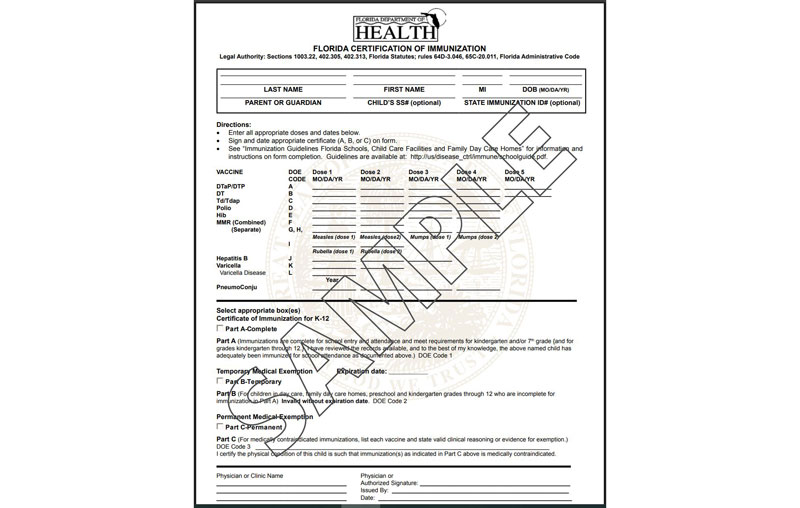
But when the reporter requested school-level data from four Central Florida districts, only Lake County provided the vaccination and exemption rates for each campus for the current school year. Public information officers for the Orange, Osceola and Seminole school districts said they didn’t have this data, though parents currently must submit proof that their child is up-to-date on vaccines or has obtained an exemption when they register for school.
Though vaccination has become a political issue across Florida, with mostly Republicans pushing to end state-mandated shots, Health Department data shows parents in right-leaning counties are not necessarily more likely to obtain exemptions than their counterparts in more liberal areas of the state. In rural Taylor County, for example, where 64% of voters are registered as Republicans, 97% of last year’s kindergartners were vaccinated. And one of the state’s bluest areas, Broward County, reported one of the lowest vaccination rates, with just 82% of children starting kindergarten with all of their shots.
But campus-level data from the Lake school district illustrates how reporting only countywide rates can mask pockets where vaccination rates are particularly low.
At Leesburg Elementary School, for example, more than 95% of students were fully vaccinated. But at Astatula Elementary, just 82% had received their shots, according to the data provided by the district. That campus, in a rural area south of Tavares, has 17% of its students claiming exemptions, meaning they didn’t need to provide proof of immunization to register for school.
Researchers, public health workers and school administrators all have good reasons to want to know whether most students on an individual campus have received their shots, Salemi said.
“The goal of data like this would not be to single out or ostracise parents or schools or children,” he said. “It’s just about prevention.”
Overall, kindergarteners in nearly every Central Florida county were less likely to be vaccinated than the state average. Orange posted the lowest rate in the Central Florida region, with slightly more than 85% of kindergartners having all their shots, four percent below the state average.
Andrea Rice’s children, ages 3 years and 5 months old, are still years away from starting school, but Florida’s stance on vaccines has already prompted her to consider leaving the community where she grew up. She said she thinks people have forgotten about the dangers of once-common diseases like measles and polio because they were eliminated by vaccines.
Now measles has made a comeback, with more than 1,500 cases reported across the country this year and she fears other viruses could, too. Whooping cough, for example, often results in hospitalization or even death in infants.
And knowing how many kids at her children’s schools would provide a valuable piece of information, the Winter Springs mom said.
“Data saves lives and it has gotten us to where we are, to where the first time ever, the majority of kids reach adulthood,” Rice said.
Winter Park Voice Editor Beth Kassab contributed to this report.
As a parent it is my responsibility to “protect” my children as are our health departments (local to national), to provide pertinent information about the health of the public records.
My taxes are used to make this public knowledge.
In addition, as a parent, would I intentionally send my child to school or other public institution if I knew a high percentage of folks were well? or sick?
Information about the “health” of a school and access to this information secures trust in those who my tax dollars were used to hire and keep me informed.
We must demand our “health information” be made available in a collective manner so we, as parents (and the public) can make valuable decisions to safeguard our young ones and ourselves.
Somehow all of us Boomers survived without this information available to our parents about our fellow students!
I’m not sure you’re drawing an appropriate comparison. The Boomers were a generation whose parents were grateful or at least accepting of inoculating their children from diseases. This generation helped stamp out polio, measles and more. It was a victory for public health. And the information absolutely was available … it may not have been online until the last 25 or so years, but it was there for those who wanted access.
Respectively,
Worrying about your kid’s fellow student’s vaccine status was most definitely not a topic of concern for parents in the 60’s and 70’s. Available information or not, it was not an issue.
Yes, most students got the required vaccines without any issues from the parents.
Exactly my point. Misinformation did not spread like a wildfire. Diseases were being eradicated. Not brought back. So, yeah, less need for parents to worry back then. The facts today: There was a measles outbreak at a Broward County elementary school in 2024. Another case this year popped up at a Miami high school. State leaders are moving to end vaccine requirements for schools. Florida already has a broad and lenient religious exemption policy in place. I’m a journalist, but also a parent with children in K-12 school. I know how fast the flu, colds and covid spread in that environment. Another fact: our children also run drills on the regular during the school day to practice hiding and/or fleeing from gunmen. I don’t think it’s asking too much for parents to have basic data about the vaccine rates at their school to make informed choices about at least one preventative safety measure that we can control.
Your anti vaccine choice bias is disappointing. Your article assumes that the vaccinated kids are healthier and pose less of a risk. In reality, data has shown that unvaccinated children are significantly healthier. I wish I had this data when my children were growing up.
Took me about 30 seconds to find the “data” to which you are likely referring to. And another 30 to determine it was bunk. There is no proof of such a claim. This is another bit of misinformation floating around.
Please cite the study that supports your conclusions. Did it come from a scientifically peer-reviewed journal? Were the research procedures carried out in a customary manner for epidemiological studies? Were the authors of the study trained in this field?