
Lot Split Request Puts Future of Gamble Rogers Estate in Question
Lakefront lot splits are against Winter Park policy. But the prospective owner of the largest lot on the city’s esteemed chain of lakes says the alternative could be worse — a residence so large it dwarfs the Library & Events Center
Feb. 7, 2026
By Beth Kassab
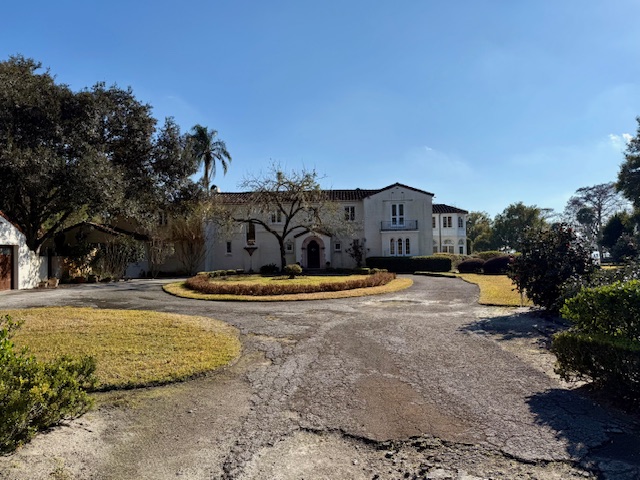
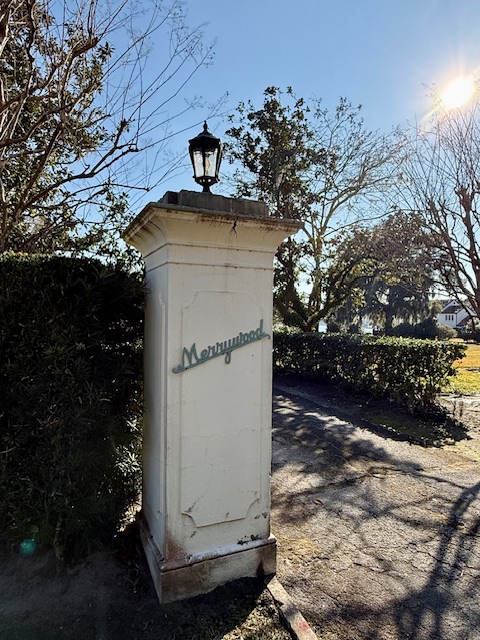
The fate of 1020 Palmer Avenue — a once-grand home and among the largest and most ornate ever designed by James Gamble Rogers II (think velvet-covered handrails) and known in recent years as “Merrywood” — appears to hinge on whether a unicorn buyer emerges to save the property.
Such a feat would take not only millions of dollars, but also approval from city officials to break one of Winter Park’s cardinal development rules: No lakefront lot splits allowed.
Tara Tedrow, the prospective buyer who has the property under contract, is asking for an exception to that rule to allow the 3.67-acre lot — the largest property on the picturesque Winter Park Chain of Lakes — to be divided into two lots on Lake Osceola. Each lot, she said, would be at least 150 feet wide and 1.5 acres or larger.
Zillow estimates the property at $12.1 million while other estimates, such as Redfin, list it at $6.4 million.
Tedrow, a land-use attorney at Lowndes who also used to practice cannabis law there, could then potentially sell the lot with the existing home and build a new home for her family on the newly created lakefront lot. The exception would be written in such a way that it would apply only to her lot and no others, according to city staff, because the lot Tedrow wants to purchase is the only one large enough.
While she told the Planning & Zoning Board earlier this week that she believes the currently vacant home is beyond repair, she said she is open to talking with buyers interested in restoring the 7,000-square-foot structure, which dates back to 1940.
She also met with Betsy Owens, granddaughter of Gamble Rogers and leader of the Casa Feliz Historic Home Museum — a Gamble Rogers home and now a popular event space that was famously moved from Interlachen Avenue to just off the ninth fairway of the Winter Park Nine 25 years ago after it was threatened with demolition.
“I’m certain if I’m not in the picture, that the house will get torn down,” Tedrow told the P&Z board earlier this week of the Palmer Avenue home.
The house at 1020 Palmer Avenue is not on the city’s historic register because the longtime owners chose to keep it off. It could be destroyed with a simple demolition permit. However, the property is listed on the Florida Master Site File, a state database of historical and cultural resources, which means the city’s Historic Preservation Board could delay a demolition request for 90 days to allow time to consider alternatives or ways to preserve pieces of the home.
The P&Z board voted 4–2 on Tuesday to grant Tedrow’s request to delay the hearing on the lot split until June — so far, there is no demolition request — to give her time to see whether anyone comes forward who may be interested in restoring the property.
“We appreciate the opportunity to present this case to the city and to hear from our neighbors and members of the historic preservation community,” Tedrow told the Voice. “Having grown up in Winter Park, I appreciate just how unique and beautiful the city is. As I am expecting my third baby in three years, I want more than ever to move back to Winter Park.”
Alex Stringfellow, Bill Segal, David Bornstein, and Charles Steinberg voted in favor of granting the continuance.
Jason Johnson, chairman of the P&Z board, and board member Michael Dick voted against continuing the hearing on the lot split. Both expressed skepticism that a lot split — which would require a change to the comprehensive plan that governs how the city will develop in coming years — should be granted.
The rule states that a property owner cannot divide a lakefront parcel into two and build a house on each one. Such splits would increase density and development along the shorelines of the city’s lakes and decrease the diversity of lot sizes central to the city’s unique character.
The only exception in the plan — which does not apply in this case — is when there is a lakefront lot with a house that is historically designated and older than 1950, and the lot split does not create a new lakefront lot, said Planning & Zoning Director Allison McGillis. In such a case, which occurred last year with another Gamble Rogers house on North Park Avenue, one lot remained on the lakefront while the newly created lot was not on the water.
McGillis told the board she has heard from residents in the area who have concerns about a potential lot split.
“I’ve gotten questions about the fate of the house,” she said. “Most people I’ve talked with want to preserve the Gamble Rogers house because there are not many of them left.”
While splitting the lot does not guarantee that the home would be preserved, Tedrow said a potentially worse outcome could be on the horizon if a lot split is not granted.
Because of the size of the lot, a buyer could demolish the old home and would be entitled to build a new house as large as 56,000 square feet.
“The largest home in the city has a gross floor area of over 36,000 square feet — this 3.67-acre property is legally entitled to have a home 55% larger,” Tedrow told the Voice in an email. “To further put this into perspective, the city’s new library and event space total around 50,000 square feet. The home that could be built at 1020 Palmer Avenue under today’s Comprehensive Plan would be larger than both buildings combined on the city’s library campus and would dwarf every home in Winter Park.”
Such a house would also dwarf the home of Marc and Sharon Hagle, who spent years constructing the largest residence in Winter Park — the one Tedrow mentioned that is 36,000 square feet — just a few doors down Palmer Avenue.
“I think there are some buyers out there who might do that,” she told P&Z members. “I’m not that buyer. So maybe we flip this to somebody else …”
Owens, who also attended the meeting, said she appreciates that Tedrow came to Casa Feliz and is considering ways to find a buyer who might be willing to restore the home.
“We appreciate her willingness to work with us,” Owens said.
The property was most recently the home of Dr. Raymond Gilmer, an orthopedic surgeon who died in 2020 at age 90, and his wife, Sarah, who purchased it in 1977.
The home is now vacant and owned by the couple’s children. Tedrow said the family decided to keep the property off the historic register in case the land would be worth more with the potential for demolition.
There is no publicly available list price because Tedrow offered a contract on the property before it hit the MLS.
She said the price of the existing house would depend on the exact configuration of a potential lot split, if approved, and other factors.
The house was featured as one of about a dozen properties in a 2004 book celebrating the architecture of Gamble Rogers in Winter Park by Patrick and Debra McClane.
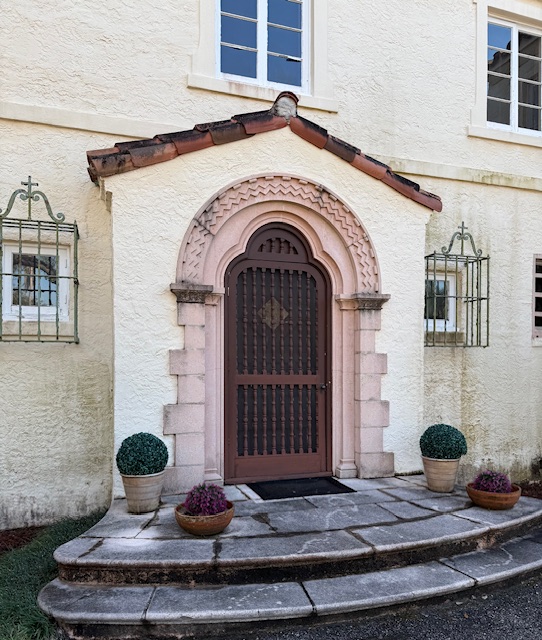
“The initial series of interior spaces is unusual for a residence and more closely resembles a hotel or theater entry in that a lobby is provided, which is flanked by a coat room and a powder room,” reads the section on the property, referred to as the Plant House for its original owner. “Stepping up from the lobby, one then enters a large entrance hall nearly 45 feet in length. Triple arched openings on the south wall of the hall — with a fixed window in the center and double-leaf, multiplane doors on the sides — lead to the loggia and then the sunken patio, with Lake Osceola beyond.”
The house boasted features such as “floor buttons” in the dining areas that rang to wait staff in the kitchen, as well as “ornate wrought-iron railings and balusters [that] lined the staircase, and a velvet-covered handrail … provided on the interior wall.”
Jack Rogers, architect and son of Gamble Rogers, told the Voice last year that there are fewer than 10 true examples of his father’s work left in Winter Park as more are torn down every year.
“There’s probably 15 or 20 left, and eight or 10 are absolutely precious, and we seem to be losing them at the rate of one or two a year,” Rogers said. “We still have several wonderful examples.”
WinterParkVoiceEditor@gmail.com
Update: The original version of this story noted cannabis law as a part of Tedrow’s law practice. She no longer practices in that area.
I’m wondering given the larger dramas in our society that this decision, one way or the other, really makes any difference for the Winter Park community. I mean, how many people will be affected by this? Maybe a dozen? There is so much more to worry about and try to fix in our community that impact more residents.
Disagree. Policy decisions about who gets to break the rules and for what reason can have an impact on the entire city. There’s also the question of whether these decisions could lead (or not) to the loss of a historical asset in the city. These are issues in the public interest. If we start ignoring stories because another one seems more important then that’s a fool’s errand as something else is always more important to someone else. The mission of a news site is to take a more comprehensive view than that. Readers can decide if a story is important to them and, if not, move on. But when something out of the ordinary is happening, it’s our job to make information available to the best of our ability.
I think I miscommunicated in my comment above. I find the article in the WPV very important and informative. What has frustrated me is that Winter Park has gentrified and I have had to deal with nonstop construction around my small home for the past ten years and it has been a mess. That is why I am apathetic to whatever happens here as mansions block the sun that I used to see. But the article is a good one.
Beth, the issue is never who gets to break the rules. It is always whether the rules make any sense. Further, an “historical asset” is in the mind of the beholder and only the property owner has a right to that designation for their property.
The house is on the Florida Site Master File. That’s a database kept by the state of Florida of historical and cultural resources. So, no Pete, facts are not in the “mind of the beholder.” And I can very much assure you there’s almost always a story in who gets to break the rules or why the rules are broken. There are some basic principles of news value that we could go over if you need. I think the most important one for you to grasp right now is that facts are based in evidence and reality and can be shown to be true. You are one of my most loyal readers and I feel confident that if you continue to read the Voice you will begin to understand what facts are. I am here to help.
Beth, you don’t understand. The Florida Master Site File is a political operation. Anyone can add a property to that file. The purpose of the file is to create a political excuse for declaring a property “historic.”
I encourage you to research this.
See: https://winterparkperspective.org/2015/08/12/politics-of-historic-preservation/
I would love to see the Gamble Rogers house saved , but the real issue is why does city zoning permit a 55,000 square foot house on that lot . Isn’t one lakefront abomination on that street more than enough?
Having chosen Winter Park for its charm it is painful to see monstrous architectural abominations being built ridiculously close to their neighbors .
Charm takes many decades to develop and mere minutes to destroy .
100% agree!! You can’t preserve the charm of old Winter Park by allowing the building of mega mansions.
“Observer” makes a valid point. The rule about not splitting lake front lots is a bit of dogma added in the 2000’s. A more thoughtful policy would be to set lot split guidelines. In this case, the lot split would leave 2 lots averaging 1.8 acres. Note that 9 of 13 lots on the Isle of Sicily are less than 1.8 acres, as are the vast majority of lots on Lake Osceola.
OMG, I agree with this statement by Pete Weldon.
Is my hair on fire? ;-D
It is a well stated and rational idea. let’s keep developing our thoughts along this line.
Rules are rules. Split this one and it opens the door to split other properties. Before you know it the chain of lakes will be the condo chain of lakes.
I agree with Peter..Rules are rules. I also like what Steph Thomas wrote
“Charm takes many decades to develop and mere minutes to destroy.”
I thank the two P&Z members who voted against the continuance. Just recently a lake lot split was approved. Here comes the second one and more will follow. I do not know the answer as it is important to save this Gamble Rogers house and the Winter Park Charm.
“The house at 1020 Palmer Avenue is not on the city’s historic register because the longtime owners chose to keep it off. It could be destroyed with a simple demolition permit.” Longtime owners were smart.
Destroyed is an interesting way to describe a potential buyer choosing to exercise their private property rights. This isn’t communal property. I know some folks in WP wanted to subvert private property rights about 10 years ago with a mandatory preservation ordinance, but WP residents rejected the extremist position.
Perhaps it’s possible to make lot split approval contingent upon placement of the house on the Winter Park Historic Register. Also a deed restriction preventing demolition could be required. Save house, split lot, new not mega-house on a large piece of property.
I believe the existing house has to be demolished as it straddles both the proposed lots as split.
Since a smaller lot would mean a smaller house I would approve the split. I would not be in favor if it meant an additional lakefront lot, but it doesn’t, and I can think of at least three splits in addition to New York Ave.; Via Tuscany, Virginia Drive. And New England Ave. All of the original houses are still standing.
Yes, Ann, I totally agree. A wise lot split can actually maintain our residential character better than an overbuilt mega mansion. It has worked well in the past.
Many say “I hope they save the house.“
There is no “they.“ If people want this house to be saved “we” need to step up, probably with the money to do it as people did for Casa Feliz. Either as a community project or a private/public grant to the restoring owner.
I personally am all for the lot split, especially if it leads to the preservation of this historic house and a lovely new home for a local family. One new house on a 3-acre lot built to the minimum setbacks would be a disaster for this stretch of Palmer and for all of Winter Park. Is such a “home” really our image? 
Winter Park land is scarce and expensive. Every builder is going to maximize square footage allowed by code. The historic Winter Park of tasteful mansions set back on expansive parklike grounds is over and done. We have to deal with the new reality of scarce land and endless international wealth. 
This is why we need to stay true to the code and not split the lot. Ms. Tedrow says she needs the city of Winter Park to split the lot or there is a better-than-good chance that a 55,000 square foot Walmart-inspired McMansion will be built there. When did extortion become an acceptable negotiating strategy to achieve the outcome one desires?
This speaks to some big questions about our community.
Sixty-four years ago, a young Harvard-educated attorney earning $15,000 a year couldn’t stomach the prices on Palmer Avenue and retreated to Stirling Avenue, across the lake from Rollins. The story goes that $36,000 for a lakefront home on Palmer was out of reach; $29,000 was manageable. That was our mother and father.
Bear with me for a moment on art and scale. To a studied eye, the artistry of a Gamble Rogers home is undeniable. I struggle, however, to understand how 36,000 square feet serves any meaningful purpose. Not my monkey, not my circus. But there is a difference. When a home presents beautiful architecture to the community, it is, in my opinion, a selfless act of care. When a stacked white box is built behind a wall of greenery, the nice finishes are reserved solely for the occupants. Both choices are allowed in a free society. I simply wish more people chose the former.
Yes, this home can be restored to its former glory and be stunning. That is not speculation; it is fact, from someone who has lived in the trenches of this work and knows it well.
The mechanics of a lot split combined with preservation may be complex, perhaps even impossible. That decision rests with the Commission. Still, a review of satellite imagery and lot dimensions suggests it is spatially reasonable.
There is also a financial reality. A buyer willing to purchase this house, restore it at great expense, and do so on a smaller lot is rare—but they do exist, and they would be my hero.
Such an outcome would allow the current buyer to build their dream home while preserving a piece of architectural art—one that remains visible and meaningful to those who pass along Palmer Avenue, possibly for another century.
I agree with all you have said. There is so much money moving in from NY and CA who would think $12M for this estate to be a bargain, and have the money to renovate. This house doesn’t need to be demolished. It makes me so sad to think it will.
“The exception would be written in such a way that it would apply only to her lot and no others, according to city staff”. No thanks, better to have the rules hold once in a while, and people will stop bringing this endless string of after contract/purchase requests for “their own rules”
I would offer the following for consideration. Our client approached P&Z recently to split a long time family property on Lake Osceola into two lots and were denied. If this request is approved, this now opens the possibility for our clients property as well as others to receive like zoning approval. So the question becomes if this is what the City wants to occur over time that would change the historical beauty of the Winter Park Chain of Lakes for better or worse?
Mr. Nasrallah has a good point. Providing a significant lot change (split) may set precedent for future zoning asks on these trademark, lakefront properties.
Also, I personally dislike doing business with people who propose the “do this or else” offer. The buyer with her offer to the private party contingent on a zoning demand forbids a fair market opportunity to sell the property by excluding the open market.
In other words, her position (threat) that not honoring her request would open this land up to anyone suggests the likelihood another buyer would mow it down and erect a monstrosity per WP laws. That isn’t true. Without selling on an open market, the city commission will never know if that outcome is 100%. That’s really just a threat.
It’s a stunning property, I canvassed there for multiple candidates. The entrance is one of a kind.
I hope it’s saved in all its glory including the beautiful land it sits on.
Could the City offer a property tax benefit for an extended period in exchange for a renovation and historic designation?
Beth, no one is disputing that the house appears in the Florida Master Site File. The issue is what authority that listing actually carries.
The Master Site File is an inventory, not a preservation designation. It does not restrict demolition, override zoning, or impose obligations on a property owner. That’s not a matter of opinion, that is how the system is structured.
So the question remains the same one Peter raised: if a property was never locally designated, never protected by ordinance, and remains subject to existing zoning, on what basis should a private owner now be constrained beyond the rules in place at the time of purchase?
That’s a policy question, not a dispute over whether “facts exist.” Reasonable people can acknowledge the history of a structure while still insisting that property rights and predictable rules matter.
If Winter Park wants preservation outcomes, the solution is proactive designation, incentives, or acquisition, and not retroactive pressure when a lawful proposal surfaces.
I support approving the lot split because it represents a practical and balanced outcome under the law.
The property was purchased in good faith and is governed by existing zoning rules. Private property rights need to remain predictable if we expect people to invest responsibly in Winter Park. At the same time, it’s reasonable to acknowledge the home’s architectural history and the community’s interest in preserving what makes the city special. Those two values don’t have to be in conflict.
While the house appears in the Florida Master Site File, that listing functions as an inventory, not a preservation designation. It does not restrict demolition or override zoning. If the city or preservation advocates believed this structure warranted protection, the appropriate tools were local designation, incentives, or acquisition. Those steps weren’t taken, and it’s important to respect the legal framework that exists today.
It’s also worth noting that denying the lot split does not preserve the house. Under current zoning, the owner could legally demolish it and build a much larger single residence. Approving the split keeps more options available, including adaptive reuse or transfer to a preservation-minded buyer. From a practical standpoint, it offers a better chance for a thoughtful outcome than an outright denial.
More broadly, this case highlights an opportunity for Winter Park to refine how it balances historic preservation with private property rights going forward. Preservation works best when it is proactive, clearly defined, and supported by incentives that encourage cooperation. Aligning zoning and preservation policies so that reuse is easier than demolition would benefit both owners and the community.
This does not need to be framed as a zero-sum dispute. Respecting property rights, applying the rules consistently, and offering constructive pathways for preservation can coexist. Approving the lot split reflects that balance and sets a positive, predictable precedent for the city.
“Beth, no one is disputing that the house appears in the Florida Master Site File. The issue is what authority that listing actually carries.”
That is not the issue at all. It’s very clear. And it’s stated in the story. The listing means the state and others have flagged the property as having some historical or cultural value. It also means that any demo permit would got to the city’s Historic Preservation Board and the board has the authority to put a 90 day hold on the permit to explore alternatives. That’s in the code.
Not really sure why you are trying to frame this as a private property rights issue. The longtime owner exercised their right NOT to designate the property on the local register. That means the home can be torn down. Period. The prospective owner is asking for additional rights to split the lot and starting a conversation about whether anybody might be willing to save the property. The story explains all of this pretty clearly.
Beth, you misunderstand the source of listings on the “Florida Master File.” The file’s existence is a fact. The presence of properties on that list is entirely arbitrary. Anyone can submit a property for the list. The state has to include the property and there is no way to remove it. Historic preservation advocates who want to superseded property rights routinely add properties to the list in an effort to create a non-existent historic authority. You declined to approve my reply to your snarky post above that included a link documenting the details of the “Master File.” I hope you approve this post so our residents can have more relevant information. See: https://winterparkperspective.org/2015/08/12/politics-of-historic-preservation/
The list isn’t arbitrary. That’s such a misleading statement and I’m sure you know that. The list was created as an inventory of cultural and historical resources. Those who submit to the Florida Master Site File must submit a form and attachments such as photos, maps, plats etc. The state puts out a 33-page guide to submitting such forms. It’s all the website you want everyone to read. It’s not a political vehicle. It’s the way people have collected data on archeological sites, old cemeteries, old buildings, bridges etc for decades. It’s an excellent resource for researchers or those who are planning future development etc. As the story stated, the listing does not prevent demolition. But Winter Park’s city code references the file five or so times because it’s the best source available for certain information. The site file is maintained even though it doesn’t match with local and national historic registers. That’s by design. The file is intended to be a more comprehensive list. It’s all on the web site. As for why owners aren’t allowed to remove their properties? That’s by design, too. The File is intended to be a public and historical record. It’s updated as properties are changed or destroyed. Here’s what the state has to say about that:
“Q: Can a building be removed from the Site File at the owner’s request?
A: No. The FMSF holds public information gathered, processed, and organized partly or wholly at public expense. Granting such requests would be similar to deleting public tax records at the taxpayer’s request.”
Beth, please either remove your snarky reply to my post and apologize or post my reply to the snark. I welcome your factual rebuttal of this:
https://winterparkperspective.org/2026/02/15/politics-of-historic-preservation-2026/
Thank you for clarifying the procedural role of the Historic Preservation Board. No one disputes that the Master Site File listing can trigger review and a potential 90-day hold under the code.
Where I believe the discussion is broader is in how recognition and regulation intersect. Inclusion in the Master Site File acknowledges historical significance and allows time to explore alternatives, but it does not create permanent preservation status or override existing zoning. After that review period, demolition remains legally permissible unless the property is locally designated.
That’s why this becomes a policy conversation as much as a procedural one. When a property has not been formally designated and remains subject to existing zoning, it’s reasonable to discuss how preservation goals and property rights are balanced within the system.
Ultimately, I hope this case encourages Winter Park to align its preservation tools and zoning policies more intentionally so that expectations are clear for everyone. Predictability for property owners and thoughtful preservation planning do not have to be in conflict, but they do require proactive policy rather than reactive debate.
I agree with Beth on this one. She has the clearest understanding of the situation and its implications. Based on her detractors use of language and writing skills, I believe she’s being pursued by a gaggle of lawyers, and it’s worth noting that the proposed buyer is also a lawyer. Please do not split this property because someone wants to become wealthier.
How much do we realistically think this could sell for? It would need probably millions in restoration costs. I would still give everything I have for this home.