
Preempted Again. New FL Law Prohibits Cities from Protection Against Damage from Internet and Cable Companies
Plus, the ordinance allowing construction of five Habitat for Humanity homes in partnership with Orange County Public Schools gains first necessary approval
April 24, 2026
By Kathryn Brudzinski
Winter Park Mayor Sheila DeCiccio expressed frustration this week that the state government is, once again, impeding the city’s ability to govern itself.
This time officials said they had no choice but to toss out a pair of ordinances designed to protect city roads, pipes and other assets from damage that sometimes occurs when communications companies such as AT&T or Spectrum run underground lines.
The new rules, which were scheduled to be voted on by the City Commission this week and would have required a bond from communication companies to pay for potential damage to the public right of way, were modeled off similar ordinances in Winter Garden.
City pipes, irrigation systems and roads often take on damage when the private companies move overhead lines underground or install new lines.
But Gov. Ron DeSantis signed Senate Bill 488 into law on Tuesday.
The bill includes a provision that limits cities like Winter Park from enacting financial protections against damages and other requirements on communication companies. As a result, both Ordinance 455 and Ordinance 456 are now unable to move forward, leaving the city with no choice but to find another way to protect itself.
DeCiccio said it can often be difficult for the city to seek financial restitution for broken pipes and other problems that occur from the private companies’ construction. According to the staff report, Florida statutes previously allowed municipalities to hold utilities “responsible for any damage resulting from the installation or maintenance of such facilities.”
“However, the governor signed Senate Bill 488 just yesterday and that won’t allow this,” DeCiccio said. “So, we’re going to go back to the drawing board and see what we can do.”
Ryan Mathews, a lobbyist who represents Winter Park and other cities in Tallahassee, provided commissioners with an update on the recent legislative session and said the limitations on city governments was ”tucked” into a large transportation bill and hadn’t received much discussion.
“It’s not a problem unique to Winter Park,” Mathews, of the GrayRobinson firm, said. “We hear quite often that contractors who cause damage are very slow to, if at all, ultimately pay for that damage. It’s certainly an issue that is ongoing.”
In Tallahassee, he added, larger bill packages often see provisions placed in the latter part of the legislative session at which point “there is very little that can be done about it.”
Still, DeCiccio questioned what the city could’ve done to combat the efforts of communication company lobbyists to include the provision if it’d been known about ahead of time.
“We could have made calls, we could have had you lobby on our behalf, because this is really bad for the cities,” she said. “This isn’t just Winter Park, this is all cities. This is terrible for us, it does nothing to help us.”
In recent years, the Florida Legislature and DeSantis have taken other steps — often referred to as preemptions — to limit the powers of local governments. Cities and counties can no longer protect the rights of residential renters, can’t enforce worker protections such as rules to prevent heat stroke for those who labor outdoors, must enforce a statewide ban on homeless people who camp in public spaces and can no longer regulate the use of Styrofoam products or artificial turf.
Habitat for Humanity and OCPS housing project nets first approval
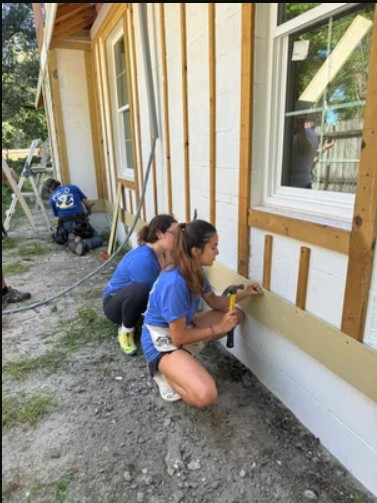
Commissioners unanimously approved a zoning change this week to allow five Habitat for Humanity homes for public school employees to be built on the former Orange Technical College campus.
Habitat for Humanity of Winter Park-Maitland will be responsible for the development of five houses on the back end of the property along Webster Avenue still owned by the Orange County School Board.
The move is part of a greater effort by Orange County Public Schools to offer affordable homes to workers faced with the county’s housing crisis. ,“The plan would be to divide that area of the property into five single family lots,” said Planning and Zoning director Allison McGillis. “The only hiccup with the proposal is that within the PQP zoning district, detached single family zoning units are not permitted. So, the Commission gave direction to staff to move forward with this ordinance.”
In addition to the zoning change to allow the homes to be constructed, the Winter Park City Commission also offered up to $200,000 in funding for funding of water, sewer and other utility infrastructure for the property. The money had originally been allocated to help Habitat acquire new lots for homes, but the commission pivoted to the partnership with OCPS as a result of soaring land prices in Winter Park.
Jeff Briggs, the city’s former planning director who serves as treasurer for the local Habitat organization, said the project is moving along and explained its lease would cover much of the information commissioners may still have queries about.
“It’s the lease that answers your questions — it commits this property only to be used for homes owned by Orange County public school employees,” Briggs explained. “So if it’s time to sell, then they’re going to sell and recycle to other Orange County public school employees. They also have to remain income qualified, which means they’re not going to sell for half a million dollars, because the income qualified person couldn’t afford that.”
WinterParkVoiceEditor@gmail.com
Yet Florida voters continue to elect these clowns. You get what you vote for. 😡
My experience has been that these companies tear up yards and leave the homeowner or city to fix their mess. I had one installer digging up our new plants and throwing them out of his way while looking for the buried box. He refused to replace them once he found the box and left a mess. I ended up calling the police department while he was on our property and they couldn’t figure out what to do and were useless despite some heated verbal exchanges and the fact that the installer was on our property past the easement by at least two feet which would be trespassing.
Elections have consequences. The current administration in Tallahassee continues to restrict how local municipalities can govern. For example “no property taxes” sounds great. But how do parks, streets, lakes, etc. get maintained?? Please keep this in mind when you vote in November.