by Anne Mooney | Jul 26, 2017 | Headline, News
News Update
No Medical Marijuana Dispensaries in WP
On June 9, 2017, the Florida Legislature passed Senate Bill 8A (SB 8A), the Medical Use of Marijuana Act, designed to establish regulations for the implementation of Amendment 2, which allows the sale of medical cannabis in the state of Florida.
Political Banana Peel
In what Commissioner Peter Weldon called a “political banana peel thrown under our feet,” the law makes county and municipal governments choose. Either they must treat medical marijuana dispensaries exactly the same way they treat pharmacies or they must ban them altogether.
Dispensaries Banned – For Now
On Monday, July 24, the Commission voted 4-1 to pass an ordinance banning medical cannabis dispensaries from the City of Winter Park. Commissioner Sarah Sprinkel cast the dissenting vote.
Medical Marijuana Supporters Seek to Overturn Law
Meanwhile, proponents of medical marijuana dispensaries are asking the courts to overturn the state law. If they are successful, adoption of the City ordinance automatically establishes a one-year moratorium, which would give the City time to understand the impact of the court ruling and to devise an alternative ordinance that would be in full compliance.
Editor’s Note: Readers wishing to comment on this latest development should scroll to the end of the full story and click the Comment link there.
Will of the Voters – Up In Smoke?
State Rules Restrict Medical Marijuana in FL Cities
July 26, 2017 / by Anne Mooney
 At a special work session July 25, the Planning & Zoning (P&Z) Board moved to request the Commission enact an ordinance “to prohibit medical marijuana treatment center dispensing facilities within the boundaries of the city . . . .”
If the Commission passes it, this ordinance will repeal and replace a 2014 ordinance, No. 2981-14, which would have permitted dispensaries of non-euphoric medical cannabis in limited industrial and warehouse districts within the city.
Winter Park is among 88 municipalities and four counties (Osceola, Sumpter, Hernando and Columbia) considering prohibitions, moratoriums or other restrictions on medical marijuana dispensaries.
Voters Want Medical Cannabis
On the November 8, 2016, ballot, Florida voters approved the Florida Medical Marijuana Legislation Initiative, also known as Amendment 2, with a decisive 71.3 percent of the vote. The measure went into effect January 3, 2017. The state legislature, however, neglected to establish the necessary rules and regulations for the implementation of Amendment 2 during their regular session.
House Speaker Wants to Make the Rules
House Speaker Richard Corcoran, however, objected to ceding power for making rules for implementation to the Florida Department of Health and called for a special legislative session to address medical marijuana legislation. “To just leave it to bureaucrats sitting over at the Department of Health,” he said, “I think would be a gross injustice.”
Gov. Scott: ‘Okay, Make the Rules’
On June 2, Governor Rick Scott called for a special session June 7 through June 9. He issued a statement, “Medical marijuana was approved by 71 percent of Florida voters in 2016, and I believe that it is the role of the Florida Legislature to determine how to best implement this approved constitutional amendment. I am glad that both the Florida Senate and House are moving toward crafting legislation to help patients, and I have added medical marijuana to the call for special session.”
Senate Writes the Rules . . .
On June 9, 2017, the Florida State Legislature passed Senate Bill 8A (SB 8A), the Medical Use of Marijuana Act, designed to establish regulations for the implementation of Amendment 2.
SB 8A defined the medical conditions that qualified a patient for medical marijuana. It placed a cap on the number of retail dispensaries and medical marijuana treatment centers until April 1, 2020. It banned smoking medical marijuana. It banned doctors with a financial interest in marijuana growing or testing facilities from prescribing marijuana. It levied no tax on medical marijuana.
Locals Implement the Rules . . .or Not
The law also gave local county and municipal governments a choice. Either they can regulate medical marijuana dispensaries exactly the same way they regulate pharmacies . . . or they can ban them.
In short, the only way to regulate them is to ban them completely.
Commission to Decide at July 24 Meeting.
To comment or read comments from others, click here →
by Anne Mooney | Jul 11, 2017 | Headline, News, Zoning and Development
News Update: New England Ave. Project Denied
by Anne Mooney
On a 5-0 vote last night, the Commission denied BFC Holdings’ application to build a 52,600 square-foot mixed use complex at 158 E. New England Ave.
Fuzzy Parking Math Still Not Cleared Up
The basis for denial was the applicant’s failure to offer sufficient mitigation for the 80- to 100-space parking deficit (the exact number depends on who’s counting and how). Even though the City was prepared to grant an unprecedented concession of requiring three parking spots per 1,000 square feet of office/retail space – all other Class A office buildings in Winter Park are required to provide four spaces per thousand – BFC Holdings still came up short.
CBD Parking Study Now in Progress
When this project was tabled at the March 27 Commission meeting, Planning Director Dori Stone observed that the City’s parking studies needed updating. The City has since hired a consultant, Kimley-Horn, who is now in the midst of a parking assessment of the Central Business District (CBD). Commissioners suggested that allowing this project to go forward with such a large parking variance before they have the study results would be premature.
If the Parking Code is Wrong, Why Is It Still In Place?
Commissioner Sarah Sprinkel objected to the Commission being asked to grant what amounts to a change in the parking code for a single applicant. “Why is the code still in place, even when you are now telling us it shouldn’t be?” asked Sprinkel.
‘Class A Office in the CBD Is Different’
At the March 27 Commission meeting, Planning Director Dori Stone asserted that Class A office space in the CBD operated differently from Class A office space in any other part of Winter Park and could, therefore, be supported by three spaces per 1,000 square feet.
‘What Is Class A Office, Anyway?’
At the July 10 meeting, Planning Manager Jeff Briggs stated that staff “was having difficulty coming up with an agreed-upon definition of Class A office space.” Parameters for size and other characteristics of everything from hallways to conference rooms, which would set ‘Class A’ apart from Classes B or C, apparently do not exist.
Can Valet Parking Promise Be Enforced?
Referring to the applicant’s assurances that all visitors to the new complex would be required to use valet parking, either in the New England Avenue building garage or in the Bank of America garage across the street, Commissioner Greg Seidel questioned how the requirement to use valet parking would be enforced.
Unless the applicant enforces the valet parking, it probably will not be enforced at all, since Winter Park employs only one parking enforcement officer for the entire City.
Time to Close This Chapter
Commissioners asked the applicant for compromise. “The building is lovely,” they all agreed, “but it’s too big.” Commissioner Peter Weldon said he thought it was time to “close the chapter” on the application in its current form, and he moved to deny. The other four Commissioners agreed.
Duck the Summer Heat & You’ll Miss All the Fun
BFC Holdings is Back with New England Ave. Project
July 8, 2017 / by Anne Mooney
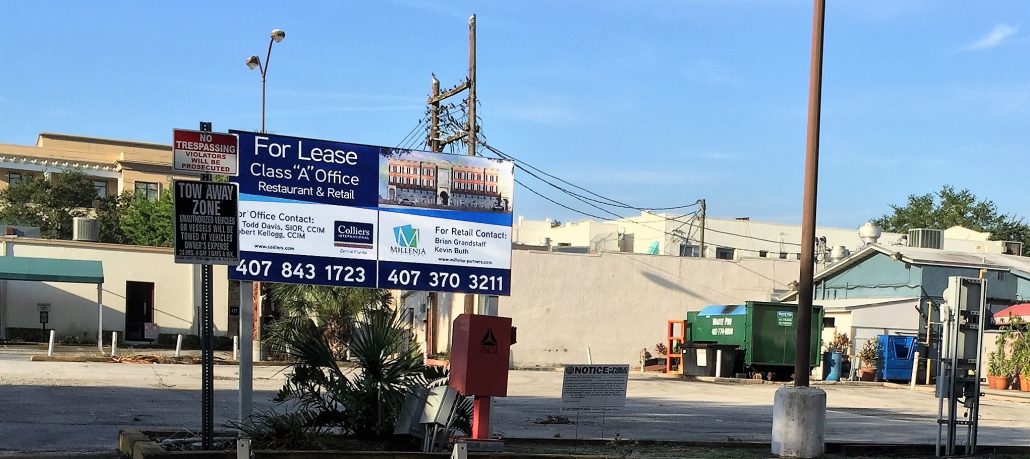
BFC Holdings will return to the Commission on Monday, July 10, with their proposal to build a 52,600 square-foot mixed use building at 158 East New England Avenue.
BFC Wants Big Variances
The proposal came before Planning & Zoning and then the Commission in March of this year. Neither body was able to reach a decision regarding the project, which requests variances for building height, third-floor setbacks and a significant parking deficit.
P&Z Can’t Decide
After hearing the application on March 7, P&Z was evenly divided, with a 3-3 vote. Rather than tabling again – as they had at the November 7, 2016 meeting — or denying the application, P&Z kicked it forward to the Commission.
Commission Can’t Decide
On March 27, the Commission couldn’t decide either. They were okay with the variance for 45 feet of building height, rather than the 40 feet permitted in C-2 zoning. They were also willing to go along with a vertical façade along Knowles Avenue with no setback or terracing on the third floor to break up the vertical mass of the 45-foot-high wall. But they just couldn’t solve the applicant’s fuzzy parking math. See Winter Park Sings the Parking Blues.
‘Back to the Drawing Board’
Concluding a meeting that lasted well beyond 10:00 p.m., the Commission unanimously voted to table the application, advising the applicant their project “was not ready for prime time,” and to “work things out” regarding the parking variances.
What’s Changed Since March 27th Meeting?
According to the July 10 Agenda Packet, City staff has “discussed parking issues and suggested changes with the applicant based on comments made by individual commissioners at the public hearing. However, the application is unchanged since the March 27th meeting.”
Only the Weather Has Changed
Apparently, the only things that have changed are the weather and the requirement for public notice. According to City Code, after a tabling the only people required to receive notice in the mail of a public hearing are property owners within 1,500 feet of the subject property. The hearing is, however, publicly advertised, as are all public meetings.
Form, Not Content
The application contains a draft Developer’s Agreement that was not included in the March 27th application. According to the Agenda Packet, the agreement incorporates approvals needed and commitments from the applicant made at the March 27th meeting. The draft, however, contains changes recommended by the City Attorney only “as to form but not content.”
Two Hearings Required for Approval
Since no decision was reached at three previous hearings, BFC still has to clear the hurdles. As a request for Conditional Use for a three-story building within the Central Business District, BFC’s application requires two more hearings. A July 10 Commission decision to approve the project would result in a second hearing July 24.
To comment or read comments from others, click here →
 At a special work session July 25, the Planning & Zoning (P&Z) Board moved to request the Commission enact an ordinance “to prohibit medical marijuana treatment center dispensing facilities within the boundaries of the city . . . .”
Recent Comments