
Downtown Security Barriers and Mead Gardens Pond Cleanup Land in State Budget
Gov. Ron DeSantis has said he expects to veto a number of projects but local lawmakers argue the money for two Winter Park line items should be spared
May 30, 2026
By Gabrielle Russon
The city of Winter Park is slated to get state money to help clean up Central Florida’s waterways and beef up security for public outdoor events as the Legislature approved the 2026-27 budget Friday.
State lawmakers passed a $114.5 billion spending plan that provides $500,000 for a Mead Gardens water project and $62,500 for Winter Park Police road barriers to keep vehicles from driving into crowds at festivals and other events.
Lawmakers inserted the pair of Winter Park projects into the state budget after they met behind closed doors this month to negotiate spending on everything from school funding, law enforcement and members’ pet projects during a special session this month.
The Legislature had failed to approve a budget — their only constitutional required job — during the 60-day regular session that ended in March.
Even though the Legislature approved the budget Friday, the money is not official for Winter Park until it survives Gov. Ron DeSantis’ veto pen.
DeSantis has been clear he wants to trim spending.
“It’s probably a safe assumption that when I’m done with my veto pen that it’ll be less than the current year budget,” DeSantis said this week about the next fiscal year starting July 1.
DeSantis also is open about how he weaponizes his veto power to punish lawmakers who don’t support his agenda.
“If the members are supporting good policy, then, you know, I see their budget items, that’s just something you take into account,” DeSantis said earlier this month at The Federalist Society.
Winter Park officials declined to comment for this story as they await DeSantis’ spending decisions, but the state lawmakers who advocated for the Winter Park project spoke to The Voice about why they feel the money is important.
Mead Gardens Pond Flows to Chain of Lakes
State lawmakers want to tackle cleaning up waterways by lowering nutrients like nitrogen and phosphorus that cause algae booms and destroy biodiversity.
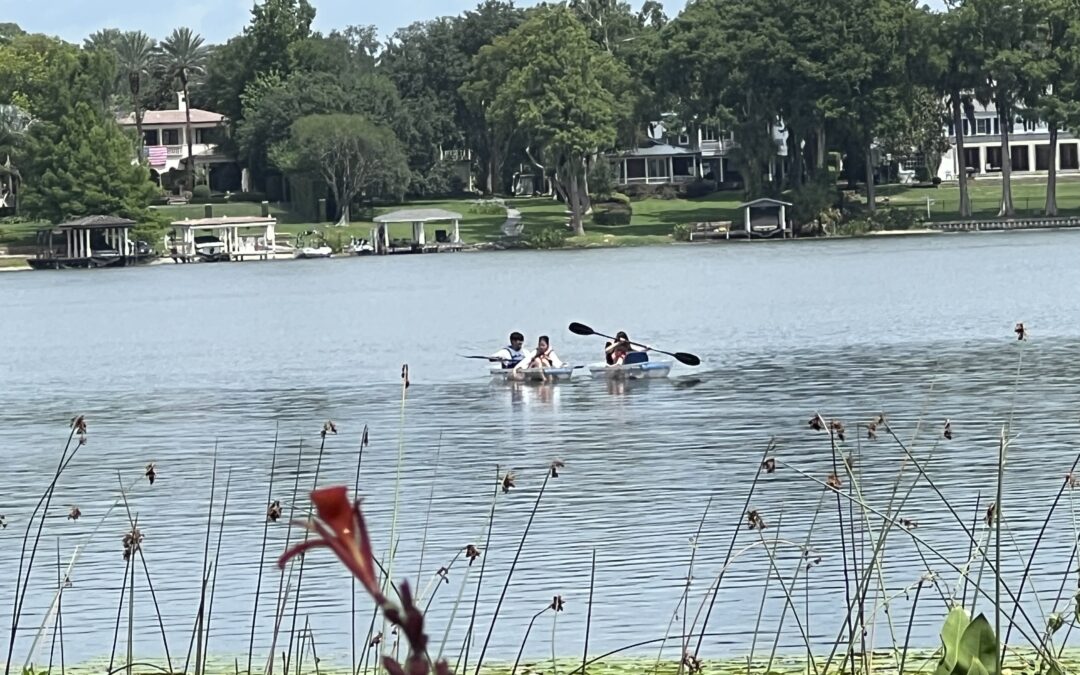
In the state budget, Winter Park would receive $500,000 to filter the excessive nutrients from Alice’s Pond in Mead Gardens as the Loch Haven Chain of Lakes flows into the Winter Park Chain of Lakes.
The funding request is a bipartisan effort from an influential Republican, state Sen. Jason Brodeur, and Democrat state Rep. Anna Eskamani. The two have a history of collaborating on water projects even though they are on opposite ends of the political spectrum.
“The Winter Park Chain of Lakes, its health impacts the health of all lakes in Central Florida,” Eskamani said.
Their project seeks to improve water quality throughout the interconnected lake systems of Winter Park and Maitland which are the headwaters to Lake Jesup and the St. Johns River, Florida’s longest river.
“People live on these water bodies and they’ve been there long enough to remember when it was actually a place you might actually want to swim or boat,” said Brodeur who grew up on Lake Jesup. “It gets gross because it gets overgrown with weeds and things that don’t belong there because the balance is out of whack with its nutrient load.”
Central Florida’s waterways play a big role in Florida’s ecosystem since three of the water management districts come together, Brodeur said.
“If a drop of rain falls somewhere in Central Florida, it could end up in Fort Myers, it could end up in the Everglades, it could end up in Jacksonville,” Brodeur said.
Keeping the waters clean is important to support local businesses and tourism because of a long list of water recreational activities, such as paddle boarding, rowing and boating, Eskamani added.
Street Barriers Would Help Protect Outdoor Crowds
Last year the city of Winter Park received $62,500 for the road barriers and now an additional $62,500 is included in the 2026-27 budget.
In the state House, Rep. David Smith sought the money both times even though Winter Park isn’t even in his district — Smith lives in Seminole County.
“One of the reasons that I supported the appropriation request not only last year but this year is, the city of Winter Park hosts a lot of street festivals,” Smith said. “So if we’re going to spend state money to protect pedestrians against a potential attack, that’s a legitimate use of state tax dollars.”
Each spring tens of thousands of people attend the three-day Winter Park Sidewalk Art Festival. Other popular events include charity runs down Park Avenue, beloved parades and more.
“Who doesn’t love the Winter Park Arts Festival?” said Brodeur, who handled the local funding request in the upper chamber. “We got people from all five surrounding counties driving in. We want to make sure they’re safe for events like that.”
Brodeur called the police barriers an important investment in the context of the region’s tourism industry.
“Very frequently people have the mindset, or at least local municipalities have the mindset that ‘We want this really cool toy, we’ll just ask the state for it,’” Brodeur said. “The state funding should be state taxpayers paying for something of regional interest. Now because Winter Park has so many events that draw so many from all over Central Florida and the whole state, this is a safety issue of regional interest.”
As he talked about the water clean up and police barriers, Brodeur also revived an argument that’s been debated in Central Florida for years. Should taxpayer money fund these projects? Or should tourists foot those bills with revenue from Orange County’s hotel tax?
“Should we expand what we can spend tourist development tax on? If the tourists that we’re bringing in and doing all these things for are the ones that are lining the coffers, shouldn’t we be doing more things for our residents besides expanding the convention center?” Brodeur said.
WinterParkVoiceEditor@gmail.com
Why in the world should the state pay for barriers in Winter Park? If we need them, the city should be paying for them. Not so sure about cleaning up the Mead gardens water, but I would think that too is a local project for funding not a state project. Sounds like pork to me.
Those barriers seem terribly expensive. Perhaps shopping around or find local carpenters who can do just as many excellent barriers for half the price.
The barriers aren’t made of wood! 🙂 They are specially designed to withstand heavy moving vehicles, not something you make in your garage.