
P&Z Board Approves Controversial Split of Lakefront Merrywood Lot
One board member called the outcome a ‘special favor’ for the buyer of the ornate estate that appears fated for the bulldozer
June 4, 2026
By Kathryn Brudzinski
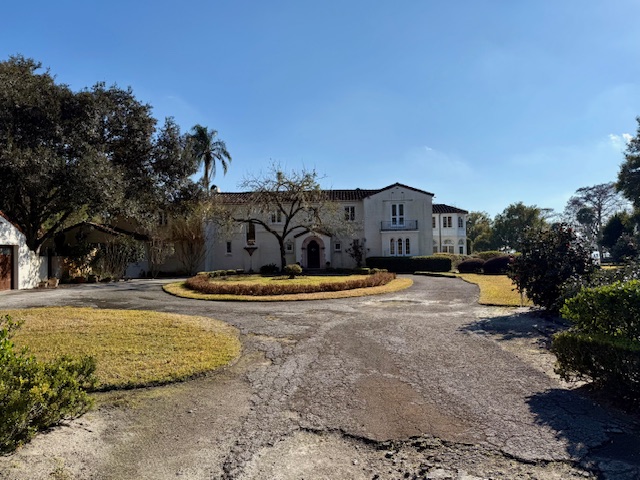
A split vote by the Planning & Zoning board this week gave the go ahead for one of the largest lakefront lots in Winter Park to be split in two, a move that at least one board member who opposed the split called a “special favor” for the buyer and one others decried as the probable end of the nearly 90-year-old estate known as Merrywood.
Tara Tedrow, who has the property under contract, asked the board to amend the city’s comprehensive plan to allow the 3.7 acre property at 1020 Palmer Ave. to be split into two lots. Tedrow, a land use attorney at the Lowndes law firm, has said she would like to build a home for her family on the new lot and sell the portion that includes the old vacant home that preservationists have tried to save in recent months.
The vote was 4-2 on Tuesday with Bill Segal, Alex Stringfellow, Charles Steinberg and Samuel King in favor of the amendment to allow the lot split and Michael Dick and Jason Johnson opposed. Board member Vashon Sarkisian was absent.
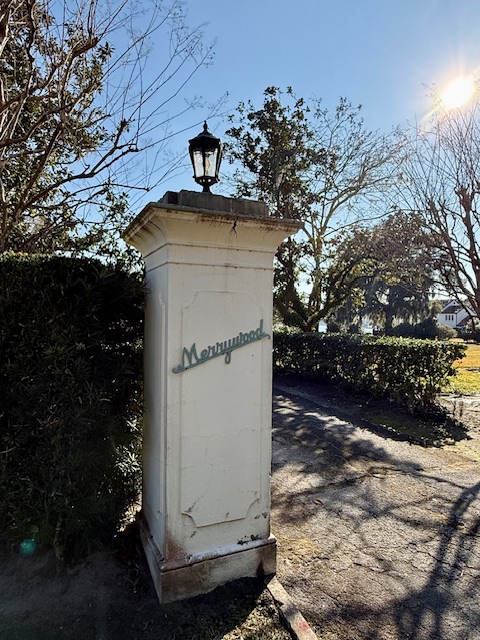
A sign at the edge of the driveway on Palmer Avenue helped cement the estate’s name among locals. (Beth Kassab)
The matter will next go to the City Commission for final approval.
While much of the discussion centered on if the home could be saved, Johnson said to him the issue was never about that.
“The question for me is whether the new policy that’s being proposed by the applicant is either the right way to go about getting the relief she wants or good for the city of Winter Park,” Johnson said, just prior to the vote. “My answer to both of those is no.”
He said the city’s comprehensive plan includes a policy to preserve lakefront lot estates in order to “perpetuate the unique character of Winter Park that sets it apart from other cities throughout Florida.”
“I think that policy exists for a very good reason,” Johnson added. “…The applicant is seeking a new policy that she acknowledges would apply to one single parcel of real property in the city of Winter Park. That, to me, screams special favor for one property owner, and I’m just generally against that from a policy perspective.”
A demolition application was already filed for Merrywood by owners Cathleen and Raymond Gilmer, siblings who inherited the estate from their parents, who bought the 1939 home on Lake Osceola in 1977. Tedrow facilitated the demolition permit, she said, to initiate an earlier conversation with the Historic Preservation Board to see if any ideas emerged for saving the house.
She also said extensive efforts had been made to work with “preservation-minded and historic designation-minded groups in the city and outside of the city” to find a potential buyer for the home since August. But no one stepped forward to buy the house with the goal of restoring it.
“We have put forth a significant amount of effort,” Tedrow said. “…We’ve had nearly 100 people, not open houses that anybody could come to, but nearly 100 vetted people who wanted to save this house come, and not one of them submitted an offer afterward. Everybody just wanted somebody else to do it, and that’s the unfortunate reality that we’re in.”
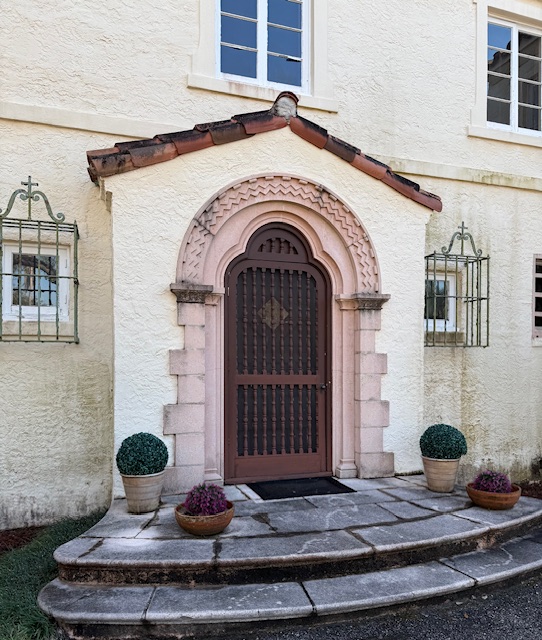
In addition, she said she commissioned a structural engineering report to see if the house could be “made realistically livable,” though never submitted the report for fear of being accused of “tainting the water” regarding the sale.
“Our report shows that the foundation is settling,” Tedrow added. “There are incredible structural problems that the recommendation was not to save the house, and this company could have profited from the efforts to save a house, and it was recommended to not.”
According to the city staff’s report, Tedrow’s justification statement for the split argued the current comprehensive plan prohibition on splitting lakefront lots was “intended to prevent excessive subdivision of lakefront properties, but that the subject property represents a unique circumstance due to its size and zoning.”
Staff noted that the property’s 1938 residence was listed on the Florida Master Site File, but is not designated on the city’s historic register, leaving city officials without any power to stop demolition.
“Although the applicant’s proposal would facilitate the creation of an additional lakefront lot, staff has concerns regarding the potential demolition or loss of the historic residence, as well as the broader precedent associated with permitting additional lakefront lot splits,” the staff report reads.
Instead, staff recommended an alternative modification to the city’s comprehensive plan to allow for certain lakefront lot splits if the change is tied to the preservation and designation of historic homes constructed prior to 1950.
Johnson asked Tedrow if it’d be “safe to say” she would not be in favor of the city’s alternate proposed policy change as she’d know she’d have to designate the home as historic and would “never be able to sell that.” She said yes.
“I received an unsolicited call from a historic homeowner in the city of Winter Park, who said, ‘Just so you know, when you get your historic house on 1020 Palmer, you won’t get home insurance’,” Tedrow replied, adding the caller had said her home insurance was cancelled on her own historic home.
Some Winter Park residents disagreed with Tedrow’s claims of troubles with home insurance, like Aimee Spencer, a former member of the city’s Historic Preservation Board, who said her own 100-year-old house was able to be insured without issue. The sentiment was later echoed by John Skolfield, who serves on the historic board, who said his own home is insured despite being built in the 1920s and that Tedrow’s claim was “just not true.”
Tedrow addressed the disputes about homeowner’s insurance, stating she’d brought up the call she received as an example of issues people had presented to her as part of the home buying process.
She added that she understood the desire for the house to be saved, emphasizing that perhaps pieces of the home could be preserved if the estate is demolished.
“If the reality is this house is coming down, if there’s anything you want to save … if there’s parts you want to salvage and take for something, we are open to all of that,” Tedrow said.
Others spoke in support of the lot split, like resident Scott Peelen who said he resides about 1,000 feet from Merrywood and believed the proposal to be a good solution for the “blighted area.”
“It’s been run down for a long, long time,” he said. “I know everyone in this room is here because they love Winter Park…All of us want what’s best for it.”
Support also came from some on the board, such as board member Bill Segal who said he understood the love for the city’s historic homes but that the board’s job was to do what’s best for the city.
“They mean a lot in Water Park, but the public doesn’t own it — it’s privately owned,” Segal said. “Some members of the public really strongly want to preserve this thing, and we heard some of them tonight, but I walked through this home…it’s just in terrible shape, so I think we just need to get rid of this idea that [it’s going to be saved].”
Skolfield, who owns the construction and renovation firm Skolfield Homes, disputed the idea that the home couldn’t be saved, saying it simply came down to price.
“Merrywood is realistically livable — maybe not for $15 million, but it can be done,” Skolfield said. “…It is possible. It may not make the world’s best financial sense. But you know, when we’re on our deathbed, is that really what’s going to matter? Maybe the art matters, too.”
WinterParkVoiceEditor@gmail.com
You fail to mention the huge factor (and the point I made at the meeting) that the choice really comes down to keeping the large single lot and watching a 30,000-55,000 s.f. home get built on it, or dividing it into two still large (1.8 acre) lots with homes that match the size of adjacent properties. You quote Ms. Spencer but don’t mention my commentary. The property owner is unwilling to designate the house as historic, so it’s going to get torn down. Period. Mr. Johnson’s point is off target. What is best for Winter Park in this case is maintaining the scale of homes, not encouraging mega-mansions that are monuments to ego and wealth.
I think that this is a bad decision. It is likely that an old house in poor condition will be torn down and at the end of the day we are allowing an owner a favor which an expectation that someone else will come forward with a request to divide and have this as a precedent.
If the split required a retention of the house, I might have a different perspective.
But as it is it seems like a favor for a friend. It does not pass the smell test
It is simple for me. If a private citizen or entity wants to buy Merrywood and preserve it, I’m good with that. However, after much publicity and sincere efforts by Ms Tedrow, there are no buyers.
So then I would ask Mr Johnson…how many 3.7 acre lakefront lots are there on the Winter Park chain?
The answer will be…not many. So how is it a “ special favor “ to grant this lot split? Has quality of Winter Park suffered because of all these 1+ acre lakefront lots?
Many years ago lots were often split. A large lot on Lake Virginia on corner of Virginia Dr. and Highland was split and new home was built on the corner!
There are so many nuances to this situation that are difficult to appreciate unless one takes the time to dig deeply.
If the objective is to maximize financial value, the playbook is fairly straightforward. Assemble a highly talented team, engage a top-producing real estate firm, market the property exclusively, and attract the highest level of expertise available. Then follow the process: apply for a demolition permit, conduct extensive due diligence regarding preservation alternatives, and obtain an engineering report concluding that preservation is not feasible.
Quite frankly, I admire the skill of everyone involved in advancing that objective and narrative. I am confident they will ultimately succeed.
What breaks my heart is hearing comments that the house has little value, that it is ordinary, that the floor plan no longer accommodates modern buyers, or that preservation is somehow impractical. To me, those arguments only reinforce an evolving concern that we, as a community—and perhaps as a country—have increasingly come to value material wealth above art, beauty, history, and place.
My pen is unlikely to change that trend. Yet failing to use it feels, at least to me, like a small abdication of responsibility.
If the owner, applicant, and real estate team truly believed that this remarkable architectural contribution to Winter Park should survive—not for themselves, but for future generations—the path forward is neither mysterious nor particularly difficult. In fact, the preservation component may represent only a modest percentage of the overall economics.
The approach is relatively simple: pursue a lot split concurrently with preservation of the historic structure, ensure that future landscaping cannot completely obscure the restored home from public view, a wise recommendation from Bill Seagal, and then market Merrywood as what it truly is—a significant Gamble Rogers-designed residence on an extraordinary lakefront parcel.
At that point, the brilliance of the real estate professionals can go to work. Cast a national net. Tell the story. Find the buyer who values architecture, history, and stewardship. There may well be someone somewhere in the country eager to call Winter Park home and willing to pay handsomely for the privilege.
But that path requires effort. It requires imagination. It requires patience.
Much easier to review the paperwork, open DocuSign, sign the demolition contract, and move on. Done.
I have generally tried to avoid the simplest paths.
👏👏👏
Mr. Skolfield,
Thank you for your thoughtful comments, which seemed to look at all aspects of the situation. I felt better once I read your comments.
Mr. Skolfield, Thank you for succinctly summing it up. It is indeed realatively simple and straightforward. One would have hoped that those elected officials who got elected because of their desire to protect and retain the charm and historic value of Winter Park would actually act on it. But as you said, it requires imagination and patience – things that are sadly lacking in people and the current architecture abundantly popping up in Winter Park (which lessens that actual charm and historic value by the day). The fast and easy route isn’t always the best one. A restored Gamble Robers in Winter Park on lakefront would be a jewel for the city and yes, someone would pay handsomely for that privilege. How that is lost on people who are so money focused is mind boggling.
Knowing how the real estate agents feel is unfortunately telling. The listing agents have nothing good to say about the house, without any real knowledge on the subject, and a STRONG bias against any course of action besides demolition. Not a great sales tactic and an unfair disservice to the home.
P&Z made a wise decision here. Let’s hope the commission will do the same.
Ms. Brudzinski’s article is a disservice to all readers. It is not “fair and balanced” reporting, it is more akin to advocacy. Many reasonable comments above, however, and it indeed boils down to weighing the outcomes of two alternatives and approving the applicant, resulting in two lots (larger in width and depth than either of the adjacent lots at 950 and 968 Palmer), and with maximum FARs (above grade home size) of 20,000 sf each. This will insure the preservation of the charm and scale of the surrounding neighborhood and will eliminate the possibility of a single 56,000 SF mega-mansion, in size and scale as the mega-mansion at 926 Palmer, which is +/- 36,000 SF. Far from a “special favor” outcome, this is the rational logic that was articulated by the majority at the P&Z hearing (but thinly reported here) and underpins the 4-2 approval vote at P&Z. Hopefully, this sound logic will also be thoughtfully considered, endorsed and adopted by the members of the City Commission.