
Safety Rules for Electric Bikes and Scooters Vetoed by Gov. Ron DeSantis
Improving safety regulations, especially near schools, is a priority in cities like Winter Park where officials have already begun drafting their own ordinance
July 3, 2026
By Gabrielle Russon
Some local officials expressed surprise and frustration after Gov. Ron DeSantis recently vetoed a bipartisan bill considered an important step in tackling the epidemic of electric bike and scooter crashes.
DeSantis’ decision came less than two months after a 13-year-old boy was killed in Orlando’s Lake Nona area while riding his e-scooter to buy Mother’s Day flowers.
Without a statewide safety law, rules will fall to local governments like Winter Park, which has already begun drafting an ordinance that city officials say they want in place before the start of the school year in August.
Roads near schools are of particular concern to local officials because so many students use e-bikes and e-scooters on a daily basis.
“We know they’re dangerous. We know they’re killing students. And so I’m not sure why we needed to delay taking any action knowing how dangerous they are. … All of us were hoping that we would get some guidance from the state,” said Orange County School Board Member Stephanie Vanos, who represents Winter Park. “It just doesn’t seem like the governor cares all that much about what’s happening to our kids.”
School Board members are scheduled to discuss what to do next at a Tuesday work session.
Senate Bill 382 won unanimous approval from the Legislature in March, but DeSantis has expressed concerns it could lead to more police surveillance and bring unintended consequences.
“What it will lead to is more surveillance of people by law enforcement and we don’t need that. I think there were problems with it,” DeSantis said when he spoke to journalists late last month during a press conference. “Certainly, I don’t want to do anything that’s going to lead to more surveillance.”
Winter Park City Commissioner Warren Lindsey said he would prefer cities draft the new regulations for their specific needs instead of the state imposing one set of rules for all of its 23 million people.
“My opinion is that it’s better to regulate that by local ordinance rather than state statute,” Lindsey said. “In a time when you’ve got preemption, where the state’s taken away local governments’ ability to regulate anything, this one is good because what works in Winter Park may not work in Maitland. What works in Winter Park may not work in Orlando or Ocoee so I’m in favor of local ordinance.”
Winter Park is developing an e-bike and e-scooter ordinance with the goal of rolling it out before school starts on Aug. 11, said Lindsey, who was the only city commissioner who responded to an interview request for this story.
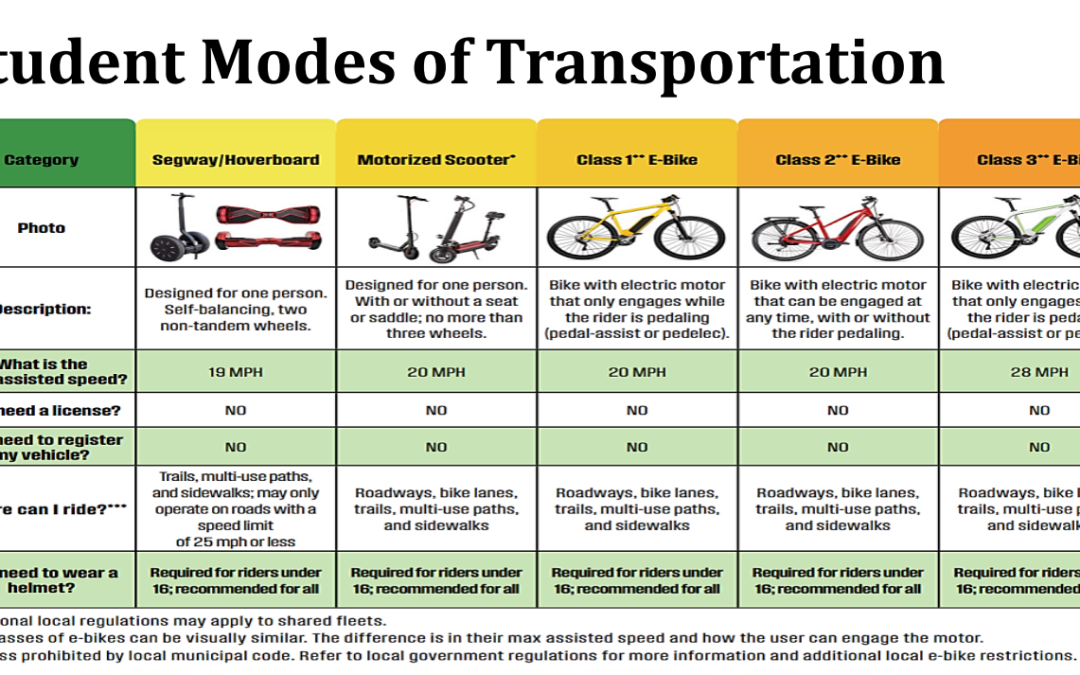
Some of the potential regulations could include setting a speed limit for e-scooters and e-bikes on sidewalks, increasing the helmet age requirement from 16 to 18 years old and imposing fines for those who break the rules.
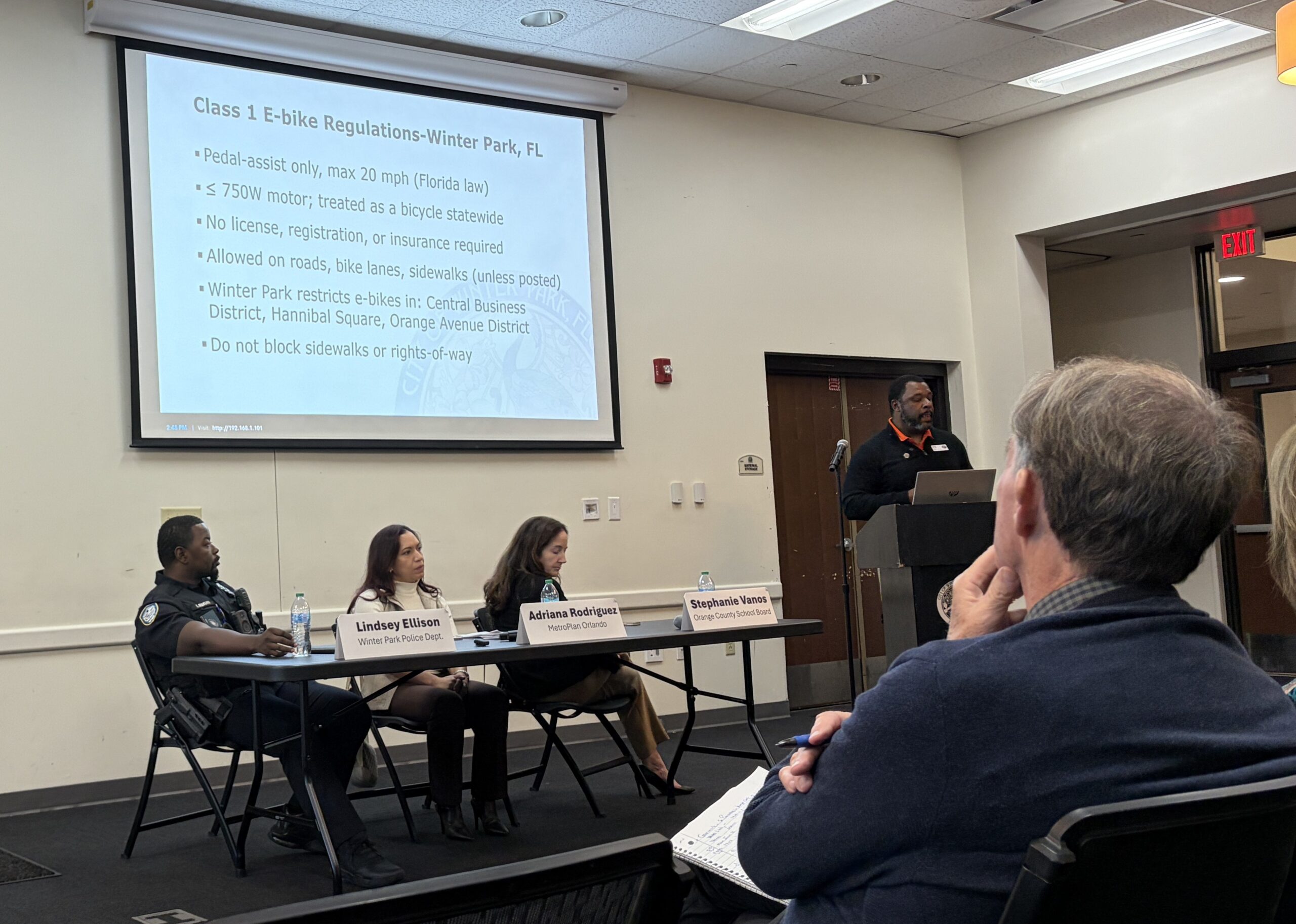
Winter Park Commissioner Craig Russell, who is also a teacher at Winter Park High, held a community meeting about e-bike safety earlier this year and has advocated for a local ordinance. School Board member Stephanie Vanos (third from left) sat on the panel.
Lindsey, whose day job is a criminal defense lawyer, called e-bikes and e-scooters “definitely a public safety issue.” However, he said he is mindful that minors don’t end up with traffic records as the city drafts a policy.
“The purpose of the proposed regulations are not intended in any way to be punitive to children but rather to be educational and to protect them because they’re inexperienced and to educate them on proper and safe operation of e-bikes and scooters,” he said.
In 2025, nearly 500 e-bike and e-scooter crashes were reported in Orange, Osceola and Seminole counties, according to MetroPlan, Central Florida’s regional transportation planning organization.
MetroPlan is focused on working with local governments, like Winter Park, to lower those statistics.
“We were expecting for some action to be taken at the state level, but I would say that the fact that it didn’t pass isn’t significantly changing how we were planning to proceed as an agency for metropolitan Orlando,” said Lara Bouck, MetroPlan project development manager.
The group is considering whether to draft a model ordinance to help local governments. Bouck said she hopes a Winter Park representative joins a working group expected to take on that task.
“The intent there is to give each of our municipalities, including Winter Park, a starting point that they can sort of pivot off of if they’re going to adopt their own ordinances, which I think will be a priority now that nothing passed at the state level,” Bouck said.
MetroPlan also launched a pilot program offering a free rider safety online course for parents at selected schools.
If DeSantis had signed SB 382 into law it would have required all law enforcement agencies across Florida to document micromobility device crashes the same way and record crash date, time and rider’s age or if the rider has a valid Florida learner’s driver license or regular license as well as other information.
The challenge is law enforcement agencies currently don’t report crashes in a uniform way, making it hard to understand the big picture.
Another provision in the bill would have allowed police to write $30 nonmoving traffic violations if an e-bike goes faster than 10 mph within 50 feet of pedestrians.
“I understand law enforcement has a job,” DeSantis said. “Do we really want to have policing of e-bikes? Are you going 10 miles or eight miles? I think it was a little bit of overreach.”
The bill would also have created a statewide task force to propose recommendations by Oct. 1 how to regulate “micromobility devices” like e-scooters and e-bikes.
Vanos acknowledged the bill wasn’t “perfect” but said it was “moving us in the right direction.”
She testified in Tallahassee during the Legislative Session to urge lawmakers to give schools representation on the task force.
Both Vanos and Orange County Commissioner Kelly Martinez Semrad, who represents Winter Park, said improving safety also means addressing bigger infrastructure challenges in communities.
“Devices that can reach higher sustained speeds are increasingly being operated in mixed-use environments—roads, sidewalks, and multi-use trails—without consistent rules, training requirements, or clear expectations for right-of-way behavior,” Martinez Semrad wrote on social media Thursday. “The result is a preventable risk environment: faster vehicles, denser shared spaces, and no modernized regulatory framework to govern how they interact.”
WinterParkVoiceEditor@gmail.com
So we can thank DeSantis for doing nothing to help what is becoming a serious problem with kids riding very fast e-bikes and scooters without requiring training, helmets, safety gear, headlights, stoplights or turn signals. It’s OK for DeSantis to ban books in all Florida schools, but not help protect kids from possible injury or death. Politics…don’t get me started.
Kudos and thanks to our Winter Park Commissioners for stepping up to address this problem!
So Garland you seem to want the Governor and Tallahassee to dictate what goes on in our communities. Not every community is the same and I for one want regulations put in place for these scooters, but I want my City to determine what the regulations are going to be.
Sick of cyclists who blow through 4 way stops, lights that are red, etc. *Now* we have golf carts, scooters and e-bikes doing the same. All crying waaghhhh when hurt. (looking at you, scooter/e-bike parents). Sadly, the ambulance chaser lobby is LOVING the carnage. They’re the winners in all this and we’re paying for it in our outrageous insurance premiums and increased cost of goods (because of businesses increased premiums). DeSantis and the Republicans don’t have the guts to clip the wings of this lobby or make common sense laws it seems. We are the most litigious state in the nation, folks. And if a Democrat replaces Ronnie I have zero confidence they’ll do anything about it either. Enjoy Red Hot and Boom tonight folks, you’ve paid for it.
How many crashes occurred in Winter Park in 2025? It’s kind of misleading to lump Orange, Seminole, and Osceola counties all together. Do you have just Winter Park e bike and scooter crash statistics for 2025?
Please consider possible “scooter and e bike safety classes” required for anyone 16 and younger (before they have a drivers license).
If you have a younger child who wants to operate a boat, they need a “boaters safety course”. If you have a child who wants to hunt, they are required to take a “hunters safety class”. This puts the responsibility on the parent when they get an e bike or a scooter for their child, who is younger than 16 years of age. The parent needs to get them to a class or the parent has consequences. Maybe this will protect our Winter Park kids and pedestrians. The model for boating safety and hunter safety may be a good way to start the discussion.
Thank you for protecting our City and thankful this discussion is local and not mandated from on high.
I like how we’re straw-manning e-bikes as some societal threat as if the gigantic SUV’s and Trucks flying down the streets in WP and Orange County aren’t the real danger to everyones lives. I can’t go two days without someone on the news either crashing into a house or causing a fatal accident on the highway. I don’t think these kids should be zipping down the Cady Way Trail without having to pedal at all, but lets not lose focus of what actually kills people daily.
The real e-bike danger comes in the form of the higher cost of goods and services (as a result of increased insurance costs because of the never-ending lawsuits). “— got me $5 million” costs all of us every day in everything we purchase. Anything we can do to reduce accidents and injuries will save us all money in the long run ——of course when one door closes those trial attorneys always manage to find a window.