by Beth Kassab | Mar 23, 2023 | City Commission, Orange Avenue Overlay
Commissioner asks if Playhouse could build in new park's surface lot
In an attempt to find a new home for the beloved Winter Park theater, Todd Weaver proposes park could be the answer without eating away greenspace
Intense debate erupted earlier this month when the operators of Winter Park Playhouse announced they were losing their lease and asked the City Commission if the small theater could find a home in the new Seven Oaks Park at the corner of Orange Avenue and Denning Drive.
Some argued the playhouse needs to remain in Winter Park, which is a challenge because of high commercial rents and land prices, and suggested there would be room to build a theater in the area already set aside for a building at the under-construction park. But critics of that plan countered that the theater would subtract from the park’s long-desired greenspace and worsen parking and traffic problems for nearby businesses and residents.
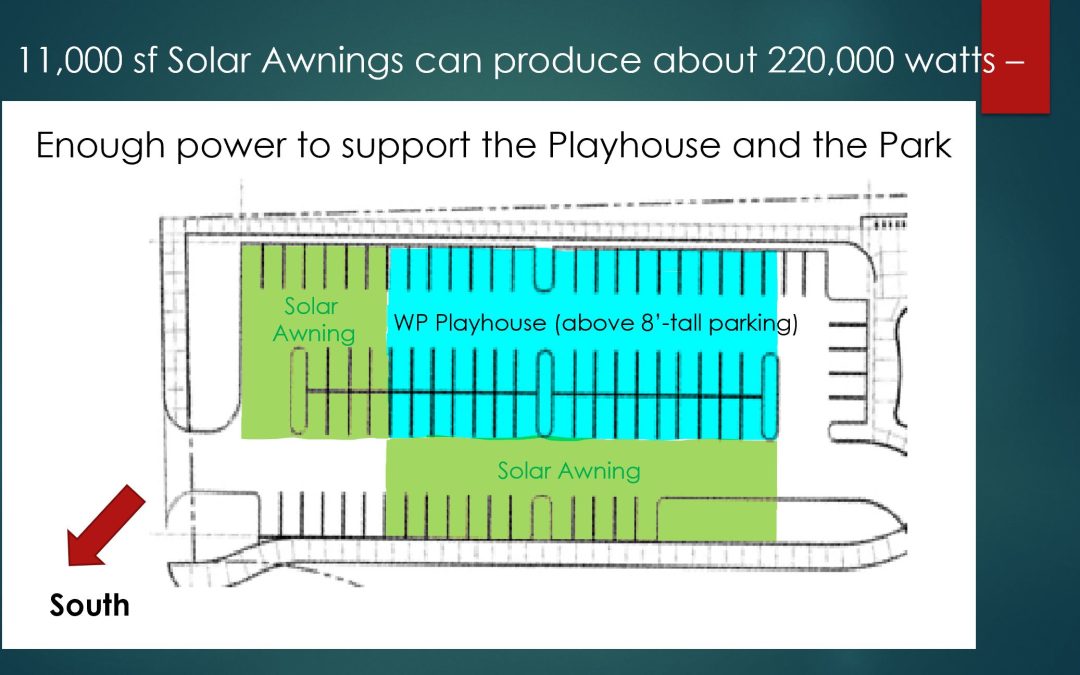
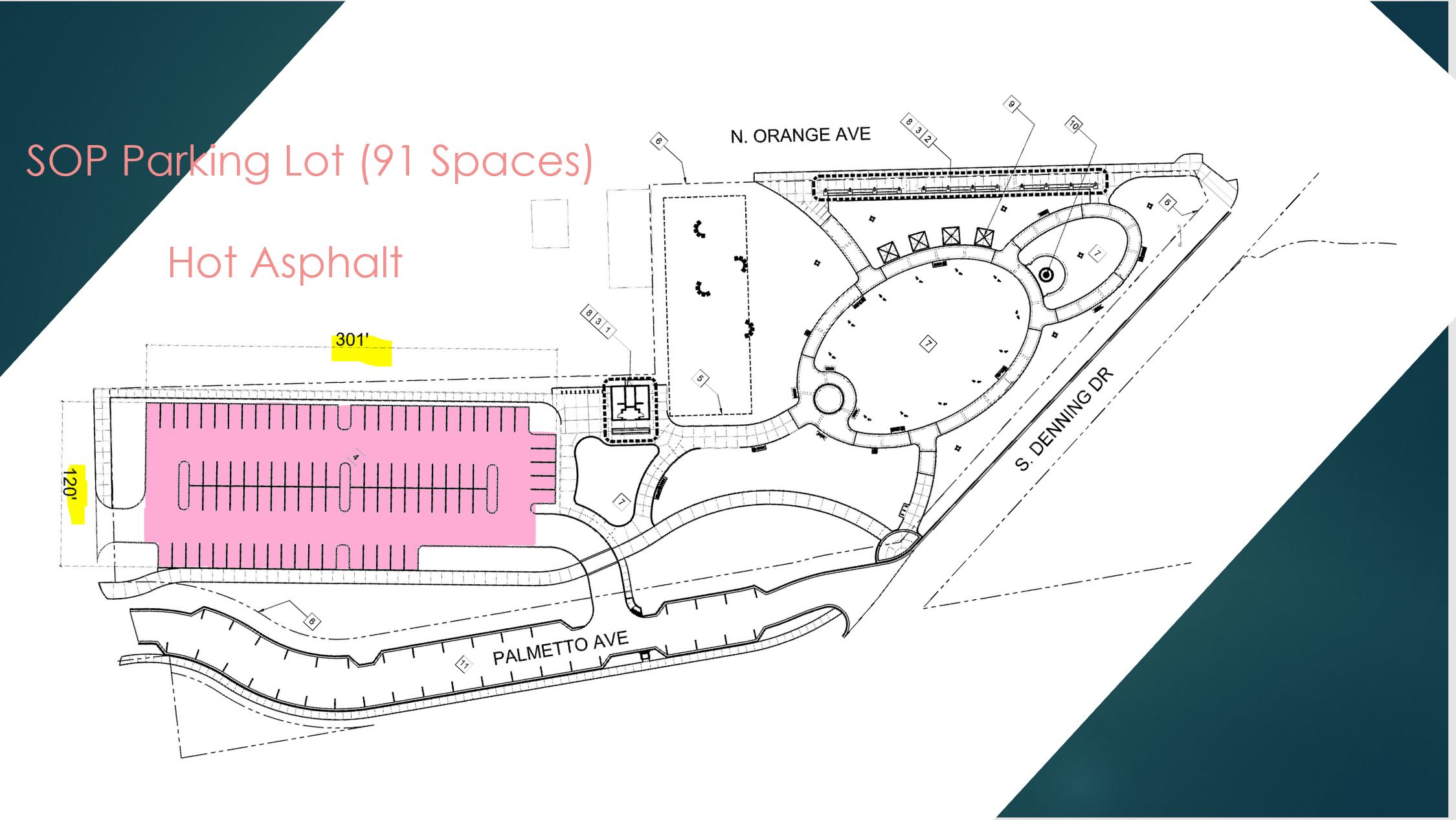
On Wednesday, Commissioner Todd Weaver proposed a meet-in-the-middle solution, though a number of questions remain. He presented PowerPoint slides that showed how the playhouse could construct a 12,000-square-foot theater by elevating it above the 36,000-square-foot parking lot already planned for the park. There is also enough space for solar awnings to help power the theater and park, he said.
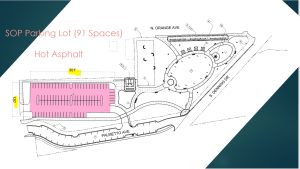
The pink area shows the parking lot planned for Seven Oaks Park.
Under that concept, Weaver said, none of the planned greenspace or any of the 91 parking spaces on the site formerly known as Progress Point would disappear to accommodate the theater. (Commissioners officially named the new park Seven Oaks on Wednesday after an online public vote.)
“Time is of the essence,” Weaver said, noting that the playhouse has 18 months to find a new space and he’s heard from a number of residents who want to keep the theater in the city.
He also said an earlier suggestion to reuse the old Winter Park Library for the theater likely would not work because the ceiling heights are too low.
Under Weaver’s proposal, the city would negotiate a land lease with Winter Park Playhouse, but the nonprofit operators would be responsible for raising the money to build the new theater as well as maintain and operate the building.
Heather Alexander, founder of the playhouse, along with Mayor Phil Anderson and Commissioner Sheila DeCiccio expressed support for the concept.
“We never got into this request to start a fight,” Alexander said. “This would solve certainly our problems and allow us to go forward with a capital campaign.”
The concept will likely be evaluated in more detail at a meeting next month.
“This wouldn’t impact any of the greenspace,” Weaver said. “The parking lot can be shaded, which I love.”
While that plan would not decrease the number of parking spots already planned for the site, it would prevent a future parking garage from being built there. Parking is a sore spot among businesses along Orange Avenue, which have been looking forward to relief for their patrons from a surface lot at the new park.
Construction on Seven Oaks Park is set to break ground next month.
To comment or read comments from others, click here →

by Beth Kassab | Mar 23, 2023 | City Commission
Winter Park Commission adopts new banner policy
After dust-up over Gay Pride flags, commissioners vote to change rules without debate
New restrictions now govern who can fly banners on public light poles in Winter Park after commissioners voted unanimously on the policy change that stemmed from complaints over Pride flags and cries of censorship by one resident who wasn’t allowed to fly a “Choose Life” message.
The vote on Wednesday came without any debate about the new rules, which prompted a lengthy discussion and public comments at a meeting earlier this month.
Bonnie Jackson, who said she represented Winter Park Republican Women Federated and filed the application for a flag showing a stick-figure family, including a pregnant woman, was the only person who spoke.
She made the application in June as the Winter Park Pride Project flew rainbow-colored peacock banners on city poles for the second year in a row.
“I followed the policy and for some reason this banner was objectionable,” she said on Wednesday. “I had to come down here multiple times just to be acknowledged.”
Commissioners said at the previous meeting that they favored changing the policy to prevent public property from becoming a venue for political or ideological messages.
The new policy limits flags to city-sponsored events or non-profits related to education, art or history with poles physically in front of their property such as the Morse Museum or Rollins and Valencia colleges.
If an applicant is denied, the decision can be appealed in front of the City Commission, according to the new policy.
To comment or read comments from others, click here →
by Beth Kassab | Mar 16, 2023 | City Commission, News
Board votes Progress Point site to be called Seven Oaks Park
The recommendation for the name of the new park will be taken up by the City Commission next week
By Beth Kassab
The soon-to-be constructed new park at the corner of Orange Avenue and Denning Drive will be called Seven Oaks Park if the Winter Park City Commission follows the recommendation of an advisory board at next week’s meeting.
The name for the property known as Progress Point won out over other contenders in a public contest with 702 online votes cast. Seven Oaks Park received a clear majority — 485 votes — compared to 114 votes for Progress Point Park and 89 for Gateway Park, according to a city memorandum.
This week the Parks & Recreation Advisory Board voted to elevate Seven Oaks Park as its recommendation to the City Commission, which will meet on Wednesday.
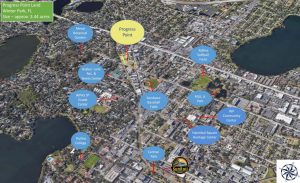
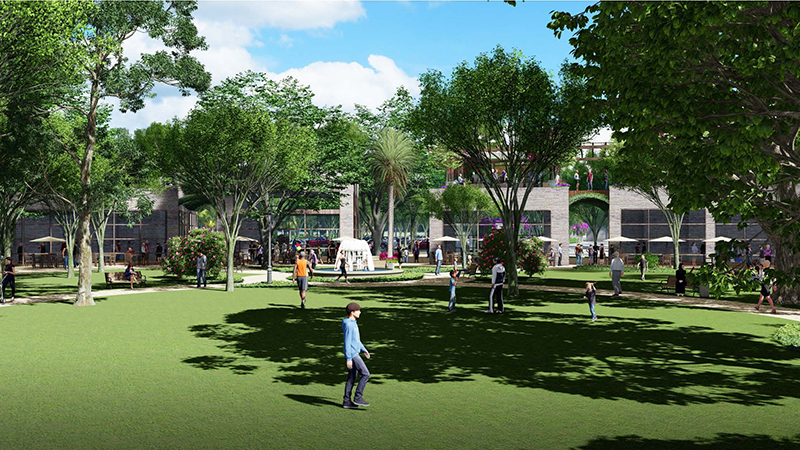
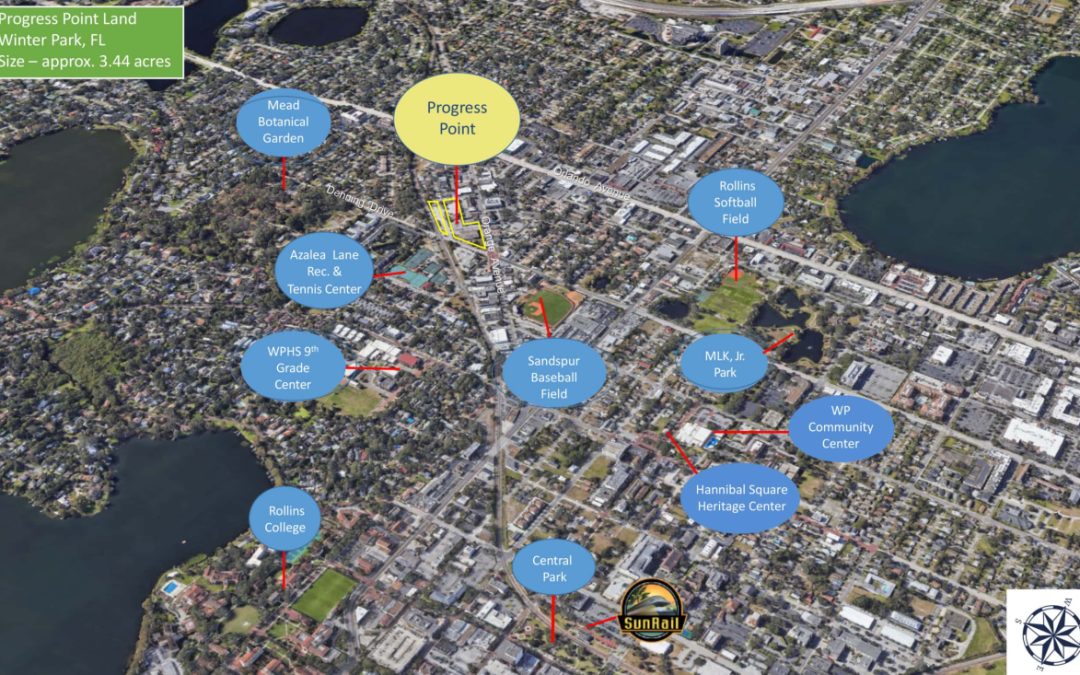
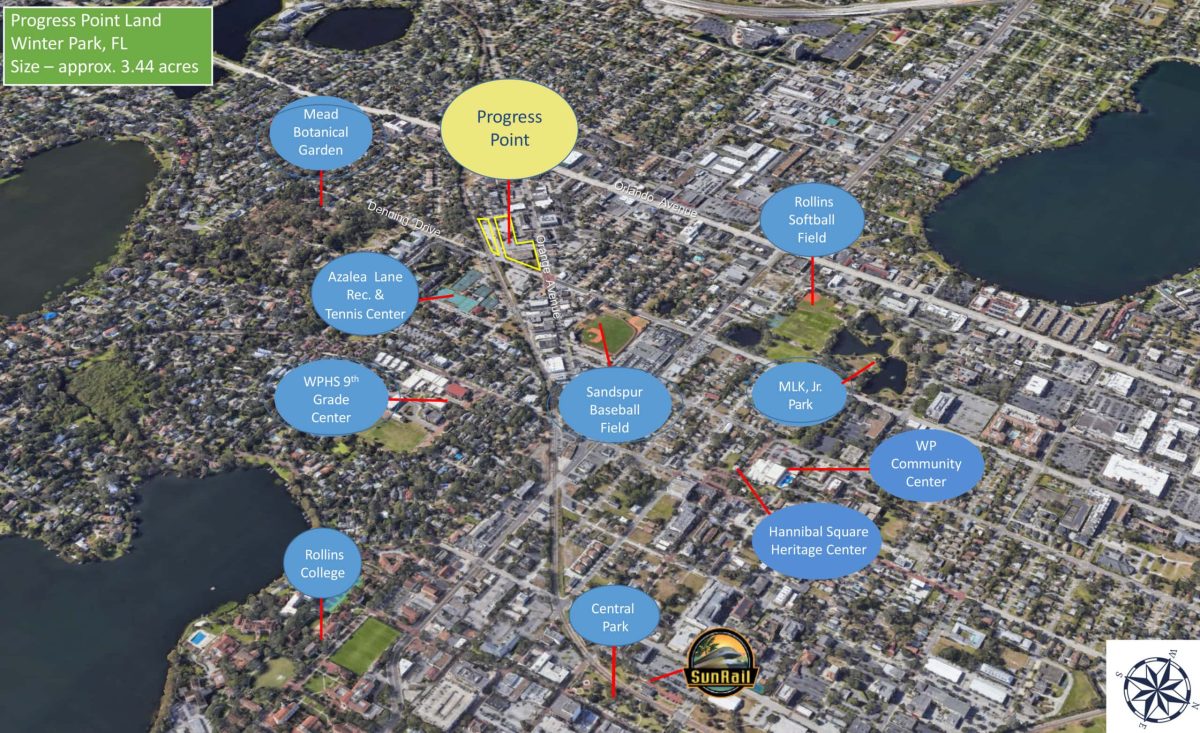
Last year the city planted seven mature oak trees on the property acquired by the city to become a green refuge amid the highly developed Orange Avenue corridor and, one day, potentially serve as a sort of “greenway” to connect other nearby parks such as Mead Botanical Gardens and Martin Luther King Jr. Park.
A groundbreaking event to kick off construction is scheduled for April 13, according to the memo.
To comment or read comments from others, click here →
by Beth Kassab | Mar 15, 2023 | City Commission, News
Winter Park to change rule after request to fly "choose life" flags
Florida’s culture wars hit the city after rainbow banners on public light poles heralded Pride Month
By Beth Kassab
The city of Winter Park will no longer fly rainbow flags to mark June as Pride Month under proposed new restrictions governing banners on public light poles.
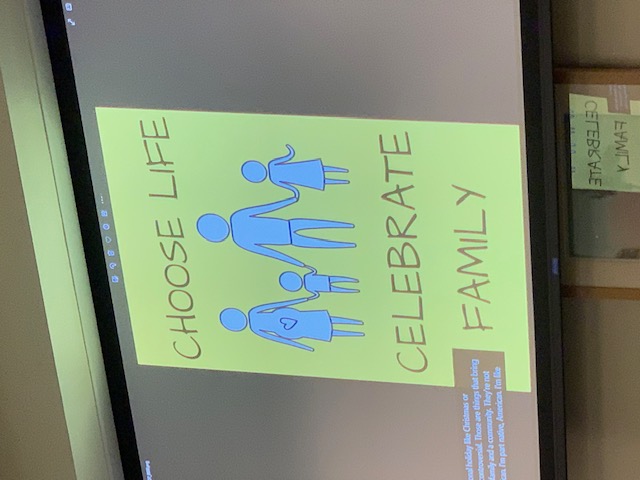
The changes, which are set to be voted on by the City Commission next week, come in response to a request from a city resident who sought to hang banners that read “Choose Life” and “Celebrate Family” with the image of a pregnant mom, a dad and two children holding hands.

The rainbow peacock created by the Winter Park Pride Project helped mark Pride Month in 2021 and 2022.
Bonnie Jackson, an unsuccessful candidate for the Florida House last year, filed the application while the Pride flags were up in June 2022 and took to social media that same month to parrot the rhetoric often heard from Gov. Ron DeSantis by calling on city residents to “take a stand against the woke Winter Park City Commission and the woke Winter Park Chamber of Commerce using city property (including right outside St. Margaret Mary Catholic Church) to promote political speech.”
It was hardly a galvanizing message — it received six likes on Facebook. A video she posted the following month in which she said she she was “offended” by the Pride flags because she is Christian and called the commission “anti-Christian” received 36 reactions.
The city staff mostly ignored Jackson’s request and did not provide an answer about whether she could pay to hang her flags on city light poles as the Winter Park Pride Project had done for two years.
Jackson appeared at recent Commission meetings to demand a response. She finally got an answer this month in the form of a proposed overhaul of Winter Park’s banner program that more severely limits who can request to hang flags.
“I’m sad today this has become an issue in Winter Park,” said Thor Falk, founder of the Winter Park Pride Project, which was created to promote inclusivity by encouraging residents and businesses to hang their own rainbow flags in solidarity with the marginalized LGBTQ communities. “Having those banners actually made people from outside Winter Park look at Winter Park in a new way … I understand that some people think that being a good neighbor is political.”
According to the Armed Conflict Location & Event Data Project, demonstrations and political violence against LGBTQ people have risen to the highest level since ACLED began collecting data for the United States in 2020. Acts of political violence more than tripled in 2022 compared to 2021.
Jackson, who made her original request on the heels of DeSantis’ attack on Disney last year after the company spoke out against the law dubbed “Don’t Say Gay,” which limits what can be taught in public schools, said at a Commission meeting this month that she objected to the notion that flying the Pride flag is part of being a good neighbor.
“I fly the American flag at my house and that makes me a good neighbor to everybody,” she said. “… I resent the implication that if I don’t fly your flag I’m not a good neighbor .. the problem is that the city doesn’t want to fly my proposed banner … Are you standing here as elected representatives of the citizens saying you are anti-life? You do not celebrate family? Because that’s what I’m hearing.”
Jackson said she opposed the proposed changes to the city’s banner rules because “they are just as broad.”
“If the first one could be interpreted to put up Pride flags, well, then so could this one,” she said.
Another resident who spoke at the meeting said, “I don’t see how rainbow peacocks help promote the culture, history, health, safety and general welfare of the city of Winter Park. Do you? … This doesn’t mean anything to most of us in this room and I’m sure the peacocks are not happy about this.”
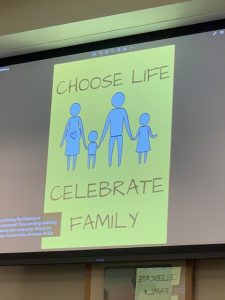
A proposed “Choose Life” banner is displayed at a recent Winter Park City Commission meeting.
Commissioners expressed reservations about limiting the organizations that could take part in the banner program, but also noted they did not want the program used as a venue for political or ideological statements.
The proposed changes to the rules, which will be voted on at the next City Commission meeting, limit banner applicants to city-sponsored events or certain nonprofits who meet criteria for a longstanding presence in the city. The rules will allow denials to be appealed to the Commission.
The new rules are written to make clear that the public light poles are a venue for the city’s speech rather than a public forum for private speech. That distinction is important because of a U.S. Supreme Court ruling last year that said Boston was wrong to deny a group’s request to fly a “Christian flag” outside its City Hall because the flagpole had been used by other groups as a forum for private speech, which would include religious speech.
But the court’s decision also noted that Boston could change its rules going forward so that flags are limited to city-endorsed speech.
Falk said the overall response to the rainbow peacock flags was “mostly positive” and the Winter Park Pride Project will continue to promote its “good neighbor” campaign to encourage LGBTQ friends and allies to hang a Pride flag at their own home or business.
He said he is disappointed about the likely rule change not just for his organization, but for other nonprofits who now won’t be able to utilize the banners to promote their events.
“Unfortunately, the presence of our banners has resulted in a discernment process that is going to hurt all of the city,” he said, but he noted the group will continue to make inclusivity a mission this June by handing out rainbow flags to residents and businesses to display on their storefronts or patios.
“We will work harder on our flag program,” he said.
To comment or read comments from others, click here →
by Beth Kassab | Mar 9, 2023 | City Commission, News, Orange Avenue Overlay, Zoning and Development
Winter Park Playhouse is losing lease, asks to build at Progress Point Park
The future of the beloved 21-year-old theater is uncertain as commissioners debate greenspace vs. development in new park
Winter Park City Commissioners expressed reservations Wednesday about a request from the leaders of Winter Park Playhouse to include space for the theater in the new Progress Point Park at the corner of Orange Avenue and Denning Drive.
Judith Marlowe, past president of the nonprofit theater’s board, urged commissioners to keep the performance space in the city and likened a potential move to the still-under-construction park to the presence of Orlando Shakes at Loch Haven Park. Without help, she said, the theater would likely leave Winter Park once its lease ends in about a year.
“We don’t want to be the Winter Park Playhouse located in Maitland,” she said. “We ask you to consider this option.”
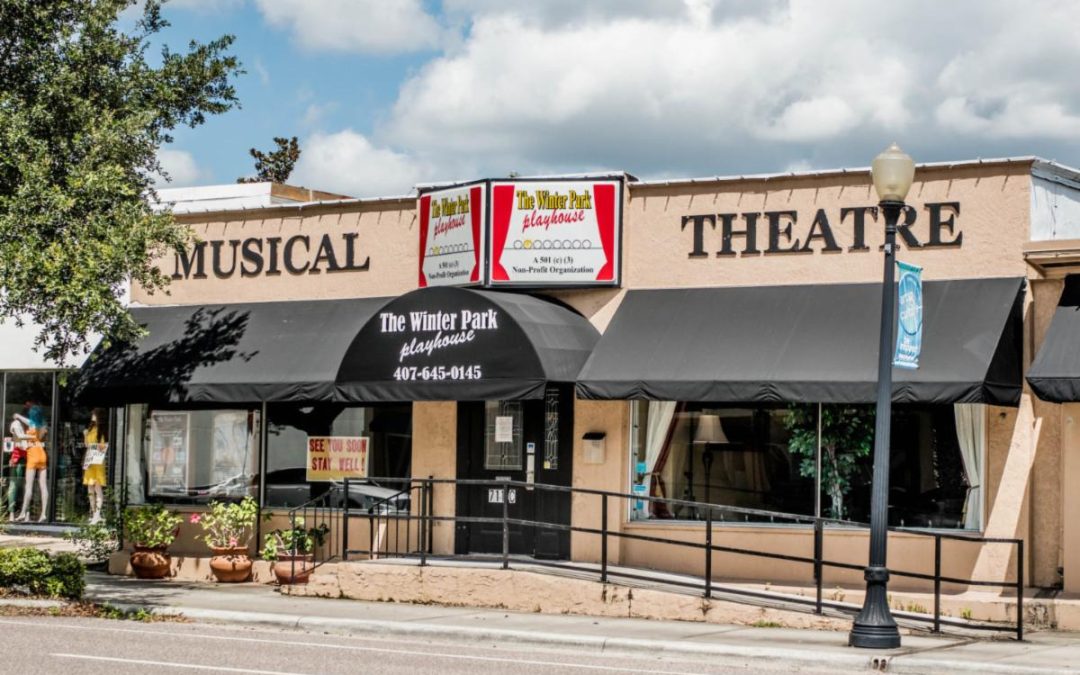
Heather Alexander, founder and executive director of Winter Park Playhouse, said the theater group is losing its lease on the only building it’s ever occupied at 711 Orange Avenue, about two blocks north of the still-under-construction park land.
She said a potential footprint for a 10,000-square-foot building within the park brought a unique opportunity for Winter Park to help maintain the playhouse, which serves about 30,000 patrons a year, close to its roots. She asked the city for a land lease, but said the theater, not the city, would fundraise for construction of the building and pay the mortgage, noting the group does not currently have any debt.
But commissioners expressed concerns about potential parking problems and whether the theater’s presence would subtract too much greenspace from the park envisioned as an urban oasis and potential connector to other nearby parks such as Mead Botanical Gardens and Martin Luther King Jr. Park.
“This is a tough one,” said Commissioner Todd Weaver. “I’d love to see playhouse down there, but I don’t think the timing would work out,” noting the group’s current lease would likely end before construction could be completed.
Alexander said the theater operates even now without designated parking and a number of patrons arrive by chartered buses, cutting down on the need for spaces.
Commissioner Kris Cruzada noted his parents regularly attend performances at the theater.
“I’m intrigued by the thought of a playhouse there, but I would really like it to remain a greenspace if at all possible,” he said.
Bob Bendick, co-chairman of the Winter Park Land Trust, which helped the city acquire the property for Progress Point, joined other residents in urging the commission to remember the intention of providing “relief from an increasingly urban cityscape.”
“The city should designate as much area as possible as permanent greenspace,” Bendick said.
From the start of the discussion, Commissioner Sheila DeCiccio and Mayor Phil Anderson advocated taking a more in-depth look at the matter in April when the Commission is set to also discuss what will become of the old and now vacant Winter Park Library building. The City Commission will hold a work session on April 13.
“Is this the use we want for Progress Point?” DeCiccio asked. “If we do not provide space on Progress Point, is there another location we have within the city for [the theater]? Or is the commission willing to lose the playhouse?”
To comment or read comments from others, click here →
by Beth Kassab | Feb 22, 2023 | City Commission, Library, News, Orange Avenue Overlay
Commissioner: What about market or food hall at new Progress Point?
Sheila DeCiccio asks to bring development ideas forward for new park along Orange Avenue
by Beth Kassab / February 23, 2023
Winter Park City Commissioners agreed Wednesday to push for more urgency in the development of potential retail and business space at Progress Point, a new park under development on the corner of Orange Avenue and Denning Drive.
Commissioner Sheila DeCiccio asked that the board consider putting out requests for development proposals soon and suggested a concept modeled off of the popular East End Market shopping and food hall in Orlando’s nearby Audubon Park Garden District neighborhood.
“I spoke with the businesses on both sides of Orange Avenue … and they want to see this,” she said, noting that Progress Point has the potential to turn that stretch of Orange Avenue into the “next Main Street, but it will not happen if not activated.”
Several small businesses grew into success stories from tiny quarters inside East End Market such as Gideon’s Bakehouse, purveyor of fist-size cookies, which now also has a shop in Disney Springs.
Commissioners agreed to discuss requesting formal proposals in the next month or two along with soliciting new concepts for the old Winter Park Library building, which is now being discussed as potential workforce housing.
The city board also agreed on its lobbying priorities in Washington D.C. this year and added Mead Botanical Gardens and Howell Branch Preserve to its list of parks that would benefit from new federal dollars.
Along with park improvements, commissioners approved another run at acquiring the Post Office property that could expand Central Park along Park Avenue. They would like to see grant dollars to improve stormwater drainage projects in the wake of Hurricane Ian, which brought swift and severe flooding throughout Central Florida in September. City staff noted there would be heavy competition among cities for those dollars.
“How many grants have they actually gotten for us?” asked DeCiccio. “I just want to know what we’re getting for our money.”
City staff responded that lobbyist Jim Davenport of Thorn Run Partners helped secure more than $100,000 for signals at city intersections, which has helped the fire department respond to calls.
To comment or read comments from others, click here →

Recent Comments