by Beth Kassab | Jul 21, 2025 | City Commission, News
Winter Park looks to weigh in on Orange County redistricting maps
As Orange looks to add two more districts, how the map is drawn will decide how Winter Park is represented
July 21, 2025
By Beth Kassab
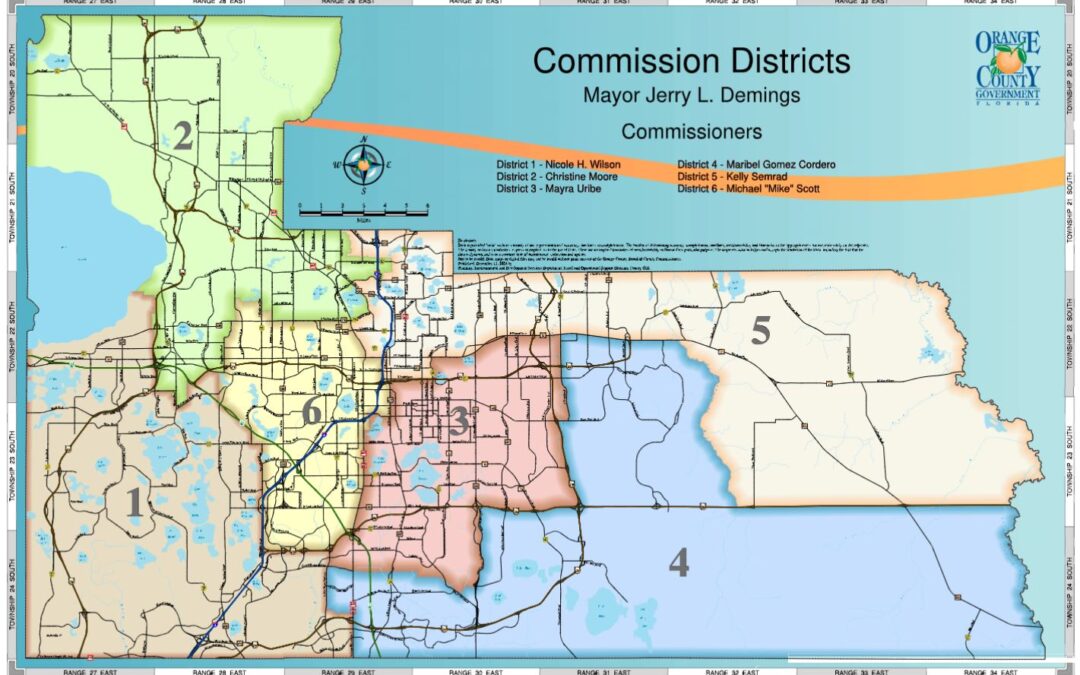
Winter Park officials appear poised to endorse an Orange County redistricting proposals that group the city with Maitland and Eatonville along with portions of Orlando and Apopka rather than the vast eastern rural section of the county that stretches to the Brevard County line.
A discussion about the proposed maps that will decide how the county of 1.5 million people is carved up and represented at the Board of County Commissioners is scheduled for Wednesday’s City Commission meeting.
The county districts must be redrawn after voters decided last year to grow the County Commission from the mayor plus six seats to the mayor plus eight seats.
Winter Park is currently part of District 5, which is represented by Commissioner Kelly Semrad, and stretches some 30 miles from from Orlando’s College Park neighborhood east to Christmas and the Brevard County line. As a result the district mixes urban neighborhoods and cities like Winter Park and Maitland with the eastern section of the county where large swaths of land are still undeveloped.
Meanwhile, Eatonville, the historically Black town of 2,200 people sandwiched between Maitland and Winter Park is carved out of District 5 and grouped with Apopka, the county’s second largest city at 60,000.
A memo from City Manager Randy Knight said it would make sense to group Winter Park with Maitland, Eatonville and area to the west rather than the eastern section of the county.
“That portion of Orange County is more rural and its needs and priorities are much different than those of Winter Park,” the memo read. “Staff believe Winter Park would be better served by a district made up of other more urban areas that are largely built out, like Maitland, Eatonville, College Park, north Orlando and southeast Apopka.”
Commissioner Marty Sullivan said he agreed with that idea.
“To have nearby municipalities grouped in one district I think makes a lot of sense,” he said.
Sullivan said of the 18 maps under consideration by the redistricting committee, he like the map known as Callan-1, which stretches east to capture the campus of Full Sail University, but is compactly centered on Winter Park. That proposed district runs north to Lockhart and Fairview Shores and south to downtown Orlando.
Knight’s memo cautioned that one of the proposed maps groups Winter Park with all of Apopka and cuts out Eatonville and College Park. Given the size of Apopka the city could potentially “dominate the representation,” it said.
City officials said they would like to provide input at the next redistricting committee meeting scheduled for July 30. The process is slated to be complete by September, when the County Commission will finalize the new map with eight districts.
WinterParkVoiceEditor@gmail.com
To comment or read comments from others, click here →
by Beth Kassab | Jul 17, 2025 | City Commission, News, Police
Federal Lawsuit Against City and Police Over Killing of Unarmed Man Ends
Winter Park Police shot the man seven times at his niece’s wedding in 2022
July 17, 2025
By Gabrielle Russon
In a lawsuit settlement, the city of Winter Park won’t pay anything to Daniel Knight’s fiancée nor admit any wrongdoing after police shot and killed the unarmed man at his niece’s wedding in 2022.
The federal lawsuit filed by Mellisa Cruz, the mother of two of Knight’s children, against the city of Winter Park and the police was settled and dismissed in May, according to court records.
The agreement came just months after a partial victory for the family when a federal judge ruled her claim could proceed against one of the officers, who fired his weapon seven times. The judge called the shooting “so far beyond the hazy border between excessive and acceptable force that the official had to know he was violating the Constitution even without case law on point.”
Cruz will not receive any money from Winter Park nor its insurance company nor the officer nor his insurance company, spokeswoman Clarissa Howard confirmed to the Voice.
The probate court must approve the settlement agreement, Howard added.
However, it appears that Cruz could still get some compensation even though no other additional lawsuits have been filed.
“The city is not party to any other settlement with the plaintiff that may have taken place, however, we understand there may be discussions regarding other settlements,” Howard said, declining to comment further.
Cruz’s attorney Paul Aloise Jr., declined to comment for this story.
Against Knight’s estate, creditors have filed claims for more than $100,000, including about $44,000 for a 2019 Chevrolet Suburban and $47,000 for a 2019 Dodge Ram 1500, according to Polk County Probate Court records.
The probate case became inactive in November 2023 because of the pending wrongful death lawsuit.
A Winter Park Police Sergeant shot and killed Knight, who was unarmed and intoxicated, less than two minutes after arriving at the Winter Park Events Center on Feb. 19, 2022, records show.
Knight’s niece was left in a bloody wedding dress while wedding guests screamed in horror.
The family accused the police of escalating the scene and acting aggressively after a city employee called 911 and complained Knight was behaving in a “violent” manner. The family told police he had too much to drink and they had taken him outside for some air, where he was standing with his sister as police arrived.
Knight got into a scuffle with police after they tried to separate him from his sister and he refused. Knight struck one of the police officers leading up to the shooting, the records also said.
U.S. District Judge Roy B. Dalton Jr. noted Knight had been defending his sister when the police, who did not announce themselves, arrived in the dark at the wedding reception.
Dalton ruled Sgt. Kenton Talton, who killed Knight, was not immune from Cruz’s lawsuit.
Knight’s family had “sufficiently pled that the use of deadly force was not objectively reasonable under these circumstances,” Dalton wrote in his February ruling. “… Shooting an unarmed man seven times at point-blank range within just a few minutes of arriving on scene, without first trying to de-escalate, investigate, or use less-than-deadly force, is also ‘so far beyond the hazy border between excessive and acceptable force that the official had to know he was violating the Constitution even without case law on point.”
The officers involved at the shooting were cleared of any wrongdoing by the Orange County State Attorney in 2023.
That decision, authorities said, was because Knight did not follow the officers’ commands and Knight hit one of the officers who fell backward and was knocked out. A second officer tried to use his taser on Knight but that failed.
Winter Park leaders celebrated their legal victory in May after the lawsuit’s end.
“I know we were successful with the Knight lawsuit,” Mayor Sheila DeCiccio said when asking the city for an update during the May 28 city council meeting.
“That case has been dismissed, it was really our insurance attorneys working on that,” City Manager Randy Knight said.
Knight’s sister, Katrina Knight, who witnessed the shooting, had spoken out at city council meetings to raise attention about her brother’s death and excessive police force.
“My family has the right to see Daniel remembered for who he truly was, not for the false narrative that was created to justify his killing,” she wrote city officials in a February email.
She declined to comment for this story because of the pending settlement.
Correction: An earlier version of the story stated the incorrect date for a City Commission meeting in May. The date was May 28.
WinterParkVoiceEditor@gmail.com
To comment or read comments from others, click here →
by Beth Kassab | Jul 11, 2025 | City Commission, Library, News, Uncategorized
Winter Park has a Long List of Complaints over Library and Events Center Construction
City officials and the contractor are meeting to try to resolve the problems
July 11, 2025
By Beth Kassab
Note: This story has been updated to include a statement from the contractor received on Saturday.
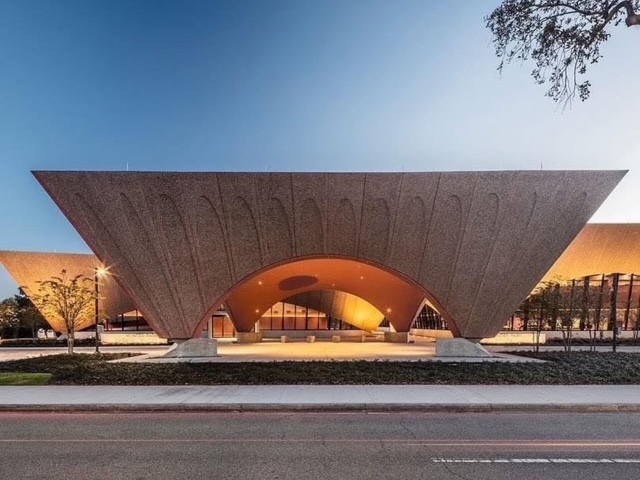
During the nearly four years since the more than $42 million Library and Events Center opened, Winter Park officials have compiled a list of what they say are construction concerns such as fracturing glass in some of the large panoramic windows, roof leaks, problems with the elevator and even the port-cochere, the grand covered entrance to the structure.
City Manager Randy Knight recently told the City Commission that the city is frequently meeting with representatives from contractor Brasfield & Gorrie to resolve the problems.
“Right now, we think they are going to resolve these issues,” Knight said. “But we’re going to go ahead and preserve our rights” before the statute of limitations runs out on filing a lawsuit over the claims.
This week the city notified the construction company and insurers of what it considers to be a “default” on the job to preserve the city’s right to sue if the problems aren’t fixed.
A spokeswoman for Brasfield & Gorrie, a national construction firm with offices in eight states that reported $6.4 billion in revenues last year, confirmed on Saturday that the firm is in talks with the city.
“We are discussing the city’s concerns and seeking resolution,” said a statement from the company.
Voters narrowly approved a bond referendum for $30 million in 2016 to pay for the project designed by British architect David Adjaye. Then, in 2020, the City Commission approved spending $41.7 million on the project. But, so far, the final tally is even higher at $42.3 million after the city added another $300,000 in 2022 from the American Rescue Plan Act, the federal stimulus package spurred by the pandemic.
The letter to the contractor lists 12 items that “has not been performed per plans and specifications” from the doors, lighting, air-conditioning and even the bathroom faucets along with the doors, windows, roof leaks and other concerns.
City spokeswoman Clarissa Howard said on Friday the contractor is continuing to meet with the city and working to resolve the matter.
WinterParkVoiceEditor@gmail.com
To comment or read comments from others, click here →
by Beth Kassab | Jul 10, 2025 | City Commission, News, Uncategorized
City Says the Problem Causing Smelly Water is Now Resolved
But the odor caused after lightning struck a water treatment plant could linger a few more days. Plus, state budget wins for Winter Park projects
July 10, 2025
By Beth Kassab
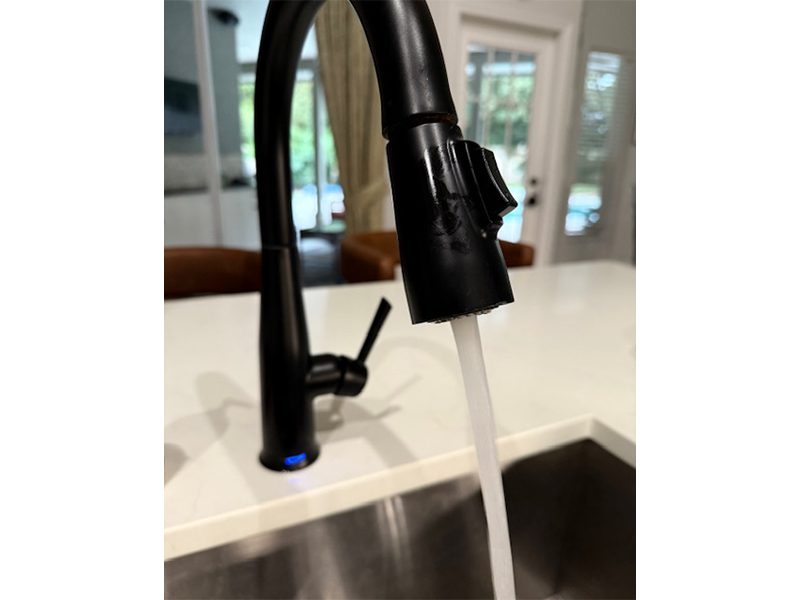
Residents complaining of a strong sulfur smell coming from their faucets in recent weeks got some good news on Thursday: The damage likely caused by a lightning strike to the ozone generator at one of the city’s water treatment plants appears to be resolved though the odoriferous problem may continue for a few days.
City Hall posted the update on Thursday afternoon after complaints about the smell and lack of information about it surfaced publicly at the City Commission meeting on Wednesday.
A power surge during a lightning storm hit the water treatment plant, one of three that supplies water to residents, on June 27 and city staff has been working ever since to bring the machine that oxidizes the city’s water to help purify it and reduce the rotten egg smelling sulfur often associated with Florida groundwater.
The water is safe to drink and the output from the damaged plant was reduced and treated with additional chlorine while repairs were underway, City Manager Randy Knight said.
“Twelve days of sulfur smell is a lot,” Cathy Baumgardner, who lives just north of Howell Branch Road, told the commission on Wednesday. “That’s not the big issue. The big issue is the lack of communication. Nobody contacted us … we didn’t know it was healthy until we called and asked.”
David Zusi, director of Water and Wastewater Utilities, said the water plants had withstood lightning strikes before but never one so severe that a portion of the treatment system was offline for so long. He said a number of experts, including the manufacturer of the ozone generator, which removes hydrogen sulfide from the water, were called in to help resolve the problem.
“This issue was extremely difficult to diagnose because no fault code was generated within the system,” the official update read. “Please note it may take a few days for the water with elevated hydrogen sulfide to flow out of the distribution system before it returns to normal odorless water.”
City to get $800k in project dollars from state
At at time when local governments are scrapping for every dollar from Tallahassee, Winter Park officials said this week that three projects requests made it into Gov. DeSantis’ final budget, escaping the veto pen.
DeSantis signed the $117.4 billion budget last week after cutting $567 million in line-item vetos.
- The largest score is $500,000 to replace the bridge on Stirling Avenue over Howell Creek. The 70-year-old bridge will be replaced, including drainage for surface water, sidewalks and railings over the bridge.
- The city will also receive $250,000 to dredge Lake Lillian at Mead Gardens.
- And $62,500 will go toward bollards or sturdy posts that act as a barrier between pedestrians at events and vehicles.
WinterParkVoiceEditor@gmail.com
To comment or read comments from others, click here →
by Beth Kassab | Jul 10, 2025 | City Commission, Library, News, Uncategorized
Winter Park Approves Limits on Protests and Activity at Library and Events Center
In a split vote, the City Commission approved a new ordinance that they claim is based on complaints over photo shoots and one small protest at the public buildings
July 10, 2025
By Beth Kassab
The Winter Park City Commission on Wednesday voted 3-2 to approve an ordnance that draws a boundary around the Library and Events Center as essentially a new “no protest” or gathering zone.
Mayor Sheila DeCiccio and commissioners Craig Russell and Kris Cruzada voted in favor of the ordinance. Commissioners Warren Lindsey and Marty Sullivan voiced strong objections to the change and voted against it.
DeCiccio and city staff say the ordinance is needed to protect groups and individuals who rent space in the buildings for weddings, corporate meetings and other events from disruptions from people who may want to stage protests or use the $41 million complex’s unique architecture as a backdrop for extensive photo shoots or other gatherings.
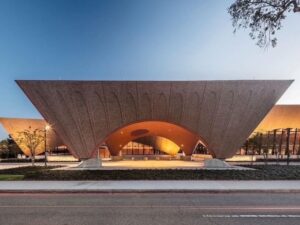
The Winter Park Events Center opened in late 2021 and was designed by British architect David Adjaye.
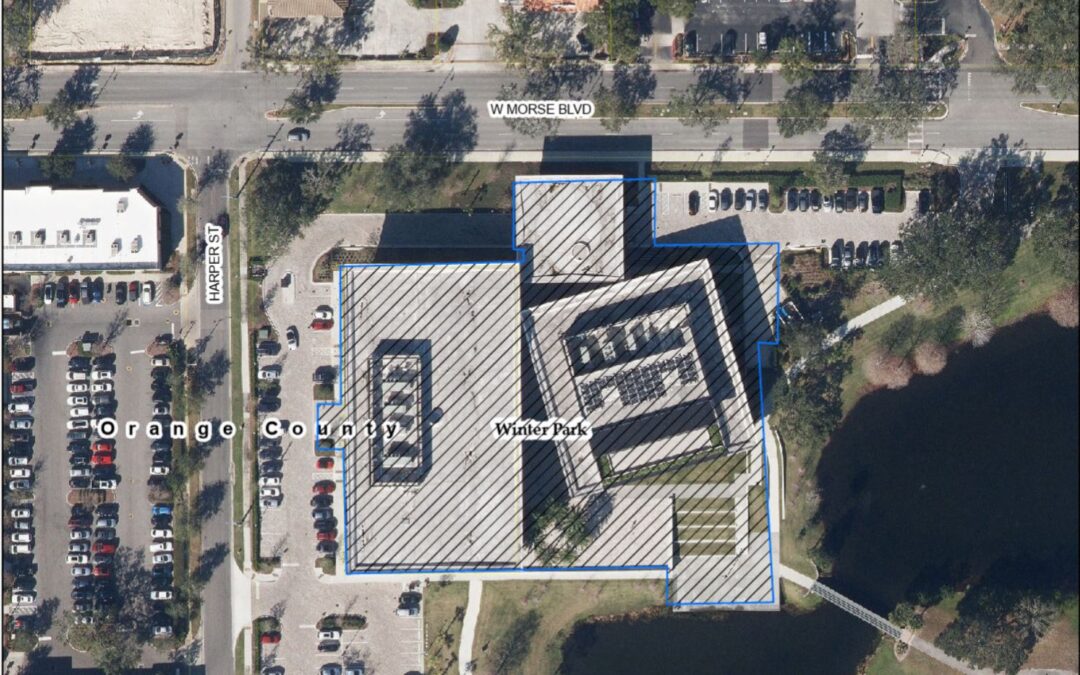
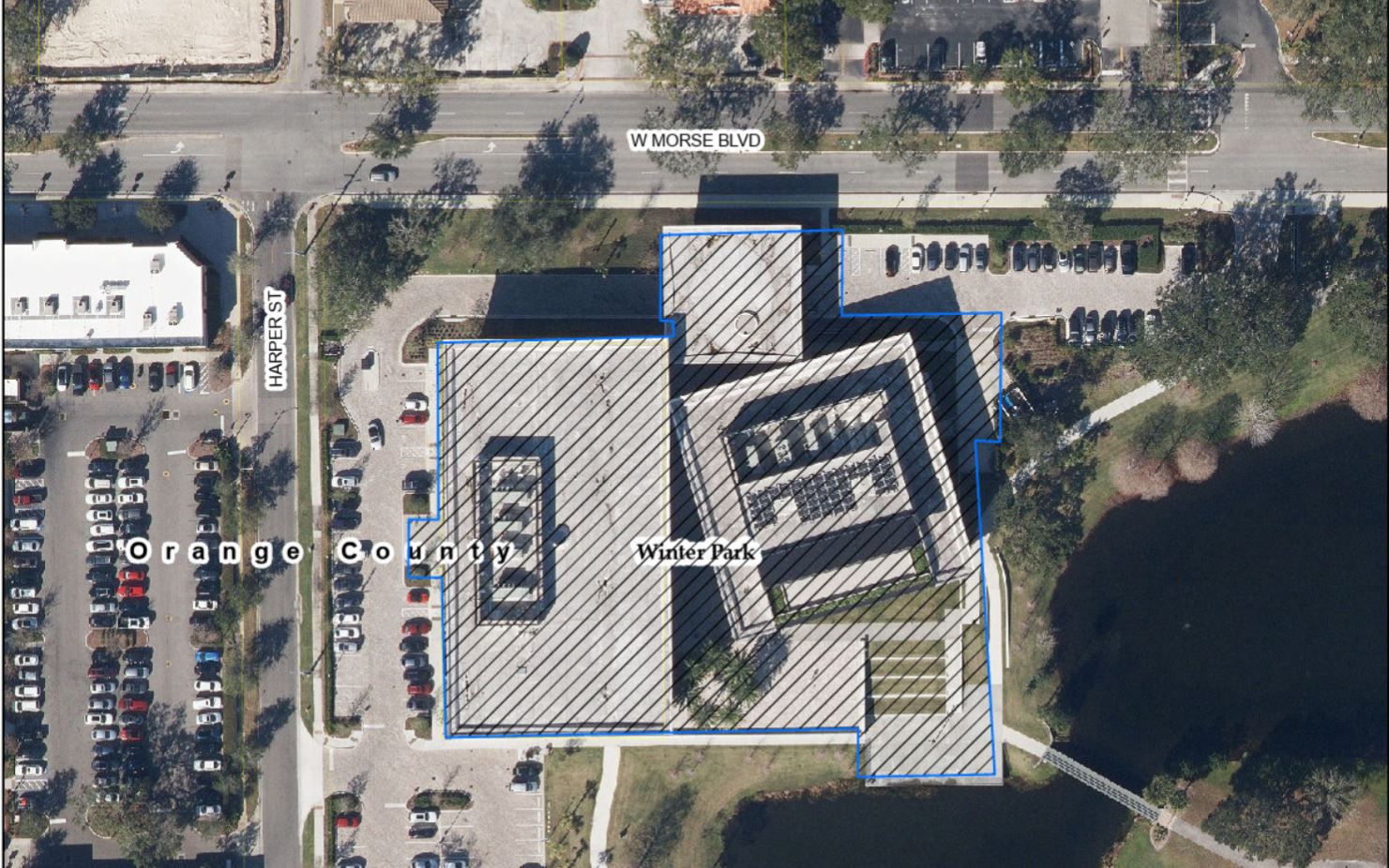
The new “no protest” area — the blue line drawn around the complex in the image above — mostly hugs the outline of the buildings, but also includes a large amount of outdoor space on the southeast corner of the building, which has large windows looking out onto Martin Luther King Jr. Park.
Lindsey, a criminal defense attorney, noted the irony of the city imposing what he views as First Amendment restrictions on the same week Winter Park plans to dedicate its commissioned larger-than-life bronze statue of King at an installation in the park known as Unity Corner.
“I think it’s interesting that this coming up Saturday we are going to be dedicating the statue … probably within 200 or 300 yards of the restricted areas,” he said, noting that the monument includes the words “courage is the power of the mind to overcome fear.” “I think a lot of times there a temptation that because we’re fearful of something we will overreact and Martin Luther King Jr. provided us instruction on that.”
He called the ordinance an “unnecessary use of government power.”
“We should be very, very careful how we use our power, especially how we use our police power,” he said. “And the only real argument for passing this thing is to deal with a hypothetical problem that has not occurred … that is something we should be very careful about doing.”
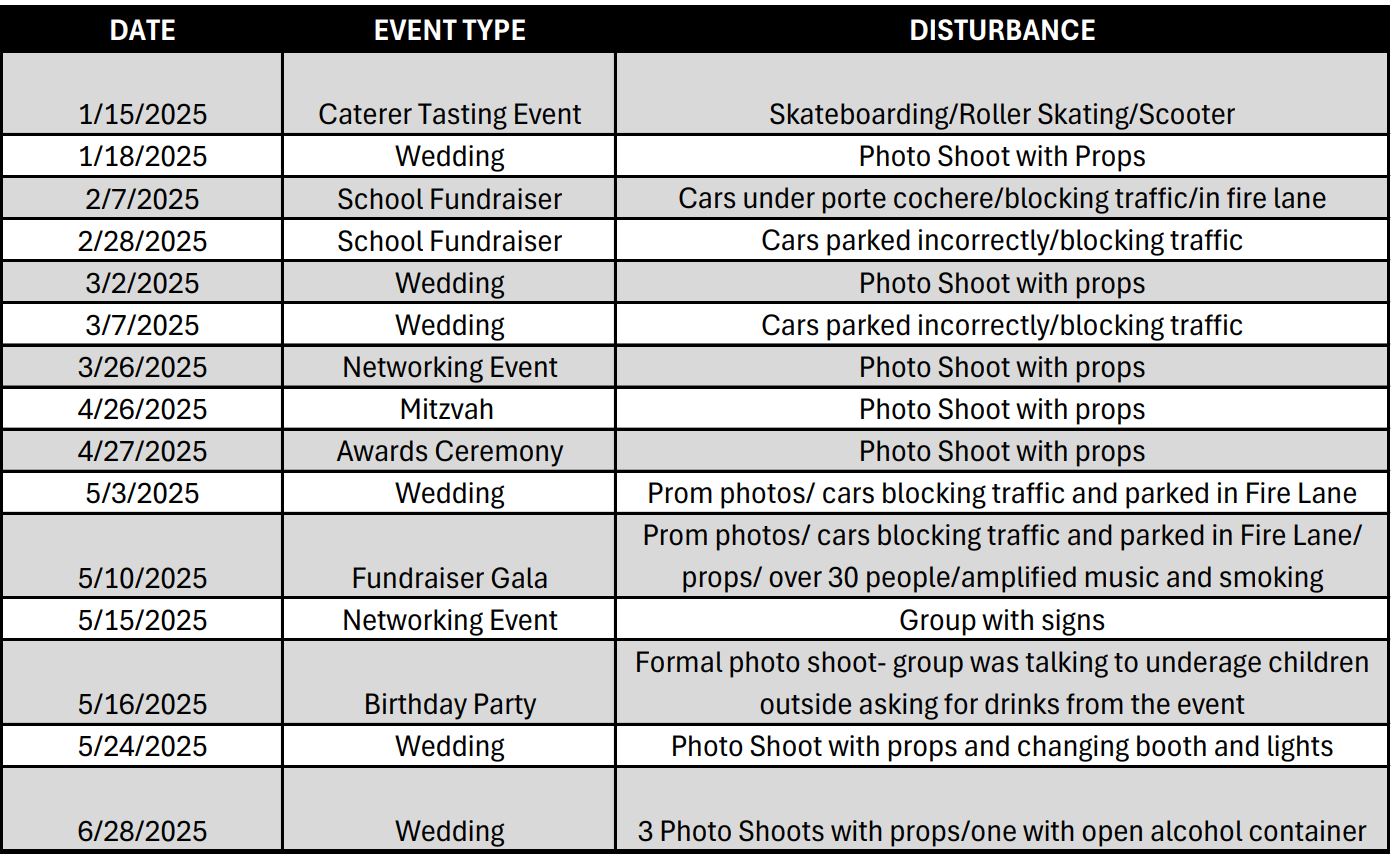
A list of 15 “disturbances” since the beginning of this year provided by the city is not enough justification for the ordinance, Lindsey and Sullivan argued. Of those, 10 are described as “photo shoot with props” or “prom photos.” One noted a “changing booth” and “lights.”
The other disturbances were listed as “cars blocking traffic” or “skateboarding/rollerblading/scooter.” Only one was listed as “group with signs” or anything resembling a demonstration or a protest.
A police dispatch call log noted someone called police just after 6 p.m. on May 15 to report “6-7 people outside on the south side near the lake, holding up signs protesting.”
About the same time the police arrived, the caller called back to report “her boss says they are allowed to be there.”
At the time, the events center was being rented by the Orlando Lawyers Chapter of the Federalist Society for an event featuring Josh Blackman, who was recently appointed by President Donald Trump to the Religious Liberty Commission’s advisory board of legal experts. Blackman is a constitutional law professor at South Texas College of Law Houston.
Winter Park attorney Michael Sasso is the president of the Orlando chapter.
Sullivan said people should be required to pull permits for elaborate photo shoots and that there are laws on the books already to address cars blocking traffic or disorderly conduct. But the kind of demonstration that occured on May 15 should not be limited.
“I have it from a reliable source there were four people at 5:30 in the afternoon standing there with small signs,” he said. “To me, that should be an allowable public gathering and that in my mind illustrates how this [ordinance] goes beyond what is needed … this prohibits activities that in my mind are permitted First Amendment activities.
City Attorney Daniel Langley argued that the city is allowed to put more restrictions on the library and events center because it’s not “traditional public forum” because it’s rented out and used by other entities.
He said that perimeter is drawn tightly around the buildings and, in many cases, “they could move two feet into the parking lot and continue that activity.”
The ordinance calls for a warning to be issued before people are trespassed from the area and potentially given a fine.
Commissioner Craig Russell said he is in favor of the ordinance because it’s about safety and protecting the space for those renting the venue.
“… We’re also not trying to recreate Tiananmen Square either as a city, so I think this is a very reasonable measure,” he said, referring to the 1989 crackdown on protests by the Chinese government. “Out of all the green spaces we have in the city, why there? It’s a unique space and we have the responsibility to protect it … I truly believe it’s not about stifling rights or anything of that nature.”
DeCiccio, also an attorney, cited a U.S. Supreme Court case over a municipal bandshell that she said allows the city to put restrictions in place.
She said the ordinances “does not silence voices,” but sets aside a “relatively small area” to be protected from potential disruptions.
WinterParkVoiceEditor@gmail.com
To comment or read comments from others, click here →
by Beth Kassab | Jul 8, 2025 | Arts and Culture, City Commission, Library, News
What Sparked Proposed Protest Ban at Library & Events Center? Mostly photo shoots
Records show photo shoots account for most of the reported disruptions at the Library and Events Center, a popular TikTok backdrop with its sharp angles and vaulted rooflines
July 8, 2025
By Beth Kassab
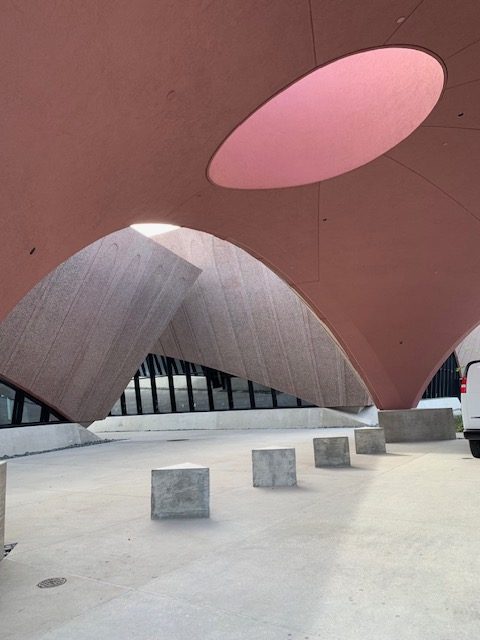
Winter Park ordered up a spectacle with a more than $41 million Library & Events Center by British architect David Adjaye featuring rose-tinted concrete of sweeping angles and a complex of vaulted pavilions.
The Winter Park Events Center. Photo courtesy of the city of Winter Park.
And that’s exactly what it got based on the reasoning for a proposed new ordinance to limit protests and other gatherings at the public space that opened in late 2021 at Martin Luther King Jr. Park.
“Because of current unrest that is being experienced around the country as well as recent event-related interruptions that have been reported at the Library and Events Center, the city felt this ordinance was necessary,” City spokeswoman Clarissa Howard said in an email. “The Library and Events Center has become a very popular rental venue for weddings, reunions, and other special events. It also architecturally lends itself to serve as a beautiful backdrop for professional and amateur photographers and all types of video productions/recordings. This ordinance would clearly outline the areas in which these types of activities can co-exist balancing public safety and free speech. It is a proactive measure to prevent potential hazards to pedestrian and vehicular traffic.”
A list provided by Howard includes 15 “disturbances” since the beginning of this year. Of those, 10 are described as “photo shoot with props” or “prom photos.” One noted a “changing booth” and “lights.”
The other disturbances were listed as “cars blocking traffic” or “skateboarding/rollerblading/scooter.” Only one was listed as “group with signs” or anything resembling a demonstration or a protest.
The city provided law enforcement call logs for some of the incidents. No one was cited or arrested and the logs appear to indicate the person who called in the complaint dropped the matter or the people or vehicles who were the subject of the complaints moved or left the area when asked.
A search of TikTok and Instagram posts tagged with the library or events center address yielded a handful of users posting photo shoots, wedding videos and other content.
After the first proposal was heavily criticized by two commissioners as potentially unconstitutional last month, the City Commission on Wednesday will consider a revised ordinance that includes a more narrow boundary around the buildings than first presented.
The revised version also includes a lower fine — from a maximum of $500 per day to $200 for the first infraction — for violations referred to Code Enforcement. The new wording also explicitly exempts political activities during elections, which is governed by state law — particularly because the library is a popular early voting site.
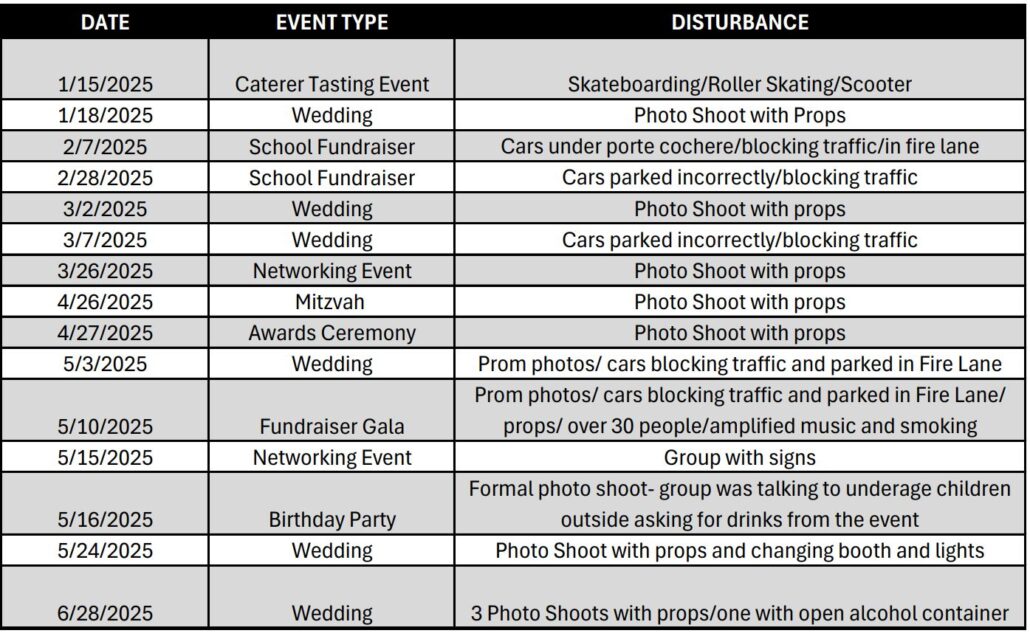
A list provided by the city of Winter Park shows disturbances logged at the Library and Events Center in 2025.
Commissioners Warren Lindsey and Marty Sullivan objected to the new rules last month, citing free speech and other concerns.
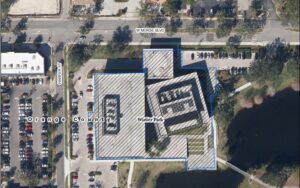
The blue line represents the new proposed boundary around the Library and Events Center to be considered this week.
“It’s not just just speech,” Lindsey said. “It’s also the right to assembly.”
He said the ordinance is a “solution looking for a problem” and that there are other rules on the books in Winter Park such as a noise ordinance and statutes against disorderly conduct that could apply to the concerns in question.
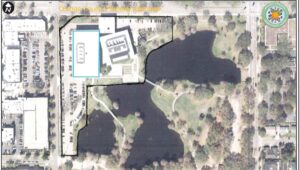
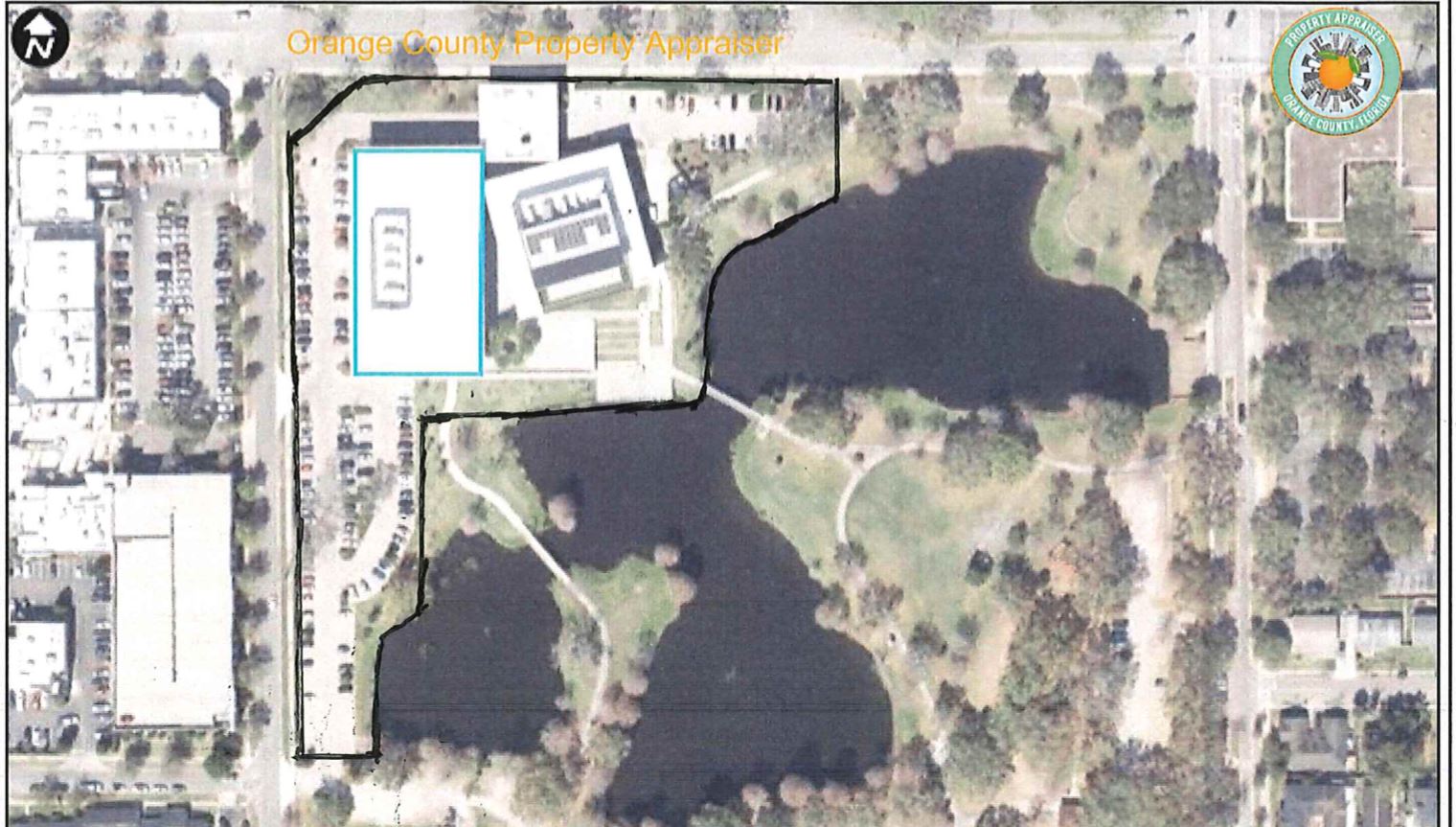
This image shows the original boundary drawn around the no-protest zone at the Library and Events Center considered on June 25.
All of the incidents on the list took place on a day or time while the Event Center, the city’s highest money-maker when it comes to venue rentals, was rented for a wedding, fundraiser or other private event.
The venue brings in $650,000 to $700,000 each year, according to the city budget. There have been 165 events through May at the venue, mostly for weddings and non-profit or corporate events. Repeat clients include Orlando Health, AdventHealth, the League of Women Voters and City Year Orlando, the budget stated.
WinterParkVoiceEditor@gmail.com
To comment or read comments from others, click here →
Recent Comments