
by Anne Mooney | Feb 12, 2021 | Election
‘Blatant Collusion’ Question Frays City-Chamber Relationship
by Anne Mooney / February 12, 2021
The Commission met Feb. 11 to discuss the deteriorating relationship between the City of Winter Park and the Winter Park Chamber of Commerce. The special meeting was necessary because a public meeting is the only way Commissioners can speak with one another to air opinions and exchange views.
At issue was a question posed at the Chamber-sponsored Feb. 5 debate between mayoral candidates that accused Commissioners of “blatant collusion” on a vote on the Henderson Hotel project, a vote that never took place.
Loaded Question
The debate question in its entirety reads as follows.
“It was dismaying to see the members of the city commission blatantly colluding to spike the Henderson project, which was approved by P&Z [Planning & Zoning] and was supported by the residents of Winter Park three to one over those opposing the project. As mayor, how would you ensure the commission enacts the wishes of the majority of WP residents, not just the agenda of an entitled few?”
Anderson campaign & Chamber issue joint statement
After a tense exchange between Chamber President Betsy Gardner Eckbert and mayoral candidate former Commissioner Phil Anderson about the propriety of the question, the Anderson campaign and the Chamber issued a joint statement that the two parties had “come to terms with the matter and look forward to placing it behind us in an effort to bring our community together.”
While that might have taken care of the issue for the Chamber and the Anderson campaign, the question was still circulating digitally through the community and the integrity of the sitting Commissioners continued to be impugned.
Commissioners want an apology
Commissioners Todd Weaver, Marty Sullivan and Sheila DeCiccio met in person Thursday afternoon to discuss the matter. Commissioner Carolyn Cooper participated remotely by phone later in the meeting. Mayor Leary was absent.
Commissioners expressed their desire to mend the rift between the Chamber and the Commission and to find an easier, more productive way to work together, while acknowledging that the missions of the Commission and the Chamber differ in several important respects.
Commission & Chamber Board should meet – soon
Commissioners agreed that a meeting between the Commission and the Chamber Board of Directors to address the issue should be scheduled as soon as possible. Commissioners also made clear an apology for the “blatant collusion” question was in order and would go a long way to calm troubled waters.
Allegations of collusion are defamatory
“That question was reviewed and allowed by the Chamber,” said Commissioner Sheila DeCiccio. “Such spurious and toxic allegations are, at their worst, defamation per se; and at the least, they are highly unprofessional and inappropriate. They have no place in a political debate.”
“Therefore,” DeCiccio continued, “the Chamber is complicit in staging the question, and the Commissioners deserve an apology for the baseless, false implication of collusion. Indeed, the people of Winter Park deserve an apology for having their Commissioners impugned.”
What obligation did Chamber have to vet debate questions?
Representing the Chamber was attorney Derek Bruce, who stated that he had advised Ms. Gardner-Eckbert not to speak and that he would speak on behalf of the Chamber.
‘Secret’ or ‘Brazen’?
Derek Bruce kicked off his remarks by noting that collusion is defined as a ‘secret agreement for fraudulent or unlawful purposes,’ but that the word blatant refers to something that is ‘brazenly obvious.’ He continued round the barn to explain that if a thing is blatant [obvious], it can’t really be collusion [secret]. Mr. Bruce conceded that reasonable people could disagree whether that question was appropriate, but he went on to dismiss it as “just two words in a question,” and not worth all the time and resources being spent on it.
No apology from the Chamber
When DeCiccio’s asked, “Is it your position that the Chamber has no responsibility to offer the Commission an apology for the question?” Bruce stated he had “not been authorized to issue an apology at this time.” When DeCiccio followed up with, “Is it your position that the Chamber has no responsibility to vet the questions in the debate?” Bruce avoided answering the question.
‘Hot Mic’ Moment
At this point, Vice-mayor Carolyn Cooper joined the meeting remotely by phone to object to the way the meeting was going, to the amount of time that had been allotted to Mr. Bruce, and to Mr. Bruce’s refusal to acknowledge that there was anything wrong with the “blatant collusion” question. Cooper, who broke into the conversation with the word ‘stupid’ later clarified that her interjection was intentional.
“Of course there was a problem with it,” said Cooper. “The question as presented accused this Commission of an illegal act. . . . The League of Women Voters has been doing [debates] for years, and they are very diligent about making sure no inappropriate questions are asked. I believe the Chamber has the same responsibility.“
City Attorney supports defamation claim, confirms question is not ‘protected speech’
At Cooper’s request, City Attorney Kurt Ardeman stated that he felt Commissioner DeCiccio’s recitation of the law was correct. “The law is pretty clear,” said Ardeman, “that when a writer publishes a defamatory falsehood with the knowledge that it was false, or with reckless disregard as to whether it was true or false, it is a defamatory statement. Now, you each are elected officials, and the bar is high; however as individuals you are protected against defamatory speech.”
Ardeman advised Commissioners to pursue meeting with the Chamber Board of Directors to reach some resolution and, if possible, to avoid any more back-and-forth between lawyers.
Commissioner Weaver asked Mr. Bruce if the Chamber would take down the debate video that was, at that time, playing on a continuous loop at the Mayflower. Mr. Bruce explained the video had been uploaded to Facebook and he didn’t know if it could be edited or taken down.
As of this writing the debate video is featured prominently on the Chamber website with the disclaimer, “The moderated portion of this forum includes questions from the public, and the views expressed by the public do not reflect the views of the Chamber of Commerce.” The disclaimer makes no promise of impartiality nor does it include an apology.
To comment or read comments from others, click here →

by Anne Mooney | Feb 1, 2021 | Election
Get Ready, Get Set . . . to Go VOTE
by Anne Mooney / February 1, 2020
The Winter Park mayoral election is March 9. This year’s easy – the mayoral race is the only item on the ballot. All you need to do is cast one vote, either for Phil Anderson or for Sarah Sprinkel.
Voter information is available online at ocfelections.com. You can make sure you are registered, request a Vote by Mail ballot, track the status of your Vote by Mail ballot or locate your polling place if you’d rather vote in person on election day. Did I mention election day is March 9?
Here are some other important dates.
Deadline for Voter Registration: February 8.
Last day to mail Vote by Mail Ballots: March 1.
Dates of Early Voting: March 1 – March 5, at the Supervisor of Elections office ONLY.
Important to note, there will be no early voting at the Winter Park Public Library this year. To vote early in person, you must go to the Elections Office at 119 W. Kaley Ave., Orlando FL 32806.
All ballots must be physically present in the Elections Office no later than 7:00 p.m. March 9.
Post marks don’t count.
If you have any questions, it’s easy to find someone with a pulse at 407-836-8683 (Vote by Mail phone line) or at the General number 407-836-2070.
REMEMBER: VOTE MARCH 9!
To comment or read comments from others, click here →

by Anne Mooney | Nov 12, 2020 | Election
Single Member Districts Fails
Tie Vote on 1st Reading Spells Failure – for now
by Anne Mooney / November 12, 2020
With only four Commissioners present at the November 11 meeting, the ordinance to put Single Member Districts (SMD) to a vote on the March 9, 2021, ballot failed on a 2 – 2 vote. Commissioners Marty Sullivan and Sheila DeCiccio voted in favor. Mayor Steve Leary and Vice Mayor Carolyn Cooper voted against. Commissioner Todd Weaver was absent because of illness.
Ironically, the measure failed twice. First, Cooper moved to deny putting the measure on the ballot. Cooper and Leary voted for; Sullivan and DeCiccio voted against. Immediately following, Sullivan moved to approve putting the measure on the ballot – with the same result.
The Devil is in the Details
Changing the basis of a city’s governance, one that seems to have served the city well for more than 130 years, is complicated – and scary. Just the thought of change can cause anxiety in most people.
That’s not to say change is bad, or that a city can’t change its mode of governance. But it is a difficult and complex task, one that does not happen quickly or easily. Each question seems to give rise to five others. How will districts be drawn? Who will draw them? What data is available to do this in an equitable way? After all, the most recent Census data is now 10 years old. What happens if we annex another neighborhood? What if no candidate files to run in a particular district? In the case of SMD, more than most, the devil is in the details.
Voters Still Want Info about SMD
Despite its defeat last night, email and Facebook traffic indicate that Winter Park voters still want information about what SMD might mean for Winter Park. At a virtual information session conducted by the Coalition for Access and Representation (CFAR) Monday night, Jamie Joyce of the Society Library, a non-partisan non-profit 501(c)(3), presented a white paper that laid out the arguments for and against SMD in Winter Park. The event, including the white paper, can be viewed here. https://www.facebook.com/Coalition-For-Access-and-Representation-CFAR-103882477624971/ What follows is a summary of the arguments Ms. Joyce presented for and against SMD in Winter Park.
Winter Park should have Single Member Districts, because . . .
It promotes civic engagement.
District elections might improve community participation if candidates are more engaged with a particular community. Under-represented constituents will be more likely to participate if they know they are truly represented.
Con: All commissioners should be accountable to all citizens. With SMD, a citizen will technically have only one representative, plus the Mayor, on the commission.
SMD improves racial diversity in representation.
SMD will give Winter Park residents the opportunity to elect a person of color.
Con: In any fairly drawn district in terms of population size, the Winter Park African American population would not achieve a majority. The opportunity to elect a person of color to the Commission is not dependent on SMD, but on the qualifications and appeal of the individual candidate.
SMD improves economic diversity of representation.
Because it is less expensive to campaign in a single district, people at a lower income can afford to run for office.
SMD improves geographic representation.
Single member districts ensure geographic representation.
Con: Geographic representation, in and of itself, still may not ensure representation for under-served ethnic populations like Winter Park African Americans who, because of West Side gentrification, are no longer concentrated in a single small area.
What’s to lose?
If the ordinance is put on the ballot, then it’s up to the voters to decide, freeing the Commissioners from having to make the decision.
Con: Winter Park voters are not educated on this issue; it’s a waste of their time.
Answer to the Con: Then educate them; it’s their civic duty to become informed.
Answer to the answer: Four months is too little time, especially without knowing what the districts would look like.
SMD makes Commissioners more accountable.
Commissioners can be more easily held accountable by localized citizens.
Con: Only the mayor and one Commissioner will be accountable to any given citizen, thereby reducing accountability of the Commission as a whole.
SMD ensures localized issues will receive attention.
Commissioners would be more in touch with issues affecting their constituents.
Con: This will lead to Commissioners putting localized issues ahead of the needs of the whole City.
Builds more effective constituent relationships.
SMD improves overall responsiveness to local issues.
Con: Winter Park Commission already performs well in response to constituent concerns.
Makes elections more free and fair.
Because the cost of a single-district campaign is less, there would be less reliance on contributions from special interests.
Con: Because the cost of a single-district campaign is less, it will be easier for special interests to ‘buy’ an election.
SMD is a more progressive form of government.
Supreme Court Justice Ginsberg cited at large voting, along with racial gerrymandering, as a preeminent second-generation way to deny equal opportunity for minority voters and candidates. A number of local jurisdictions in FL and across the country who traditionally used at large systems have faced federal lawsuits to force a switch to a district-based system as part of the Voting Rights Act.
Con: At just over 7 percent, the minority population of Winter Park is too small for SMD to make any difference.
If we don’t vote on it now, we’ll miss the chance.
If the Commission does not put this ordinance on the ballot now, they are unlikely to consider it again unless some special circumstance arises.
Con: It is still possible to put the ordinance on the ballot through a petition. There is still time to conduct enough information sessions to inform the public.
Winter Park should not have Single Member Districts, because . . .
It’s not the right time.
This is an emotional time for the country, and decisions about government should not be swayed by emotion.
Con: There are good non-emotional reasons to support the ballot initiative.
It won’t achieve the goals it was meant to achieve.
If the goal is to increase the chances of electing an African American commissioner, in any fairly drawn district in terms of population size, the African American population of Winter Park could not achieve a majority, if that’s what it takes to ensure the election of an African American commissioner.
Con: Just because SMD will not ensure the election of an African American commissioner does not mean SMD still is not best for the city and won’t lead to increased diversity in city government.
The electorate doesn’t really want it.
Vice Mayor Cooper noted she had received more than 230 emails from residents about backyard chickens, compared with 26 emails about SMD (five of which came from people who were not Winter Park residents).
Con: Emails to the Vice Mayor is only one indicator. CFAR’s Barbara Chandler has collected more than 100 signatures in support of the motion.
All groups are fairly represented in Winter Park.
Historically, candidates, both successful and failed, have come from fairly distributed parts of the city.
Con: No African American has been elected to the Commission in 133 years.
It’s the wrong cause.
Not enough ethnically and economically diverse candidates are running for office in Winter Park.
Con: It’s likely because of how expensive it is to campaign at large. SMD will make running for office more accessible to residents of various income levels, identities and backgrounds.
SMD is not how cities our size do things.
At-large elections tend to be more practical in small cities and in more homogeneous areas.
Con: Several Central Florida cities in Winter Park’s size range have SMD, including Ocoee, Cocoa, Mt. Dora, Sanford and Winter Garden.
At-large elections are more democratic.
At-large elections allow all residents to vote for all commission candidates.
Con: Democratic institutions have a duty to protect minority groups from disenfranchisement and under-representation by majority rule.
SMD will make the Commission less effective.
SMD may encourage in-fighting, vote-trading and competition among districts for city resources.
Con: The efficacy of the Commission depends upon the quality and character of the individuals who are elected.
SMD will give voters fewer options.
Voters will have a smaller pool of candidates from which to choose.
Con: The options they do have will be more likely to represent their interests.
Asked for her thoughts on the outcome of last night’s Commission vote, CFAR’s Barbara Chandler replied, “. . . this is considered more delaying.”
For more information about SMD, go to http://cfarvote.com/cfar-home-mobile/
To comment or read comments from others, click here →
by Anne Mooney | Oct 25, 2020 | Custom Author, Election
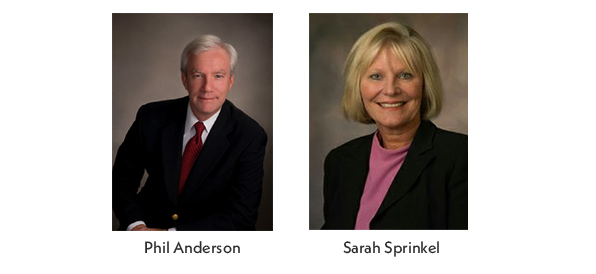
Anderson, Sprinkel Run for Mayor
by Anne Mooney / October 25, 2020
Former Commissioners Phil Anderson and Sarah Sprinkel will vie for the Mayor’s seat being vacated in March 2021 by Steve Leary. Even though the filing deadline is not until January 19, 2021 — which means there could be additional contenders — Anderson and Sprinkel have established campaign organizations and will begin active campaigning following the November 2020 election. The Winter Park general election is March 9, 2021. A runoff, if necessary, will be held April 13, 2021.
Platform Statements
On her platform, Sprinkel promises not to raise your taxes, to provide leadership during the pandemic and to exercise fiscal responsibility. In his platform, Anderson promises to protect the charm and character of Winter Park, to put residents’ interests first at City Hall and to make decisions that will keep Winter Park financially strong and prepared for the future.
You can find out more here https://www.electsarahsprinkel.com
And here https://www.philforwp.com
Campaigning in a Pandemic
This pandemic-era election cycle will look very different from previous campaigns. Sprinkel said, “I never want to put someone else at risk. I worry about my husband as much as I worry about myself. I don’t think I’ll be out and about very much – I don’t think we’re quite ready for that. So, this will be a different kind of campaign.”
Anderson was of like mind. “We are holding virtual campaign meetings and small-group outdoor meetings,” he said. His campaign is holding ‘meet & greets’ either outdoors with social distancing or via Zoom. He said they are also relying heavily on social media.
Anderson talked about the difference between this campaign and the campaign when he won the Commission seat he held from 2008 to 2011. “What I enjoyed about the 2008 cycle was the door to door thing, meeting people, hearing their stories,” he said. “But we can’t do that this time. I’m still going to do the Farmer’s Market – but not until after the general election.”
Who is Sarah Sprinkel?
Sprinkel served three terms as Commissioner from 2011 to 2020, when she stepped down in order to run for Mayor in 2021. If she is elected, Sprinkel will be the first woman to serve Winter Park as Mayor. Asked if she thought her gender would influence her leadership style, Sprinkel replied, “Yes, women look at things differently than men. My whole life has been spent lifting up families. I think we could do with some nurturing in leadership, under the circumstances. We should be working on a safety net for families right now. You have to have that open heart and that open mind.”
Sarah Sprinkel is a teacher. According to her website, she taught kindergarten for 10 years, then moved into administration to develop early childhood programs. She retired from the Orange County Public School System after 33 years and went to the Central Florida YMCA to partner with Disney to create two child development centers for cast members’ children. After retiring from Disney, she went to Florida Virtual School to create an Elementary program for FLVS. She now teaches classes as an adjunct at UCF and works with interns there.
Who is Phil Anderson?
Phil Anderson is a business executive with 35 years’ experience in finance and operations. He earned a degree in civil engineering from Georgia Tech and began his career building power plants for Georgia Power Company — valuable experience when it comes to understanding the complexities of the City of Winter Park utilities.
Over the past 35 years, Anderson has helped create several businesses that have invested over $10 billion dollars in more than 300 communities across the country. Most recently, he co-founded Bridge Seniors Housing Fund Manager in Orlando where he serves as Chief Investment Officer. Prior to that he served as Chief Operating Officer of CNL Retirement Properties.
Anderson and his wife Jennifer are patrons of local organizations such as the Boys & Girls Club of Eatonville, the Albin Polasek Museum and Gardens, and the Winter Park History Museum. Anderson is the founding treasurer of the Winter Park Land Trust and a member of the board of directors of Legacy Pointe at UCF — a non-profit retirement community.
How do they feel about the Orange Avenue Overlay?
Asked about her feelings on the OAO, Sprinkel said, “I have no problem with it. Remember, it didn’t begin with this project. They’ve been looking at this since form-based codes in 2003. It’s past time for the city to solve the problems that are in that area, especially road safety. People working together can solve things. That is the most dangerous road in Winter Park. Safety is paramount. For me, it’s never been about anything but safety. I do hope it eventually comes to fruition.”
To the same question, Anderson responded, “This is a great illustration of differences between me and Sarah. The OAO is very good as a concept. I do not agree, however, that it was ready for a vote when it got pushed through at the last minute. I’m glad the present commission is demanding illustrations of what the increased density would look like before they grant three to four times the increased maximum allowable building size.”
Anderson continued, “I believe we didn’t follow the norms of how we grant substantial increased densities to various landowners. When Rollins moved forward with the Innovation Triangle, we got a flier in our mailboxes with a diagram of the new buildings and a statistical table of their “ask.” The table showed what they were entitled to and what variances they were seeking. Why did that not happen in the largest rezoning in Winter Park history? The situation is now being corrected by the new commission. That’s the substance of the work sessions – illustrations of what these plans might allow. We badly need that to encourage an informed debate about the future of our city’s skyline.”
To comment or read comments from others, click here →
by Anne Mooney | Aug 30, 2020 | Custom Author, Election, Events
WP Voters to Decide on Single Member Districts
Back Yard Chicken Pilot Program Takes Off
by Anne Mooney / August 30, 2020
Single Member Districts on March 2021 Ballot
At their August 26 regular meeting, Commissioners voted 3-2 to draft an ordinance that would add the single member districts question to the March 2021 ballot. If the ordinance is passed by the Commission, the ballot question would ask voters if they want to continue the current “at large” form of representation, in which each Commissioner represents all Winter Park citizens, regardless of where they live, or if the City should be divided into districts, with each district represented by a Commissioner from that district.
This issue was discussed at length during the 2019 Charter Review in preparation for the 2020 vote on updated Charter revisions. Single member districts was not among the 11 Charter questions on the 2020 ballot, as the Charter Review Committee felt Winter Park was geographically too small to be divided up into separate districts.
The question remained, however, in the minds of some citizens who are advocating for single member districts, which they believe will provide members of the historically Black Hannibal Square neighborhood a better chance for a strong voice in city government. There has not been a Black commissioner in Winter Park since the late 19th century, despite the crucial role of the Black community in the incorporation of first the town and then the city of Winter Park.
Advisory Board Appointments a First Step
One of the 11 Charter revisions that passed in 2020 was the change in Advisory Board appointments. Instead of the Mayor making all board appointments, each Commissioner also has authority to make board appointments, resulting in the appointments of several Black citizens to advisory boards this year. Service on a Citizen Advisory Board is generally regarded as one path to election to the City Commission.
Single Member Districts Requires a City Charter Change
In order to create single member districts, the City Charter would have to be revised, and a Charter revision can only be accomplished at the ballot box. There are two ways to put the question to the voters – by petition or by ordinance. In a citizen initiative, at least 10 percent of registered voters must sign a petition requesting the change. That would require gathering just over 2,000 signatures – in the midst of a pandemic.
The Commissioners also have the authority to pass an ordinance placing the question on the ballot, without the need for a petition drive. And that is what they did on August 26th, with Commissioners Todd Weaver, Sheila DeCiccio and Marty Sullivan voting in support and Commissioner Carolyn Cooper and Mayor Steve Leary dissenting.
January 20, 2021 – Deadline for the 2021 Ballot
Between now and January 2021, the Commissioners expect to hold a series of workshops in which they will have to decide how many districts there would be, where district lines would be drawn and, if the measure were to pass, how any change would affect those Commissioners currently holding office. In most cities that have single member districts, for example Orlando, the Mayor serves the city at large and each Commissioner represents a single district.
Personal Fowl
 An ordinance allowing back yard chickens, which has been under discussion since 2014 or earlier, finally passed its first reading at the August 26 Commission meeting. The City plans to issue up to 25 permits for residents in single family homes to keep up to four hens – the recommended number for happy hens.
Did you know, the color of the chicken’s eggs is the same as the color of her ears. Have you ever been close enough to a chicken to look at her ears? You may now have the chance.
The chickens must be cooped in a structure no higher than 7 feet. Chicken coops must be in fenced back or side yards and placed far enough from neighboring homes to cause no disturbance. Only hens are allowed; roosters are prohibited, as they are the ones who are noisy. Residents who keep chickens must complete an educational class on chicken care and will undergo periodic City inspections to ensure coops are clean and well maintained.
The ordinance establishing this two-year pilot program is based on successful programs already in place in Orlando, Maitland and Longwood. Winter Park’s back yard chicken ordinance still has to pass its second reading before it becomes a reality, but Commissioner Todd Weaver believes that will come soon.
To comment or read comments from others, click here →
by Anne Mooney | Jul 13, 2020 | Custom Author, Election, Headline
Primary Elections – August 18
Do Not Ignore This One — Get Out and Vote!
by Anne Mooney / July 13, 2020
While everyone’s attention is focused on the November elections, the August 18 Primary Election will also have an immediate and lasting impact. Mark your calendars and get out and VOTE.
Register to Vote
The deadline to register to vote or to update your party affiliation for the August 18 Primary is July 20. You can do this online at RegisterToVoteFlorida.gov, or by phone by calling 407-836-2070. You can go in person to any driver’s license office, the Winter Park Public Library, or the Orange County Elections office at 119 W. Kaley St., Orlando FL, 32806.
Vote by Mail
The deadline to request a Vote by Mail ballot is August 8 at 5:00 pm. You can request a Vote by Mail ballot online at ocfelections.com, by phone at 407-836-8683 or by email at voter@ocfelections.com.
Early Voting
If you prefer to cast your ballot in person before Election Day, go to <ocfelections.com/early-voting> to find an early voting location that is convenient for you. Unlike on Election Day, when you must vote at your assigned polling place, you can vote at any early voting center. Early voting dates are August 3 – 16. Note the locations, dates, and hours of operation on the <ocfelections.com> website. Be sure to bring photo and signature identification.
What’s on the Ballot?
In addition to several partisan races, there are five non-partisan races, so what appears on the ballots will depend upon your party affiliation.
Republicans will vote for the Congressional Representative from District 7, a State Committeeman, a State Committeewoman, four judges for the 9th Judicial Circuit and a member of the School Board.
Democrats will vote for State Attorney, Sheriff, Property Appraiser, four judges for the 9th Judicial Circuit and a School Board member.
Those with No Party Affiliation will vote only for the School Board member and the four Circuit Court judges.
You can confirm your voter status and find your polling place on the ocfelections.com website. If you have questions, call 407-836-2070 and someone will be able to assist you.
To comment or read comments from others, click here →

Recent Comments