
by Anne Mooney | Jun 30, 2020 | Custom Author, News
Change is Necessary
by Mary Daniels / June 30, 2020
 Events since the death of George Floyd at the hands of Minneapolis police have raised more questions than answers. Floyd’s death seems to have been the proverbial ‘straw that broke the camel’s back.’
What to do? First, we examine those questions. The answers will come when we are able to engage in honest conversation about the systemic racism that has plagued our culture for 400 years. The black community is not the only community to suffer from racial injustice, but it is my community and the community for which I can speak authentically.
What can we do?
One has to look deep within oneself and acknowledge the fact that the problem has and does exist. No problem can be solved unless you can first truly acknowledge that there is a problem.
Does one have to ask why “Black Lives Matter”?
Black lives have NOT mattered in this society’s system for 400 plus years, when our ancestors were first brought here as slaves in the hulls of ships in inhumane conditions.
The institution of slavery created systemic racism.
We’ve all been told for years that our system works. “If it’s not broken why fix it? it’s worked for years!” Yes, but for whom does it work? And who is being disenfranchised by our system?
Who needs to worry they might be killed while they’re driving, jogging or simply walking home? Should a doctor unpacking his car in the driveway of his home be worried? Should you be worried, sleeping in your bed, that authorities with no warrant and without announcing who they are will break into your house and open fire?
On May 25, George Floyd, a 46-year-old black male, was murdered on national TV in Minneapolis, Minnesota.
Mr. Floyd was handcuffed by a white police officer who had his knee on Floyd’s neck for eight minutes and 46 seconds. Mr. Floyd was crying he couldn’t breathe, asking for help and calling for his [deceased] Mom.
While Officer Chauvin knelt on Floyd’s neck, looking into the middle distance with his hands in his pockets, and while two other officers knelt on Floyd’s back and a fourth officer stood by watching, George Floyd took his last breath.
If this brutal act of murder did not touch everyone, there is definitely something wrong. This ls one of many such events across this nation. And they continue.
Winter Park finally speaks in a soft voice.
On June 4, ten days after Floyd’s death, Winter Park Chief of Police Michael Deal posted a message on cite-news stating the City of Winter Park was committed to de-escalation and has banned excessive use of force, such as the use of choke holds.
On June 24, City Manager Randy Knight posted a letter on the city website on behalf of the Mayor, Commissioners and Staff as a follow-up to the June 22nd Commission meeting. The mayor himself has never spoken.
Being silent sends the wrong message.
Although conversations on racism are difficult, especially for white people, we can start the process by reaching an understanding that black people did not create racism.
Black people were thrown into it by being brought over in the hulls of slave ships and sold as chattel to slave owners. They suffered inhumane treatment, raping of the ladies and their daughters, and filthy congested conditions. The males, for sale to slave owners like cattle, were seen as inferior because their skin was black.
These captives were stripped of their culture, their birthright and even their names. As slaves, they were required to assume the surnames of their new masters.
What was my great-grandfather’s name?
These were people who were good enough to breast-feed your white babies, raise your white kids, cook your food, clean your homes, wash your clothes, plant and harvest your food — but not good enough to sit at a table and share a meal with you or sit next to you at Church or at a restaurant or on a bus.
The color of our skin, that beautiful brown and black complexion, that color you yearned for when you sat in the sun to get a tan, was what made black people perceived as something dirty and inferior.
How does this 400-year history of systemic black oppression play out within the context of the history of Winter Park?
Black Men Mattered in 1887, when the Town of Winter Park was incorporated.
At that time, there were not enough registered Democratic white voters for the community to become a town. One black man, Gus Henderson, editor of Winter Park’s first newspaper, The Advocate, rallied the black Hannibal Square Republicans to march across the tracks after sunset to exercise their voices and their right to vote. It was the black Republican vote that secured the incorporation of Winter Park as a town.
Walter B. Simpson, a land-owner, was elected Alderman and served from 1887 to 1893.
Frank R. Israel, a land-owner, also served as Alderman from 1887 to 1893.
De-annexation
Once the white power brokers had achieved their goal of incorporating the Town of Winter Park, they sought to overturn the election results because they did not want blacks to serve in any governing capacity. Initially they failed. Later succeeding, they finally were able to remove the Hannibal Square community from the town limits. Hannibal Square, as a whole, was kicked out of the Town of Winter Park.
Re-annexation
Thirty years later, in the 1920s, Winter Park still lacked the required number of registered voters to achieve their new ambition to become a City. Once again, they needed those black Republican voters. So the Hannibal Square community was brought back and restored as part of the City of Winter Park. The rest is history. No black man or woman has served in an elected capacity since 1893.
Black Women Matter.
Some 50 years ago, a black woman, Mary Allen Howard, ran for City Commission. She was told she would never win. In 2019, 50 years after Mary Allen Howard’s unsuccessful bid, a young black Winter Park entrepreneur, Barbara Chandler, also ran for a City Commission seat. Chandler is the manager of the Hannibal Square Heritage Center. She lives in Winter Park.
In the course of her work, Chandler learned the history of the Hannibal Square community, which has had no representation since 1893. As she continued to meet the residents, Chandler became concerned and inspired. She asked herself, ‘what I am doing to make a difference to help eradicate such disenfranchisement through systemic racism?’ Barbara’s campaign for a commission seat, though not successful, made an impact and hopefully has inspired others to be involved and to claim a voice in the city’s governing body.
Fairolyn Livingston, Chief Historian of the Hannibal Square Heritage Center, was
born in Winter Park, attended Hannibal Square Elementary, Hungerford High School, and Howard Community Jr. College. She graduated from Rollins College.
Fairolyn has researched and interviewed every contributor to the permanent collection of Oral & Pictorial History exhibits at the Hannibal Square Heritage Center. She oversees the project in which she records residents and documents their rich history in the Hannibal Square community. I often tell her she is a walking encyclopedia. The Hannibal Square Heritage Center is a program of the Crealde School of Art. Everyone is welcome to come there and learn the history of what was a thriving community.
All Lives Matter
I have heard people respond to the “Black Lives Matter” movement by saying, ‘All lives matter.’ All lives do matter – but in our current system, black lives matter less. That is wrong!
What is my Name? Can you see me? Yes, I am still HERE in 2020!
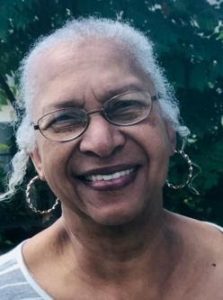
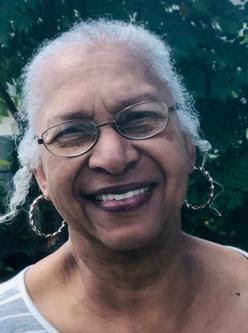
My name is Mary Daniels. I am beautifully Black! I Matter!
Yes, “BLACK LIVES MATTER”!
SILENCE Is Not an Option. Change Is Necessary. We Are ALL Humans and We All MATTER!
Mary Daniels is a citizen of Winter Park. About who she is, Mary writes, “All that anyone is came from the beginning ancestors Adam & Eve. So then, who are we blacks, and even more importantly, who are you whites – and all the different races of the world? We breathe, bleed and have the same organs as all other human beings. I make no apology for my being born black, my culture and heritage of being a strong, respectful, beautiful woman of color.”
To comment or read comments from others, click here →
by Anne Mooney | Jun 11, 2020 | COVID 19, Custom Author, News
Black Lives Matter in Winter Park
Peaceful Demonstration in Central Park
by Anne Mooney / June 11, 2020
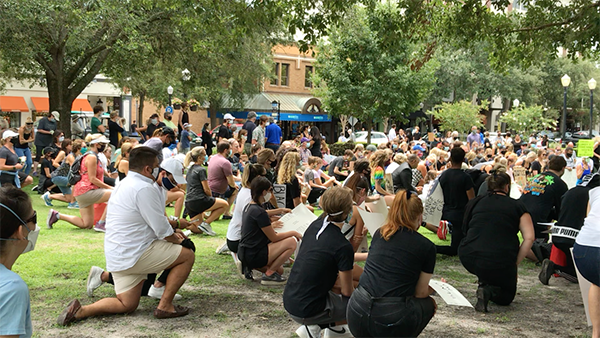
It’s been nearly a week since demonstrators gathered peacefully on June 5 in Central Park to support the Black Lives Matter movement and to mourn the deaths of George Floyd and others at the hands of law enforcement officers.
A crowd of roughly 300 baked in Florida humidity and 90-degree heat. Young and old, black, brown and white, they took a knee to stand for the future they want to see.
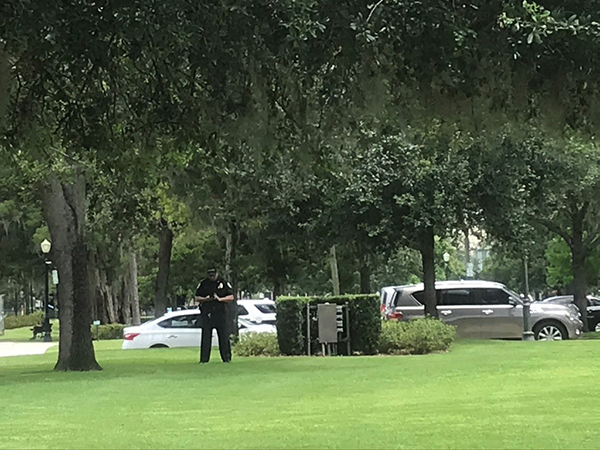
Watchful Winter Park police officers kept a respectful distance.
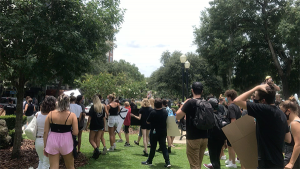 After listening to speakers, several of whom were from Winter Park’s African American community, the group joined in prayer. The youthful organizer of the gathering, Adrian Bouchout, asked the crowd to remain peaceful as they turned to march out of Central Park and down Park Avenue.
The crowd marched down to Fairbanks and back up through the Hannibal Square neighborhood, finally ending up at the Public Safety Building, where protesters and police thanked one another for a peaceful and successful event.
Present at the rally were Commissioners Marty Sullivan, Sheila DeCiccio and Todd Weaver. Later in the week, Sullivan and DeCiccio sent messages to constituents. 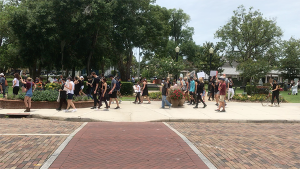
DeCiccio Calls for Support for Police
“I believe it’s essential for our Police Department to have the support it needs,” wrote DeCiccio. She spoke with Police Chief Michael Deal, who confirmed that the Police Department adheres strictly to the following policies.
- No chokeholds or strangleholds.
- De-escalation is required, and officers have received special training.
- Officers must issue a warning before firing a weapon.
- Officers must exhaust all other means before shooting.
- Officers have a duty to intervene when they see a breach of procedure, especially one involving excessive force.
- Shooting at moving vehicles is prohibited.
- All officers are required to employ the “use of force continuum.”
- Comprehensive reporting of all incidents is required.
Chief Deal stated the WPPD has zero tolerance toward police brutality.
The body cameras that were approved last year by the city commission arrived just as the COVID19 crisis hit, so the department is still in the process of training officers on their use. Deal said, “Everyone is looking forward to wearing their cameras.”
Sullivan Calls on Winter Park to Support All of Its Citizens
In his message to constituents, Commissioner Marty Sullivan wrote, “We have outlawed government mistreatment of minorities, but we have yet to exterminate racism.”
He called on the city to hold a referendum on single-member districts, to provide participation from all neighborhoods in city government, to reflect citizen desires with Advisory Board appointments and Commission decisions and to provide infrastructure support for all neighborhoods.
“Peaceful gatherings across the country show that we still care,” wrote Sullivan, “we still love our fellow citizens, and we ask, rather demand, that entrenched racism be defeated. Most Americans desire this, and I believe that continuing nonviolent action will bring about this needed change.”
To comment or read comments from others, click here →
by Anne Mooney | May 6, 2020 | COVID 19, Custom Author, Events, Headline, News
Happy Mother’s Day!
City Hosts Special Mother’s Day Weekend
by Anne Mooney / May 6, 2020
 May 8 – 10, the City is hosting a special Mother’s Day weekend of socially-distanced restaurant dining and limited retail therapy.
Streets Closed for Distance Dining and Shopping-Withdrawal Relief
To facilitate safe outdoor dining, portions of Park Ave., Morse Blvd. and New England Ave. will be closed to vehicular traffic from 4:00 pm Friday, May 8, to 11:00 pm Sunday, May 10.
Park Ave. from Swoope to Fairbanks
New England Ave. between Pennsylvania and Virginia Ave.
Morse Blvd. between Center St. and New York Ave.
All Shops & Restaurants May Participate
Outdoor shopping and dining is not limited to Park Ave. and Hannibal Square, however. Any retail store or restaurant within the City limits may apply for a permit from the City to extend their business outside. The permit is good only through the weekend.
Restaurants and shops must maintain the 6-foot required distance between patrons outside and limit inside occupancy to 25 percent of capacity.
Mini-Sidewalk Sales
Retail shops must also adhere to the 25-percent-capacity rule, but they may also have a single merchandise rack or table on the sidewalk outside the shop.
Each business will bear the responsibility of ensuring its customers meet social distancing requirements at all times. “As we continue to take methodical steps to reopen the City following the State guidelines, we are hosting this special weekend to help our business community and to give the public a chance to support our local businesses and celebrate Mother’s Day,” said Assistant City Manager Michelle Neuner.
To comment or read comments from others, click here →
by Anne Mooney | Mar 29, 2020 | COVID 19, Custom Author, Headline, News
You Must Pre-Register for Virtual Commission Meeting Tomorrow at 5:00
Registration is Open Now
by Anne Mooney / March 29, 2020
The virtual dais at the Live Virtual Commission meeting at 5:00 pm tomorrow night, Monday, March 30, will once again feature five live Commissioners. Newly elected Commissioners Marty Sullivan and Sheila DeCiccio will now be sitting in Seats #1 and #2 respectively.
Our gratitude for their service goes to former Commissioners Greg Seidel and Sarah Sprinkel, who can now watch from the comfort of their homes.
Registration for the Meeting is Open Now
Go to https://cityofwinterpark.org/government/live-video-broadcasts and click on “Live Virtual Meeting” in the yellow banner. That will take you to the registration page.
Public Comment Will Be Taken
As this is a regular meeting of the Commission, public comment will be taken during the meeting. There are three ways for citizens to comment – by email, by submitting a comment form or by phone.
Email — You may comment in advance of the meeting by emailing mayorandcommissioners@cityofwinterpark.org. Emailed comments will become part of the record but will not be read aloud.
Public Comment Form — If you would like for your comments to be read during the meeting, submit the Public Comment Form found at <cityofwinterpark.org/public-comment> The form will be accessible at 5:00 Monday as the meeting begins.
Phone – If you are unable to submit online comments, the City will activate the public comment phone line at 5:00 pm Monday – 407-599-3410. Calls will be answered by City staff, and your verbal comments will be entered into the online system on your behalf. Phoned-in comments will be read during the meeting as part of the official record.
All comments will be monitored in accordance with City standards of decorum.
To comment or read comments from others, click here →
by Anne Mooney | Mar 27, 2020 | COVID 19, Custom Author, Headline, News
WP Goes Virtual
Dry Run for Special Commission Meeting Monday, March 30
by Anne Mooney / March 27, 2020
 Yesterday, March 26, from 5:00 to 6:30 pm, the Winter Park City Commission held its first Virtual Meeting – and probably the first meeting ever attended by all 7 past and present commissioners. And even with 7 Commissioners present, the meeting began and ended right on schedule.
Work Session on City Response to Coronavirus Lockdown
The meeting was a live-streamed Work Session on the City’s response to the coronavirus situation. Participating from home but visible and audible on computer screens across the City were Mayor Steve Leary, Commissioners Carolyn Cooper and Todd Weaver, soon-to-be-former-Commissioners Sarah Sprinkel and Greg Seidel, Commissioners-elect Sheila DeCiccio and Marty Sullivan and City Manager Randy Knight with key city staff.
Exec Order from Governor
The meeting was made possible by an Executive Order from Governor Ron DeSantis suspending the Florida statute that required a quorum to be present in person at a specific place. The Executive Order allows local governments to utilize media technology to hold meetings.
As with any Commission Work Session, there were no Commission votes or public comment.
Dry Run for Monday’s Commission Meeting
Yesterday’s Work Session was a dry run for a Special Commission Meeting Monday, March 30 at 5:00 pm. At that meeting, the Commission will vote and take public comment. If you missed last night’s meeting, you can tune in Monday at <cityofwinterpark.org/cclive>
Register in Advance to Participate
In order to participate, you must register in advance. Space is limited, so do not delay. Go to <cityofwinterpark.org> and click on Access Virtual Commission Meeting Live Video Broadcast & Instructions. You will find all the information you need to register and participate.
Public Comment Will Be Taken Monday
Public comment will be taken at the 5:00 pm hour, as usual. You can comment in advance of the meeting by emailing mayorandcommissioners@cityofwinterpark.org Emailed comments will become part of the record, but will not be read aloud. You can also comment by phone, and your comment will be recorded and will be audible on the live stream. The public comment line, which will be activated Monday at 5:00 pm, is 407-599-3410. Live comments will be monitored in accordance with City standards of decorum.
Meanwhile, although City Hall is closed to the public, the City itself is Open for Business.
Police and Fire-Rescue Departments are at full staffing. The Police Department reports a decline in criminal activity and calls for service, due to fewer people being on the streets.
Fire Chief Dan Hagedorn reported that, as of yesterday, there were 2,235 reported COVID19 cases in Florida, with one fatality. Two cases have been reported in Winter Park – one is a resident and one a non-resident. Emergency crews who transported these patients to the hospital are on 14-day quarantine as a precaution, but are showing no symptoms.
Parks & Recreation Director Jason Seeley reported that the March 13 order of a 10-person-group limit marked the drawdown of City recreational programs. Playgrounds are now closed, but open spaces such as Central Park and Mead Botanical Garden are open, with social distancing required. Monday’s Commission meeting will likely see decisions to close the Dinky Dock boat ramp and the Winter Park Golf Course. Citizens may enjoy continued lake access from their private docks.
Infrastructure departments such as the Electric Utility, Water & Waste Water, Code Enforcement and the Building Department are open and active.
City Budget
In his discussion of the budget, City Manager Randy Knight acknowledged that the City anticipates a drop in revenue, but said it is difficult to tell at this early stage how great or small that will be or how long it will last. Knight said he does not anticipate cutting essential services for residents. He plans to present the Commission with a revised budget for this Fiscal Year.
City Assistance to Residents & Businesses
Utility cutoffs for non-payment have been suspended, and staff is working on programs to assist residents and businesses with utility payment plans. City Staff will work with the Winter Park Chamber of Commerce to help local businesses apply for loans and other financial assistance. Restaurants are allowed to offer takeout and delivery services.
City staff is working to develop virtual programs for youth and seniors. The City is considering creating a micro-loan program for businesses in the CRA. And the City Manager is looking into acquiring Federal assistance available to state and local governments.
To comment or read comments from others, click here →
by Anne Mooney | Mar 17, 2020 | Custom Author, Headline, News
Winter Park – Coronoavirus Update
by Anne Mooney / March 17, 2020
 The City has issued a list of closings and cancellations effective immediately, as it continues to monitor the status of the coronavirus and the COVID-19 disease.
City Hall and Facilities Closed to the Public
Effective immediately, City Hall and City facilities are closed until further notice. City services and assistance will remain available by phone or email.
The Public Safety Building at 500 N. Virginia Ave., Fire Station #62 on Lakemont and Fire Station #64 on Howell Branch Rd. are closed to visitors, except for emergencies.
The Saturday Winter Park Farmers Market is suspended until further notice.
Recreational facility closures include the Community Center, Cady Way Pool, Showalter Stadium, the Winter Park Golf Course and the Azalea Lane Tennis Center. Public parks and playgrounds and greenspaces will remain open. Please practice social distancing protocol by keeping a space of at least six feet between you and others not in your household.
Events and Gatherings Cancelled
The March 23 City Commission meeting is cancelled. Future Commission meetings will be announced as they are scheduled.
City Advisory Board Meetings are cancelled until further notice.
All events and gatherings of more than ten people are cancelled or postponed until further notice.
Recreational programming and events for youth, adults and seniors are cancelled until further notice.
Public Safety Facilities and Services
Winter Park Fire & Rescue service will continue to provide fire and EMS services. Winter Park Police Department will operate normally with modified non-emergency responses. For more information, call 407-644-1313.
Utility Customers
Although utility statements and due dates remain on schedule, the City understands that some customers may experience unavoidable financial difficulty during this period and has suspended the disconnection for non-payment policy until further notice.
For billing questions, call 407-599-3220; for outage and service issues call 877-811-8700.
Restaurants and Bars
A recent Executive Order by Gov. Ron DeSantis requires all Florida bars and nightclubs to close for 30 days, effective today. Restaurants are required to remain below 50 percent occupancy. As this creates considerable hardship for City businesses, the City is working with the Chamber of Commerce to help. Go to the Winter Park Chamber of Commerce website to check out curbside food pickup and home delivery options from our local restaurants.
Building Permits & Services Online
Although City Hall is closed to the public, Building & Permitting Services will be reviewing plans submittals and issuing permits electronically at permits@cityofwinterpark.org Inspectors will continue on a case-by-case basis. You can schedule inspections online at <Epay> or call 407-599-3350.
Stay Informed
Information regarding the spread of the coronavirus and the COVID19 disease changes daily, please remain informed using the following resources.
cdc.gov/COVID19
cityofwinterpark.org
Facebook.com/WinterParkEmergencyInfo
twitter.com/winterparkfla
OUTREACH – sign up for the City’s emergency notification system
nexdoor.com – sign up for your neighborhood information
winterparkvoice.com for the latest from the City.
Stay safe – and stop hoarding the toilet paper.
To comment or read comments from others, click here →

 Events since the death of George Floyd at the hands of Minneapolis police have raised more questions than answers. Floyd’s death seems to have been the proverbial ‘straw that broke the camel’s back.’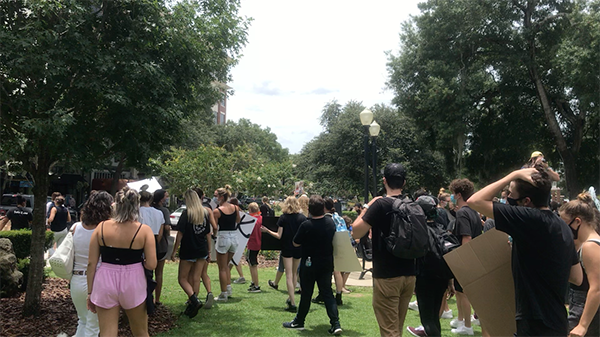



Recent Comments