by Beth Kassab | Mar 5, 2024 | News, Uncategorized, Zoning and Development
Trinity Prep wins approval to expand, build science building
Seminole County commissioners removed a cap on Trinity Prep student enrollment, but Orange County’s cap still applies
This article was provided in partnership with nonprofit, independent newsroom Oviedo Community News.
March 5, 2024
By Abe Aboraya
The Seminole County Commission unanimously approved an expansion at Trinity Preparatory School last week.
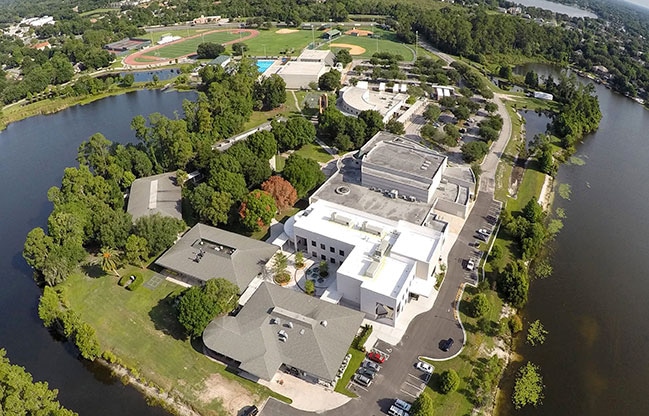
Trinity Prep is on 90 acres of land at the south side of Aloma Avenue just west of where it meets Tuskawilla Road, with the property straddling both Seminole County and Orange County. The Commission gave approval to build a two-story, 30,000-square-foot science building on the forested northeastern end of the school’s property.
Commissioners asked about an enrollment cap at the school. Orange County caps their enrollment at 888 students, and Seminole County wanted to increase the cap to 1,200 students. School officials said they wanted the ability to eventually expand enrollment without having to come back to the county for approvals.
“The cap inhibits us in terms of growth,” Trinity Prep Headmaster Byron Lawson said to commissioners.
He said the school would like to expand, especially with the younger grade levels. “But I also understand where I live, and we want to take this next step with the county to provide a great education for the kids we have now.”
Ultimately, Commissioner Bob Dallari made a motion to approve the school expansion – and completely eliminate the cap.
“I just want to make sure we’re treating the applicant fairly,” Dallari said.
Now, if Trinity Prep wants to increase its enrollment, it would still need to get approval from Orange County.
Additionally, Seminole County Commissioners:
- Awarded a $2.9 million contract to Oviedo-based Ovation Construction Company Inc. to build Phase II to replace a wastewater processing plant equipment at Yankee Lake. The facility is off of State Road 46 in Sanford. Separately, the county also gave early approval to a $3.8 million project to recharge the aquifer through a well at Yankee Lake.
- Signed off on $13.5 million tax exempt bonds being issued to help pay for construction of affordable housing in Sanford. Riverbend Landings Partners plans to build an 89-unit development off of State Road 46 in Sanford. A key detail: 20% of the units would be for residents earning 50% of the median income of the area.
© 2022 Oviedo Community News. Used with permission. To learn more about the nonprofit newsroom covering Greater Oviedo & Winter Springs and subscribe to free e-news, visit OviedoCommunityNews.org.
To comment or read comments from others, click here →
by Beth Kassab | Feb 28, 2024 | City Commission, News, Uncategorized, Zoning and Development
Rollins presses pause on request for faculty apartments
The controversial project, which would have provided accessible housing to faculty and staff near the liberal arts campus, drew criticism from neighbors
Feb. 28, 2024
By Beth Kassab
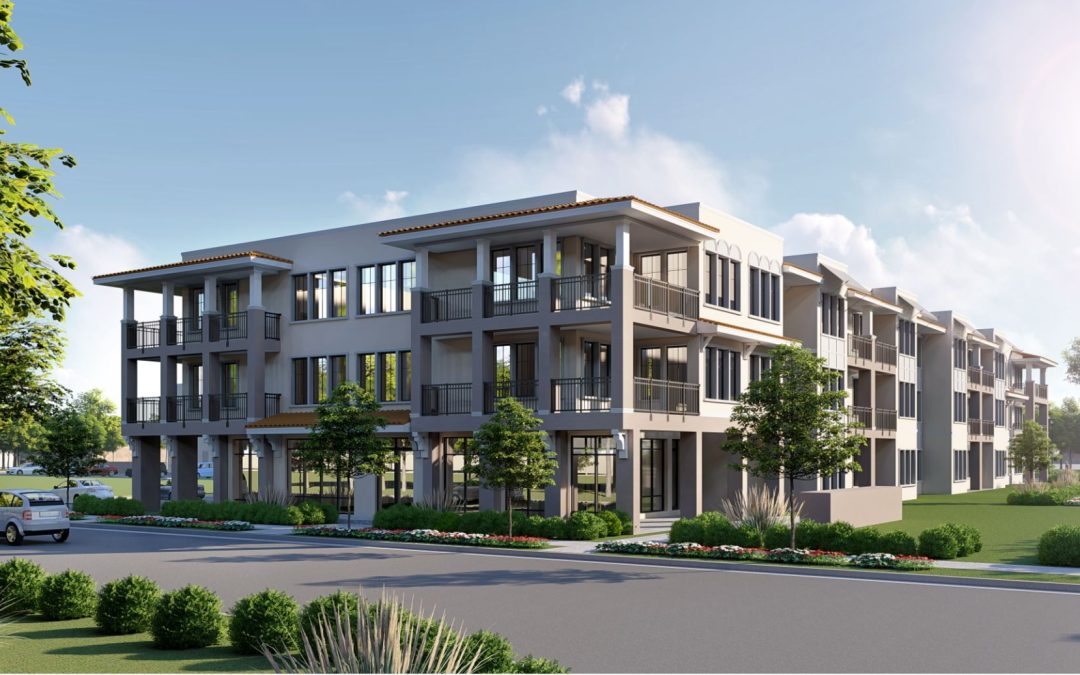
Rollins College withdrew its request to build faculty apartments a few blocks from Park Avenue after an outcry from neighbors and concerns from commissioners that the building wouldn’t fit in the neighborhood.
“College leadership has talked with each commissioner over the past several weeks, seeking input and feedback on accommodations while striving to preserve the integrity of the project,” Rollins administrators said in a statement. “This project remains a strategic priority of the college. We will take time to explore our options and come back with a project that benefits the College and the City’s Central Business District.”
President Grant Cornwell has said the college needs to be able to offer attainable housing to recruit younger faculty because housing prices in Winter Park are often $1 million or more.

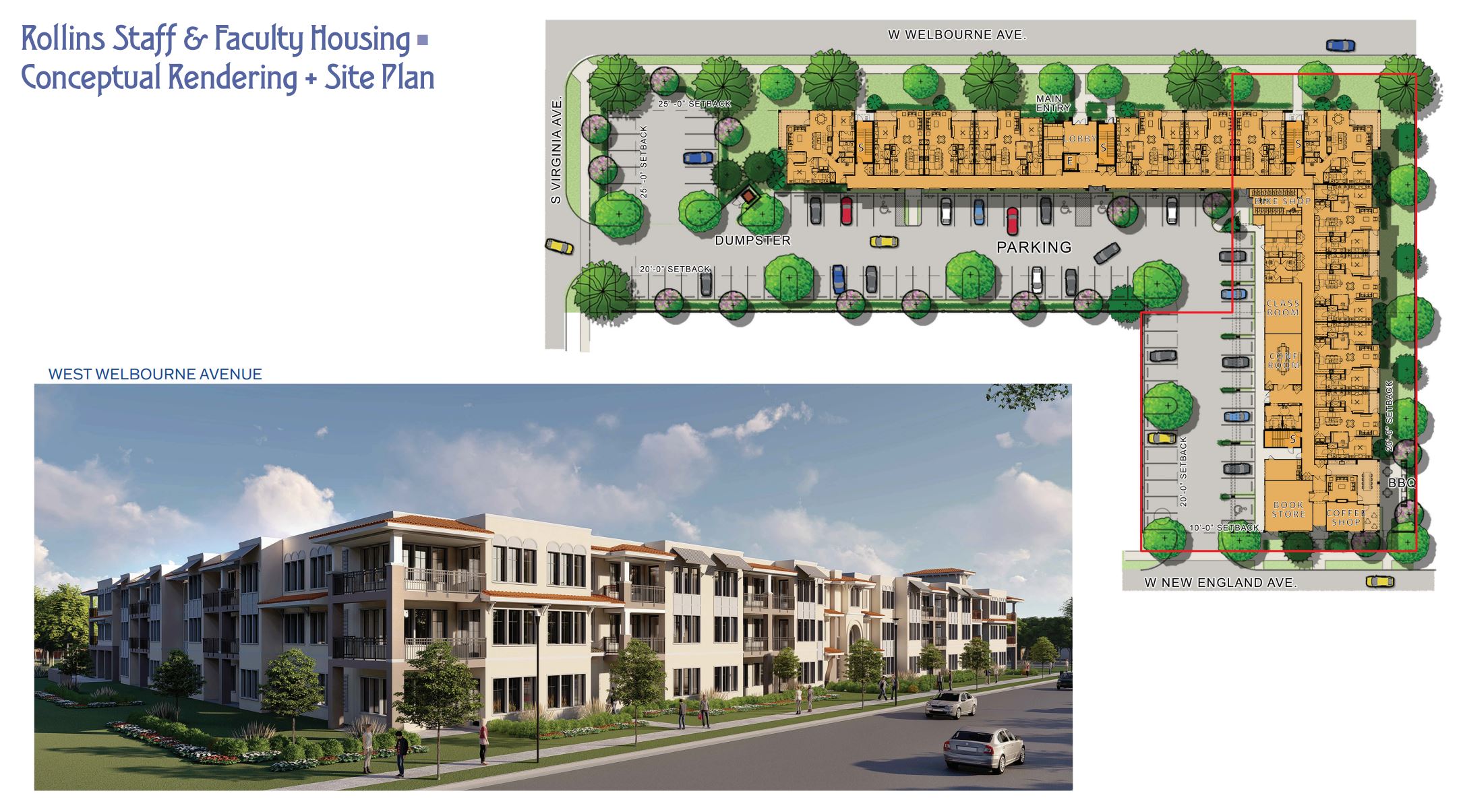
A rendering shows a faculty and staff apartment project proposed by Rollins College.
Workforce housing and affordable housing are often thrown around as priorities of the City Commission, particularly in the context of expanding the city’s Community Redevelopment Agency.
But the Rollins project quickly became a target for neighbors to shoot down, asserting the building would decrease their property values.
In January, Rollins attempted to appease some of those concerns by lowering the number of proposed units from 48 to 39 and reducing the size and length of the building along Welbourne Avenue.
The proposal was for a three-story 72,933-square-foot building with 104 parking spaces, which meets code requirements, according to a memorandum from city staff.
A number of residents of the Douglas Grand condominium building said they feared their own units will drop in value because of Rollins’ planned framed construction with what they called too few architectural details to emulate the Spanish-Mediterranean style the main campus is known for.
“Please consider whether or not you would purchase a $1 million residence across the street from what would be at best an average maintained, subsidized apartment complex,” read one email to commissioners from a resident.
“It is the appearance of the rental facility that makes it even more distasteful,” read another.
“Not to sound snotty, but this is the type of apartment better suited for cities like Fern Park or Casselberry,” a resident wrote.
In it’s statement, Rollins did not say when it expected to try again to seek approval for the project, but signaled it would do so eventually.
“We remain committed to ongoing dialogue with commissioners as we continue to refine the proposal,” the statement said. “We are grateful to the many Winter Park residents and community members who have shown support for this initiative aimed at addressing the college’s workforce housing needs.”
WinterParkVoiceEditor@gmail.com
To comment or read comments from others, click here →
by Beth Kassab | Feb 28, 2024 | City Commission, Election, News, Uncategorized
Big money flows into Winter Park elections
The three-way race for Seat 2 on the City Commission is also proving a tight financial contest
Feb. 28, 2024
By Beth Kassab
Money is flowing into Winter Park elections, with five candidates for two open seats raising a combined $200,000 so far, and about half of that still on hand to spend before the March 19 election.
The biggest money is pouring into the three-way race for Seat 2 on the City Commission.
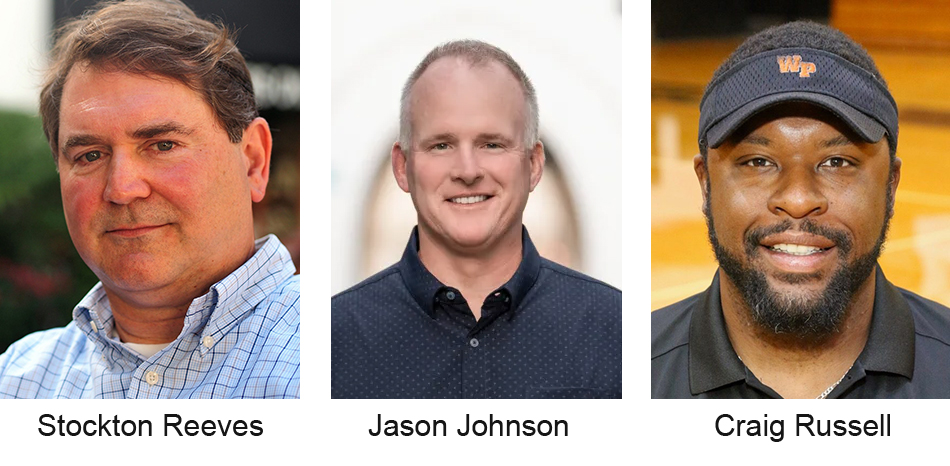
Craig Russell, a teacher and coach at Winter Park High School and first-time candidate, raised $49,128, according to the most recent reports filed with the city clerk last week. That figure was enough to overtake the $41,952 raised by Jason Johnson, an attorney and also a first-time candidate, who was the early money leader in the race.
The Winter Park Chamber of Commerce announced earlier this month that it would endorse Russell and his contribution records show a $1,000 check from the chamber’s political action committee as well as donations from other business leaders associated with the chamber.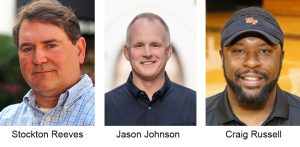
Notably, at least $8,000 in contributions are from businesses owned by or associated with the Holler family, which owns car dealerships and Winter Park real estate. Individual checks are logged from Holler Honda, Holler Hyundai, Holler Driver’s Mart, Classic Mazda and Audi among others, according to the reports.
Frank Hamner, an attorney for the Hollers, gave two separate checks of $1,000 a piece on Jan. 16 and Feb. 16, both marked as individual contributions. Hamner said in an email message that one of those contributions was “misclassified” on the report and was actually from his law firm rather than a personal check. Each individual and business is limited to $1,000 maximum per cycle.
Strong Persuader Arms, a gun store on Wymore Road owned by Hamner, also contributed $1,000 on Feb. 16.
The combined total donations related to Hamner and the Hollers adds up to $11,000 or more than 20% of Russell’s total contributions.
The Holler family or corporations affiliated with the family own prominent land along Orange, Fairbanks and Park avenues that could one day be redeveloped. The family also was at one time involved in a lawsuit against the city of Winter Park, arguing that commissioners improperly overturned the original Orange Avenue Overlay zoning rules.
Hamner said the Hollers’ support of Russell evolved because they know him as a leader in the community from his work at the high school and his nonprofit Army of Angels.
“The property they own and plans for that property have zero to do with supporting Coach Russell,” he said, noting that Russell is “a great leader” and an “impressive young man.”
Russell told the Voice, “I am no more beholden to developers than I am to the other citizens of Winter Park, including our police, firemen, nurses, young professionals and others who can’t enjoy Winter Park because there’s nowhere for them to live.”
At a candidate forum hosted by the Chamber of Commerce, he said he was open to the idea of revisiting the original overlay plans.
At that same forum, Johnson said he was not interested in revisiting the OAO.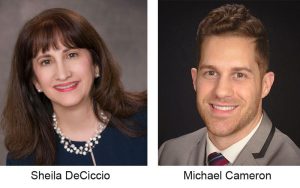
A mix of well-known names contributed to Johnson, including Full Sail University CEO Ed Haddock and his wife Edye, who each gave $1,000; a $1,000 from former Winter Park Mayor David Strong; $1,000 from former gubernatorial candidate Chris King and $1,000 from former U.S. Congressman Alan Grayson.
Noting that his opponents have surpassed him in fundraising, Johnson said he doesn’t believe the race will be decided on money alone. He said he’s been focusing on talking with as many voters as he can in individual and small group meetings.
He is the only candidate who lists detailed expenses for coffee with voters or stakeholders such as Police Chief Tim Volkerson and former Mayor Terry Hotard and sponsoring a golf tournament for Dommerich Elementary.
“I’m not trying to win the battle of the mailers,” Johnson said. “Getting in front of people and talking to voters is really, in my opinion, where this race is won.”
Mailers appear to be a key strategy for Stockton Reeves, who has sent at least eight to voters homes so far.
Reeves, the executive director for the Center for Public Safety who also ran for a Florida House seat, has brought the most money into his campaign account with more than $69,000 so far. But the bulk of that total — $53,000 — is in the form of loans from himself to his campaign. That means he’s raised just $16,000 from other contributors.
He received $250 from David Albertson, a former citrus grower and real estate investor who was one of the original founders of the Orlando Magic and $250 from Mike Clelland, an attorney and former Democratic member of the Florida House among others.
Reeves declined to answer questions about his mailers or fundraising because, “I will be giving away our strategy for the final few weeks of the campaign.”
With less than three weeks until Election Day on March 19, vote-by-mail has already started and early voting at select locations will begin on March 4 and run through March 17.
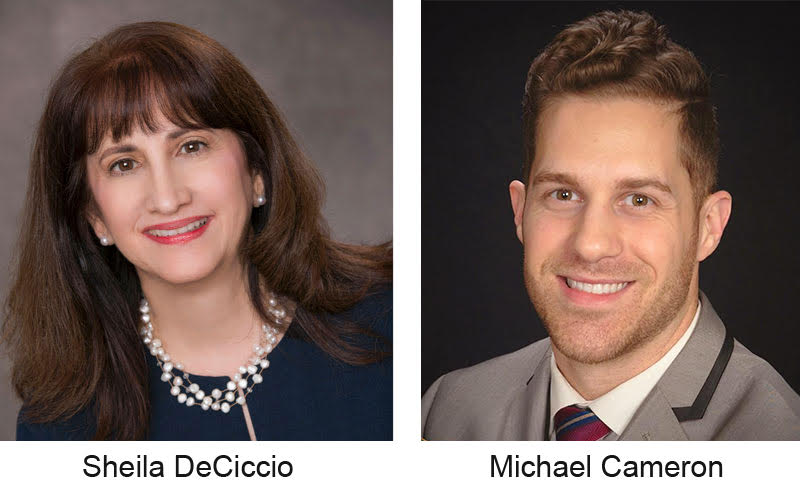
Sheila DeCiccio, who is leaving Seat 2 to run for mayor, is the clear money frontrunner in her race. She has picked up nearly $40,000 in contributions and spent more than $25,000 so far, according to reports.
Her contributors include $1,000 from King, the former gubernatorial candidate, Strong, the former mayor, and Alan Keen, an attorney and developer.
Michael Cameron, who is running against DeCiccio and owns a real estate school, has raised $4,971 and has spent nearly all of that on a political consultant called Panoplia Consulting Group started in 2022 by former Republican state house candidate Jeremy Sisson.
Panoplia’s web site describes itself as a firm that “exclusively serves Kingdom-focused candidates who are called to serve their communities in a civic capacity.”
The site calls on candidates to “put on the full armor of God” and says, “We equip our clients with the armor and weapons necessary to do battle in the political arena.”
Cameron, who has not appeared at any public forums and also skipped a private forum at the Mayflower senior living community, did not respond to questions from the Voice.
WinterParkVoiceEditor@gmail.com
To comment or read comments from others, click here →
by Beth Kassab | Feb 24, 2024 | City Commission, News, Orange Avenue Overlay, Uncategorized, Zoning and Development
News & Notes: Rollins apartments, McCraney property and leaf blowers
The developer of the first new building in the Orange Avenue Overlay is bringing significant changes back to the City Commission for consideration
Feb. 24, 2024
By Beth Kassab
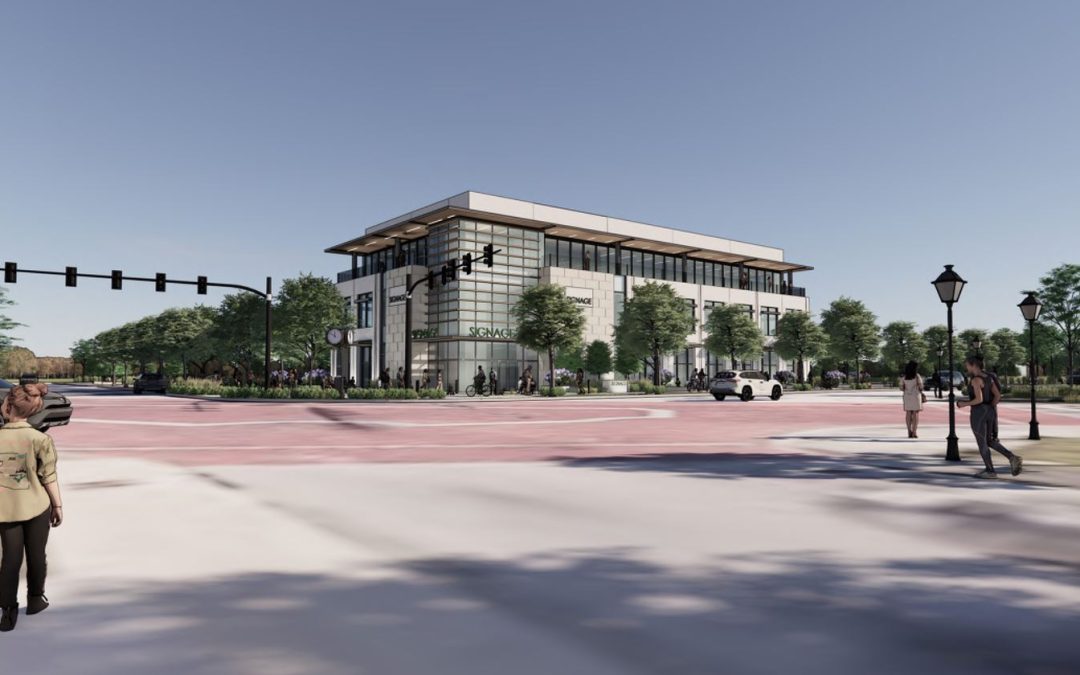
The City Commission on Wednesday will hear a list of proposed changes for the three-story office building slated to be developed next to Seven Oaks Park along Orange Avenue.
The changes are the result of a lengthy public hearing two weeks ago during which a number of residents spoke both for and against the building.
Commissioners criticized the building’s height, which exceeded the limit, as well as its single-use purpose as an office building among other concerns.
Since then, Steve McCraney, the developer who wants to use the building, in part, as his corporate headquarters, has submitted the following changes:
- The building will no longer be used exclusively for offices and now will be a mixed-use project. The other uses proposed weren’t immediately clear.
- The building’s architecture has been updated (see rendering above).
- The screen wall on the roof of the building intended to shield the air-conditioning unit and other equipment from view will now be shorter.
- The green space planned in front of the building along Minnesota and Denning is adjusted, though the building will still provide more than the required number of parking spaces in the back.
After a first hearing, which didn’t require a vote on Feb. 14, commissioners are expected to take a vote on the project after the second hearing on Wednesday.
Rollins seeks approval for apartments
The liberal arts college that has helped define central Winter Park is expected to come back to the board for approval of new faculty apartments after pausing its request earlier this month.
Neighbors and commissioners have asserted the plan, which is intended to provide attainable housing close to campus exclusively for Rollins faculty and staff, doesn’t fit with the neighborhood and will decrease property values.
At the end of January, Rollins attempted to appease some concerns by lowering the number of units from 48 to 39 and reducing the size and length of the building along Welbourne Avenue.
The proposal is now for a three-story 72,933-square-foot building with 104 parking spaces, which meets code requirements, according to a memorandum from city staff.
Will residents vote on leaf blower ban?
In what has proven to be just as explosive of a topic as development in Winter Park, Commissioners could take a step this week in quieting — once and for all — the noise over leaf blowers.
Commissioners are expected on Wednesday to vote on an ordinance that could allow voters to decide if gas-powered leaf blowers should be banned.
The ordinance comes after Sen. Jason Brodeur threatened to pass a law to prohibit Winter Park and other cities from enforcing their own rules on the matter.
Brodeur demanded the city delay implementing the ordinance, which was originally passed on Jan. 12, 2022, until June 1, 2025, which would allow voters to first have a say on the March 11, 2025 ballot. Voters would be asked whether the gas powered devices, which many consider a nuisance both as noisemakers and air pollutants, should be banned.
Commissioners are expected to vote on doing just that. At the last meeting, Marty Sullivan and Todd Weaver signaled they were against meeting the senator’s demands while Phil Anderson and Kris Cruzada said they were open to it. Sheila DeCiccio, who is running for mayor in the March 19 election, is expected to be the swing vote.
WinterParkVoiceEditor@gmail.com
To comment or read comments from others, click here →
by Beth Kassab | Feb 23, 2024 | City Commission, Election, News, Uncategorized, Zoning and Development
Seat 2 campaigns intensify over development, public safety claims
The three-way race appears focused on one of Winter Park’s most asked questions: How will growth look in the future?
Feb. 22, 2024
By Beth Kassab
Election mailers and the accusations that come along with them are flying in Winter Park as three candidates compete for the seat on the City Commission vacated by Sheila DeCiccio, who is running for mayor.
The issue taking the most attention? Growth and development — Winter Park’s perennial dog fight.
At stake is how Orange and Fairbanks avenues as well as U.S. 17-92 look over time as major property owners begin to redevelop their land along with continuing redevelopment across the city’s western neighborhoods.
The person who is elected to the open seat will likely have significant influence over those projects and two of the candidates, Jason Johnson and Craig Russell, are clearly differentiating themselves on the matter. A third candidate, Stockton Reeves, appears to be focusing on taxes and inflation as well as claims about public safety.
A mailer to residents from the Winter Park Chamber of Commerce’s Political Action Committee somewhat crystalizes what is emerging as a defining issue in the race: Whether development codes should be more lenient.
“Did you know?” the mailer asks is large type. “Park Avenue would be prohibited from being built today under current city code.”
The mailer goes on to say that the code “blocks Winter Park’s iconic charm from enhancing other parts of the city.”
The chamber endorsed Russell, a teacher and coach at Winter Park High School, who was the only candidate at the chamber election forum who said he was open to revisiting the original Orange Avenue Overlay rules that allow for taller buildings and higher density. Those rules were overturned by the City Commission in 2020 and the city won a lawsuit filed by major property holders over that decision.
Russell is also the only candidate who said he was open to the chamber’s proposal to do away with the city’s parking codes that require developers provide a certain number of spaces based on the type of development.
“Current codes limit commercial land owners from creating new mixed use venues of a similar size and aesthetic to Park Avenue because of the onerous and outdated parking requirements,” Betsy Gardner, chamber president and CEO, said in a statement. “Small concessions have been made over time for tenants in the Central Business District, but any new development in the city faces parking mandates that leave businesses overparked, creating empty lots, visual blight and a less walkable and more car-centric environment.”
Russell, who did not respond to a request for comment, has said at previous public forums that he would “listen to the experts” for guidance on growth and development issues. One recent mailer from Russell’s own campaign said he wants to “promote smart growth, opposing irresponsible high-density developments.”
Johnson, who opposes tossing out parking codes and emphatically said he did not agree with returning to the original OAO rules, questioned whether Russell would speak for residents or business interests when it comes to new development.
“The comment about ‘listening to the experts’ is a deflection and a way of saying if an expert comes in on behalf of a developer and says something, we should just listen to that rather than what the residents think,” he said.
Johnson, an attorney who has made maintaining Winter Park’s charm a central element of his campaign, sent out an email to voters this week that emphasized, “I am NOT endorsed by the Winter Park Chamber’s PAC, which endorsed a candidate who supports development of large out-of-scale buildings near Park Avenue, and doing away with parking requirements for future commercial developments.”
Reeves, who did not show up at the public candidate forums, has sent at least eight mailers to voters so far — the most of the three candidates.
One of his pieces exclaims “higher prices and inflation aren’t the only things out of control” and says “our property taxes are going up too!” He accused the commission of increasing taxes by 7% in 2022 and nearly 9% in 2023.
His claims are based on the idea that commissioners could have adopted the “rollback rate” or lowered the city’s milage rate to collect the same tax revenue as was collected the prior year.
Instead, commissioners kept the tax rate the same, but collected more taxes because property values have increased. That means each property owner paid a higher assessment based on their increased value.
During budget meetings last year, commissioners noted the need to increase police and fire budgets as inflation and other factors, have driven up wages and equipment costs. Police and fire make up the largest portion of the city’s general fund expenses followed by parks and public works.
In a separate mailer, Reeves asks “Quick question – How many ambulances does Winter Park have for over 30,000 resident?”
“It is shocking to me that we only have 2 full-time ambulances,” the piece stated.
City officials said a third ambulance is already being staffed part-time and that is set to increase over the coming year.
“Winter Park Fire Department uses the ‘right-sized’ approach, which has proven world-class and credible as WPFD is five-times fire accredited and four-times EMS accredited,” said a statement from the department. “We have already phased in a third rescue/ambulance at Station 64 during select periods. This will continue with the adoption of the [2025] budget, which already includes the hiring of additional personnel.”
Reeves told the Voice that staffing the third ambulance should happen sooner, “I am not satisfied with this and believe it should be staffed full time.”
But considering Reeves also says he supports adopting a rollback tax rate and wants to collect less revenue for the city, it’s unclear where he would find the money to continue to keep up with the costs of public safety.
He did not respond to a question from the Voice seeking details of his plan.
WinterParkVoiceEditor@gmail.com
To comment or read comments from others, click here →

by Beth Kassab | Feb 15, 2024 | City Commission, News, Uncategorized
Commission to consider resident vote on gas leaf blower ban
Sen. Jason Brodeur signaled he would not try to preempt the ban if commissions let voters decide its fate next year
Feb. 14, 2024
By Beth Kassab
The noise over Winter Park’s ban on gas leaf blowers intensified Wednesday at a hastily called work session for the City Commission to decide how to respond to a threat by Sen. Jason Brodeur (pictured above) to take away control over the issue from local officials.
City Manager Randy Knight told commissioners he spoke with Brodeur and the senator would be willing to drop his plan to pass a state law to prohibit all cities and counties from banning the gas devices — but only if Winter Park met Brodeur’s demands:
- Commissioners must delay enforcing the ordinance to June 1, 2025 rather than Jan. 1, 2025 as they decided last month.
- Commissioners must also place a question on the March 2025 ballot so voters can decide whether the ban should be repealed.
Mayor Phil Anderson, Vice Mayor Sheila DeCiccio and Commissioner Kris Cruzada said they would be open to following those orders, but the commission did not reach a decision and opted to consider the matter again at the next meeting on Feb. 28.
DeCiccio, who is running for mayor in the March 19 election, was the swing vote as the necessary third commissioner to potentially pass the voter referendum. Commissioners Todd Weaver and Marty Sullivan said they were against it.
Knight suggested that agreeing to the voter referendum could be the only way to keep Brodeur from attempting to pass a preemption law this legislative session, which is more than half way over. A number of Florida cities such as Naples and Biscayne Bay have already enacted bans, but even those could be thrown out by Brodeur’s legislation.
Brodeur briefly introduced an amendment on Feb. 6 in Tallahassee to preempt cities from enacting such a ban and then immediately withdrew it.
Just two days later on Feb. 8, Knight sent a text message to Brodeur asking to have a discussion, according to text messages provided to the Voice through a public records request.
On Monday morning, Knight reached out to Brodeur again and let him know that the city scheduled a work session about leaf blowers for Wednesday and referred to the idea of a referendum as if it was already a done deal.
“I have briefed all commissioners on our discussion and I feel good about it,” Knight wrote. “We don’t take public comment at work sessions but of course will when the referendum ordinance comes forward.”
“Outstanding,” Brodeur responded. “Much appreciated.”
Brodeur got involved in the issue just weeks ago after complaints from constituents escalated after the city passed a rebate for homeowners who purchased electric leaf blowers.
The ban has been around since 2022, but commissioners opted to delay its start until July of this year.
Landscape companies say the electric devices are too expensive, don’t have enough power and will bring an increased burden on their small businesses and individual workers.
Anderson said Wednesday that he recalls the survey the city conducted more than two years ago before passing the ban came back split about 50-50 in terms of support and opposition.
“I don’t know that we have 100% of the answer what our constituents want and I don’t know that Sen. Brodeur has 100% of the answer so it’s kind of an interesting idea to let the citizens weigh in on it,” he said. “It’s better than Survey Monkey.”
Commissioner Marty Sullivan expressed more skepticism.
“Even if the majority said no,” to a leaf blower ban, Sullivan said, “I think it’s incumbent on us to look to the future and do what’s right for the future. I believe this leaf blower ban is a great step forward for our city. I am hesitant about this compromise put forth by our senator.”
Commissioner Todd Weaver pointed out that the original vote for the ban was unanimous and that commissioners are elected to represent the interests of the city, rather than manage “threats” and edicts handed down from Tallahassee. He said he would rather see the question make it to the ballot because citizens gather enough signatures to place it there — an estimated 1,400 or so — rather than by a vote of the commission.
DeCiccio also said she support a citizen-led effort to put the question on the ballot next year and asked Knight to approach Brodeur to see if he would also be amenable to that option.
Knight will bring another report back to the commission on Feb. 28 when they will also take a vote on whether to allow voters the chance to repeal the ordinance next year.
The legislative session is scheduled to end the following week on March 8, which still leave Brodeur nine days to slip the preemption language into a bill if he doesn’t like the results of the next city meeting.
In recent years, Florida legislators have taken control away from municipal and county elected officials on everything from setting renewable energy standards, gun ranges, tenants’ rights, affordable housing projects and even the books on the shelves at public schools.
Anderson, who met with landscape company owners last month to hear their concerns and called a special meeting to potentially change the ordinance, is pushing the city to provide a directory of companies that have already converted to electric equipment so residents can make more informed decisions about who they hire.
“Whether we’re preempted or not, the city believes this is the right thing to do,” he said, noting he wants more resources and education available.
DeCiccio asked how bans are playing out in other cities that have enacted them for the same reasons — to reduce nuisance noise and pollution.
“They’ve all stuck with it,” Knight said. “They haven’t repealed it. They haven’t expressed that it’s been much of a challenge for them.”
WinterParkVoiceEditor@gmail.com
To comment or read comments from others, click here →
Recent Comments