
Lawsuit Filed Today Challenges Florida Property Tax Amendment
Winter Park commissioners did not indicate on Wednesday whether or not they would join the legal challenge against the measure that would cut in to both the revenue and autonomy of local governments in Florida
June 11, 2026
By Beth Kassab
City Attorney Kurt Ardaman on Wednesday told the Winter Park City Commission about a legal challenge against the ballot amendment pushed by Gov. Ron DeSantis and the Florida Legislature to radically reduce property tax revenue for local governments.
Ardaman said the commissioners could join — as a group or as individuals — the lawsuit filed Thursday morning by Jamie Cole, one of Florida’s most well-known local government attorneys for his work on previous ballot amendments and cases protecting home rule with the law firm Weiss, Serota, Helfman, Cole & Bierman.
“Most local governments in the state of Florida do not want to be a plaintiff and we don’t need to go into those reasons here,” Ardaman said. “But they are looking for individuals as well.”
None of the commissioners on the dais — Commissioner Kris Cruzada was absent — offered any comment or indicated their thinking. Winter Park is projected to lose at least $5.6 million in homestead tax starting in 2028 if the required 60% of voters approve the amendment.
DeSantis is attempting to make property tax reform a key part of his legacy before he is term-limited out of office at the end of the year and has openly talked about using his veto pen against those who don’t support his agenda. Winter Park is waiting to see if two projects survive the governor’s red ink.
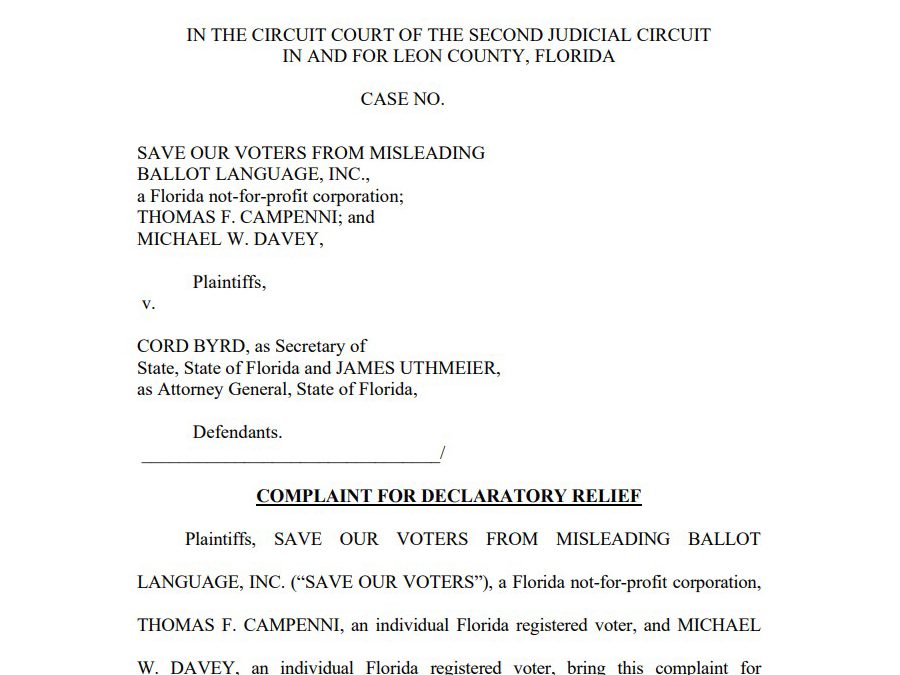
The lawsuit filed in the Second Judicial Court in Leon County on Thursday names as defendants Secretary of State Cord Byrd and Attorney General James Uthmeier. A spokeswoman for Byrd said his office does not comment on pending litigation. The Voice also reached out to Uthmeier for comment, but has not yet received a response.
Plaintiffs in the lawsuit so far are Save Our Voters from Misleading Ballot Language Inc., a new nonprofit that just filed with the state of Florida this month and lists the chief operating officer of Cole’s law firm as its incorporator, as well as Thomas Campenni, a voter in Martin County who previously served as the mayor of Stuart and Michael Davey, a voter in Miami-Dade County who previously served as mayor of the Village of Key Biscayne.
The legal challenge doesn’t argue against the general concept of reducing homesteaded property taxes, but asserts the amendment slated to go before voters is inaccurate and misleading.
“Plaintiffs recognize the great importance of property tax reform, and understand the Legislature’s zeal to enact changes as quickly as possible,” it reads. “However, on an issue as important as this, voters are entitled to a fair, clear, accurate and nonmisleading ballot statement to assist them in making this critical decision.”
Cole currently represents the city of Weston and said on a recent law firm podcast that there are multiple legal problems with the amendment that aims to increase the homestead property tax exemption to $250,000 in 2028 as well as limit the growth in the values of non-homestead properties.
He led the challenge against a property tax reform amendment in 2007 that resulted in it being taken off the ballot.
Cole said the title of the 2026 amendment is just one issue that violates the legal standard for the ballot language to be neutral.
The title is, “Save Our Homes from Excessive Property Taxes.”
He equated the wording to a “clear political slogan.”
“When you read it, it reads like a political flyer you would get in the mail,” he said.
He said the summary also fails to be neutral enough and doesn’t accurately explain what the amendment would do. It leaves out, for instance, that the exemption would first only be increased to $150,000 in 2027 before $250,000 in 2028.
The language goes on to say that voting yes means “ensuring funding for core services” such as public safety, education, infrastructure and natural resources.
“The problem is that it does not ensure funding for those core services,” Cole said. “It does the opposite.”
The amendment takes away from property taxes, the most crucial source of local revenue for local governments, and doesn’t offer any replacement.
He predicted that many local governments would raise their property tax rates and also raise other fees to make up for the loss.
Such moves, he said, would also contradict wording that claims to protect small businesses.
While the measure would limit the growth in annual assessments on non-homesteaded property to 5% instead of the 10% cap in place today, that would apply to far more than small businesses.
“What this really does to small business is if they own a piece of property their tax rate will most certainly go up … that’s hurting small businesses,” he said.
WinterParkVoiceEditor@gmail.com
If the commission or individual members join this suit, they do so at their own peril. Automatic residential property tax increases due to increased valuations are not popular and are considered taxation without representation by some.
can you elaborate on how that constitutes “taxation without representation,” Peter?