Rethink Zoning Laws? Author Argues Rules Impair Upward Mobility
The Winter Park Chamber offered a zoning history lesson at its annual Outlook luncheon and set the stage for a contested city commission race with Michael Carolan likely to run against Elizabeth Ingram
Sept. 19, 2025
By Beth Kassab
Winter Park Chamber of Commerce President and CEO Betsy Gardner called on city leaders and residents to rethink zoning laws that she says have protected anti-development interests and blunted the opportunities for new housing in Winter Park.
Gardner said the city’s desire to remake Fairbanks Avenue near Interstate 4, now part of the Community Redevelopment Agency, is Winter Park’s next chance to prevent more strip centers and encourage the kind of growth that will attract families and new residents.
“This conversation about land use is also a conversation about who gets to belong,” she said, though she added, “We do not support the replication of the density we see in Maitland.”
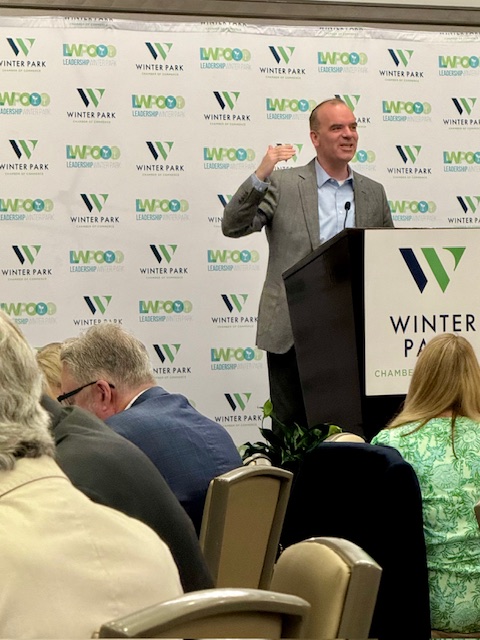
Yoni Appelbaum, pictured above, spoke at a lunch hosted by the Winter Park Chamber of Commerce on Friday.
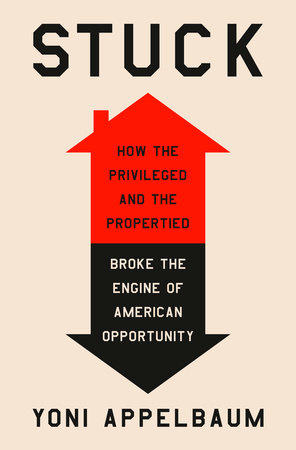
Gardner’s remarks came at the chamber’s annual Outlook lunch, which explores topics related to economic development. This year’s keynote speaker was Yoni Appelbaum, who wrote, “Stuck: How the Privileged and the Propertied Broke the Engine of American Opportunity.”
Appelbaum, also deputy executive editor of The Atlantic and a historian, discussed how Americans “invented a profound human freedom” known as upward mobility. For more than a century, people were free to move beyond the station in life they were born into and toward prosperous city centers with jobs, social currency and a solid supply of housing stock.
That meant families moved many times, each time upgrading the kind of home they lived in.
But that’s not the case today, he said, as housing is often unaffordable and hard to come by in the places considered most desirable because of proximity to jobs and lifestyle amenities. (Case in point: Winter Park, where the median housing price is $700,000 or more, according to some sources.)
“Americans have stopped moving to the most prosperous places. People now move away from those places and to where the housing is cheap,” Appelbaum said. “Many have the sense that something has gone wrong in their lives .. that some element of the American promise has been broken.”
That’s the kind of loss of community and disenfranchisement credited with sweeping President Donald Trump into office and remaking the focus of the Republican Party.
Appelbaum stayed away from politics in his talk, but said the root of that shift dates back to the beginnings of zoning laws that came about as a way for those already settled in a place — mostly rich and white homeowners — to keep out others who were new and different.
He pointed to early laws in Modesto, CA that segregated Chinese laundry workers into what ultimately became known as “Chinatown” because white homeowners did not like that the workers were also living in their places of business. In 1885, Modesto outlawed laundry facilities “except within that part of the city which lies west of the railroad track and south of G Street,” the book reads.
And zoning laws, often dictating where certain types of businesses could operate, were born.
Later came height caps on buildings in New York City to drive up prices and push sweatshops farther to the outskirts. And historic preservation laws in Charleston, S.C. that he says served to stunt the city economically in the name of preserving a past that depended on enslaved people.
“What I find useful about the past is the ability to imagine different presents and different futures,” he said. “I am not here to tell you to abandon historic preservation or abandon zoning. What I do want for us to all think about is what we’re all after.”
In one passage of his book he discusses how he can see three large apartment buildings going up out his own window that will combine to a couple thousand new units, including more than a fifth described as “affordable.”
“Like all new developments, it leaves a good deal to be desired,” he wrote. “The architecture strikes me as blandly corporate. Local regulations, historic preservation and participatory planning have combined to limit the development on the site to just a fraction of what it might have held … Although I have little affection for cookie-cutter six-story apartment buildings, I don’t want to repeat Veiller’s error of mistaking my own aesthetic judgments for the public good.”
Those apartments, he noted, will mean upward mobility for some families.
Gardner said what happens in the Fairbanks corridor is up to residents and called on attendees — which included Mayor Sheila DeCiccio and commissioners Craig Russell, Marty Sullivan and Warren Lindsey along with city administrators — to use their power in the voting booth in March when two city commission seats are on the ballot.
At a recent workshop commissioners discussed potential rule changes, including lowering transportation impact fees, to encourage development. There appeared to be support for “quality, mixed-use development with a multi-family, workforce housing component, and to develop a comprehensive approach with the Planning and Zoning Board and Economic Development Advisory Board,” according to minutes of the meeting.
In a brief interview after the program, Gardner told the Voice that many people “lost trust” in the public process after the original development guidelines for the Orange Avenue Overlay were overturned, in part by DeCiccio and Sullivan.
Asked who she would support in the March election, she introduced attorney Michael Carolan, chairman of the real estate department at Winderweedle, Haines, Ward and Woodman, as a candidate for Seat 1 on the commission to replace Sullivan, who is retiring after two terms.
Carolan, who was chairman of the chamber board in 2020 and has also served on the board of the Coalition for the Homeless in Central Florida, said he plans to run but has not yet made it official by turning in paperwork to the city clerk.
Elizabeth Ingram is also seeking Sullivan’s seat and officially launched her campaign this week with an email to residents that said she is committed to “protect the qualities that make Winter Park special — its historic charm and small-town character, parks and recreation, and strong sense of community — while planning responsibly for the future.”
The trained opera singer currently serves on the Public Art Advisory Board and led the Dommerich Elementary Parent Teacher Association and is the only person who has officially opened a campaign account so far.
Russell, who serves in Seat 2, has said he plans to seek re-election.
The official qualifying period for the election runs from Dec. 1 to Dec. 8.
WinterParkVoiceEditor@gmail.com
“At a recent workshop commissioners discussed potential rule changes, including lowering transportation impact fees, to encourage development. There appeared to be support for “quality, mixed-use development with a multi-family, workforce housing component, and to develop a comprehensive approach with the Planning and Zoning Board and Economic Development Advisory Board,” according to minutes of the meeting.”
Ha Ha Ha! Throw in “citizen task force with 19 public meetings” and you have the Orange Ave Overlay.
“Fool us once, shame on you….”
This is like a flashback to the last election and the Chamber’s very successful campaign to get their candidate commissioner of choice elected. Bring in an expert, present on a topic that doesn’t really apply to Winter Park but does to other cities, and introduce a candidate who will support the policy that will “fix” all of our problems. I give the Chamber credit for their success along with their leadership, but now we have two very different candidates-Elizabeth and Michael and the foreshadowing of a city divided-those for and against large development. And in the long run, I was just hoping to have our power lines underground and the pond size potholes fixed! Fasten your seatbelts Winter Parkers as this is going to be a wild ride!
Growth is not what I want to see in Winter Park regardless of what the chamber wants. We don’t have to open the doors and be accessible to everyone. We are quite fine the way we are. Affordable housing is not right for every community especially when the town is as small as Winter Park. I believe I speak for at least half the residents and I will continue to support commission candidates who want to keep Winter Park as it is.
First, Winter Park real estate prices are determined by supply and demand. Plain and simple. Second, there is a large percentage of lakefront property driving property values. Plain and simple. Second, real estate, like any other investment, is one for which no one wants to incur a loss. Plain and simple. FOR THESE REASONS, property owners do what they can to protect their investment, including supporting zoning laws that maintain or improve property values. Plain and simple. (It is my belief) Winter Park property values would be negatively impacted by a significant increase in density (such as abundant and or large-scale apartment complexes). That is why (a majority of voting) residents have not been supportive of such developments. Plain and simple. It is not to stomp on upward mobility, or to break the American dream. (Side note- Since when did the American dream become “the American promise”?). The American dream is homeownership, not renting a unit in a large apartment complex. I think most Winter Park property owners would support single family housing development selling “starter”-sized, affordably priced homes. This is how to support the American dream or upward mobility without breaking it for the existing property owners. I am hopeful people can see past the inflammatory tone of Appelbaum’s message (designed to sell books, and garner speaking engagements) and surpass his line of thought to develop more advanced, reasonable approaches to development in Winter Park. Winter Park is not like Charleston, nor Modesto. It was started a vacation destination. Then Rollins was established. Then a non-seasonal city began to grow. Since then, Winter Park has continued to be a very desirable place to live due to preservation of its scale, charm, and commitment to arts, education, and community wellbeing. Plain and simple. Just one person’s view.
Sorry I missed a typo. The second “second” should say “Third”.
Time to hang out the “No Vacancy” sign in Winter Park. Every gathering establishment has a sign inside that says, “Occupancy Limited to …” We need a big sign like that for our town. Enough is enough. Let the developers line their pockets elsewhere.
Housing, a tough topic: I’ve lived in Winter Park for 65 years, built a business here, and serve as chair of the HPB, I love this place. The author is right: the upward mobility that homeownership once provided has slipped away. But it’s folly to blame any single cause. Interestingly, over that same period, a simple diversified stock index fund has done remarkably well.
Affordability: Our dad, a Harvard attorney, with mom bought our childhood home on Lake Virginia in 1962 for $29k, probably 1.5 x his annual salary. ChatGPT puts todays similar attorney at >$150k/year. I’m looking but can’t find a lakefront house for $225k! Teacher, same thing. Winter Park Pines, nice house in the ‘60’s, double a schoolteacher’s starting salary, now 10X.
Back then: Homes were modest. A typical house was 1,100 square feet, two bedrooms and one bath. Billy and Bobby shared a bedroom. There weren’t luxury TVs, oversized air conditioners, elaborate floor plans, or high-style architecture. Just a solid roof, slab on grade, block walls — done. And families made it work. Ask Pulte Homes today if they could sell 1,100 s.f. 2/1s and they’ll laugh.
Access to equity: The friction once involved in tapping home equity has long since vanished. Folks spent 30 years paying off a home, now a phone call lands a pile of cash.
Density and design: We face the old trade-off — aesthetics or affordability. Apartment building design has improved, and increased density will help our housing supply. Perhaps corridors like Fairbanks and I-4 are reasonable for this, though we should avoid the mistakes of Maitland and drive the scale down and have some space. Or not, perhaps this type of density can be placed in many areas nearby.
Zoning realities: This isn’t just local; zoning is a national issue. But let’s be honest — who here truly wants a duplex going up on their R-1A street? Not many hands raised although it can work. Our housing seems to say that a teacher and doctor are incompatible socially. I dare say, many doctors could benefit from chatting on the sidewalk with a teacher that is their neighbor.
A practical answer: Accessory dwelling units (ADUs). I have a couple myself, and they’ve been a win. Behind our home lives a 25-year-old professional getting her start. We learn from her, and she learns from us — and it’s affordable. I believe more neighborhoods should allow this simple solution, provided it fits the site and parking works.
Fascinating and depressing redux for someone who raised his family in Winter Park. Our city does not need any more apartments regardless of target demographic. Nor do we need high rise office buildings. Winter Park is 10 square miles in the middle of 1340 square miles of humanity known as Orange and Seminole Counties. Let the rest of them develop. Winter Park needs to stay focused as a single family residential oasis. We can secure the correct strategic future by shutting down the CRA and investing those dollars in our residential assets.
No to the lawyer/developer serving in Winter Park. They’d fill in the lakes to build condos.
Just no.
I couldn’t of said it better. Absolutely no to the lawyer/developer serving Winter Park. I’ll certainly be making a campaign donation to the opposition.
Winter Park is a 10-20 minute drive from affordable (as affordable as anything can be these days) housing. Why increase our density to ensure lower income earners can buy in the city and avoid a 15 minute commute? Personally I commute far longer than 15 minutes out of our city to go to my place of work. Maybe I’m missing something here???