
Winter Park Steps Out Front to Challenge Status Quo on Tourist Taxes
Will other cities follow a call to push Orange County and lawmakers to use the public money for transit and other needs?
Sept. 8, 2026
By Beth Kassab
UDPATE: This story has been updated to include a comment from Winter Garden City Manager Jon Williams.
Mayor Sheila DeCiccio and others on the City Commission are already on the record saying they want to see Orange County use its gargantuan pot of tourist tax dollars to solve local problems that come along with welcoming masses of visitors each day such as fixing crowded roads and improving the local bus and rail systems.
The question the Winter Park Commission seems to be asking now is: “Who’s with us?”
On Wednesday, the Commission will take up a resolution that solidifies its position that local governments should “explore every avenue to expand alternative uses of the tax, including but not limited to transportation and affordable housing, adding additional pennies, and lowering the 40% threshold for tourism promotion, and to make this a legislative priority.”
Such an action would not only serve as a message to the Orange County Commission, and particularly whoever is elected in November as the next Orange mayor, but also as a call for other cities to follow suit.
Michael Poole, the local investment banker who DeCiccio appointed as the city’s representative to Orange County’s latest citizen task force on the tourism development tax, put the political juggernaut that is changing the status quo in stark terms to Winter Park officials.
“You know, it’s hard to do it from behind the curtain,” Poole told city commissioners at a meeting last month. “But I think if you guys would lead, I think other cities … I met other representatives … they all talk the same way that we’re talking. That we need money for different things, especially transportation … I think other cities would follow your lead, especially if you called them up and said, ‘Hey, let’s do this together.'”
Leaders in neighboring Maitland told the Voice they would consider a similar resolution.
“I can see the case for it,” said Scot French, the Maitland council member who will take over as interim mayor in November when John Lowndes resigns because he is seeking a state Senate seat. “We’ll certainly have a louder voice if we’re speaking in concert on these issues … My sense is there is a great deal of support for broadening the areas in which these funds can be spent to include transportation and county-wide problems.”
Winter Garden City Manager Jon Williams said his city, which has a population of about 46,000 people on the west side of the county, has not taken a formal position, but generally supports expanded uses of the tax.
Officials in Orlando, Apopka and other cities in Orange County did not immediately respond to questions about the uses of TDT from the Voice.
DeCiccio has emerged as an outspoken voice in favor of using the 6% tax levied on hotel rooms for infrastructure projects. She said she is grateful Winter Park-based groups such as the Rollins College art museum and the Winter Park Playhouse have received grants in recent years from a portion of TDT set aside for arts and sports organizations, but sees a greater need that still isn’t being fulfilled.
“I’m a firm believer we need to get a train from the airport to the attractions to I-Drive and to Winter Park,” DeCiccio said. “And affordable housing is so necessary right now,” she said pointing to Killarney Elementary, which serves a portion of Winter Park and lists 20% of its students as homeless, often because they are living in motels or doubling up with another family.
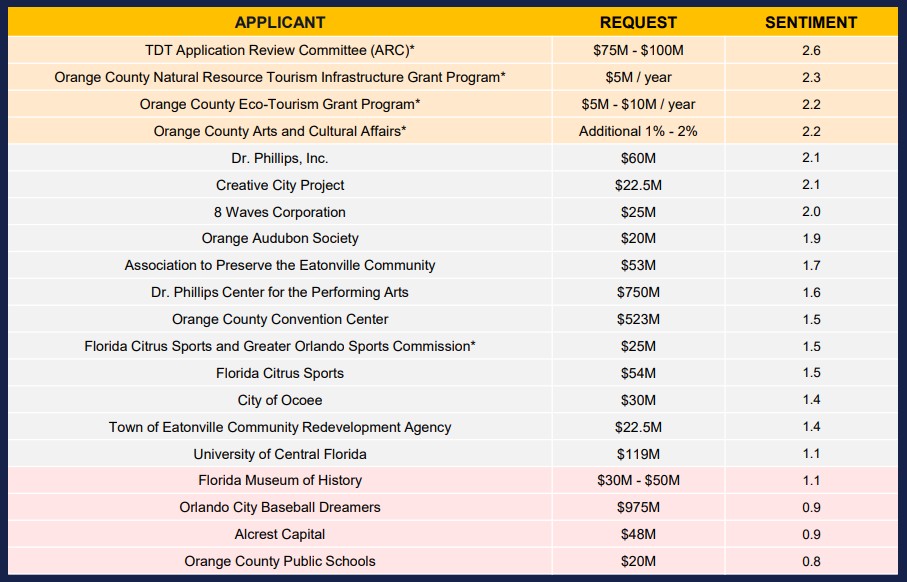
The projects related to the Orange County Convention Center, Florida Citrus Sports, the University of Central Florida as well as the bottom four projects on the above list were NOT recommended by the citizen task force.
Orange County collects the largest haul in all of Florida when it comes to hotel taxes — a record $385 million last year. The money is primarily used to pay off debt related to the convention center as well as support its operations and maintenance along with paying to subsidize advertising and promotion for the tourism industry and pay debt for the city of Orlando on the arena used by the Orlando Magic.
County officials have long pointed to a state law that governs the tax and limits its uses as the reason why the pot of dollars can’t be used to pay for mass transit, public safety, affordable housing or other essential needs.
But, to be clear, other counties have succeeded in carving exceptions into the law when they have made a deliberate lobbying push.
For example, some beachfront counties are now allowed to use tourist tax dollars to fund lifeguards and law enforcement services “which are needed to address impacts related to increased tourism and visitors to an area.” And in 2024 the Legislature allowed local governments in the Florida Keys to use a portion of the money to purchase or build affordable housing.
The current law also says if a county that spends at least 40% of its tourist tax revenue on tourism promotion then it can spend a portion of the tax dollars on transportation, sewer, water or “pedestrian facilities.”
Some members like Poole have suggested that, depending on how the figure is counted, Orange County might already meet the threshold.
Orange County says it’s spending 26% to 30% on tourism advertising, according to Poole, but he also said he doesn’t have the calculation for how that figure was determined.
“All I know is people have asked for it and we haven’t gotten it. Maybe people you know might be able to get it,” he told DeCiccio at a city meeting.
“I’ve tried,” she responded. ” I don’t have that much pull. I wish I did.”
The resolution Winter Park will vote on this week is based, nearly word-for-word, on one of the recommendations made last month by Orange Mayor Jerry Demings’ TDT Citizen Advisory Task Force.
DeCiccio and others including County Commissioner Kelly Semrad, who represents Winter Park, urged Demings to expand representation on the group to more people who understand what it is like to live in different parts of the county rather than be focused on a group of people who mostly represent the interests of the major hotels, theme parks and the convention center.
Tourism companies are known for pumping hundreds of thousands of dollars into political campaigns for local offices.
“In looking at the proposed makeup of the Task Force, it appears to be heavily weighted toward those who currently benefit from how TDT funds are allocated,” DeCiccio wrote in a letter to Demings in June. “I respectfully request the Task Force makeup be weighted more to the entities that represent the people of Orange County and the entities that must provide the needed infrastructure.”
As a result, Demings allowed each county commissioner to appoint two people from their districts instead of just one to serve on the task force. Each city was allowed to appoint one person to the group.
Lowndes, the current mayor of Maitland, sent Demings a letter in July urging a broader scope for the task force than evaluating capital proposals like a convention center expansion or new museums. He called on Demings to help “fairly distribute the burden” of supporting low-wage tourism workers across the county.
“Tourism is, of course, the prime engine of Central Florida’s economy,” wrote Lowndes, who is challenging Sen. Jason Brodeur for a district that includes parts of Orange and Seminole counties. “It demands strong infrastructure: roads, mass transit for tourists and tourist-corridor workers, robust public safety, and affordable housing for thousands who work in the industry, many at modest wages. The residents of Orange County now shoulder much of this burden through our property taxes. Certainly, the community benefits from tourism, but it is time to fairly distribute the burden.”

A snapshot of promotional materials on the website for Visit Orlando, which receives dollars from the TDT to subsidize industry advertising.
Together, Maitland and Winter Park represent about 50,000 people, including about 35,000 registered voters who are close to evenly split between Republican and Democrat, according to the latest voter roll statistics. That’s a small piece of the voter roll for all of Orange County, which tallies about 813,000 registered voters who lean Democrat (39%) over Republican (28%) with the remainder without a party affiliation or registered to a third party (33%).
But there is evidence the sentiment in Winter Park and Maitland is present elsewhere given the actions of the committee led by former Orange Mayor Linda Chapin and Lift Orlando President Eddy Moratin.
The 34-member task force spent much of its time evaluating 20 applications for a combined $3 billion dollars to build everything from a Zora Neale Hurston museum in Eatonville to another expansion of the convention center at a proposed $523 million and a nearly $1 billion expansion of the Dr. Phillips Center for the Performing Arts.
Ultimately, the group did not include the convention center among it’s list of recommended projects — a notable shift from a similar task force that convened just three years ago.
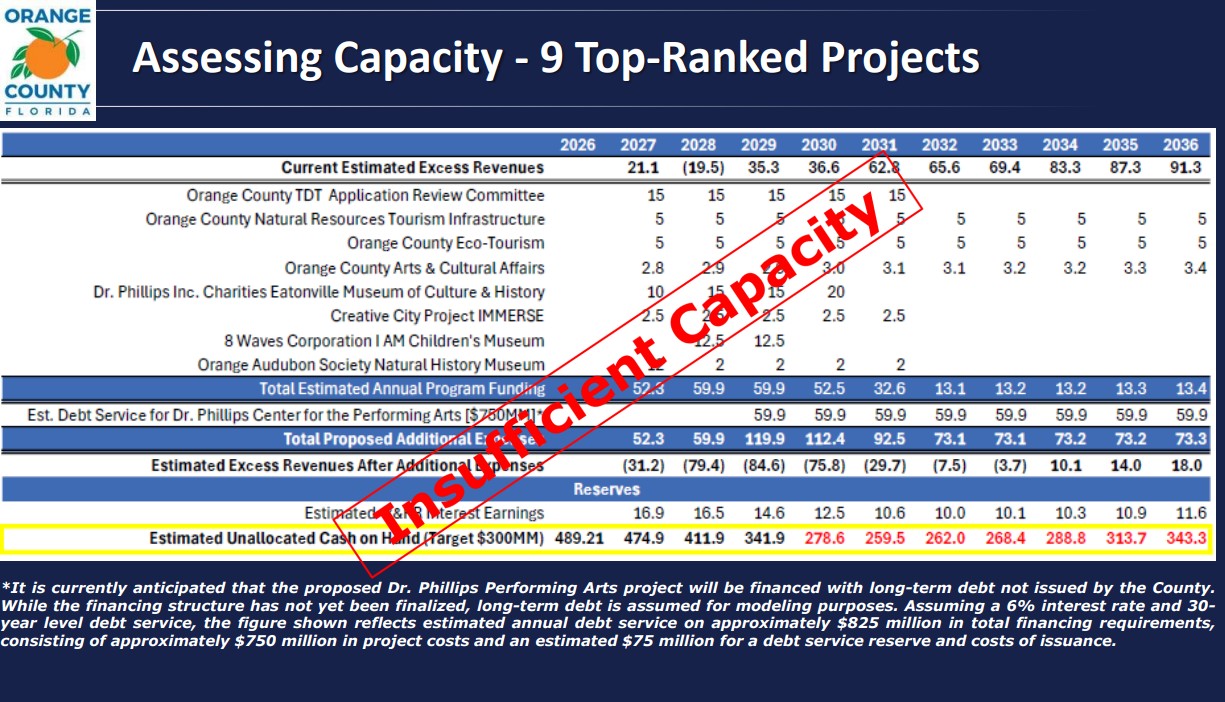
A chart from Orange County shows reserves (bottom line) dipping below the recommended $300 million by 2030 if the Top 9 projects are funded in the above scenario.
Chapin, who led the county from 1990-1998 and has a theater named for her in the convention center after overseeing previous expansions, noted that since the inception of the tourist development tax more than $3 billion was spent on the building. This time around, she said, she couldn’t support a motion to approve another addition.
“Given the opportunities we have to benefit more of the community and different kinds of visitors,” she told the group. “The idea of moving this forward when it is still under construction from the last amount they were granted … what I would like to see is that we vote the motion down, expect the County Commission to request a review of all that’s been done when the project is completed, and then decide, depending on what the circumstances are at that point in time, to either move forward with more or not. So I won’t be supporting the motion.”
And the group took extra time to discuss and include a recommendation that Orange County expand its uses of the tax — the one Winter Park is now looking to formalize in a resolution.
That motion was made by Chapin and seconded by Doug Gomber, who was the city of Ocoee’s representative to the group. Chris Mueller, a Hilton executive who represented the International Drive Chamber of Commerce and Jacqueline Bozzuto, a Lowndes law firm attorney who works with hospitality clients and represented the Central Florida Hotel & Lodging Association, voted against the recommendation.
Central to the discussion now is whether enough political will exists among leaders in Orange County to follow through with that recommendation and ask the Legislature when it convenes again next year for an exception similar to the way other areas in the state have received special permission for certain needs.
Also in question is how much money from hotel collections would be left — if any at all — for mass transit or affordable housing if the County Commission approves all or even some of the projects that the task force recommended move forward. The task force was not told how much money they had to work with so they didn’t put dollar figures to their recommendations, though those asking for the money listed a dollar figure in their requests.
The Dr. Phillips Center for the Performing Arts, for example, is asking for $750 million for new theaters and a parking garage and other improvements at its downtown Orlando campus. If the entire amount was funded it would leave little to nothing for new uses like transportation improvements sought by Winter Park and others.
“If the money for all these projects is paid out for the next 10 years, there won’t be any extra money. So, how will we be able to pay for transportation then?” DeCiccio asked at a recent City Commission meeting, noting Dr. Phillips’ request to build 11 more theaters struck her as “a little excessive.”
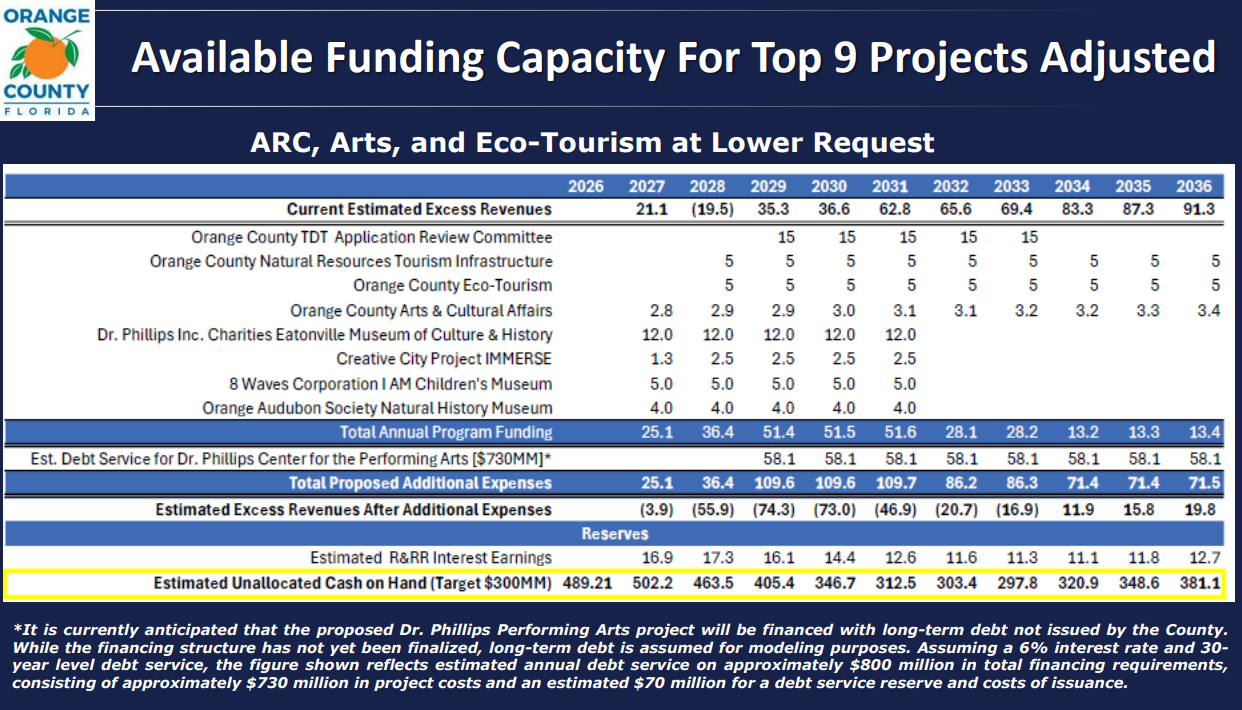
Under a different fund scenario, a chart provided by Orange County, shows how the projects can be funded and mostly maintain reserves. Multiple scenarios were presented at the county meeting on Aug. 25.
The County Commission accepted the task force’s recommendations late last month, but did not give an official a thumbs up or thumbs down to any of the projects on the list. At least two county commissioners said they even wanted to reconsider more projects, which means the convention center or Camping World Stadium could still receive funding.
Semrad, who was elected in 2024 after running on a platform of expanding the uses of TDT and refusing to take any campaign contributions from the tourism industry, called the process rushed and said she was disappointed there wasn’t more clarity surrounding how much money will be available.
A county spokeswoman said the comptroller is working on the question of exactly how much funding can be used and the timing of that funding. Then the County Commission will made a decision on who gets money and who doesn’t and whether the group will back a push to use the dollars for more community needs.
“[The Legislature]pretty much gives the changes when cities ask for them,” DeCiccio told the Voice. “We want to do it but we aren’t strong enough to do it alone. We need Orange County.”
The county commission appears to support the comptroller’s plan to keep at least $300 million from TDT reserves in case of an economic downturn so that figure is factoring into the discussion about what money is available and when.
The date for that discussion has not been set.
WinterParkVoiceEditor@gmail.com
One public transit priority should be a direct link from Sunrail to the airport. A conventional train isn’t the answer, due to track sloping and curvature, expense to build and operate and larger required easements.
A better, cheaper solution is to build a tram link (just like those currently on airport property) from the Sand Lake Sunrail station to the airport. Trams can turn tighter radii, rise in elevation in shorter spaces and cost far less than a rail link. And, the City and County already own much of the necessary easements.
Such a link would reduce road traffic, reduce on-airport parking needs, expand ridership on Sunrail and give residents and visitors a huge benefit to explore Central Florida without the need for a car.
I think that I agree with Todd regarding the tram link idea. More railroad tracks is not an ideal solution, but a raised tram link is safer and may have less of an impact on natural resources and habitat. Well worth exploring.