
by Concerned Reader | Nov 12, 2020 | Election
Single Member Districts Fails
Tie Vote on 1st Reading Spells Failure – for now
by Anne Mooney / November 12, 2020
With only four Commissioners present at the November 11 meeting, the ordinance to put Single Member Districts (SMD) to a vote on the March 9, 2021, ballot failed on a 2 – 2 vote. Commissioners Marty Sullivan and Sheila DeCiccio voted in favor. Mayor Steve Leary and Vice Mayor Carolyn Cooper voted against. Commissioner Todd Weaver was absent because of illness.
Ironically, the measure failed twice. First, Cooper moved to deny putting the measure on the ballot. Cooper and Leary voted for; Sullivan and DeCiccio voted against. Immediately following, Sullivan moved to approve putting the measure on the ballot – with the same result.
The Devil is in the Details
Changing the basis of a city’s governance, one that seems to have served the city well for more than 130 years, is complicated – and scary. Just the thought of change can cause anxiety in most people.
That’s not to say change is bad, or that a city can’t change its mode of governance. But it is a difficult and complex task, one that does not happen quickly or easily. Each question seems to give rise to five others. How will districts be drawn? Who will draw them? What data is available to do this in an equitable way? After all, the most recent Census data is now 10 years old. What happens if we annex another neighborhood? What if no candidate files to run in a particular district? In the case of SMD, more than most, the devil is in the details.
Voters Still Want Info about SMD
Despite its defeat last night, email and Facebook traffic indicate that Winter Park voters still want information about what SMD might mean for Winter Park. At a virtual information session conducted by the Coalition for Access and Representation (CFAR) Monday night, Jamie Joyce of the Society Library, a non-partisan non-profit 501(c)(3), presented a white paper that laid out the arguments for and against SMD in Winter Park. The event, including the white paper, can be viewed here. https://www.facebook.com/Coalition-For-Access-and-Representation-CFAR-103882477624971/ What follows is a summary of the arguments Ms. Joyce presented for and against SMD in Winter Park.
Winter Park should have Single Member Districts, because . . .
It promotes civic engagement.
District elections might improve community participation if candidates are more engaged with a particular community. Under-represented constituents will be more likely to participate if they know they are truly represented.
Con: All commissioners should be accountable to all citizens. With SMD, a citizen will technically have only one representative, plus the Mayor, on the commission.
SMD improves racial diversity in representation.
SMD will give Winter Park residents the opportunity to elect a person of color.
Con: In any fairly drawn district in terms of population size, the Winter Park African American population would not achieve a majority. The opportunity to elect a person of color to the Commission is not dependent on SMD, but on the qualifications and appeal of the individual candidate.
SMD improves economic diversity of representation.
Because it is less expensive to campaign in a single district, people at a lower income can afford to run for office.
SMD improves geographic representation.
Single member districts ensure geographic representation.
Con: Geographic representation, in and of itself, still may not ensure representation for under-served ethnic populations like Winter Park African Americans who, because of West Side gentrification, are no longer concentrated in a single small area.
What’s to lose?
If the ordinance is put on the ballot, then it’s up to the voters to decide, freeing the Commissioners from having to make the decision.
Con: Winter Park voters are not educated on this issue; it’s a waste of their time.
Answer to the Con: Then educate them; it’s their civic duty to become informed.
Answer to the answer: Four months is too little time, especially without knowing what the districts would look like.
SMD makes Commissioners more accountable.
Commissioners can be more easily held accountable by localized citizens.
Con: Only the mayor and one Commissioner will be accountable to any given citizen, thereby reducing accountability of the Commission as a whole.
SMD ensures localized issues will receive attention.
Commissioners would be more in touch with issues affecting their constituents.
Con: This will lead to Commissioners putting localized issues ahead of the needs of the whole City.
Builds more effective constituent relationships.
SMD improves overall responsiveness to local issues.
Con: Winter Park Commission already performs well in response to constituent concerns.
Makes elections more free and fair.
Because the cost of a single-district campaign is less, there would be less reliance on contributions from special interests.
Con: Because the cost of a single-district campaign is less, it will be easier for special interests to ‘buy’ an election.
SMD is a more progressive form of government.
Supreme Court Justice Ginsberg cited at large voting, along with racial gerrymandering, as a preeminent second-generation way to deny equal opportunity for minority voters and candidates. A number of local jurisdictions in FL and across the country who traditionally used at large systems have faced federal lawsuits to force a switch to a district-based system as part of the Voting Rights Act.
Con: At just over 7 percent, the minority population of Winter Park is too small for SMD to make any difference.
If we don’t vote on it now, we’ll miss the chance.
If the Commission does not put this ordinance on the ballot now, they are unlikely to consider it again unless some special circumstance arises.
Con: It is still possible to put the ordinance on the ballot through a petition. There is still time to conduct enough information sessions to inform the public.
Winter Park should not have Single Member Districts, because . . .
It’s not the right time.
This is an emotional time for the country, and decisions about government should not be swayed by emotion.
Con: There are good non-emotional reasons to support the ballot initiative.
It won’t achieve the goals it was meant to achieve.
If the goal is to increase the chances of electing an African American commissioner, in any fairly drawn district in terms of population size, the African American population of Winter Park could not achieve a majority, if that’s what it takes to ensure the election of an African American commissioner.
Con: Just because SMD will not ensure the election of an African American commissioner does not mean SMD still is not best for the city and won’t lead to increased diversity in city government.
The electorate doesn’t really want it.
Vice Mayor Cooper noted she had received more than 230 emails from residents about backyard chickens, compared with 26 emails about SMD (five of which came from people who were not Winter Park residents).
Con: Emails to the Vice Mayor is only one indicator. CFAR’s Barbara Chandler has collected more than 100 signatures in support of the motion.
All groups are fairly represented in Winter Park.
Historically, candidates, both successful and failed, have come from fairly distributed parts of the city.
Con: No African American has been elected to the Commission in 133 years.
It’s the wrong cause.
Not enough ethnically and economically diverse candidates are running for office in Winter Park.
Con: It’s likely because of how expensive it is to campaign at large. SMD will make running for office more accessible to residents of various income levels, identities and backgrounds.
SMD is not how cities our size do things.
At-large elections tend to be more practical in small cities and in more homogeneous areas.
Con: Several Central Florida cities in Winter Park’s size range have SMD, including Ocoee, Cocoa, Mt. Dora, Sanford and Winter Garden.
At-large elections are more democratic.
At-large elections allow all residents to vote for all commission candidates.
Con: Democratic institutions have a duty to protect minority groups from disenfranchisement and under-representation by majority rule.
SMD will make the Commission less effective.
SMD may encourage in-fighting, vote-trading and competition among districts for city resources.
Con: The efficacy of the Commission depends upon the quality and character of the individuals who are elected.
SMD will give voters fewer options.
Voters will have a smaller pool of candidates from which to choose.
Con: The options they do have will be more likely to represent their interests.
Asked for her thoughts on the outcome of last night’s Commission vote, CFAR’s Barbara Chandler replied, “. . . this is considered more delaying.”
For more information about SMD, go to http://cfarvote.com/cfar-home-mobile/
To comment or read comments from others, click here →

by Concerned Reader | Oct 30, 2020 | Library
Raising the Roof
Library-Events Center Reaches Milestone
by Anne Mooney / October 30, 2020
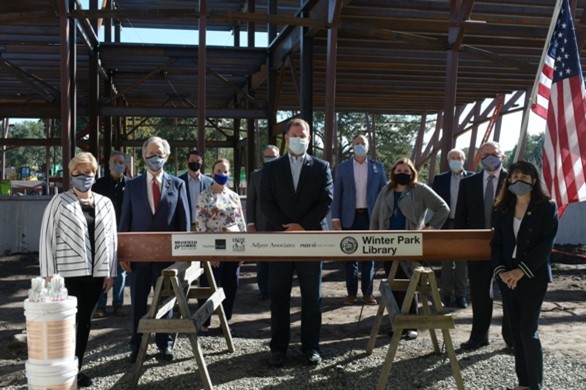
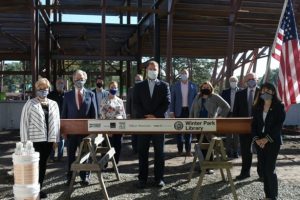 A group of 50 or so dignitaries gathered this morning, October 30, to celebrate the ‘topping out’ of the Winter Park Library & Events Center. This important milestone – the signing and hoisting of the final roofbeam — signifies that the structural skeleton of the building is now complete. Representatives of the Winter Park Public Library, the construction and the architectural firms and major donors joined the Mayor and Commissioners to place their signatures on the beam.
The signing and hoisting of a roofbeam is an ancient practice dating back thousands of years. Some describe origins from pre-medieval Scandinavian cultures, some refer to native American practices, and still others hark back to 2700 BC Egypt. The ceremony marks the completion of the building’s skeleton, and the beam is symbolic of the upper-most piece going into place as the building reaches its full height.

David Odahowski, President & CEO of the Edyth Bush Charitable Foundation, a major donor to the Library-Events Center, affixes his signature to the beam.
Via Skype, design architect Sir David Adjaye said to the assembled crowd, “Today’s topping out ceremony represents a huge milestone in the completion of the Winter Park Library & Events Center. The power of this project is that it represents another prototype, another version of what the library has evolved into – the library as a campus of knowledge. Once completed, the new complex will bring together knowledge and community facilities to make a village, a hamlet of knowledge.”
“The new Library & Events Center in Martin Luther King, Jr. Park, will not only activate reading, imagination and creativity,” said Winter Park Public Library Board of Trustees President Lawrence Lyman, “it will be transformative for our community. . . . I couldn’t be more thrilled that the library’s vision has been brought to life by such a masterful architect.”

The grand opening of the Winter Park Library & Events Center is expected in the Fall of 2021.
To comment or read comments from others, click here →
by Concerned Reader | Oct 25, 2020 | Custom Author, Election
Anderson, Sprinkel Run for Mayor
by Anne Mooney / October 25, 2020
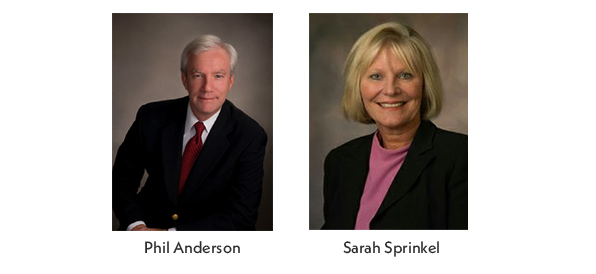
Former Commissioners Phil Anderson and Sarah Sprinkel will vie for the Mayor’s seat being vacated in March 2021 by Steve Leary. Even though the filing deadline is not until January 19, 2021 — which means there could be additional contenders — Anderson and Sprinkel have established campaign organizations and will begin active campaigning following the November 2020 election. The Winter Park general election is March 9, 2021. A runoff, if necessary, will be held April 13, 2021.
Platform Statements
On her platform, Sprinkel promises not to raise your taxes, to provide leadership during the pandemic and to exercise fiscal responsibility. In his platform, Anderson promises to protect the charm and character of Winter Park, to put residents’ interests first at City Hall and to make decisions that will keep Winter Park financially strong and prepared for the future.
You can find out more here https://www.electsarahsprinkel.com
And here https://www.philforwp.com
Campaigning in a Pandemic
This pandemic-era election cycle will look very different from previous campaigns. Sprinkel said, “I never want to put someone else at risk. I worry about my husband as much as I worry about myself. I don’t think I’ll be out and about very much – I don’t think we’re quite ready for that. So, this will be a different kind of campaign.”
Anderson was of like mind. “We are holding virtual campaign meetings and small-group outdoor meetings,” he said. His campaign is holding ‘meet & greets’ either outdoors with social distancing or via Zoom. He said they are also relying heavily on social media.
Anderson talked about the difference between this campaign and the campaign when he won the Commission seat he held from 2008 to 2011. “What I enjoyed about the 2008 cycle was the door to door thing, meeting people, hearing their stories,” he said. “But we can’t do that this time. I’m still going to do the Farmer’s Market – but not until after the general election.”
Who is Sarah Sprinkel?
Sprinkel served three terms as Commissioner from 2011 to 2020, when she stepped down in order to run for Mayor in 2021. If she is elected, Sprinkel will be the first woman to serve Winter Park as Mayor. Asked if she thought her gender would influence her leadership style, Sprinkel replied, “Yes, women look at things differently than men. My whole life has been spent lifting up families. I think we could do with some nurturing in leadership, under the circumstances. We should be working on a safety net for families right now. You have to have that open heart and that open mind.”
Sarah Sprinkel is a teacher. According to her website, she taught kindergarten for 10 years, then moved into administration to develop early childhood programs. She retired from the Orange County Public School System after 33 years and went to the Central Florida YMCA to partner with Disney to create two child development centers for cast members’ children. After retiring from Disney, she went to Florida Virtual School to create an Elementary program for FLVS. She now teaches classes as an adjunct at UCF and works with interns there.
Who is Phil Anderson?
Phil Anderson is a business executive with 35 years’ experience in finance and operations. He earned a degree in civil engineering from Georgia Tech and began his career building power plants for Georgia Power Company — valuable experience when it comes to understanding the complexities of the City of Winter Park utilities.
Over the past 35 years, Anderson has helped create several businesses that have invested over $10 billion dollars in more than 300 communities across the country. Most recently, he co-founded Bridge Seniors Housing Fund Manager in Orlando where he serves as Chief Investment Officer. Prior to that he served as Chief Operating Officer of CNL Retirement Properties.
Anderson and his wife Jennifer are patrons of local organizations such as the Boys & Girls Club of Eatonville, the Albin Polasek Museum and Gardens, and the Winter Park History Museum. Anderson is the founding treasurer of the Winter Park Land Trust and a member of the board of directors of Legacy Pointe at UCF — a non-profit retirement community.
How do they feel about the Orange Avenue Overlay?
Asked about her feelings on the OAO, Sprinkel said, “I have no problem with it. Remember, it didn’t begin with this project. They’ve been looking at this since form-based codes in 2003. It’s past time for the city to solve the problems that are in that area, especially road safety. People working together can solve things. That is the most dangerous road in Winter Park. Safety is paramount. For me, it’s never been about anything but safety. I do hope it eventually comes to fruition.”
To the same question, Anderson responded, “This is a great illustration of differences between me and Sarah. The OAO is very good as a concept. I do not agree, however, that it was ready for a vote when it got pushed through at the last minute. I’m glad the present commission is demanding illustrations of what the increased density would look like before they grant three to four times the increased maximum allowable building size.”
Anderson continued, “I believe we didn’t follow the norms of how we grant substantial increased densities to various landowners. When Rollins moved forward with the Innovation Triangle, we got a flier in our mailboxes with a diagram of the new buildings and a statistical table of their “ask.” The table showed what they were entitled to and what variances they were seeking. Why did that not happen in the largest rezoning in Winter Park history? The situation is now being corrected by the new commission. That’s the substance of the work sessions – illustrations of what these plans might allow. We badly need that to encourage an informed debate about the future of our city’s skyline.”
To comment or read comments from others, click here →
by Concerned Reader | Sep 25, 2020 | Custom Author, Headline, Taxes
FY2021 Budget Passes
Millage Rate Unchanged for Year #13
by Anne Mooney / September 25, 2020
On September 23, Commissioners passed the FY2021 Budget, holding the millage rate steady at 4.0923 for the 13th consecutive year. Ordinances establishing the millage rate and adopting the Budget passed on a 4-1 vote, with Mayor Steve Leary dissenting.
Orange County sets property valuations
Property taxes will rise slightly, since property values were assessed by Orange County in January 2020 prior to the beginning of the pandemic. This reporter’s annual property taxes rose by less than $50, so with the steady millage rate, the increase for most property owners will be minimal.
According to Peter Moore, Winter Park’s Division Director of the Office of Management and Budget, residential real estate taxes comprise about 79 percent of the City’s tax base, leaving the City on solid fiscal footing for now. The City boasts unencumbered General Fund reserves of approximately $17 million.
Postponed SunRail payments used to create contingency fund
The City also has created an approximately $500,000 contingency fund. This money was originally budgeted to pay for SunRail, but the state of Florida has postponed SunRail payments for another two years, allowing the money to be reallocated. “These funds are available now for emergency relief,” wrote Peter Moore, “as we manage the economic repercussions of the pandemic.”
Cautiously optimistic outlook for the future
Moore cautioned that while property tax revenues will be unaffected in the present, as values were established before the pandemic, possible future deterioration in the real estate market could affect Winter Park, and business closings and vacant storefronts will have a definite negative impact. “With almost $2 million in assistance either pledged or spent already by the city to assist its businesses and residents,” wrote Moore, “the city continues to work with all our stakeholders to navigate this difficult time.”
To comment or read comments from others, click here →
by Concerned Reader | Sep 10, 2020 | Custom Author, News, Taxes
FY 2021 Budget Passes First Reading
Millage Rate Unchanged
Chickens Squeak Through
by Anne Mooney / September 10, 2020
Chickens will come home to roost
Despite emails indicating Winter Park was split down the middle on the backyard chicken question, the ordinance creating a two-year backyard chicken pilot program narrowly squeaked through its second and final reading on a 3-2 vote – with a few amendments.
Among the raft of amendments was reduction of maximum coop height to six feet, requirement for a fence to obscure the coop from neighbors and a requirement to obtain written permission from all neighbors whose property abuts the property with the chickens. A provision for 48-hour warning before inspections was removed, allowing Code Enforcement to make unannounced spot inspections. Coops can be in backyards only, not side yards. Chicken owners who receive repeated complaints will face escalating fines, and a “three-strikes-you’re-out” rule will remove the chicken owner from the program on the third complaint.
None of the current Commissioners will apply to keep backyard chickens.
Commission passes 2021 Budget, millage rate on First Reading
The FY 2021 Budget passed on a 5-0 vote with only one amendment, proposed by Commissioner Sheila DeCiccio, to grant up to 3.5 percent raises to City staff rather than freezing their salaries.
Mayor argues for rollback rate
The millage rate was kept at 4.0923 for the 13th year, despite arguments by Mayor Steve Leary to drop the millage to the rollback rate of 3.9509. The rolled-back rate represents the millage rate that would generate the same level of property tax revenue as the prior year, excepting growth due to inflation factor and new construction.
Dropping the millage rate to the rollback level would mean removing the contingency, but Leary said he felt comfortable the $17 million in reserves would cover any contingency.
Vice-Mayor: “Situation is too fluid.”
Vice-Mayor Carolyn Cooper disagreed. “I am not comfortable,” she said, “because the City is cutting services and curtailing and freezing staff. First, the City brought us a balanced, but curtailed budget. Then we were told that revenue projections were even lower, but that was followed by state projections that changed again.”
Cooper went on to point out just how fluid the situation might be. “Orange and Osceola Counties have a backlog of foreclosures stacked up until the moratorium is lifted. What happens then? What about people being evicted from apartments? And if empty property remains vacant, what will happen to property valuations? I believe it is prudent to hold back on costs and continue to accrue the same millage rate we have had for 12 years.”
The August 18 Orlando Business Journal noted Central Florida is still dealing with high unemployment and pandemic. “Orlando attorneys were prepared for a wave of evictions and foreclosures when the statewide moratorium neared expiration at the end of July.” According to the most recent data available, the unemployment rate for metro Orlando was 16.5 percent in June, while the rate in Florida was 10.7 percent.
To comment or read comments from others, click here →

Recent Comments