
by Beth Kassab | Feb 19, 2026 | City Commission, News, Taxes
Slash Reserves and Services? Annex Maitland? Winter Park Mulls Answers to Property Tax Cuts
The (some not so serious) suggestions came in response to Legislative proposals to dramatically reduce city revenue and recommendations from Florida DOGE to eliminate some cities
Feb. 19, 2026
By Beth Kassab
The Florida House voted Thursday to ask voters to eliminate all property taxes — except those that fund schools — for people who live in their homes, but the Senate has yet to take up a plan.
With just three weeks left in the regular legislative session, Gov. Ron DeSantis signaled Thursday morning that he is in no hurry to finalize a proposal that must be approved by 60% of voters to take effect.
“Given that it can’t be voted on by the people before November, it’s better to do it right than do it quick!” the governor posted on X.
State leaders could call a special session after the annual 60-day lawmaking period ends March 13 to address property tax cuts or other unfinished matters.
The uncertainty over the future of their most important and flexible revenue stream has local governments such as Winter Park contemplating a bleak future if the cuts become reality.
“We’re losing people. We’re losing quality of life. We’re losing services,” Commissioner Kris Cruzada said last week as the City Commission heard staff projections. “You call down to City Hall, and you may not get a live person to deal with an issue.”
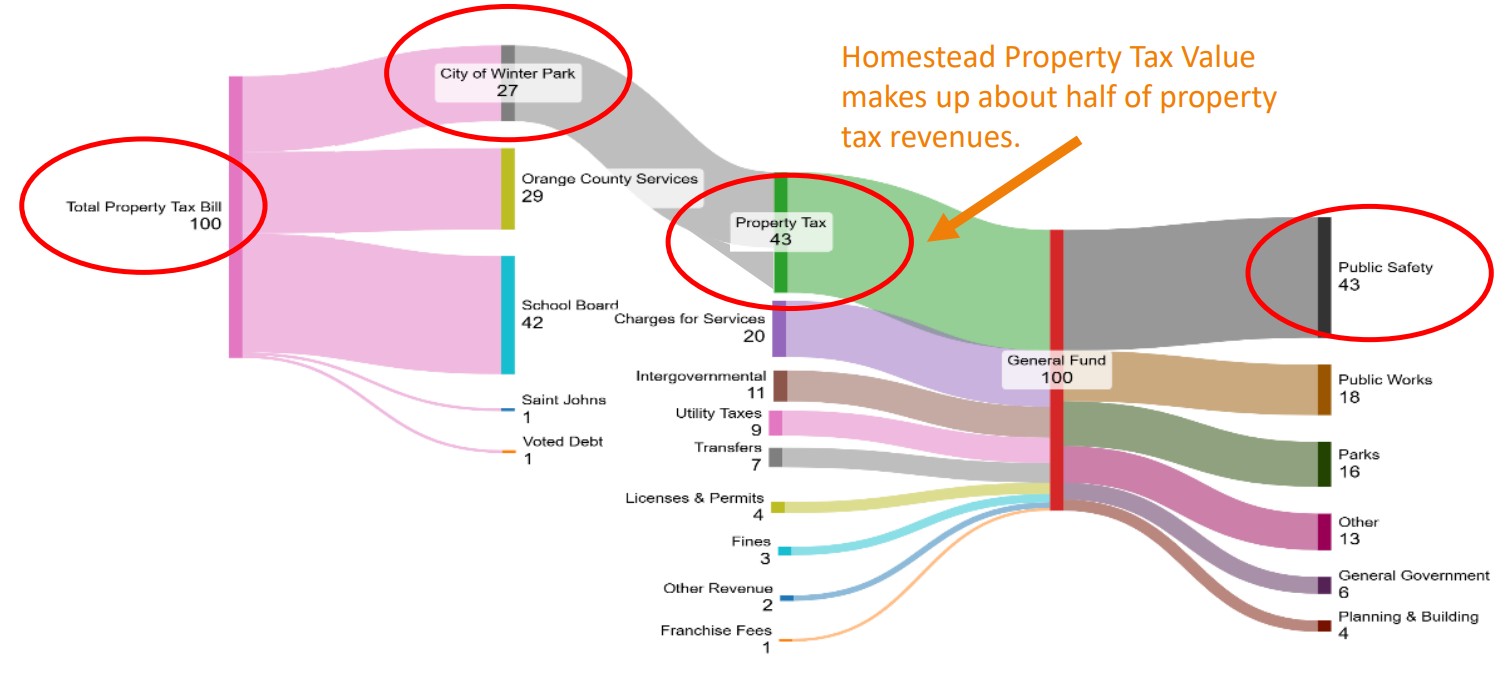
A city of Winter Park chart shows how property taxes flow into city services.
Peter Moore, director of the city’s Office of Management and Budget, presented an analysis projecting a $250 million loss over 11 years if a proposal like the one adopted by the House on Thursday is ultimately approved by voters.
While the House proposal aims to protect police and fire funding by prohibiting local governments from cutting those departments, it would impede the city’s ability to expand public safety and meet other local needs, including parks, roads, building permits and inspections, code enforcement, storm-related tree trimming, after-school programs, and playing fields for youth and adult sports leagues.
“This would call into question our ability to grow, and in the past we’ve had plans to expand our police and fire personnel. Those things are certainly not possible under scenarios like this,” he said. “It also implies that any government service that’s not public safety isn’t important.”
The tax repeal proposals address only those paid by property owners with homestead exemptions — those who live in their homes as a primary residence. That means people who own second homes, businesses, commercial properties or rental houses would likely face a higher, shifting tax burden that could be passed along to tenants in the form of higher rent.
“The part that bothers me the most,” Moore told the commission, “is that those who deserve the greatest voice in government — our local citizens — are not going to be contributing anything to it. And — this is tongue-in-cheek, and we don’t mean it — but we would be financially better off as a city if we really upset our citizens, they all left, sold their homes to BlackRock and let them be rented out as an Airbnb. Then we could at least pay for roads.”
Property taxes assessed on homesteaded property make up about $19 million — roughly half of the city’s annual property tax revenue — and more than 20% of total annual revenue, according to Moore.
Commissioner Warren Lindsey called the proposals “objectively one of the greatest threats, certainly since I’ve lived in Winter Park for 35 years.”
DeSantis and other state leaders have argued the proposals are driven by the need to make life more affordable for Floridians as government spending and waste have spiraled out of control.
But city officials across the state argue that state spending is ballooning at the same rate as local governments because both are affected by inflation and higher costs of goods and services, especially wages for police officers and firefighters.
Moore said the city’s general fund spent about $70 million in 2024, up from about $43 million in 2015 — an annualized growth rate of about 5.6%. The state of Florida increased spending during that same period from $30 billion to $50 billion, or about a 5.7% annual growth rate.
City officials also took exception to some of the characterizations and recommendations in the recently released “Report on Local Government Spending” by DeSantis’ Florida DOGE, or Department of Government Efficiency.
The report calls out 13 cities and counties, including Orange County, for what it describes as “excessive spending.”
“Property taxes are an expense that is entirely within the control of governments to rein in, and by ending the era of irresponsible spending, Florida and its local governments can give Florida’s homeowners freedom from this burden,” the report states.
The 98-page report is part financial audit and part ideological playbook outlining what the governor considers appropriate local government activities.
In the recommendations section, the unnamed authors predicted their proposals “will spark opposition.”
“Bureaucracies entrench themselves and create stakeholders who will argue that stronger oversight threatens ‘home rule,’ disrupts operations, risks federal funding or undermines public servants,” the report states. “They will highlight some recipient who benefits from every expenditure of public funds — ignoring that every dollar spent must also be taken from a taxpayer who is thereby harmed.”
The recommendations include giving Florida’s chief financial officer more power over local governments and standardizing local budgeting processes and wages, including freezing hiring and pay levels for city and county employees.
The report also says the state should forbid the use of government funds, facilities or communications to promote diversity, equity and inclusion concepts such as “social justice” or “systemic bias,” along with any phrases “that rely on the concept that mankind is inherently racist, sexist or oppressive, whether consciously or unconsciously, or bears responsibility for actions committed in the past by others based on race, sex or related characteristics.”
In addition, the report recommends changing state law so that state and local governments cannot enforce “green energy” or other “climate initiatives.”
The recommendation that drew the most pushback from Winter Park officials included a proposal to cap city reserve, or rainy day, funds at 10%.
After Hurricane Charley in 2004, Winter Park adopted a policy calling for reserves to stand at about 30%.
Winter Park’s reserve fund is about 27% today, or roughly $23 million.
Mayor Sheila DeCiccio said the funds are used to respond quickly to flooding and power outages before state and federal emergency reimbursements arrive.
Cruzada said the state is essentially telling local governments to be “irresponsible” and rely on state and federal assistance rather than manage their own affairs.
“What the state is doing is limiting our ability to raise revenue but, at the same time, reducing our reserves and it’s practically — for lack of a better term — telling us to be irresponsible,” he said.

An image created in jest by city staff to bring some levity to the property tax discussion shows City Manager Randy Knight and Assistant City Manager Michelle del Valle on a quest to annex Maitland, which is not actually under consideration at this time, though the Florida DOGE report recommended some cities should consolidate.
The report’s final recommendation calls for some cities to disappear entirely and be absorbed by larger neighboring cities or counties.
“Florida should review the 411 municipalities for potential opportunities to provide local government services more efficiently through abolition or consolidation, with particular attention paid to small municipalities and highly urbanized counties,” the report states.
That prompted another tongue-in-cheek response from Winter Park officials, who joked about annexing neighboring Maitland.
Moore pointed to what he called a “curious note” in the report suggesting that “perhaps there are too many cities.”
He then showed an AI-generated image of City Manager Randy Knight and Assistant City Manager Michelle del Valle dressed in Colonial-era attire “crossing Howell Creek to invade our neighbors to the north.”
“Never to not be a team player, we are willing to do this,” Moore said, drawing laughter from the chamber.
WinterParkVoiceEditor@gmail.com
To comment or read comments from others, click here →

by Beth Kassab | Feb 10, 2026 | News
Winter Park Voice Helps Launch New Weekly Podcast
The program is a product of the News Collaborative of Central Florida. It will air Wednesdays on Central Florida Public Media and be available on-demand as a video and audio podcast
Feb. 10, 2026
UPDATE: The name of the show to be launched by the News Collaborative of Central Florida is still under consideration. The name of the show reported in the original version of this story and by other outlets in the collaborative is changing. Stay tuned for another update soon.
Staff Report
The News Collaborative of Central Florida (NCCF), a collective of independent local news outlets and aligned partners working toward a more informed and engaged Central Florida, is launching a new show.
Hosted by local journalist Steve Mort, the weekly radio and podcast program explores key issues in Central Florida through conversations with the local journalists who cover them. The first episode will air on Wednesday, Feb. 18, 2026, at 6:30 p.m. on Central Florida Public Media’s radio frequencies 90.7 FM and 89.5 FM. It will also be available on YouTube and all podcast platforms.
“Local journalists across Central Florida are doing important work, and this show creates the time and space to focus on that reporting,” said Steve Mort, host of the show. “Plus, it gives people a better understanding of the critical issues shaping their communities and lets them get to know the journalists covering them.”
Mort has traveled on assignment with the PBS Newshour, reported for Rocky Mountain PBS in Denver and covered Washington and the United Nations for a variety of international news outlets. Most recently, he was the host and executive producer of WUCF’s NewsNight for six years until the show was discontinued in 2025.
The project will preserve an important forum for regional reporting while advancing NCCF’s mission to support a strong, accessible local journalism ecosystem. The program is made possible through funding support from Central Florida Public Media, Orlando Sentinel, Winter Park Voice and the Central Florida Foundation.
In addition to financial support, the Winter Park Voice will also be among the partners who share news stories with the podcast and video show.

Steve Mort
“We are thrilled to help launch this new show that will bring our readers local news in podcast and video formats,” said Voice Editor Beth Kassab. “We know our readers count on the Voice to bring them trustworthy information about the places they care about most and the show is another way we will deliver on that mission alongside our partners in the News Collaborative.”
The launch of the podcast reflects how NCCF’s work is expanding in 2026. Since launching publicly in Jan. 2025 with a shared reporting effort on the local impacts of Florida’s Unauthorized Public Camping and Public Sleeping law (House Bill 1365), NCCF partners have collaborated to share more than 100 stories, extending the reach of that reporting across Central Florida.
This year, NCCF has secured $50,000 in support from the Collaborative Journalism Resource Hub and the Central Florida Foundation, onboarded its first dedicated team member and aligned around joint election coverage. The new show highlights the NCCF mission of targeted collaboration by providing an important platform for local reporting and bringing that work to the region on a regular basis.
“[The show] represents an important milestone for the News Collaborative of Central Florida,” said Judith Smelser, NCCF task force chair and president and general manager of Central Florida Public Media. “It says a lot when news organizations are willing to work together to offer local residents an easy, approachable way to access trusted local reporting and information from professional journalists across our region. Central Florida Public Media is proud to be the show’s broadcast partner.”
WinterParkVoiceEditor@gmail.com
To comment or read comments from others, click here →
by Beth Kassab | Feb 7, 2026 | Arts and Culture, City Commission, Historic Preservation, News
Lot Split Request Puts Future of Gamble Rogers Estate in Question
Lakefront lot splits are against Winter Park policy. But the prospective owner of the largest lot on the city’s esteemed chain of lakes says the alternative could be worse — a residence so large it dwarfs the Library & Events Center
Feb. 7, 2026
By Beth Kassab
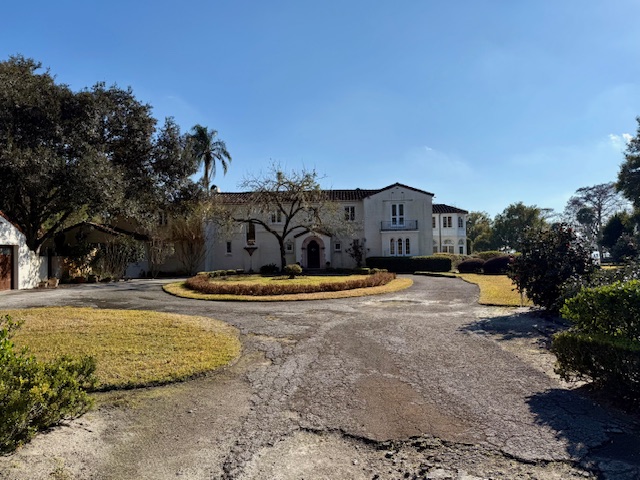
The fate of 1020 Palmer Avenue — a once-grand home and among the largest and most ornate ever designed by James Gamble Rogers II (think velvet-covered handrails) and known in recent years as “Merrywood” — appears to hinge on whether a unicorn buyer emerges to save the property.
Such a feat would take not only millions of dollars, but also approval from city officials to break one of Winter Park’s cardinal development rules: No lakefront lot splits allowed.
Tara Tedrow, the prospective buyer who has the property under contract, is asking for an exception to that rule to allow the 3.67-acre lot — the largest property on the picturesque Winter Park Chain of Lakes — to be divided into two lots on Lake Osceola. Each lot, she said, would be at least 150 feet wide and 1.5 acres or larger.
Zillow estimates the property at $12.1 million while other estimates, such as Redfin, list it at $6.4 million.
Tedrow, a land-use attorney at Lowndes who also used to practice cannabis law there, could then potentially sell the lot with the existing home and build a new home for her family on the newly created lakefront lot. The exception would be written in such a way that it would apply only to her lot and no others, according to city staff, because the lot Tedrow wants to purchase is the only one large enough.
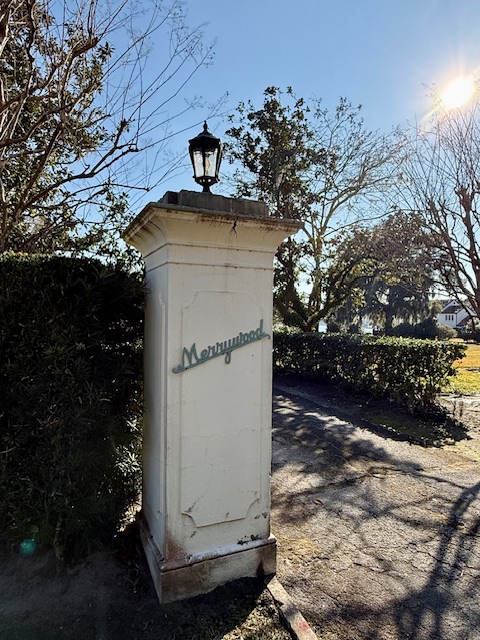
The name “Merrywood” at the start of the driveway at 1020 Palmer Avenue.
While she told the Planning & Zoning Board earlier this week that she believes the currently vacant home is beyond repair, she said she is open to talking with buyers interested in restoring the 7,000-square-foot structure, which dates back to 1940.
She also met with Betsy Owens, granddaughter of Gamble Rogers and leader of the Casa Feliz Historic Home Museum — a Gamble Rogers home and now a popular event space that was famously moved from Interlachen Avenue to just off the ninth fairway of the Winter Park Nine 25 years ago after it was threatened with demolition.
“I’m certain if I’m not in the picture, that the house will get torn down,” Tedrow told the P&Z board earlier this week of the Palmer Avenue home.
The house at 1020 Palmer Avenue is not on the city’s historic register because the longtime owners chose to keep it off. It could be destroyed with a simple demolition permit. However, the property is listed on the Florida Master Site File, a state database of historical and cultural resources, which means the city’s Historic Preservation Board could delay a demolition request for 90 days to allow time to consider alternatives or ways to preserve pieces of the home.
The P&Z board voted 4–2 on Tuesday to grant Tedrow’s request to delay the hearing on the lot split until June — so far, there is no demolition request — to give her time to see whether anyone comes forward who may be interested in restoring the property.
“We appreciate the opportunity to present this case to the city and to hear from our neighbors and members of the historic preservation community,” Tedrow told the Voice. “Having grown up in Winter Park, I appreciate just how unique and beautiful the city is. As I am expecting my third baby in three years, I want more than ever to move back to Winter Park.”
Alex Stringfellow, Bill Segal, David Bornstein, and Charles Steinberg voted in favor of granting the continuance.
Jason Johnson, chairman of the P&Z board, and board member Michael Dick voted against continuing the hearing on the lot split. Both expressed skepticism that a lot split — which would require a change to the comprehensive plan that governs how the city will develop in coming years — should be granted.
The rule states that a property owner cannot divide a lakefront parcel into two and build a house on each one. Such splits would increase density and development along the shorelines of the city’s lakes and decrease the diversity of lot sizes central to the city’s unique character.
The only exception in the plan — which does not apply in this case — is when there is a lakefront lot with a house that is historically designated and older than 1950, and the lot split does not create a new lakefront lot, said Planning & Zoning Director Allison McGillis. In such a case, which occurred last year with another Gamble Rogers house on North Park Avenue, one lot remained on the lakefront while the newly created lot was not on the water.
A view of the home from Palmer Avenue.
McGillis told the board she has heard from residents in the area who have concerns about a potential lot split.
“I’ve gotten questions about the fate of the house,” she said. “Most people I’ve talked with want to preserve the Gamble Rogers house because there are not many of them left.”
While splitting the lot does not guarantee that the home would be preserved, Tedrow said a potentially worse outcome could be on the horizon if a lot split is not granted.
Because of the size of the lot, a buyer could demolish the old home and would be entitled to build a new house as large as 56,000 square feet.
“The largest home in the city has a gross floor area of over 36,000 square feet — this 3.67-acre property is legally entitled to have a home 55% larger,” Tedrow told the Voice in an email. “To further put this into perspective, the city’s new library and event space total around 50,000 square feet. The home that could be built at 1020 Palmer Avenue under today’s Comprehensive Plan would be larger than both buildings combined on the city’s library campus and would dwarf every home in Winter Park.”
Such a house would also dwarf the home of Marc and Sharon Hagle, who spent years constructing the largest residence in Winter Park — the one Tedrow mentioned that is 36,000 square feet — just a few doors down Palmer Avenue.
“I think there are some buyers out there who might do that,” she told P&Z members. “I’m not that buyer. So maybe we flip this to somebody else …”
Owens, who also attended the meeting, said she appreciates that Tedrow came to Casa Feliz and is considering ways to find a buyer who might be willing to restore the home.
“We appreciate her willingness to work with us,” Owens said.
The property was most recently the home of Dr. Raymond Gilmer, an orthopedic surgeon who died in 2020 at age 90, and his wife, Sarah, who purchased it in 1977.
The home is now vacant and owned by the couple’s children. Tedrow said the family decided to keep the property off the historic register in case the land would be worth more with the potential for demolition.
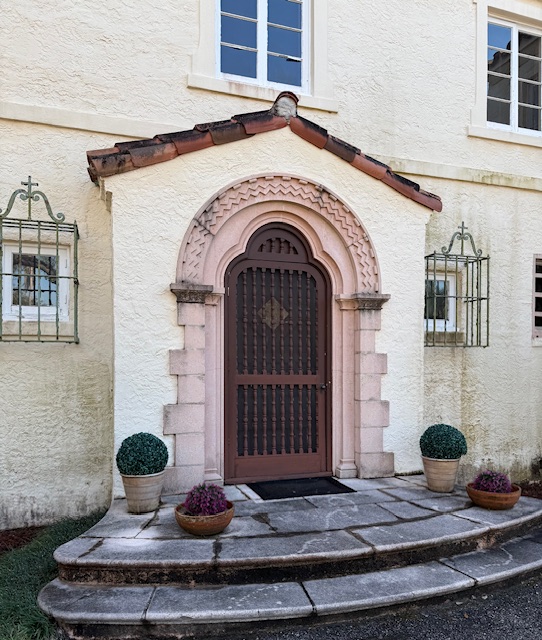
A close-up of the front entrance to the property.
There is no publicly available list price because Tedrow offered a contract on the property before it hit the MLS.
She said the price of the existing house would depend on the exact configuration of a potential lot split, if approved, and other factors.
The house was featured as one of about a dozen properties in a 2004 book celebrating the architecture of Gamble Rogers in Winter Park by Patrick and Debra McClane.
“The initial series of interior spaces is unusual for a residence and more closely resembles a hotel or theater entry in that a lobby is provided, which is flanked by a coat room and a powder room,” reads the section on the property, referred to as the Plant House for its original owner. “Stepping up from the lobby, one then enters a large entrance hall nearly 45 feet in length. Triple arched openings on the south wall of the hall — with a fixed window in the center and double-leaf, multiplane doors on the sides — lead to the loggia and then the sunken patio, with Lake Osceola beyond.”
The house boasted features such as “floor buttons” in the dining areas that rang to wait staff in the kitchen, as well as “ornate wrought-iron railings and balusters [that] lined the staircase, and a velvet-covered handrail … provided on the interior wall.”
Jack Rogers, architect and son of Gamble Rogers, told the Voice last year that there are fewer than 10 true examples of his father’s work left in Winter Park as more are torn down every year.
“There’s probably 15 or 20 left, and eight or 10 are absolutely precious, and we seem to be losing them at the rate of one or two a year,” Rogers said. “We still have several wonderful examples.”
WinterParkVoiceEditor@gmail.com
Update: The original version of this story noted cannabis law as a part of Tedrow’s law practice. She no longer practices in that area.
To comment or read comments from others, click here →
by Beth Kassab | Feb 2, 2026 | City Commission, News
Winter Park Officials Report No Major Power Disruptions During Prolonged Cold Snap
The city, which runs its own electric utility, asked major power users like AdventHealth and Publix to conserve and use generators as usage soared to heat homes and businesses
Feb. 2, 2026
By Beth Kassab
Winter Park Mayor Sheila DeCiccio alerted residents on Monday evening that the city appeared to be through the worst of the impacts from two consecutive days of below freezing temperatures with few disruptions.
An email from DeCiccio relayed a message from Randy Knight:

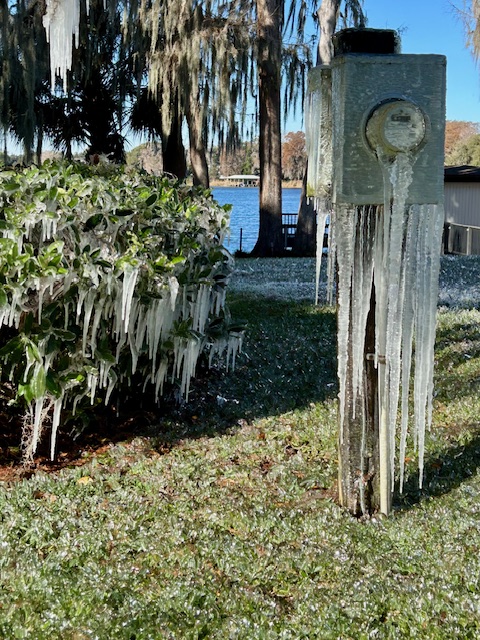
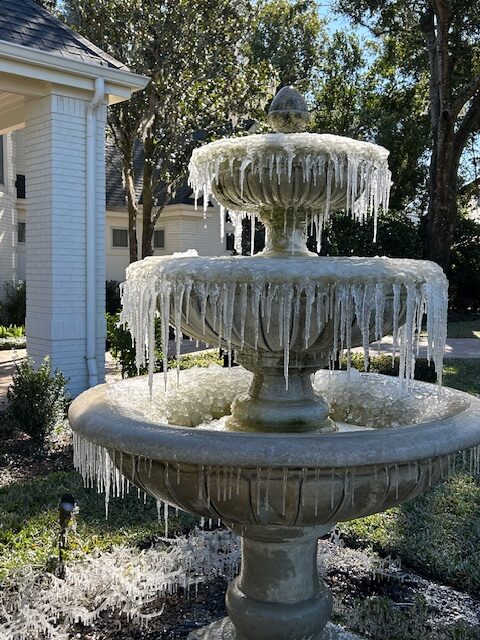
Ice appeared across the city on Sunday morning such as on this plant off Palmer Avenue.
“Well, we made it through the worst of the cold weather without any brownouts or blackouts,” he wrote. “We had a few minor outage events that impacted approximately 40 customers.”
Winter Park, which owns its owns electric utility, relies most significantly on power produced by natural gas through purchasing agreements with the Florida Municipal Power Agency and the Orlando Utilities Commission.
Knight said he and other officials called big customers in the city such as Publix and AdventHealth and asked them to use generators during peak hours to free up capacity needed to heat homes and businesses.
“… We were cranking out 2.1mw at our Interlachlen Substation Feeder 159 and when Winter Park Hospital turned on their generators it took 1.4mw off that demand,” he said. “That is a good community partner.”
Publix also placed stores across Florida on generators, Knight wrote.
“That went a long way in helping the state utilities make it through this event,” he said.
The city also used generators to power some of its own facilities and temporarily closed some buildings. For example, the Winter Park Library did not open until noon on Monday.
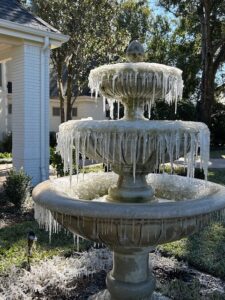
A resident’s pond froze off Via Tuscany not far from the shores of Lake Maitland.
Running central heat for prolonged periods consumes more power than air-conditioning. That caused concerns about whether the utilities had capacity to manage the loads over the weekend and into Monday when temperatures dropped below 30 degrees.
The cold weather was brought on by a major winter storm that impacted multiple states and drove natural gas prices to temporarily sky-high levels as production of the gas decreased during the storm.
Knight told the City Commission last week that if prices remained high it could increase the amount Winter Park residents and businesses pay for electricity.
In October, customer electric rates increased 4%, in part, after the City Commission determined high prices were justified to help raise enough capital to finish the city’s long-running project to underground every power line.
But customer bills actually dropped because the costs associated with fuel (which, again, is mostly natural gas) were low, though fuel prices tend to be volatile.
Knight said last week he expected the commission to have a discussion this month about whether the city will need to up the amount customers pay for fuel beginning in March to recoup some of the higher expenses brought on by the storm.
“Fuel is a pass through to the customer, we don’t make a profit on that part,” he said at the Jan. 28 meeting.
WinterParkVoiceEditor@gmail.com
To comment or read comments from others, click here →
by Beth Kassab | Jan 27, 2026 | News, Police and Public Safety, Uncategorized
Police Release Image of Possible Suspect in Winter Park Church Fire
Police asked the public for information in the case of a person who cut down a banner with a rainbow flag on the lawn of First Congregational Church of Winter Park and set it on fire near the church doors
Jan. 27, 2026
By Beth Kassab
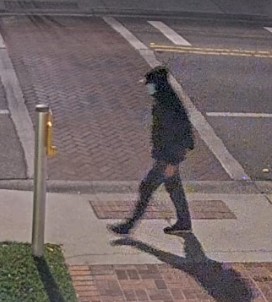
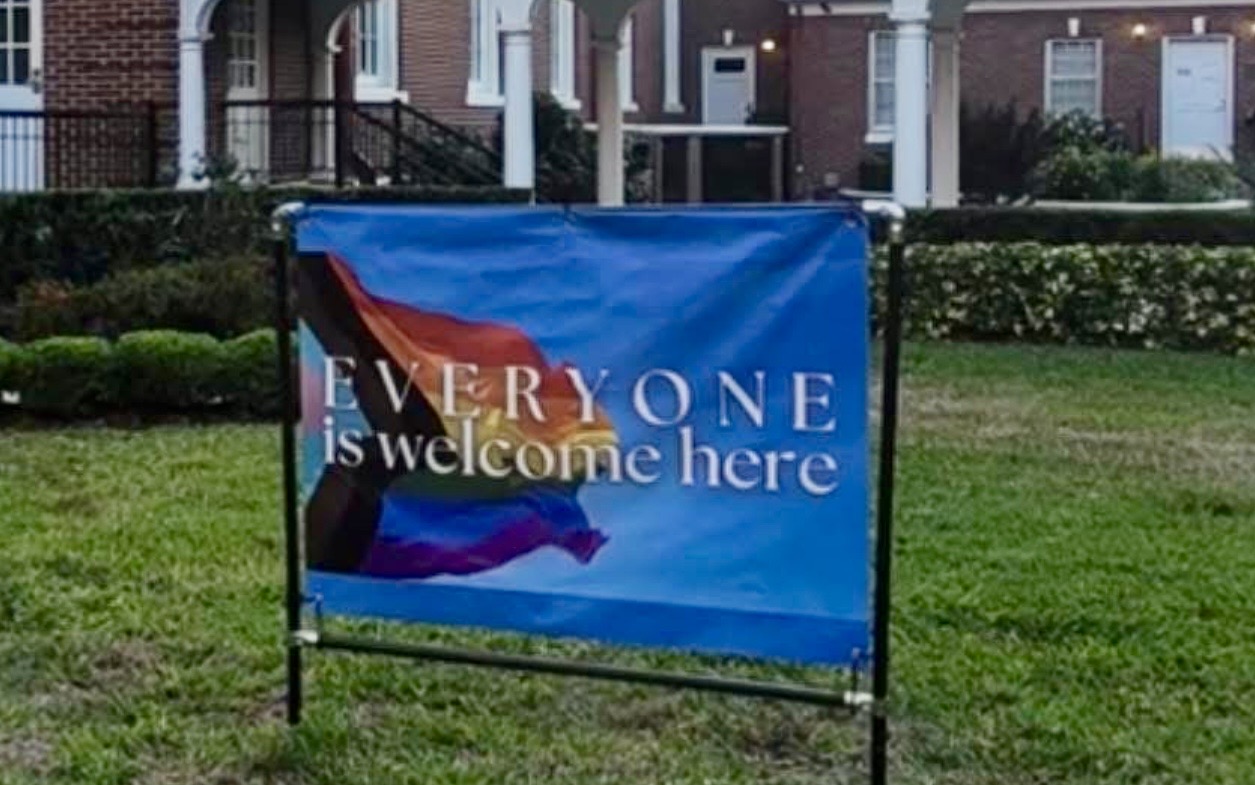
The Winter Park Police Department on Tuesday released an image captured from surveillance video that shows a possible suspect in the fire set at First Congregational Church of Winter Park that targeted a banner that said “Everyone is welcome here” over a sky blue background with a rainbow flag.
The photo appeared to show a man on a sidewalk in dark clothing wearing a hat and possibly a face mask. The man is also wearing dark shoes with white soles. It wasn’t clear from the information released by the police department where the image was captured or when.
An image released by police shows a potential suspect in the church fire that burned a welcome banner.
The department did not address why it waited a week since the fire that left a pile of ash and minor damage on the eastern double doors of the church to solicit help from the public in identifying a suspect.
“All avenues of investigation are being followed to identify the suspect and determine if the crime committed had a biased-based motive,” a release from the department stated.
Florida statutes call for tougher penalties on misdemeanors and felonies if there is evidence the defendant acted out of hate or prejudice based on the “race, color, ancestry, ethnicity, religion, sexual orientation, national origin, homeless status or advanced age of the victim.”
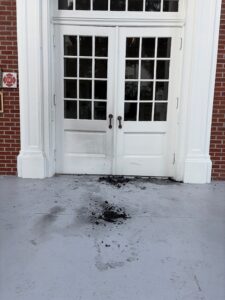
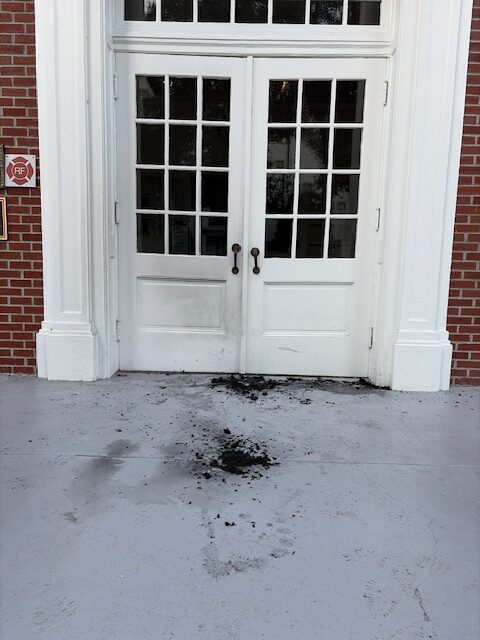
A pile of ash and smoke and heat damage can be seen at the church doors after the banner was set on fire. (Photos courtesy of First Congregational Church of Winter Park)
On Sunday, Senior Minister Shawn Garvey delivered an emotional sermon with a number of notable community members in the pews to show solidarity with the church such as Anna Eskamani, who represents Winter Park in the Florida House, former Mayor Steve Leary, who recently ran for Orange County commissioner, and a number of officials from Rollins College and the Mayflower, a senior community.
Garvey read a statement from Orange County Mayor Jerry Demings that said, in part, “though they destroyed the sign, they can never destroy what’s in your heart.”
Garvey told the congregation that, a times, the church’s long history of social justice work and Christian teachings are principles that “sometimes bring the heat, literally.”
“Bring it …,” he said. “…. If the building disappears, we’ll meet somewhere else. Who cares? They won’t break us.”
Garvey said the church’s newly installed surveillance cameras captured the suspect “making a beeline” toward the welcome banner just before midnight on Jan. 20. The church is widely known for its acceptance and support of the LGBTQ community often represented by the rainbow flag on the banner.
The video shows the person cutting down the banner and bringing it to the church doors before setting it on fire.
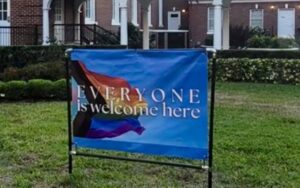
The banner stood on the lawn of First Congregational Church of Winter Park since about Easter until it was cut down and set on fire last week.
A police report released Tuesday says an unidentified witness called police about 11:50 p.m. after smelling smoke and seeing the fire while walking to the Alfond Inn, which is just across Interlachen Avenue from the church.
The fire was quickly extinguished and city Fire Marshal Jim Santoro and Det. Daniel Fritz from the state Bureau of Fire, Arson and Explosives arrived to investigate.
Santoro told the Voice that the state bureau along with Winter Park Police would take the lead in the investigation. He said the fire appeared intentionally set, though it wasn’t immediately clear what was used to start the fire.
He said such cases are unusual in Winter Park.
“This is not very common,” Santoro said. “We probably only get something like this every couple or three years and I’ve never seen one exactly like this and I’ve been with the department 36 years.”
The police report listed potential charges of attempted arson, petty theft and damage to church property.
Police are asking anyone who has any information about the incident to contact Winter Park Det. R. Budde at 407-599-3658 or Crimeline at 800-423-TIPS(8477).
WinterParkVoiceEditor@gmail.com
To comment or read comments from others, click here →



Recent Comments