by Beth Kassab | Jan 7, 2026 | City Commission, News, Zoning and Development
Mixed-Use Development Proposed for DePugh Nursing Center Site
The new project by Z Properties will include commercial and residential elements on the prominent corner of Morse and Pennsylvania. The nursing center closed last year.
Jan. 7, 2026
By Beth Kassab
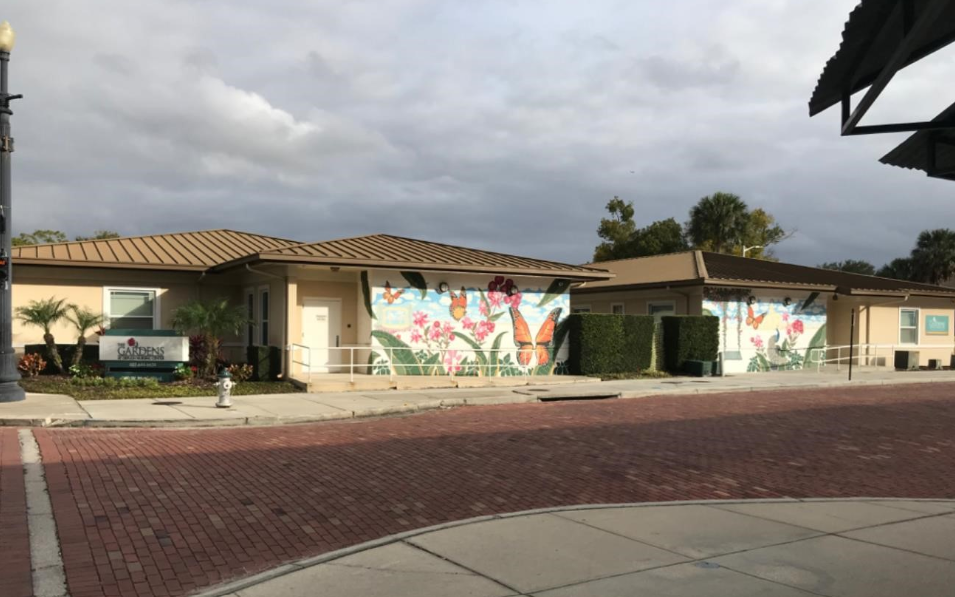
The Gardens at DePugh Nursing Center, which closed in the fall after 70 years, will be demolished and replaced with a “flexible, mixed-use environment offering modular opportunities to purchase space” along with a residential component, according to an announcement on Wednesday by Z Properties.
The Winter Park-based development and design firm led by Zane and Emily Williams said in a news release that the residential portion is still in the early planning. The commercial part of the development will look for a mix of “professional, creative, retail, hospitality and service-oriented businesses, with generous ceiling heights, thoughtfully-designed interiors and flexibility to support a range of uses.”
Zane Williams, who did not immediately respond to an interview request, acknowledged the prominence of the corner at 550 W. Morse Boulevard near Pennsylvania Avenue, and the potential for the new buildings to “set the tone” as visitors enter downtown Winter Park via Morse.
“Our goal here, as always, is to develop with intention and care, and to add beauty to our surroundings,” Williams said in the release. “This is a special corner, and we feel a responsibility to create something locals and visitors will pass by and think, ‘That feels right.’”
The new development will bring further change for the historically Black neighborhood west of Park Avenue that dates back to the city’s founding. The area has undergone significant gentrification over the past 25 years with the redevelopment of Hannibal Square and a number of larger homes replacing small, single-story houses.
The DePugh center opened in 1956 as the first state-approved nursing home where aging Black residents could seek care during segregation. The center was named for Mary Lee DePugh, who moved to Winter Park in 1937 to work for a white family she knew from the Chicago area and began advocating to provide health care to those in need as part of her work with the Ideal Woman’s Club, which she founded on the west side of the city. She died before the center opened.
Leaders of the Center decided to close it because of rising operating costs.
Z Properties applied for a demolition permit in October, said city Planning & Zoning Director Allison McGillis. The permit is likely to be approved because the building is not historically designated.
A representative of the firm said renderings of the proposed project will be available in the coming months.
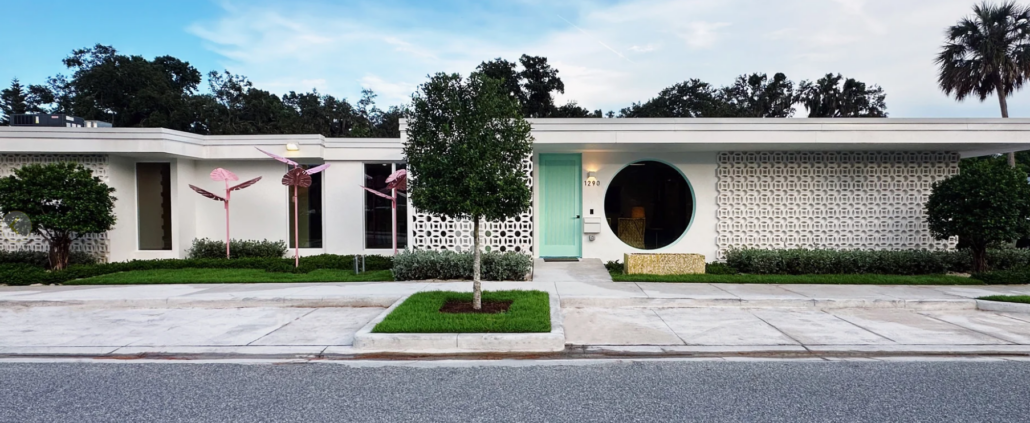
A portion of the Palmetto Grove work spaces by Z Properties near Seven Oaks Park. The project, which refurbished older buildings, recently won praise from City Commission members. (Photo courtesy of Z Properties)
Williams said in the release that one unique aspect of the plan will be the option for business owners to also own a physical space.
“There are so many business owners who dream of designing and owning their own building in the same way people dream of building their homes,” he said. “Ownership allows you to establish permanence, identity, and control of your space — this project is about making that a reality.”
Z Properties is partnering with Stream Realty on the development.
“It’s exceptionally rare to come across the opportunity to own custom-designed commercial space in Winter Park,” Darryl Hoffman, executive vice president at Stream Realty, said in the news release. “We’re thrilled to partner with Zane on this first-of-its-kind development for the area.”
Z Properties recently received praise from the City Commission related to its makeover of workspaces near Seven Oaks Park known as Palmetto Grove along Palmetto Avenue. The buildings were refurbished to have an elevated, high-end look not far off of Orange Avenue where the city is working to improve one of its gateways.
The release said the team is aiming for completion of the project on the DePugh site in 2027 and will unveil its name and more details in the near future.
WinterParkVoiceEditor@gmail.com
To comment or read comments from others, click here →
by Beth Kassab | Jan 6, 2026 | Arts and Culture, City Commission, News
Construction on Park Avenue Will Begin this Month Starting on the North End
The estimated $8.5 million project will upgrade technology and aesthetics along the busy shopping and dining district
Jan. 6, 2026
By Beth Kassab
Construction will begin later this month on the first major overhaul in 25 years of Park Avenue’s aesthetics and technology — a project known as the Park Avenue Refresh that will include nearly $1 million worth of new streetlights and a total price tag estimated at $8.5 million over the next three years.
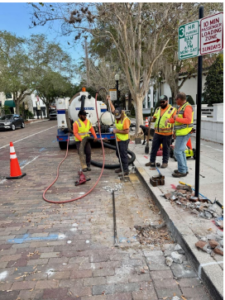
Workers began some tasks last year as the city prepared to launch Phase 1 construction this month. (Photo courtesy of the city of Winter Park)
The work on the first of the three project phases is slated to start Jan. 20 on the north end of the avenue and run from Webster Avenue, near the University Club of Winter Park and the city’s nine-hole golf course to Garfield Avenue along the northern border of Central Park.
The stretch includes the Morse Museum, which houses a large collection of glass windows, lamps, jewelry and other delicate work by Louis Comfort Tiffany, and museum leadership has expressed concerns about potential vibrations from construction, Clarissa Howard, the Refresh’s project manager, told the City Commission last month.
Howard said city staff is working with the museum and others along the stretch such as St. Margaret Mary Catholic Church, which also runs a school with busy drop-off and pick-up times, to minimize disruptions from the construction.
“Fortunately, our project will not be using jack hammers or equipment that would create that type of severe vibrations that could cause damage to the fragile glass,” Howard said in an email. “We are very sensitive to the fragility of the museum’s pieces so we are working closely with them on our construction schedule and activity. We were asked by the museum team to do our work around the museum during the day so they could have staff on standby to keep an eye out for their pieces during construction.”
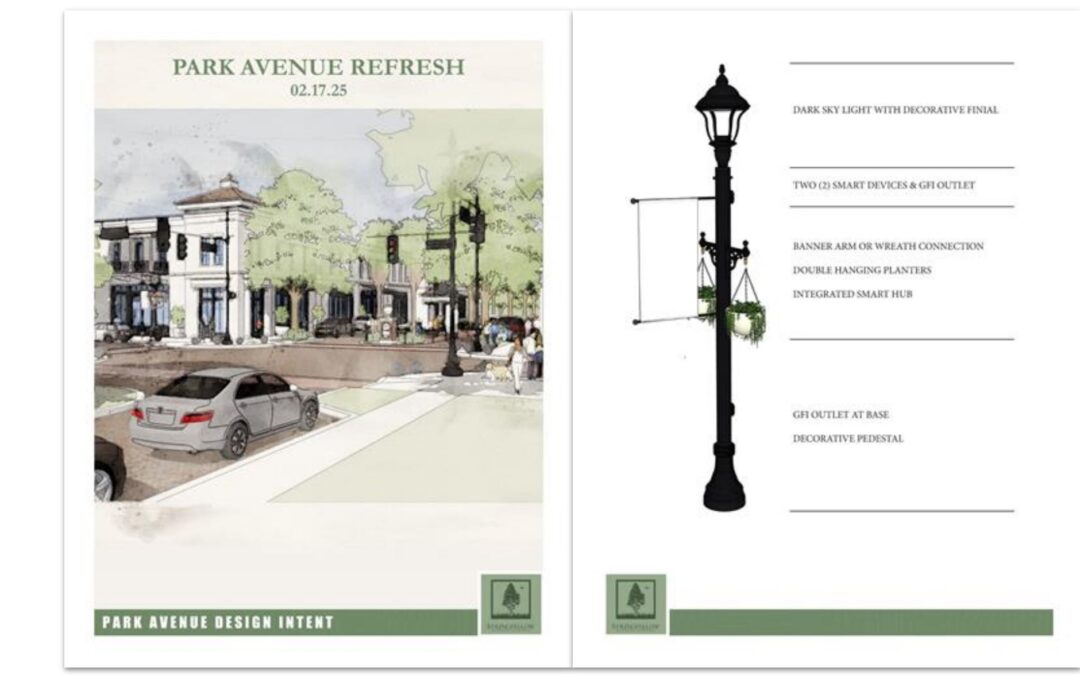
The new streetlights, which the commission voted in April to purchase for nearly $1 million, include “dark sky” lamp fixtures that cast LED lights downward, wi-fi receivers, electric hook-ups for cameras and speakers and internal sprinklers for potted plants that will hang from the fixtures. The new cameras on the north end of Park Avenue are for security and will allow law enforcement to obtain footage of incidents for a period of time if needed.
In addition to the new light poles, the avenue will get some noticeable upgrades in the form of new oak trees, new sidewalks, repairs to raised planter beds, new potted plants, new trash and recycling bins and bollards or short posts designed to prevent cars from encroaching on the sidewalks. Other work will be done underground to wire the new lights and irrigation system, help contain tree roots and address stormwater runoff concerns.
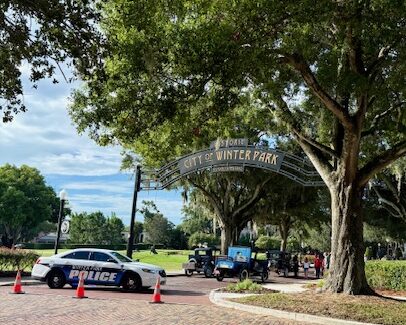
A new sign arches above the north end of Park Avenue near where the Refresh project is slated to begin later this month.
Some work will be done overnight to minimize disruptions to shops and businesses, which rely on foot traffic along one of the region’s busiest shopping and dining hubs.
Last year downtown Winter Park logged more than 1.3 million visitors, according to a city count.
Construction on Phase 2 of the project will start in 2027 and run from Garfield to New England Avenue.
Alex Stringfellow, who serves as the urban planner for the project, said the next phase will be mindful of coordinatization around the considerable space occupied by cafe tables along the sidewalks as well as maintaining the health of the oak tree in front of Briarpatch, the largest along the avenue.
Phase 3 will begin in 2028 and run from New England to Fairbanks Avenue.
WinterParkVoiceEditor@gmail.com
To comment or read comments from others, click here →
by Beth Kassab | Dec 31, 2025 | City Commission, News, Police and Public Safety, Schools
Are Electric Scooters and Bikes Too Dangerous for Schools?
Orange School Board members and Winter Park officials say more safety measures are needed
Dec. 31, 2025
By Tilly Raij
Stricter rules over electric scooters and bikes on school campuses – or even a temporary ban — are slated for discussion next month as officials from Orange County Public Schools and Winter Park grapple with soaring injuries and accidents attributed to the high-speed vehicles.
School board members tossed around potential new regulations such as requiring licenses, training and speed limits at a meeting in November. Stephanie Vanos, the member who represents District 6, which includes Winter Park, said she recognized that regulations involving the devices can be challenging to carry out.
“It’s hard to enforce speed when some of these don’t even have speedometers. It’s hard to enforce licensure because they come from anywhere,” said Vanos, who raised the idea of a temporary ban of electric scooters and similar devices until a more complete evaluation of the situation is done.
OCPS Superintendent Maria Vasquez suggested a ban could be the easiest way to enhance safety without shouldering school staff with the extra work of enforcing new rules while a larger safety plan is explored.
“…I don’t think we want to prohibit them on our campuses, but if we’re looking at the conditions that currently exist, that’s probably the one action we can take that doesn’t add more burden to our staff while we are looking at other options,” Vasquez said.
The comments came in response to a presentation last month from Joe Silvestris, who leads the school district’s Office of Safety and Emergency Management.
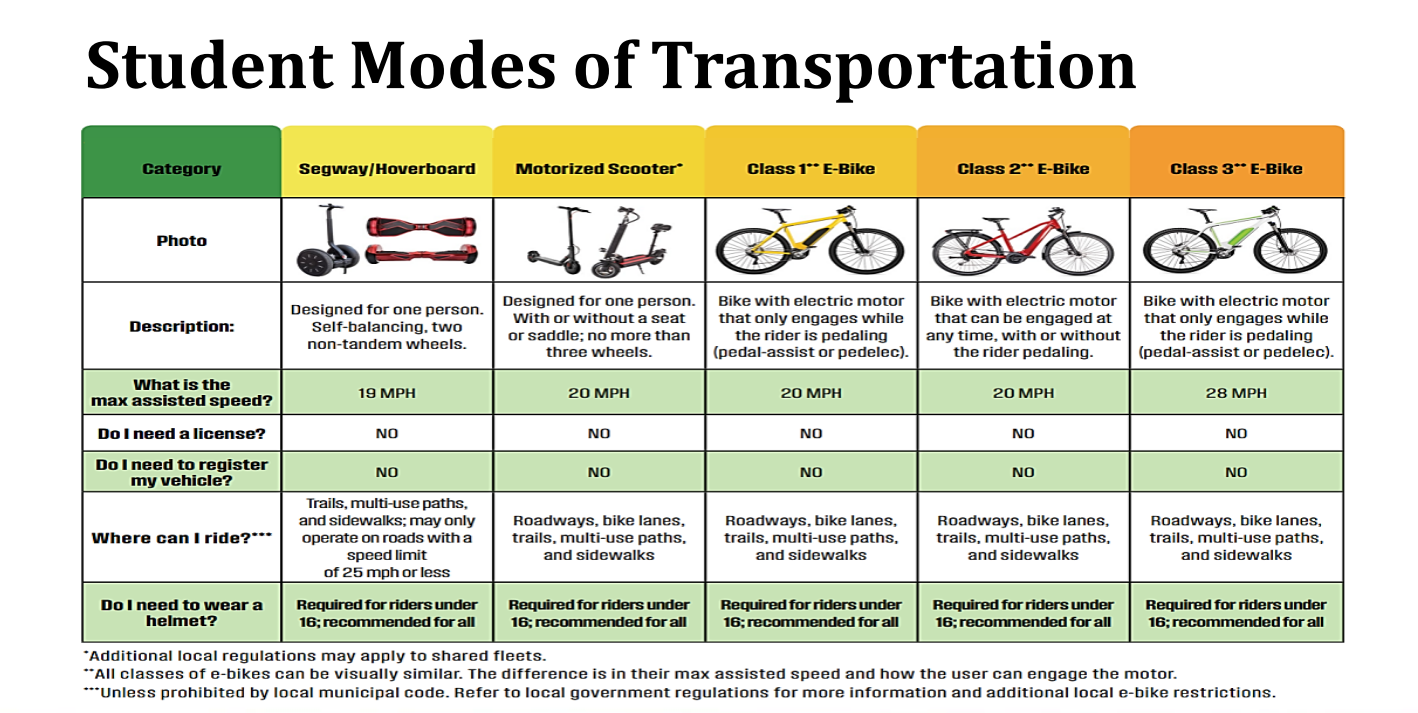
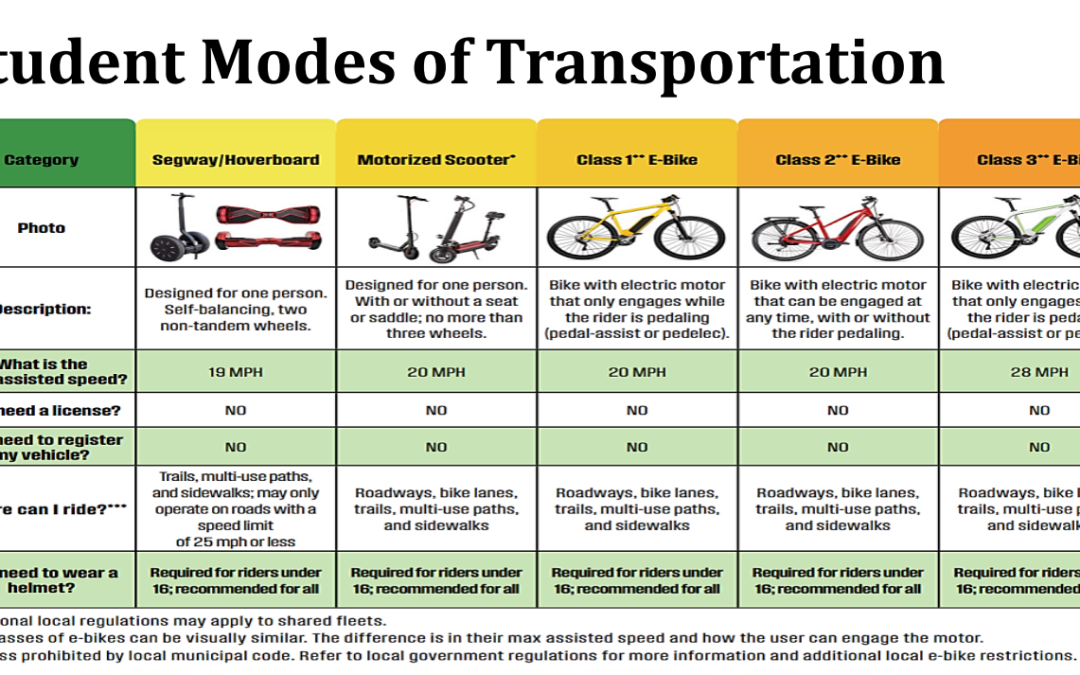
An OCPS presentation detailed the different devices students are commonly using on campuses.
Since 2017, electric scooter injuries in the U.S. have surged by 400%, with Florida being a top state in emergency room visits for such injuries, Silvestris told the school board at a November work session, citing data from the Consumer Product Safety Commission. These accidents have more than doubled since 2023 for children under 15, he said.
Lack of helmets, poor infrastructure, and rider inexperience and poor behavior were some common causes of scooter-related trauma that Silvestris listed. It was also noted that collisions involving distracted drivers, particularly newly licensed high schoolers, are prevalent on OCPS campuses. The district has previously provided guidance on these vehicles in the Deputy Superintendent Newsletter and on ParentSquare, an app used to send messages to families. The district has also partnered with Bike/Walk Central Florida to deliver safety presentations in schools.
But electric bikes and scooters are so common now that some school and city officials say more is needed.
Winter Park City Commissioner Craig Russell, who is a teacher and coach at Winter Park High School, said he has seen first-hand the dangers of electric scooter accidents and has worked with Winter Park Police on a safety campaign aimed at students and parents.
“A student in my class now has to withdraw and do Hospital Homebound because he was hit by a car [while] riding his e-scooter,” Russell said. “I think as a community we need to learn more about the scooters as a tool. We have to empower ourselves with knowledge of not only how to operate them, but how to teach our kids how to operate them properly and know the rules of the road.”
While some policy makers are worried about the dangers of electric scooters and bikes, many students see them as an essential part of daily life to get to school, work, sports practice and other activities.
“They’re not dangerous because if you really know what you’re doing and if you’re aware of your surroundings, you really can’t go wrong,” said Marco Malave, a sophomore at Winter Park High who uses his e-scooter to get to school and extracurricular activities. Although Malave has had accidents with his scooter before, he doesn’t believe licensing or a ban are needed as long as simple rules are created to “keep everyone safe.”
School Board member Alicia Farrant, who represents District 3, which runs from downtown Orlando south to near Walt Disney World, questioned the idea of a ban at the November meeting and suggested more safety education would suffice.
“As the school district, our place here is really to educate parents, educate the community on what is happening…but I don’t know that it is our duty as a school district to eliminate something completely, and I would be more in favor with each school having more of a say in…their area,” Farrant said.
District 2 member Maria Salamanca, who represents Lake Nona, advocated for rules governing scooters and bikes to be added to the OCPS Code of Student Conduct, which currently doesn’t mention the motorized devices.
“I have seen a really large uptick of very dangerous accidents with scooters on the way to school and very near to campus,” Salamanca said. “I think one of the things I’m seeing a lot, specifically in high school as well, is very young drivers who are distracted and then very fast scooters who are on their phone, and they crash in or around campus.”
Board Chair Teresa Jacobs expressed the need for a thorough course of action if rules are not followed.
“I would look along the lines of what is already not allowed, increase the limitations hopefully at a statewide level, and then use the authority of our Code of Student Conduct to put in place consequences for those students who are violating those,” she said.
When the Florida Legislature convenes in January, at least one member is already pushing a bill to require operators of high-speed versions of the devices hold a license and pushes for other safety measures like collecting and maintaining data on electric scooter and bike accidents.
Under HB 243 filed by Rep. Yvette Benarroch, R-Naples, operators of Class 3 e-bikes, which can go up to 28 miles per hour, would be required to have a learner’s permit or driver’s license.
“I filed this bill because government’s first duty is to protect the people,” Benarroch said, according to the Florida House’s informational page about the bill. “Freedom comes with responsibility, and when public safety is at risk, we have a duty to act. Guided by the Constitution and common sense, this bill protects lives, preserves liberty, and does what’s right for all Floridians.”
Potential new rules for school campuses are expected to be discussed at a meeting for Orange County principals in January. And Russell is planning a community meeting for parents and students in Winter Park.
WinterParkVoiceEditor@gmail.com
Tilly Raij is a sophomore at Winter Park High School. Her work has been published in The Community Paper, J Life Magazine and The Wildcat Chronicle.
To comment or read comments from others, click here →
by Beth Kassab | Dec 18, 2025 | Arts and Culture, City Commission, Taxes, Uncategorized
Arts Board Backs Off Seven Oaks Sculptures Because of Spending Optics
The decision came this week just days before state CFO Blaise Ingoglia held a press conference in Winter Park on Thursday to call city governments “wasteful”
Dec. 18, 2025
By Beth Kassab
Winter Park’s Public Art Advisory Board this week hit the pause button on spending as much as $175,000 on permanent sculptures for Seven Oaks Park after City Manager Randy Knight appeared at the meeting to warn of bad optics and even a potential budget shortfall if Gov. Ron DeSantis is successful in his drive to reduce property taxes.
“Is that something we’d be criticized for?” Knight asked of the potential expenditure. “Should we wait and see what’s coming before we decide to spend that kind of money on public art?”
The decision by the board, which includes new Commissioner-elect Elizabeth Ingram, is evidence of a chilling effect on local governments brought by the DeSantis administration’s attacks on local spending and threat to significantly decrease local tax revenue.
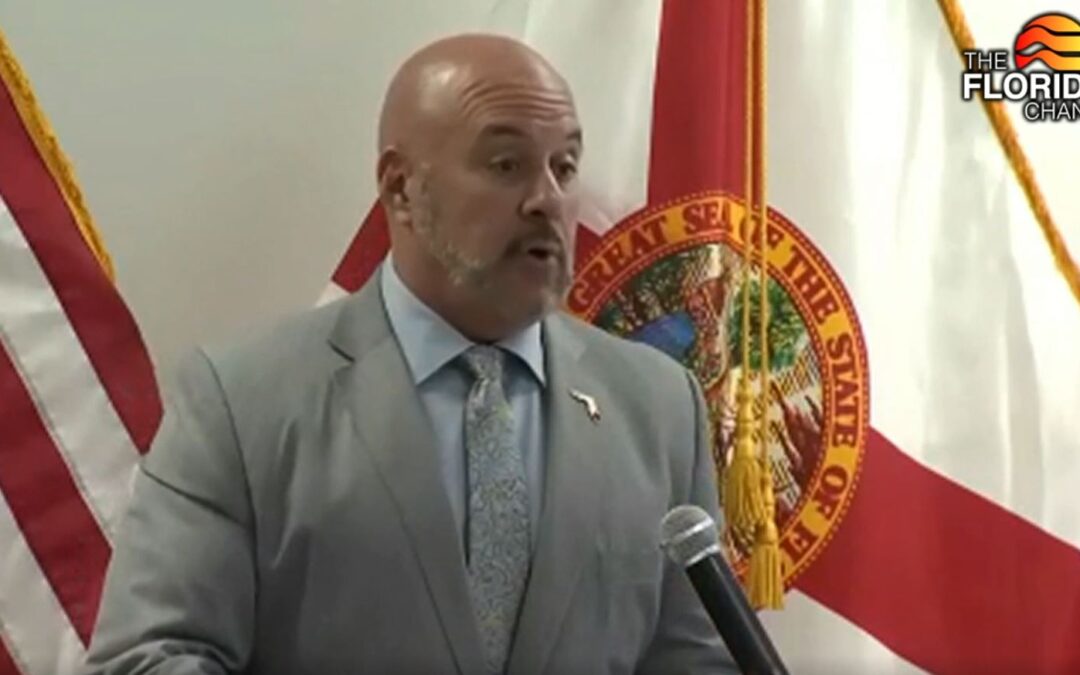
Without mentioning Winter Park a single time, state Chief Financial Officer Blaise Ingoglia, who is running for re-election, held a press conference in the city on Thursday morning.
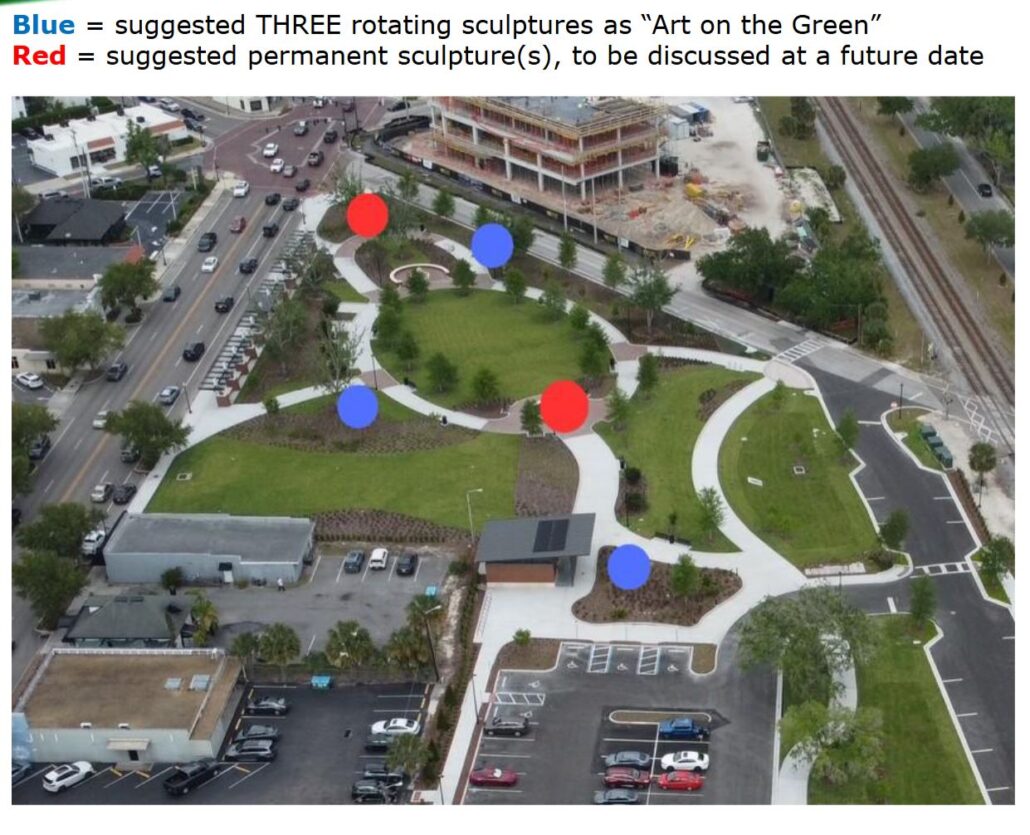
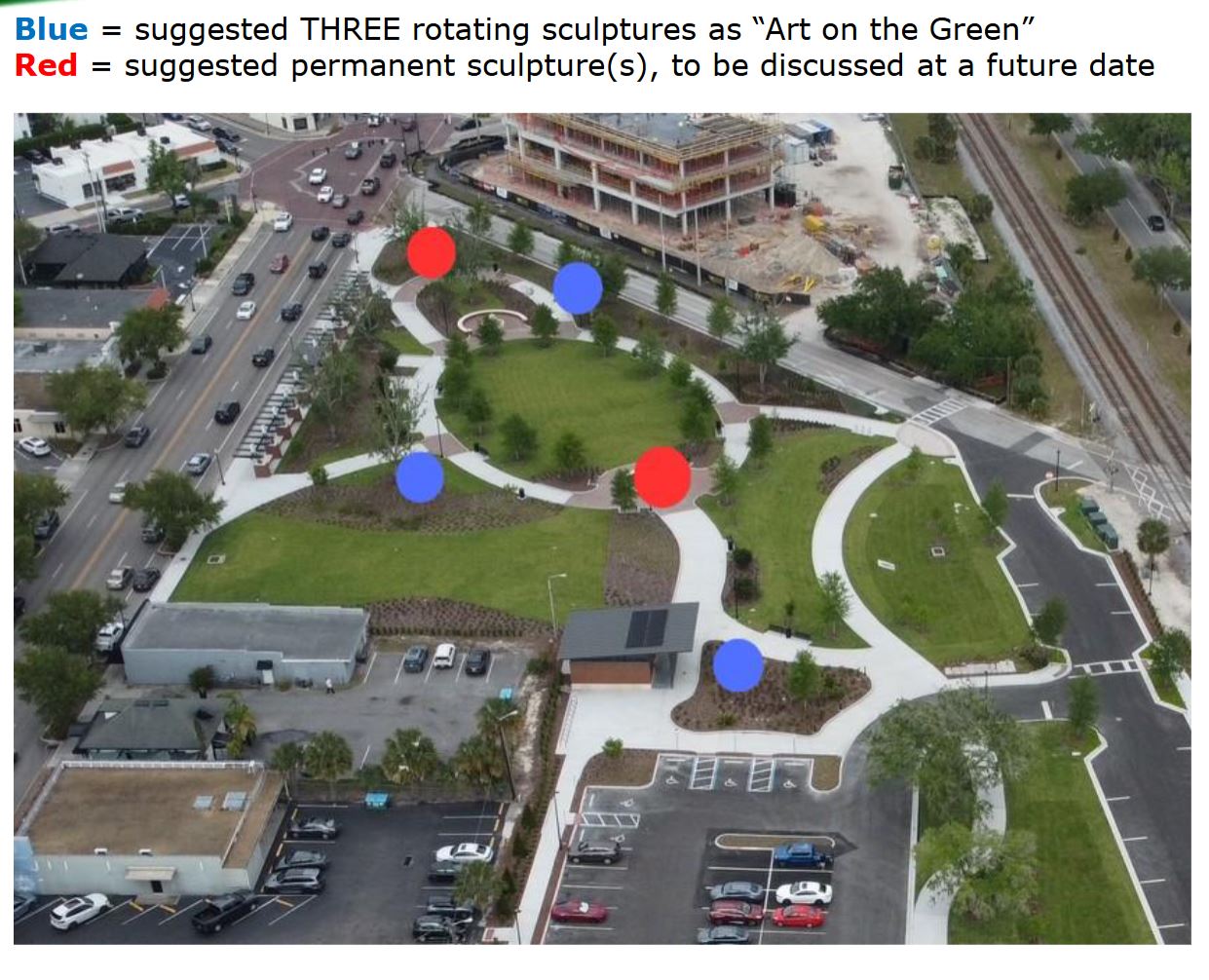
A city graphic shows the proposed location of artwork in Seven Oaks Park.
He repeatedly called cities and counties “wasteful” of public dollars, particularly money collected through property taxes.
But he didn’t cite any examples of cities with bloated budgets that he attributed, in large part, to hiring more staff that far exceeded a city’s need based on its population.
Ingoglia announced a proposal for a new law that would require cities and counties to post their budgets online (which is already required by state law) and to post proposed budget amendments seven days in advance of the hearing. His proposal also would require local governments to identify at least 10% worth of cuts as part of the budget process, though fire and police could not be part of those reductions.
He said the law change would prohibit cities from considering if a business is minority or women-owned when handing out contracts.
Ingoglia called for the end of “the practice of DEI in contracts,” which he said stands for “division, exclusion and indoctrination.”
“Stop with this crap,” he said.
Ingoglia’s office did not immediately respond to a question from the Voice about why the event was held in Winter Park.
The plan for the Seven Oaks Park sculptures came about as part of the city’s public art initiative to promote culture and visitation in Winter Park’s newest public space, which opened earlier this year.
Winter Park is known as one of the top tourism draws in the region and logged 1.4 million visitors to the downtown in 2024.
A plan to bring rotating loaned artwork from Orange County to the park in January is still underway. But the board hit the brakes on purchasing new art to remain in the park permanently.
Arts Board Chairwoman Carolyn Fennell thanked Knight for the information and guidance and noted that the city should “maintain its arts and cultural branding.”
“We all know the importance of arts in our city but others looking in may not have the same value of art as you do or certainly as we do as a community,” Knight said during the meeting.
WinterParkVoiceEditor@gmail.com
To comment or read comments from others, click here →

by Beth Kassab | Dec 12, 2025 | City Commission, News, Uncategorized, Zoning and Development
Via Tuscany Homeowner Owes More Than $300k in Code Fines
Construction on the house began in 2018 and just concluded this year, prompting repeated complaints by neighbors
Dec. 12 , 2025
By Beth Kassab
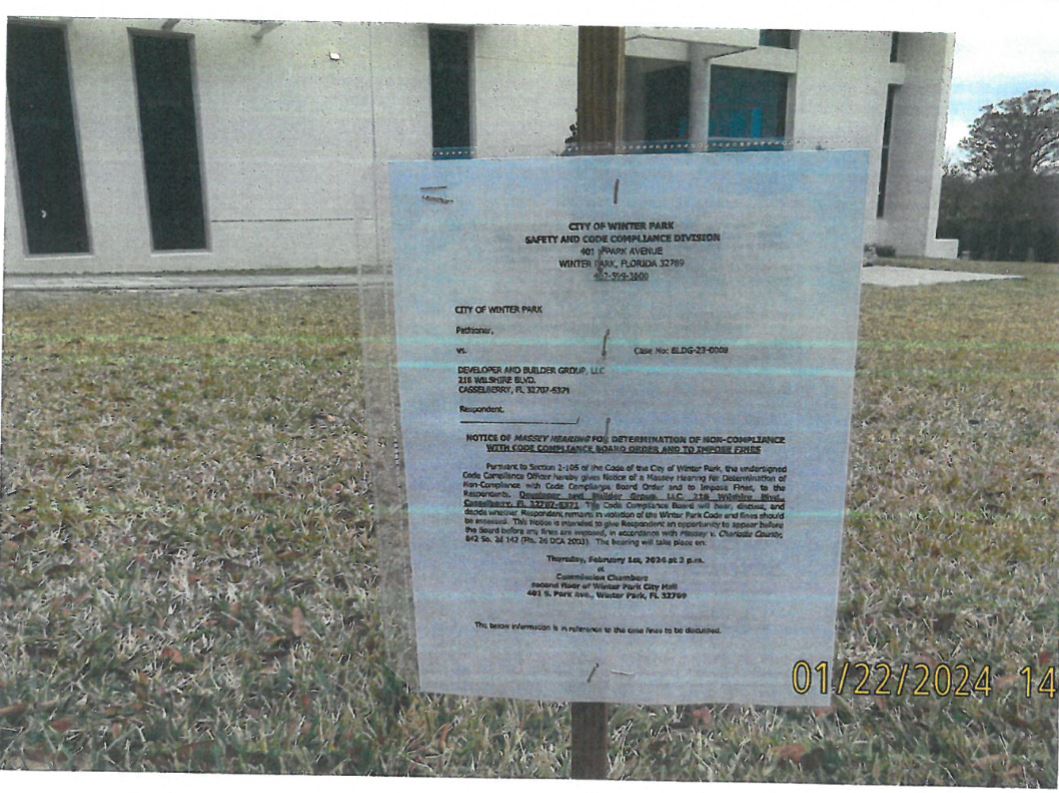
The owner of an ultra modern mansion on the corner of Via Tuscany and Howell Branch Road owes more than $331,000 in code enforcement fines after the City Commission refused the man’s request to eliminate the fines he accumulated during nearly seven years of construction.
Fernando Bermudez, the owner of the home through Casselberry-based Developer and Builder Group LLC, told city officials in a letter dated Sept. 5, 2025 that the drawn-out construction timeline was the result of complications brought on by COVID-19, which killed one of his partners, and Hurricane Ian, which struck in September of 2022.
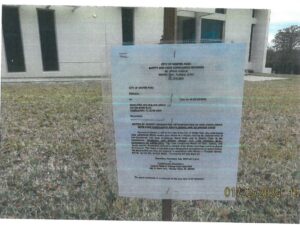
A snapshot included with Winter Park code enforcement documents shows a notice of violation posted in front of the home.
But the construction process at 2661 Via Tuscany started long before those events when the first permit was granted by the city in September of 2018. The certificate of occupancy for the 4-bedroom, 4,500-square-foot house was finally issued in July of this year.
Bermudez, who attended the City Commission meeting on Wednesday, said through his attorney that he was unaware of the fines and blamed a number of problems on his contractors, which changed repeatedly during the project.
But Gary Hiatt, building and permitting director, showed commissioners minutes from a Code Enforcement Board hearing in November of 2022 that showed Bermudez was in attendance and spoke along with a contractor about the timeline of the project. At that meeting, the board ordered that fines of $250 a day per violation would begin accumulating if the house wasn’t completed in 60 days, according to records.
“There were multiple times where they gave us, ‘We’ll be done by here or we’ll be done by here,’ and it just never came to fruition,” Hiatt said.
Violations, which included allowing permits to expire without completing the project and failing to meet deadlines, went on in at least one case for more than 900 days and, in another, more than 300.
“The incomplete vacant structure remains a public nuisance,” the code board concluded in a March 23, 2023 order that said fines would continue and the city would place a lien on the property.
In his letter to city officials to request the fines and lien be eliminated, Bermudez claimed ignorance about the existence of the fines and detailed how construction materials ordered from Europe were delayed by the pandemic as well as how the project was impeded by his own illness and the loss of his partner to the virus.
A Realtor.com listing for the property, which is now up for sale for $6.6 million (more than $1,400 per square foot), boasts of two primary suites (one on each floor), lighting fixtures from Greece, Italian porcelain flooring and “unparalleled craftsmanship, high-end finishes, and an open-concept layout for those who appreciate architectural brilliance and luxury living.”
The house, “follows commercial-grade construction standards, making it a bunker-style fortress unlike any other,” according to the listing.
But Bermudez wrote that the amount of the fine is “a debt impossible for us to pay.”
He said “the real estate market is now extremely slow” and he faces potential foreclosure by a private lender.
But commissioners said they didn’t hear any good reasons to reduce or eliminate the fines.
“These are legitimate fines in my opinion,” Commissioner Craig Russell said, noting that Bermudez’s company had developed other houses so should have had some familiarity with the process.
Russell and Commissioner Warren Lindsey also noted how the lengthy construction process affected the neighborhood.
Neighbors complained to the city about the project repeatedly, citing the unfinished work, debris and other violations.
“Overall, the process has been unprofessional (single workers showing up after hours or on weekends as if the whole project is some sort of shady after thought), unnecessarily drawn out and damaging to our property,” one neighbor wrote the city.
WinterParkVoiceEditor@gmail.com
To comment or read comments from others, click here →
by Beth Kassab | Dec 11, 2025 | City Commission, News, Zoning and Development
Up to Eight Billboards in Winter Park to be Removed
The concept of a deal approved by the City Commission calls for four new billboards along I-4 while eight billboards along surface roads come down
Dec. 11, 2025
By Beth Kassab
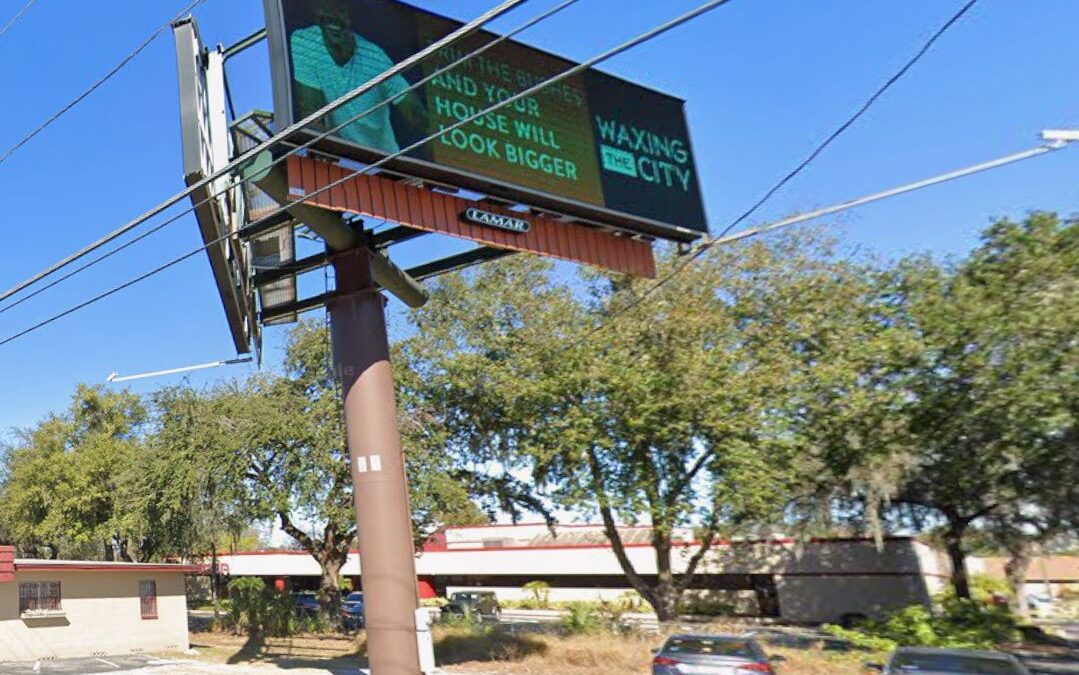
For years, Winter Park officials have wanted to rid the city of billboards — considered by some to be analog roadside spam — and this week brought the first step in taking down as many as two billboards on Fairbanks Avenue, four of the structures on Aloma Avenue, one on Lee Road and one on Interstate 4.
City commissioners voted 5-0 to approve the concept of a deal that will require a series of land swaps and annexations and the permitting of four new billboards along I-4 in exchange for the eight other signs coming own.
“We’ve been working for many, many many years to try to eliminate as many billboards in the core of the city,” City Manager Randy Knight told the commission.
The terms call for:
- Clear Channel Outdoor will remove two billboards at 1873 and 2095 Fairbanks Avenue and one at 2522 Aloma Avenue. All three of those signs are double-sided. In exchange, Winter Park will issue a permit for Clear Channel to construct a new billboard at 2600 W. Fairbanks with a digital sign facing westbound I-4 traffic and a static sign facing eastbound traffic. Clear Channel would also remove a three-sided billboard at the southeast corner of I-4 and Lee Road. It would be replaced by a new billboard about 300 feet to the south, which will require a property swap with the city. The property swap could come before the commission as early as January.
- The Lamar Company will remove a digital billboard at 1621 Lee Road and the city will permit a new digital billboard at 909 N. Wymore Road. This means the city will also need to annex a portion of land for the structure.
- Outfront Media will remove three billboards at 2090, 2145 and 2431 Aloma Avenue. The city will issue a permit for a new digital billboard at 1885 Dartmouth Avenue. The city must annex several properties on Dartmouth to make that portion of the deal happen.
Mayor Sheila DeCiccio asked if Clear Channel could also remove a billboard on U.S. 17-92 and Gay Road. The company would not agree to remove it but said it would replace the digital side of that billboard with a newer technology that creates less light pollution.
“We definitely want that,” DeCiccio said of the upgraded features.
WinterParkVoiceEditor@gmail.com
To comment or read comments from others, click here →


Recent Comments