by Beth Kassab | Oct 27, 2023 | City Commission, News, Uncategorized
Four-day work week for City Hall postponed
City Commission seeks more information on customer service impact
Oct. 27, 2023
By Beth Kassab
Winter Park City Hall’s plans to move to a four-day work week for many employees is on hold after Mayor Phil Anderson asked for more clarity on customer service standards.
The City Commission voted to table the change until next month.
City staff conducted a survey and 80% of employees are in favor of four 10-hour days versus the five-day traditional work week. Other cities such as Maitland and Casselberry already operate under such a schedule.
Under the new schedule, City Hall would still remain open five days with a staggered employee schedule.
The police and fire departments as well as the parks and recreation department would be excluded from the change, according to a staff memo.
The financial impact would be “minimal,” according to a staff memo.
winterparkvoiceeditor@gmail.com
To comment or read comments from others, click here →

by Beth Kassab | Oct 26, 2023 | City Commission, News
City gives partial approval to 53-unit Winter Park Commons project
The proposed rentals on the west side drew concerns about parking, flooding and traffic
Oct. 26, 2023
By Beth Kassab
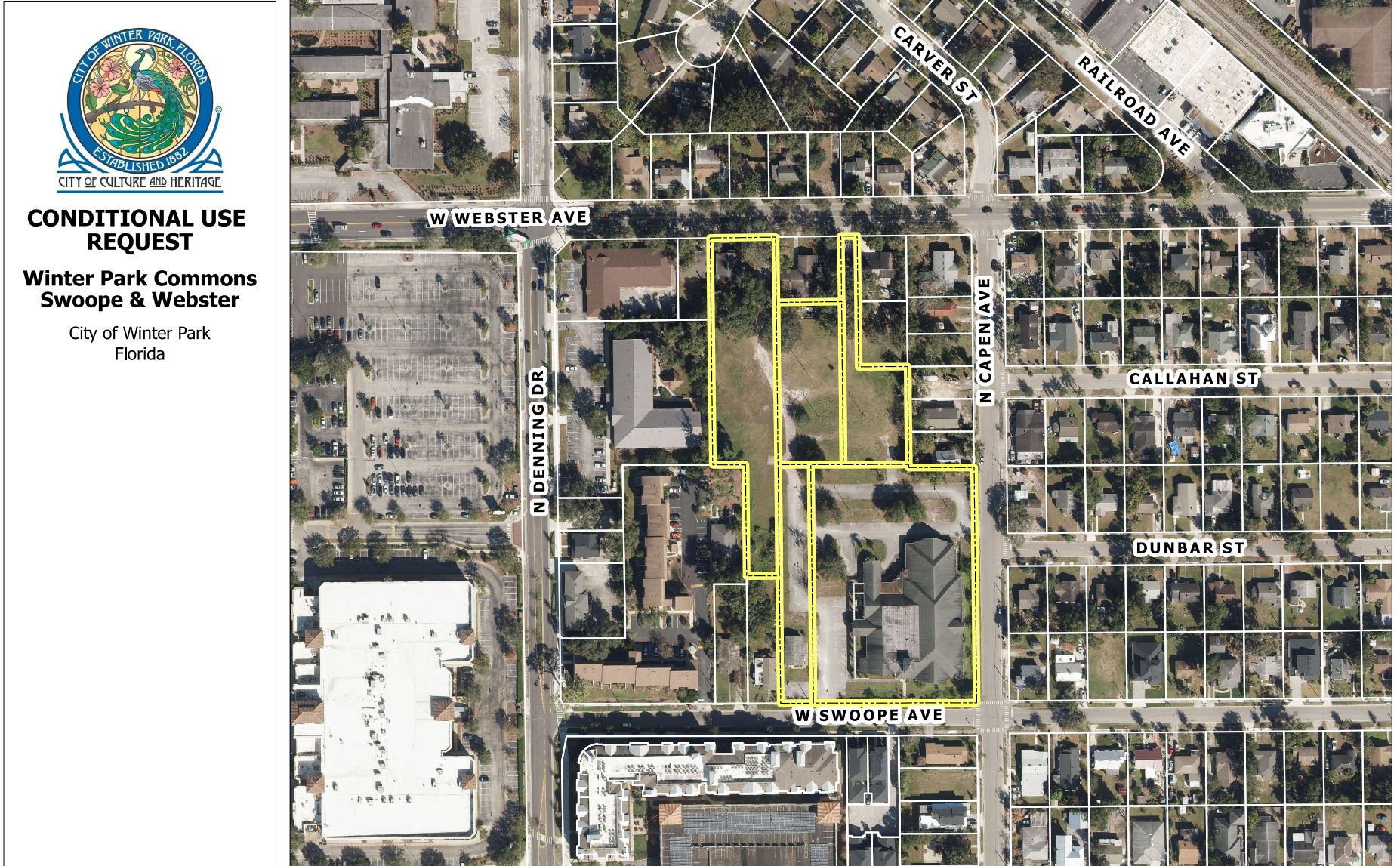
City Commissioners gave partial approval Wednesday to a new development of townhomes between Swoope and Webster Avenues near Winter Park Village, despite objections from residents over potential flooding, traffic and the overall whittling away of the historically Black neighborhood on the city’s west side.
Commissioners stopped short of a full approval for the 53-unit Winter Park Commons, delaying until the Nov. 8 meeting a vote on details of the conditions required of the developer.
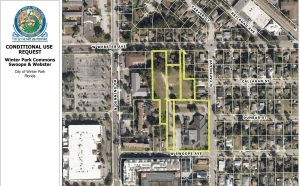
A proposed 53-unit development will be heard at the Nov. 8 City Commission meeting.
Mayor Phil Anderson said the delay would give the city and the developer time to perhaps widen the entry and exit points of the project to mitigate traffic concerns.
A number of residents said they did not like how the project, which would replace a now-vacant church, would add mostly townhomes rather than single-family homes to the neighborhood, possibly prompting some longtime families to leave the neighborhood because it’s changed so drastically.
“I just want to say I think beautification is important … we can help existing residents who might not be able to afford to beautify their homes,” said Roda Ward Carter, who owns a home on West Canton Avenue. “But, wow, you want to save the trees that are there. What about the families that are there? Families are more valuable than trees.”
One of the conditions the city is asking of the Miami-based developer, who bought the land in 2019, is to preserve three live oak trees on the land.
Rebecca Wilson, an attorney with Lowndes who is representing the developer, said Winter Park Commons has gone above and beyond the city’s typical standards for such projects and noted the property has been zoned for multi-family housing since the early 1970s.
The developer has already agreed to add additional stormwater retention — enough to hold three inches of water rather than the two inches required by code — to ease concerns about the special flood hazard area. Flooding of homes and streets in that area was particularly severe following Hurricane Ian last year.
“I have not lived in this city nearly as long as these neighbors have … I appreciate the things they said,” Wilson said. “No one is denying they went through a tremendous tragedy with stormwater during those hurricanes. We recognize that and we are doing what we can, which is more than what any other developer has been asked to do, to address stormwater.”
Other conditions, which likely will increase in number before the next meeting, include:
- The five parcels involved (totaling 4.5 acres) will be consolidated to one, and the single-family units now included in the plan will be zoned as individual lots so they can be sold that way in the future.
- No changes are allowed within a 20-foot radius of three live oak trees in the interior of the project.
- The seven single-family homes to be built on Capen Avenue must show architectural diversity and cannot be the same style or color.
- The newly required water retention areas must include planting new cypress trees as well as perimeter landscaping.
The seven single-family homes in the plans were originally townhome duplexes, but concerns about compatibility with the neighborhood drove the change.
winterparkvoiceeditor@gmail.com
To comment or read comments from others, click here →
by Beth Kassab | Oct 20, 2023 | City Commission, News
Judge rules in favor of city in lawsuit over rescission of Orange Avenue Overlay
The case brought by commercial property owner Mary Demetree challenged a 2020 decision by newly-elected commissioners to take back zoning changes along the busy corridor
Oct. 20, 2023
Note: This is a developing story. Please check back for updates.
By Beth Kassab
A judge ruled in favor of the city of Winter Park on Thursday, bringing to an end a three-year dispute over the vote to rescind major zoning changes that would have allowed taller buildings and more dense development along Orange Avenue. Read the ruling here.
The summary judgement signed by Circuit Court Judge Vincent Falcone ruled that the intended changes to the city’s comprehensive land plan had not gone into effect by the time the commission voted to take back the ordinances that would have altered the plan. He also ruled that the court could not conclude the city violated it’s own procedures or Florida’s Government in the Sunshine laws as it quickly moved to undo the recommended changes for Orange Avenue between Park Avenue and U.S. Highway 17-92.
“Plaintiffs leave no doubt of their sincere belief that the process of adopting the Rescission Ordinance was unfair (if not unseemly) and a sharp retreat from the process that produced the 2020 CPA Ordinance, which they describe as being marked by public participation and reasoned decision making,” Falcone wrote. “The Court’s role is, however, a limited one, and it would be a dangerous infringement on local authority and legislative decisions for a single jurist to void enactments by elected officials based on general notions of fair play.”
The lawsuit was brought by four entities that own property in the corridor and are managed by Mary Demetree, a commercial real estate owner and developer.
Charles Greene, Demetree’s attorney, said he was unable to comment because he has not yet reviewed the decision.
Daniel Langley, an attorney for the city of Winter Park, characterized the ruling as “a complete victory for the City,” in an email on Thursday evening to city commissioners and administrators.
The city and Demetree recently went to mediation to try to resolve the dispute, but reached an impasse. The case was scheduled for trial next month and the city attorneys were in the process of trying to prohibit current and former city commissioners from testifying. The trial is now cancelled as a result of the judge’s ruling.
The suit alleged improprieties by the City Commission in March of 2020 just after Sheila DeCiccio, who is now running for mayor, and Marty Sullivan were elected for the first time.
Under former Mayor Steve Leary the city conducted years of meetings and forums on potential zoning changes along Orange Avenue to revitalize the area.
The Commission approved by a 3-2 vote the Orange Avenue Overlay district, which called for buildings to be as many as six stories in some areas, on March 9, 2020.
DeCiccio and Sullivan were elected less than 10 days later.
Then, on March 30, as the pandemic was beginning to shut down the world, the new commission held a special meeting and took the first of two votes to rescind the previous overlay vote earlier that month. Leary was the only dissenter.
Falcone said he did not find any evidence of wrongdoing on the part of the new commission.
“Even if the Court views the evidence in the light most favorable to Plaintiffs, there are at most emails indicating that the Rescission Ordinance was added to the agenda at Commissioner-Elect DeCiccio’s request, and she commented on, and worked with City staff to revise, the draft Rescission Ordinance,” the ruling stated. “Her indication in an email that ‘we are not amending the ordinance but are replacing it’ is a statement regarding the intended effect of the Rescission Ordinance and, without more, does not establish that Commissioner-Elect DeCiccio had discussions or made decisions with other Commissioners or Commissioners-Elect in a non-public context.”
Questions or comments? Email the editor at WinterParkVoiceEditor@gmail.com
To comment or read comments from others, click here →
by Beth Kassab | Oct 20, 2023 | City Commission, News
New 53-unit multi-family proposal near Winter Park Village up for vote
The development, known as Winter Park Commons, has gone through a series of changes leading up to next week’s debate
Oct. 19, 2023
By Beth Kassab
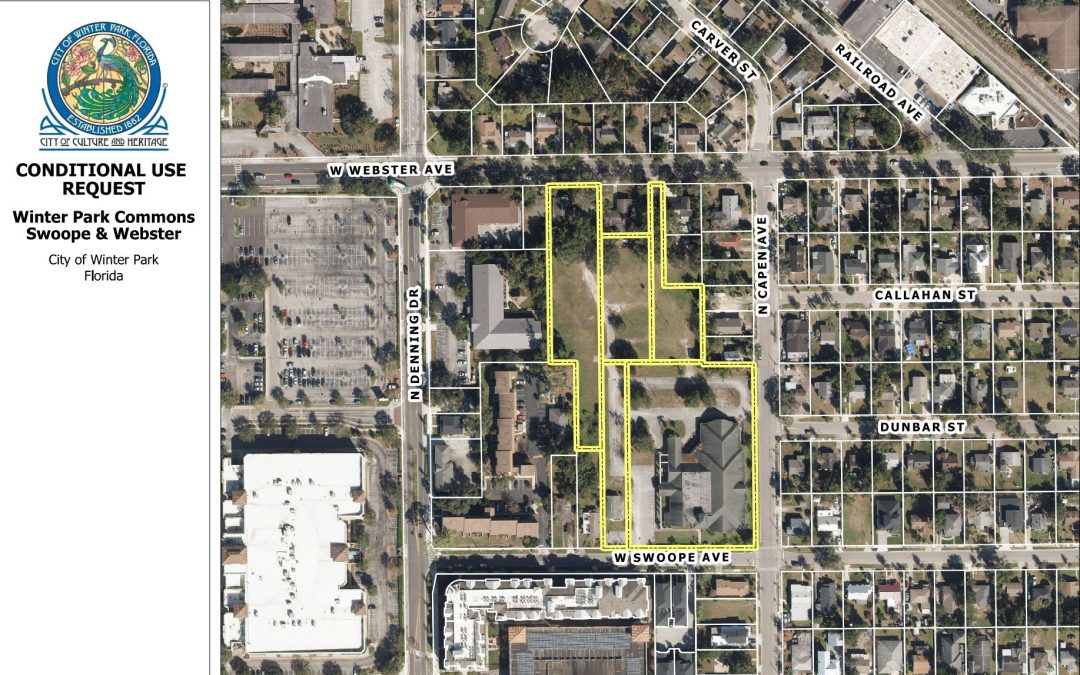
Miami-based developers are seeking approval Wednesday for 53 units of mostly rental townhomes. The proposed location for the units is between Swoope and Webster Avenues, less than a block from Winter Park Village.
The project, known as Winter Park Commons, by Miami real estate developer Carlos Ortiz, underwent significant changes to respond to concerns from city staff about potential flooding, tree preservation, aesthetics and parking.
The City Commission will consider a revised version of the proposal that calls for the demolition of the Seventh-Day Adventist Church that was sold to the developer in 2019. The Planning & Zoning board voted 3-2 to recommend the following conditions:
- The five parcels involved (a combined 4.5 acres) will be combined to one and that the single-family units now included in the plan will be shown as individual lots so they could potentially be sold that way in the future.
- No changes within a 20-foot radius of three live oak trees in the interior of the project.
- The seven single-family homes to be built on Capen Avenue must show architectural diversity and can not be the same in terms of style or color.
- The newly required water retention areas must include new cypress trees as well as perimeter landscaping.

Renderings show architectural inspiration for the proposed seven single-family units included in the Winter Park Commons development.
The developer already agreed to add additional stormwater retention — enough to hold 3 inches of water rather than the 2 inches required by code — to ease concerns about how the development might contribute to the special flood hazard area.
The seven single-family homes in the plans were originally townhome duplexes, but concerns about compatibility with the neighborhood drove the change.
Staff said the development is likely to result in the new residents parking on Capen, Swoope and Callahan avenues.
Questions or comments? Email the editor at WinterParkVoiceEditor@gmail.com
To comment or read comments from others, click here →
by Beth Kassab | Oct 19, 2023 | City Commission, News
Winter Park City Hall to consider four-day work week
The move comes after a survey aimed at improving employee recruitment and satisfaction
Oct. 19, 2023
By Beth Kassab
City commissioners next week will consider moving City Hall from a traditional five-day work week to a four-day week comprised of 10-hour days.
About 80% of employees voted in favor of the change in a recent survey and similar changes are already in place in nearby Maitland and Casselberry. The goal of the change is to improve employee engagement and improve staff retention and recruitment.
The police and fire departments as well as the parks and recreation department would be excluded from the change, according to a staff memo. City Hall would remain open five days a week.
The financial impact would be “minimal,” the memo stated.
Questions or comments? Email the editor at WinterParkVoiceEditor@gmail.com
To comment or read comments from others, click here →

by Beth Kassab | Oct 18, 2023 | City Commission, Election, News
Terry Hotard withdraws from mayoral contest
The city clerk on Wednesday posted that the former mayor is no longer running against current Vice Mayor Sheila DeCiccio
Oct. 18, 2023
By Beth Kassab
Terry Hotard, the former mayor who said last week he would run for the job again, is no longer in the contest against Vice Mayor Sheila DeCiccio, according to the Winter Park City Clerk’s office.
The office added a “withdrew” notation under Hotard’s name on the city’s election page on Wednesday.
Hotard told the Voice that he was “completely humbled and overwhelmed” by messages supporting his candidacy, but ultimately concluded the timing wasn’t right.
“I came to a decision that I would rather spend my time and efforts elsewhere,” he said. “I wish whoever is elected as our next mayor the very best.”
He opened a campaign account and said he intended to run a week earlier.
One of his chief concerns, he said, is the placement of large utility boxes near property owned by Marc and Sharon Hagle, who are building what is to be the largest home in Winter Park on Palmer Avenue. Hotard, also a former city utility executive, said the boxes are eyesores and should be hidden on private property rather than public right of way.
DeCiccio announced her bid for the post earlier this month and is focused on maintaining Winter Park’s charm and shoring up the city’s aging infrastructure.
She had to resign from her commission seat in order to run triggering an election in March for someone to serve the remainder of her term.
The official qualifying period for both contests is in December.
Questions or comments? Email the editor at WinterParkVoiceEditor@gmail.com
To comment or read comments from others, click here →


Recent Comments