What Publicists for the Library Bond Issue Don’t Publicize
Editor's Note: Articles written by citizens reflect their own opinions and not the views of the Winter Park Voice.
When the razzle-dazzle of the notion of building another library on the west side of Winter Park quiets down, the City will face a stark reality: a large, very expensive building that few if any patrons will walk to — a Building, with a Parking Garage, in a Park.
How does it serve residents, most of whom live east of the library, to move it to the west side of the city? Many residents will not want to use a parking garage in an area so close to 17-92. The proposed location may make it more attractive as a place for wanderers to hang out, a problem some libraries have experienced and have been legally unable to remedy.
“Pave Paradise & Put Up a Parking Lot?”
The proposed site for the new library/parking garage would require that at least a portion of MLK Park be paved over. Valuable green space would disappear and park land would be permanently lost. The move would commercialize the library by putting it adjacent to a commercial development. The buffer quality of the park would be lost.
Current Location Central, More Walkable
The central location of the existing library is much closer to most residents than the westerly proposed re-location. The area is safely residential and an easy walk for many users. It’s also close to, but separated from, Park Avenue. It is near several pre-schools whose students use it. Parking is hardly ever an issue. It is generally easier to park there than to park at Publix during busy times.
Space for Children & Seniors? Got That
While those who advocate a new library talk about space needed for children and tutors, we already have several. The Community Center on New England has a children’s library with computers. This facility also offers activities for senior citizens and has a frequently-used commercial kitchen.
$30 Million’s Not the End of It
The existing library had a third story added some years ago; other needed changes can be made to accommodate patrons. Books are still the most important part of a library.
The bond referendum calls for up to $30 million to finance this unneeded construction. Millions more dollars would be required for interest and operating costs. Winter Parkers would pay tens of millions in taxes over twenty years.
When Winter Park voters mark their ballots, they face a decision that will have a far greater, more lasting impact on the life of this City than any politician is ever likely to have. Commissioners come and go, but this is a 20-Year, $30 Million Dollar Question. Will the citizens of Winter Park vote to spend $30 million tax dollars over the next 20 years on a new combined Library – Events Center?
Official ballot language
“For the purpose of building the Winter Park Library and Events Center, to include library facilities, civic meeting and gathering facilities and related parking structure, and improvements, and all purposes incidental thereto, shall the City of Winter Park, Florida, issue not exceeding $30,000,000 general obligation bonds, bearing interest at not exceeding the maximum legal rate, maturing within 20 years from date of issuance, payable from ad valorem taxes levied on all taxable property in the City area, without limitation as to rate or amount; as provided in Ordinance No. 3020-15?”
The PAC presidents articulated their positions for The Winter Park Voice. Jeffry Jontz, President of the Board of Winter Park Library Trustees, speaks in favor of building a new library. Michael Poole, who currently chairs the Keep Winter Park Beautiful and Sustainable Advisory Board, speaks in favor of leaving the Winter Park Library in its current location.
Voters Will Have the Last Word
A Yes vote is a vote for the Referendum. A No vote is a vote against the Referendum. The vote is not for or against the Library. Winter Park will always have a Library, but You, the Voters, must decide whether or not the City will issue $30 million in bonds to erect a new building in MLK Park.
At the November 9 Commission meeting, City staff brought forward a draft ordinance with referendum language asking Winter Park voters to approve a bond not to exceed $30 million, to be paid back over a period of 20 years, for the purpose of building a combined library — civic center complex. The referendum will appear on the March 15, 2016, ballot.
According to City Manager Randy Knight, the financial impact on each property owner will amount to $49 per year per $100,000 of assessed valuation. Assuming the average value of a home in Winter Park is around $400,000, the owner of that home would pay, at most, an additional $196 per year in property taxes.
Nov. 23 – Second Reading
Adoption of the ordinance requires two readings. The second and final reading will be at the November 23 Commission meeting.
If the Winter Park voters decide in March to build a combined library – civic center complex, it will in all likelihood be located on Morse Blvd. at the site of the present Rachel Murrah Civic Center.
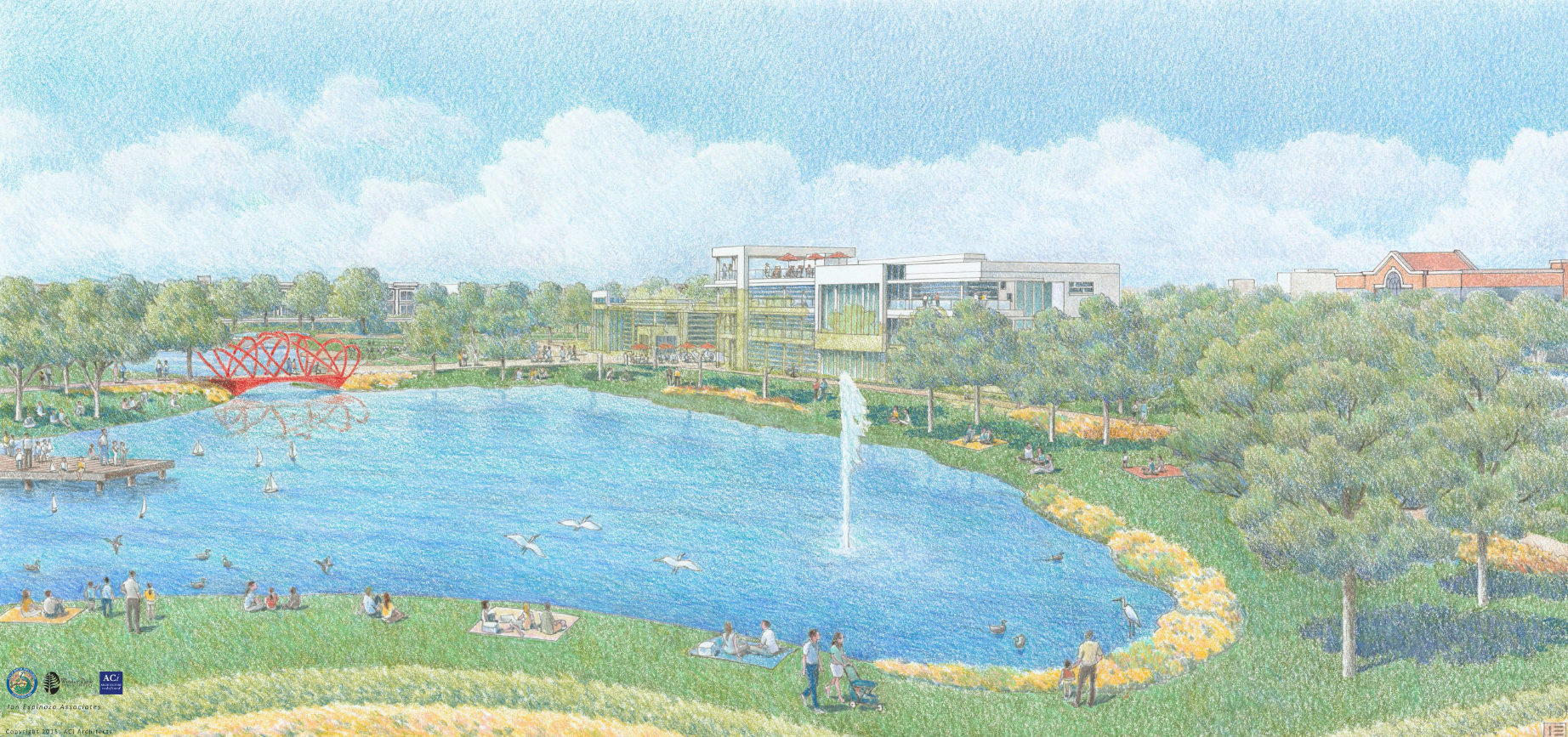
ACi Design — Purely Conceptual
John Cunningham, design partner of the consulting architectural firm ACi, presented the report to the Commission October 26, and the Commission voted unanimous approval at that meeting. The report was based on more than a year’s study, dozens of task force meetings, eight public forums and countless individual meetings with Winter Park citizens. Cunningham stressed that the report describes a concept for a new combined library and civic center. The actual building design will be determined by the architectural firm hired by the city if the referendum passes.
Innovative Public Input
Elements of ACi’s conceptual design are rooted in ideas that emerged during public workshops August 22 – 23. Some of the most innovative of these came from children who accompanied their parents. At right, a Winter Park fourth grader suggests a nap area where small children can sleep while their mothers read or study.
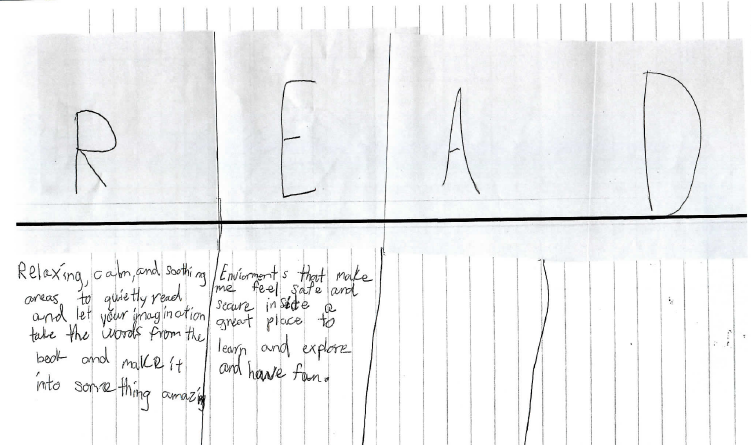
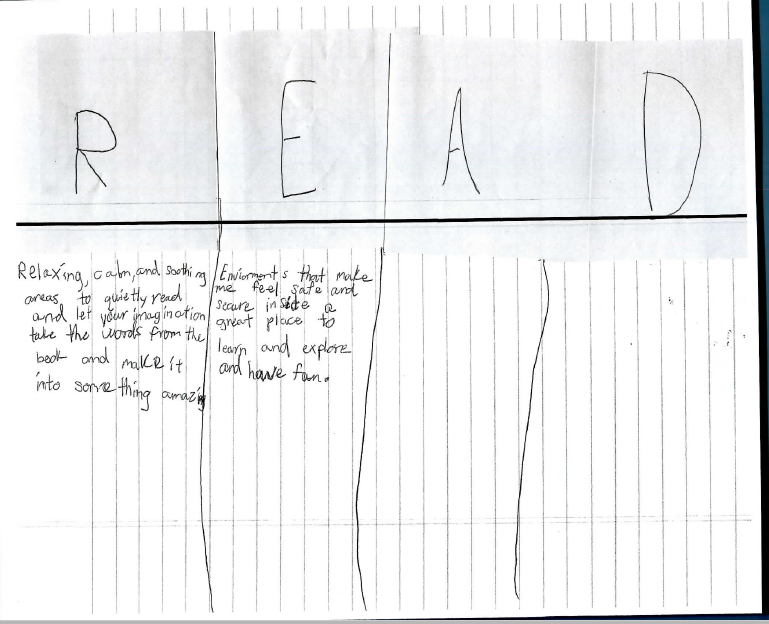
Another fourth grader describes a library with “Relaxing, calm, and soothing areas to quietly read and let your imagination take the words from the book and make it into something amazing.”
One child’s Notion of What a Third Place Should Be
“Environments that make me feel safe and secure inside a great place to learn and explore and have fun.”
Library Builds Community
Dr. Jonathan Miller, Director of Olin Library at Rollins College, agrees. “The most important feature of any library,” he said, “is its community – the people it serves.” Miller said the idea of the Third Place came from Ray Oldenburg, PhD, an urban sociologist from Pensacola, FL, who published a book in 1991 entitled The Great Good Place, about the importance to a community of informal public gathering places.
According to Dr. Oldenburg, the First Place is home; the Second Place is work; and the Third Place is where one chooses to be when he or she is not at home or at work. Oldenburg argues that these Third Places – coffee shops, bars, general stores, and libraries — are central to local democracy and community vitality.
Miller described Olin Library, which is designed to serve the academic community at Rollins, as a place of “collaboration, contemplation and community.” Miller said there is complete reciprocity between Olin and the Winter Park Public Library, and that anyone with a WP library card may use it at Olin.
Asked about the prospect of a new combined public library and civic center for the city, Miller deferred to Winston Churchill, who said, “We shape our dwellings and afterward, our dwellings shape us.”
All of us know those special “cool” places we seek out when we want to experience personal fulfillment beyond our First Place (home) and our Second Place (work).
These places have certain characteristics we enjoy. They present socially diverse, culturally engaging environments. These “social condensers” or “civic cafes” encourage open conversation and create places for all levels of a community to come together. They allow the suspension of social and political distinctions that have made us increasingly divided and isolated.
Ray Oldenburg, in The Great Good Place (1989), calls these locations Third Places. Third Places are critical to a community, according to Oldenburg. Dom Nozzi, AICP, summarizes Oldenburg’s notion of Third Places:
[av_promobox button=’no’ color=’theme-color’ custom_bg=’#444444′ custom_font=’#ffffff’ size=’large’ icon_select=’no’ icon=’ue800′ font=’entypo-fontello’ box_color=” box_custom_font=’#ffffff’ box_custom_bg=’#444444′ box_custom_border=’#333333′ av_uid=’av-1y8cen’] They are distinctive informal gathering places, they make the citizen feel at home, they nourish relationships and a diversity of human contact, they help create a sense of place and community, they invoke a sense of civic pride, they provide numerous opportunities for serendipity, they promote companionship, they allow people to relax and unwind after a long day at work, they are socially binding, they encourage sociability instead of isolation, they make life more colorful, and they enrich public life and democracy. Their disappearance in our culture is unhealthy for our cities because . . . they are the bedrock of community life and all the benefits that come from such interaction.
[/av_promobox]
Other experts like William H. Whyte (City) and Fred Kent, Founder of Project for Public Spaces www.pps.org, have described the distinctive characteristics of a successful Third Place. It must be readily available to all groups – either free or for a nominal charge — to enter and purchase food, drink, entertainment, be educated or partake of other activities that are present within. It must be easily accessible to neighborhoods, community stakeholders and visitors. It should be a place where people feel welcome and comfortable, and where they are encouraged to enter into conversation with one another. People who go there should anticipate meeting old friends and making new ones, and they should expect to take away something they cannot normally find in other places.
Examples of important Third Places include cafes, parks, museums, libraries, playing fields, churches and bars. A good new Third Place builds its own constituency. It gets people to form routines — for example, alfresco lunches, morning lattes or the children’s storytelling time. This encourages people to use new paths. In other words, supply will create demand.
Oldenburg points out that desirable experiences will occur when there are places that are conducive to them — or they will not occur at all. When certain kinds of places are not active, certain positive experiences disappear. A Third Place is not something to look at, it is something to live within.
Today, the City of Winter Park is, itself, a Third Place. It is envied and studied by cities and planners locally, regionally and internationally. Citizens and visitors alike know and enjoy the long-ago developed Third Places within our Third Place, like Central Park, Park Avenue, Mead Gardens, museums, sidewalk dining, the golf course — the list goes on. Over time, some of these places have even changed location, like our library, hotels and post office.
As a 30-year citizen I’ve been blessed to live and raise our two daughters in Winter Park. I would encourage not only the preservation of our past and present world-class Third Places, but also ask that we all support our city’s process of envisioning our future. Continuing to create new Third Places that help further express our rich diversity and ability to socially and intellectually connect with one another may make us one of the very few cities that can continue to do what others cannot.
Editor’s Note: Bob and Jill Bendick have lived in Winter Park for almost 20 years. Jill is a retired software engineer. Bob has a background in urban, regional and environmental planning.
We have lived in Winter Park for almost 20 years and have long been users and supporters of the Winter Park Library. Jill has spent many Sundays volunteering at the library bookstore.
Good Case for Library Expansion
Through hard work and research the Library Task Force has made a good case for expansion of the library building to serve the people of Winter Park in the 21st Century, but we object to the relocation of the library to either of the two sites in and adjacent to Martin Luther King Park. A new or expanded library should continue to be located in Winter Park’s downtown area.
Base Final Site Decision on Visioning Process
In May we wrote to the City Commission to suggest that a decision on the expansion and potential relocation of the library should await completion of the Winter Park visioning process now underway. Our reasoning was that a new library, as the largest foreseeable investment by the city in a cultural and educational facility, should reflect and reinforce our collective vision for the city’s future.
We suggested that it is reasonable to wait a few months until the completion of the visioning process before making the library siting decision. It is now clear that the Commission is moving forward with the library project without with the benefit of advice from the Visioning Steering Committee.
Should We Jump Ahead of Visioning?
From our perspective this then requires that we jump ahead of the visioning effort to imagine what it might recommend. We certainly cannot predict the whole picture, but one would hope and expect that the Visioning Steering Committee and, ultimately, the City Commission will conclude that the attribute that makes Winter Park so unique in Florida is its graceful, busy, pedestrian and transit-friendly downtown. Maintaining the sense of place and the spirit of community of the downtown area should be a pillar of the City’s vision for its future.
Downtown Character Depends on Community Investment
It is an illusion to believe that the economic and social vitality of this special area will take care of itself without continuing attention from the City government. Florida is littered with downtowns that have, sadly, succumbed to competition from sprawling, automobile-centered commercial development nearby. Winter Park’s downtown will only retain its character and function as the heart of our community by continuing investment by the City in community events, services, public transportation, and public facilities concentrated in that area.
Environmental Quality Makes WP Sustainable
This brings us to the library which is now proposed to be located between what some city officials call the 17-92 and Denning Avenue “corridors”. While this area deserves redevelopment, it is a pedestrian unfriendly, traffic-clogged, and architecturally generic competitor to Winter Park’s historic downtown. A decision by the City to move its most important cultural institution from its downtown to this area can only be interpreted as a decision by the City of Winter Park to move away from what makes this a unique community and toward exactly the kind of development patterns that have damaged so much of Florida. And the fact that the proposed library location takes away precious green space would convey an additional message about the city’s future — that the quality of the environment that makes the city sustainable is unimportant.
Collective Vision of WP in the 21st Century
As we said in our May letter to the City Commission, a decision of this importance should not be made simply from the internal perspective of the library and its advocates, but should take into account the larger framework that is our collective vision for the future of Winter Park in the 21st Century.
Finally, we, and we suspect many others, would likely be supporters of a referendum to pay for a new or expanded library if it were part of a coherent plan to build upon what makes this City such a special place to live. But we will oppose the expenditure of our tax dollars for construction of a library building that undermines the quality and character of life that residents of Winter Park appreciate and enjoy.
One of the first questions I am asked when I speak to members of our community about our quest for a new building to house the Winter Park Public Library is, “but do you really need a new building?” It is a fair and logical question. It is the crucial first question the Library Task Force set out to study.
The short answer is a resounding YES! But my guess is that you are not reading for the short answer, so allow me to explain.
It is the fully informed judgement of multiple architects, planners, nationally recognized library experts and the nine-member Library Task Force appointed by the Winter Park City Commission that the current library building is not adequate and a new facility is necessary to provide the community with the library materials, services and programs it needs now and in the future.
After 10 months of investigating every aspect of the current library building and researching library trends around the country, we realized that not only has the current library building fallen behind in many ways, but it also lacks the ability to adapt to the technologies and service trends that are right around the corner.
When the Library Task Force presented its first report to the City Commission in December, 2014, it delivered a compelling case that thoroughly documented serious library building deficiencies in the areas of capacity, accessibility, flexibility and technology. The report is packed with data and anecdotes illustrating the problems the library faces and you are encouraged to view it at www.wppl.org/FutureWPPL. It is hard to believe that in a community like Winter Park, we have a library where we must remove a children’s book for each we add due to a lack of space. It is hard to believe that we daily turn away tutors looking for quiet spaces to teach children and adults how to read. But both are just the tip of the iceberg in terms of how the current library building is failing us, and there is no doubt that we need better. Winter Park deserves better.
Throughout this process, I started a list and added to it every time a new deficiency was detected. Eventually it became known as my “not enough” list and it includes: electrical capacity; infrastructure to support current and emerging technologies; parking; space for staff; rooms for programming, tutoring and small group meetings; and accessible shelving for children and seniors. There is not enough of any of those things, and there is not enough flexibility in the current structure to address those failings.
People ask what could possibly be so wrong with the current structure that it cannot be adapted. The truth is that we could do so. It would require that the current structure be completely gutted – taken down to the studs and block. As soon as we started that project, we would have to bring the building into compliance with current building codes. Even if we did not expand a single square inch, we would still be 32 parking spaces short of meeting the number of code-required spaces. We would not have solved any of our space constraint issues, and we would still be ill positioned to meet the needs of future users. Our bathrooms, elevator and stairs don’t meet current code. The best estimate we have for a renovation exceeds $5 million, which doesn’t include the cost of relocating the library for a year during construction. So for more than $5 million dollars, we would have a still-inadequate building that cannot meet current or future needs and that may still require a parking structure. So yes, it’s possible. It just doesn’t make any sense.
As the Task Force moved forward with its work, the overwhelming evidence of the need for a new facility led the Task Force to re-direct its efforts to considering what the capabilities, funding and location of a new facility would be. Those have been interesting and exciting discussions from a diverse group of citizens appointed by the City Commission and the Library Board. After reviewing a dozen locations, we are down to four locations that would create new possibilities for the library and our community. In a few weeks, we will present our findings to the City Commission.
Over the last year, I have personally visited newly constructed libraries in our state and around the country, and I am encouraged to see vibrant new buildings meant to last for generations to come. Two outstanding new libraries are the Ft. Myers City Center Library and the Sarasota County Gulf Gate Library. Both libraries have large, open, flexible rooms with a lot of computers, high-quality centers for children and teens, quiet rooms for small meetings and tutoring, and a lot of power outlets for all the devices that are available to the library visitor today. They have a great deal of open space and non-garage parking. I have also toured the new library in Cedar Rapids, Iowa, which just won a national award for design and innovation and is becoming a great community center for the City of Cedar Rapids after the 500-year flood the city suffered in 2008. If you were to visit those libraries, you would see starkly what we are missing.
The Task Force is unanimous in its enthusiastic assertion that Winter Park needs and deserves a library that will honor our community’s commitment to education and learning — now and for generations to come. It is an honor to participate in the process that will guide the Commission in making the final decision.
We Depend on your support, make a tax-deductible donation here.
Mission
The Winter Park Voice is a trusted nonprofit journalism site that covers our City Hall and beyond. We endeavor to engage, inform and connect citizens on all sides of issues affecting the quality of life in Winter Park.


Recent Comments