by Anne Mooney | Jul 15, 2021 | News
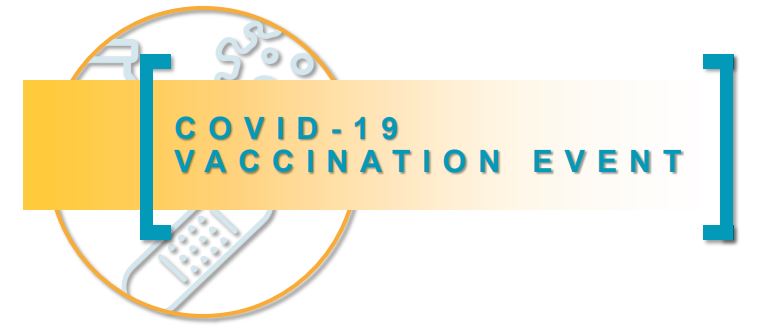
Free Vaccinations at the Farmer’s Market
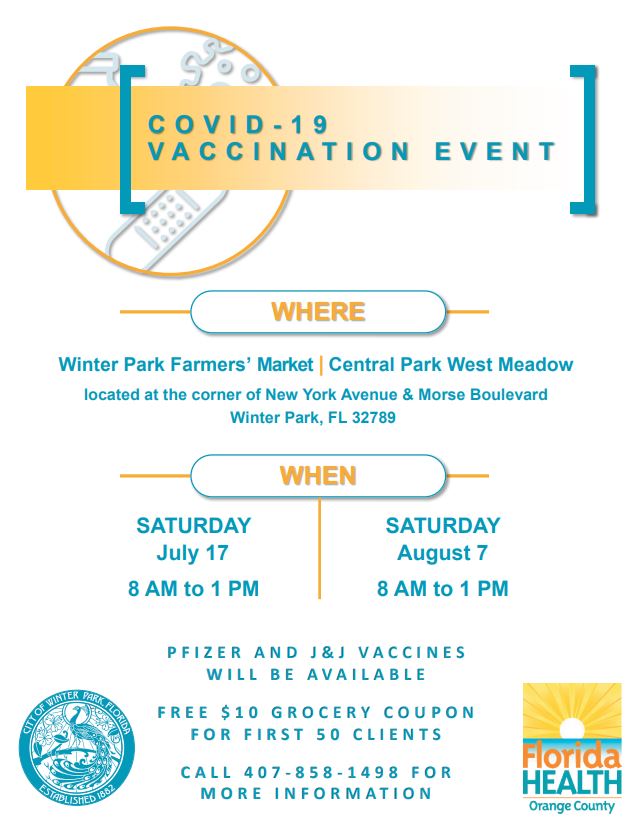
Saturday, July 17 & Saturday August 7
by Anne Mooney / July 15, 2021
The City of Winter Park is partnering with the Orange County Health Department to provide COVID-19 vaccinations at the Farmer’s Market this Saturday, July 17th. Vaccinations are available free of charge to Winter Park residents and guests 12 years of age and older.
Free grocery coupons for the first 50
The first 50 people to receive a vaccination will also receive a $10 grocery coupon.
Pfizer and Johnson & Johnson vaccines available
On Saturday, July 17, Health Department personnel will be offering first doses of the Pfizer vaccine. They will also have limited quantities of the single-dose Johnson & Johnson vaccine. If you get there early, you can choose which you want to receive. The City of Winter Park will have standby medical personnel on site.
Second Pfizer doses available August 7
On Saturday, August 7, medical personnel will administer for 2nd doses of the Pfizer vaccine and will, again, have limited amounts of the single-dose Johnson & Johnson vaccine.
“So far we’ve received a lot of positive feedback,” said Fire & Rescue Chief Dan Haggedorn. “It couldn’t get better or easier.”
Winter Park Mayor Phil Anderson said, “We are happy to partner with the Florida Department of Health in Orange County to bring vaccinations to our community. We want to make it as easy as possible for everyone to protect themselves during the challenges we’re experiencing with COVID-19.”
To comment or read comments from others, click here →
by Anne Mooney | Jun 29, 2021 | News
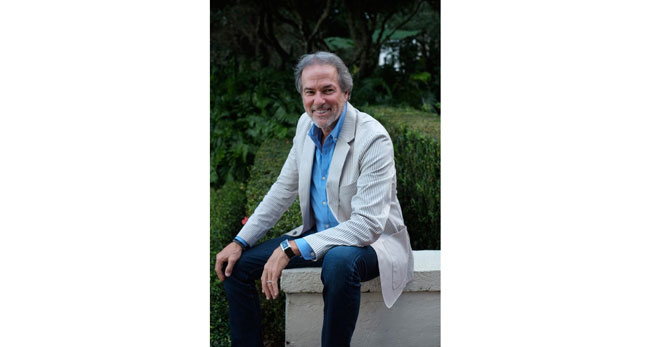
Randall Robertson Takes Over Winter Park Institute
Winter Park Institute to Find New Home at the Library-Events Center
by Anne Mooney / June 29, 2021
Effective July 1, Randall B. Robertson will become owner and executive director of the popular Winter Park Institute (WPI). WPI, the speaker series that has brought many celebrities to Winter Park, was created by Rollins College in 2007. WPI hosted speakers such as Maya Angelou, Ken Burns, David McCullough, Jane Pauley, Itzhak Perlman, Gloria Steinem and Winter Park’s very own 2-term U.S. Poet Laureate Billy Collins.
The Institute ceased operation last year when the COVID-19 pandemic put a halt to live events. In order to keep the program alive, Winter Park Publishing Company (WPPC), owner of Winter Park Magazine, took over the Institute’s operation during lockdown.
WPPC conducted two virtual events during 2020, with the goal in mind of finding community partners as the pandemic receded and live events could return. At the top of the list of possible partners was Randall Robertson, who for the past 12 years has operated Gladdening Light, a Winter Park-based non-profit that sponsored an annual symposium that drew speakers and attendees from all over the U.S.
“The more I talked to Mr. Robertson, the more it became obvious that to ensure the continuity of WPI in a way that honors its tradition and delivers what Winter Park residents expect, he should be the person to run it,” said Winter Park Magazine editor and publisher Randy Noles. “Happily for everyone, he was at once committed and enthusiastic.”
Robertson said he is a long-time fan of WPI because it provided a forum for citizens “to hear from thought leaders in the public square, challenging us to stretch our thinking.”
“We want to continue attracting visionaries and extraordinary people from the arts and humanities, the sciences and literature, to advance public themes in education, society, the economy and politics,” said Robertson.
Robertson, himself a WPI speaker in 2012, said the new Winter Park Public Library and Events Center will be WPI’s official home, and that most of its events will be in one of the venues at the complex. “The Institute represents a beautiful opportunity to showcase Winter Park to the world,” he said.
To comment or read comments from others, click here →

by Anne Mooney | Jun 27, 2021 | News
ARPA Funds Available to Non-Profits
Funding for non-profits that do not already receive City funding
by Anne Mooney / June 27, 2021
In May, the City announced it would receive about $13 million in COVID-19 recovery funds over the coming year. In addition to the dozen or so not-for-profit entities that already receive City subsidies, the Commission has allocated $200,000 for any 501(c)(3) in the City, subject to certain restrictions.
Application posted on City website July 1
Beginning July 1, any not-for-profit 501(c)(3) in good standing that is headquartered in Winter Park, whose annual operating expenses do not exceed $2 million, may apply for organizational funding support from the American Rescue Plan (ARPA). Applicants can begin the application process by going to cityofwinterpark.org/ARPA.
Successful applicants must have been in operation for at least the past three years. The organization must have a Board of Directors responsible for oversight, and it must provide a service. Applicants must demonstrate a detrimental impact caused by the COVID-19 pandemic.
Grants up to $25,000
This is a grant program, not a loan. The maximum amount available to each organization is $25,000 or one-half the annual operating expense, whichever is less.
The grant process is designed to assist not-for-profits in their recovery efforts and to ensure that allocations of public funds are used to offer services that can be provided to greater advantage by not-for-profit community organizations.
Non-profits already receiving City funding
ARPA funds also have been set aside for a dozen non-profits that receive annual Organization Support as a line item in the City’s budget, but those ARPA funds are separate from this $200,000 pot. The 501(c)(3)s that already receive City funding include the Winter Park Public Library, Historical Association, United Arts, Polasek, Winter Park Day Nursery, Blue Bamboo, Welbourne Day Nursery, Enzian Theatre, Winter Park Playhouse, Depugh Nursing Home and the Heritage Center (Crealde).
To comment or read comments from others, click here →
by Anne Mooney | Jun 20, 2021 | News, Taxes, Zoning and Development
Open Letter to Current Mayor & Commissioners
Do not blow this opportunity again. Now is the time for the Post Office!
Guest Columnist Sally Flynn / June 20, 2021
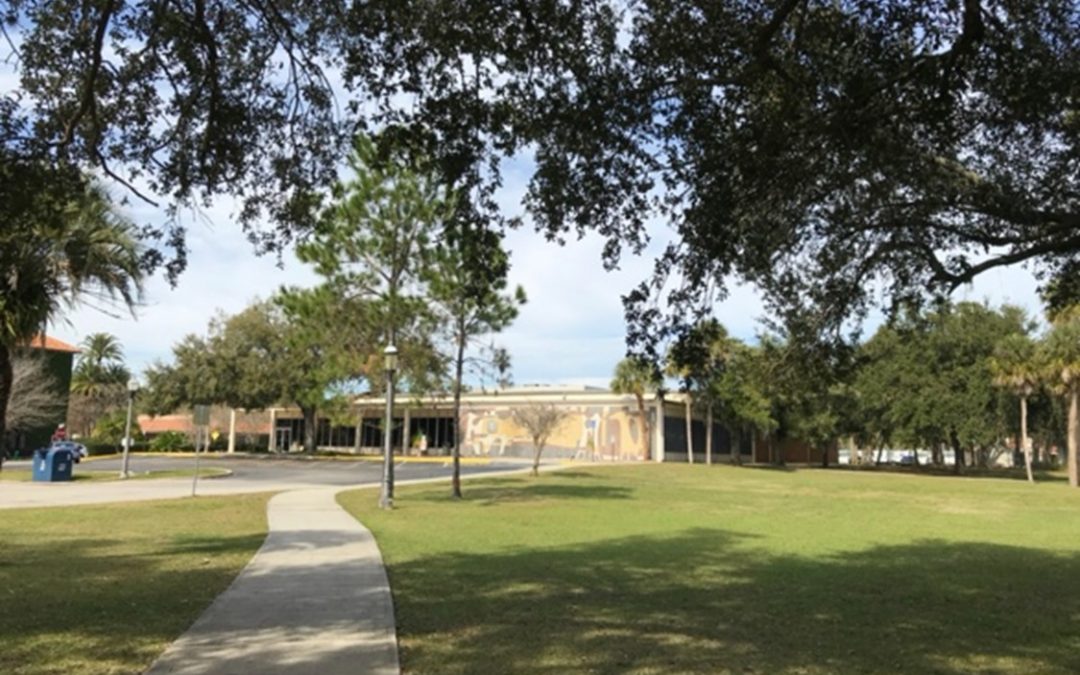
 On June 9, the Orlando Sentinel published a letter from six former Winter Park mayors cautioning the current Winter Park Commission against acquiring the Winter Park Post Office property for the purpose of expanding Central Park.
I do not care what these past mayors think about how we should spend our money, and I don’t believe most Winter Park citizens do, either.
In 1886, When Charles Hosmer Morse deeded the land that is now Central Park to the City, that deed came with a restriction protecting the park from commercial use or development. For 135 years, Winter Parkers have honored that restriction and have taken pride in enhancing and expanding the park.
Protecting the Park
Over the years, City leaders have created a web of local ordinances to protect the park. In 1999, a citizens’ initiative put in place a prohibition to keep the City from building on land in or adjacent to Central Park. In 2009, the height of properties affecting the open vista of Central Park was limited to two stories. In 2011, the downtown area that includes Park Avenue, Central Park and the Post Office was placed on the National Register of Historic Places. In the 2016 Visioning process, Winter Park residents stated unequivocally that one of their top priorities is the expansion of green space within our community.
City has long history of effort to acquire the Post Office
In 2014, then-Congressman John Mica arranged a meeting with the U.S. Postal Service (USPS) and the City, and a series of productive negotiations commenced. The USPS agreed to allow their facilities to be separated between a downtown retail facility and a separate distribution facility. This made the project more affordable and was agreeable to both the City and USPS.
USPS was willing to move
By January 2015, negotiations had progressed. USPS Vice-president of Facilities wrote in response to City Manager Randy Knight’s suggestion of a particular site, “Randy, after completing a few layouts, we believe that the site has high potential of working for us (subject to a 30% design). I think you should proceed with your discussion with the City Council.”
City stalls negotiations
Instead of following the USPS V.P.’s recommendations to continue discussions at the Commission level, however, staff prepared an agenda item recommending the Commission delay negotiations and, instead, prepare a notice of disposition to sell Progress Point and use the proceeds to purchase the Post Office. Mayor Steve Leary moved to cease negotiations with the Post Office; his motion passed on a 3-2 vote.
CRA funding becomes available
Fast-forward to October 28, 2019, when the City Commission voted 5-0 to execute a Resolution in support of acquiring the USPS property to expand Central Park, dedicating this land to park use in perpetuity. In January 2020, the Community Redevelopment Agency (CRA) voted to allocate funding for the Post Office acquisition in the CRA Capital Improvement Plan.
On January 27, 2020, the Commission voted to direct the City Manager to move forward to negotiate and execute a Letter of Intent to buy the Post Office Property. The City now has funds budgeted for FY 2021 and FY 2022 to bring this project to fruition.
Now is the time
Our CRA is scheduled to go out of existence in 2026. After that happens, putting together the necessary funds to acquire the Post Office property will be very difficult, if not impossible. Now is the time for our City to show it has the courage of its convictions: now is the time to act.
To comment or read comments from others, click here →
by Anne Mooney | May 11, 2021 | News, Zoning and Development
$13 Million in Stimulus Funds Earmarked for Winter Park
by Anne Mooney / May 11, 2021
Winter Park stands to receive almost $13 million in federal stimulus funds earmarked through the American Rescue Plan (ARP), providing us a rare opportunity to rebuild from the pandemic and to shape future programs.
Tomorrow’s Commission discussion is one you may want to tune into, as it could directly affect many people and organizations in Winter Park.
Commission will decide where to spend the money
At its Wednesday, May 12, meeting, the Commission will undertake to prioritize the allocation of ARP dollars, which they anticipate will arrive in two payments. The first payment of $7,426,723 should arrive this month, May 2021; the second payment in the same amount should come in May 2022. The ARP requires all funds to be expended by the end of 2024.
Some dollars are restricted
Although guidance from the Feds is oblique (surprise!), City staff estimates about $3 million may be spent on any purpose the City decides, as these funds are intended to replace losses incurred as a result of the pandemic. A suggestion in a federal document reads, in part: “(1)(A) “. . . assistance to households, small businesses, and non-profits, or aid to impacted industries such as tourism, travel, and hospitality.”
The remaining $10 million will be subject to restrictions imposed by the legislation. Clearly allowed are transfers of funds to non-profits, economic development studies, water and sewer enhancements and internet improvements.
Other infrastructure dollars under discussion at the federal level
Less clear is whether the City can use these funds for transportation improvements. City staff is monitoring discussions at the federal level of a separate $2 trillion infrastructure bill, as that money could fund transportation improvements that are not eligible under the ARP.
Thoughts from the April 28 workshop
On April 28, the Commission held a workshop to discuss setting priorities for ARP funds. Funding that can only be spent on eligible categories fell into four broad categories: 1) recurring non-profit partners, excluding Dr. Phillips Performing Arts Center, 2) households and small businesses, 3) tourism, travel and hospitality, and 4) broadband.
Interesting among the categories was the discussion around “recurring non-profit partners.” First was the exclusion of the Dr. Phillips Performing Arts Center, which will still get its promised $100,000, but no extra money from the ARP pot of dollars.
Local organizations will receive extra ARP dollars
Commissioners discussed using the ARP funds to add 50 percent to current City funding levels for each of the following non-profits. For further detail and exact dollar amounts, click here: Local Organizations
Winter Park Public Library
Historical Association
United Arts
Polasek
Mead Garden
Winter Park Day Nursery
Blue Bamboo
Welbourne Day Nursery
Enzian Theater
Winter Park Playhouse
Depugh Nursing Home
Heritage Center (Crealde)
WPPL – just another non-profit?
The Winter Park Public Library, currently the recipient of the largest tranche of City dollars, could garner an additional $828,000 through the ARP – if it is treated the same as the other non-profits that receive City support. The question of whether or not to make the library a separate line item or to include it with the rest of the non-profits has yet to be answered.
“Apples and peaches,” says Weaver
“I would prefer the Commission discuss library funding from the ARP as a line item separate from the other non-profits,” said Commissioner Todd Weaver. “I don’t think we can compare the effect the pandemic had on the library with the effect it had on the other non-profits, which are dependent on sales or attendance at events. They are apples and peaches.”
Sullivan is of like mind.
“I am in favor of continuing the funding, which is approximately two-thirds of their budget,” said Commissioner Marty Sullivan. “However, it seems apparent that financial impact of COVID on the library would be less than on the other non-profits, because they already rely primarily on the City for their funding, whereas the others do not.”
Commissioner Carolyn Cooper said she thought it might be a good idea to consult one of the City Advisory Boards as to the appropriate allocation of funds among these groups.
Tune in tomorrow to find out.
To comment or read comments from others, click here →
by Anne Mooney | Apr 27, 2021 | News
Join the ‘City Nature Challenge’ April 30 – May 3
Grab Your Phone, Take a Walk and Help Winter Park Plan Its Green Future
Guest Columnist Bob Morris / April 27, 2021
 Walking around our neighborhood the other day, on the outskirts of Mead Botanical Garden, I spotted a couple of bright red fruitlike things growing on a scraggly vine in a stormwater ditch. They looked sort of like plum tomatoes but were tinier than my thumb. So I took a photo and uploaded it into my trusty sidekick of late – the iNaturalist app.
I’m not typically an app-grabbing kinda guy. Why accumulate more attention-sucking novelties when life is too cluttered as it is?
But the iNaturalist app? It’s free, and it’s one of the coolest things going. Especially, if like me, you enjoy walking around Winter Park, traipsing through our parks and along our lakes, taking in all the gorgeous stuff that deserves to be taken in and, much of the time, having absolutely no idea what you’re looking at. With iNaturalist, all you do is take a photo, load it into the app-osphere and up pops, if not a definitive i.d., then at least a solid suggestion based on similar sightings and reviews by a community of bona-fide naturalists, botanists, zoologists and scientists of every sort.
Sign up! Join in! The City Nature Challenge is April 30 – May 3.
More important: the iNaturalist app is an essential tool if you’d like to join in the upcoming City Nature Challenge (April 30-May 3), an international survey of urban biodiversity that Winter Park will be taking part in this year for the first time.
Let me put that in stronger terms: Sign up! Join in! Because keeping track of what’s living around us now will help determine how we all live in the future.
Discover our smaller Winter Park residents.
“Truth is, most of us don’t know and appreciate the pieces of nature that are all around us because our urban parks and green spaces are too often overlooked,” says Bob Bendick, of the Winter Park Land Trust, which is helping to organize identification of as many plant and animal species as possible within Winter Park as part of the City Nature Challenge. “Greenspace in cities is important habitat for a diversity of plants and animals. Discovering that gives added meaning to our enjoyment of the outdoors and added direction to the conservation of our open space here in Winter Park and in other cities”.
What is the City Nature Challenge?
Launched in 2016 as a friendly competition between Los Angeles and San Francisco to see which city could tally the most sightings of plants and animals, the City Nature Challenge has grown into a worldwide event with tens of thousands of participants – most of them rank amateurs, like myself. Despite restrictions from Covid-19, the 41,000 participants in the 2020 City Nature Challenge still managed more than 815,000 observations and identified some 32,000 different plants and animals, plus 1,300 rare or endangered species. And this year, Winter Park and the rest of Orange County will join more than 300 participating cities around the world, from Adelaide, Australia to Zagreb, Croatia with places like Kisumu, Kenya and Tulsa, Oklahoma in between.
“Information collected during the City Nature Challenge will provide baseline data that will help form conservation and development guidelines for years to come,” says Christianah Oyenuga, of the Nature Conservancy in Florida, who is helping direct overall efforts in Orange County as part of the City Nature Challenge. “We count on community members of every age and background – our citizen scientists – to get out there and let us know what they see.”
Volunteers are still needed.
In Winter Park, volunteers in the City Nature Challenge will be roaming around a half dozen parks and green spaces taking photos of what they see over the course of the four-day event-– Mead Botanical Gardens, Martin Luther King Park, Howell Branch Preserve, Kraft Azalea Gardens, and Lakes Virginia and Mizell. A team from Rollins College will be searching the Genius Preserve which is not open to the public. The City of Winter Park’s Parks Department is encouraging this survey and helping to support the City Nature Challenge event. To sign up, go to https://www.inaturalist.org/projects/city-nature-challenge-2021-orlando-metro
“Winter Park residents are particularly sensitive to maintaining and improving the quality of life that we enjoy here. The City Nature Challenge is a great way for people who love Winter Park to take part in something that will add to the long-range vision, inform our elected officials and help guide our city,” says Steve Goldman, chair of the Winter Park Land Trust board of trustees.
Using the iNaturalist app
Using the iNaturalist app, I’ve discovered that among the many non-descript “weeds” that might otherwise go unnoticed on my walks is Calyptocarpus vialis, which has recently begun sporting the dainty yellow flowers that contribute to its common name – Straggler Daisy. And that strange pink earthworm I plucked from the caladium bed last week? Turns out it was actually a Florida Worm Lizard (Rhineura floridana.) They are the last living members of a family of legless, burrowing lizards that eat spiders and termites and are found only in Florida. Let’s just say, I didn’t put it on a hook and go fishing with it.
As for the bright red fruitlike things I spotted in the stormwater ditch? The jury is still out on that. “We are not confident enough to make a recommendation, but here are our top suggestions,” the iNaturalist app told me before going on to list a few possibilities – a Butcher’s Broom perhaps, or maybe a Christmas Berry. For now, though, I’m content to let it remain a mystery. It makes those walks around the neighborhood all the more interesting.
Volunteer now!
For more information about the City Nature Challenge and to sign up, please visit https://www.inaturalist.org/projects/city-nature-challenge-2021-orlando-metro
or contact Bob Bendick at the Winter Park Land Trust at rbendick1@gmail.com.
To comment or read comments from others, click here →
Recent Comments