The Charter Review Advisory Committee (CRC) wrapped up their report Friday, Sept. 20, at Noon. The report will go to the Commission on Monday, Sept. 23, at a 6:00 pm workshop following the regular Commission meeting.
Every 10 years, a committee of Winter Park citizens is assembled to review the City Charter and make updates to bring it into compliance with state and federal law and to eliminate archaic language. The last review was in 2009.
Charter Review Committee
The committee members were Steve Brandon, Marjorie Bridges, Lisa Coney, Mary Daniels, Amanda Day, James Johnston, Bud Kirk, Jr., Nick Pope and Lawrence Lyman. They had 10 two-hour meetings between April 23 and September 20, 2019, in which they reviewed the Charter, line-by-line, and recommended changes. Recommendations required a consensus threshold of 75 percent of the committee. Issues decided could be readdressed with the consent of 75 percent of the committee.
Led by Marilyn Crotty
Not only was there robust discussion among committee members, there was substantial time devoted to public comment both before and following the formal meetings. Facilitator Marilyn Crotty, who led the effort and who has had a long career as a facilitator for cities throughout Florida, stated that she observed more participation from Winter Park citizens than she had for any other city with which she had worked. She commended Winter Parkers for their extraordinary level of civic engagement.
Implementation Procedures
The Commission will have the weekend to review the CRC’s report. Following the regular Commission meeting Monday, the Commissioners and the committee members will have an informal workshop to discuss the committee’s recommendations. Although the Commission could decide otherwise, it is customary that during an informal workshop, such as the one Monday night, no decisions will be made and no public comment will be taken.
It will be an important meeting for concerned citizens to attend, however, to see which issues are discussed and to hear the tenor of the conversation.
First, the Commission
The Commission can decide to accept all, some or none of the CRC’s recommendations. Recommendations the Commission does accept will be placed on the ballot at the Presidential Preference Primary March 17, 2020. The procedure for that is as for anything placed on the ballot. The Commission will pass an ordinance that will include the ballot language through a process of two public hearings and an affirmative vote of a majority of Commissioners. Public notice and public comment will play leading roles in that process.
Then to the Ballot for a Decision by the Voters
At the September 20 committee meeting, Ms. Crotty estimated there could be as many as 19 separate recommendations to go on the ballot in March – a substantial amount of information for anyone to take in, especially in a Presidential Primary year when there are sure to be distractions.
Elaborate Voter Info Program Recommended
The CRC is recommending the City fund a community education program consisting, at a minimum, “. . . of access to copies of the proposed Charter changes, printed informational brochures, public forums, information on social media and the City website, and a speakers’ bureau to inform voters of the proposed changes.”
Hot Topics
During the committee meetings, the items that came up for discussion most frequently – and tended to be the most controversial – were the following four.
Should Commissioners be elected from a geographic district rather than representing the citizens at large? Some believed districts might provide fairer representation for under-served communities, such as the West Side neighborhood. Others believed Winter Park is not large enough to warrant being divided up geographically. No consensus was reached on this issue, so it will not go forward as a recommendation from the committee, but Commissioners are still likely to hear about it.
Should the Mayor have the sole authority to make appointments to Citizen Advisory Boards? Again, no consensus – five voted for, three against, one was absent – but the vote did not reach the required 75 percent consensus threshold. While a recommendation from the committee will not be forthcoming, this discussion too is probably far from over.
How to ensure our local elections remain non-partisan? The difficulty here was crafting rules that are a) unambiguous and b) do not conflict with state and federal statutes and certain U.S. Supreme Court rulings. The committee recommends language prohibiting candidates from publicly advertising affiliation with any political party or accepting campaign contributions from any political party. It also provides for penalties for infractions.
Increased compensation for Mayor and Commissioners. The committee is bringing its recommendation for base annual salaries for Commissioners of $12,600 and for the Mayor, $15,000. According to a table distributed by Marilyn Crotty, each Commissioner now receives $2,400 per year, and the Mayor receives $3,000.
Holding office entails a significant commitment of time and resources, and that can be a barrier for someone who has family obligations and is not self-employed, retired or independently wealthy. While no current Mayor or Commissioner would receive an increase, the increase would bring Winter Park compensation more in line with other cities in Central Florida. More important, the hope is that this increase would encourage a wider pool of potential future candidates to run for elected office.
Civil Service Board Survives
The committee was able to work through one topic — the possible elimination of the Civil Service Advisory Board – to avoid controversy. Suggested Charter language had the potential to eliminate the Civil Service Board, which forms a layer of protection between Police and Fire first responders and the more politically oriented City government. Instead of a Civil Service Advisory Board, the Charter would have mandated a Civil Service Code, (as yet, unwritten) which the Commission would adopt by Ordinance and which would govern first responders.
A Civil Service Code exists, but has not been updated for many years and is largely irrelevant. When asked about this, Police Chief Michael Deal told the Voice, “The Code is outdated and should be modernized, but the Board should remain intact. This keeps politics out of [first responder] work.”
Chief Deal went on to explain that nearly everything first responders do is governed by state law and state accreditation standards. “I am very happy in my job,” said Deal, “and the City Manager and the Commission are very supportive – they all let me do my job.”
“The issue is how the City functions,” he said, “not about the specific personalities involved. Right now, everything’s fine, but there could come a time when politics could enter in – which it doesn’t now – and that would not be appropriate.”
Chief Deal and City Manager Randy Knight have agreed to work together to update the Civil Service Code to meet today’s conditions. In the meantime — except in the highly unlikely event the Commission decides to abolish it — the Civil Service Advisory Board will remain.
Given the weather forecast, most Winter Parkers are engaged in activities other than meetings. All City meetings through September 8 have been cancelled. First up is the Commission meeting September 9. Check this link for the most current information. https://cityofwinterpark.org/government/boards/
The Chapman Room and the Commission Chambers are on the second floor of City Hall.
Coffee Talks
In addition to commissions, boards and task forces, we also have informal gatherings with City Officials, where you can let them know what you’re thinking and find out what they’re thinking.
The Mayor’s Coffee Talk was in July. Vice Mayor Greg Seidel’s was August 8. The remaining Coffee Talks will be held 8:00 to 9:00 am at the Winter Park Golf and Country Club, 761 Old England Ave.
Winter Parkers have been busy this summer, giving generously of their time to serve on one or another of three task forces. All three groups are set to complete their tasks this fall.
The Orange Avenue Steering Committee is studying redevelopment opportunities along the Orange Avenue gateway to our city. The Charter Review Task Force is reviewing the City Charter, line-by-line, as it must every 10 years. A dedicated and creative group — the Old Library Reuse Task Force — has been tasked with figuring out what to do with the current library facility once the new library at the Canopy has opened.
What follows is a snapshot of where each of these groups is in their process. It’s said the devil is in the details, and these 25 volunteers are way into the weeds as summer winds down and hurricane season gears up. Every person in Winter Park owes these volunteers a debt of gratitude for their hard work this summer.
Orange Avenue Overlay Steering Committee
The Orange Avenue Steering Committee is charged with creating an actionable document and providing input and recommendations to the City Commission for an Orange Avenue Zoning Overlay District.
Steering Committee Members are Jill Hamilton Buss, Sheila DeCiccio, Michael Dick, Ben Ellis, Sally Flynn, Lamont Garber, Phil Kean, Lambrine Macejewski, Bill Segal, Bill Sullivan, Laura Turner.
Previous Studies, but No Action — City discussions surrounding the redevelopment of Orange Avenue began in the early 2000s. The Commission requested Planning Staff to explore the creation of new codes that would facilitate redevelopment opportunities, but over the years, none of the studies yielded any actionable documents or created any City Code. These studies included Plan the Possibilities, Vision Winter Park and portions of the updated 2017 Comprehensive Plan.
Committee Has Heard a Variety of Views — Since May 29, the Steering Committee has met every two weeks. Meetings have featured panels of speakers representing area residents, small property owners, Rollins College, larger property owners who have developed property, such as Commerce National Bank & Trust and Jewett Orthopedics, and large property owners whose property is as yet undeveloped. Developers-in-waiting include Holler Properties, Demetree Global and the City of Winter Park, which probably will sell the property at Progress Point to a private developer.
Orange Avenue Issues — Panelists and Committee members alike have agreed that the issues along the Orange Avenue Corridor are insufficient parking, inadequate drainage and storm water management, traffic and pedestrian safety – and insufficient parking.
Did We Mention Insufficient Parking? The lack of sufficient parking along the corridor, combined with dangerous road conditions and archaic zoning codes, has caused obsolescence. Existing small businesses, including many along Designers’ Row, are at or over their allowed floor area ratio (FAR) – which is to say, the size of the building exceeds what is allowable for the size of the lot under current codes.
Upgrades or renovations undertaken by an owner would require bringing the building up to current code, and that’s frequently not possible because there just isn’t room. The most frequently mentioned barrier is insufficient space to create the required parking.
The Steering Committee will meet at least two more times, on September 4th and 18th from 5:30 to 7:30 pm in the Commission Chamber at City Hall. Planning Director Bronce Stephenson stated in an email that his department planned to ask for more time for the Task Force to complete their recommendations. “We only get once chance at this,” wrote Stephenson, “and we don’t want to rush the process.”
The public is welcome and urged to attend the Task Force meetings.
Charter Review Task Force
Every 10 years, the City Charter – Winter Park’s primary governing document – is reviewed and updated to reflect changes in state and national legislation and to incorporate revisions relevant to the City as it is now.
Task Force Members are Steve Brandon, Marjorie Bridges, Lisa Coney, Mary Daniels, Amanda Day, James Johnston, Bud Kirk, Lawrence Lyman and Nick Pope. The Task Force is facilitated by Marilyn Crotty.
The Voters Decide — After exhaustive study and discussion, the nine-member Task Force will submit their recommendations to the City Commission. The Commission then will deliberate to accept or reject Task Force recommendations and to incorporate their own changes. Final Charter revisions will be placed on the March 17 ballot for a decision by the voters.
Charter Review Issues — Questions discussed at the Charter Review Task Force meetings have included, but are not limited to, the following:
If Winter Park is to have non-partisan elections, exactly how does the City propose to define the term “non-partisan.” What may candidates do and not do during their campaigns, and how would rules be enforced?
The mayor and commissioners are currently elected ‘at large.’ In order to ensure even distribution of representation, should the City be divided into districts, with each commissioner representing one of those districts, while the mayor is still elected ‘at large’?
Should the authority for appointments to Citizen Advisory Boards continue to rest with the Mayor, or should that provision be stricken from the Charter and Advisory Board members be appointed by the Commission as a whole?
Should Police and Fire Departments continue to report to the Civil Service Board, or should they report directly to the City Manager?
Should compensation for the mayor and commissioners be increased?
No Final Determination — The Task Force has not yet finalized their recommendations. With the generous time allotted for public comment, citizens are encouraged to attend meetings and express their views.
The Task Force meets at the Community Center on New England Avenue from 6:00 to 8:00 pm. Public comment is taken both at the beginning and the end of the meeting. There will be one or two September meetings, depending on need. Check the City website for meeting dates. Because the proposed Charter revisions must go on the March 17 ballot, the Task Force will submit their recommendations to the Commission in October.
Old Library Site Reuse Task Force
Five people are charged with the task of recommending the future use of the current library facility once the new library at the Canopy site has opened.
Task Force Members are John Caron, Miguel DeArcos, David Lamm, Jack Miles and Marjorie Thomas.
Possible Uses — Although a recent appraisal cited the “highest and best use” of the property would be to sell it to a developer for luxury condos, the majority of the Task Force discussion has focused on ways to keep the facility as a City amenity and avoiding selling it.
Among the uses that have been discussed are branch library, public art space, senior activity center, incubator space, temporary space for City staff while City Hall is renovated and various combinations of all the above.
Rollins CFO Ed Kania stated at one meeting that Rollins has no interest in purchasing the site.
Issues with the Old Library include two years of deferred maintenance and the current state of the building, the cost of renovation, the fact that it is in a residential neighborhood and therefore not appropriate for commercial or restaurant use, inadequate parking and Fairbanks traffic.
The Task Force meets at noon in the Chapman Room at City Hall. Check the City website for September dates.
Even in August, things aren’t slowing down much. We’re at 21 public meetings (down from 23 in July). Nothing is written in stone, so use this link to keep up with the latest schedule changes. https://cityofwinterpark.org/government/boards/
Social Notes from the Last Commission Meeting
Something’s Rotten at City Hall. The dais where the Commissioners sit has termites. Like the Trojan Horse, the beautiful custom woodwork facing the audience harbors an invading army. Before the army gets out and attacks the entire building, the dais will have to be dismantled and removed and the invaders eradicated. Here’s hoping the City of Winter Park is more successful than the Trojans were. Search is underway for an artisan to design a replacement.
Body cameras for Winter Park’s Finest are in the FY2020 budget. And the Commission voted not to demolish the building at Progress Point. A majority agreed they would wait and see what happens with redevelopment plans for the Orange Avenue corridor. The City did, however, mow the grass at Progress Point. Neighbors are grateful.
Schedules for Commission, Advisory Boards and 3 Task Forces
Commission meetings are held the second and fourth Monday of each month, beginning at 3:30 pm, in the Commission Chambers on the second floor of City Hall. They go until they’re finished – typically until 5:30 to 6:30 pm unless there is a controversial item on the agenda.
Nineteen citizen boards advise the Commission on topics ranging from Police Officers’ Pensions to Lakes and Waterways and Code Compliance. A full list of these boards and board members can be found at the City website (above link). The August schedule is on the chart below.
In addition to the standing advisory boards, there are currently three task forces, which are formed for a single stated purpose with definite beginning and ending dates. The three task forces are described below. You are urged to attend their meetings.
Charter Review Advisory Committee
This task force is formed every 10 years for the purpose of updating the Winter Park City Charter. The Charter is our City’s ‘Constitution,’ its primary governing document. Some major issues are under discussion, making these meetings interesting and relevant. Meetings are held once a month at the Community Center from 6:00 to 8:00 pm. The first hour is devoted to public comment, so best be on time. The next meeting is Tuesday, August 27.
Orange Avenue Steering Committee
The purpose of this task force is to decide the parameters of a zoning ‘overlay,’ which will establish guidelines for the redevelopment of that stretch of Orange Avenue reaching from 17-92 to just north of the corner of Denning and Fairbanks. Meetings are held twice a month from 5:30 to 7:30 pm in the Commission chambers. The next meeting is Wednesday, August 7.
Old Library Reuse Task Force
This group is charged with recommending to the Commission the proper disposition of the current library facility. The task force meets twice a month in the Commission chambers at Noon. The next meeting is Wednesday, August 14.
Coffee Talks
Not only do we have official commissions, boards and task forces, we also have informal gatherings with the Mayor and Commissioners where you can let them know what you’re thinking and find out what they’re thinking.
The Mayor’s Coffee Talk was in July. Coffee Talks with the Commissioners will be held 8:00 to 9:00 am at the Winter Park Golf and Country Club, 761 Old England Ave.
Commissioner Greg Seidel – August 8.
Commissioner Sarah Sprinkel – September 9.
Commissioner Carolyn Cooper – October 10.
Commissioner Todd Weaver – November 14.
Here’s the August Lineup.
The Chapman Room and the Commission Chambers are on the second floor of City Hall.
Note: this schedule is subject to change. Check the City website link at the top of the article for the latest information.
Mayflower Nixes City’s Request for Bike Path Easement
When the Mayflower retirement community came before the July 22 Commission seeking final approval for plans to expand their facilities and services, most of the discussion centered not on the expansion, despite substantial changes to the version that received preliminary approval in 2018, but on the City’s request for an easement along the western border of the property where it could maybe, someday, build a 15-foot wide path for bikes and pedestrians. The City wanted to create a route that removed bikes and pedestrians from the dangerous motor traffic on Lakemont Avenue.
In January 2018, the Mayflower received preliminary approval to add a new three-story health care center and a one-story memory care center, a one-story club house and four separate three-story residential buildings. Conditions of approval were that the Mayflower would “explore” a bike path, install buffer landscaping for adjacent properties and come up with a storm water plan approved by the St. Johns River Water Management District.
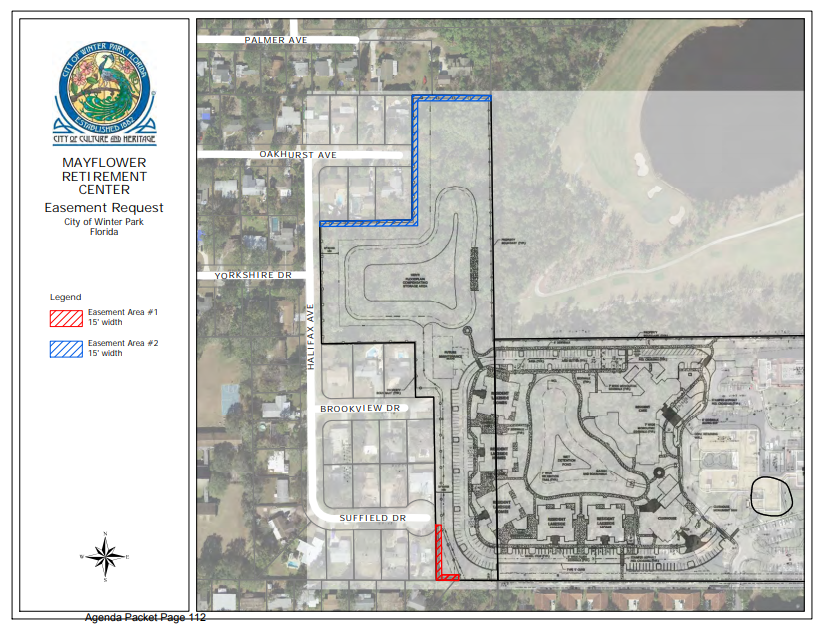
A year and a half later, in addition to the new club house and additional residences, the Mayflower wanted to combine the health care facility with the memory care center in a single four-story structure to make room for a fifth 24,000-square-foot residential building. The plan presented to the Commission displayed easements along the western border of the Mayflower property for the bike path. The easements are indicated in red and blue on the map above.
Sprinkel Has Heartburn
Commissioner Sarah Sprinkel pointed out that when the original request came before the Commission in 2018, the Mayflower was asked to “explore” a bike path that would serve as a northeast connector trail, but the path was not a condition of approval. “We have not, as a Commission, even approved this bike path,” said Sprinkel.
Turns out the bike path easement was a staff recommendation, which City Code, Sec. 58-90, “Conditional Use,” allows the City to impose. Code says that if an applicant brings for final approval a project in which the height has changed by more than one foot and the floor area has changed by more than 250 feet, the City can re-open all negotiations. Planning Manager Jeff Briggs cited the intent of the 2010 Comprehensive Plan to get cyclists and pedestrians from Lakemont up to Palmer, and said staff believed there was an opportunity for that along the western border of the Mayflower property, as had been discussed in 2018.
Seidel Suggests a Sunset Date
Commissioner Greg Seidel stated while an easement is no guarantee the City will build the bike path, the Mayflower’s failure to grant the easement would guarantee it won’t be built. Seidel suggested establishing a 10-year “sunset date” on the easement – if no bike path is built there within 10 years, the easement will cease and the property will revert to the Mayflower.
Connectivity Plan “Accepted” but Never “Adopted”
The connectivity plan for bikes and pedestrians goes back to the Bikes & Peds Board before it was renamed the Transportation Advisory Board. The Bikes & Peds Board submitted a plan for connecting bike and pedestrian paths through the City, which Mayor Steve Leary said was “accepted” by the Commission, but not “approved.”
Mayflower Project Has ‘Substantial Change’
Addressing Commissioner Spinkel’s ‘heartburn,’ Commissioner Carolyn Cooper pointed out that since the Mayflower came back for final approval with a project that was substantially different from the one that received preliminary approval, “. . .we can start all of these conversations all over again. . . . Alternatively,” said Cooper, “the Commission also has the right to ask the developer to revert to the original plan, since the substantial changes have not received preliminary approval by the Commission.”
“Winter Park is a Big Dead Zone”
Commissioner Todd Weaver addressed the concerns of the Mayflower residents for their own pedestrian safety on the property. He pointed out that between the fence and a 50-foot landscape buffer separating the proposed bike path from the Mayflower property, the residents would not even see the path, let alone encounter bicycles. Weaver recounted a recent Metroplan meeting at which a map of the inter-connected greenways in Orange, Osceola and Seminole Counties showed a big ‘dead zone’ at the center — Winter Park. “It is City staff’s mandate to complete our Comprehensive Plan, and part of that is our mobility,” said Weaver. “This connectivity plan has been 10 years in the making, and we are 10 years behind every other city in our area.”
We Are Asking for the Opportunity
Weaver went on to explain that the City had neither planned nor funded the actual path, that it was simply requesting an easement for the opportunity to do so at some future date. He stated that there would be no design and that no plans would be made without including Mayflower residents, surrounding neighbors, City staff and the Commission.
Everyone Wants Trails – Just Not In Their Back Yards
Public commenters criticized City government for its failure to come up with a well-defined plan for greenway connectivity. Citizens hastened to assure Commissioners that they were not against bike and pedestrian paths, as long as they are far enough away from their property.
Attorney Tripp Cheek, who is a member of the law firm representing the Mayflower, Winderweedle, Haines, Ward & Woodman, PA, but who spoke as a private citizen, cited a case in which the St. Johns River Water Management District required a developer to improve a wetlands property he did not own in return for granting him a permit to develop his own property. The developer successfully sued the District, claiming the wetlands improvement had nothing to do with his own development and should not be used as a condition for approval. Cheek cautioned the Commissioners against asking for the bike path easement, warning they were “asking for a problem” in the future.
Cheek’s remarks drew a sharp response from Seidel. “I don’t appreciate it when people threaten me with a lawsuit over something I’m trying to decide,” said Seidel. “That is not going to sway me one way or the other.” Seidel said he would defer to the City Attorney.
Ardaman’s Response
Ardaman cited City Code, which says the Commission has three options. One, the Commission can decide the Mayflower’s changes are not significant. Two, they can find the changes are significant but acceptable. Or, three, they can decide the changes are significant and unacceptable, in which case the applicant must amend the plan to conform with the original conditional use and resubmit it to the Commission.
The Problem is Lakemont
A significant hurdle to the decision is the City’s failure to adopt a connectivity plan. One by one, each Commissioner admitted that where the ball had been dropped was right in their laps. “We didn’t do it because we couldn’t,” said Sprinkel, “we didn’t have agreement up here. Now we need to do something about this.”
“I know that our Advisory Boards have worked hard on this issue,” said Cooper. “They’ve done planning, but their plans have been ‘accepted,’ not ‘adopted.’ I’m glad [City Planning Director Bronce Stephenson] has a different impression about this plan.”
Weaver asked if people in the audience would favor using the “complete streets” treatment on Lakemont that has been employed on Denning. A cheer and a show of raised arms arose from the back of the chamber. Weaver then asked how many of those people would agree to have their taxes raised in order to pay for an improved streetscape on Lakemont. Again, a strong show of support.
Leary Stands by the Mayflower
Before calling for a vote, Mayor Steve Leary stated that in the nine to ten years he has been going to the Mayflower, he has made a commitment. “If the Mayflower doesn’t support this, I’m not supporting it,” said Leary.
The Trick Box
When the vote was called, Seidel offered an amendment requiring 15- to 20-foot wide easements at the western border of the property, with a ten-year sunset, for the purpose of building the path for non-motorized transportation, and the City would bear the cost of any improvements required to construct the path. The amendment passed 3 – 2, with Leary and Sprinkel dissenting.
Before calling the vote on the final approval, with Seidel’s amendment, Leary offered the Mayflower the opportunity to pull or table the application prior to the final vote.
At least half a dozen lawyers headed for a huddle at the rear of the chamber, with attorney Cheek at the center of the pack.
The Mayflower attorney returned to the podium to report that the Mayflower would agree to a part of the easement at the southwest corner of the property, provided the Commission would approve their plan with the four-story building as presented. The Mayflower offered the easement marked in red at the lower left corner of the map at the top of the article.
In a confusing turn of events, Seidel withdrew his original amendment for the expanded easement, which had already passed, and offered a new amendment that granted the Mayflower’s request, which passed on a 4-1 vote. The main motion, to approve the Mayflower’s plans as presented and with only the smaller easement, then passed on a 5-0 vote.
The planned Canopy project may be the largest public works project ever undertaken by the City of Winter Park. Approved in 2016, the Library, Events Center and Parking Garage referendum garnered a slim majority of 214 votes, out of over 10,618 votes cast.
Campaign Literature in 2015-16 Promised Cost Levels
New Library:
$17,435,700
New Events Center:
$ 3,004,943
Parking Deck:
$ 3,004,943
Shared Costs:
$ 8,405,496
(demolition, design/engineering, landscaping, site work)
Library Board to Raise: $ 2,500,000
TOTAL PROJECT COST $ 29,914,311 with a promised 15 percent contingency
Three years later, why does the public continue to be skeptical about the chances for success?
Why is public trust in this project, funded by taxpayer dollars, continuing to falter? The answers to these questions are not difficult. Look at the project track record over the past four years. Promises were made, then discarded. Trust evaporated. The trend line below speaks for itself.
Original Pledges
$29.9 million project with a 15 percent contingency
50,000 square foot library
LEED-certified building including solar energy capacity
Multi-deck parking garage to ensure easy access, safety and security for patrons
Footprint that takes no more than 1 percent of MLK Jr Park acreage
A site suitable to build upon with no extraordinary contamination or soil stability issues
Storm water plan that could be addressed without taking more parkland
A transparent process open to public comment, with all commissioners kept in the loop
Project focus is a world class library and a community events center
Robust community fundraising support assured
CRA funds unlikely to be needed and should be reserved for other city priorities, like the purchase of the Post Office property.
The Path Forward
Price tag increased to $40+ million and is tilting toward $50 million Note: Taxpayer dollars restricted to the original $30 million bond limit
Greatly reduced contingency fund resulting from a challenging construction environment
Library size reduced to 34,400 square feet with no LEED certification
No parking garage, requiring consumption of more park space for parking lots
No traffic study of Morse & Harper to address congestion and safety issues Note: Plan proposed to model the entire Orange Avenue MLK Park region
Continued flooding of Morse and Harper with no approved storm water plan Note: Lake Mendsen is currently at capacity, per St Johns River WMD
Complex site issues with debris buried to 30-35 feet and muck. Note: Building site has been shifted west to avoid muck pockets.
Trees removed without public notice or involvement. Note: There is a moratorium on future tree removal.
Consumption of MLK Park acreage now in excess of 15 percent of park space, and
Lake Mendsen could be further expanded by taking 1-2 more park acres. Note: There is some effort to dial back the size of the project footprint.
Lack of Transparency — the last comprehensive public forum on the project was the April 9, 2018 City Commission Meeting approving Schematic Designs.
Tourism as priority pitched to Orange County Tourist Development Council (TDC) — our own “I-Drive.”
One commissioner was not informed of TDC meeting and the request for $6 million.
Fundraising from the community still not accounted for, though the deadline was April 2019.
CRA funds will likely be tapped to bail out this project.
Martin Luther King, Jr: still has not been honored as the namesake of this park.
What if This Were Your Own Health?
Citizens have not been presented with a satisfactory explanation for this list of discrepancies. This is the chance for the commission to step forward and demonstrate leadership.
If this project were a medical patient, we could say we have seen the X-Rays and indicators of a potential complication are all there.
If we wait seven more months, until January, when construction pricing comes due, we then face a crisis decision of whether to administer chemo or radiation or both. Why not take preventive measures now? Get a second opinion? If your health was at stake, what would you do?
Maybe change medical providers?
Can We Afford This Project?
For many, the fiduciary handwriting is on the wall: we cannot afford this project.
No wonder the citizenry is concerned.
Cost estimates and overruns will not diminish. Instead, they will likely increase. Change orders will become a major concern. Our Central Florida construction market is robust but stressed, increasing pressure on construction costs. That context has already been established with the I-4 Ultimate, Orlando Airport’s New South Terminal and the building boom.
Commissioners Need the Chance to Talk to One Another
At the June 10 Commission meeting, Commissioner Carolyn Cooper requested a workshop so the Commission as a whole could discuss various budget issues, including the Canopy and the CRA, without having to go through the City Manager. She was dismissed by Mayor Steve Leary, but her suggestion deserves reconsideration.
Recommendation: Give Us the Benefit of Your Shared Vision
Hold a Workshop.
Put the questions on the table and explore some answers together.
Educate a very concerned public.
How Much Can the Camel Carry?
In the case of the Canopy, it is reasonable to say that a $1,000 per square foot public works project is unacceptable. So, what is acceptable? $700 per square foot? $500 per square foot? $350 per square foot? That guide star needs to be established — or at least discussed – and the public needs to hear the discussion.
If we cannot attain that acceptable price per square foot, alternative scenarios need to be explored. When a project moves beyond 60 percent design, the time and money already invested make it increasingly difficult to say “no” or even to change tack.
Think Big: Where is Plan B?
The goal is to maximize all our assets to make this project the best it can be. For this reason, the process deserves heightened public involvement, heightened communication and heightened stewardship by our elected leaders.
Are our taxpayer dollars being wisely spent? If so, show us how.
We Depend on your support, make a tax-deductible donation here.
Mission
The Winter Park Voice is a trusted nonprofit journalism site that covers our City Hall and beyond. We endeavor to engage, inform and connect citizens on all sides of issues affecting the quality of life in Winter Park.



Recent Comments