Editor's Note: Articles written by citizens reflect their own opinions and not the views of the Winter Park Voice.
Dear Mayor and Commissioners:
Please allow this vision of the Blake Yard at the east end of Comstock Avenue by the railroad tracks to be heard and understood, with all the practical and symbolic benefits that can be realized by our City.
Blake Yard
This property, an awkward piece of land by all accounts, has served as a “lay down” yard for power poles and the like. The City Commission will determine its destiny, as it should, duly elected and graciously contributing to the preservation and improvement of Winter Park. Skolfield Homes, L.L.C., proposes to purchase the property and develop it.
The Math
Our concept discards some long-standing norms and assumptions that have informed developers and builders. Development in Winter Park is, essentially, math – which maxes out at 50 percent impervious, 38 percent FAR, with prescribed height limits and setbacks, etc.
We propose to build a highly visible model, supported by a forward-thinking City that embraces the inevitable future of housing. I ask you to support a sustainable future and a housing style that lifts the hearts of young and old.
The Vision
I see four houses with three detached carports, as illustrated in this basic sketch. Each house has a footprint of about 600 square feet, plus open porches. With full basements half below grade and porches a few feet above grade, the two stories combined average 1,200 square feet plus 600 square feet of basement. The houses will be 24 percent floor-area-ratio (FAR) and 30 percent impervious.
A Completed Example
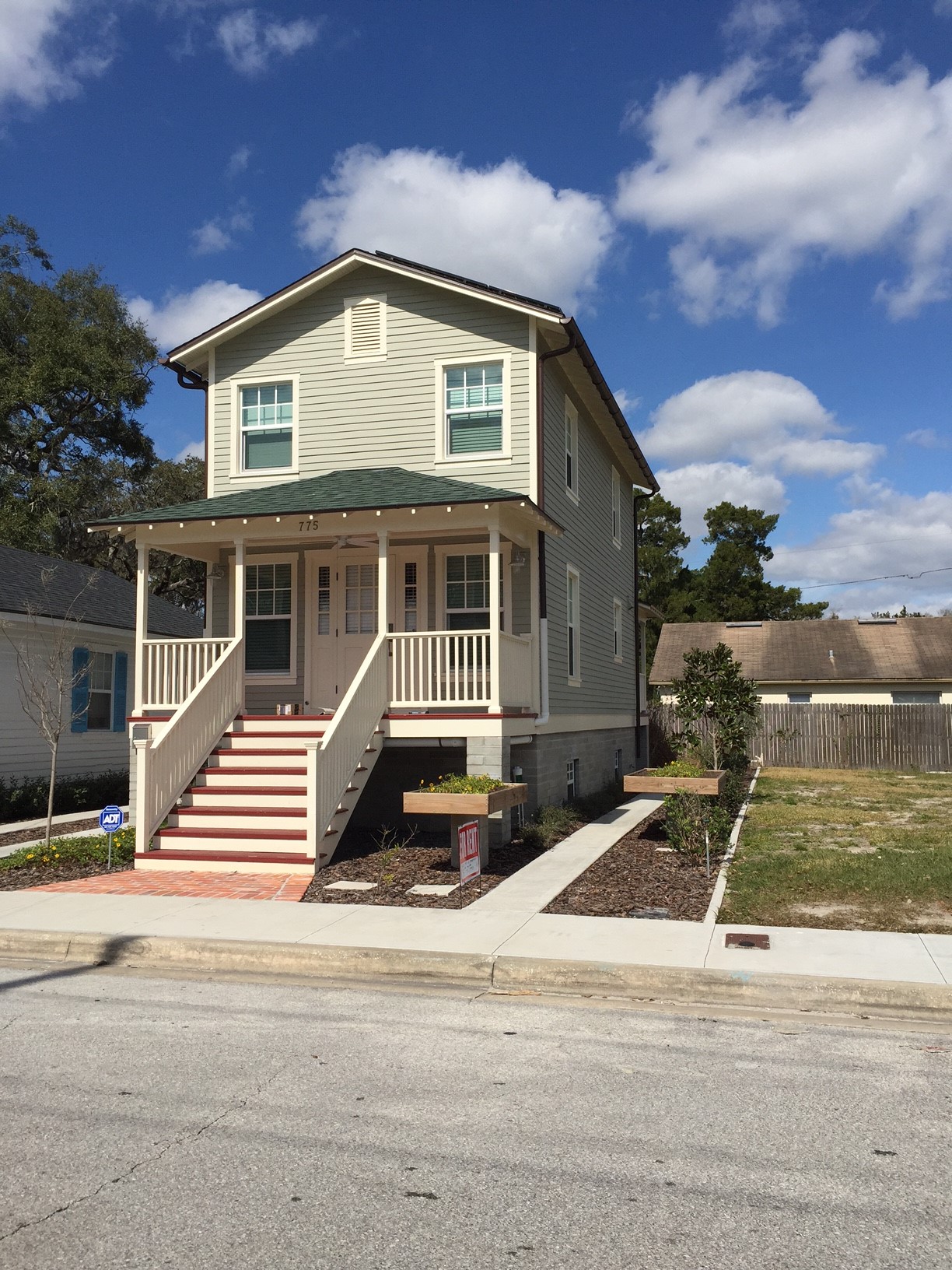
Here is 775 W. Lyman Avenue. This is my baby. I dreamed it, and thanks to our team, we built it. This little house boasts high quality construction, traditional design with plenty of charm, serious efficiency (net zero, solar panels), and a human scale. The house generates more power than it uses, retains rainwater for raised vegetable gardens and warms the souls of the folks who live there.
The Basic Concept is ‘Basic’
We Americans house too much Stuff in too many rooms. In this scenario, the stuff (if one absolutely must have it) goes in the basement, leaving the resident free to actually use the rooms they need, without having to dust stuff in rooms they don’t need. Do you get a visual of that darkened ghost town of a living room that serves as a sound barrier between the street and the rest of the house?
We built the Lyman Ave. house on a 32’ x 70’ lot with no variances. Lo and behold, the market responded. The highly successful executive of a large corporation undertook the maiden voyage. She could have afforded a far larger house, but realized she would live more comfortably in a house that had a more human scale.
Inclusion = Sense of Place
We would build this small community in the midst of the larger community of Winter Park. Ultimately, walls, fences and gated communities don’t work, even for the segment of society that can afford them. The solution is inclusion, and that must be a part of the vision.
Winter Park – Overrun by ’Generic’
Winter Park is at risk of losing its character, according to National Geographic Magazine. For every exceptional new home going up, there are dozens of sadly generic boxes that follow a playbook of size over quality. We are being overrun by generic. That was not the mentality of our founders.
Millenials – Size Matters Less
When it comes to housing, today’s young folks tend to prefer quality to size. In fact, the smaller home trend would tell us they’re not thinking size at all. Their picture of the future is sustainable, walkable, built on a human scale with efficient energy sources and rainwater retention for growing things.
What’s in it for Winter Park?
Let’s start with image. Thousands of visitors and Sunrail riders will witness sustainable, human-scale homes bearing Winter Park’s imprimatur come to life. These homes will contribute to the sense of place that already exists in this neighborhood, but which is swiftly eroding and in jeopardy. A development on this scale would elevate our standing as a forward-thinking, progressive community.
Honor Neighborhood Character
West Side residents know new homes will be built, and old, termite-damaged homes will come down to make room. There is, however, a long-standing set of zoning codes and processes in place to protect the character and the heritage of this part of our town. This area was established with small lots a century ago. We propose to honor and preserve the characteristics of the West Side that those of us who live here hold dear.
On June 27, the Ladybird Academy came before the Commission to request a reversal of the Planning & Zoning Board’s denial of their application to build a 13,000-square-foot preschool and child care facility on the west side of the K-Mart Plaza fronting Gay Road and Trovillion Avenue.
Residents: Pre-School Not Compatible with Neighborhood
Near some of Winter Park’s most congested intersections — Lee Rd. at 17-92 and Lee Rd. at Webster – the neighborhood between the K-Mart Plaza and Lake Killarney has quiet, two-lane streets and is home to the Killarney Bay and Chateau du Lac condominium complexes, as well as several smaller single family homes. The population is predominantly, though not exclusively, seniors. Residents from this peaceful neighborhood showed up in force, with signed petitions, to oppose the proposed child care facility.
Peak Hour Operation for 144 Kids
Ladybird Academy, a franchise operation with several locations in Central Florida, wanted to build a preschool and child care facility that would accommodate 144 children. They planned to operate between the hours of 7:00 a.m. and 6:30 p.m. The company, incorporated in 2011, is headquartered in Lake Mary. Ladybird offers not only day care and preschool for children ages 6 weeks through 5 years, it also offers before- and after-school and summer camp programs, according to their website. www.ladybirdacademy.com
Neighbors Fear Noise, Traffic
On June 7, the Planning & Zoning Board heard extensive public comment about increased traffic when parents dropped off and picked up their children during morning and evening peak traffic hours – those times when drivers trying to avoid congestion on Lee Road and 17-92 cut through the residential streets. Residents also were concerned about the level of noise that might be generated by 144 children during lunch and recess.
Major Retail Coming to the Area
Residents pointed out that much of K-Mart Plaza is presently unoccupied because it is undergoing renovation. The Whole Foods center, which also will have other major retailers, is also due to open soon. City Planning Director Jeff Briggs noted that traffic generated by these additional large retail developments will be spread out over the day, reducing the impact at any one time. To add an additional 140 or so cars at peak traffic hours, however, could tip an already stressed road system into total gridlock.
Ladybird Experts Weigh In
Ladybird Academy produced a sizeable group of experts that included a traffic engineer and a real estate appraiser, each bearing the proper list of credentials. The traffic engineer cited statistics indicating that both 17-92 and the interior neighborhood streets were currently operating well below capacity, a condition that is not immediately apparent to the anecdotal observer.
The real estate appraiser, Mark Carpenter, was tasked with reassuring current residents that the proposed daycare facility would not diminish the value of their property. He contended that the project would have the opposite effect, to enhance property values. “Basically, right now,” he said, referring to the proposed site, “it’s an eyesore.”
Gladys Renqifo-Ellis who, like many of her neighbors, enjoys the quiet expanse of green space that is the proposed site, disagreed with Mr. Carpenter’s characterization.
Ladybird Seeks Conditional Use Approval
While the Ladybird Academy project did not require zoning changes, because of the nature of its business, the project had to meet 12 criteria for Conditional Use set forth in city code. These criteria were enumerated by City Attorney Kurt Ardaman.
Basically, the code requires the proposed project be consistent with the Comprehensive Plan and comply with land use code. The building, landscaping, and irrigation must be compatible with the scale and character of the surrounding neighborhood. There needs to be adequate parking, lighting, storm water retention and noise mitigation.
Academy Fails Compatibility Test
Where the Ladybird Academy project fell short was in the area of compatibility. Criterion #3 reads: “Operating hours, noise, parking and traffic impact will be compatible with existing and anticipated land use activities in the immediate neighborhood and compatible with the character of the surrounding area.”
Criterion #7 reads: “That traffic generated from the property use should not on a daily or peak hour basis degrade the level of service on adjacent roads or intersections. . . . That access directs traffic away from residential roads and toward more heavily traveled roads.”
According to Ardaman, if the project fails to meet any of the criteria for Conditional Use, it is the obligation of the Commission to uphold the decision of P&Z and deny the application.
On the night of Tuesday, May 3, Winter Park residents spoke to the Planning & Zoning (P&Z) Board to successfully defend the single family scale and character of the Hannibal neighborhood in west Winter Park against another expensive, speculative development of high-density, multi-family units.
Developer Asks to Build Three-Story Duplexes
Attorney Becky Wilson, representing the developer, came before P&Z to request approval to develop the properties at 326 and 354 Hannibal Square East and at 465, 463 and 455 West Lyman Avenue with six three-story duplexes totaling twelve residential units.
City Planner Recommends Denial
City Planning Director Jeff Briggs, who presented the application to the P&Z, recommended P&Z deny the applicant’s request on the basis of the Comprehensive Plan, which “strongly discourages” out of scale development in neighborhoods with single family zoning.
Comp Plan: Land Use Bible?
Ensuing discussion centered more on the purpose of the Comprehensive Plan, to protect the village scale and character of Winter Park, than it did on the relative merits of the proposed development. In his recommendation for denial, Briggs referred to the Comprehensive Plan as our “land use Bible.”
That sparked a spirited response from attorney Becky Wilson, who countered that the Comp Plan was not “divinely created.”
No More Chipping Away
When the floor was opened for comment, one after another, the neighbors approached the podium, to decry the speculative development of multi-family projects that are “chipping away” at the character of the Hannibal neighborhood.
Several also displayed a detailed knowledge of the City’s Comprehensive Plan. Notable among them was Bob Cambric.
Talk of Social Justice
Citizens and P&Z members both spoke of social justice. Barry Greenstein, who had worked on the staff of the U.S. Civil Rights Commission in Washington, D.C., warned about discriminatory zoning practices.
P&Z Upholds the Comp Plan
The men and woman who make up the Planning & Zoning Board listened to the residents. They heard the voice of the people. They upheld the recommendation of City staff and the principals set forth in the Comprehensive Plan. They voted unanimously to deny the applicant’s request to further chip away at the essence of the Hannibal neighborhood.
Now that Winter Park voters are on board to pay for a brand new library, the city is cautiously considering moving city hall into the current library building.
After city staff recommended exploring the idea Monday, city commissioners called for more information about the site’s strengths and weaknesses. A staff report said the building was in “good” condition with a “fairly new” heat and air-conditioning system and energy-efficient lighting. City Manager Randy Knight also said some current city-hall functions could be moved to another site if they didn’t need to be in a prime location.
Not everyone was enthusiastic about the idea, however. Commissioner Sarah Sprinkel noted the city already knows about the existing library from the research done by the Library Facility Task Force. The task force nixed renovating the building after concluding it has too many challenges, including poor wi-fi connections and limited space and parking.
Commissioners Pete Weldon and Carolyn Cooper both stressed the importance of hearing from the public before making any decision about city hall or any other high-profile city properties valuable to residents. Cooper said it was “fiscally responsible to explore reuse of that [library] building,” but she would not support selling the property.
One staff option for city hall never made it into the discussion. Staff raised the possibility of another bond-issue to build a new city hall on the Park Avenue site, but Mayor Steve Leary said any discussion of that idea was “premature.”
Meanwhile, Winter Park’s new library seems destined to be built in Martin Luther King Jr. Park. The issue was never raised Monday except for a plea from former mayor Joe Terranova during the public-comment portion of the meeting. “You’re going to have to reconsider this,” he said, noting the close vote on the library bond issue. “You have a split community now.”
On February 23, ROC Seniors Housing Fund Manager, LLC, formally withdrew their offer to buy the Progress Point property to build a mixed use development consisting of an assisted living facility, a memory care unit and a restaurant.
Progress Point – that infamous piece of land the City acquired when they traded away the State Office Building property up the road at Morse and Denning. At the junction of Orange and Denning, right beside the railroad tracks, split down the middle by a road, contaminated by heavy metal, it has sat unwanted and unloved since 2011.
For Sale Sign Goes Up April 2015
In April 2015, the City put it up for sale. They advertised in the Sentinel and on Loop Net. Thirty packets containing the Notice of Disposal (NOD) were sent to potential buyers. After 90 days, there was one response.
One Potential Buyer
A proposal was submitted by ROC Seniors for an 82 unit assisted living center with a 32-bed memory care facility and a 6,000-square-foot restaurant. The developer, represented by former Winter Park City Commissioner Phil Anderson, offered $4.5 million which, according to City records, was in keeping with a 2011 appraisal of $4.4 million.
Staff and EDAB Recommend the Project
Both City staff and the Economic Development Advisory Board (EDAB) recommended approval, pointing out that the development would “activate the taxable value,” adding between $71,000 – $86,000 annually to the General Fund. “Staff feels that the project meets the character of Orange Avenue,” read the Agenda Item, “promotes new jobs and creates active redevelopment along Orange Avenue.”
ROC Seniors cited several important benefits their project would bring to the City. There would be no impact on schools. The facility would provide an under-served need for seniors. The project would create greater employment opportunities than other uses and would be an attractive presence consistent with existing Orange Avenue businesses.
Price Just Went Up
On the Friday before the September 14, 2015, Commission meeting, the City received a new appraisal, which had been ordered after the NODs went out. It came in at $5.69 million. As a result, ROC Seniors came before the Commission with an offer that was nearly $1.3 million below what was now the most recent appraisal.
Leary Opposed
A lengthy discussion among the commissioners about whether the proposed use was appropriate for the Orange Avenue corridor began with Mayor Steven Leary’s unequivocal opposition to ROC Seniors’ proposed use.
The NOD had contained no guidelines regarding what kind of project the City would like to see there. Public comment, mostly from business owners along Orange Avenue, was heavily in opposition to the project.
ROC Meets the Price
After an acknowledgement from Mr. Anderson that ROC Seniors would meet with City staff to discuss raising their offer to meet the new price, the Commission decided to table the issue and send the question to Planning and Zoning for their opinion on an appropriate use for the site.
How Did We Reach This Point?
How did such an unlovely site gain $1.3 million in value, you might ask. In a November 5, 2015, letter from ROC Seniors to the City, Anderson points out certain ‘assumptions’ the appraiser used in assigning the $5.69 million value.
The City would realign Palmetto Avenue so that it would no longer run through the middle of the property, creating one contiguous piece of land.
The City would deliver a “clean, clear site” by removing residual contamination.
The City would accommodate storm water offsite.
The City would approve a mixed use.
In his letter, Anderson requested the City definitively clarify the appraiser’s assumptions. He also highlighted the need of surrounding businesses, including the Jewett Clinic, for additional parking and suggested the City retain a portion of the Progress Point land for that purpose.
After six months of discussion between the City and ROC Seniors, the City failed to come to a clear decision. The City has not confirmed that it would complete the items on which the appraiser based his valuation, and it has not clarified what kind of use they believe would be appropriate for that site.
“No one has said they want an assisted living facility or a mixed use project on that site,” Anderson told the Voice. “And no one has said they don’t want that kind of project. It’s time for us to move on.”
A snug row of four large homes soon will occupy what is now a vacant, tree-shaded lot on Pennsylvania Avenue. Lot frontages will average 60 feet, instead of the 75- to 85-foot minimum called for in city laws.
A majority of city commissioners at the September 28 meeting had no problem with that tight squeeze. They ignored city planners’ recommendation to deny the request and snubbed a formula that staff has used for some 30 years to come up with such positions.
Instead, commissioners agreed with their planning and zoning board’s unanimous recommendation for approval. The site’s location at the edge of a neighborhood and enthusiastic support from four nearby homeowners appeared to have swayed the advisory board more than the city’s subdivision rules, its comprehensive plan and staff’s opinion. The homeowners, who earlier had written almost identical letters of support, told the city commission they were glad to see the lot finally developed. No one spoke in opposition.
The .87-acre lot north of Tantum Avenue, owned by the Morse Genius Foundation, is more than big enough for three residential lots, but the request sought several exceptions to the rules. The applicant wanted to create room for four homes, each about 3,500-square-feet in size, to be marketed to empty nesters. Besides the narrower lots, the applicant sought a rear setback of ten feet instead of the required 15 feet to allow rear access. Rebecca Wilson, an attorney representing the applicant, noted the mixed zoning south of the site, including an industrial building, denser residential lots and the city golf course. She argued that nearby homes on Beloit Avenue had rear access and frontages less than 60 feet.
City planners said they had no choice but to recommend denial, even though by one measure the new lots exceed zoning requirements. (They will range from 9,191 to 9,985 square feet, compared to the code minimum of 8,500 square feet.) The frontages, however, would be too small by any measure, staff said. The zoning code requires 75-foot frontages in R1A areas and 85 feet for corner lots. Both the code and the comprehensive plan say a lot split should create lots consistent with homes within 500 feet.
Using a formula in practice since the mid-1980s, Planning Manager Jeff Briggs checked how well the proposal meshed with neighboring residential lots. He found a large majority of those frontages were at least 75 feet wide. The average was 69.7 feet; the median was 75 feet. Expanding the radius to include 91 homes produced similar results.
The only way for the city to approve such a deviation was through a zoning variance, said planning Director Dori Stone. “It’s not staff’s job to ask for approval of variances. It’s our job to recommend enforcement of code regulations.”
Mayor Steve Leary and Commissioners Sarah Sprinkel and Tom McMacken voted for the request, with the condition that the houses vary in appearance. Commissioners Carolyn Cooper and Greg Seidel opposed it. Concerned about large oaks on the site that might be specimen trees, Seidel asked for a tree survey, but staff said code didn’t require it. McMacken said he didn’t agree with those tree rules, “but it’s the code.”
We Depend on your support, make a tax-deductible donation here.
Mission
The Winter Park Voice is a trusted nonprofit journalism site that covers our City Hall and beyond. We endeavor to engage, inform and connect citizens on all sides of issues affecting the quality of life in Winter Park.

 Dear Mayor and Commissioners:

Recent Comments