Monday, December 5, from 8 to 10 a.m., at the Winter Park Welcome Center, 151 W. Lyman Ave., city staff will host a Comprehensive Plan CoffeeTalk,
CoffeeTalks are informal meetings at which citizens can speak with city leaders in a casual setting. This CoffeeTalk will focus exclusively on questions related to the Comprehensive Plan. City staff will kick off the CoffeeTalk with a brief presentation, which will be followed by a Q-and-A session with the audience.
If you are someone who still has issues, questions, comments or strong feelings about the Comp Plan, this is an important meeting. You should attend if at all possible, as it will be the last of its kind regarding the Comp Plan. While discussion of the Comp Plan will not cease after Dec. 5, this meeting is being held for the express purpose of receiving citizen input. So, if you have input, this would be a good time to put it in.
Comp Plan Should Reach Tallahassee by Christmas
The City Commission is scheduled to hold the first reading of the proposed Comprehensive Plan at their only December meeting Monday, December 12. If the Commissioners approve it, the proposed Comp Plan amendments will go to the Florida Department of Economic Opportunity (DEO) for their review on Thursday, December 22. The City expects to receive the results of the DEO review by March 6, 2017.
Comp Plan Second Reading in April 2017
City staff has tentatively scheduled the second reading of the Comp Plan before the City Commission in April 2017. For more information regarding the proposed Comprehensive Plan elements, the adoption process timeline, drafts and revisions, visit cityofwinterpark.org/comp-plan.
Examples of Changes Still Up for Discussion
Among the proposed Comp Plan changes, the City is contemplating allowing four-story construction along the west side of Denning north from Fairbanks to the northern property line of the Orange County Public School land that includes the Votech site.
Mixed use development with an urban scale of up to eight stories in height is being considered on the south side of Fairbanks, west of Formosa along Kentucky, Oglesby and Crandon Avenues.
The City is also weighing the expansion of the Central Business District (CBD) to include Orange Avenue, bringing with it additional density along that corridor.
This is about your city — how it will look – what it will be like to live here. Your opinion matters – city officials are asking you for it. Attend this forum to express it.
The City is on a fast track with their Comprehensive Plan updates, but that does not mean it’s too late for citizen input and participation in the process.
Follow this link to the Comp Plan, where you can see how it is being edited and updated.
If you have questions, or if there is something you don’t understand, email your questions to mayorandcommissioners@cityofwinterpark.org.
Commissioners Welcome Your Input
Commissioner Greg Seidel told the Voice, “I am in the process of gathering citizens’ questions and suggestions to bring forward at the December 12 Commission meeting. I hope everyone will feel free to contact us and to participate in this process.”
Comp Plan Meeting Dec. 5
Plan to attend the Comprehensive Plan Coffee Talk December 5, from 8:00 – 10:00 a.m. at the Welcome Center, 151 W. Lyman Avenue. City Planning Staff will be there to explain the process and answer your questions.
The Comp Plan is vitally important to all of us who care about our city. It is the over-arching document that lays out the concepts and policies governing how Winter Park will look – now and in the future. Together, the Comp Plan, the Zoning Codes and the Building Codes form a sort of three-legged stool. The Comp Plan lays out the broad policies, while the Zoning Codes specify what type of structure can be built where, and the Building Codes say how the structure must be built.
Changes Possible Until Final Adoption
Even if you are unable to attend the Comp Plan Coffee Talk December 5, your input will still be welcomed by staff and elected officials. City Communications Director Clarissa Howard assured us that citizens can submit their input and that Comp Plan changes can be made until the final adoption by the City Commission, which is scheduled in April 2017.
On schedule to meet a February 1, 2017, deadline, the final four elements of the Comprehensive Plan update arrived at Planning & Zoning on the evening of Tuesday, November 8. The meeting was, relatively speaking, lightly attended, but a few concerned citizens tore themselves away from the unfolding drama of the national election to plead special cases.
The four Comp Plan elements P&Z approved to be sent to the City Commission were Capital Improvement, Housing, Transportation and Future Land Use. Predictably, the Future Land Use element drew the most attention.
Can Anyone Keep Up?
There has been considerable commentary about the speed with which the Comp Plan revision process is taking place, especially as regards the Land Use element. Pat MacDonald pointed out that there have been 22 meetings between July and October, with nearly half the meetings taking place in October. The all-important Land Use element of the Comp Plan has been whittled from 85 pages down to 31 pages. Few are able to comprehend what, if anything, was lost in those 54 pages. And very few are able to understand or keep track of all the changes to the document as a whole.
“Ambitious, Artificial Deadline”
Private citizens are not the only ones objecting to the pace at which the Comp Plan revision has been conducted. Referring to the work session Pat MacDonald mentioned in the video above, P&Z board member Peter Gottfried wrote October 18 to the mayor and commissioners, “We were just sent the latest proposed changes to the Future Land Use Element to the Comprehensive Plan. This is a major piece of legislation that needs to be thoroughly reviewed by members of the Planning and Zoning Board as well as the citizens of Winter Park prior to our workshop this afternoon. Unfortunately, time does not allow for a review that I think is crucial.”
Transportation Element Rolls in Minutes Before Meeting
“I had the same issue with our review of the Transportation element at a workshop a few weeks ago where we were given the proposed change matrix minutes before our meeting. This, my colleagues, is no way to run a railroad or a City. There is absolutely no way I, as your representative on the Planning and Zoning Board, can provide proper review and insight to this document with this ambitious, artificial, deadline.
Is Breakneck Speed Politically Motivated?
“Please put aside opinions that we need to rush this in order to avoid political implications in the upcoming city election,” continued Gottfried. “The better way to approach this is to slow down in order to give thoughtful and careful evaluation of a document that will set the tone for the development of Winter Park for years to come.”
“Can I have your support to consider changing the implementation schedule so that we have the appropriate amount of time to consider more thoughtfully this comprehensive document.”
Last-Minute Changes Requested
Toward the end of the meeting, attorney Becky Wilson requested changes to the land use map that would benefit one of her clients, and developer Dan Bellows requested changes that would benefit him. Both were requesting expanding the Central Business District (CBD), which would have the effect of increasing density but preserving the pedestrian orientation of development in the Hannibal Square district. And, once again, the issue of haste reared its head.
Why Wait Until the Last Minute?
Why, questioned Peter Gottfried, did Wilson and Bellows wait until these elements were scheduled for adoption to bring their requests for changes? Wilson’s response, that she believed this was the meeting where her requests were meant to be heard, indicates that even an attorney as familiar with the inner workings of City Hall as Wilson is did not fully understand how fast a track this train is on.
P&Z members postponed their decision for six months to provide opportunity to study the effects of the proposed changes.
Winter Park Elderly Services LLC will go before the Planning & Zoning Board on Tuesday, October 4, to ask for variances that would enable them to build a 50-bed memory care and assisted living facility at 1298 Howell Branch Road. The location is at the intersection of Howell Branch and Temple Trail. The facility will be called Villa Tuscany.
Planning Staff Recommends Denial — For Now
City Planning staff has recommended against approval. They acknowledge the need for a memory care facility in Winter Park. The staff report states their belief that the location is appropriate, but they object to the height of the building and its proximity to Lake Temple. If the developer were willing to alter the design of the building and shift its placement on the site, the Planning Department could reconsider its position and support the project.
Between a Sink Hole and a Lake
The building site is a difficult one, with wetlands and a sink hole limiting development space. It may ultimately prove too small to accommodate the nearly 40,000-square-foot facility the applicant wants to build there. According to the applicant’s survey, the entire site is 3.777 acres, but only 2.18 acres are above the Ordinary High Water elevation. The building would be located between a sink hole and Lake Temple, as shown in the site map.
Historic Live Oaks Risk the Chainsaw
The long-vacant lot is densely forested. According to the City, there are 64 protected shade trees on the lot, 29 of which the developer proposes to remove. These include several historic live oaks measuring five feet or more in diameter. According to comments from Urban Forestry, the tree diameters indicated on the Tree Preservation plan submitted by the developer are inaccurate. “Footprint corners, drive lane, and parking corners need to be staked and determined in the field,” reads the report, “prior to actual determination of the exact trees that could possibly be preserved or those that must be removed.”
Neighbors Are Divided
This project has the attention of the neighborhood. More than 40 emails and letters have been submitted to P&Z and to the Mayor and Commissioners as of this writing. The greater number of citizens has written in opposition to the project, but a substantial minority supports it.
There Is a Need for This Service
Those in favor cite the need for this type of facility in Winter Park. They point to the fact that the applicant is a locally owned company, which also owns and operates the Alabama Oaks assisted living facility at 1759 Alabama Dr. “Alabama Oaks is most always full with a waiting list,” wrote Nurse Practitioner Kelly Higgins, “and the community should welcome the opportunity to offer this type of care to elder residents in Winter Park.”
“Winter Park’s seniors should receive care in the same community they have called home for decades,” wrote Alison Polejes. “Yet, we currently have no dedicated memory care facility.”
Facility Is Incompatible
Residents opposed to the project are concerned about the suitability of the site and the size of the building. Limited parking and the impact on traffic are also mentioned.
“This facility is totally incompatible with the overall residential nature of the surrounding neighborhoods,” wrote Karen Kaczmarek. “This project, at nearly 40,000 square feet and three stories with heights reaching over 42 feet, is just too big for the area.”
“There is a sink hole on the property and a small lake backing up to residential houses,” wrote Charlotte Schmitt. “The building is too tall, too many square feet, has too small of a parking lot and is too close to the sink hole and lake.”
Donna Render wrote, “St. Johns [River Water Management District] told us years ago they could never approve a building here. How is this being ignored?” Ms. Render went on to point out, “You can’t fool Mother Nature!”
P&Z Meets at 6:00 p.m., Tuesday, October 4, in the City Commission Chambers.
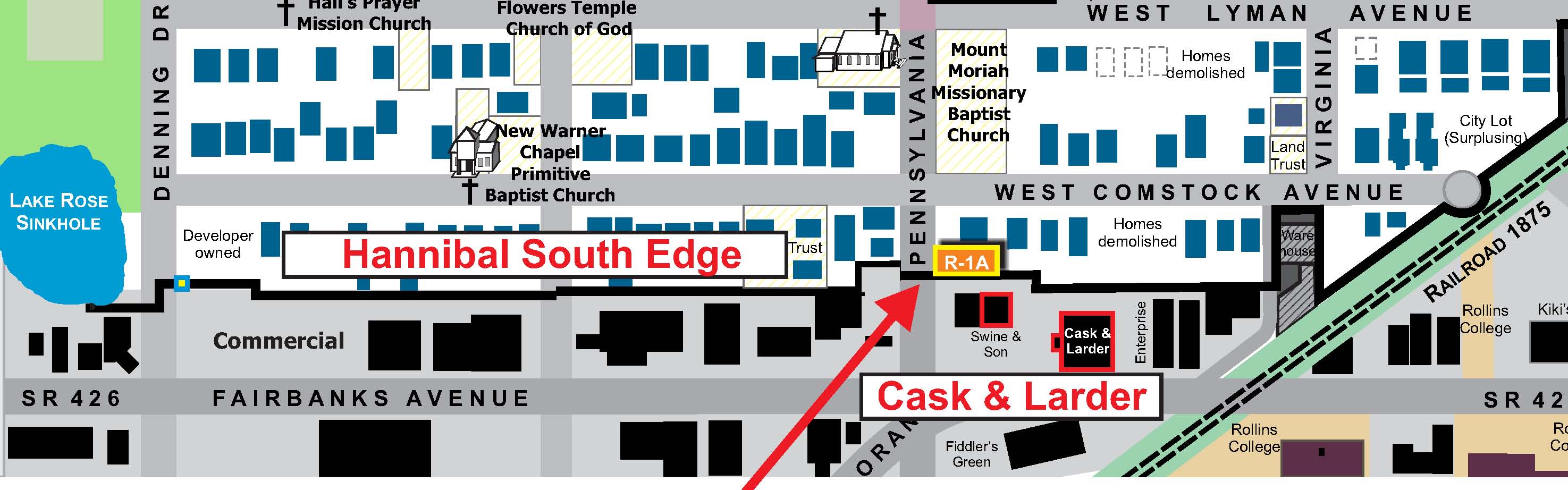
P&Z found itself in a ‘Catch 22’ Tuesday evening when James and Julie Petrakis, owners of the Ravenous Pig, Cask & Larder and Swine & Sons, announced they would be moving The Ravenous Pig from its present Orange Avenue location to the Cask & Larder site at 565 W. Fairbanks.
The Petrakises have bought the property at the corner of Pennsylvania and Fairbanks Avenues where Swine & Sons and the Cask & Larder are now situated. Since the lease on the current Ravenous Pig location is about to expire, they seek to combine the two restaurant operations, with The Ravenous Pig in the dining room and the Cask & Larder in the tap room.
What’s the Catch?
As with many businesses in the Orange/Fairbanks corridor, the issue is parking. The property includes a small, vacant, unpaved lot at 520 Pennsylvania which has for years been used for overflow parking for patrons of the restaurant on that site. This goes back to the days of Harper’s Tavern and the Cordon Bleu.
Property Needs a Facelift
As part of a facelift for the property, the new owners want to re-do the parking lot, add landscaping, upgrade the paving and lighting and add a small outdoor dining area behind the restaurant, away from the Orange Avenue frontage where now the chairs sit empty because of traffic noise and glare from the setting sun.
Pave the Parking Lot
This would include paving and landscaping the small lot at 520 Pennsylvania to make it a proper parking lot. Currently, the lot is muddy when it rains, has an uneven surface and has holes that are hard to see in the dark. The difficulty is that 520 Pennsylvania Avenue sits within the southern edge of the Hannibal Square neighborhood and is zoned single-family. In order to pave and improve it, the lot must be rezoned to “PL” (for Parking Lot), requiring a change in both the Comprehensive Plan and the Future Land Use Map.
Commercial Creep
As benign as it first appears, this is the kind of commercial creep into the single-family residential Hannibal Square neighborhood the people who live there are trying to prevent. They point out that this sort of commercial incursion would never be approved in other neighborhoods — say, in the “Vias.”
In a letter to members of the Planning & Zoning Board, sent in advance of the meeting, west side resident Mary Daniels wrote, “We are asking the board and staff to preserve what is left of R1A zoning in this community, to stop the inching encroachment process of another block of zoning changes to PL or higher density zoning based the commercial surrounding and not the residential zoning in the adjacent area.”
Historical Use is for Parking
City Planning Manager Jeff Briggs pointed out the reality that, historically, none of the restaurants that had occupied that site had ever had sufficient parking. He said if the lot at 520 Pennsylvania is not used for parking, that will drive the patrons to find parking out on the residential streets. Briggs said, without the long history of the property as a restaurant, the staff would have come with a very different recommendation.
“Our Objective Is to Make that Corner More Attractive.”
There is no question the junction of Fairbanks, Pennsylvania and Orange Avenues is unattractive and dangerous, and that it could use some love. Petrakis spoke about his desire to provide a way for patrons to enter and leave the restaurant safely – by directing traffic to enter from Pennsylvania instead of from Fairbanks. He also noted the need for an improved aesthetic. He stated he was willing to enter into a developer’s agreement stipulating that if he ever sold the lot on Pennsylvania, the zoning would revert to R1A.
Why Amend the Comp Plan?
Maria Bryant, another resident of the Hannibal Square neighborhood, agreed with Petrakis. She said she did not understand why the zoning and the Comprehensive Plan needed to be amended. The purposes of both the community and the property owner would be served with a development agreement that allowed Cask & Larder to improve and continue to use the lot for parking, but if the lot ceased to be used for parking, it would revert to its original R1A zoning and would retain R1A status on the Future Land Use map.
Future Land Use Important
Bryant’s sentiments were echoed by Mary Daniels, who pointed out not only should the Comprehensive Plan and zoning for this property remain unchanged, but the Future Land Use map should also reflect R1A status. Daniels expressed her appreciation for Petrakis and his effort to share with the neighbors in advance his plans for improving the property.
How Do We Keep Our Businesses Viable and Our Neighborhoods Safe?
Kim Allen posed an essential question when she pointed out that many businesses in major commercial corridors of Winter Park lack sufficient parking.
P&Z to Petrakis: Back to the Drawing Board
P&Z Board member Peter Gottfried solved the problem, for now, by ending the discussion. He made a motion to Table, advising the applicant to flesh out his plans and bring back a more comprehensive description of what will happen to the property at Pennsylvania and Fairbanks, and to two of the region’s most popular and respected dining establishments.
The Comprehensive Plan review has begun in earnest.
The Comprehensive Plan – a.k.a the Comp Plan – is described by the City Communications Department as “the document that governs the City’s plans for growth through policies that guide development.”
Comp Plan = City Blueprint
The policies set forth in the Comp Plan protect and improve our city assets and provide for city infrastructure. In terms of importance to the city, the Comp Plan is second only to the City Charter. The Comp Plan is required by Florida Statute, Chapter 163.3161, and is given legal status mandating that public and private development must comply with the Comp Plan.
Deadline for Completion – 2/1/2017
The Comp Plan is updated every seven years to ensure it is in compliance with Florida statutes. Last reviewed in 2009, an update it is now due. The Commission has until February 1, 2017, to approve the Comp Plan and send a final version to the Florida Department of Economic Opportunity in Tallahassee.
The City Planning Department will spearhead the review, with the assistance of the Comprehensive Plan Task Force — Nancy Miles, Laura Turner and Marc Reicher — and the City advisory boards that oversee the various elements of the Plan.
Don’t Give Up – Keep Reading (or skip this section and come back to it)
The Comp Plan consists of two major documents. The one entitled “Goals, Objectives and Policies” (GOP) is adopted by the Commission and carries the weight of law. The information from which the GOP derives is in a support document entitled “Data, Information and Analysis” (DIA). In our current Comp Plan, the GOPs and DIAs are organized into nine chapters, or ‘elements.’
• Future Land Use – Includes map of land use allowed on every property in Winter Park.
• Transportation – Addresses roadways, sidewalks, buses, rail and biking and walking trails.
• Housing – Includes projection of future population.
• Public Facilities – Infrastructure services such as sanitary sewer, solid waste disposal, potable (drinkable) water and storm water drainage.
• Conservation – Defines conservation lands, air and water quality and water conservation.
• Recreation and Open Space – Plans and policies to meet projects need for parkland and open space. Current level of service requires 10 acres of publicly owned park and conservation land per 1,000 residents.
• Capital Improvements – This element is updated annually as part of the City budget process and includes all infrastructure required to support the population.
• Intergovernmental Coordination – Outlines the City’s agreement with other government entities such as the FL Department of Transportation, Orange County School Board, St. John’s Water Management District and surrounding municipalities and counties.
• Public Schools – Reflects agreement with Orange County Public Schools to provide facilities to serve resident school-aged children.
You Still Awake?
As always, the devil is in the details. Here is one example. If you go to the City website and click the “Comprehensive Plan” icon on the main page, it will take you to the Comp Plan. Under “Data, Analysis and Inventories” is a chart listing all parks and the precise acreage of each. The total acreage listed there is 296.45 acres. dia-ch6-recreation-open-space.pdf
A document distributed by City Planning Director Dori Stone at the August 1, 2016 meeting of the Comp Plan Task Force, entitled “Park Level of Service Standards,” states Winter Park’s park and conservation land at a total of 346.16 acres.
Where Did That 50 Acres Come From?
On August 5, the City Communications Department wrote to the Voice, “Staff will need to research the differential in total acres. GIS is a factor, some new parcels were added, i.e., the West Meadow, and we need to research what others resulted in the difference.”
GIS, by the way, stands for Geographic Information System, which is a more accurate way of measuring land area. Even with GIS, however, as of this writing we are still not sure about those 50 acres. Part of the Comp Plan review process will be to manage discrepancies of this sort.
Why Does 50 Acres Matter?
At a level of service of 10 acres of park and conservation land per 1,000 residents, 346.16 acres would support a population of 34,616. (Winter Park population estimate as of 2015 stands at 28,967.) Since Winter Park is landlocked, how would we fit another 5,000 to 6,000 people? By increasing density. Where would we increase density? In those single-family residential neighborhoods the Comp Plan is meant to protect?
Is the Comp Plan Review Important to You?
If you care how this city will look in two or five or seven years, it is important. The Voice will post updates as the review process moves from Advisory Board to Advisory Board under the guidance of City staff and the Comp Plan Task Force. A “2016 Comprehensive Plan Timeline” is posted on the city website. 2016-comprehensive-plan-timeline.pdf
The City will update the schedule as necessary, and all meetings are open to the public.
As technical and wonky as it may seem, the Comp Plan review affects how we live. It is worthy of our attention. In the words of Commissioner Carolyn Cooper, our Comp Plan is “a contract between the residents of Winter Park and our government that defines how and where we will grow and what level of public services we will enjoy for the taxes we pay.”
We Depend on your support, make a tax-deductible donation here.
Mission
The Winter Park Voice is a trusted nonprofit journalism site that covers our City Hall and beyond. We endeavor to engage, inform and connect citizens on all sides of issues affecting the quality of life in Winter Park.
 Monday, December 5, from 8 to 10 a.m., at the Winter Park Welcome Center, 151 W. Lyman Ave., city staff will host a Comprehensive Plan CoffeeTalk,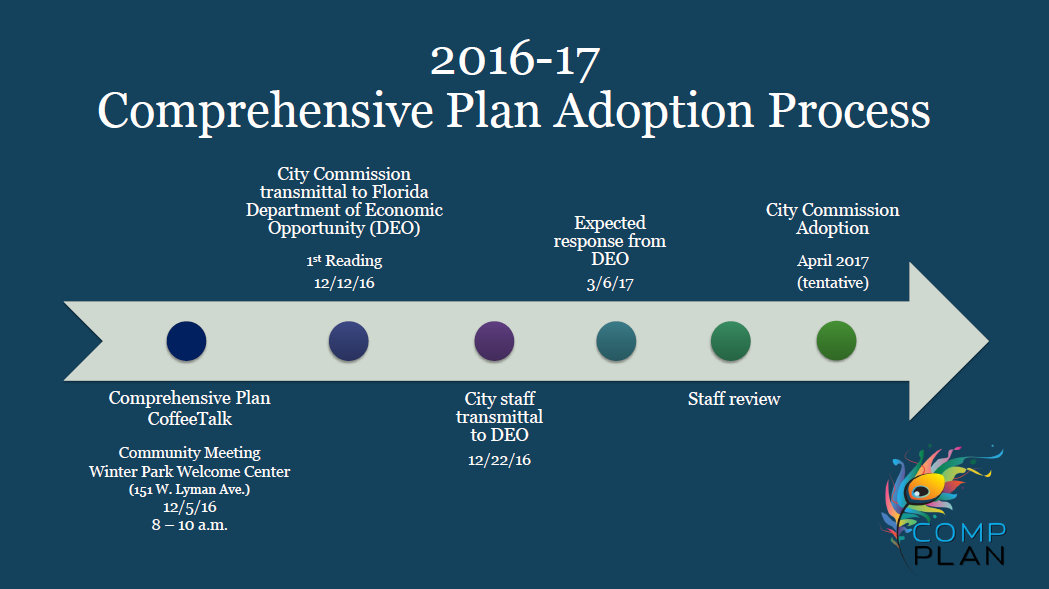


Recent Comments