WP Voters to Decide on Single Member Districts
WP Voters to Decide on Single Member Districts
Back Yard Chicken Pilot Program Takes Off
by Anne Mooney / August 30, 2020
Single Member Districts on March 2021 Ballot
At their August 26 regular meeting, Commissioners voted 3-2 to draft an ordinance that would add the single member districts question to the March 2021 ballot. If the ordinance is passed by the Commission, the ballot question would ask voters if they want to continue the current “at large” form of representation, in which each Commissioner represents all Winter Park citizens, regardless of where they live, or if the City should be divided into districts, with each district represented by a Commissioner from that district.
This issue was discussed at length during the 2019 Charter Review in preparation for the 2020 vote on updated Charter revisions. Single member districts was not among the 11 Charter questions on the 2020 ballot, as the Charter Review Committee felt Winter Park was geographically too small to be divided up into separate districts.
The question remained, however, in the minds of some citizens who are advocating for single member districts, which they believe will provide members of the historically Black Hannibal Square neighborhood a better chance for a strong voice in city government. There has not been a Black commissioner in Winter Park since the late 19th century, despite the crucial role of the Black community in the incorporation of first the town and then the city of Winter Park.
Advisory Board Appointments a First Step
One of the 11 Charter revisions that passed in 2020 was the change in Advisory Board appointments. Instead of the Mayor making all board appointments, each Commissioner also has authority to make board appointments, resulting in the appointments of several Black citizens to advisory boards this year. Service on a Citizen Advisory Board is generally regarded as one path to election to the City Commission.
Single Member Districts Requires a City Charter Change
In order to create single member districts, the City Charter would have to be revised, and a Charter revision can only be accomplished at the ballot box. There are two ways to put the question to the voters – by petition or by ordinance. In a citizen initiative, at least 10 percent of registered voters must sign a petition requesting the change. That would require gathering just over 2,000 signatures – in the midst of a pandemic.
The Commissioners also have the authority to pass an ordinance placing the question on the ballot, without the need for a petition drive. And that is what they did on August 26th, with Commissioners Todd Weaver, Sheila DeCiccio and Marty Sullivan voting in support and Commissioner Carolyn Cooper and Mayor Steve Leary dissenting.
January 20, 2021 – Deadline for the 2021 Ballot
Between now and January 2021, the Commissioners expect to hold a series of workshops in which they will have to decide how many districts there would be, where district lines would be drawn and, if the measure were to pass, how any change would affect those Commissioners currently holding office. In most cities that have single member districts, for example Orlando, the Mayor serves the city at large and each Commissioner represents a single district.
Personal Fowl
An ordinance allowing back yard chickens, which has been under discussion since 2014 or earlier, finally passed its first reading at the August 26 Commission meeting. The City plans to issue up to 25 permits for residents in single family homes to keep up to four hens – the recommended number for happy hens.
Did you know, the color of the chicken’s eggs is the same as the color of her ears. Have you ever been close enough to a chicken to look at her ears? You may now have the chance.
The chickens must be cooped in a structure no higher than 7 feet. Chicken coops must be in fenced back or side yards and placed far enough from neighboring homes to cause no disturbance. Only hens are allowed; roosters are prohibited, as they are the ones who are noisy. Residents who keep chickens must complete an educational class on chicken care and will undergo periodic City inspections to ensure coops are clean and well maintained.
The ordinance establishing this two-year pilot program is based on successful programs already in place in Orlando, Maitland and Longwood. Winter Park’s back yard chicken ordinance still has to pass its second reading before it becomes a reality, but Commissioner Todd Weaver believes that will come soon.

Commission Raises Tax Cap
Commission Raises Tax Cap
But Will They Raise the Tax?
by Anne Mooney / August 1, 2020
At their July 22 meeting, the Commission set a tentative millage rate of 4.5623. That figure represents a cap, a not-to-exceed number, and it’s the first raise in 13 years. Between now and September 23, the Commission can decide to leave the rate at its current level of 4.0923, they can raise it a little, or they can raise it to the 4.5623 cap set at the July 22 meeting. Much depends on information the City still does not have, such as information regarding available funds from the state in FY 2021. Ultimately, those projections will depend upon the depth of the recession caused by the coronavirus pandemic.
Nothing is final until September 23.
Because each year’s budget is adopted by ordinance, two readings with public input are required. The first reading of the FY 2021 budget is September 9; the second and final reading is September 23. The FY 2021 Budget will be adopted and the final millage rate will be set when the Commission votes on September 23.
It’s not just the City that sets the tax rate.
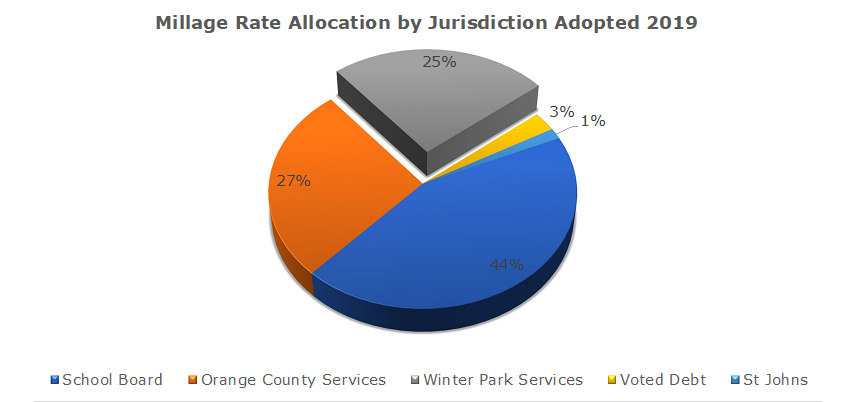
The City establishes the millage rate by creating a draft budget that seeks to balance projected expenses and revenues. Simultaneously, four other entities are doing exactly the same thing – each with eyes on our tax dollars. Our tax bill is based on a combination millage rates set by five entities — Orange County, St. Johns River Water Management District, the School Board, the City of Winter Park and the private debt created by Winter Park voters to build the Public Safety Complex and the Library-Events Center. These five millage rates will combine to form the rate we will pay on the assessed value of our property. The current rate for Winter Park is 16.3156.
Only about 25 percent of that total goes to support City services, while 44 percent goes to the schools and 27 percent goes to Orange County.
The economy has contracted in the pandemic.
According to Finance Director Wes Hamill, the City is currently facing a shortfall in 2020 of about $3 million due to the coronavirus pandemic. Hamill said he believes that by cutting costs, but without cutting services, there is still a good chance the City will break even by the September 30 year end. Some events, such as the Fourth of July parade, were cancelled because of the pandemic, thus saving those funds. Several open City positions have been frozen. If there is still a shortfall at the end of September, Hamill said the City will use reserves to cover the difference.
SunRail contribution postponed.
Hamill says he anticipates a $1.4 million decline in the FY 2021 budget from 2020. He did have one piece of good news, though. The City’s obligation to contribute to Sunrail has been delayed for two years, and will not begin until 2023.
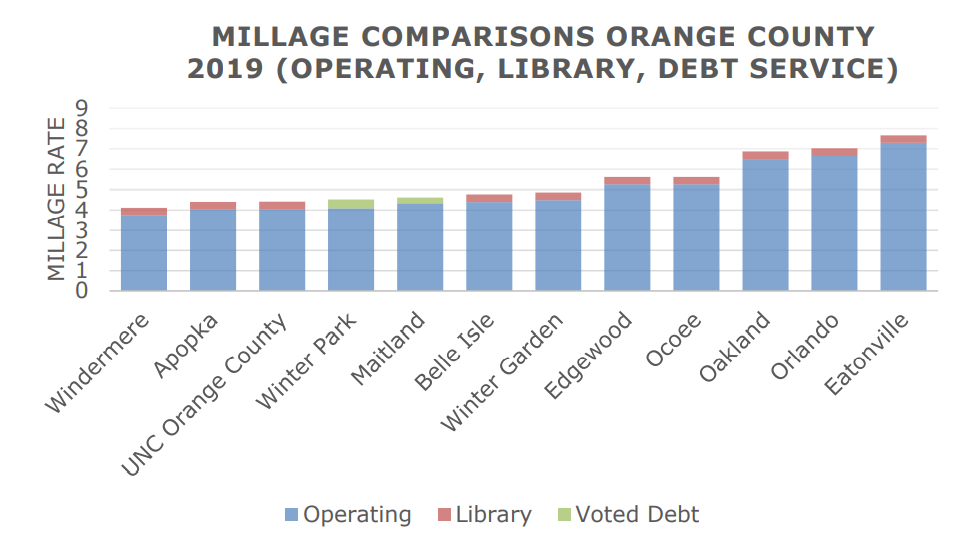
Despite the doom-and-gloom spin circulating the blogosphere, the City remains in good shape. The proposed budget document points out, “Winter park is fortunate to have the lowest operating millage rate among major jurisdictions in Orange County.” A comparison of tax rates is below.
To review the entire 401-page document, click here. https://cityofwinterpark.org/docs/departments/finance/budget/proposed-budget-2021.pdf
What does this mean for us?
The chart below illustrates the impact a rise to the current Winter Park millage cap would have on the average Winter Park homeowner. (This does not include increases from the other four taxing entities.) The chart was prepared by Finance Director Wes Hamill and Assistant City Manager Michelle Neuner.
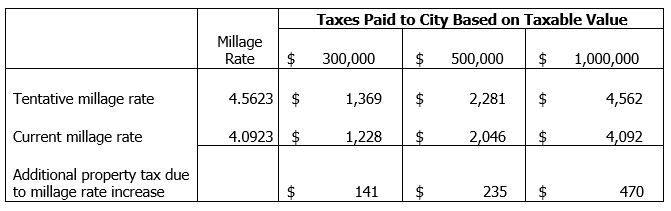
There is still much we don’t know about FY 2021projections, and these are very uncertain times. “If you asked us to guess on a hurricane, we’d be pretty good,” said Michelle Neuner. “This year, in a pandemic, it’s a little tougher.”
Progress at Progress Point
Progress at Progress Point
Commissioners Explore What Progress Point Will Look Like
by Anne Mooney / July 27, 2020
Imagining Progress Point
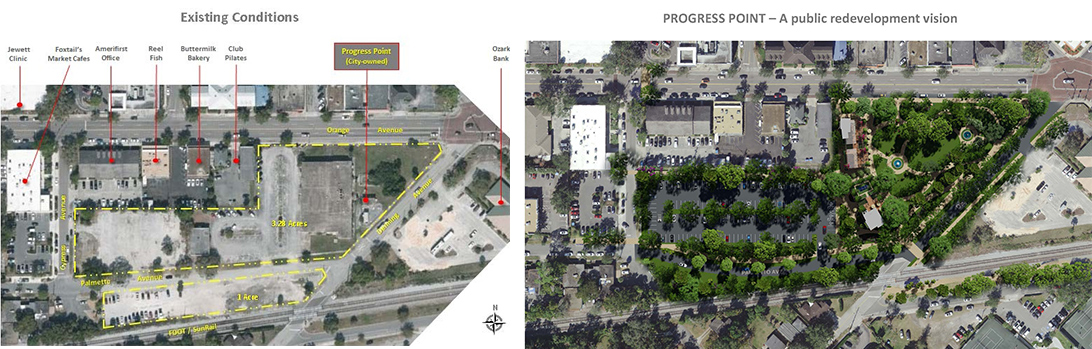
Amidst the confusion and frustration surrounding the Orange Avenue Overlay (OAO), a Commission work session on Thursday, July 23, offered a glimmer of hope there might soon be progress at Progress Point. The work session centered around ideas of what could happen at the City-owned property located at the center of the proposed overlay district, roughly half-way between the two large properties at either end, one owned by the Holler family interests, the other by Demetree Global.
Progress on Progress Point.
Commissioners met Thursday to explore the possible fate of Progress Point – an empty, blighted parcel of land snugged up against the railroad tracks that the City acquired in the infamous land swap of 2011, when the City traded the old State Office Building parcel at the corner of Morse Blvd. and Denning Dr. for the Progress Point property on Orange Ave.
Commissioners plan to make plans.
Since the meeting was a work session, the Commissioners could take no action. They did, however, agree upon what action they plan to take when the opportunity presents itself at the next commission meeting. Four Commissioners were present – Sheila DeCiccio, Marty Sullivan, Todd Weaver and Vice Mayor Carolyn Cooper. Mayor Steve Leary was absent.
After a joint presentation by a consortium that included ACi architects, LandDesign, HR Miller Landscape Architect and Steve Goldman about what Progress Point could look like, were the City to go that direction, the Commissioners agreed upon six basic principles that would guide their decisions regarding Progress Point.
What’s planned for Progress Point?
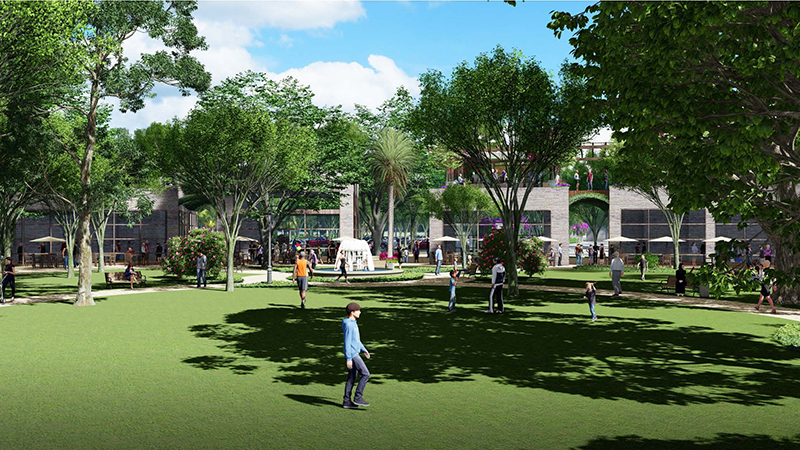
The City will maintain control and ownership of the property, though the Commissioners said they would consider the possibility of a land lease to a private developer or to a non-profit concern created specifically for the purpose. No residential property will be built on Progress Point. The parcel will contain approximately 1.5 contiguous acres of green park space and a 12-foot-wide bike path along a relocated Palmetto Avenue. Businesses in any structures built on the parcel must enhance the park experience for residents and visitors. The City will realign Palmetto Avenue, moving it south, closer to the railroad tracks, to provide more contiguous land for parking and the 1.5-acre park.
The Commissioners allocated $150,000 for the engineering and design necessary to relocate Palmetto Avenue, build surface parking and the pedestrian/bicycle path. This will enable planners to determine what infrastructure improvements will be needed to support the types of businesses that would be appropriate for that site. An additional $10,000 will go for a plan to connect the urban park spaces throughout the City of Winter Park.
This chapter of OAO history begins with OAO Steering Committee. (This is not Chapter One.)
In late 2019, after a lengthy series of meetings and public input, a 10-member OAO steering committee submitted their recommendations to the City for the adoption of an ordinance to create the OAO. The steering committee voted 8-2 in favor, with Michael Dick and [future] Commissioner Sheila DeCiccio dissenting. Michael Dick felt development entitlements for the two large property owners were overly generous. Ms. DeCiccio objected to the city planners’ idea of selling the Progress Point property to a developer for office space and a parking garage that would contain extra parking to be shared with surrounding small businesses. Instead, DeCiccio wanted the City to retain ownership.
First Reading January 13 – 16, 2020.
The ordinance to create the OAO went to the Commission on January 13 for its first reading. That Commission meeting, which began January 13 at 3:30 pm, lasted until approximately 2:30 am January 14, and was continued January 16 for another five to six hours. The ordinance, which included provisions for the 1.5-acre park, passed on a 3-2 vote, with Mayor Leary and Commissioners Sarah Sprinkel and Greg Seidel supporting, and Commissioners Carolyn Cooper and Todd Weaver dissenting.
Approved on Second Reading ‘as amended’ March 9.
The OAO ordinance was sent to Tallahassee for approval and came back to Winter Park for its second reading March 9. At the March 9 Commission meeting, the ordinance was approved as amended – there were more than 50 amendments.
New Commission March 17.
On March 17, a new Commission was elected. Commissioners Sarah Sprinkel and Greg Seidel did not seek re-election, and Commissioners Sheila DeCiccio and Marty Sullivan took their places. By then, the novel coronavirus pandemic had set in, delaying the swearing-in of the new Commissioners until March 27.
Ordinance rescinded March 30.
On March 30, the newly-seated Commissioners rescinded the OAO ordinance. Their stated intent was not to kill the OAO, but to revisit some of the rules and regulations regarding the density, size and height of new development, particularly on the larger properties. Commissioner DeCiccio also wanted to make sure Progress Point remains under City ownership.
City Sued April 24 and May 12
On April 24, Demetree Global filed suit against the City as WP Station Tower, LLC, Winterpark Station, LLC, Wintergate, LLC, and Palmetto Building 2019, LLC. The Holler properties, as DI Partners, LLLP, and CVJCR Properties, Ltd., LLLP filed suit shortly after, on May 12. The complaints request the courts to declare the ordinance rescinding the OAO null and void.
City declares temporary moratorium July 22.
While there is no restriction on development within the OAO under the City’s current zoning rules, the temporary moratorium prevents new OAO development based on the regulations in the rescinded OAO zoning plan. The moratorium is expected to last until the current Commission comes up with a revised version of the overlay plan.
Commissioners have scheduled a series of work sessions throughout the remainder of the summer to come up with a plan to move forward on development rules for the OAO district.
The process of creating the Orange Avenue Overlay is far from over. What happens at Progress Point may well be the first step.
Recent Comments